Thick cylindersare designed to withstand
high internal pressure about 40 to 60 MPa
A wall is considered thick if it is 1
/10 the
cylinder radius or more.
Presence of radial stress ( no negligence)
Variable hoop stress
Complexity involved in contrast to thin
cylinders which has
Low pressure
Negligible radial stress and
Constant hoop stress
4.
The problemof determining the tangential stress and the radial
stress at any point on a thick walled cylinder, in terms of
applied pressure and the dimensions, was first solved by the
French elastician Gabriel Lame in 1833. His analysis is
commonly known as Lame’s theory
Hence, in order to address the complexity involved in the thick
cylinders, Lame’s theory is used
Assumptions made in lame’s theory
(i) the material is homogenous and isotropic
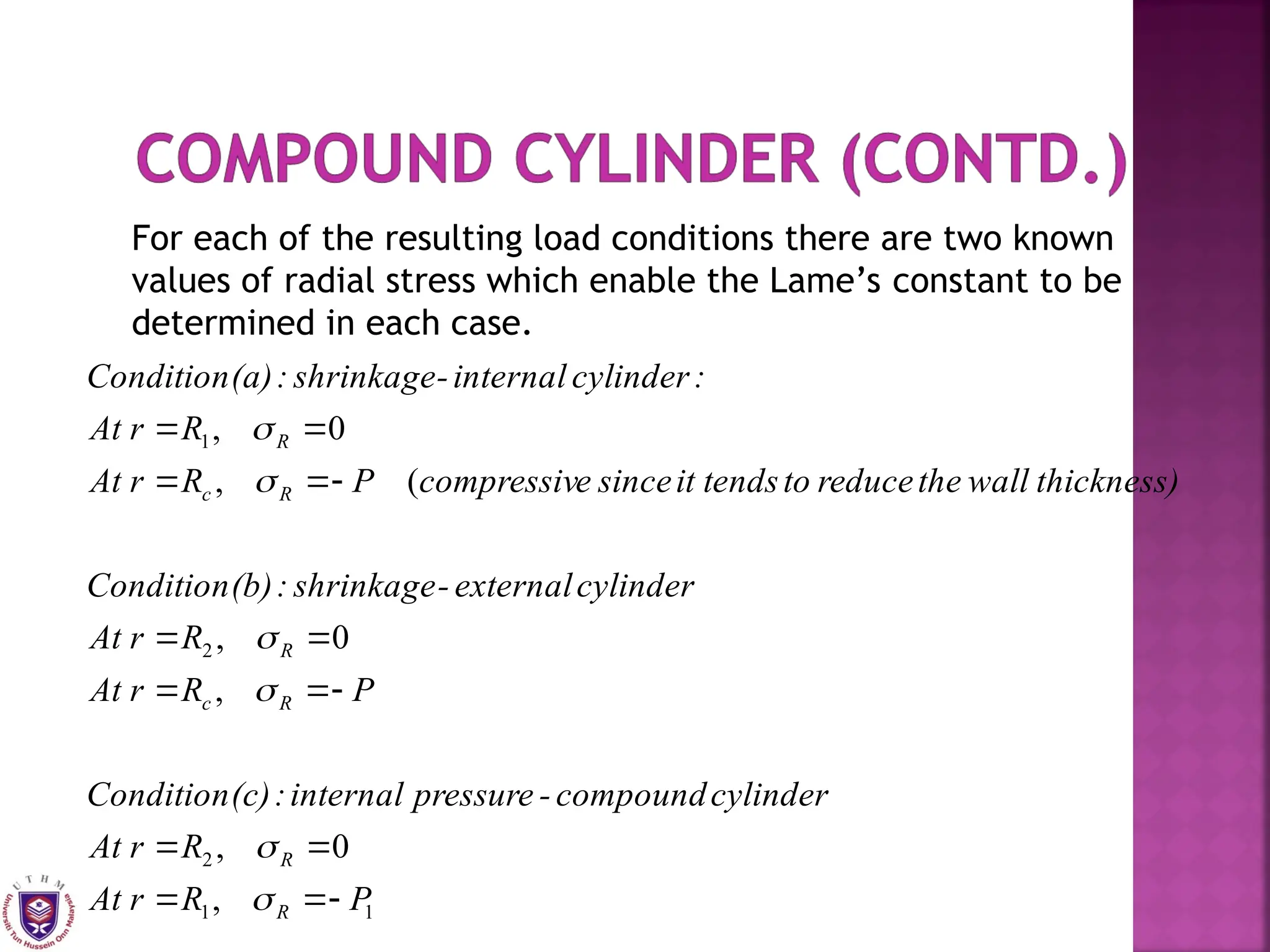
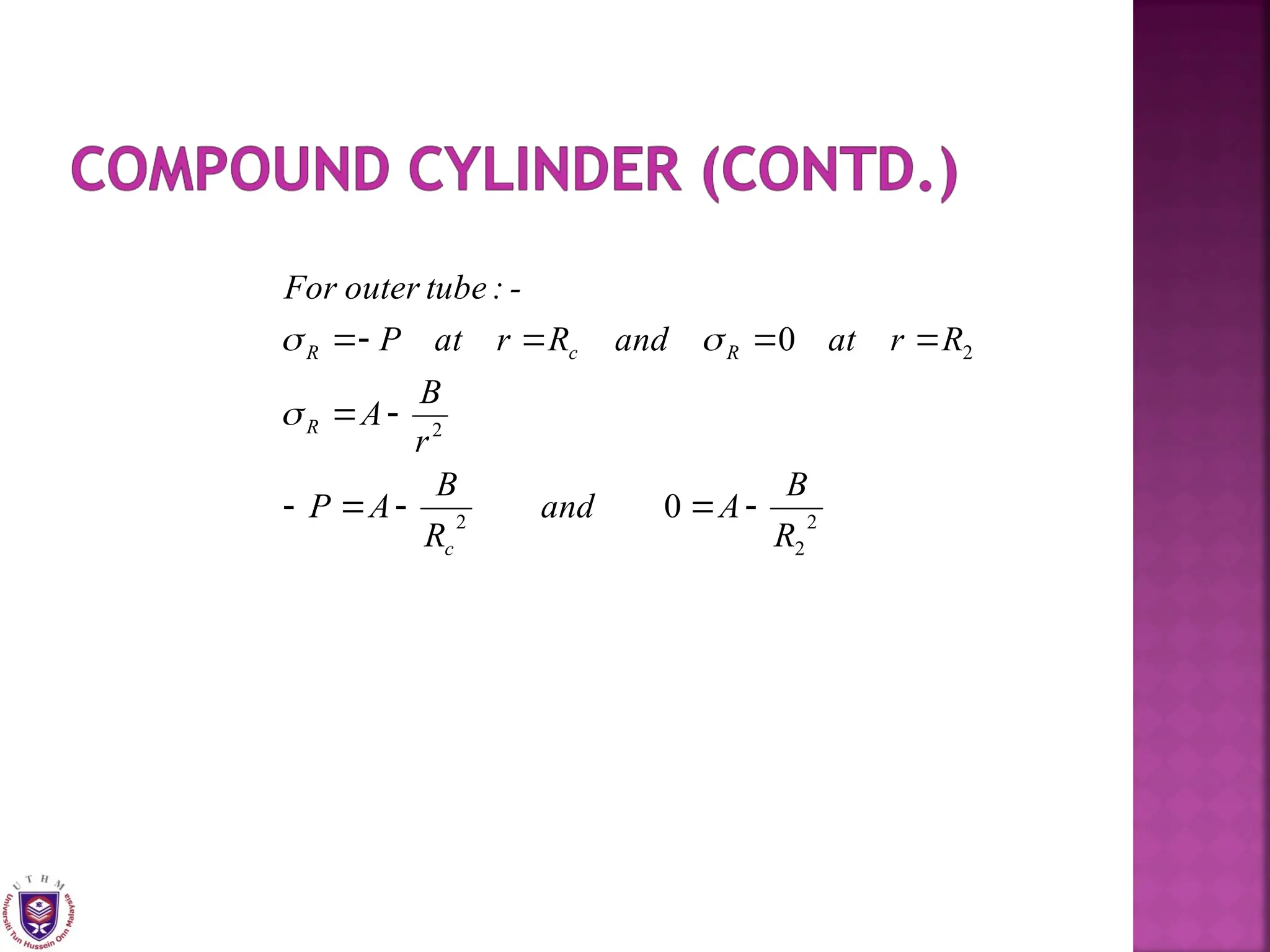
(ii) Plane transverse sections remain plane under the action
of internal pressure.
(iii) The material is stressed within elastic limit as per
Hook’s Law
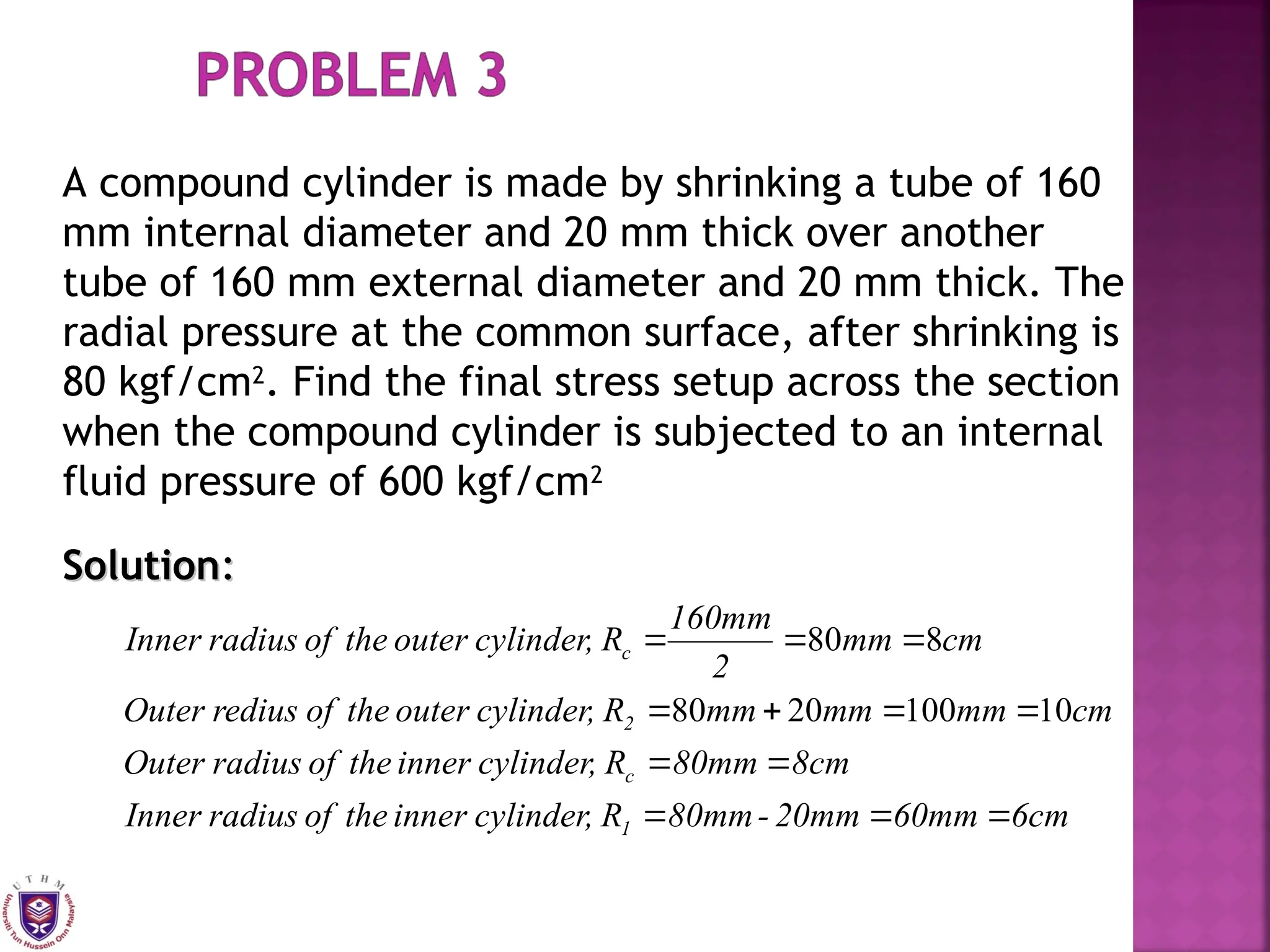
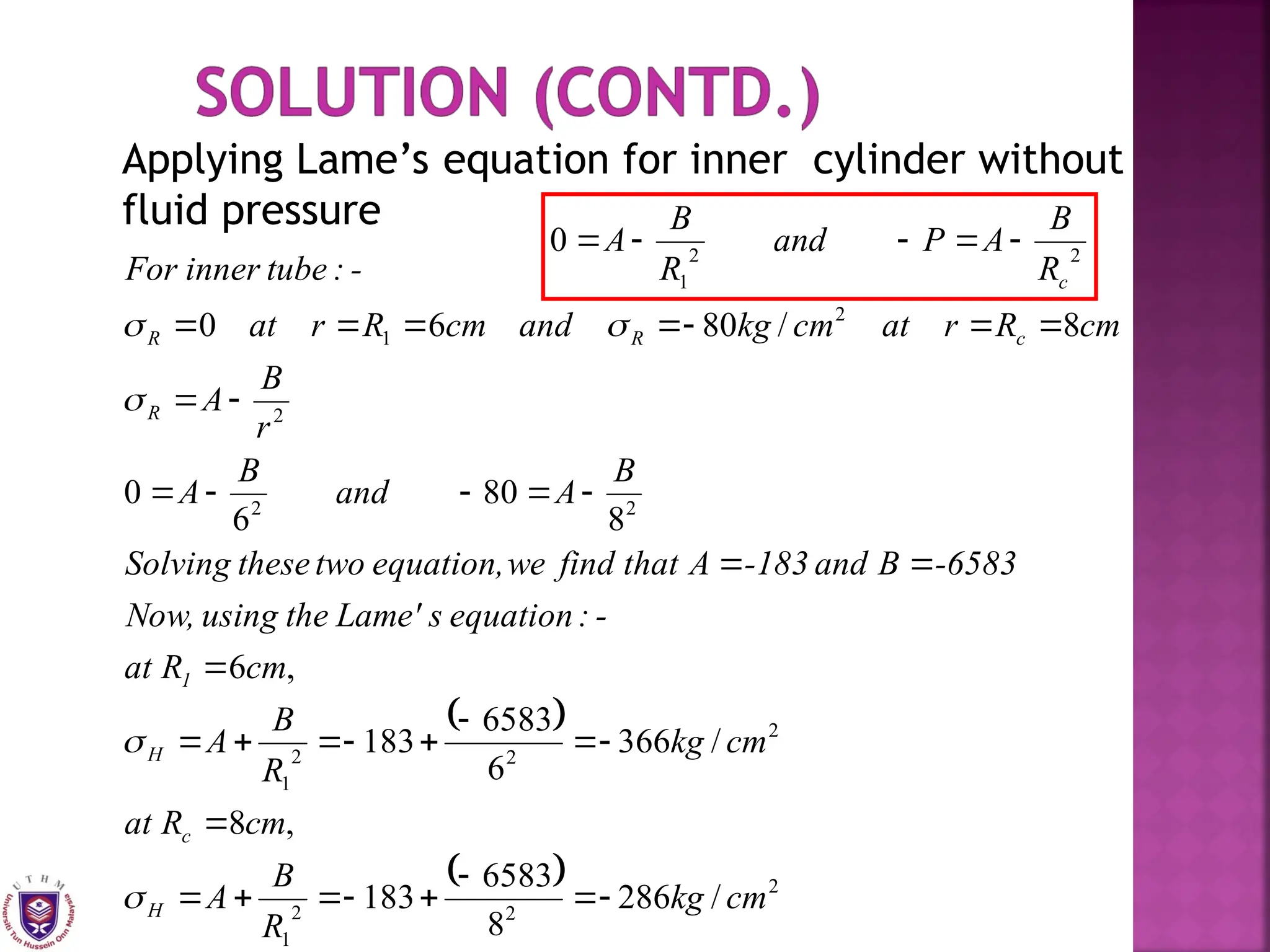
(iv) All the fibres of the material are stressed independently
without being constrained by the adjacent fibres
5.
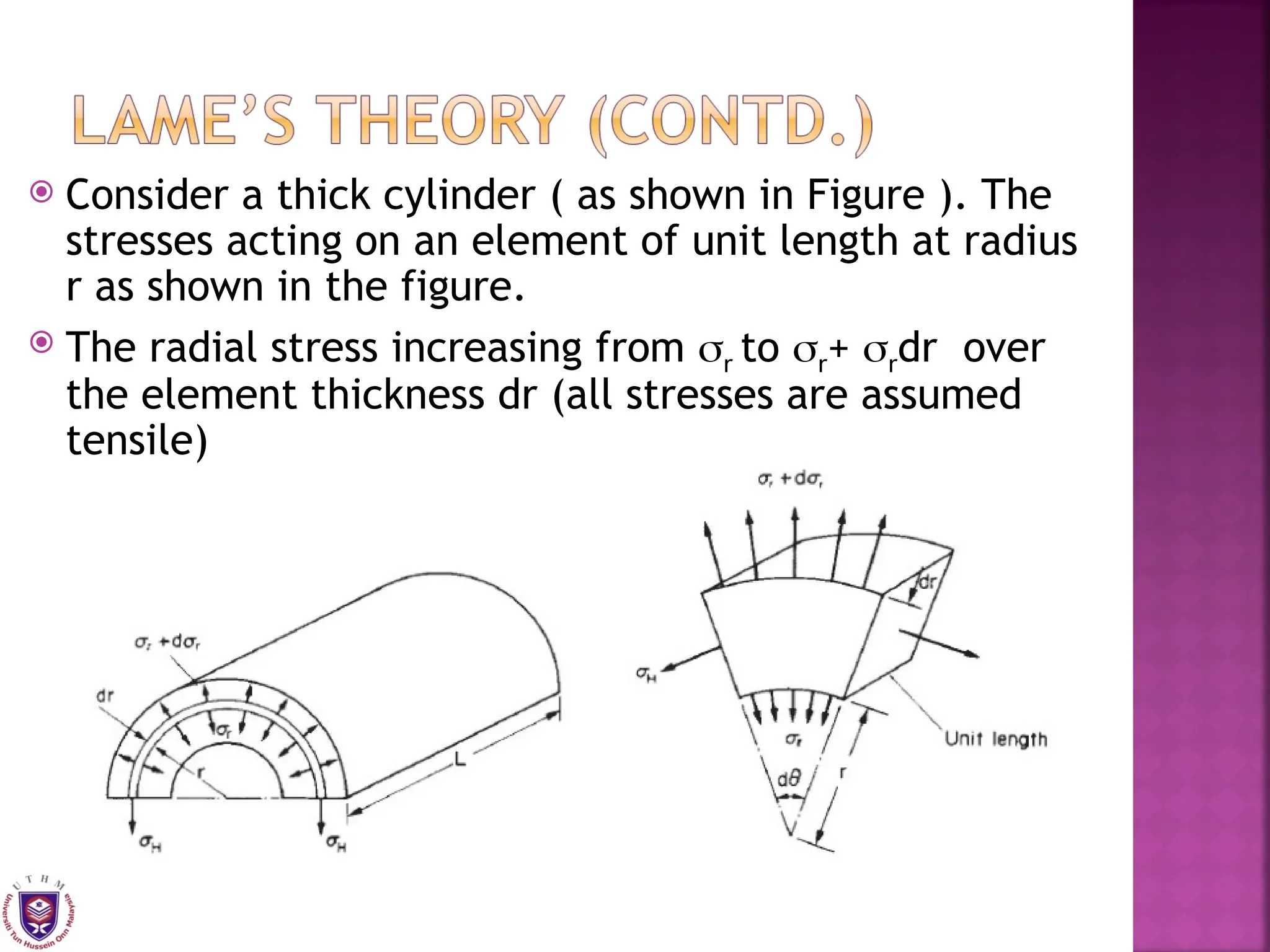
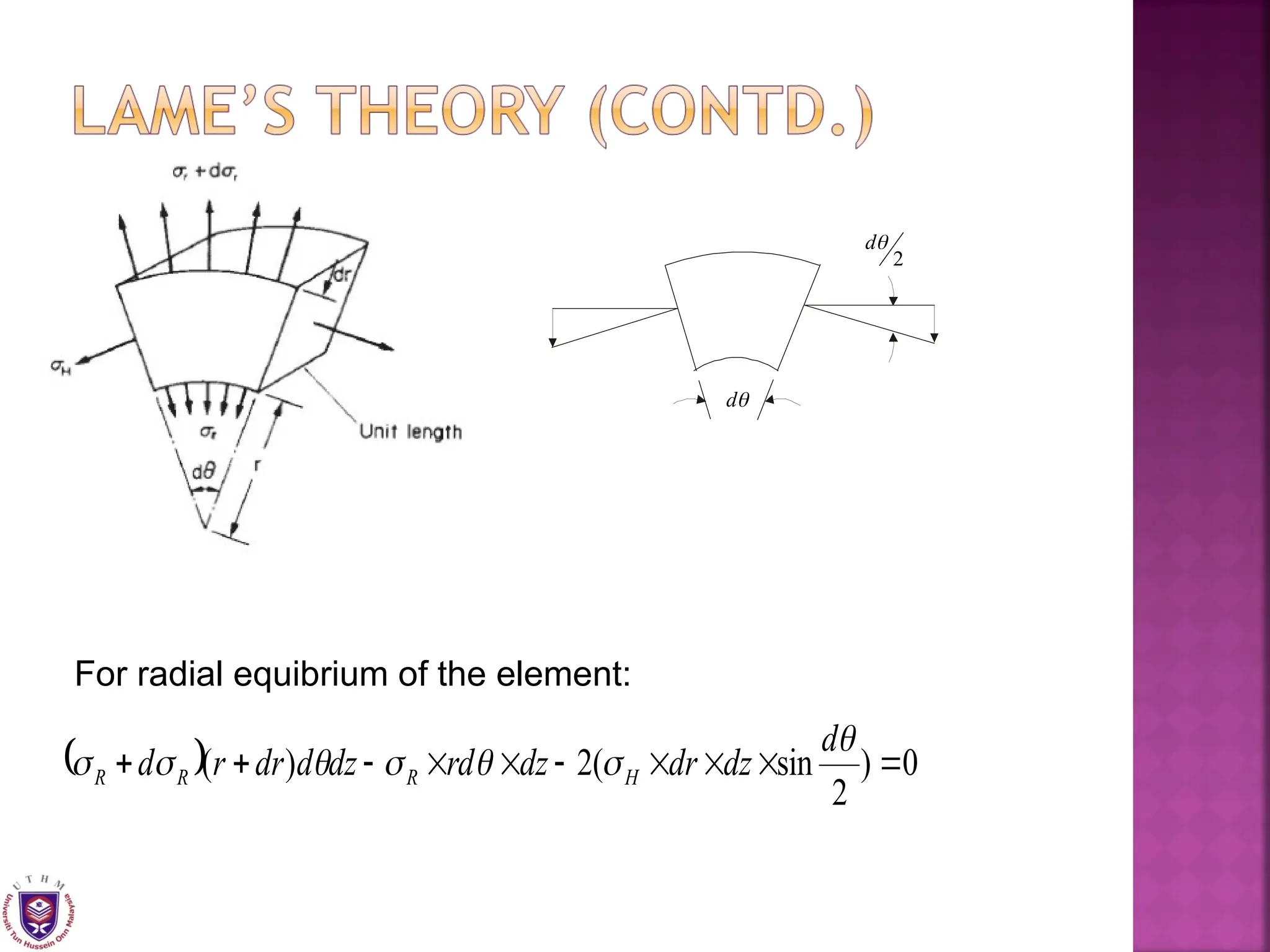
Consider athick cylinder ( as shown in Figure ). The
stresses acting on an element of unit length at radius
r as shown in the figure.
The radial stress increasing from r to r+ rdr over
the element thickness dr (all stresses are assumed
tensile)
6.
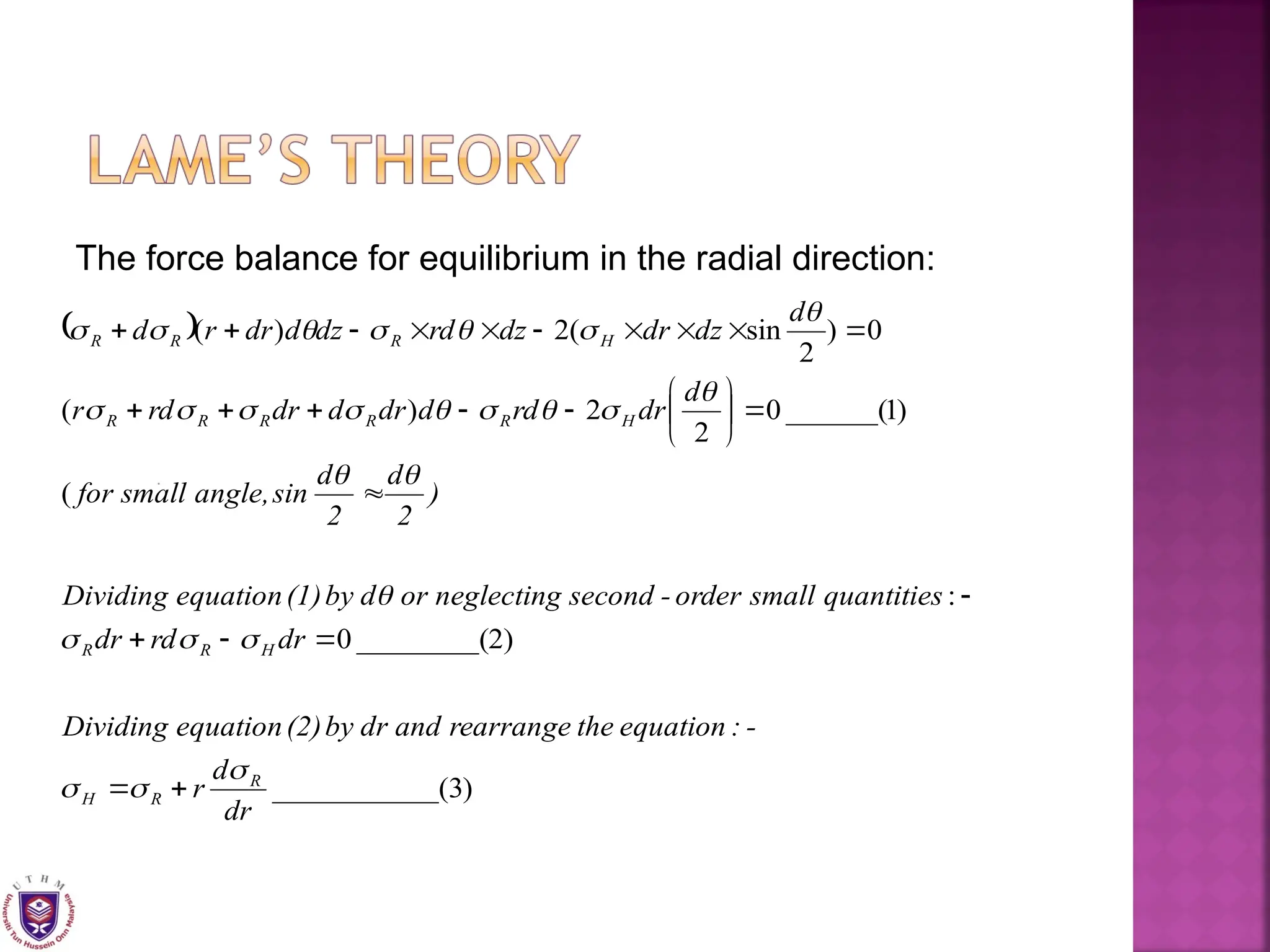
For radial equibriumof the element:
2
d
d
0
)
2
sin
(
2
)
(
d
dz
dr
dz
rd
dz
d
dr
r
d H
R
R
R
.8)
_______(eq
0
2
2r
-
:
g
rearrangin
and
r
by
through
g
Multiplyin
q.7)
________(e
2
-
:
6
eq.
into
3
eq.
from
Substitute
_(eq.6)
__________
)
(
2
:
ends
the
from
remote
points
at
walls
cylinder
the
across
constant
is
stress,
al
longitudin
that the
assumed
also
is
It
5)
q.
________(e
constant
1
q.4)
________(e
constant
1
then
cylinder,
the
of
wall
the
across
constant
strain
al
longitudin
the
i.e
plane,
remains
section
plane
that
now
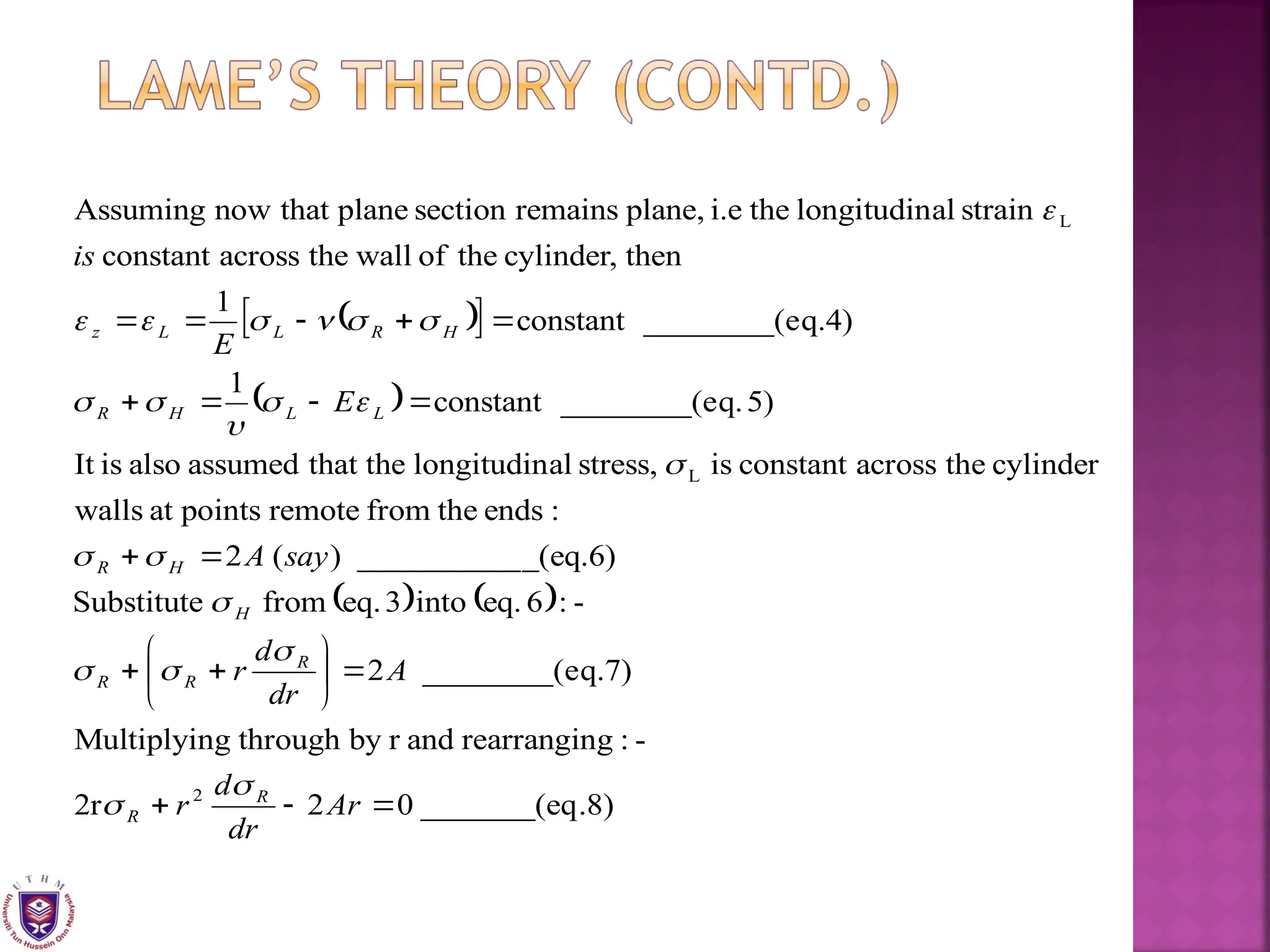
Assuming
2
L
L
Ar
dr
d
r
A
dr
d
r
say
A
E
E
is
R
R
R
R
R
H
H
R
L
L
H
R
H
R
L
L
z
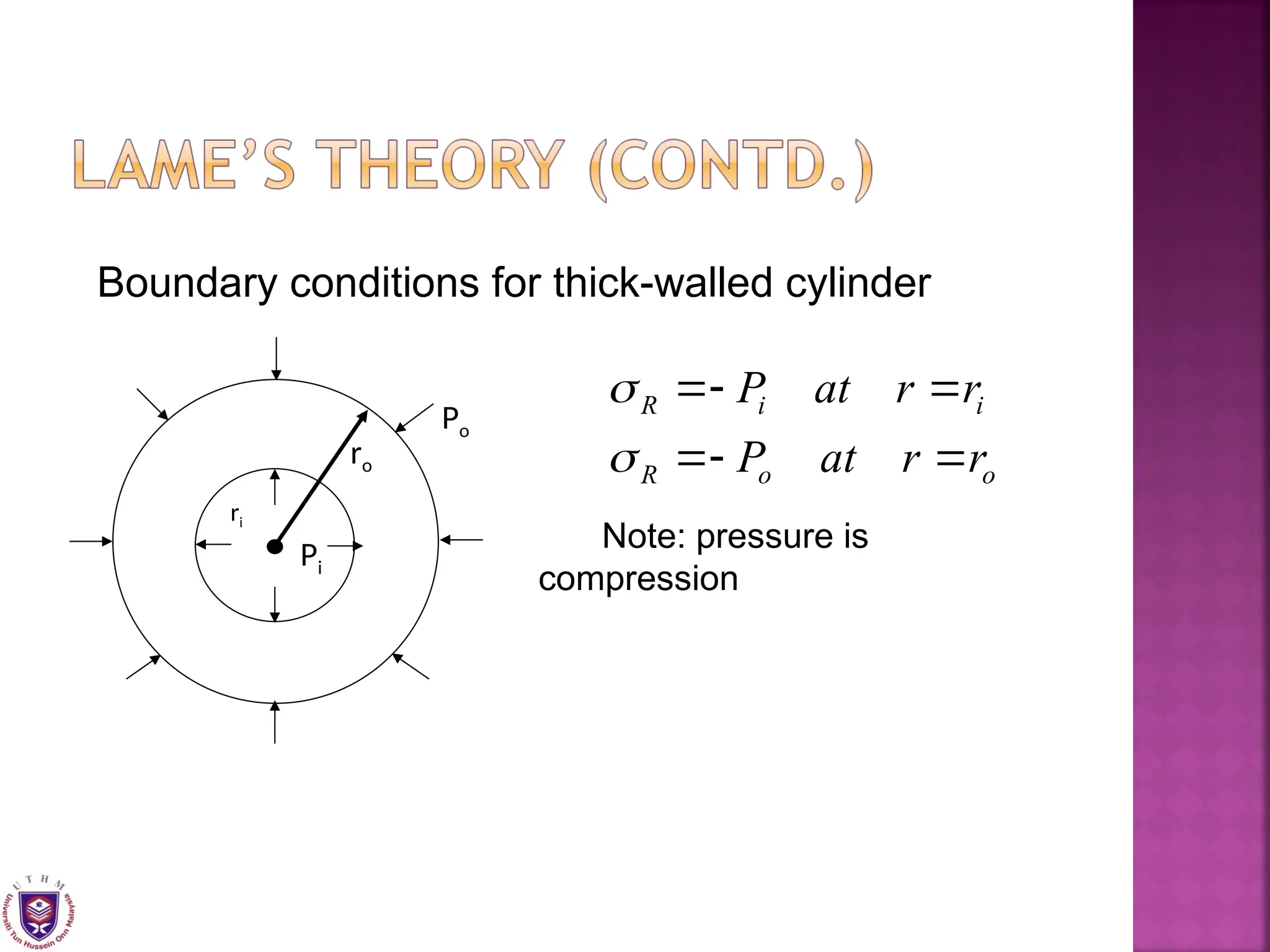
Boundary conditions forthick-walled cylinder
ri
ro
Po
Pi
o
o
R
i
i
R
r
r
at
P
r
r
at
P
Note: pressure is
compression
11.
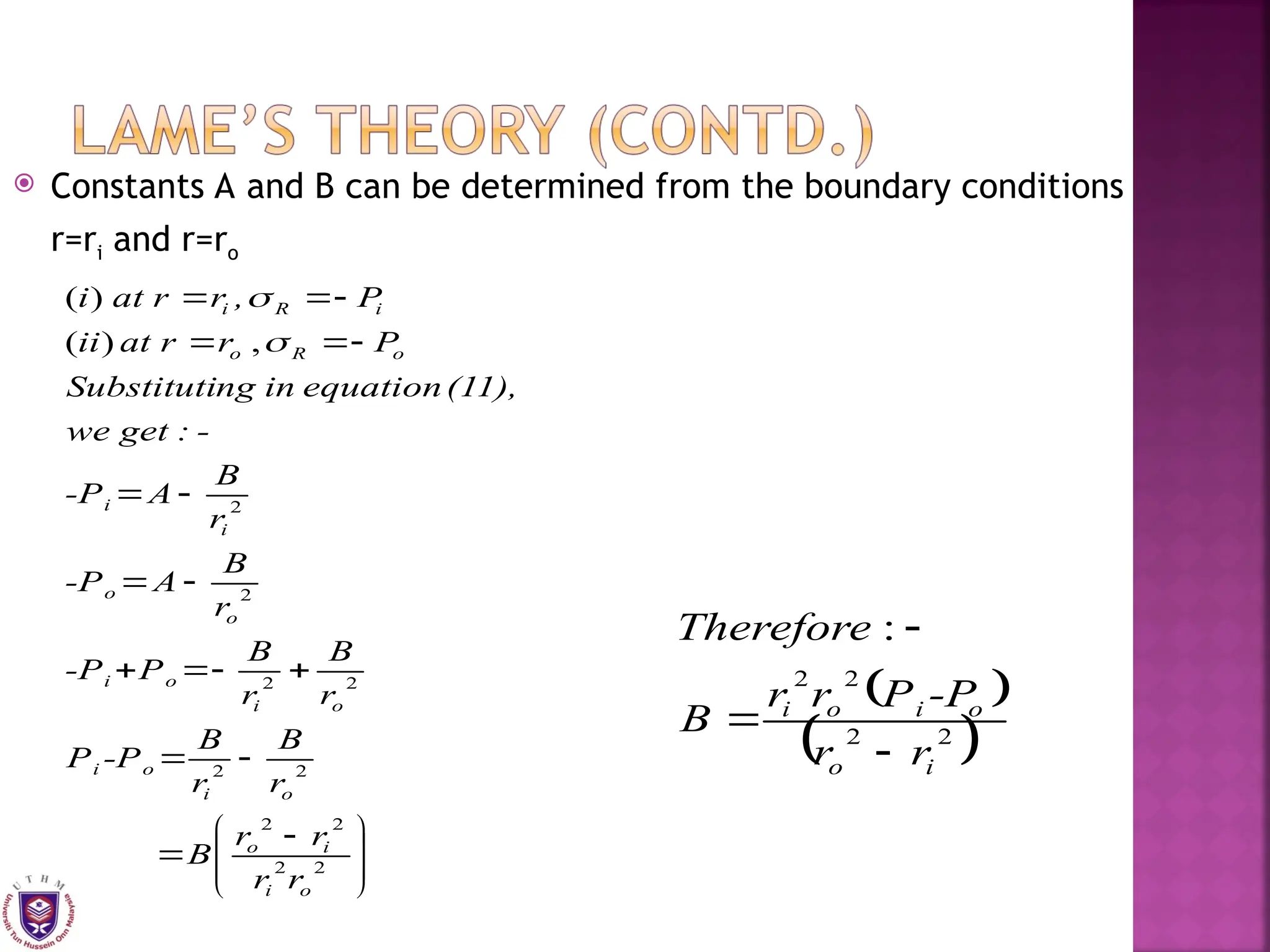
Constants Aand B can be determined from the boundary conditions
r=ri and r=ro
2
2
2
2
2
2
2
2
2
2
,
)
(
)
(
o
i
i
o
o
i
o
i
o
i
o
i
o
o
i
i
o
R
o
i
R
i
r
r
r
r
B
r
B
r
B
-P
P
r
B
r
B
P
-P
r
B
A
-P
r
B
A
-P
-
:
get
we
(11),
equation
in
ng
Substituti
P
r
r
at
ii
P
,
r
r
at
i
2
2
2
2
:
i
o
o
i
o
i
r
r
-P
P
r
r
B
Therefore
12.
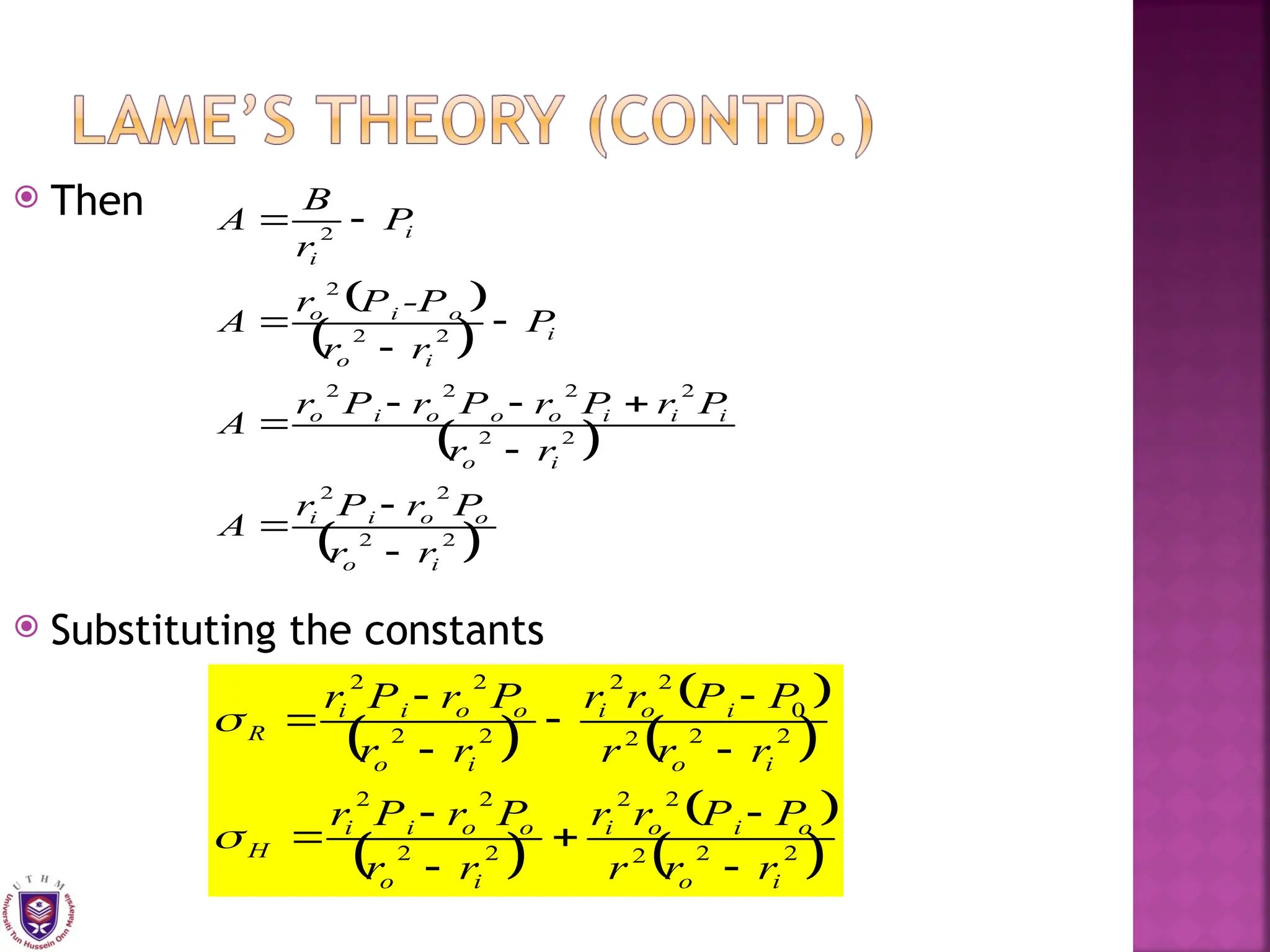
Then
Substitutingthe constants
2
2
2
2
2
2
2
2
2
2
2
2
2
2
i
o
o
o
i
i
i
o
i
i
i
o
o
o
i
o
i
i
o
o
i
o
i
i
r
r
P
r
P
r
A
r
r
P
r
P
r
P
r
P
r
A
P
r
r
-P
P
r
A
P
r
B
A
2
2
2
2
2
2
2
2
2
2
2
2
0
2
2
2
2
2
2
i
o
o
i
o
i
i
o
o
o
i
i
H
i
o
i
o
i
i
o
o
o
i
i
R
r
r
r
P
P
r
r
r
r
P
r
P
r
r
r
r
P
P
r
r
r
r
P
r
P
r
13.
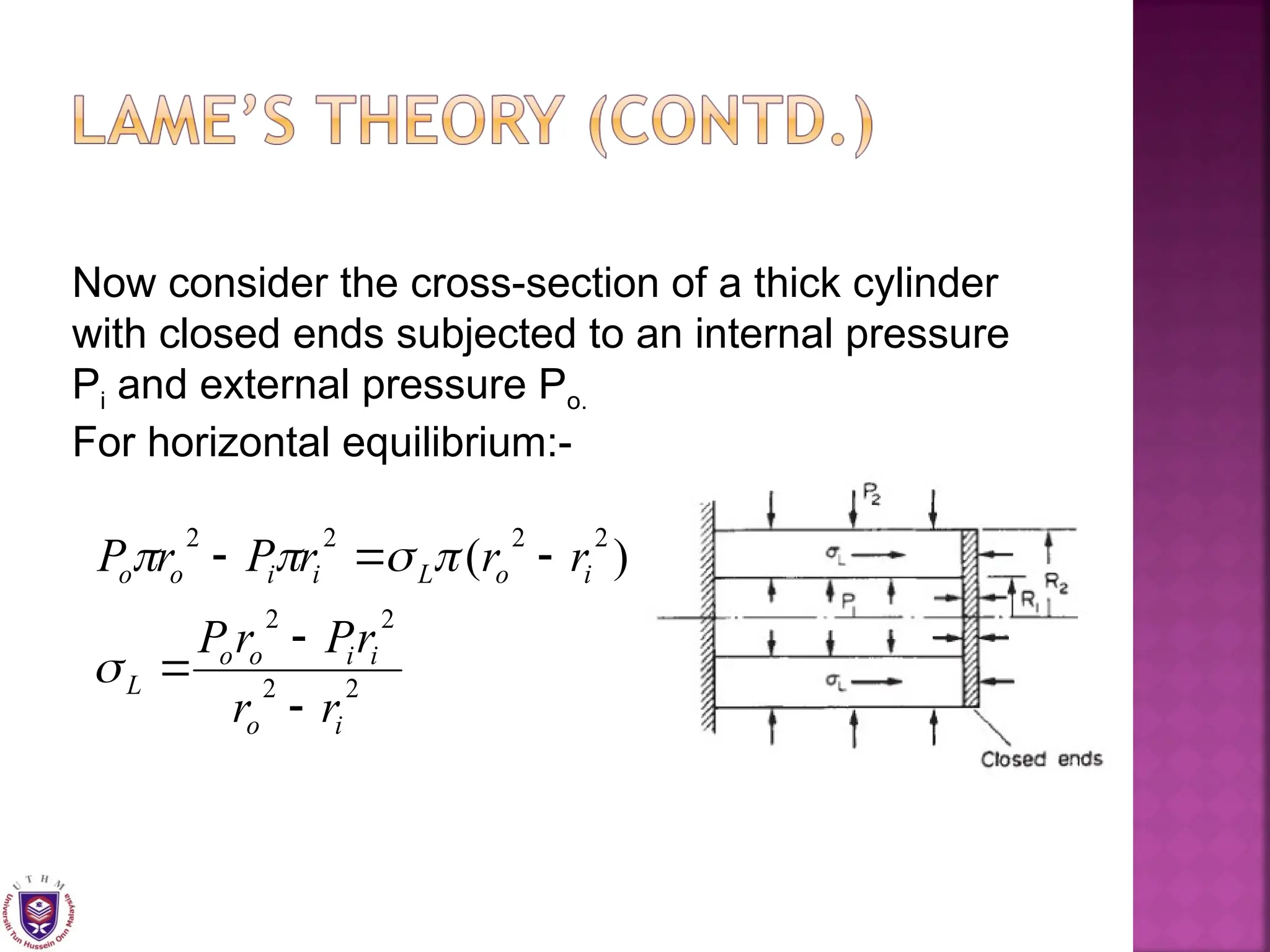
Now consider thecross-section of a thick cylinder
with closed ends subjected to an internal pressure
Pi and external pressure Po.
For horizontal equilibrium:-
2
2
2
2
2
2
2
2
)
(
i
o
i
i
o
o
L
i
o
L
i
i
o
o
r
r
r
P
r
P
r
r
r
P
r
P
14.
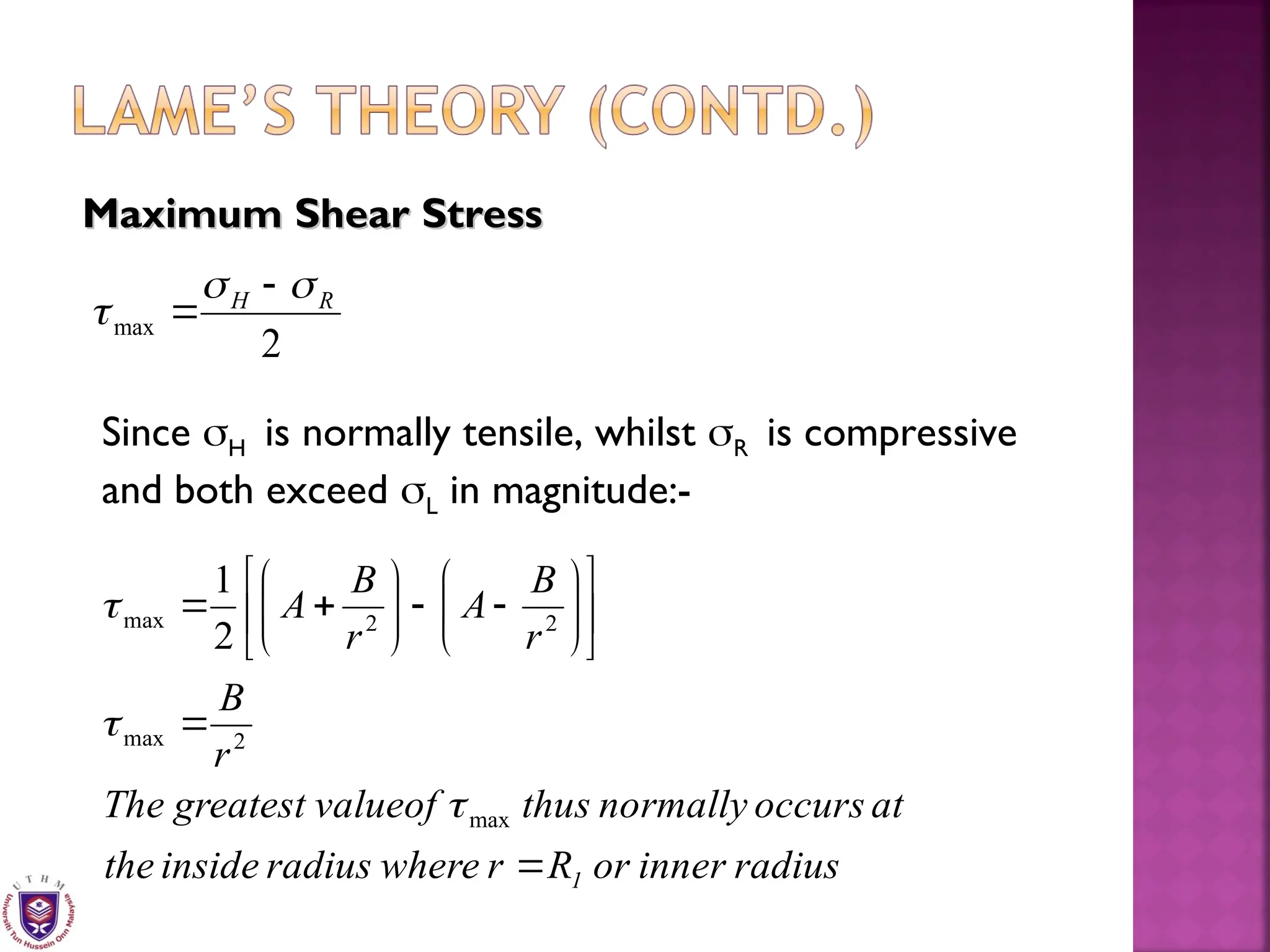
Maximum Shear Stress
MaximumShear Stress
2
max
R
H
Since H is normally tensile, whilst R is compressive
and both exceed L in magnitude:-
radius
inner
or
R
r
where
radius
inside
the
at
occurs
normally
thus
valueof
greatest
The
r
B
r
B
A
r
B
A
1
max
2
max
2
2
max
2
1
15.
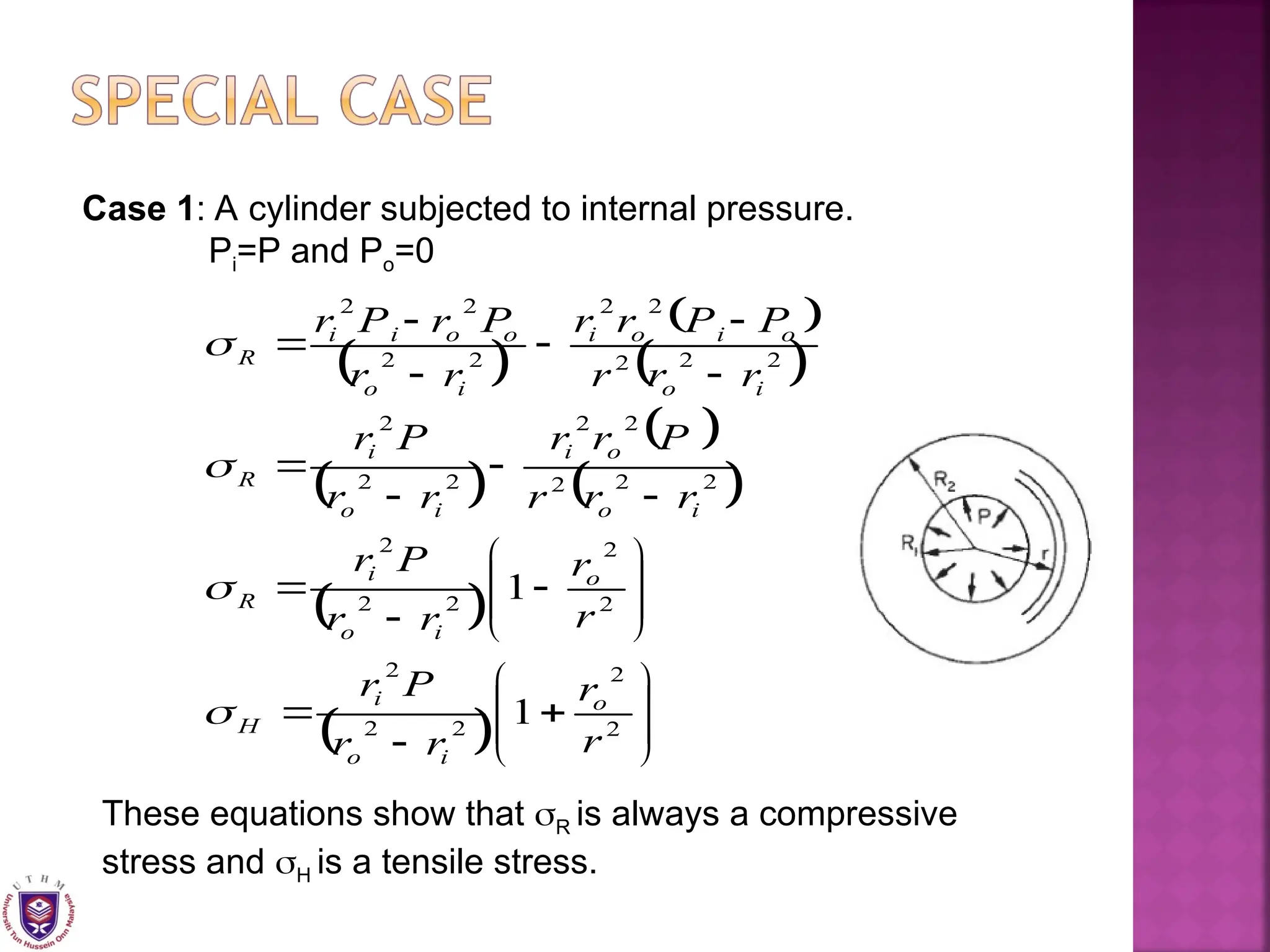
Case 1: Acylinder subjected to internal pressure.
Pi=P and Po=0
2
2
2
2
2
2
2
2
2
2
2
2
2
2
2
2
2
2
2
2
2
2
2
2
2
2
2
1
1
r
r
r
r
P
r
r
r
r
r
P
r
r
r
r
P
r
r
r
r
P
r
r
r
r
P
P
r
r
r
r
P
r
P
r
o
i
o
i
H
o
i
o
i
R
i
o
o
i
i
o
i
R
i
o
o
i
o
i
i
o
o
o
i
i
R
These equations show that R is always a compressive
stress and H is a tensile stress.
16.
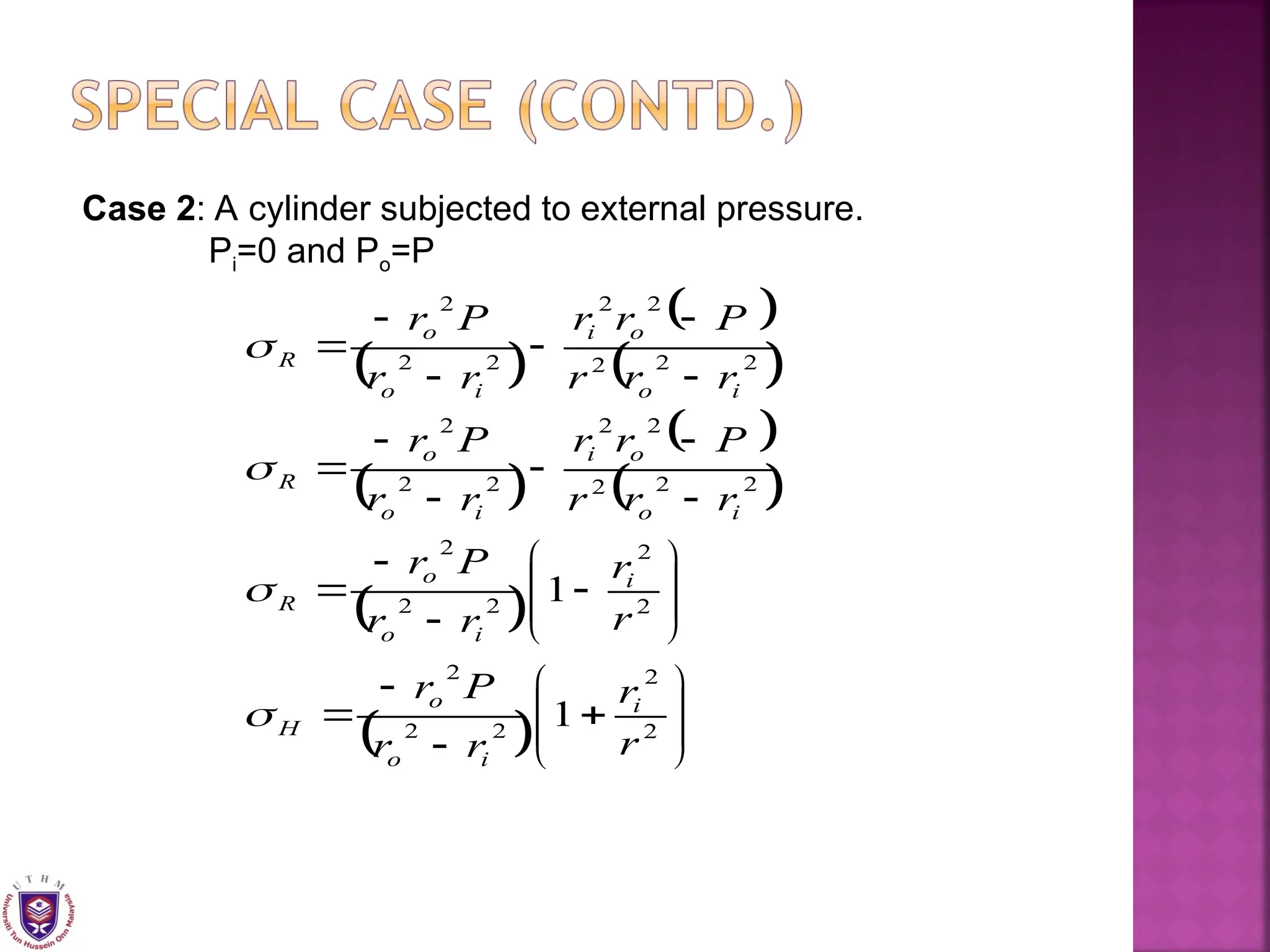
Case 2: Acylinder subjected to external pressure.
Pi=0 and Po=P
2
2
2
2
2
2
2
2
2
2
2
2
2
2
2
2
2
2
2
2
2
2
2
2
2
2
1
1
r
r
r
r
P
r
r
r
r
r
P
r
r
r
r
P
r
r
r
r
P
r
r
r
r
P
r
r
r
r
P
r
i
i
o
o
H
i
i
o
o
R
i
o
o
i
i
o
o
R
i
o
o
i
i
o
o
R
17.
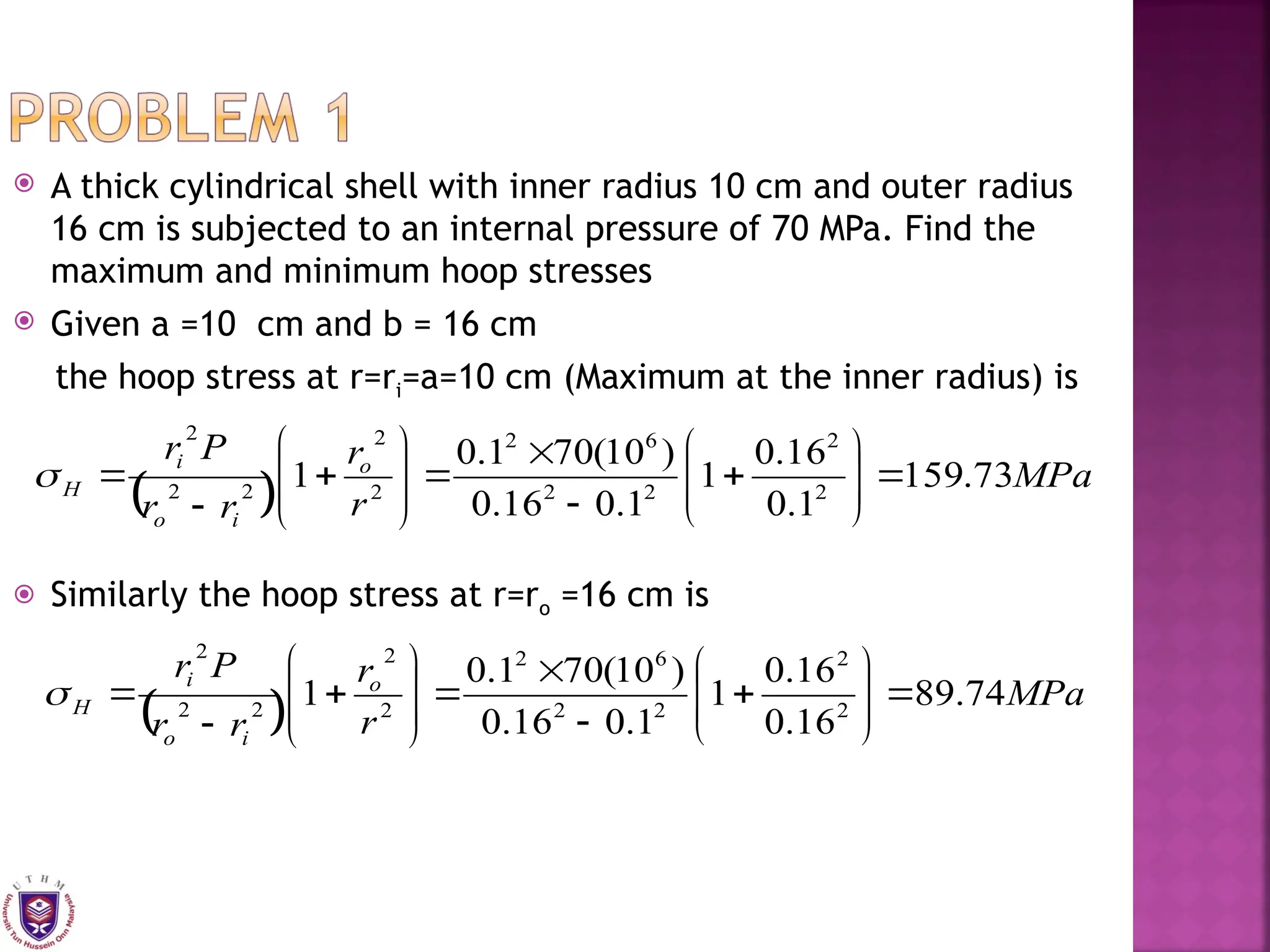
A thickcylindrical shell with inner radius 10 cm and outer radius
16 cm is subjected to an internal pressure of 70 MPa. Find the
maximum and minimum hoop stresses
Given a =10 cm and b = 16 cm
the hoop stress at r=ri=a=10 cm (Maximum at the inner radius) is
Similarly the hoop stress at r=ro =16 cm is
MPa
r
r
r
r
P
r o
i
o
i
H 73
.
159
1
.
0
16
.
0
1
1
.
0
16
.
0
)
10
(
70
1
.
0
1 2
2
2
2
6
2
2
2
2
2
2
MPa
r
r
r
r
P
r o
i
o
i
H 74
.
89
16
.
0
16
.
0
1
1
.
0
16
.
0
)
10
(
70
1
.
0
1 2
2
2
2
6
2
2
2
2
2
2
18.
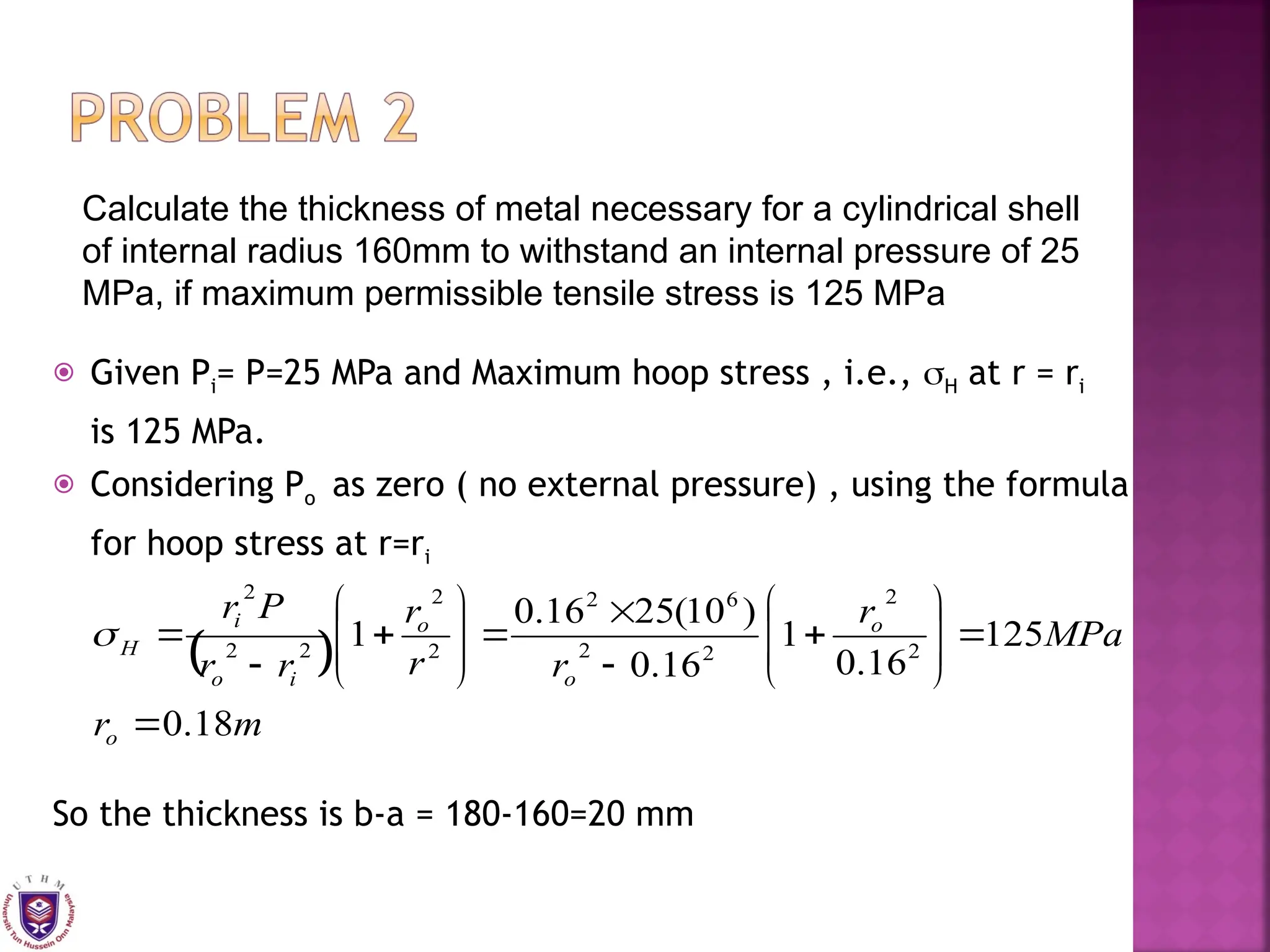
Given Pi=P=25 MPa and Maximum hoop stress , i.e., H at r = ri
is 125 MPa.
Considering Po as zero ( no external pressure) , using the formula
for hoop stress at r=ri
So the thickness is b-a = 180-160=20 mm
Calculate the thickness of metal necessary for a cylindrical shell
of internal radius 160mm to withstand an internal pressure of 25
MPa, if maximum permissible tensile stress is 125 MPa
m
r
MPa
r
r
r
r
r
r
P
r
o
o
o
o
i
o
i
H
18
.
0
125
16
.
0
1
16
.
0
)
10
(
25
16
.
0
1 2
2
2
2
6
2
2
2
2
2
2
19.
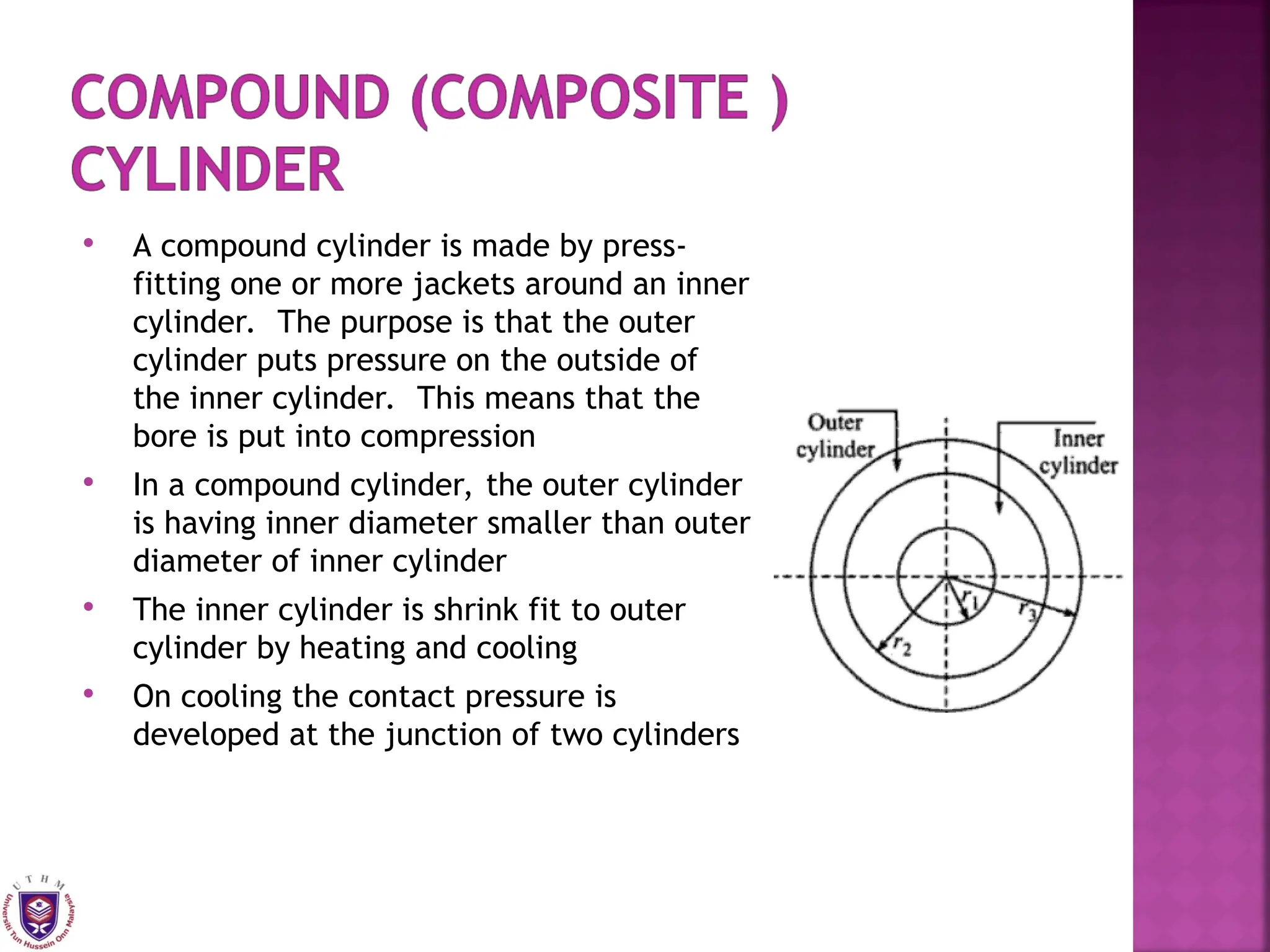
A compoundcylinder is made by press-
fitting one or more jackets around an inner
cylinder. The purpose is that the outer
cylinder puts pressure on the outside of
the inner cylinder. This means that the
bore is put into compression
In a compound cylinder, the outer cylinder
is having inner diameter smaller than outer
diameter of inner cylinder
The inner cylinder is shrink fit to outer
cylinder by heating and cooling
On cooling the contact pressure is
developed at the junction of two cylinders
20.
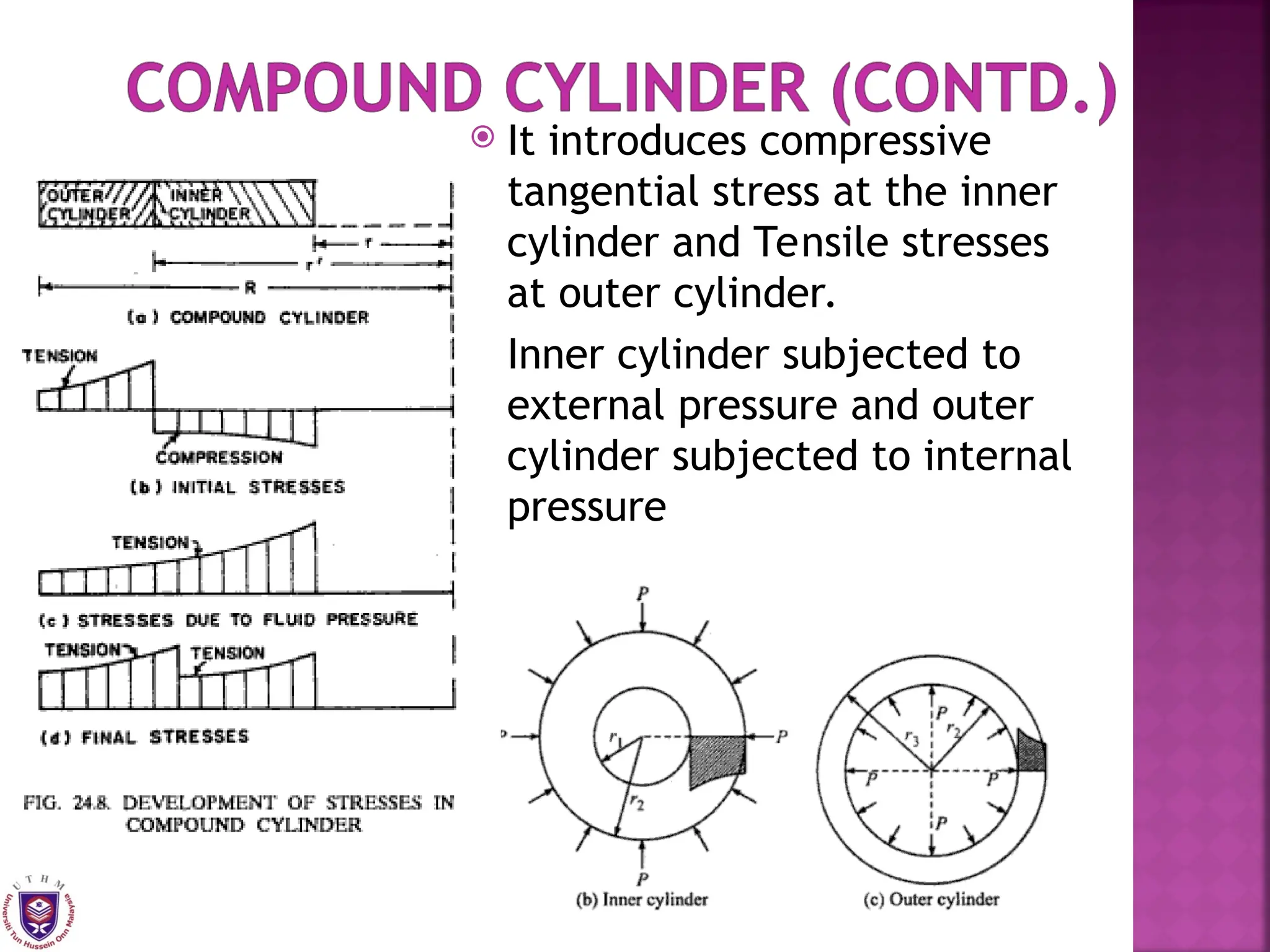
It introducescompressive
tangential stress at the inner
cylinder and Tensile stresses
at outer cylinder.
Inner cylinder subjected to
external pressure and outer
cylinder subjected to internal
pressure
21.
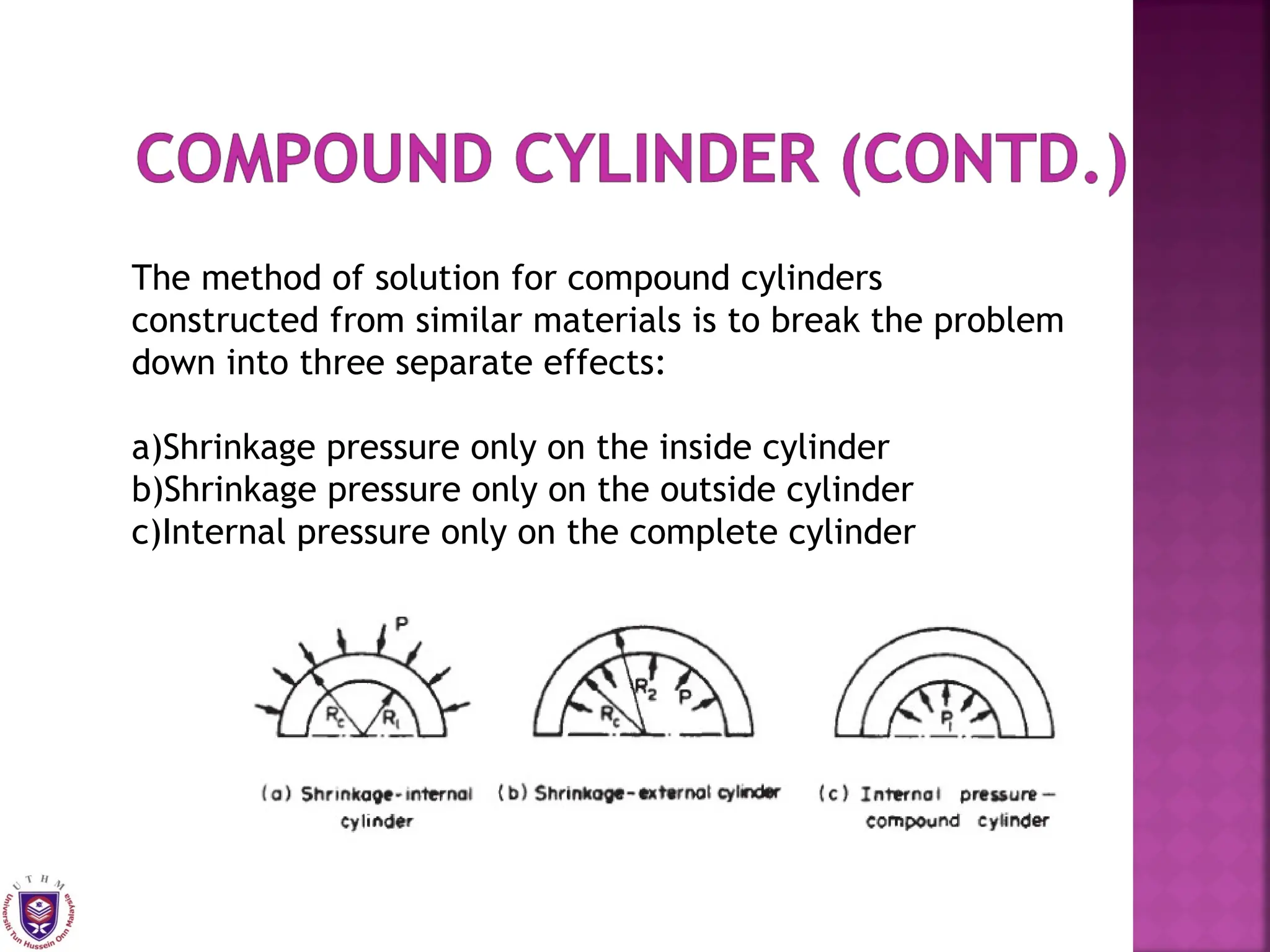
The method ofsolution for compound cylinders
constructed from similar materials is to break the problem
down into three separate effects:
a)Shrinkage pressure only on the inside cylinder
b)Shrinkage pressure only on the outside cylinder
c)Internal pressure only on the complete cylinder
22.
For each ofthe resulting load conditions there are two known
values of radial stress which enable the Lame’s constant to be
determined in each case.
1
1
2
2
1
,
0
,
,
0
,
(
,
0
,
P
R
r
At
R
r
At
cylinder
compound
-
pressure
internal
:
(c)
Condition
P
R
r
At
R
r
At
cylinder
external
-
shrinkage
:
(b)
Condition
thickness)
wall
the
reduce
to
tends
it
since
e
compressiv
P
R
r
At
R
r
At
:
cylinder
internal
-
shrinkage
:
(a)
Condition
R
R
R
c
R
R
c
R
23.
ri
rf
r0
R1 = Innerradius of inner cylinder
Rc = Outer radius of inner cylinder
(common)
R2 = Outer radius of outer cylinder
P = Radial pressure at the junction of
the two cylinder
Consider the thick compound cylinder
as shown in Figure:-
Inner cylinder
Outer cylinder
2
2
1
2
1
0
0
c
R
c
R
R
R
B
A
P
and
R
B
A
r
B
A
R
r
at
P
and
R
r
at
-
:
tube
inner
For
2
r
B
A
R
Values ofConstants A1, A2,B1 and B2 can be found if
the radial pressure is known
Hoop stress can also be found by using relative
expressions
If the fluid pressure is admitted inside the compound
shell, it will be resisted by both the shells
The resultant shell will be the algebraic some of
initial stresses and
Those due to fluid pressure
2
r
B
A
H
26.
A compound cylinderis made by shrinking a tube of 160
mm internal diameter and 20 mm thick over another
tube of 160 mm external diameter and 20 mm thick. The
radial pressure at the common surface, after shrinking is
80 kgf/cm2
. Find the final stress setup across the section
when the compound cylinder is subjected to an internal
fluid pressure of 600 kgf/cm2
Solution
Solution:
:
6cm
60mm
20mm
-
80mm
R
cylinder,
inner
the
of
radius
Inner
8cm
80mm
R
cylinder,
inner
the
of
radius
Outer
cm
mm
mm
mm
R
cylinder,
outer
the
of
redius
Outer
cm
mm
2
160mm
R
cylinder,
outer
the
of
radius
Inner
1
c
2
c
10
100
20
80
8
80
27.
Applying Lame’s equationfor inner cylinder without
fluid pressure
2
2
2
1
2
2
2
1
2
2
2
2
1
/
286
8
6583
183
,
8
/
366
6
6583
183
,
6
8
80
6
0
8
/
80
6
0
cm
kg
R
B
A
cm
R
at
cm
kg
R
B
A
cm
R
at
-
:
equation
s
Lame'
the
using
Now,
-6583
B
and
-183
A
that
find
we
equation,
two
these
Solving
B
A
and
B
A
r
B
A
cm
R
r
at
cm
kg
and
cm
R
r
at
-
:
tube
inner
For
H
c
H
1
R
c
R
R
2
2
1
0
c
R
B
A
P
and
R
B
A
28.
2
2
2
1
2
2
2
1
2
2
2
2
2
/
284
10
14222
142
,
10
/
364
8
14222
142
,
8
10
0
8
80
10
0
8
/
80
cm
kg
R
B
A
cm
R
at
cm
kg
R
B
A
cm
R
at
-
:
equation
s
Lame'
the
using
Now,
-14222
B
and
-142
A
that
find
we
equation,
two
these
Solving
B
A
and
B
A
r
B
A
cm
R
r
at
and
cm
R
r
at
cm
kg
-
:
tube
outer
For
H
2
H
c
R
R
c
R
29.
Now, apply theLame’s equation for the inner cylinder only
after the fluid under pressure of 600 kg/cm2
admitted.
2
2
2
1
2
2
2
1
2
2
2
1
2
2
2
2
1
2
/
675
10
33750
5
.
337
,
10
/
865
8
33750
5
.
337
,
8
/
1275
6
33750
5
.
337
,
6
33750
10
0
6
600
10
0
6
/
600
cm
kg
R
B
A
cm
R
at
cm
kg
R
B
A
cm
R
at
cm
kg
R
B
A
cm
R
at
-
:
equation
s
Lame'
the
using
Now,
B
and
337.5
A
that
find
we
equation,
two
these
Solving
B
A
and
B
A
r
B
A
cm
R
r
at
and
cm
R
r
at
cm
kg
-
:
tube
overall
the
For
H
2
H
c
H
1
R
R
R
The radialpressure is same for inner radius of outer tube and
outer radius of inner tube Difference in radius is given as
Tensile strain at the shell is
Increase in inner radius
Decrease in outer radius
Subscript 2 =outer tube
Subscript 1 =inner tube
32.
A steel cylinderof 300 mm external diameter is to
be shrunk to another steel cylinder of 150 mm
internal diameter. After shrinking the diameter at
the junction is 250 mm and radial pressure at the
juction is 28 N/mm2
. Find the original difference in
radii at the junction. Take E=2x10⁵
N/mm2
[Answer: 0.134 mm]





![A steel cylinder of 300 mm external diameter is to
be shrunk to another steel cylinder of 150 mm
internal diameter. After shrinking the diameter at
the junction is 250 mm and radial pressure at the
juction is 28 N/mm2
. Find the original difference in
radii at the junction. Take E=2x10⁵
N/mm2
[Answer: 0.134 mm]](https://image.slidesharecdn.com/vvvvvvvvvthickcylinders-250327204425-85e04b0b/75/vvvvvvvvv-machine-designTHICK-CYLINDERS-ppt-32-2048.jpg)


![UNIT-IV-Thin_cylinders and thick _PPT[1].pptx](https://cdn.slidesharecdn.com/ss_thumbnails/unit-iv-thincylindersppt1-250627043420-03d8c9e8-thumbnail.jpg?width=640&height=640&fit=bounds)


