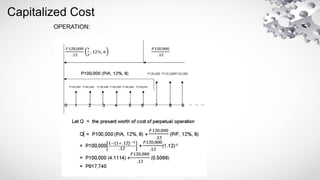
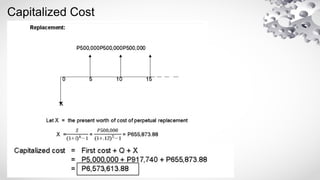
Capitalized Cost
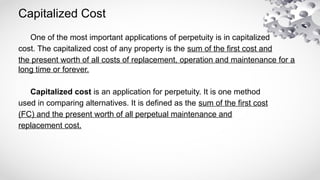
One ofthe most important applications of perpetuity is in capitalized
cost. The capitalized cost of any property is the sum of the first cost and
the present worth of all costs of replacement, operation and maintenance for a
long time or forever.
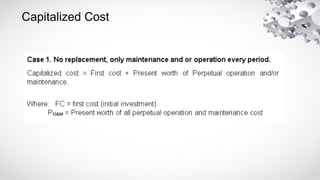
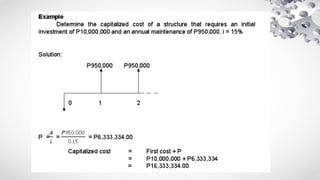
Capitalized cost is an application for perpetuity. It is one method
used in comparing alternatives. It is defined as the sum of the first cost
(FC) and the present worth of all perpetual maintenance and
replacement cost.
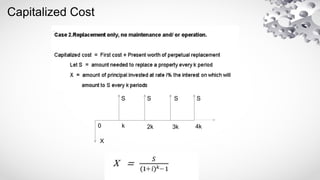
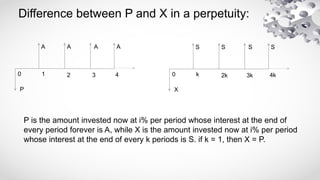
Difference between Pand X in a perpetuity:
k 2k 3k 4k
X
S S S S
0
1 2 3 4
P
A A A A
0
P is the amount invested now at i% per period whose interest at the end of
every period forever is A, while X is the amount invested now at i% per period
whose interest at the end of every k periods is S. if k = 1, then X = P.
7.
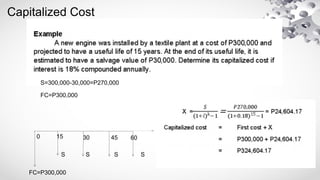
15 30 4560
0
FC=P300,000
S=300,000-30,000=P270,000
S S S
S
FC=P300,000
Capitalized Cost
AMORTIZATION
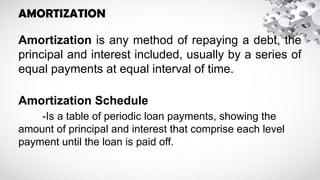
Amortization is anymethod of repaying a debt, the
principal and interest included, usually by a series of
equal payments at equal interval of time.
Amortization Schedule
-Is a table of periodic loan payments, showing the
amount of principal and interest that comprise each level
payment until the loan is paid off.
13.
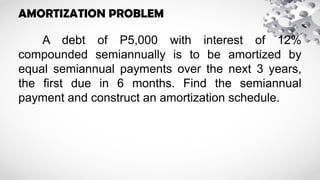
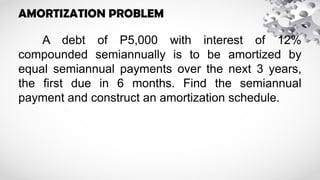
AMORTIZATION PROBLEM
A debtof P5,000 with interest of 12%
compounded semiannually is to be amortized by
equal semiannual payments over the next 3 years,
the first due in 6 months. Find the semiannual
payment and construct an amortization schedule.
14.
AMORTIZATION PROBLEM
A debtof P5,000 with interest of 12%
compounded semiannually is to be amortized by
equal semiannual payments over the next 3 years,
the first due in 6 months. Find the semiannual
payment and construct an amortization schedule.
15.
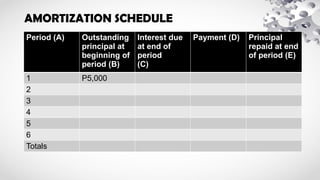
Period (A) Outstanding
principalat
beginning of
period (B)
Interest due
at end of
period
(C)
Payment (D) Principal
repaid at end
of period (E)
1 P5,000
2
3
4
5
6
Totals
AMORTIZATION SCHEDULE
16.
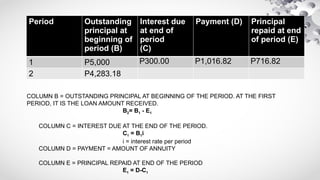
Period Outstanding
principal at
beginningof
period (B)
Interest due
at end of
period
(C)
Payment (D) Principal
repaid at end
of period (E)
1 P5,000 P300.00 P1,016.82 P716.82
2 P4,283.18
COLUMN B = OUTSTANDING PRINCIPAL AT BEGINNING OF THE PERIOD. AT THE FIRST
PERIOD, IT IS THE LOAN AMOUNT RECEIVED.
B2= B1 - E1
COLUMN C = INTEREST DUE AT THE END OF THE PERIOD.
C1 = B1i
i = interest rate per period
COLUMN D = PAYMENT = AMOUNT OF ANNUITY
COLUMN E = PRINCIPAL REPAID AT END OF THE PERIOD
E1 = D-C1
17.
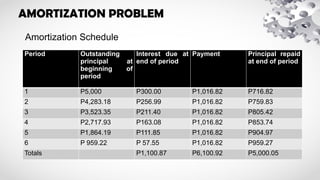
AMORTIZATION PROBLEM
Amortization Schedule
PeriodOutstanding
principal at
beginning of
period
Interest due at
end of period
Payment Principal repaid
at end of period
1 P5,000 P300.00 P1,016.82 P716.82
2 P4,283.18 P256.99 P1,016.82 P759.83
3 P3,523.35 P211.40 P1,016.82 P805.42
4 P2,717.93 P163.08 P1,016.82 P853.74
5 P1,864.19 P111.85 P1,016.82 P904.97
6 P 959.22 P 57.55 P1,016.82 P959.27
Totals P1,100.87 P6,100.92 P5,000.05
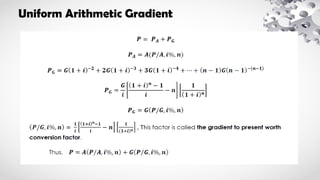
Uniform Arithmetic Gradient
Incertain cases, economic analysis problems involved
receipts or disbursement that increase or decrease by a
uniform amount each period. For example, maintenance and
repair expenses on specific equipment or property may
increase by a relatively constant amount each period. This is
known as a uniform arithmetic gradient.
Some problems involve cash flows that are projected to
increase or decrease by a uniform amount each period,
thus constituting a arithmetic sequence of cash flows.
20.
Uniform Arithmetic Gradient
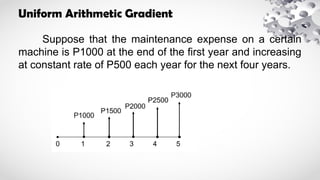
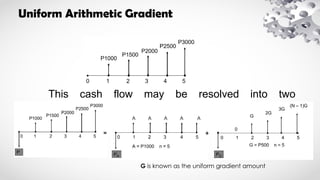
Supposethat the maintenance expense on a certain
machine is P1000 at the end of the first year and increasing
at constant rate of P500 each year for the next four years.
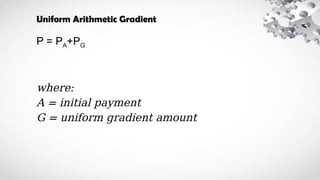
P = PA+PG
where:
A= initial payment
G = uniform gradient amount
Uniform Arithmetic Gradient
24.
Example Problem
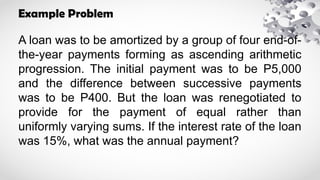
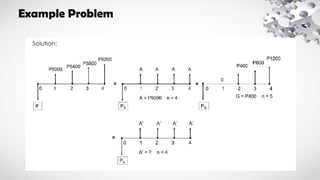
A loanwas to be amortized by a group of four end-of-
the-year payments forming as ascending arithmetic
progression. The initial payment was to be P5,000
and the difference between successive payments
was to be P400. But the loan was renegotiated to
provide for the payment of equal rather than
uniformly varying sums. If the interest rate of the loan
was 15%, what was the annual payment?
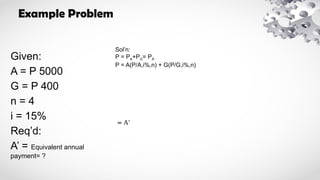
Example Problem
Given:
A =P 5000
G = P 400
n = 4
i = 15%
Req’d:
A’ = Equivalent annual
payment= ?
Sol’n:
P = PA+PG= PA’
P = A(P/A,i%,n) + G(P/G,i%,n)
= A’
27.
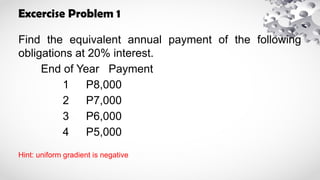
Excercise Problem 1
Findthe equivalent annual payment of the following
obligations at 20% interest.
End of Year Payment
1 P8,000
2 P7,000
3 P6,000
4 P5,000
Hint: uniform gradient is negative