Addis Ababa
City Development
and its Architecture
Prepared by Ephrem N.
• 1775-1875, is a comparatively empty period as far as
Architectural development is concerned in Ethiopia
• Introduction of modern technique by immature method, ex.
un successful ambition of emperor Tewodros to have a
giant mortar /Sebastopol/
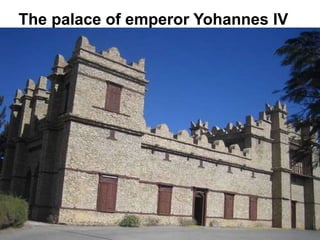
• An Italian builder, G. Naretti, worked as Architect and
builder in Mekelle. During this time the town was the
capital of Emperor Yohannes IV who reigned (1872-1889)
• He designed the Emperor’s palace and Enda Kidane
Mihret church in Mekelle
The 19th century
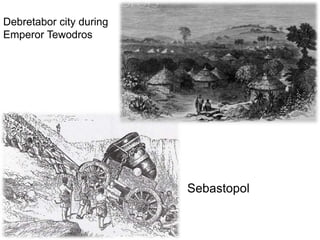
Sebastopol
Debretabor city during
Emperor Tewodros
The palace of emperor Yohannes IV
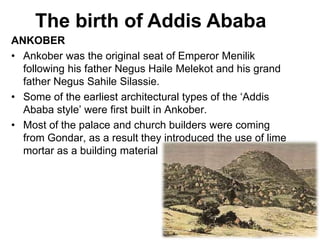
ANKOBER
• Ankober was the original seat of Emperor Menilik
following his father Negus Haile Melekot and his grand
father Negus Sahile Silassie.
• Some of the earliest architectural types of the ‘Addis
Ababa style’ were first built in Ankober.
• Most of the palace and church builders were coming
from Gondar, as a result they introduced the use of lime
mortar as a building material
The birth of Addis Ababa
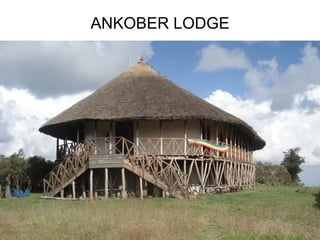
ANKOBER LODGE
The birth of Addis Ababa
ENTOTO
• Menelik selected Entoto as his new residence and
capital, following the old tradition of earlier monarchs.
• Selecting a capital based on a prophecy or the
reestablishment of an old imperial seat was an act that
Ethiopian Emperors often used to secure their
legitimacy.
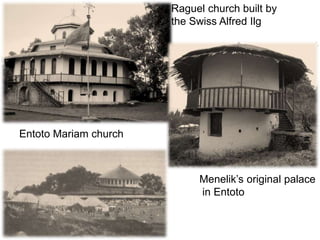
• The earliest structures built in Entoto are the churches of
St. Mary and Raguel, and Menelik’s palace.
Raguel church built by
the Swiss Alfred Ilg
Menelik’s original palace
in Entoto
Entoto Mariam church
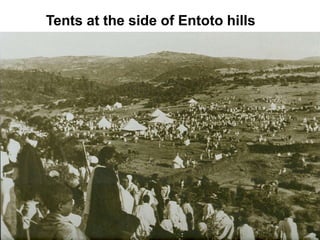
Tents at the side of Entoto hills
The birth of Addis Ababa
• The hot springs of Filwoha were a major attraction to
Menelik and his wife Taitu
• Because of the hot spring and the deforestation of
Entoto for the use of fire wood the new place became
more appropriate for a permanent settlement.
• In 1880 Addis Ababa became the new capital of the
Empire.
• The structure of Addis Ababa at the beginning of the 20th
century was that of a multicentred settlement, with the
GEBBI, the ARADA and the Church compounds as the
main landmarks later the Train station.
• The great famine(1889-92) and the victory of Adowa also
made a great impact on the increasing of the population
of Addis Ababa.
The birth of Addis Ababa
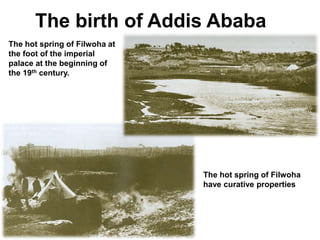
The hot spring of Filwoha at
the foot of the imperial
palace at the beginning of
the 19th century.
The hot spring of Filwoha
have curative properties
The birth of Addis Ababa
TRADE
• Despite the fact that there were political, geographical
and military reasons for the selection of Addis Ababa as
the capital of the empire, it was trade that played the
major role in the consolidation of its future.
• Main commodities, the likes of salt, coffee, grain, ivory,
gold, cattle, sheep hides, honey butter, cotton and
incense, used to come from different parts of the country
to Addis Ababa.
• Some goods were also imported, including textile, metal
products, weapons, medicine and luxury items.
The birth of Addis Ababa
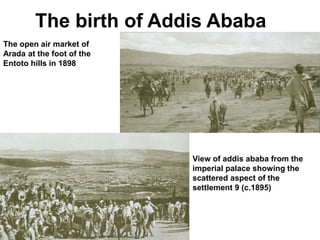
The open air market of
Arada at the foot of the
Entoto hills in 1898
View of addis ababa from the
imperial palace showing the
scattered aspect of the
settlement 9 (c.1895)
Mixture of nationalities
• Because of the strong trade relation between Addis
Ababa and other countries the city started to become a
home of different foreigners and local ethnic groups.
• The Swiss born Alfred Ilg was one of the most influential
one.
• Other nationalities including from Arab, India, German
Greek and Italy were participating in lots of construction
works as well.
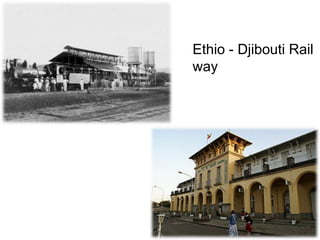
Ethio - Djibouti Rail
way
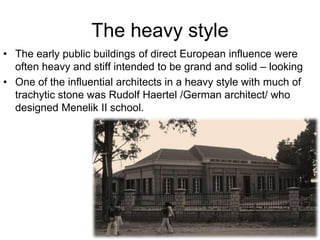
The heavy style
• The early public buildings of direct European influence were
often heavy and stiff intended to be grand and solid – looking
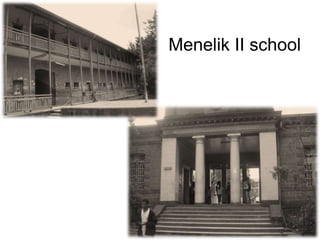
• One of the influential architects in a heavy style with much of
trachytic stone was Rudolf Haertel /German architect/ who
designed Menelik II school.
Menelik II school
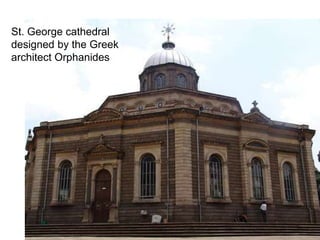
St. George cathedral
designed by the Greek
architect Orphanides
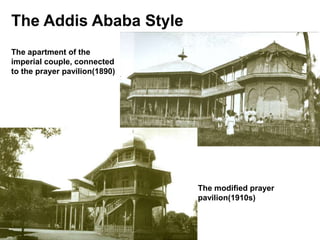
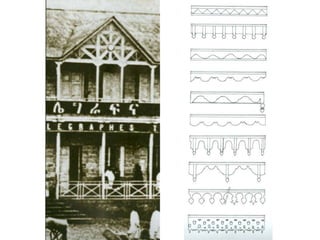
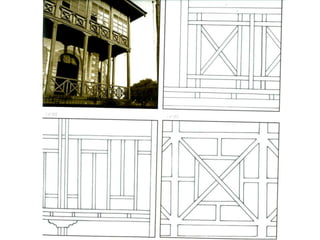
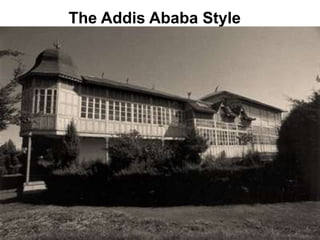
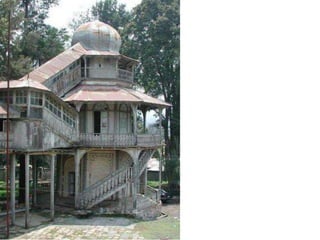
The Addis Ababa style
Characteristics
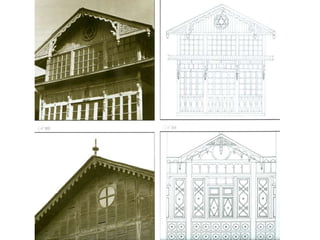
• Fanciful roof shapes
• Roofing material, thatch and corrugated iron sheets
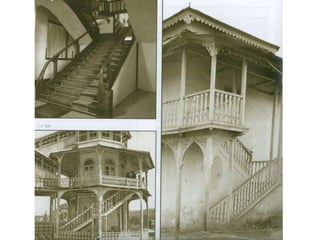
• Green painted balconies and roofs
• The verandahs and balconies are richly decorated,
mostly with wooden ornaments and sometimes with flat
metal sheets (which is decorated by cutting out of it)
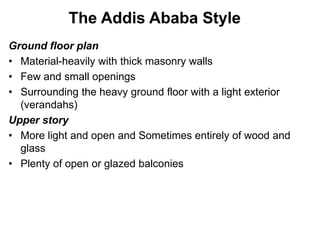
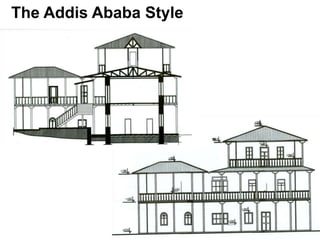
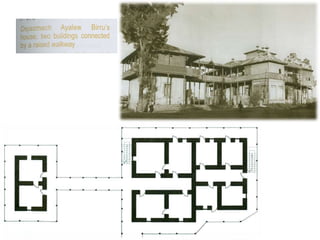
Ground floor plan
• Material-heavily with thick masonry walls
• Few and small openings
• Surrounding the heavy ground floor with a light exterior
(verandahs)
Upper story
• More light and open and Sometimes entirely of wood and
glass
• Plenty of open or glazed balconies
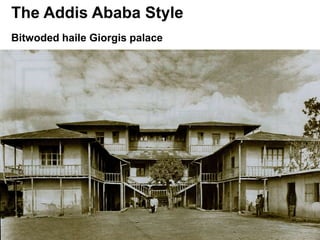
The Addis Ababa Style
Bitwoded haile Giorgis palace
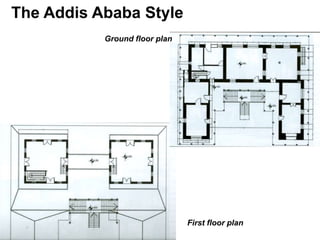
The Addis Ababa Style
Ground floor plan
First floor plan
The Addis Ababa Style
The apartment of the
imperial couple, connected
to the prayer pavilion(1890)
The modified prayer
pavilion(1910s)
The Addis Ababa Style
Origin of the Addis Ababa style
• Arabic influence was the strongest in the beginning
through craftsmen who often came from Aden.
• Emperor Menelik employed an Indian master builder,
Hajji Kawas who build the Raguel church, Gabriel church
and palace inside the old Gibbi.
• Decorated long balconies also appear in India especially
old Bombay.
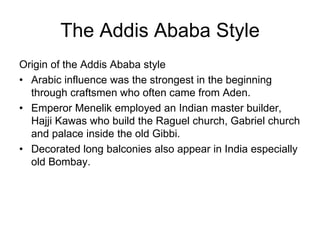
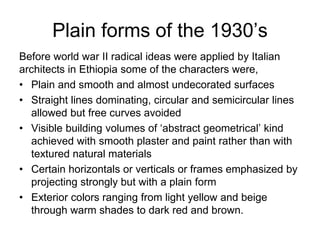
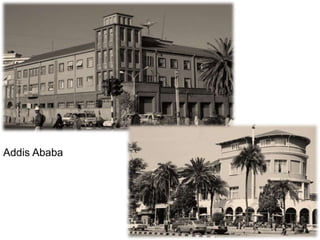
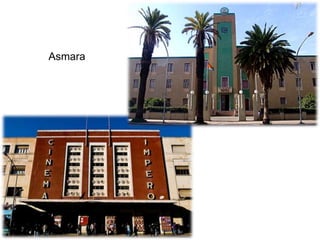
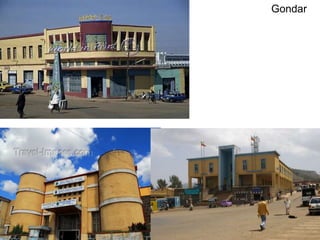
Plain forms of the 1930’s
Before world war II radical ideas were applied by Italian
architects in Ethiopia some of the characters were,
• Plain and smooth and almost undecorated surfaces
• Straight lines dominating, circular and semicircular lines
allowed but free curves avoided
• Visible building volumes of ‘abstract geometrical’ kind
achieved with smooth plaster and paint rather than with
textured natural materials
• Certain horizontals or verticals or frames emphasized by
projecting strongly but with a plain form
• Exterior colors ranging from light yellow and beige
through warm shades to dark red and brown.
Addis Ababa
Asmara
Gondar
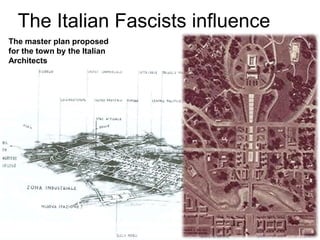
The Italian Fascists influence
Planning
• Several versions of a master plan for Addis Ababa were
prepared during the Italians occupation.
• Some of the ideas which continued until now are
• Moving the big market out of the centre and westwards
• Moving the main centre of the city downwards to level
ground
• Having an industrial zone in the southwest
• To have recreational areas in the southeast on the
Filwoha plain.
The Italian Fascists influence
The master plan proposed
for the town by the Italian
Architects
The Italian Fascists influence
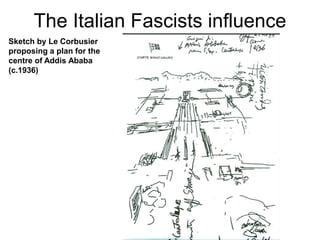
Sketch by Le Corbusier
proposing a plan for the
centre of Addis Ababa
(c.1936)
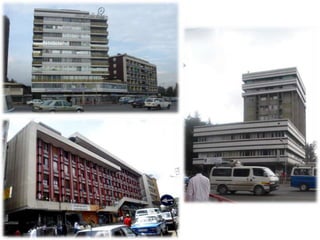
Architecture of the 1960’s
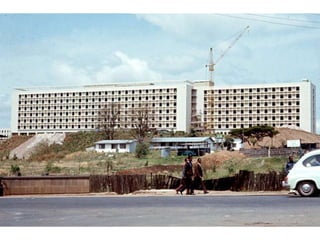
• Approximately the years 1955-68 were a boom period for
the construction industry in A.A.
• New technology was applied, with pile foundations,
vibrated concrete, factory finished surface materials,
using cranes and the likes.
• Most of the buildings were designed by different
foreigners
• All the buildings show the styles of the individual
architects rather than the styles of their countries.
Architecture of the 1960’s
• The common design factors were, functional
requirements, adaptation to the gradually more
industrialized building methods, and use of materials
which are competitive for price and availability in the
Ethiopian market.
• Also multistory buildings automatically enforce more
discipline in the design than small and low structures.
Architecture of the 1960’s
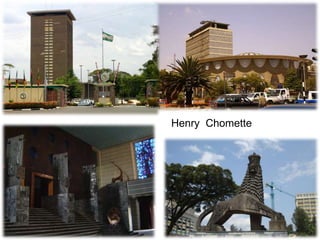
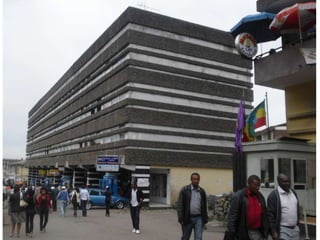
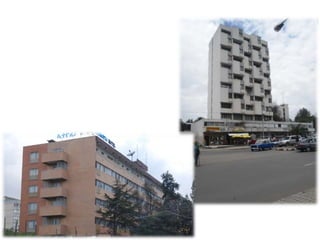
The leading architects and firms of the time includes,
• H. Chomette ------------ French
• Z. Enav and M. Tedros ----------Israeli and Ethiopian
• G. Hentz ----------- German
• Z. Kovachevic and I. Straus ---------Yugoslav
• A. Mezzedimi ------------- Italian from Asmara
• Norconsult ------------- Norwegian
• P.E.A. --------- Italian from Milano
• Technoexportstory ---------- Bulgarian
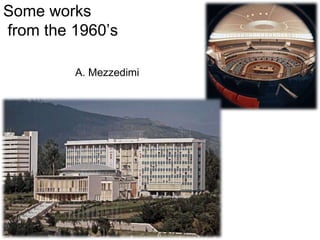
Some works
from the 1960’s
A. Mezzedimi
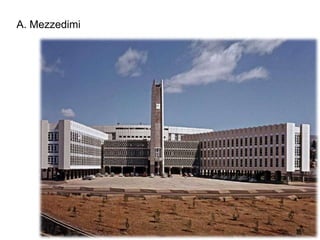
A. Mezzedimi
Henry Chomette
Lecture 6 Addis Ababa style Architecture

Lecture 6 Addis Ababa style Architecture

  • 1.
    Addis Ababa City Development andits Architecture Prepared by Ephrem N.
  • 2.
    • 1775-1875, isa comparatively empty period as far as Architectural development is concerned in Ethiopia • Introduction of modern technique by immature method, ex. un successful ambition of emperor Tewodros to have a giant mortar /Sebastopol/ • An Italian builder, G. Naretti, worked as Architect and builder in Mekelle. During this time the town was the capital of Emperor Yohannes IV who reigned (1872-1889) • He designed the Emperor’s palace and Enda Kidane Mihret church in Mekelle The 19th century
  • 3.
  • 4.
    The palace ofemperor Yohannes IV
  • 5.
    ANKOBER • Ankober wasthe original seat of Emperor Menilik following his father Negus Haile Melekot and his grand father Negus Sahile Silassie. • Some of the earliest architectural types of the ‘Addis Ababa style’ were first built in Ankober. • Most of the palace and church builders were coming from Gondar, as a result they introduced the use of lime mortar as a building material The birth of Addis Ababa
  • 6.
  • 7.
    The birth ofAddis Ababa ENTOTO • Menelik selected Entoto as his new residence and capital, following the old tradition of earlier monarchs. • Selecting a capital based on a prophecy or the reestablishment of an old imperial seat was an act that Ethiopian Emperors often used to secure their legitimacy. • The earliest structures built in Entoto are the churches of St. Mary and Raguel, and Menelik’s palace.
  • 8.
    Raguel church builtby the Swiss Alfred Ilg Menelik’s original palace in Entoto Entoto Mariam church
  • 9.
    Tents at theside of Entoto hills
  • 10.
    The birth ofAddis Ababa • The hot springs of Filwoha were a major attraction to Menelik and his wife Taitu • Because of the hot spring and the deforestation of Entoto for the use of fire wood the new place became more appropriate for a permanent settlement. • In 1880 Addis Ababa became the new capital of the Empire. • The structure of Addis Ababa at the beginning of the 20th century was that of a multicentred settlement, with the GEBBI, the ARADA and the Church compounds as the main landmarks later the Train station. • The great famine(1889-92) and the victory of Adowa also made a great impact on the increasing of the population of Addis Ababa.
  • 11.
    The birth ofAddis Ababa The hot spring of Filwoha at the foot of the imperial palace at the beginning of the 19th century. The hot spring of Filwoha have curative properties
  • 12.
    The birth ofAddis Ababa TRADE • Despite the fact that there were political, geographical and military reasons for the selection of Addis Ababa as the capital of the empire, it was trade that played the major role in the consolidation of its future. • Main commodities, the likes of salt, coffee, grain, ivory, gold, cattle, sheep hides, honey butter, cotton and incense, used to come from different parts of the country to Addis Ababa. • Some goods were also imported, including textile, metal products, weapons, medicine and luxury items.
  • 13.
    The birth ofAddis Ababa The open air market of Arada at the foot of the Entoto hills in 1898 View of addis ababa from the imperial palace showing the scattered aspect of the settlement 9 (c.1895)
  • 14.
    Mixture of nationalities •Because of the strong trade relation between Addis Ababa and other countries the city started to become a home of different foreigners and local ethnic groups. • The Swiss born Alfred Ilg was one of the most influential one. • Other nationalities including from Arab, India, German Greek and Italy were participating in lots of construction works as well.
  • 15.
  • 16.
    The heavy style •The early public buildings of direct European influence were often heavy and stiff intended to be grand and solid – looking • One of the influential architects in a heavy style with much of trachytic stone was Rudolf Haertel /German architect/ who designed Menelik II school.
  • 17.
  • 18.
    St. George cathedral designedby the Greek architect Orphanides
  • 19.
    The Addis Ababastyle Characteristics • Fanciful roof shapes • Roofing material, thatch and corrugated iron sheets • Green painted balconies and roofs • The verandahs and balconies are richly decorated, mostly with wooden ornaments and sometimes with flat metal sheets (which is decorated by cutting out of it)
  • 20.
    Ground floor plan •Material-heavily with thick masonry walls • Few and small openings • Surrounding the heavy ground floor with a light exterior (verandahs) Upper story • More light and open and Sometimes entirely of wood and glass • Plenty of open or glazed balconies The Addis Ababa Style
  • 21.
    The Addis AbabaStyle Bitwoded haile Giorgis palace
  • 22.
    The Addis AbabaStyle Ground floor plan First floor plan
  • 23.
  • 24.
    The Addis AbabaStyle The apartment of the imperial couple, connected to the prayer pavilion(1890) The modified prayer pavilion(1910s)
  • 30.
  • 32.
    The Addis AbabaStyle Origin of the Addis Ababa style • Arabic influence was the strongest in the beginning through craftsmen who often came from Aden. • Emperor Menelik employed an Indian master builder, Hajji Kawas who build the Raguel church, Gabriel church and palace inside the old Gibbi. • Decorated long balconies also appear in India especially old Bombay.
  • 33.
    Plain forms ofthe 1930’s Before world war II radical ideas were applied by Italian architects in Ethiopia some of the characters were, • Plain and smooth and almost undecorated surfaces • Straight lines dominating, circular and semicircular lines allowed but free curves avoided • Visible building volumes of ‘abstract geometrical’ kind achieved with smooth plaster and paint rather than with textured natural materials • Certain horizontals or verticals or frames emphasized by projecting strongly but with a plain form • Exterior colors ranging from light yellow and beige through warm shades to dark red and brown.
  • 34.
  • 35.
  • 36.
  • 37.
    The Italian Fascistsinfluence Planning • Several versions of a master plan for Addis Ababa were prepared during the Italians occupation. • Some of the ideas which continued until now are • Moving the big market out of the centre and westwards • Moving the main centre of the city downwards to level ground • Having an industrial zone in the southwest • To have recreational areas in the southeast on the Filwoha plain.
  • 38.
    The Italian Fascistsinfluence The master plan proposed for the town by the Italian Architects
  • 39.
    The Italian Fascistsinfluence Sketch by Le Corbusier proposing a plan for the centre of Addis Ababa (c.1936)
  • 40.
    Architecture of the1960’s • Approximately the years 1955-68 were a boom period for the construction industry in A.A. • New technology was applied, with pile foundations, vibrated concrete, factory finished surface materials, using cranes and the likes. • Most of the buildings were designed by different foreigners • All the buildings show the styles of the individual architects rather than the styles of their countries.
  • 41.
    Architecture of the1960’s • The common design factors were, functional requirements, adaptation to the gradually more industrialized building methods, and use of materials which are competitive for price and availability in the Ethiopian market. • Also multistory buildings automatically enforce more discipline in the design than small and low structures.
  • 43.
    Architecture of the1960’s The leading architects and firms of the time includes, • H. Chomette ------------ French • Z. Enav and M. Tedros ----------Israeli and Ethiopian • G. Hentz ----------- German • Z. Kovachevic and I. Straus ---------Yugoslav • A. Mezzedimi ------------- Italian from Asmara • Norconsult ------------- Norwegian • P.E.A. --------- Italian from Milano • Technoexportstory ---------- Bulgarian
  • 44.
    Some works from the1960’s A. Mezzedimi
  • 45.
  • 46.