Online bioscience course for grades 6-12 Fall 2009 bio 1.0
Class mechanics… Attend the online Office Hour on Tuesdays at 3 PM  via  tokbox-Discuss previous week’s video lecture Online video lecture e-mailed every Wednesday-view lecture and prepare to discuss the following Tuesday Comment on video lecture using website discussion  board Online Final Exam given 12/9/2009 bio 1.0
Lecture 5:  Higher cells bio 1.0
Take Homes: Higher cells are very complex, highly compartmentalized  and not streamlined… II.  The DNA genome of higher cells is packaged in linear  chromosomes… III.  The genes of higher cells are in pieces  IV.  Higher cells move in ways mediated via their  cytoskeletons… V.  Higher cells communicate  via  small molecules and proteins  which regulate their behaviors… bio 1.0
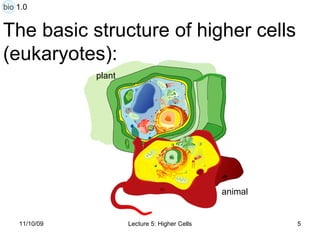
The basic structure of higher cells  (eukaryotes): plant animal bio 1.0
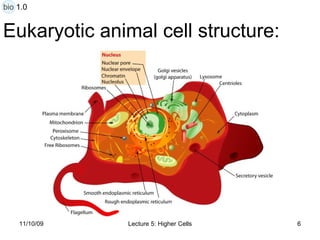
Eukaryotic animal cell structure: bio 1.0
Tour of an animal cell: http:// www.youtube.com/watch?v =PXbv95P3uhI bio 1.0
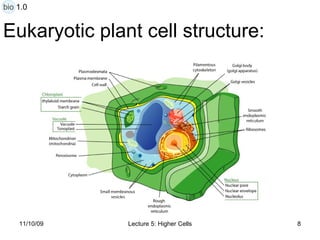
Eukaryotic plant cell structure: bio 1.0
Tour of a plant cell: http:// www.youtube.com/watch?v =LMVQ- INMSVw bio 1.0
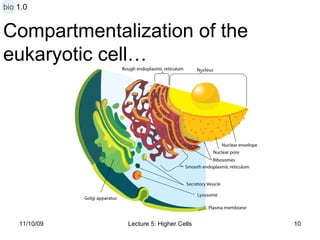
Compartmentalization of the  eukaryotic cell… bio 1.0
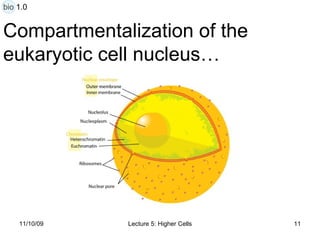
Compartmentalization of the  eukaryotic cell nucleus… bio 1.0
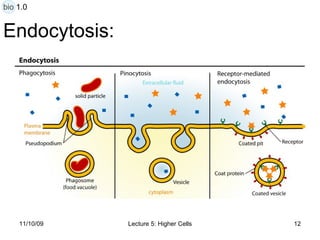
Endocytosis: bio 1.0
Cell membrane, exocytosis and  endocytosis: http:// www.youtube.com/watch?v =K7yku3sa4Y8 bio 1.0
Amoeba Feeds!  An example  of endocytosis: http:// www.youtube.com/watch?v =W6rnhiMxtKU bio 1.0
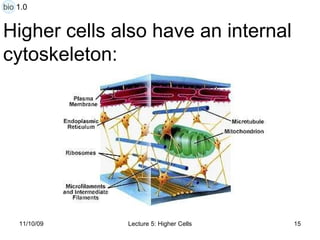
Higher cells also have an internal  cytoskeleton: bio 1.0
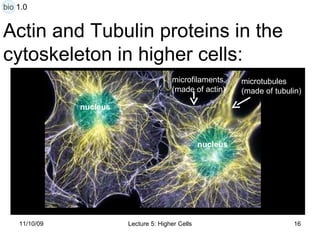
Actin and Tubulin proteins in the  cytoskeleton in higher cells: bio 1.0 nucleus nucleus microtubules (made of tubulin) microfilaments (made of actin)
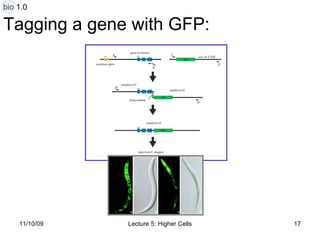
Tagging a gene with GFP: bio 1.0
The cytoskeleton is dynamic in  higher cells: http:// www.youtube.com/watch?v =DA8DvDE_nZo bio 1.0
The cytoskeleton controls  movement inside higher cells: http:// www.youtube.com/watch?v = CDWoOOd_VHo bio 1.0
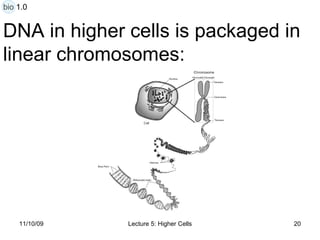
DNA in higher cells is packaged in  linear chromosomes: bio 1.0
Higher cell chromosome structure: http:// www.youtube.com/watch?v =OStI5pniHPA bio 1.0
Take Home I From their complex membrane structure, their internal cytoskeleton to their chromosomal DNA, higher cells are extremely complex and versatile… Higher cells are very complex, highly compartmentalized and not streamlined… bio 1.0
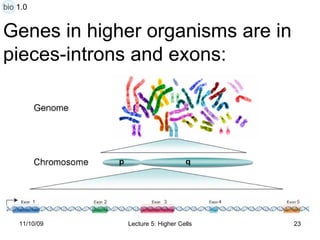
Genes in higher organisms are in  pieces-introns and exons: bio 1.0
Chromosomes, Chromatids,  Chromatin, etc… http:// www.youtube.com/watch?v =s9HPNwXd9fk bio 1.0
The ends of linear chromosomes  (telomeres) cause a problem: unlike bacterial circular chromosomes, linear chromosomes  shorten with each round of DNA replication because of the  way DNA polymerase works… bio 1.0
Telomeres and telomerase: http:// www.youtube.com/watch?v =AJNoTmWsE0s bio 1.0
Mitosis: bio 1.0
Mitosis-animation: http:// www.youtube.com/watch?v =VlN7K1-9QB0 bio 1.0
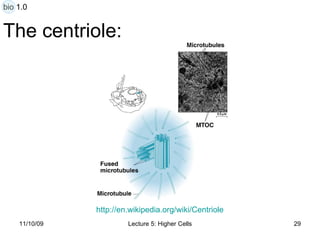
The centriole: http:// en.wikipedia.org/wiki/Centriole bio 1.0
GFP tagged tubulin-role of  microtubules in mitosis: http:// www.youtube.com/watch?v = TBfFJlKMyPA bio 1.0
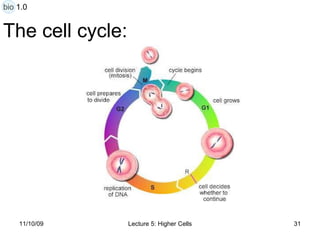
The cell cycle: bio 1.0
Take Home II Unlike bacterial chromosomes, which are circular, the chromosomes of higher cells are divided-up into collections of single linear DNA molecules…this created unique challenges in replication…and the chromosomes interact with the cytoskeletal microtubules during cell division…cell division is controlled by a clock-like mechanism called the cell cycle… The DNA genome of higher cells is packaged in linear  chromosomes… bio 1.0
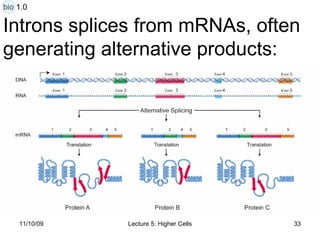
Introns splices from mRNAs, often  generating alternative products: bio 1.0
Gene expression in higher cells…: http:// www.youtube.com/watch?v =bk7PW1FKMTI bio 1.0
Take Home III Genes in higher cells are often broken-up into exons and introns, with the introns being spliced-out of RNA before it is translated by the ribosomes…genes in turn are controlled by DNA binding regulatory proteins… The genes of higher cells are in pieces and are highly regulated and processed…  bio 1.0
Movement in higher cells- pseudopodia: http:// www.youtube.com/watch?v =7pR7TNzJ_pA bio 1.0
Role of actin in cell movement  via  pseudopodia: http:// dictybase.org/Multimedia/motility/motility.htm bio 1.0
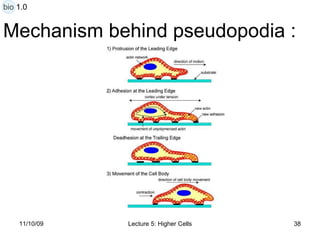
Mechanism behind pseudopodia : bio 1.0
Movement in higher cells- flagella and cilia: http:// www.youtube.com/watch?v =QGAm6hMysTA bio 1.0
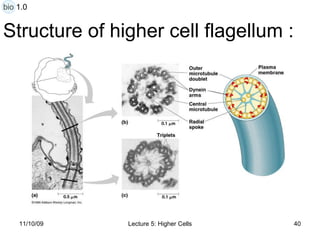
Structure of higher cell flagellum  : bio 1.0
Take Home IV Actin, myosin, tubulin and a number of other protein components of the cellular cytoskeleton effect the movement of cells  via  several different mechanisms… Higher cells move in ways mediated  via  their  cytoskeletons… bio 1.0
Higher cell communication I: http:// www.youtube.com/watch?v =QGd5kg9JqoM bio 1.0
Higher cell communication II: http:// www.youtube.com/watch?v =12QHDoSiEWM bio 1.0
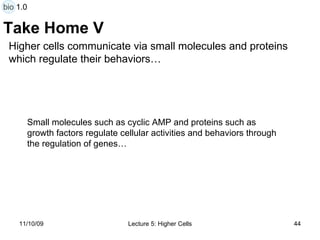
Take Home V Small molecules such as cyclic AMP and proteins such as growth factors regulate cellular activities and behaviors through the regulation of genes… Higher cells communicate via small molecules and proteins  which regulate their behaviors… bio 1.0
Next Week: Organs, tissues and organisms How higher cells interact and cooperated to form the tissues and organs of organisms… bio 1.0
instructor Mark E Minie PhD [email_address]   bio 1.0

Lecture 5 Higher Cells

  • 1.
    Online bioscience coursefor grades 6-12 Fall 2009 bio 1.0
  • 2.
    Class mechanics… Attendthe online Office Hour on Tuesdays at 3 PM via tokbox-Discuss previous week’s video lecture Online video lecture e-mailed every Wednesday-view lecture and prepare to discuss the following Tuesday Comment on video lecture using website discussion board Online Final Exam given 12/9/2009 bio 1.0
  • 3.
    Lecture 5: Higher cells bio 1.0
  • 4.
    Take Homes: Highercells are very complex, highly compartmentalized and not streamlined… II. The DNA genome of higher cells is packaged in linear chromosomes… III. The genes of higher cells are in pieces IV. Higher cells move in ways mediated via their cytoskeletons… V. Higher cells communicate via small molecules and proteins which regulate their behaviors… bio 1.0
  • 5.
    The basic structureof higher cells (eukaryotes): plant animal bio 1.0
  • 6.
    Eukaryotic animal cellstructure: bio 1.0
  • 7.
    Tour of ananimal cell: http:// www.youtube.com/watch?v =PXbv95P3uhI bio 1.0
  • 8.
    Eukaryotic plant cellstructure: bio 1.0
  • 9.
    Tour of aplant cell: http:// www.youtube.com/watch?v =LMVQ- INMSVw bio 1.0
  • 10.
    Compartmentalization of the eukaryotic cell… bio 1.0
  • 11.
    Compartmentalization of the eukaryotic cell nucleus… bio 1.0
  • 12.
  • 13.
    Cell membrane, exocytosisand endocytosis: http:// www.youtube.com/watch?v =K7yku3sa4Y8 bio 1.0
  • 14.
    Amoeba Feeds! An example of endocytosis: http:// www.youtube.com/watch?v =W6rnhiMxtKU bio 1.0
  • 15.
    Higher cells alsohave an internal cytoskeleton: bio 1.0
  • 16.
    Actin and Tubulinproteins in the cytoskeleton in higher cells: bio 1.0 nucleus nucleus microtubules (made of tubulin) microfilaments (made of actin)
  • 17.
    Tagging a genewith GFP: bio 1.0
  • 18.
    The cytoskeleton isdynamic in higher cells: http:// www.youtube.com/watch?v =DA8DvDE_nZo bio 1.0
  • 19.
    The cytoskeleton controls movement inside higher cells: http:// www.youtube.com/watch?v = CDWoOOd_VHo bio 1.0
  • 20.
    DNA in highercells is packaged in linear chromosomes: bio 1.0
  • 21.
    Higher cell chromosomestructure: http:// www.youtube.com/watch?v =OStI5pniHPA bio 1.0
  • 22.
    Take Home IFrom their complex membrane structure, their internal cytoskeleton to their chromosomal DNA, higher cells are extremely complex and versatile… Higher cells are very complex, highly compartmentalized and not streamlined… bio 1.0
  • 23.
    Genes in higherorganisms are in pieces-introns and exons: bio 1.0
  • 24.
    Chromosomes, Chromatids, Chromatin, etc… http:// www.youtube.com/watch?v =s9HPNwXd9fk bio 1.0
  • 25.
    The ends oflinear chromosomes (telomeres) cause a problem: unlike bacterial circular chromosomes, linear chromosomes shorten with each round of DNA replication because of the way DNA polymerase works… bio 1.0
  • 26.
    Telomeres and telomerase:http:// www.youtube.com/watch?v =AJNoTmWsE0s bio 1.0
  • 27.
  • 28.
  • 29.
    The centriole: http://en.wikipedia.org/wiki/Centriole bio 1.0
  • 30.
    GFP tagged tubulin-roleof microtubules in mitosis: http:// www.youtube.com/watch?v = TBfFJlKMyPA bio 1.0
  • 31.
  • 32.
    Take Home IIUnlike bacterial chromosomes, which are circular, the chromosomes of higher cells are divided-up into collections of single linear DNA molecules…this created unique challenges in replication…and the chromosomes interact with the cytoskeletal microtubules during cell division…cell division is controlled by a clock-like mechanism called the cell cycle… The DNA genome of higher cells is packaged in linear chromosomes… bio 1.0
  • 33.
    Introns splices frommRNAs, often generating alternative products: bio 1.0
  • 34.
    Gene expression inhigher cells…: http:// www.youtube.com/watch?v =bk7PW1FKMTI bio 1.0
  • 35.
    Take Home IIIGenes in higher cells are often broken-up into exons and introns, with the introns being spliced-out of RNA before it is translated by the ribosomes…genes in turn are controlled by DNA binding regulatory proteins… The genes of higher cells are in pieces and are highly regulated and processed… bio 1.0
  • 36.
    Movement in highercells- pseudopodia: http:// www.youtube.com/watch?v =7pR7TNzJ_pA bio 1.0
  • 37.
    Role of actinin cell movement via pseudopodia: http:// dictybase.org/Multimedia/motility/motility.htm bio 1.0
  • 38.
  • 39.
    Movement in highercells- flagella and cilia: http:// www.youtube.com/watch?v =QGAm6hMysTA bio 1.0
  • 40.
    Structure of highercell flagellum : bio 1.0
  • 41.
    Take Home IVActin, myosin, tubulin and a number of other protein components of the cellular cytoskeleton effect the movement of cells via several different mechanisms… Higher cells move in ways mediated via their cytoskeletons… bio 1.0
  • 42.
    Higher cell communicationI: http:// www.youtube.com/watch?v =QGd5kg9JqoM bio 1.0
  • 43.
    Higher cell communicationII: http:// www.youtube.com/watch?v =12QHDoSiEWM bio 1.0
  • 44.
    Take Home VSmall molecules such as cyclic AMP and proteins such as growth factors regulate cellular activities and behaviors through the regulation of genes… Higher cells communicate via small molecules and proteins which regulate their behaviors… bio 1.0
  • 45.
    Next Week: Organs,tissues and organisms How higher cells interact and cooperated to form the tissues and organs of organisms… bio 1.0
  • 46.
    instructor Mark EMinie PhD [email_address] bio 1.0