Structural framework of a
cell
G.Keertana
Tutor
Department of biochemistry
Time to think….
1. How can the cell purposely move and control the location of
materials between these organelles?
2. How can a eukaryotic cell transport compounds
from their place of origin (in most cases the cyotoplasm) to
where they are needed (perhaps the nucleus, the
mitochondria, or the cell surface)?
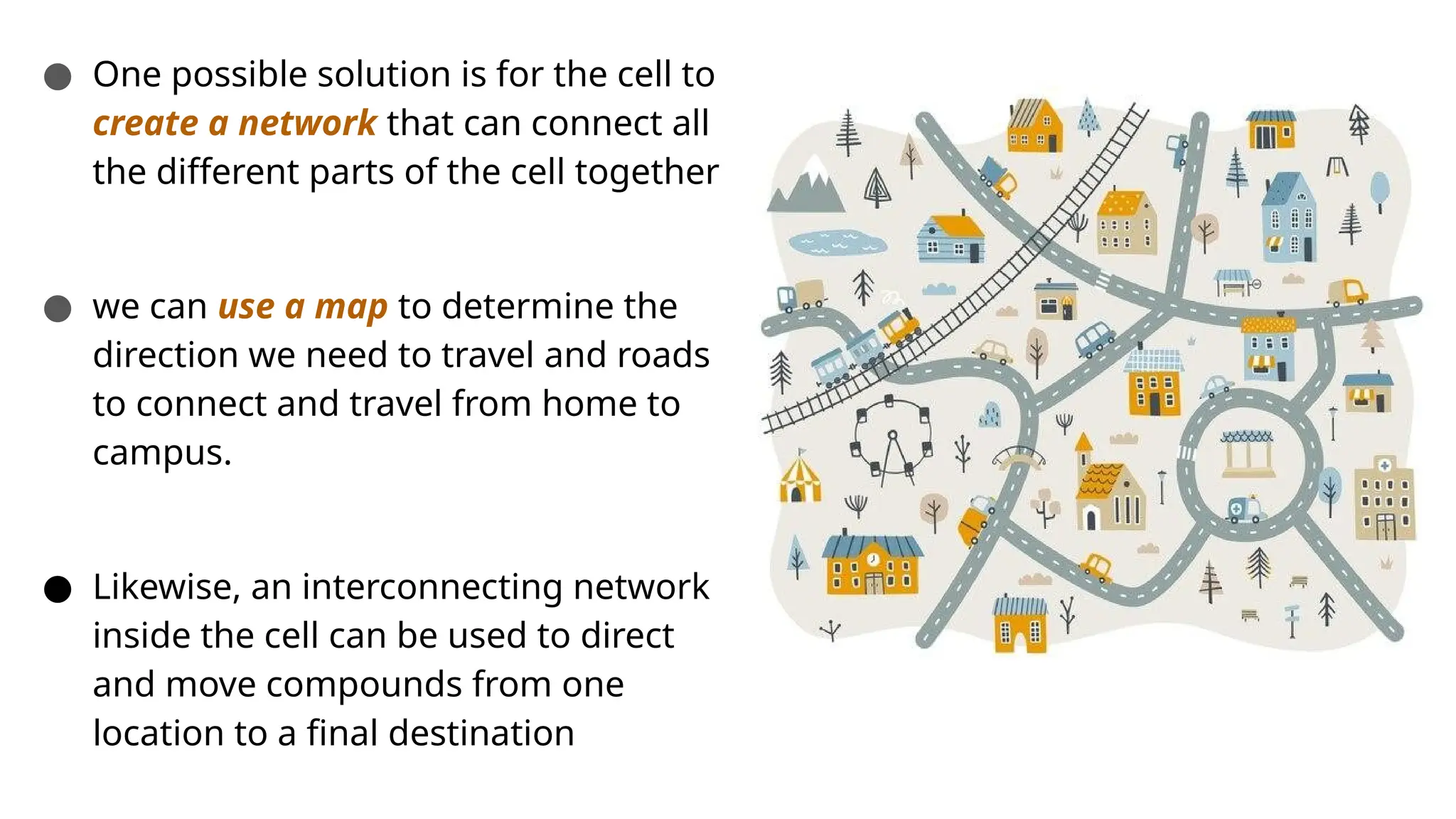
● One possible solution is for the cell to
create a network that can connect all
the different parts of the cell together
● we can use a map to determine the
direction we need to travel and roads
to connect and travel from home to
campus.
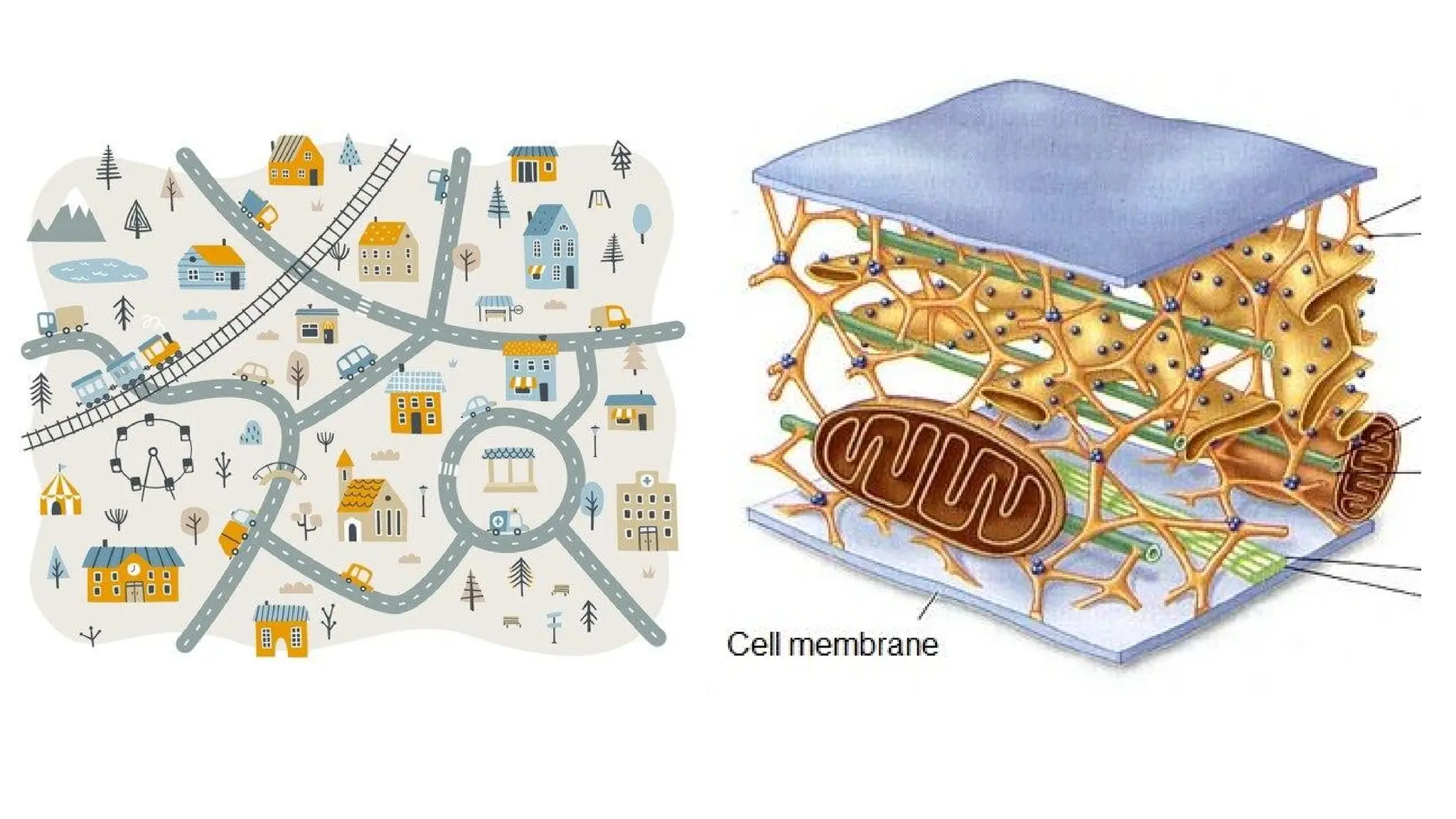
● Likewise, an interconnecting network
inside the cell can be used to direct
and move compounds from one
location to a final destination
Intracellular network
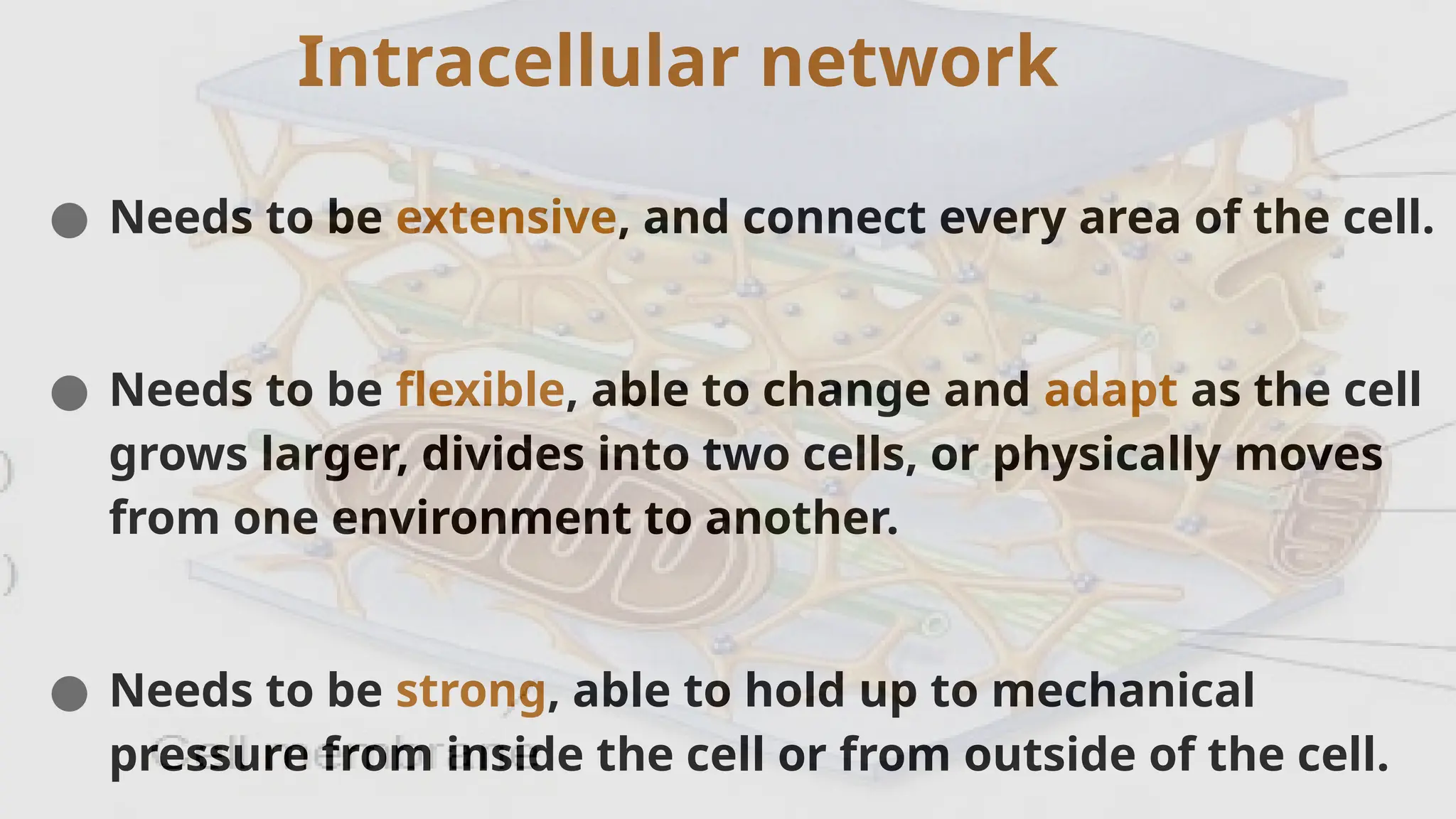
● Needs to be extensive, and connect every area of the cell.
● Needs to be flexible, able to change and adapt as the cell
grows larger, divides into two cells, or physically moves
from one environment to another.
● Needs to be strong, able to hold up to mechanical
pressure from inside the cell or from outside of the cell.
Intracellular network
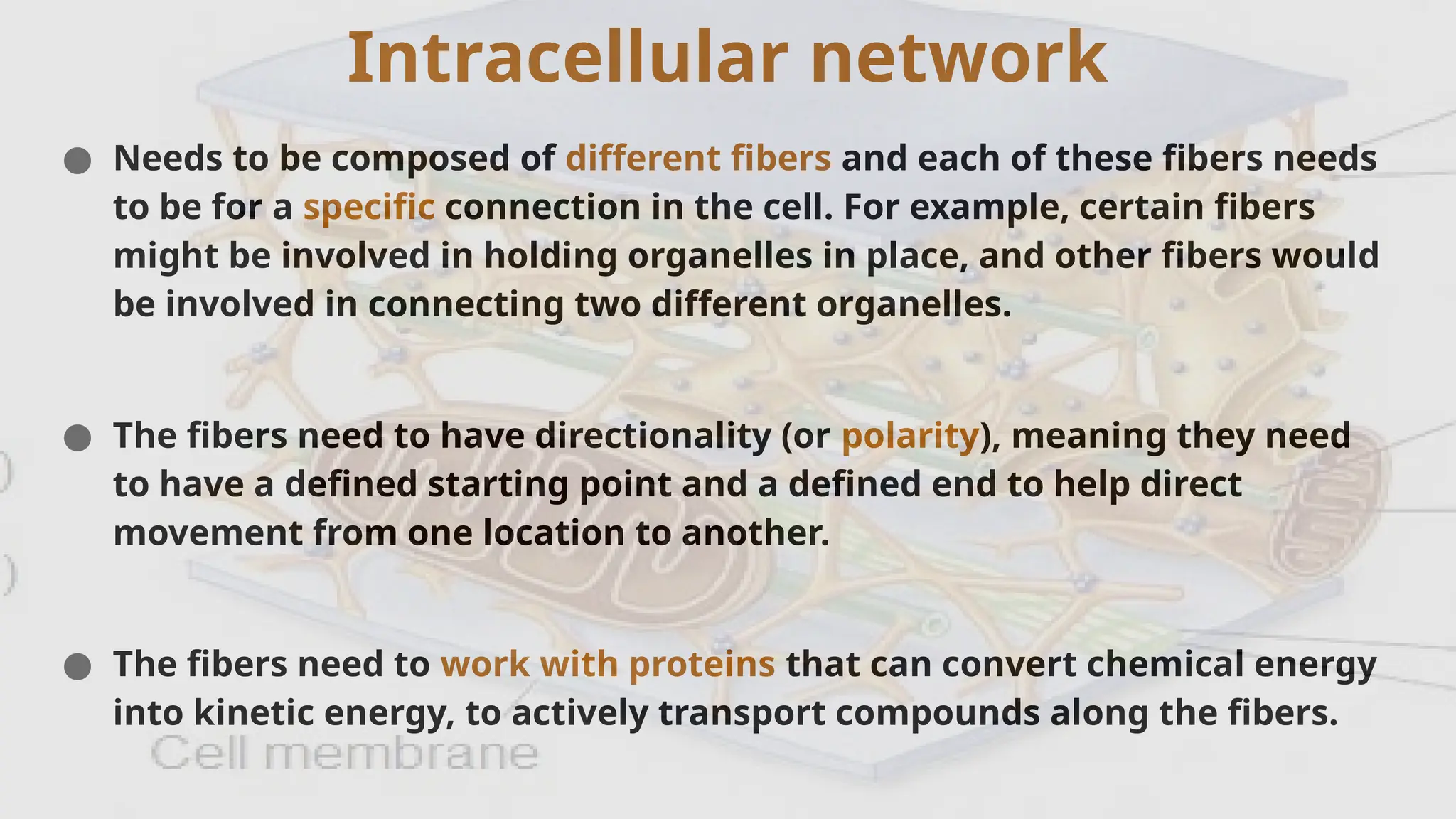
● Needs to be composed of different fibers and each of these fibers needs
to be for a specific connection in the cell. For example, certain fibers
might be involved in holding organelles in place, and other fibers would
be involved in connecting two different organelles.
● The fibers need to have directionality (or polarity), meaning they need
to have a defined starting point and a defined end to help direct
movement from one location to another.
● The fibers need to work with proteins that can convert chemical energy
into kinetic energy, to actively transport compounds along the fibers.
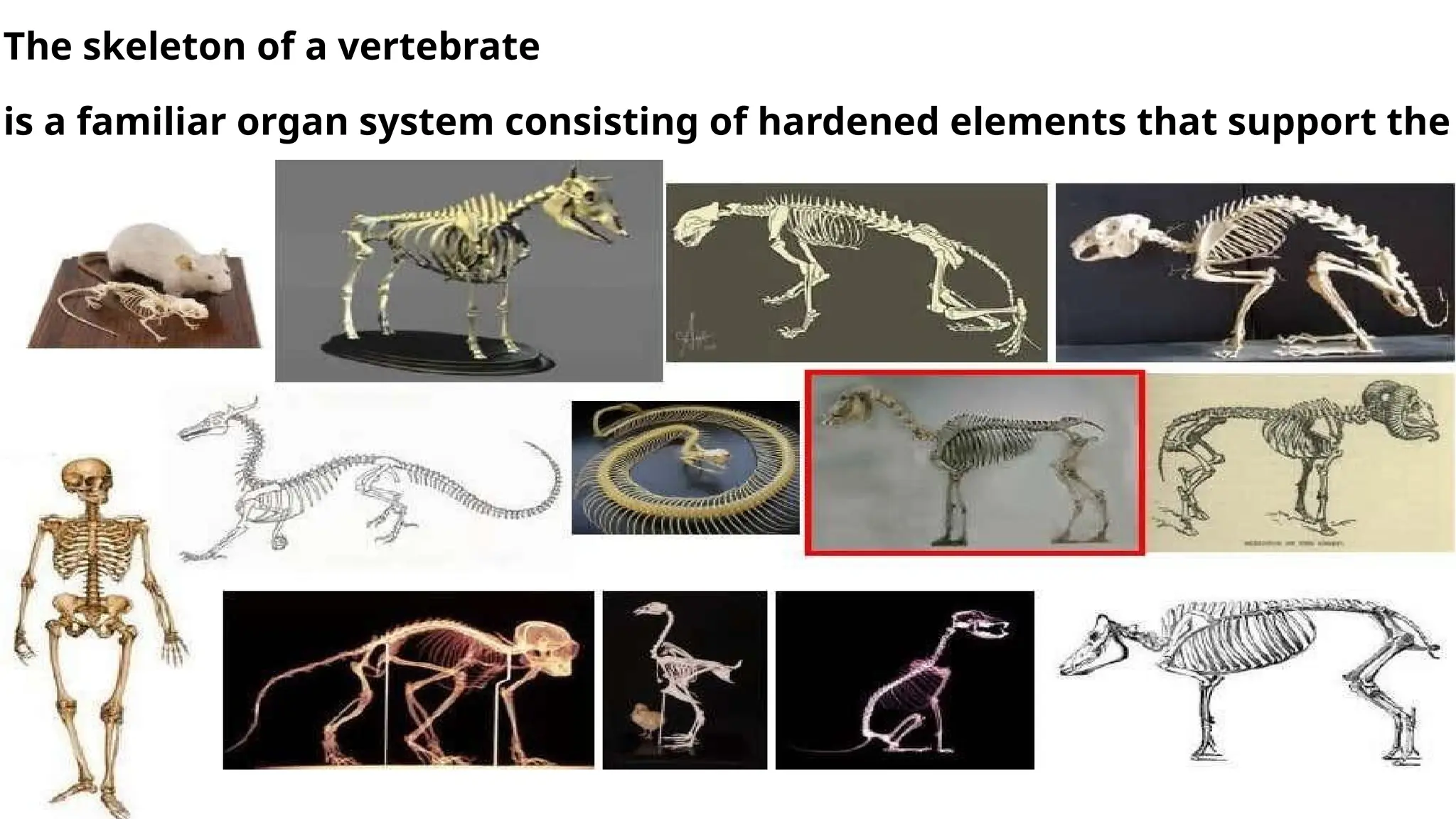
The skeleton of a vertebrate
is a familiar organ system consisting of hardened elements that support the
soft tissues of the body and play a key role in mediating bodily movements.
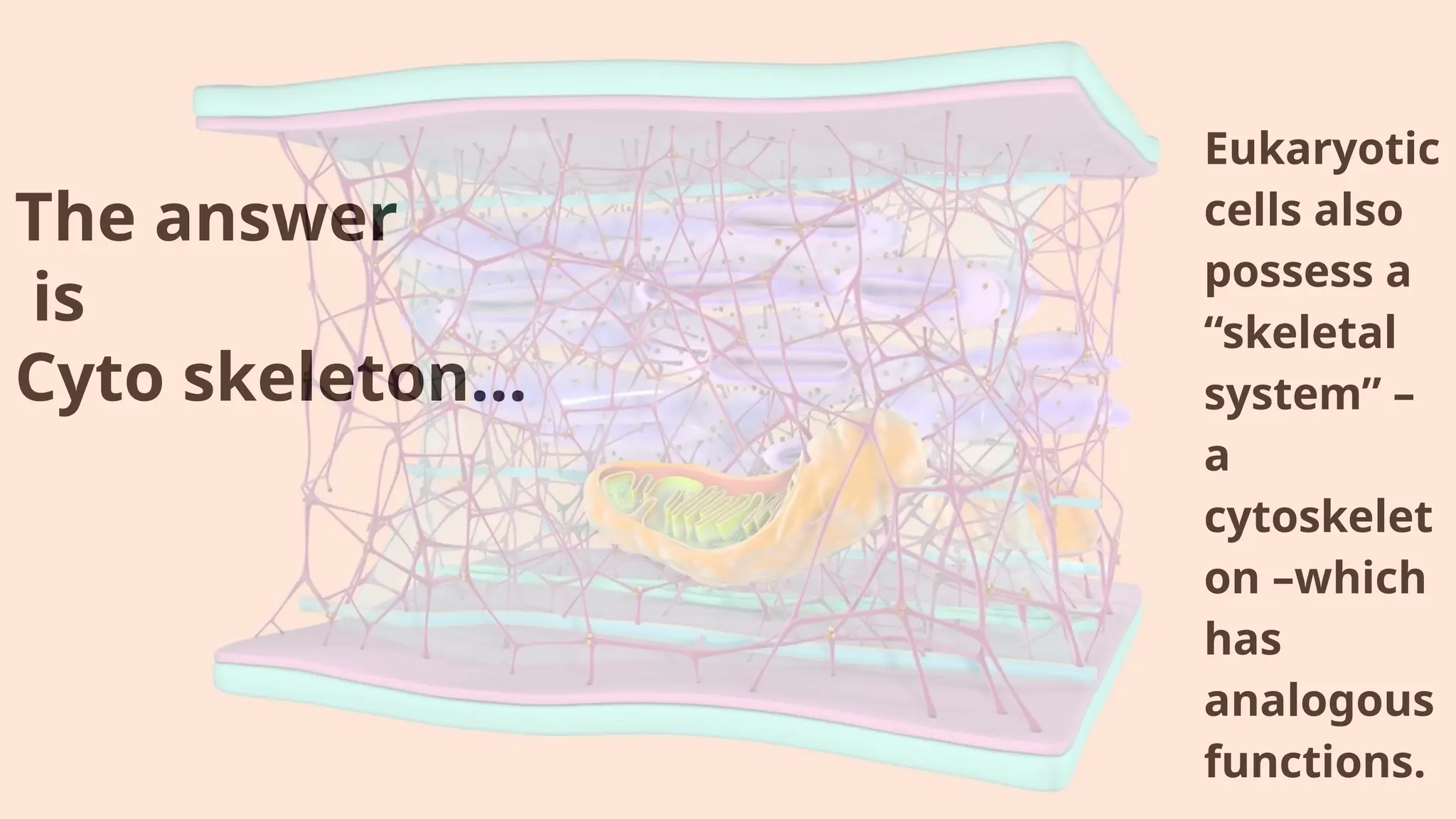
Eukaryotic
cells also
possess a
“skeletal
system” –
a
cytoskelet
on –which
has
analogous
functions.
The answer
is
Cyto skeleton…
Functions of Cyto-Skeleton
● Providing structural support that can determine the shape
of the cell and resist forces that tend to deform it.
● An internal framework responsible for positioning the
various organelles within the interior of the cell.
● A network of highways that direct the movement of
materials and organelles with cells
Eg: delivery of mRNA molecules to specific parts of a cell,
the movement of membranous carriers from the
endoplasmic reticulum to the Golgi complex, and the
transport of vesicles containing neurotransmitters down
the length of a nerve cell.
Functions of Cyto-Skeleton
● The force generating apparatus that moves cells from
one place to another.
● A site for anchoring mRNAs and facilitating their
translation into polypeptides.
● An essential component of the cell’s division machinery.
● Cytoskeletal elements make up the apparatus
responsible for separating the chromosomes during
mitosis and meiosis and for splitting the parent cell into
two daughter cells during cytokinesis.
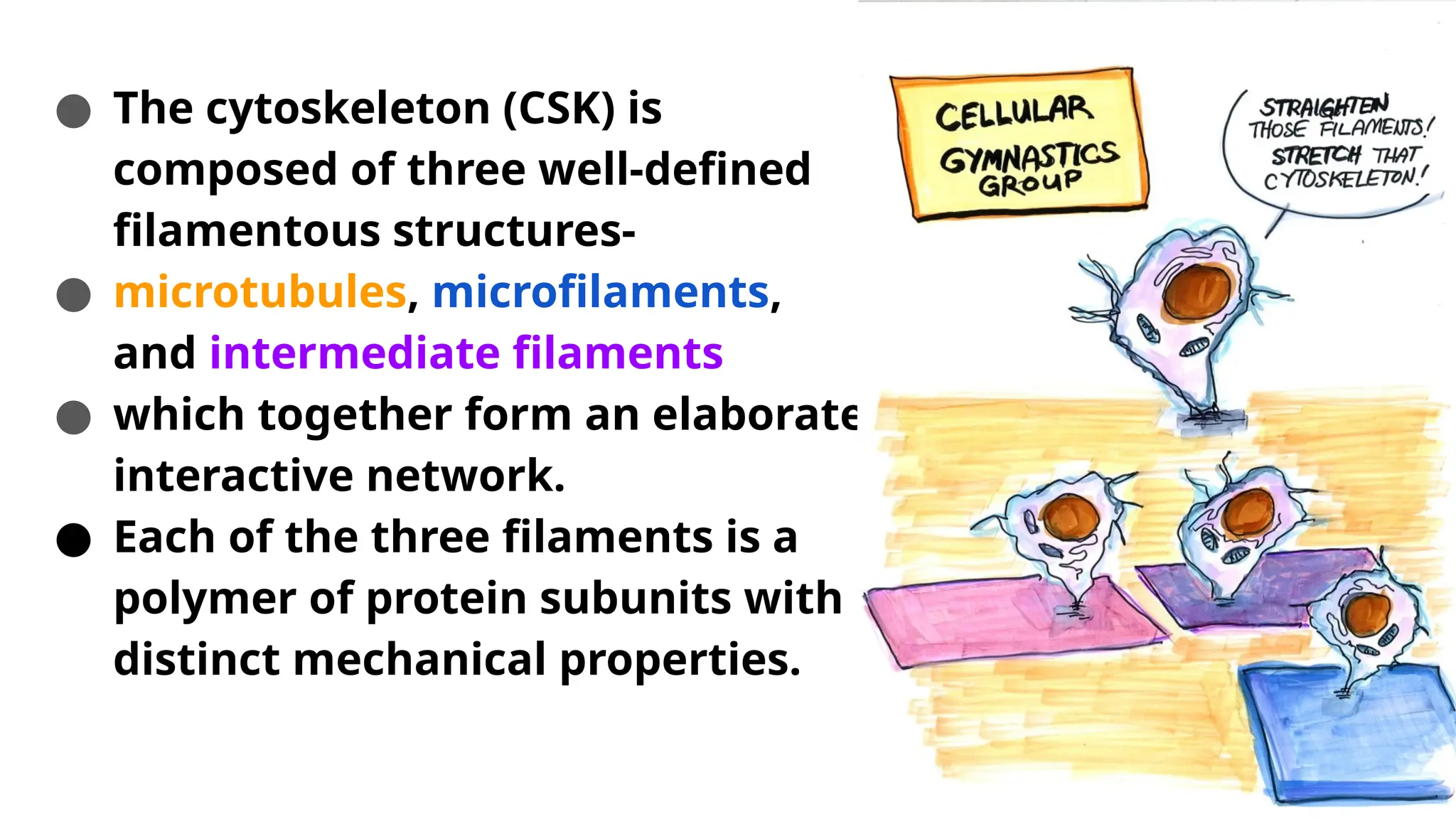
● The cytoskeleton (CSK) is
composed of three well-defined
filamentous structures-
● microtubules, microfilaments,
and intermediate filaments
● which together form an elaborate
interactive network.
● Each of the three filaments is a
polymer of protein subunits with
distinct mechanical properties.
● Microfilaments are solid, thinner structures composed
of the globular proteins- actin.
● Microtubule are rigid tubes composed of subunits of the
globular protein- tubulin.
● Intermediate filament are tough, rope like fibers
composed of a variety of related proteins.
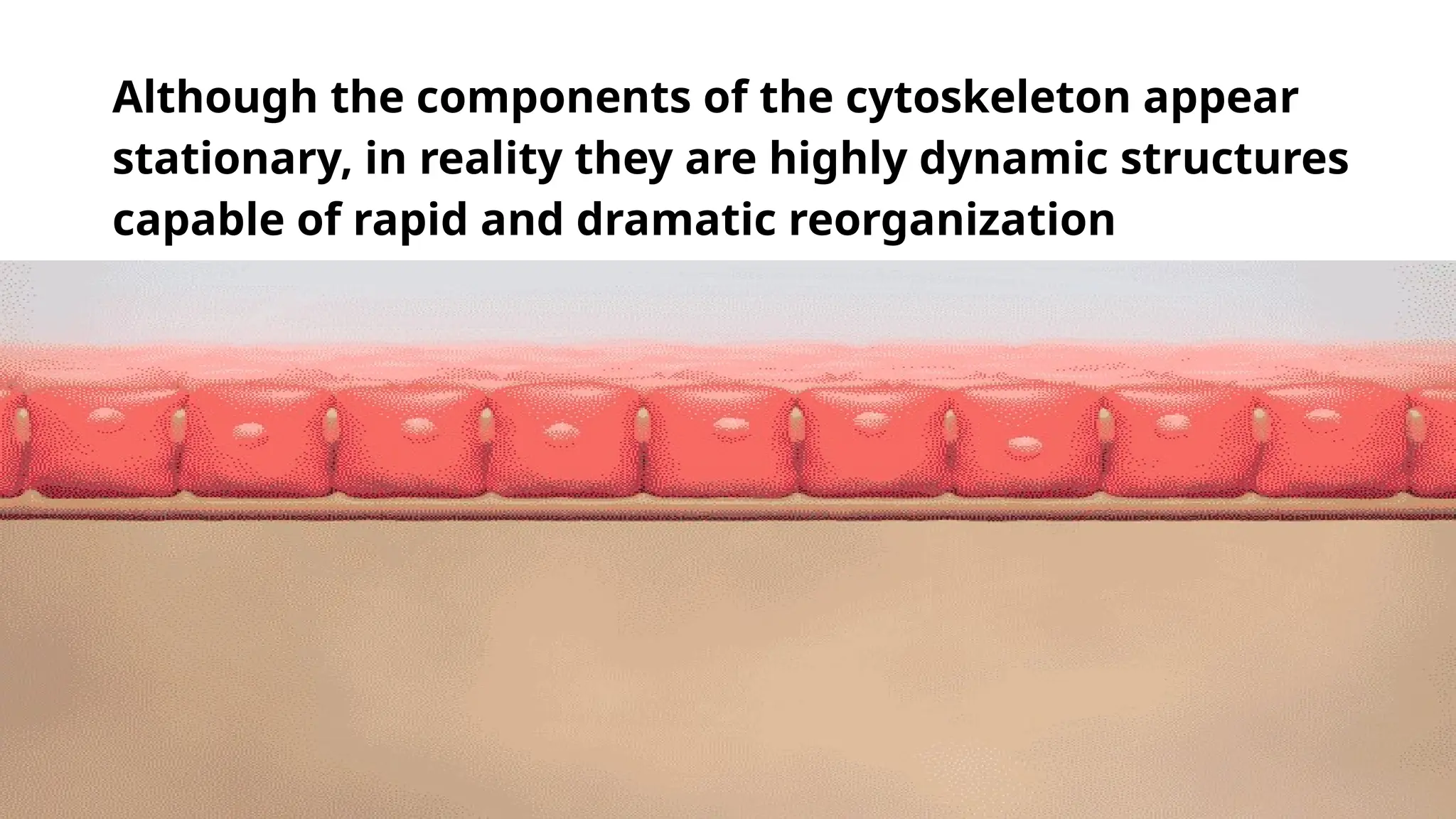
Although the components of the cytoskeleton appear
stationary, in reality they are highly dynamic structures
capable of rapid and dramatic reorganization
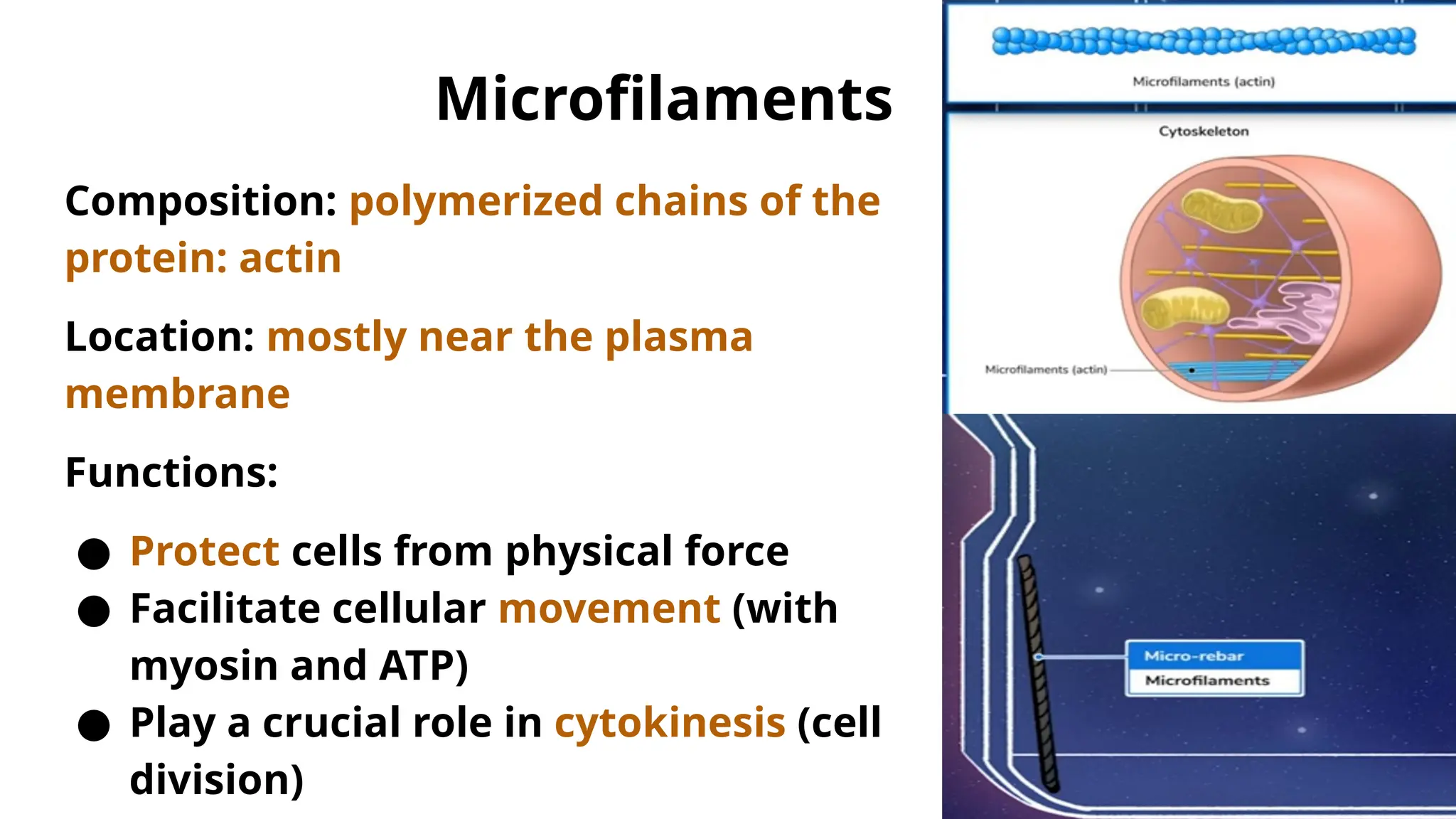
Microfilaments
Composition: polymerized chains of the
protein: actin
Location: mostly near the plasma
membrane
Functions:
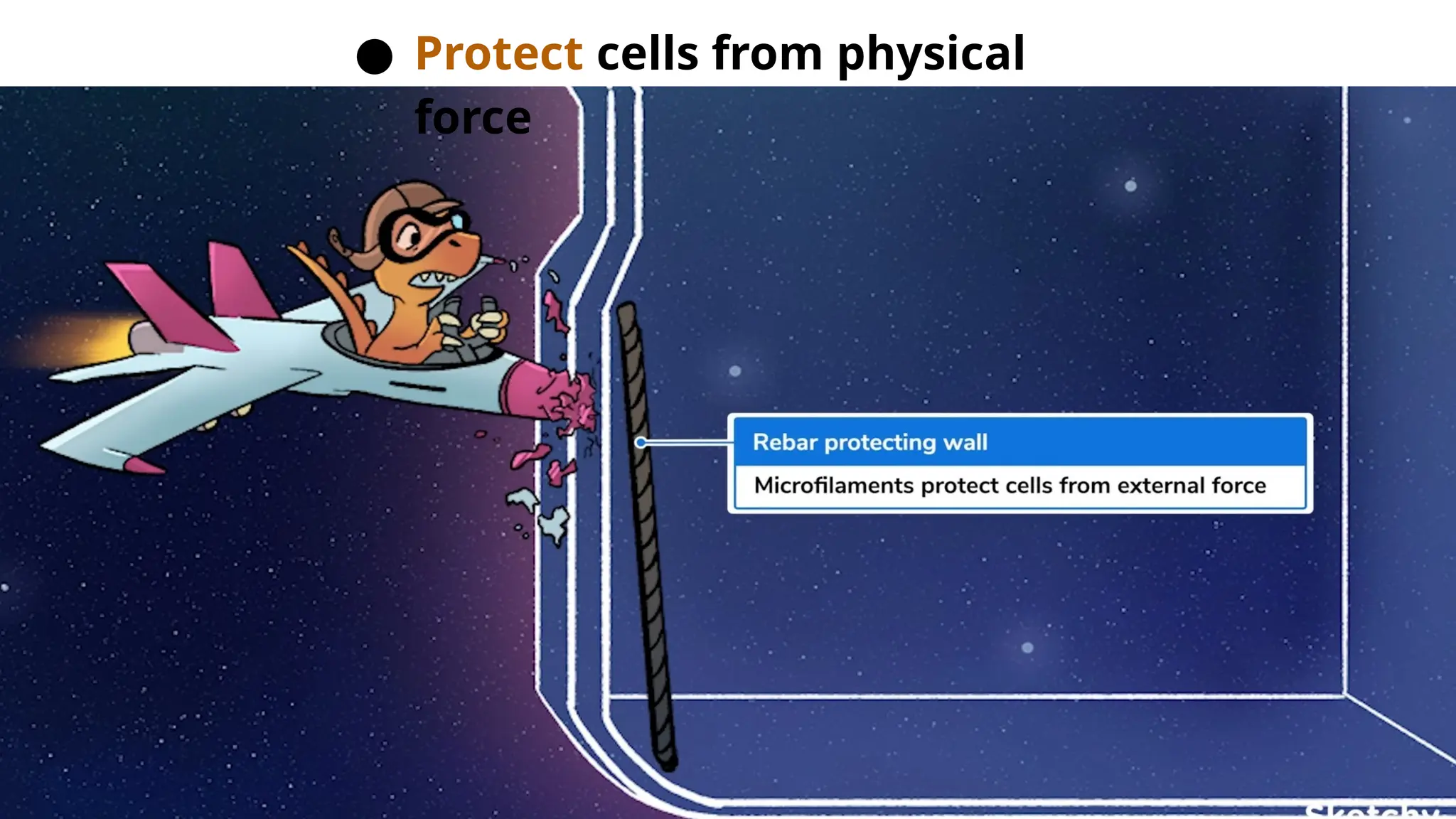
● Protect cells from physical force
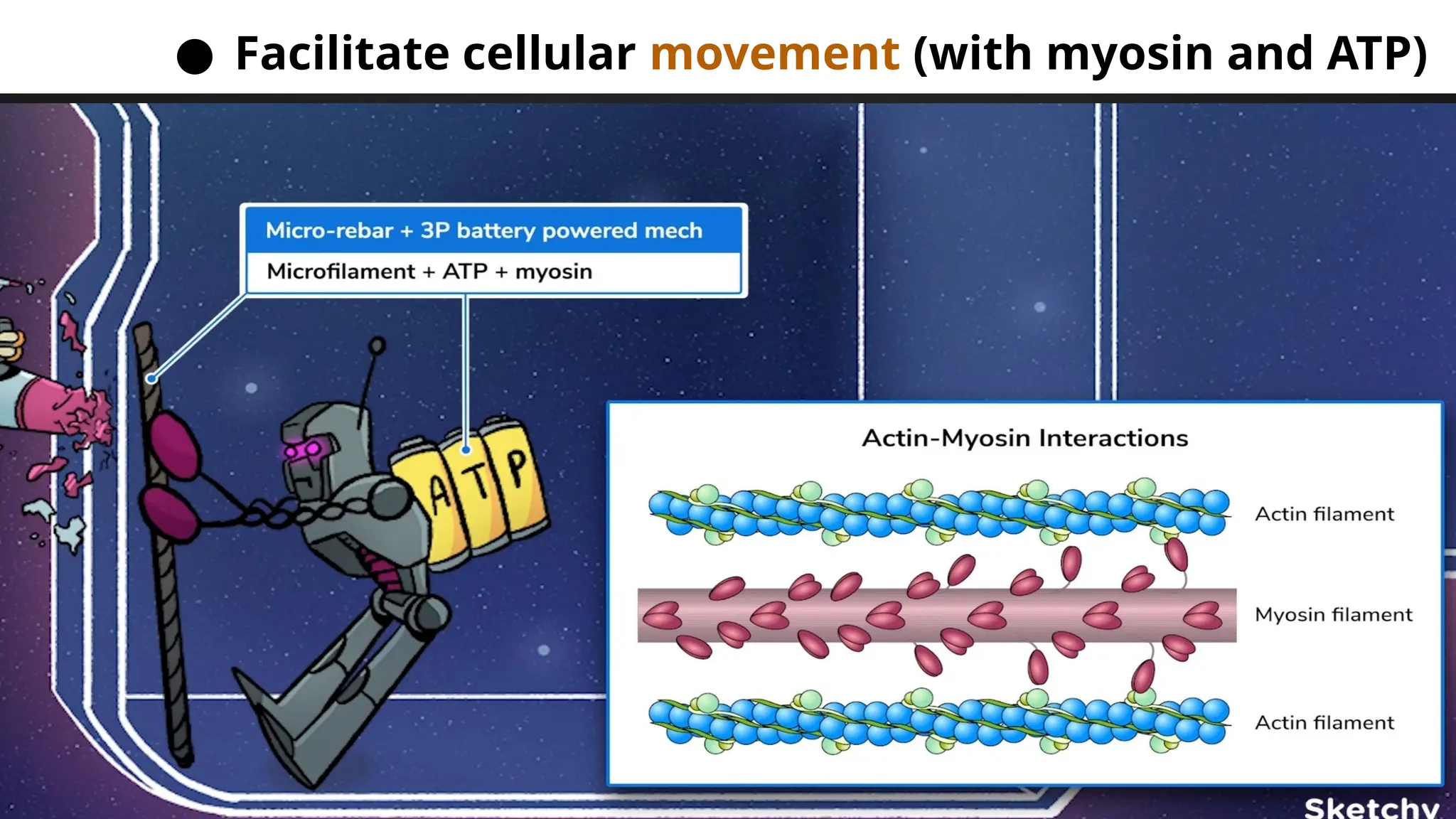
● Facilitate cellular movement (with
myosin and ATP)
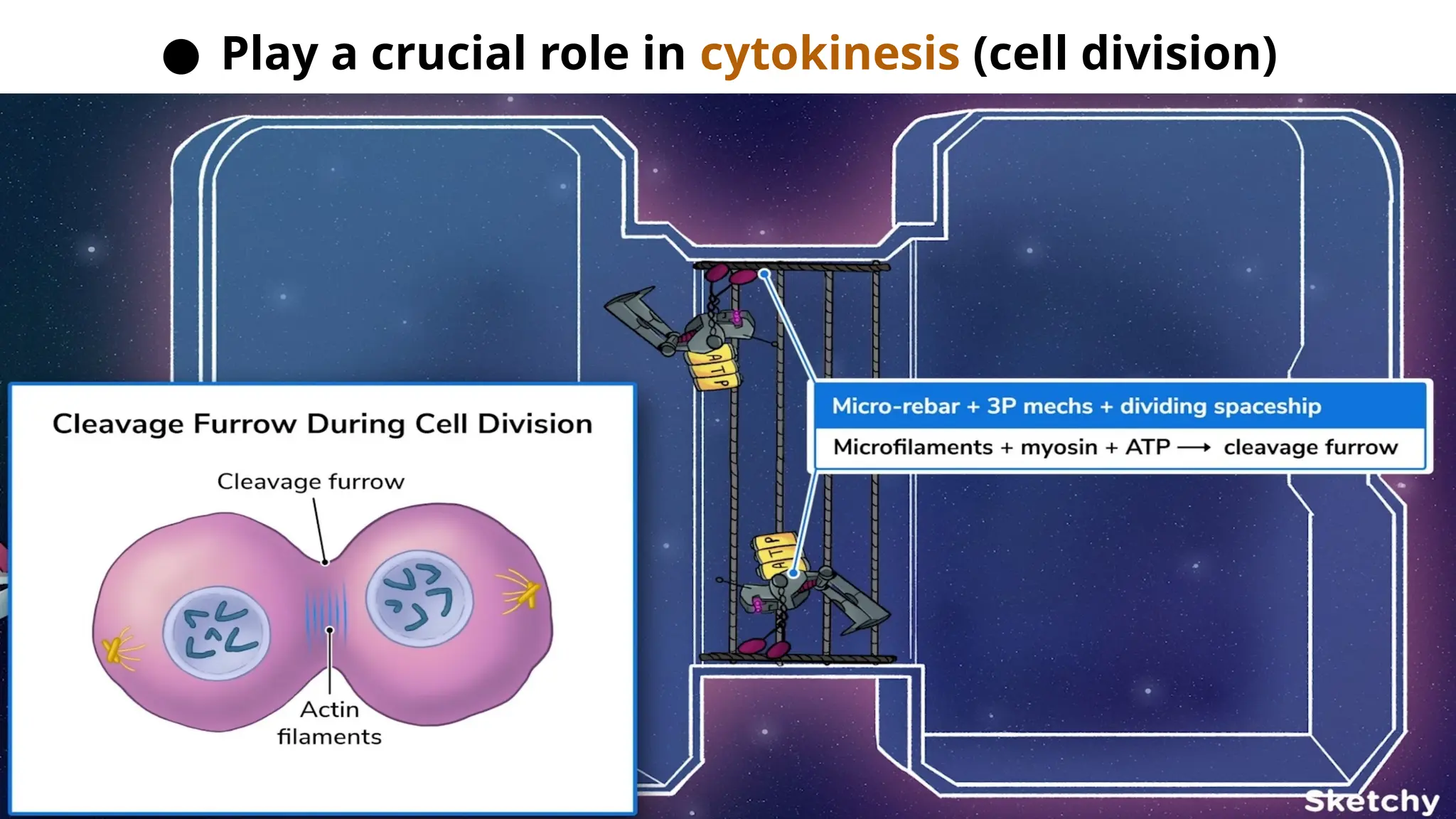
● Play a crucial role in cytokinesis (cell
division)
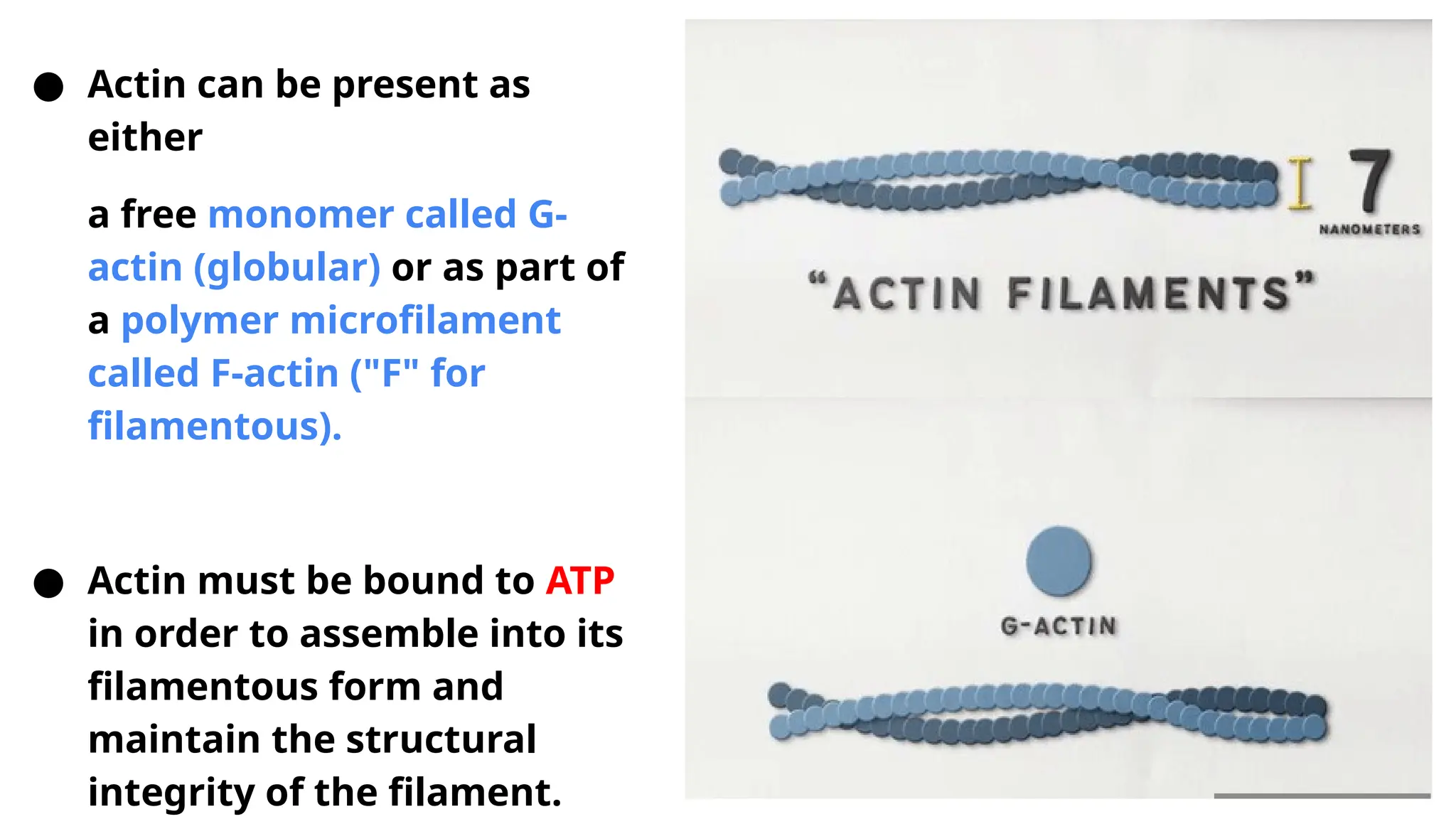
● Actin can be present as
either
a free monomer called G-
actin (globular) or as part of
a polymer microfilament
called F-actin ("F" for
filamentous).
● Actin must be bound to ATP
in order to assemble into its
filamentous form and
maintain the structural
integrity of the filament.
● The actin filament itself has structural polarity
Polarity here refers to the fact that there are two distinct ends to
the filament.
These ends are called the "(-)" end and the "(+)" end.
At the "(+)" end, actin subunits are adding onto the elongating
filament and at the "(-)" end, actin subunits are disassembling or
falling off of the filament.
This process of assembly and disassembly is controlled by the ATP
to ADP ratio in the cytoplasm.
● Protect cells from physical
force
● Facilitate cellular movement (with myosin and ATP)
● Play a crucial role in cytokinesis (cell division)
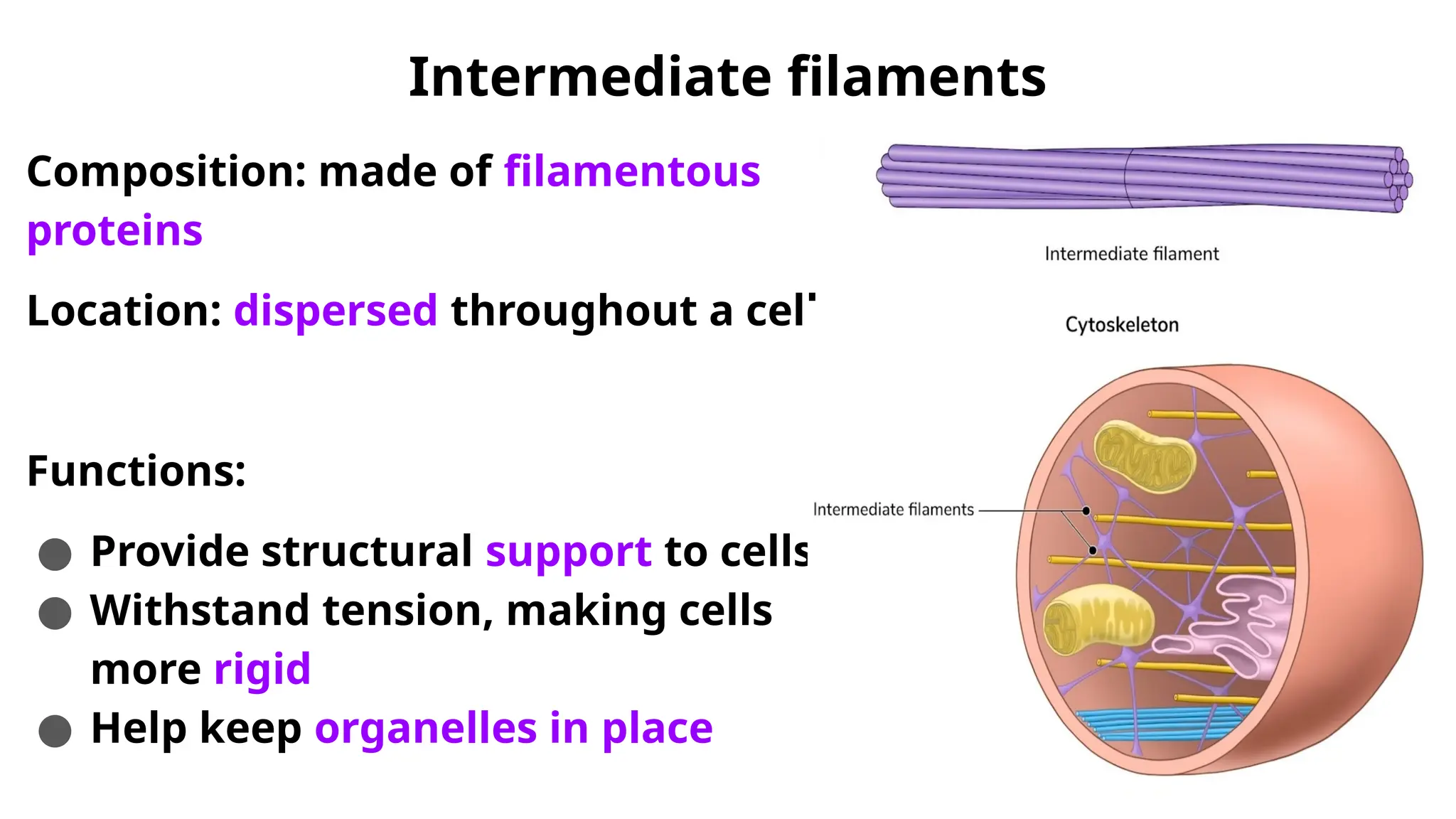
Intermediate filaments
Composition: made of filamentous
proteins
Location: dispersed throughout a cell
Functions:
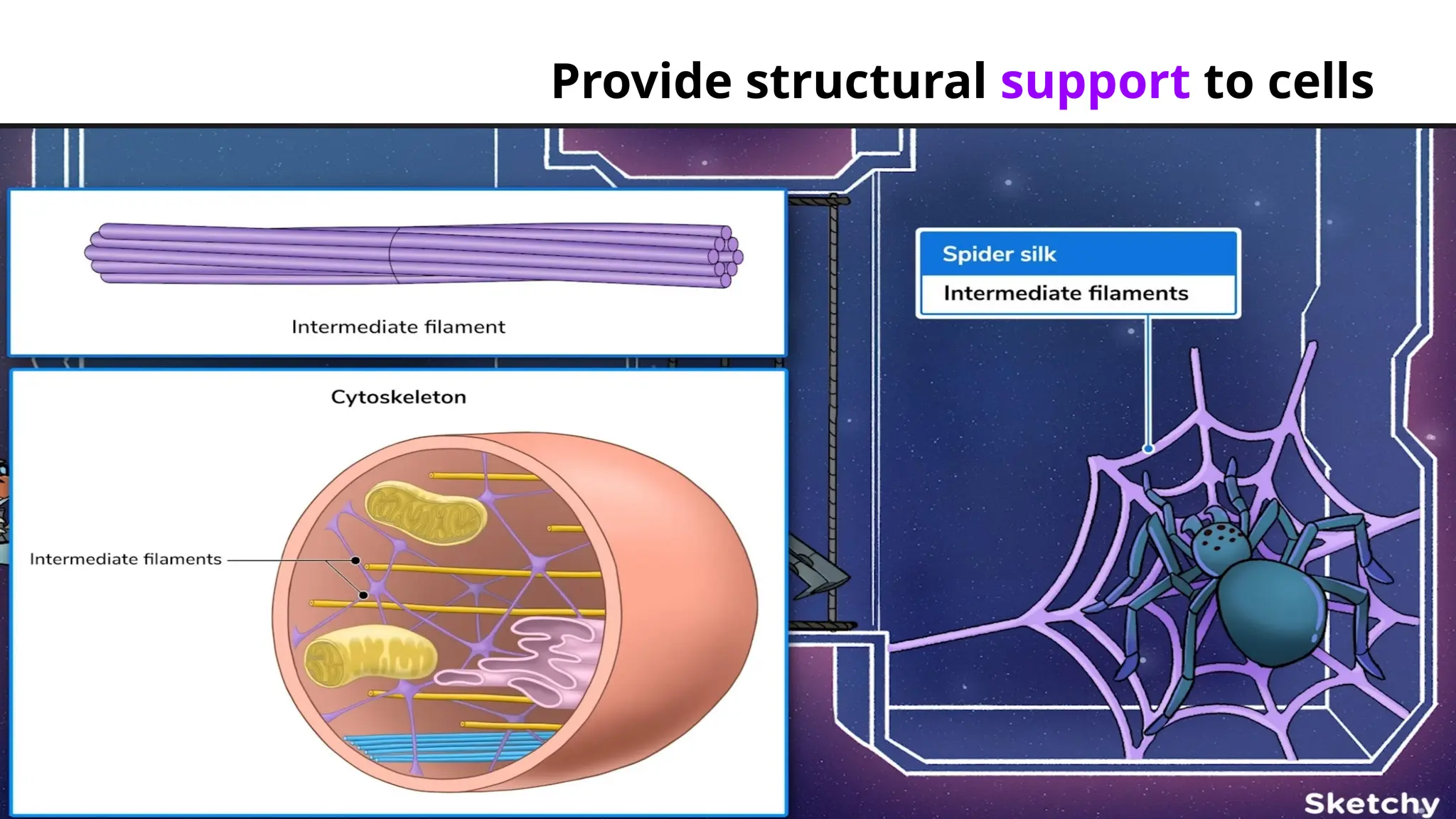
● Provide structural support to cells
● Withstand tension, making cells
more rigid
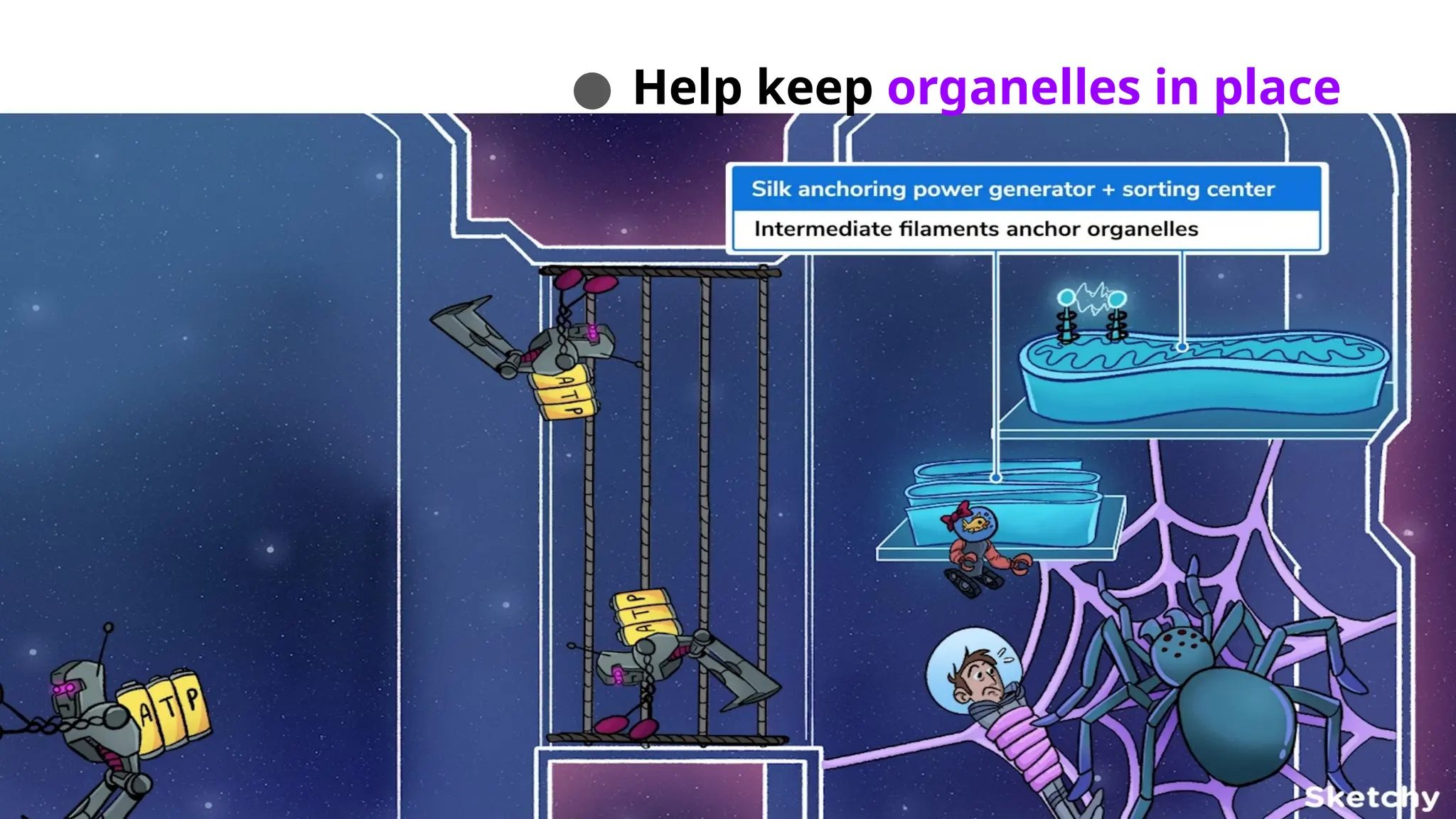
● Help keep organelles in place
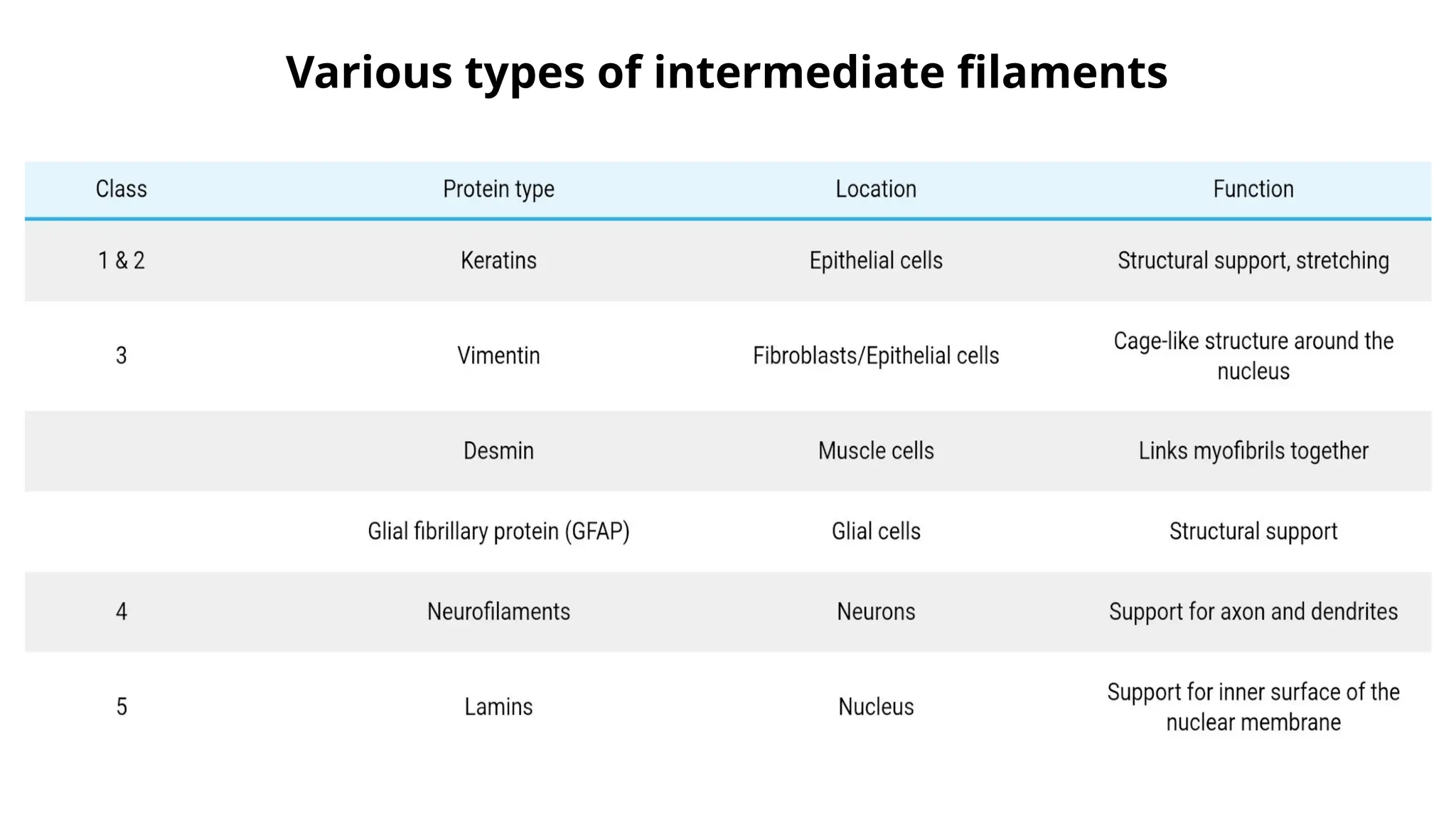
Various types of intermediate filaments
Provide structural support to cells
● Help keep organelles in place
Microtubules
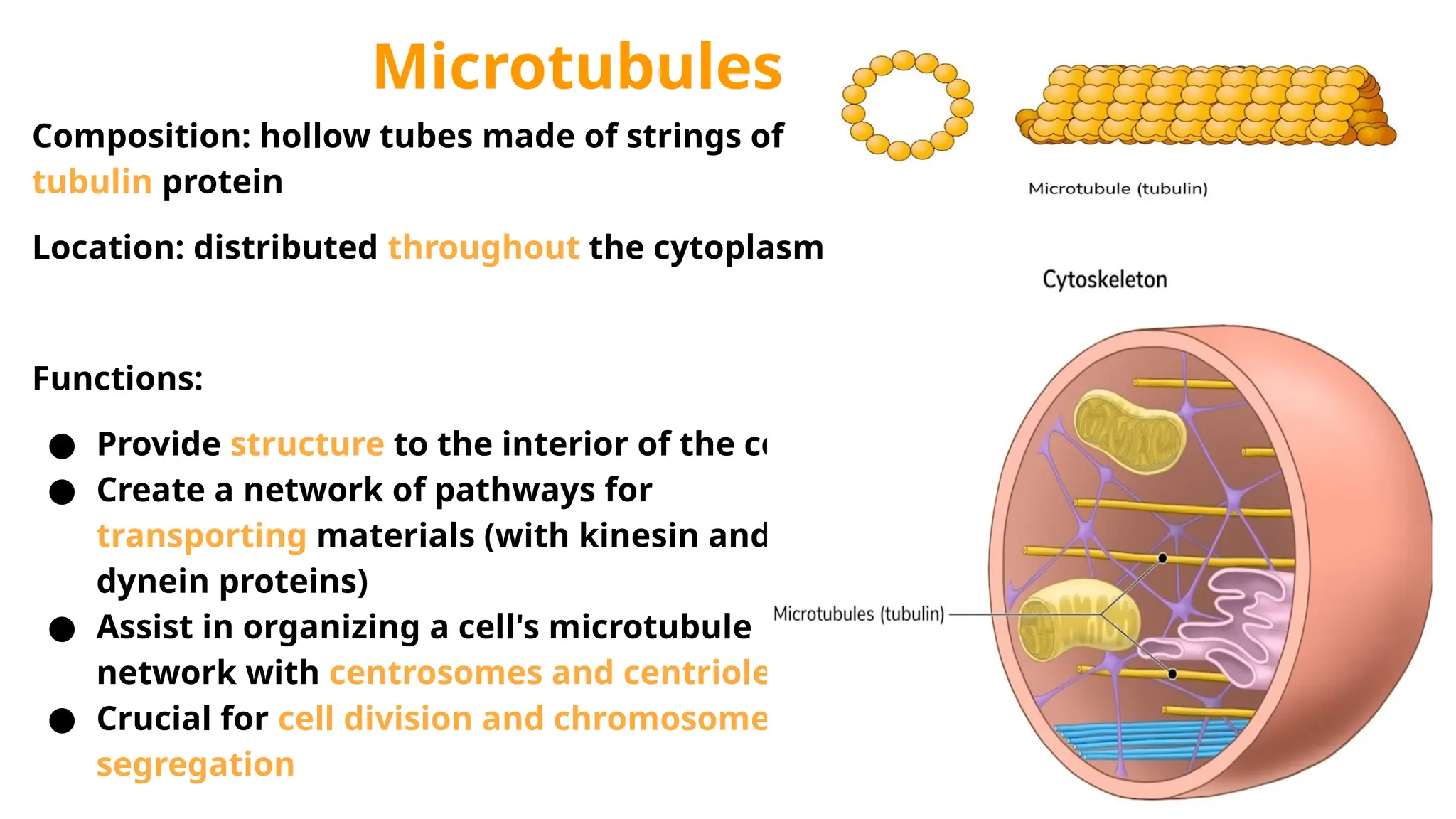
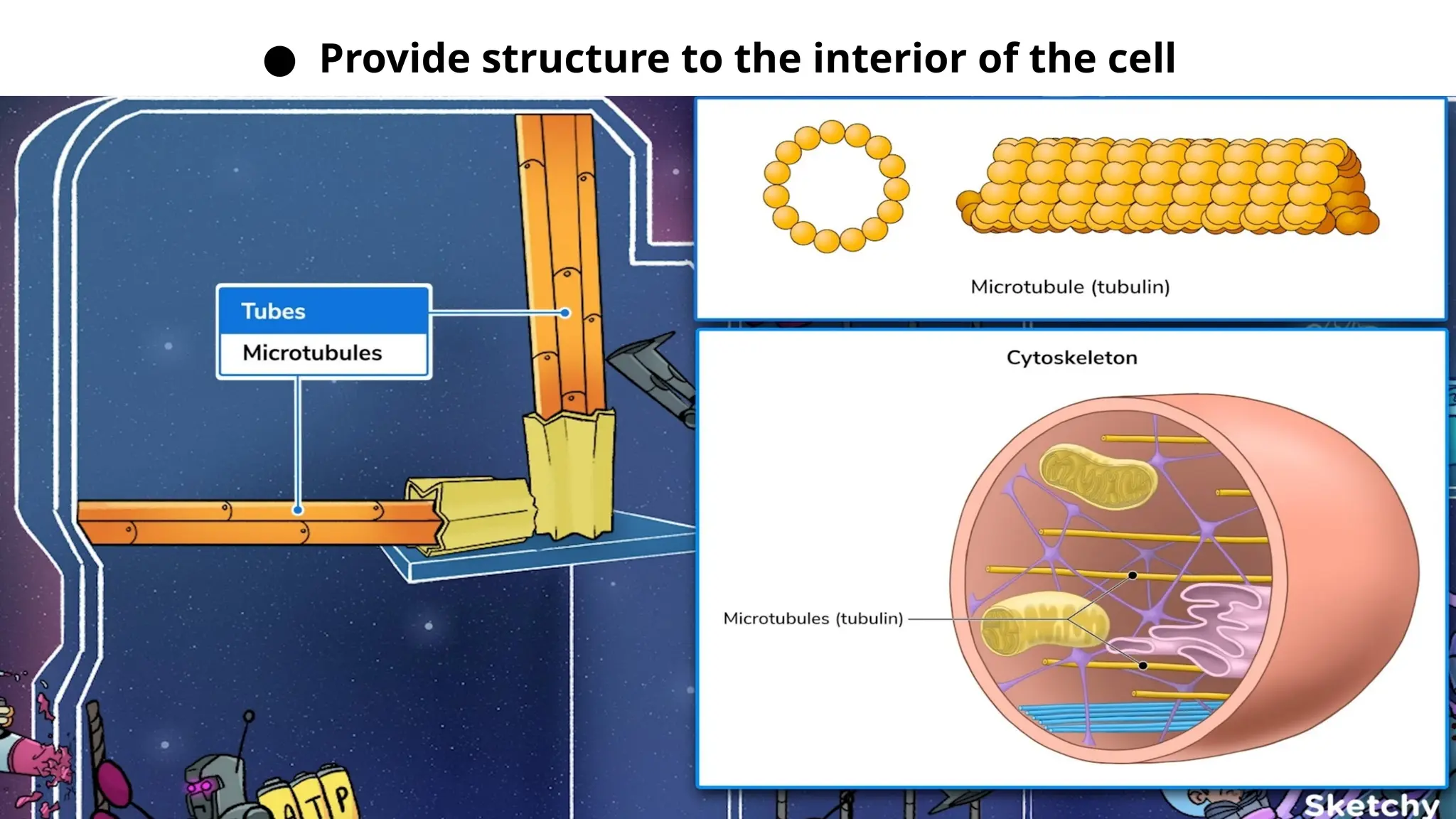
Composition: hollow tubes made of strings of
tubulin protein
Location: distributed throughout the cytoplasm
Functions:
● Provide structure to the interior of the cell
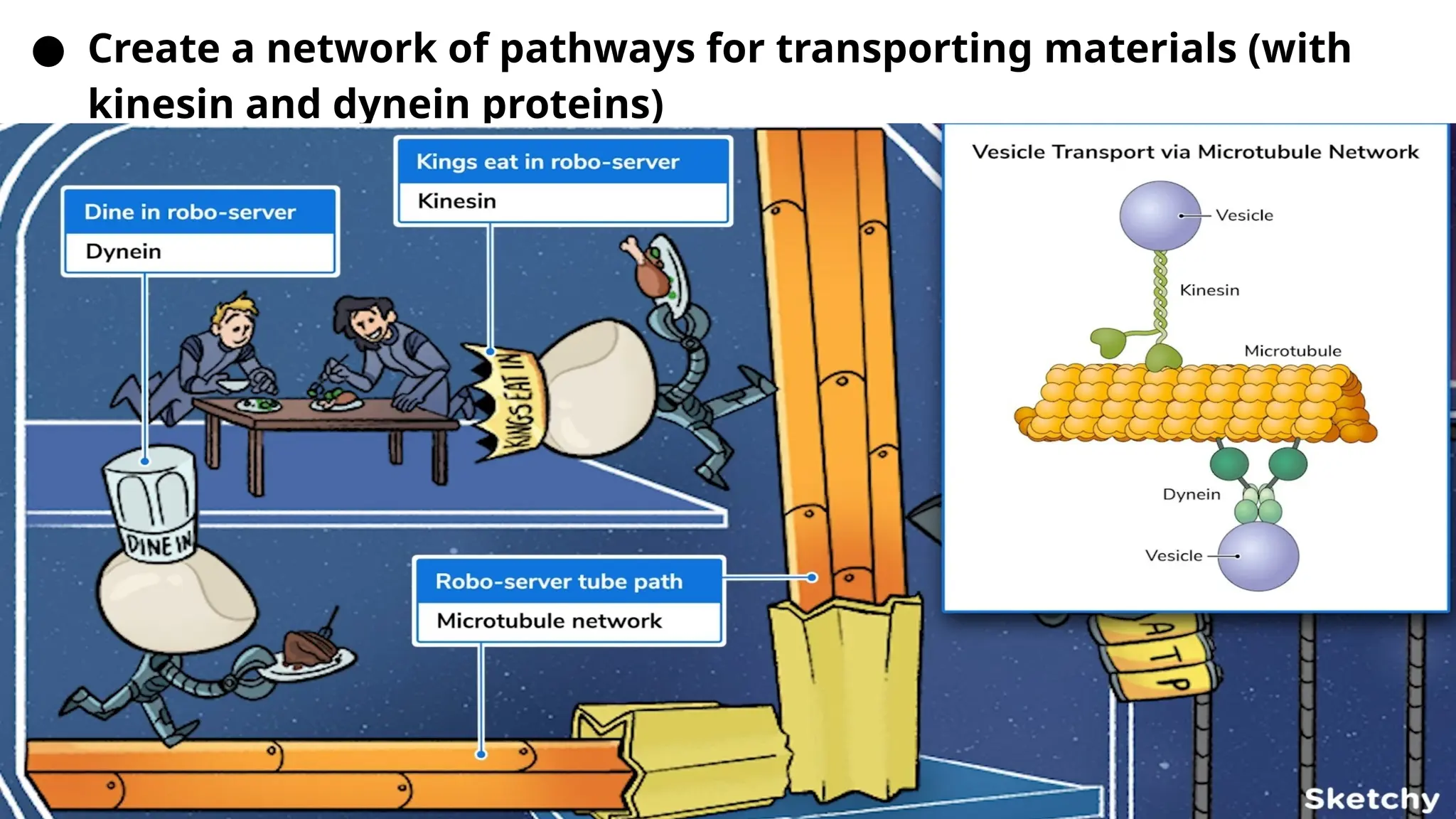
● Create a network of pathways for
transporting materials (with kinesin and
dynein proteins)
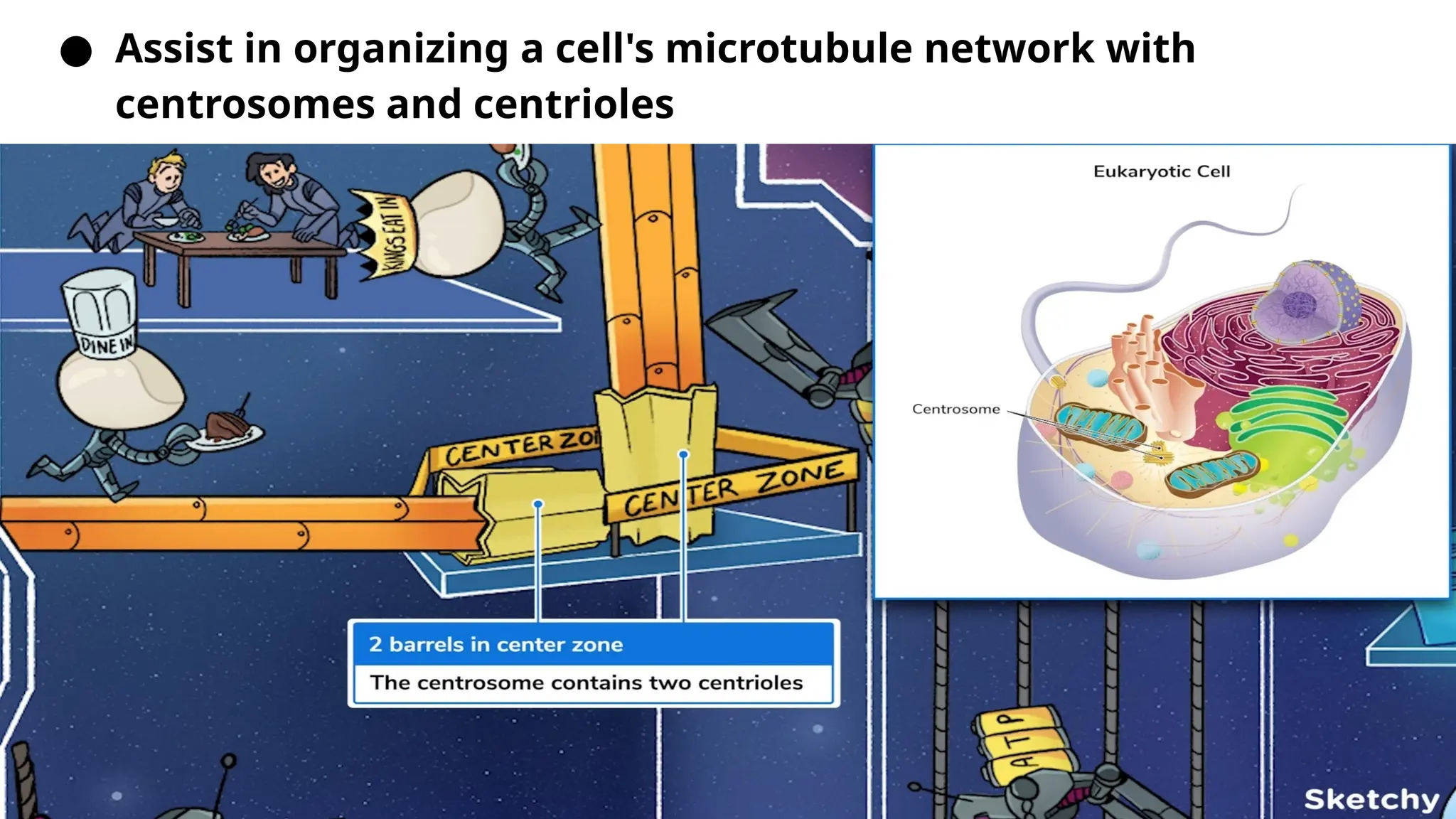
● Assist in organizing a cell's microtubule
network with centrosomes and centrioles
● Crucial for cell division and chromosome
segregation
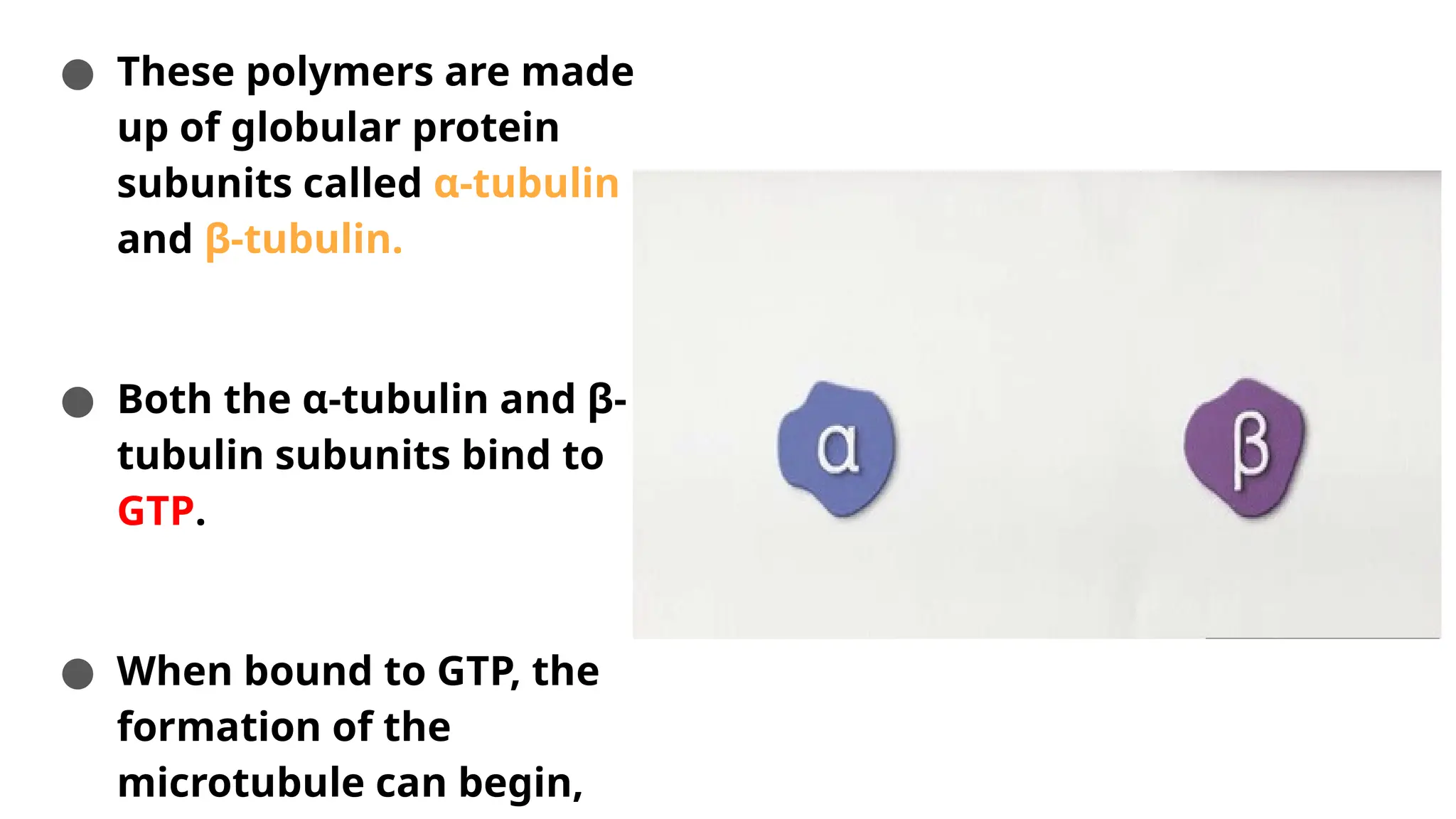
● These polymers are made
up of globular protein
subunits called α-tubulin
and β-tubulin.
● Both the α-tubulin and β-
tubulin subunits bind to
GTP.
● When bound to GTP, the
formation of the
microtubule can begin,
● As more GTP tubulin dimers assemble onto the
filament, GTP is slowly hydrolyzed by β-tubulin to
form GDP.
● Tubulin bound to GDP is less structurally robust and
can lead to disassembly of the microtubule.
● Provide structure to the interior of the cell
● Create a network of pathways for transporting materials (with
kinesin and dynein proteins)
● Assist in organizing a cell's microtubule network with
centrosomes and centrioles
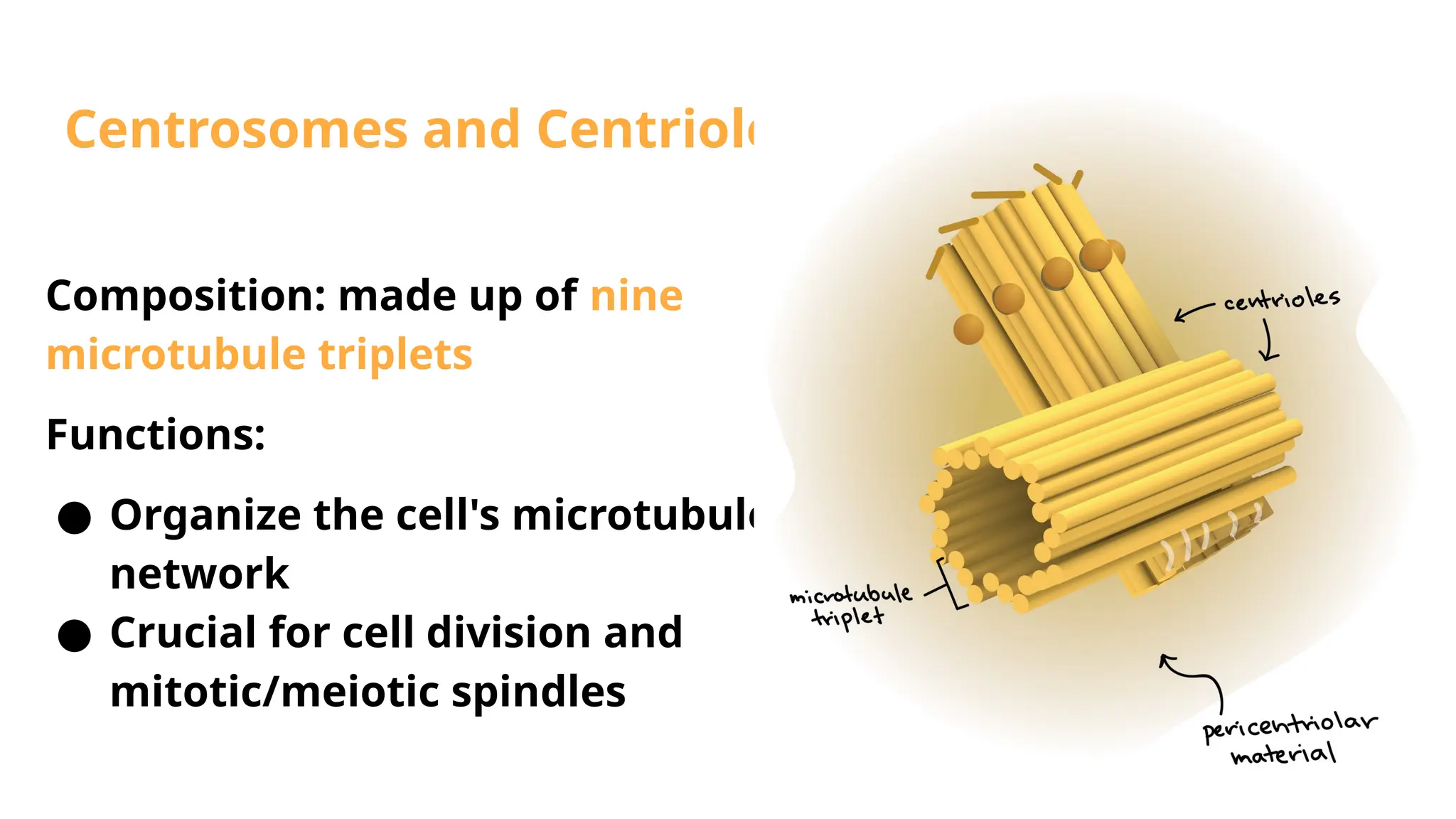
Centrosomes and Centrioles
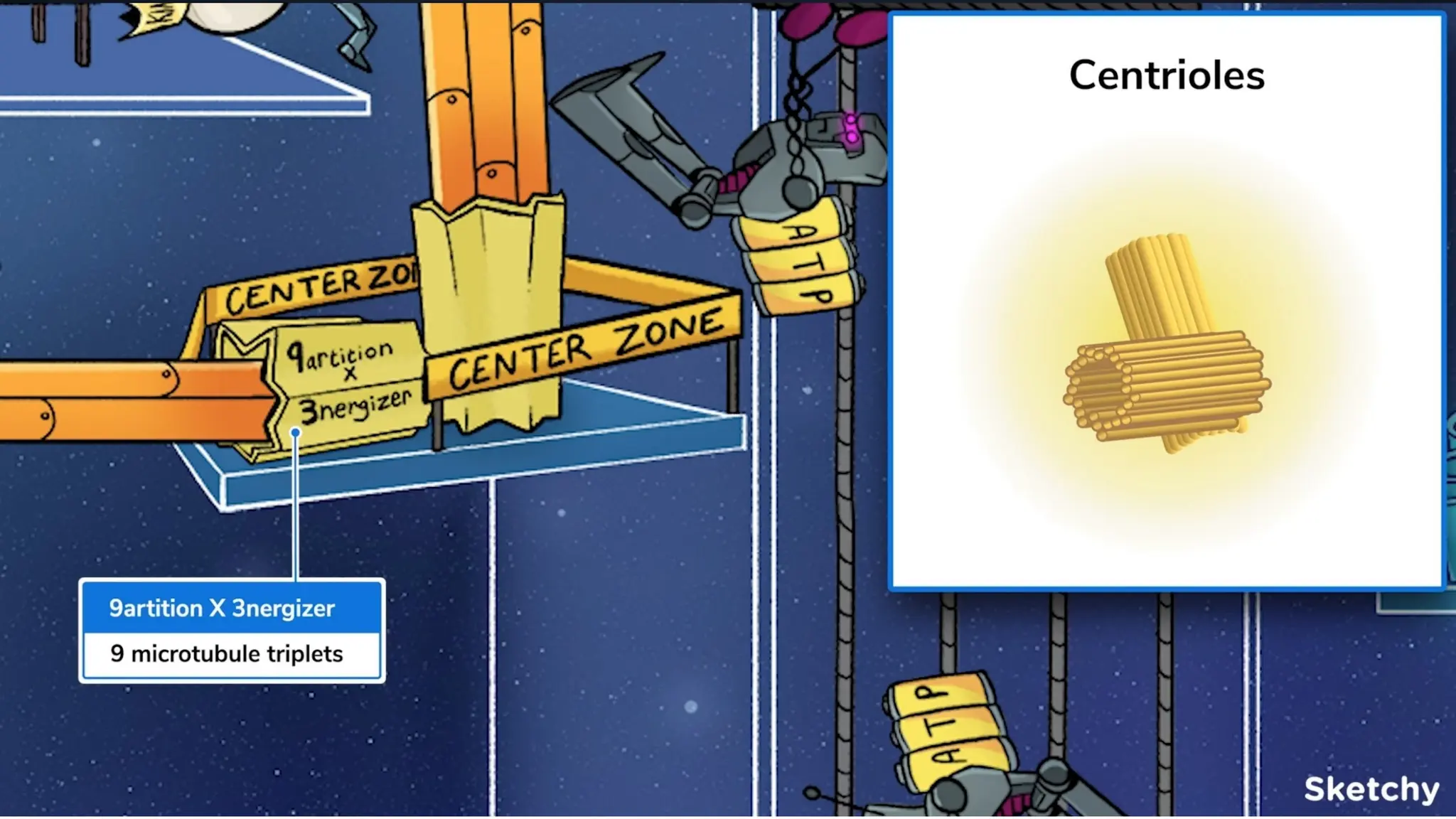
Composition: made up of nine
microtubule triplets
Functions:
● Organize the cell's microtubule
network
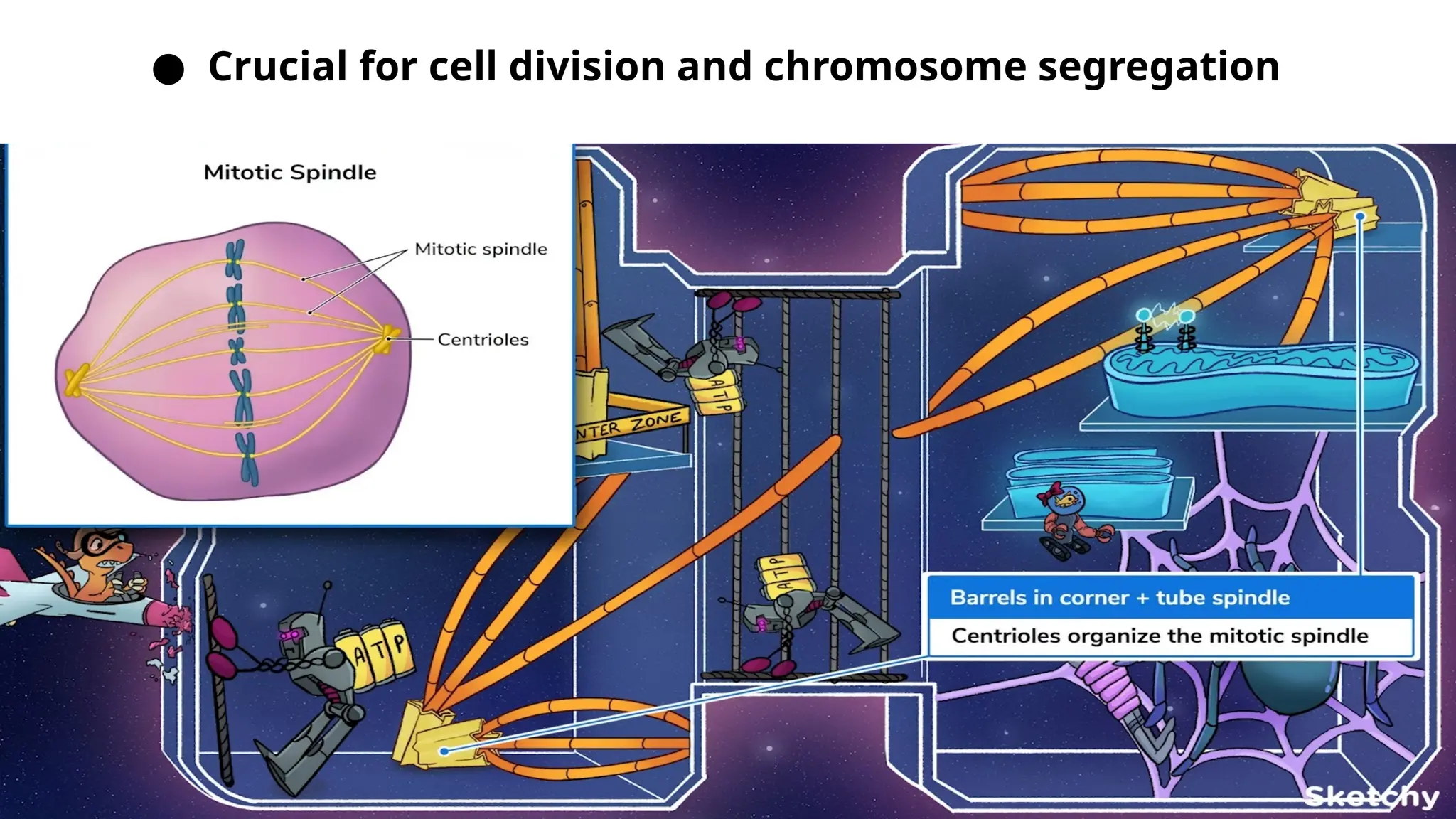
● Crucial for cell division and
mitotic/meiotic spindles
● centrosomes, structures that act as microtubule organizing
centers in animal cells.
● A centrosome consists of two centrioles oriented at right
angles to each other, surrounded by a mass of "pericentriolar
material," which provides anchoring sites for microtubules
● The centrosome is duplicated before a cell divides, and the
paired centrosomes seem to play a role in organizing the
microtubules that separate chromosomes during cell
division.
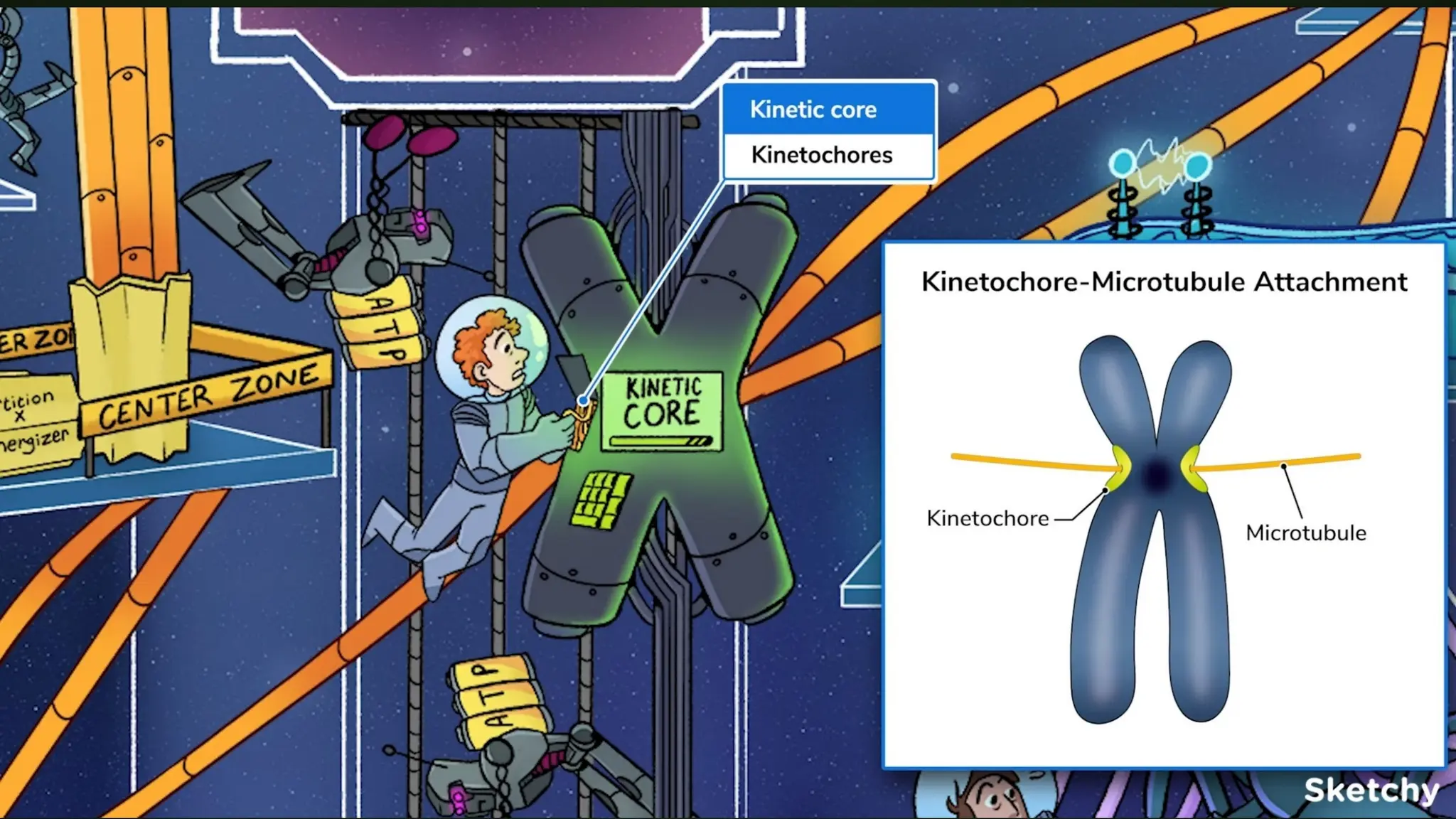
● Crucial for cell division and chromosome segregation
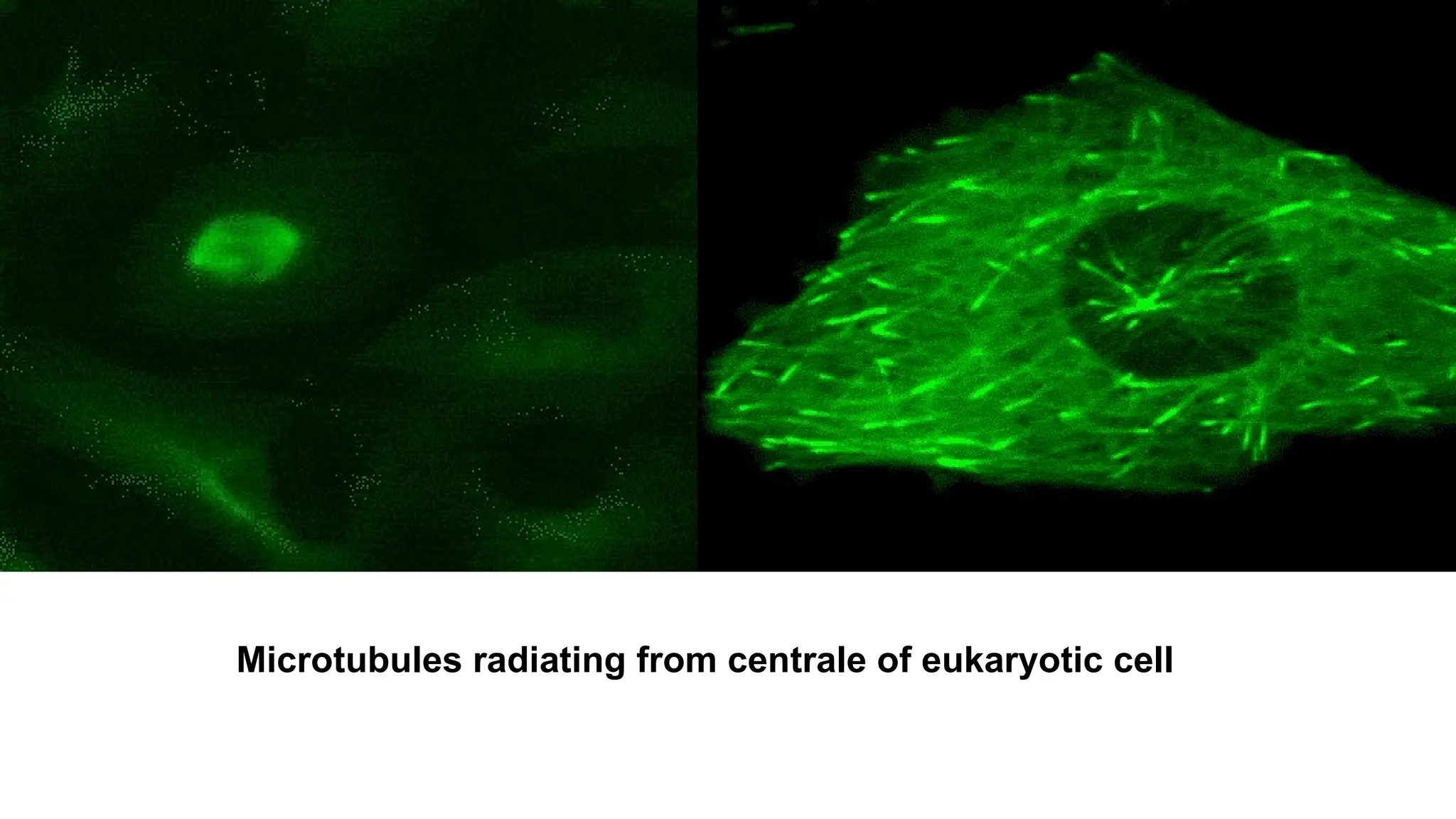
Microtubules radiating from centrale of eukaryotic cell
Motile structures (cilia and flagella)
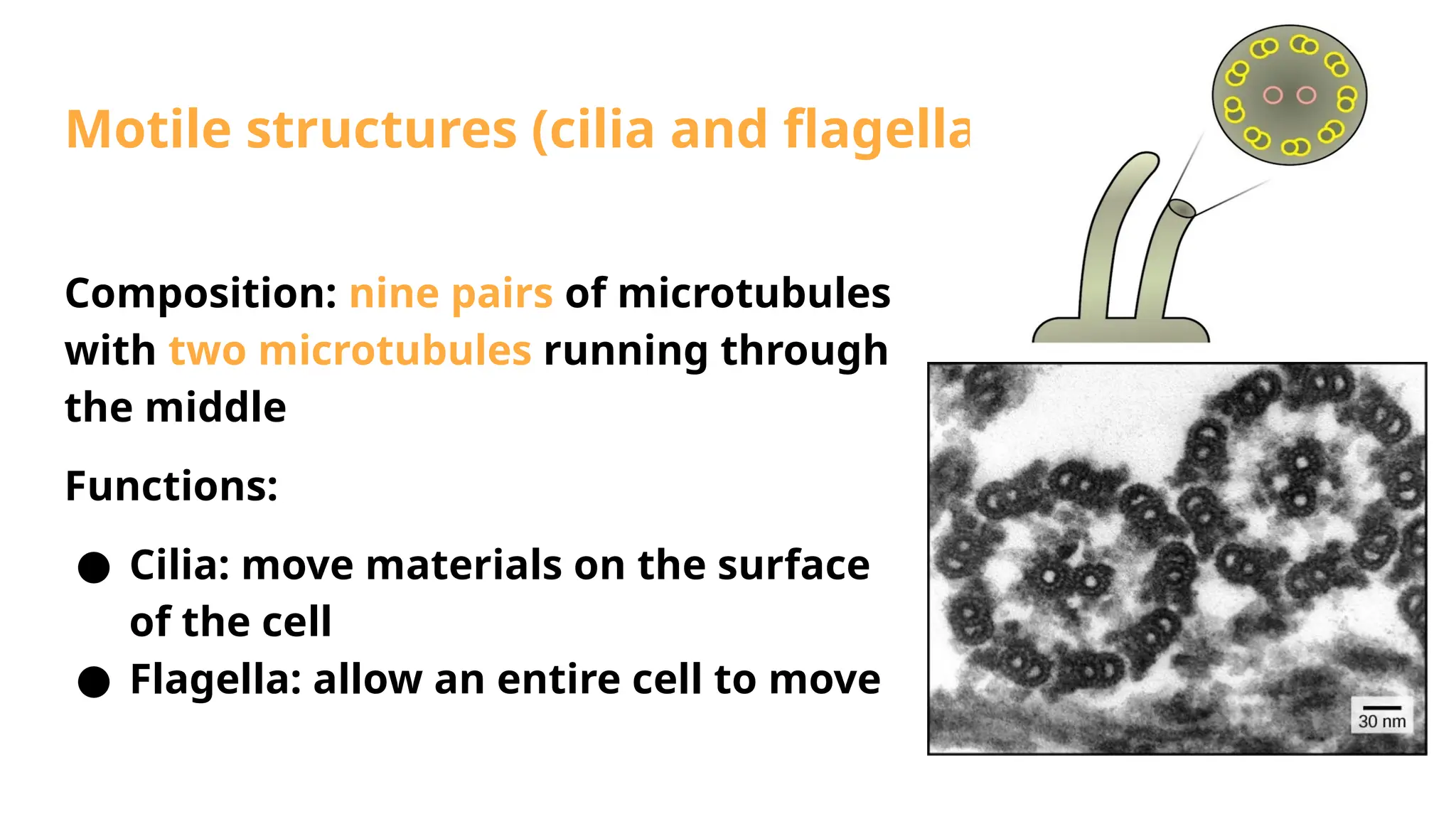
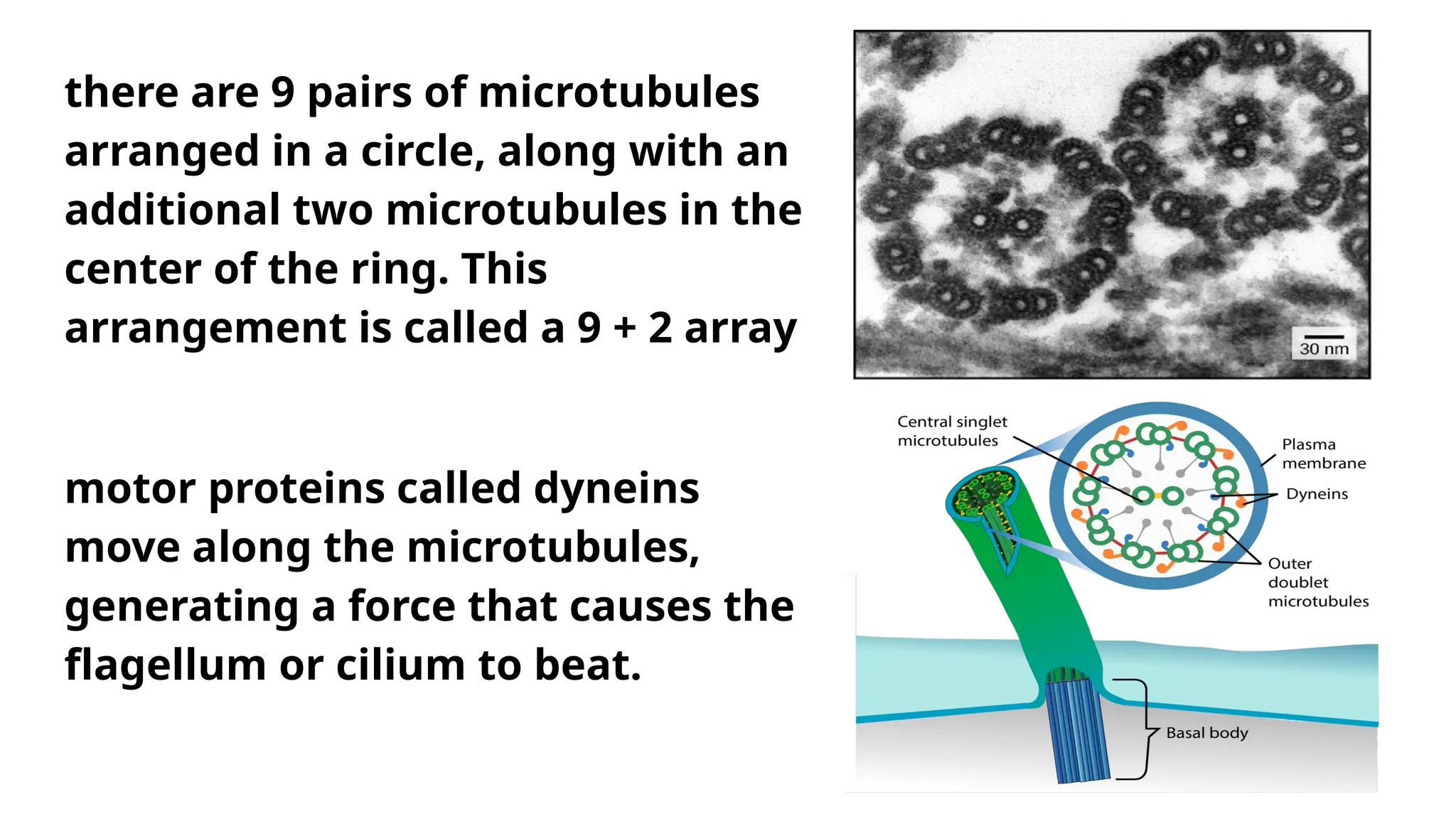
Composition: nine pairs of microtubules
with two microtubules running through
the middle
Functions:
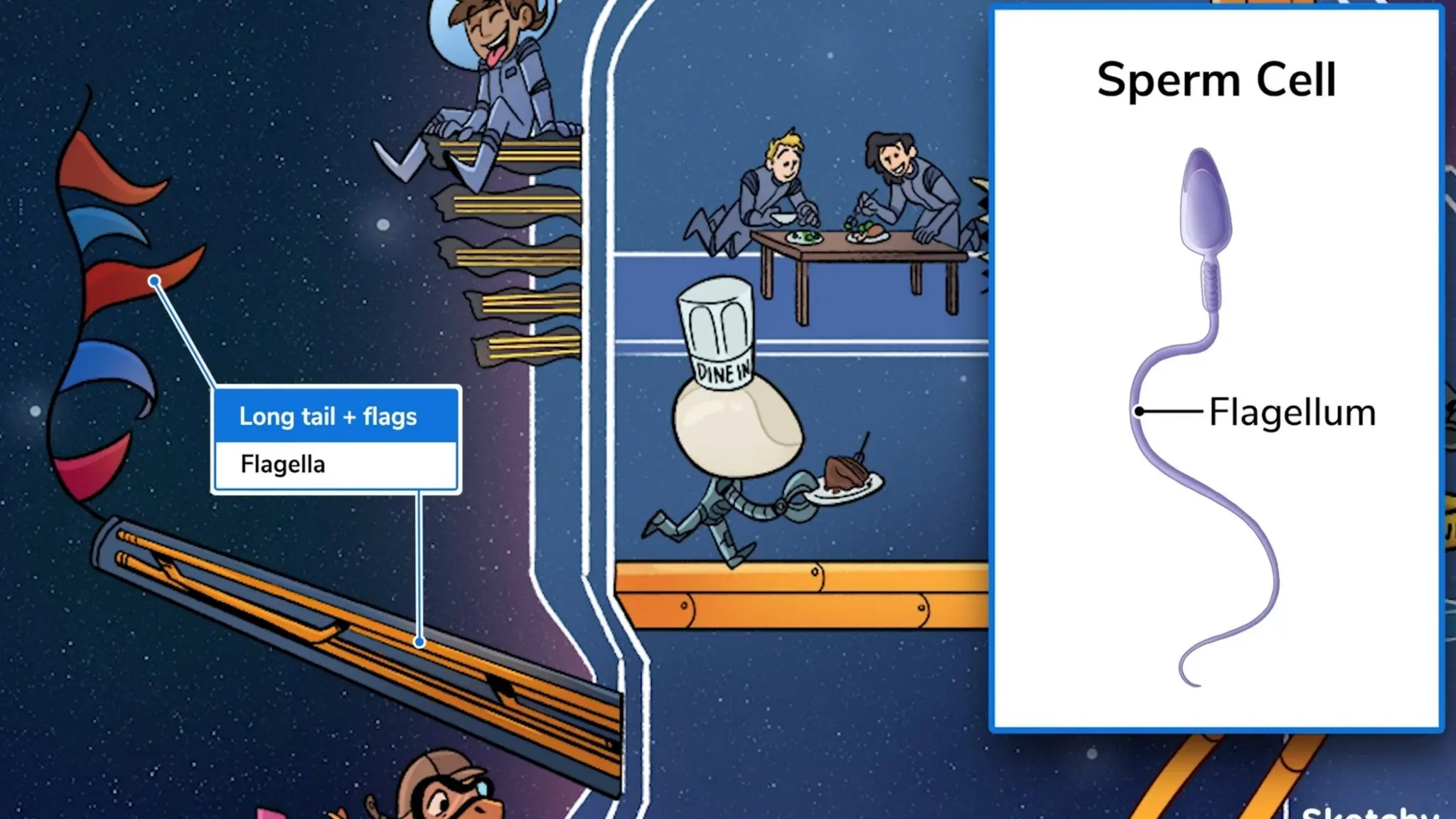
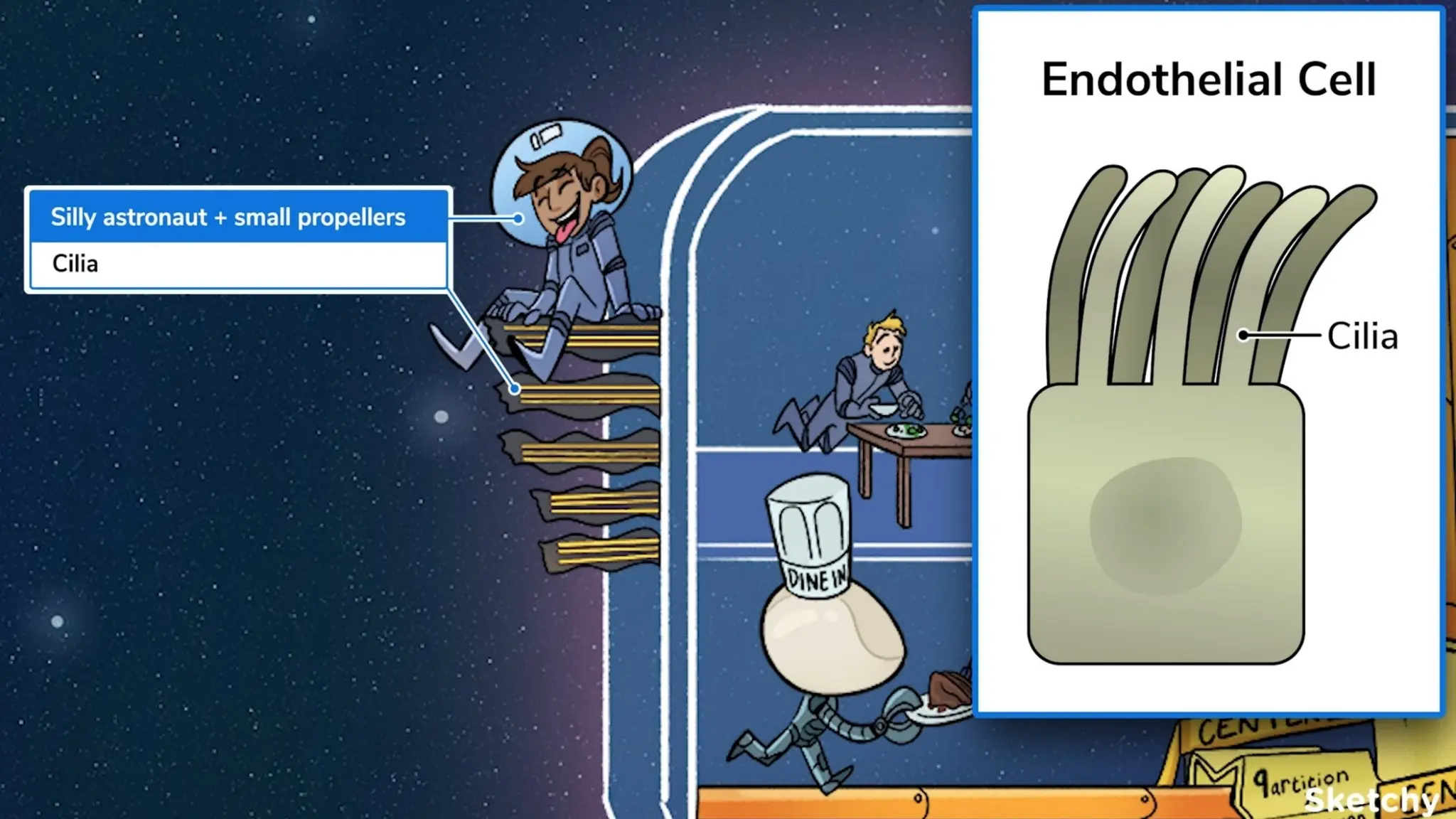
● Cilia: move materials on the surface
of the cell
● Flagella: allow an entire cell to move
there are 9 pairs of microtubules
arranged in a circle, along with an
additional two microtubules in the
center of the ring. This
arrangement is called a 9 + 2 array
motor proteins called dyneins
move along the microtubules,
generating a force that causes the
flagellum or cilium to beat.
Thank you

Cell membrane organelles cytoskeleton structure and function

  • 1.
    Structural framework ofa cell G.Keertana Tutor Department of biochemistry
  • 2.
    Time to think…. 1.How can the cell purposely move and control the location of materials between these organelles? 2. How can a eukaryotic cell transport compounds from their place of origin (in most cases the cyotoplasm) to where they are needed (perhaps the nucleus, the mitochondria, or the cell surface)?
  • 3.
    ● One possiblesolution is for the cell to create a network that can connect all the different parts of the cell together ● we can use a map to determine the direction we need to travel and roads to connect and travel from home to campus. ● Likewise, an interconnecting network inside the cell can be used to direct and move compounds from one location to a final destination
  • 5.
    Intracellular network ● Needsto be extensive, and connect every area of the cell. ● Needs to be flexible, able to change and adapt as the cell grows larger, divides into two cells, or physically moves from one environment to another. ● Needs to be strong, able to hold up to mechanical pressure from inside the cell or from outside of the cell.
  • 6.
    Intracellular network ● Needsto be composed of different fibers and each of these fibers needs to be for a specific connection in the cell. For example, certain fibers might be involved in holding organelles in place, and other fibers would be involved in connecting two different organelles. ● The fibers need to have directionality (or polarity), meaning they need to have a defined starting point and a defined end to help direct movement from one location to another. ● The fibers need to work with proteins that can convert chemical energy into kinetic energy, to actively transport compounds along the fibers.
  • 7.
    The skeleton ofa vertebrate is a familiar organ system consisting of hardened elements that support the soft tissues of the body and play a key role in mediating bodily movements.
  • 8.
    Eukaryotic cells also possess a “skeletal system”– a cytoskelet on –which has analogous functions. The answer is Cyto skeleton…
  • 9.
    Functions of Cyto-Skeleton ●Providing structural support that can determine the shape of the cell and resist forces that tend to deform it. ● An internal framework responsible for positioning the various organelles within the interior of the cell. ● A network of highways that direct the movement of materials and organelles with cells Eg: delivery of mRNA molecules to specific parts of a cell, the movement of membranous carriers from the endoplasmic reticulum to the Golgi complex, and the transport of vesicles containing neurotransmitters down the length of a nerve cell.
  • 10.
    Functions of Cyto-Skeleton ●The force generating apparatus that moves cells from one place to another. ● A site for anchoring mRNAs and facilitating their translation into polypeptides. ● An essential component of the cell’s division machinery. ● Cytoskeletal elements make up the apparatus responsible for separating the chromosomes during mitosis and meiosis and for splitting the parent cell into two daughter cells during cytokinesis.
  • 11.
    ● The cytoskeleton(CSK) is composed of three well-defined filamentous structures- ● microtubules, microfilaments, and intermediate filaments ● which together form an elaborate interactive network. ● Each of the three filaments is a polymer of protein subunits with distinct mechanical properties.
  • 12.
    ● Microfilaments aresolid, thinner structures composed of the globular proteins- actin. ● Microtubule are rigid tubes composed of subunits of the globular protein- tubulin. ● Intermediate filament are tough, rope like fibers composed of a variety of related proteins.
  • 13.
    Although the componentsof the cytoskeleton appear stationary, in reality they are highly dynamic structures capable of rapid and dramatic reorganization
  • 14.
    Microfilaments Composition: polymerized chainsof the protein: actin Location: mostly near the plasma membrane Functions: ● Protect cells from physical force ● Facilitate cellular movement (with myosin and ATP) ● Play a crucial role in cytokinesis (cell division)
  • 15.
    ● Actin canbe present as either a free monomer called G- actin (globular) or as part of a polymer microfilament called F-actin ("F" for filamentous). ● Actin must be bound to ATP in order to assemble into its filamentous form and maintain the structural integrity of the filament.
  • 16.
    ● The actinfilament itself has structural polarity Polarity here refers to the fact that there are two distinct ends to the filament. These ends are called the "(-)" end and the "(+)" end. At the "(+)" end, actin subunits are adding onto the elongating filament and at the "(-)" end, actin subunits are disassembling or falling off of the filament. This process of assembly and disassembly is controlled by the ATP to ADP ratio in the cytoplasm.
  • 18.
    ● Protect cellsfrom physical force
  • 19.
    ● Facilitate cellularmovement (with myosin and ATP)
  • 20.
    ● Play acrucial role in cytokinesis (cell division)
  • 21.
    Intermediate filaments Composition: madeof filamentous proteins Location: dispersed throughout a cell Functions: ● Provide structural support to cells ● Withstand tension, making cells more rigid ● Help keep organelles in place
  • 22.
    Various types ofintermediate filaments
  • 23.
  • 24.
    ● Help keeporganelles in place
  • 25.
    Microtubules Composition: hollow tubesmade of strings of tubulin protein Location: distributed throughout the cytoplasm Functions: ● Provide structure to the interior of the cell ● Create a network of pathways for transporting materials (with kinesin and dynein proteins) ● Assist in organizing a cell's microtubule network with centrosomes and centrioles ● Crucial for cell division and chromosome segregation
  • 26.
    ● These polymersare made up of globular protein subunits called α-tubulin and β-tubulin. ● Both the α-tubulin and β- tubulin subunits bind to GTP. ● When bound to GTP, the formation of the microtubule can begin,
  • 27.
    ● As moreGTP tubulin dimers assemble onto the filament, GTP is slowly hydrolyzed by β-tubulin to form GDP. ● Tubulin bound to GDP is less structurally robust and can lead to disassembly of the microtubule.
  • 28.
    ● Provide structureto the interior of the cell
  • 29.
    ● Create anetwork of pathways for transporting materials (with kinesin and dynein proteins)
  • 30.
    ● Assist inorganizing a cell's microtubule network with centrosomes and centrioles
  • 31.
    Centrosomes and Centrioles Composition:made up of nine microtubule triplets Functions: ● Organize the cell's microtubule network ● Crucial for cell division and mitotic/meiotic spindles
  • 32.
    ● centrosomes, structuresthat act as microtubule organizing centers in animal cells. ● A centrosome consists of two centrioles oriented at right angles to each other, surrounded by a mass of "pericentriolar material," which provides anchoring sites for microtubules ● The centrosome is duplicated before a cell divides, and the paired centrosomes seem to play a role in organizing the microtubules that separate chromosomes during cell division.
  • 34.
    ● Crucial forcell division and chromosome segregation
  • 36.
    Microtubules radiating fromcentrale of eukaryotic cell
  • 37.
    Motile structures (ciliaand flagella) Composition: nine pairs of microtubules with two microtubules running through the middle Functions: ● Cilia: move materials on the surface of the cell ● Flagella: allow an entire cell to move
  • 38.
    there are 9pairs of microtubules arranged in a circle, along with an additional two microtubules in the center of the ring. This arrangement is called a 9 + 2 array motor proteins called dyneins move along the microtubules, generating a force that causes the flagellum or cilium to beat.
  • 41.