Respiration
1
• Body cells and tissues need oxygen to live.
• Respiration is the process through which the oxygen needed for
living cells is entered into the lungs and then circulated
throughout the body.
• It has two stages:
‒ Inhalation
‒ Exhalation
Respiration Cycle
2
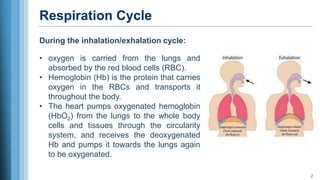
During the inhalation/exhalation cycle:
• oxygen is carried from the lungs and
absorbed by the red blood cells (RBC).
• Hemoglobin (Hb) is the protein that carries
oxygen in the RBCs and transports it
throughout the body.
• The heart pumps oxygenated hemoglobin
(HbO2) from the lungs to the whole body
cells and tissues through the circularity
system, and receives the deoxygenated
Hb and pumps it towards the lungs again
to be oxygenated.
Cell Respiration Formula
3
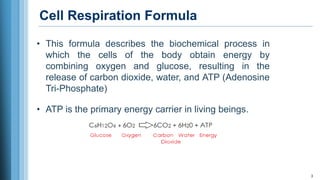
• This formula describes the biochemical process in
which the cells of the body obtain energy by
combining oxygen and glucose, resulting in the
release of carbon dioxide, water, and ATP (Adenosine
Tri-Phosphate)
• ATP is the primary energy carrier in living beings.
Respiration Rate
4
• The respiration rate is the number of
inhalation/exhalation cycles in a minute, defined as
breaths per minute and expressed as BPM.
• Normal respiration rate for adult healthy persons at
rest ranges from 12 to 20 BPM,
• For a new born (< 1 year), it ranges from 30 to 40
BPM.
• The lower or higher respiration rate, while resting, is
considered as being abnormal.
Respiration Rate Measurement
5
Respiration rate measurement is achieved through either
contact or contactless methods.
1) Contact measurement
• A physical electronic sensor is attached to the body
skin or tied to the patient clothes to sense the
motion of the chest.
• The resulting motion signal is then processed to
extract the respiration rate.
• These methods are not appropriate in some cases
such as sensitive or burned skin, or for premature
babies.
• In addition, contact sensors are less convenient
and more expensive.
Respiration Rate Measurement
6
2) Contactless measurement
• Contactless respiration methods involve computer vision techniques.
• Some examples include the tracking of contraction and expansion of
chest and abdomen region with each inhalation/exhalation cycle.
• Also, Tracking of temperature variations around the nose and mouth,
caused by air flow movement that could be captured using a thermal
camera.
• Contactless respiration rate monitoring is favorable to overcome the
issues related to attaching sensors to sensitive or burned skin, or
tying uncomfortable sensors to clothes.
• In addition, contactless techniques are proper solutions for sleeping-
related monitoring.
Respiration Signal
7
The figure below shows a sample of respiratory signal acquired
through computer vision approach. The peaks in the signal may be
used to indicate breathing cycles.
Application
8
• Implement a computer vision-based approach to plot the
breathing pattern for a human during his sleep.
You can download a dataset for this task from:
https://figshare.com/articles/dataset/sleep_dataset_zip/5518996/2
Face Recognition
9
• Face is perhaps the most common and familiar biometric feature.
• The broad use of digital cameras and smartphones made facial
images easy to produce every day.
• These images can be easily distributed and exchanged by rapidly
established social networks such as Facebook and Twitter.
Face images
Face Recognition
10
• The human face is not an ideal modality compared to other
biometric traits.
• It is less precise than other biometric modalities such as iris or
fingerprint.
• It can potentially be influenced by cosmetics, disguises, and lighting.
• However, the face has the advantages that make it one of the most
favored biometric characteristics for identity recognition.
- Natural character
- Nonintrusive
- Less cooperation
Face Recognition History
11
Recent Advancement
12
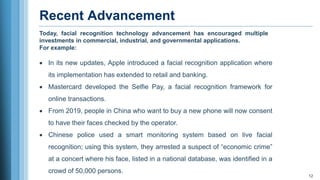
• In its new updates, Apple introduced a facial recognition application where
its implementation has extended to retail and banking.
• Mastercard developed the Selfie Pay, a facial recognition framework for
online transactions.
• From 2019, people in China who want to buy a new phone will now consent
to have their faces checked by the operator.
• Chinese police used a smart monitoring system based on live facial
recognition; using this system, they arrested a suspect of “economic crime”
at a concert where his face, listed in a national database, was identified in a
crowd of 50,000 persons.
Today, facial recognition technology advancement has encouraged multiple
investments in commercial, industrial, and governmental applications.
For example:
Main Steps in Face Recognition Systems
13
Automated face recognition includes three key steps :
(1) Face detection
(2) Extraction of features
(3) Classification
Main Steps in Face Recognition Systems
14
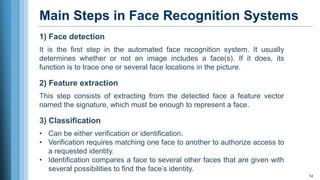
1) Face detection
It is the first step in the automated face recognition system. It usually
determines whether or not an image includes a face(s). If it does, its
function is to trace one or several face locations in the picture.
2) Feature extraction
This step consists of extracting from the detected face a feature vector
named the signature, which must be enough to represent a face.
3) Classification
• Can be either verification or identification.
• Verification requires matching one face to another to authorize access to
a requested identity.
• Identification compares a face to several other faces that are given with
several possibilities to find the face’s identity.
Facial Landmarks
15
After detection of the face region in the first step, which results a
bounding box that surround the face in the image, a number of
feature points (landmarks) are determined (manually or
automatically) inside the bounding box.
There are usually two types of facial landmarks:
1) the facial key points: The facial key points are the dominant
landmarks on face, such as the eye corners, nose tip, mouth
corners, etc.
2) interpolated landmarks: The interpolated landmark points either
describe the facial contour or connect the key points
Face Database
16
BioID: 20 landmarks are annotated
ibug: 68 landmarks are annotated
Heledominantn: 194 landmarks are annotated
MediaPipe: 468 landmarks are annotated
Face Recognition System
17
During a registration of a new face, a number of landmarks are
determined automatically or manually, and their locations are stored
for future matching. These landmarks are called ground truth
landmarks.
During validation, the same procedure is followed to extract the
landmarks and their locations.
A matching score is computed between the extracted landmarks and
ground truth landmarks.
The matching score determines the distance between each
landmark and its correspondent ground truth landmark.
Based on the matching score, the tested face image is accepted or
rejected.
Matching Score
18
• The simplest comparison is a root mean squared error (RMSE) assessment;
where the average distance between each of the N predicted landmarks
(𝑥𝑖
𝑝
, 𝑦𝑖
𝑝
) and the corresponding ‘ground truth’ (𝑥𝑖
𝑡
, 𝑦𝑖
𝑡
) is calculated on a per
landmark basis.
• Landmarks that are poorly predicted will be positioned far of their
corresponding ground truth locations and thus contribute to increasing the
RMSE value.
𝑅𝑀𝑆𝐸 =
1
𝑁
෍
𝑖=1
𝑁
𝑥𝑖
𝑝
− 𝑥𝑖
𝑡 2
+ 𝑦𝑖
𝑝
− 𝑦𝑖
𝑡 2
Applications
19
Solve Application (1) and upload it to the course Classroom
20

Lecture 4 for cognitive interaction robo

  • 1.
    Respiration 1 • Body cellsand tissues need oxygen to live. • Respiration is the process through which the oxygen needed for living cells is entered into the lungs and then circulated throughout the body. • It has two stages: ‒ Inhalation ‒ Exhalation
  • 2.
    Respiration Cycle 2 During theinhalation/exhalation cycle: • oxygen is carried from the lungs and absorbed by the red blood cells (RBC). • Hemoglobin (Hb) is the protein that carries oxygen in the RBCs and transports it throughout the body. • The heart pumps oxygenated hemoglobin (HbO2) from the lungs to the whole body cells and tissues through the circularity system, and receives the deoxygenated Hb and pumps it towards the lungs again to be oxygenated.
  • 3.
    Cell Respiration Formula 3 •This formula describes the biochemical process in which the cells of the body obtain energy by combining oxygen and glucose, resulting in the release of carbon dioxide, water, and ATP (Adenosine Tri-Phosphate) • ATP is the primary energy carrier in living beings.
  • 4.
    Respiration Rate 4 • Therespiration rate is the number of inhalation/exhalation cycles in a minute, defined as breaths per minute and expressed as BPM. • Normal respiration rate for adult healthy persons at rest ranges from 12 to 20 BPM, • For a new born (< 1 year), it ranges from 30 to 40 BPM. • The lower or higher respiration rate, while resting, is considered as being abnormal.
  • 5.
    Respiration Rate Measurement 5 Respirationrate measurement is achieved through either contact or contactless methods. 1) Contact measurement • A physical electronic sensor is attached to the body skin or tied to the patient clothes to sense the motion of the chest. • The resulting motion signal is then processed to extract the respiration rate. • These methods are not appropriate in some cases such as sensitive or burned skin, or for premature babies. • In addition, contact sensors are less convenient and more expensive.
  • 6.
    Respiration Rate Measurement 6 2)Contactless measurement • Contactless respiration methods involve computer vision techniques. • Some examples include the tracking of contraction and expansion of chest and abdomen region with each inhalation/exhalation cycle. • Also, Tracking of temperature variations around the nose and mouth, caused by air flow movement that could be captured using a thermal camera. • Contactless respiration rate monitoring is favorable to overcome the issues related to attaching sensors to sensitive or burned skin, or tying uncomfortable sensors to clothes. • In addition, contactless techniques are proper solutions for sleeping- related monitoring.
  • 7.
    Respiration Signal 7 The figurebelow shows a sample of respiratory signal acquired through computer vision approach. The peaks in the signal may be used to indicate breathing cycles.
  • 8.
    Application 8 • Implement acomputer vision-based approach to plot the breathing pattern for a human during his sleep. You can download a dataset for this task from: https://figshare.com/articles/dataset/sleep_dataset_zip/5518996/2
  • 9.
    Face Recognition 9 • Faceis perhaps the most common and familiar biometric feature. • The broad use of digital cameras and smartphones made facial images easy to produce every day. • These images can be easily distributed and exchanged by rapidly established social networks such as Facebook and Twitter. Face images
  • 10.
    Face Recognition 10 • Thehuman face is not an ideal modality compared to other biometric traits. • It is less precise than other biometric modalities such as iris or fingerprint. • It can potentially be influenced by cosmetics, disguises, and lighting. • However, the face has the advantages that make it one of the most favored biometric characteristics for identity recognition. - Natural character - Nonintrusive - Less cooperation
  • 11.
  • 12.
    Recent Advancement 12 • Inits new updates, Apple introduced a facial recognition application where its implementation has extended to retail and banking. • Mastercard developed the Selfie Pay, a facial recognition framework for online transactions. • From 2019, people in China who want to buy a new phone will now consent to have their faces checked by the operator. • Chinese police used a smart monitoring system based on live facial recognition; using this system, they arrested a suspect of “economic crime” at a concert where his face, listed in a national database, was identified in a crowd of 50,000 persons. Today, facial recognition technology advancement has encouraged multiple investments in commercial, industrial, and governmental applications. For example:
  • 13.
    Main Steps inFace Recognition Systems 13 Automated face recognition includes three key steps : (1) Face detection (2) Extraction of features (3) Classification
  • 14.
    Main Steps inFace Recognition Systems 14 1) Face detection It is the first step in the automated face recognition system. It usually determines whether or not an image includes a face(s). If it does, its function is to trace one or several face locations in the picture. 2) Feature extraction This step consists of extracting from the detected face a feature vector named the signature, which must be enough to represent a face. 3) Classification • Can be either verification or identification. • Verification requires matching one face to another to authorize access to a requested identity. • Identification compares a face to several other faces that are given with several possibilities to find the face’s identity.
  • 15.
    Facial Landmarks 15 After detectionof the face region in the first step, which results a bounding box that surround the face in the image, a number of feature points (landmarks) are determined (manually or automatically) inside the bounding box. There are usually two types of facial landmarks: 1) the facial key points: The facial key points are the dominant landmarks on face, such as the eye corners, nose tip, mouth corners, etc. 2) interpolated landmarks: The interpolated landmark points either describe the facial contour or connect the key points
  • 16.
    Face Database 16 BioID: 20landmarks are annotated ibug: 68 landmarks are annotated Heledominantn: 194 landmarks are annotated MediaPipe: 468 landmarks are annotated
  • 17.
    Face Recognition System 17 Duringa registration of a new face, a number of landmarks are determined automatically or manually, and their locations are stored for future matching. These landmarks are called ground truth landmarks. During validation, the same procedure is followed to extract the landmarks and their locations. A matching score is computed between the extracted landmarks and ground truth landmarks. The matching score determines the distance between each landmark and its correspondent ground truth landmark. Based on the matching score, the tested face image is accepted or rejected.
  • 18.
    Matching Score 18 • Thesimplest comparison is a root mean squared error (RMSE) assessment; where the average distance between each of the N predicted landmarks (𝑥𝑖 𝑝 , 𝑦𝑖 𝑝 ) and the corresponding ‘ground truth’ (𝑥𝑖 𝑡 , 𝑦𝑖 𝑡 ) is calculated on a per landmark basis. • Landmarks that are poorly predicted will be positioned far of their corresponding ground truth locations and thus contribute to increasing the RMSE value. 𝑅𝑀𝑆𝐸 = 1 𝑁 ෍ 𝑖=1 𝑁 𝑥𝑖 𝑝 − 𝑥𝑖 𝑡 2 + 𝑦𝑖 𝑝 − 𝑦𝑖 𝑡 2
  • 19.
    Applications 19 Solve Application (1)and upload it to the course Classroom
  • 20.