Lecture 1 & 2
Introduction To
Communication
Business
Communication
Subject Objectives
By the end of this subject, we will be able to:
Understand Written Communication
Understand Web Communication
Understand Verbal Communication
Lesson Objective
By the end of this subject, we will be able to:
Analyze the Essentials of Communication
Analyze the Process of Communication
Understand the Business Communication
Understand the Barriers of Communication
Business Communication
It is primarily used to interact with people in a professional set up or to promote a product, service, or
to deal with any business, legal, or other such similar situations
It is a process of sharing information between the people within and outside the organization
Now let’s have a look on the essentials of Communication
in Business Environment
Three essentials of communication are:
Listening
Understanding
Responding
Listening
It also involves an effective analysis of the non-verbal gestures such as the body language and the
facial expressions of the speaker
It involves hearing the speaker with utmost patience and interest
Understanding
It is commonly observed that most of the communication breaks down at this moment because in this
stage we easily misunderstood or misinterpret to what we listen during the communication
Giving the correct meaning to what you have understood
Responding
Reacting to something that has been already said
or done. 4 C’s to keep in mind while responding are:
Content – Right tone & style for delivering the
message of entire communication
Contact – Deciding that who is in the right
position to respond in a particular situation
Channel – Deciding the best medium through
which you could communicate message in
most efficient & effective manner
Context – Relevant parties or discussion on
which entire communication is based on
Let’s Draw
Activity
https://www.youtube.com/
watch?v=qFWsTsvJ8Xw
The Recipe for Great
communication- Video
Now let’s have a look at the process
of communication
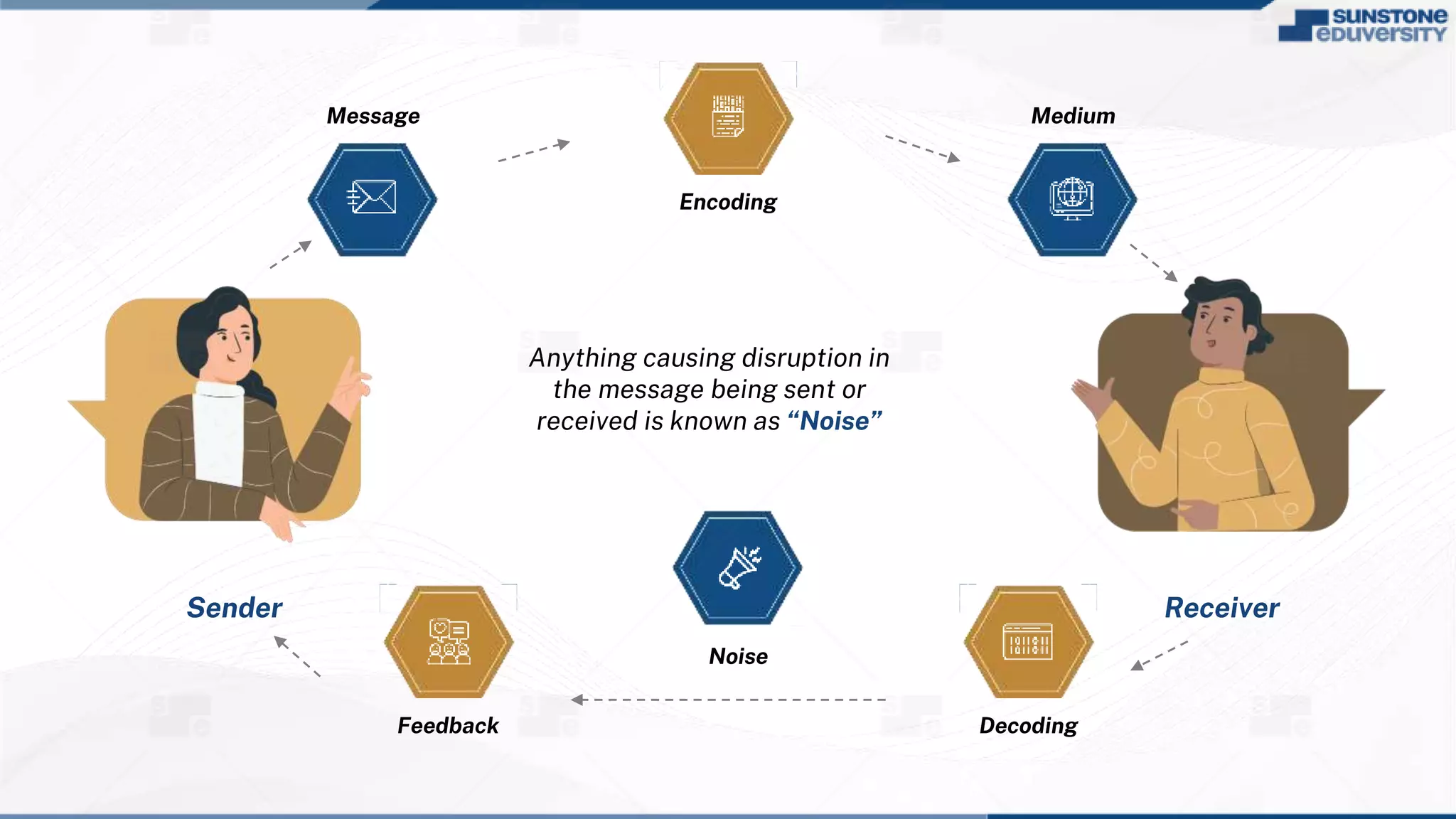
Key Elements in the Process of Communication
In the process of communication, we have:
Sender
Receiver
Message
Feedback
Medium
Encoding
Decoding
Noise
Let’s understand how communication process works with the help of all these elements…
The Communication Process
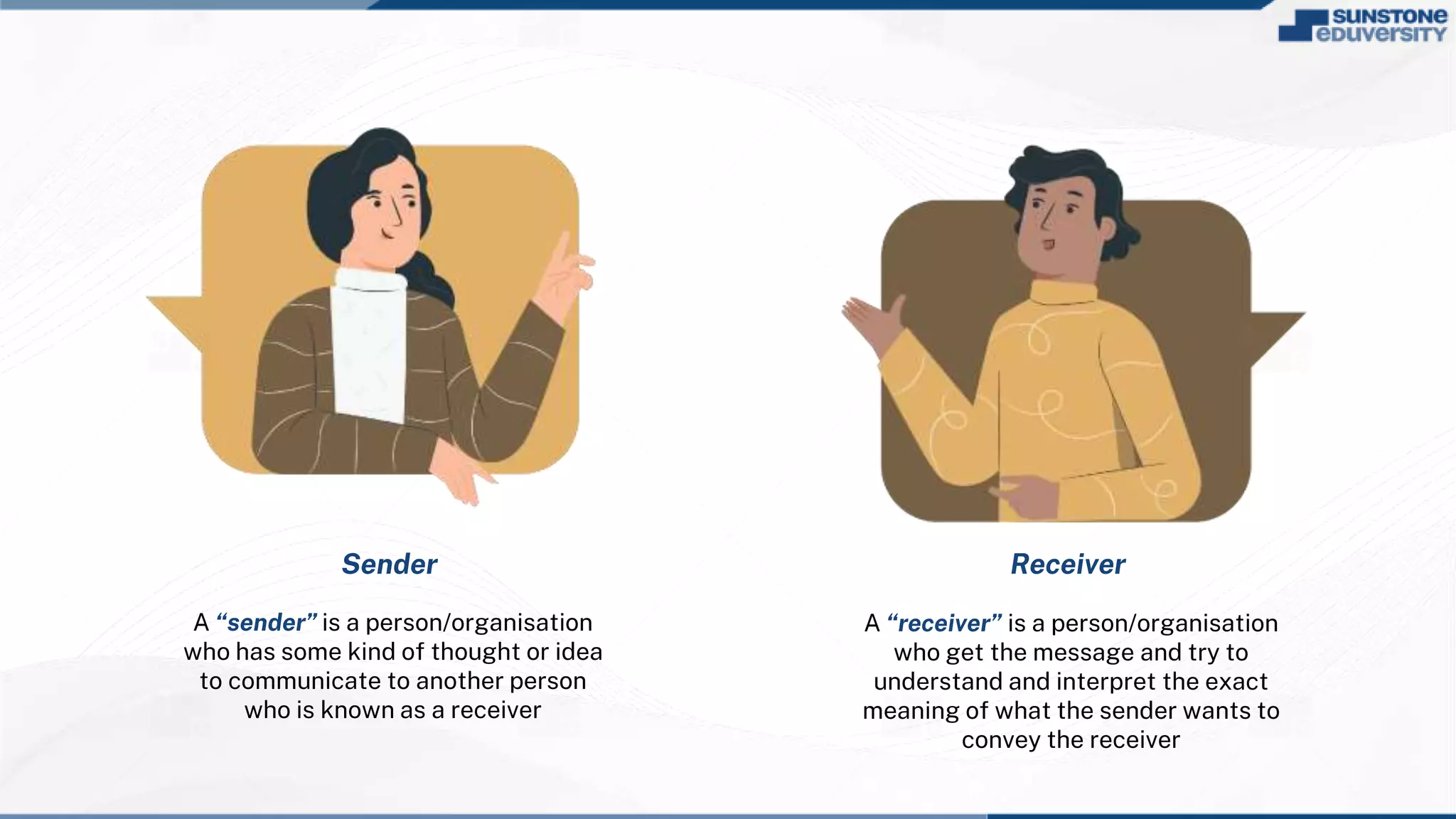
Sender
A “sender” is a person/organisation
who has some kind of thought or idea
to communicate to another person
who is known as a receiver
Receiver
A “receiver” is a person/organisation
who get the message and try to
understand and interpret the exact
meaning of what the sender wants to
convey the receiver
Sender Receiver
But the question here is How does
an idea get transferred from a
sender to a receiver?
Message
Sender Receiver
It is done with the help of a
“Message”
the idea or thought that a sender
wants to convey to a receiver
Sender Receiver
Message
Encoding
Now, the next phase here is “Encoding”.
“Encoding” refers to packing your
message in order to deliver it to the
receiver
This could be done through:
• Verbal communication
• Non-verbal communication
• Both
Sender Receiver
Medium
Encoding
Message
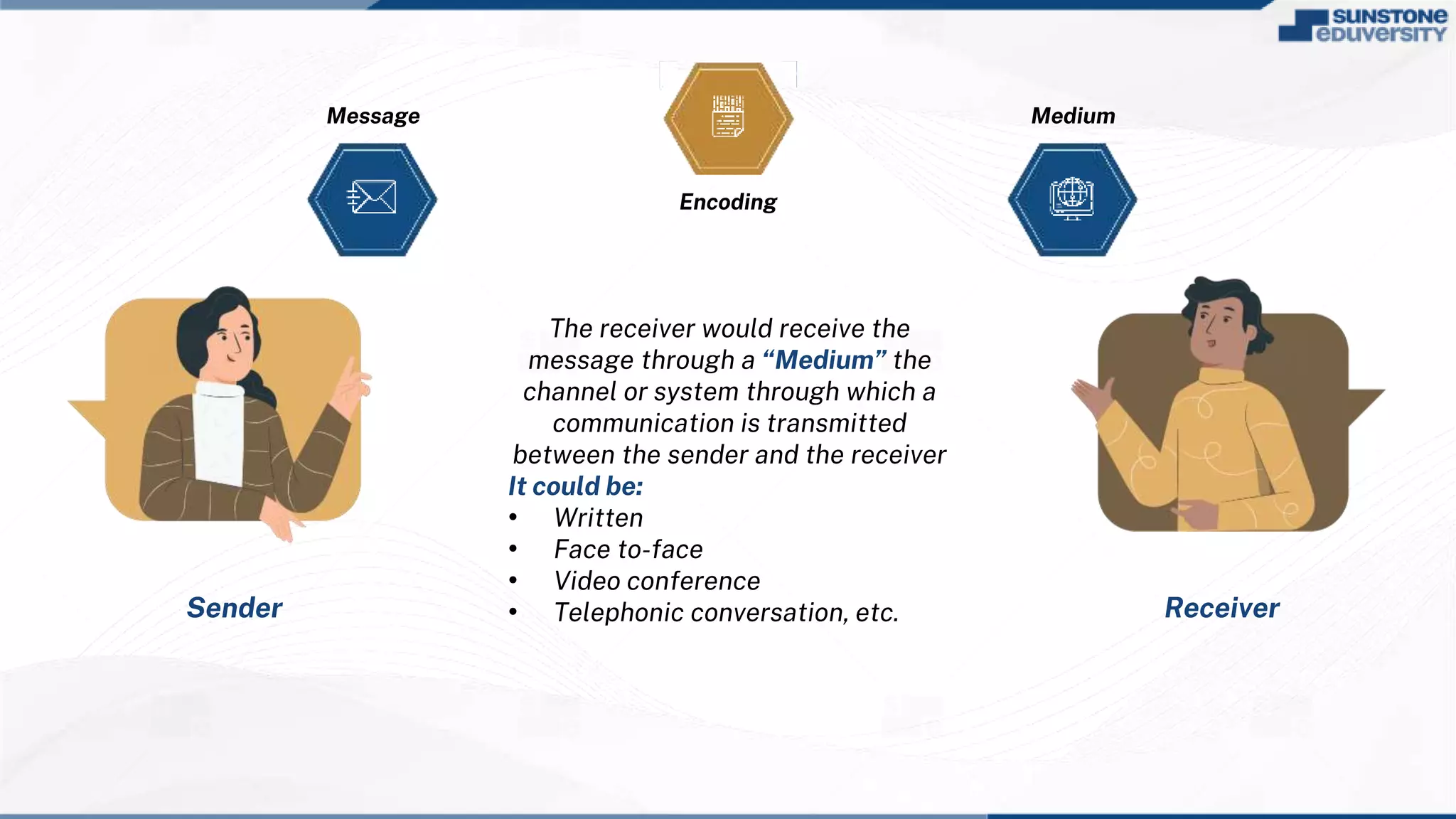
The receiver would receive the
message through a “Medium” the
channel or system through which a
communication is transmitted
between the sender and the receiver
It could be:
• Written
• Face to-face
• Video conference
• Telephonic conversation, etc.
Sender Receiver
Medium
Encoding
Message
On receiving the message, the
receiver “Decodes” the message
a method used by the receiver to
interpret the meaning and intent of
the message sent by the sender
Decoding
Sender Receiver
Medium
Encoding
Message
Feedback Decoding
At last, the receiver sends the
“Feedback” to the sender
an idea to the sender of the intent of
the message is being understood by
the receiver
Sender Receiver
Medium
Encoding
Message
Feedback Decoding
Noise
Anything causing disruption in
the message being sent or
received is known as “Noise”
https://www.youtube.com/
watch?v=slq1nAhZuqE
Barriers to effective
communication
Barriers to effective communication
The 10 Barriers to Effective Communication are:
Lack of Common Experience
Ambiguity and overuse of
Abstractions
Information Overload
Jumping to conclusions
Cultural Noise
Attitudes
Language
Psychological Barriers
Problem with Structure Design
Physical Barriers
Create an engaging
introduction for
yourself!
Activity
You have bought an item of clothing from
an expensive store. You try it on at home
and find that you do not like the item of
clothing when it is on. You do not have time
to take the item back to the store for a few
weeks, and when you do, your receipt is
out of date. The sales assistant explains
that you cannot have your money back, but
you can exchange the item for something
else. How do you respond?
Scenario
Imagine you work in a call centre for an
online retailer who offers a delivery service.
You answer your next call and find that you
are speaking to a very angry customer,
who is not happy that he has received the
wrong item. You speak to the customer
calmly to begin with, but nothing you say
will please the customer. How do you carry
on with the conversation? Do you remain
calm, or do you begin to get more and
more annoyed?
Scenario
Imagine that you are an experienced tradesperson,
who is doing some building work on someone’s
house, with junior colleagues under your
supervision. Towards the end of the day, the owner
of the house comes to you to tell you that they are
unhappy with the standard of your junior colleagues
work, and will not be paying the full amount you
quoted for the job initially. How do you react? In
your role play, you should consider how you
respond to both the owner of the house, and the
junior colleague who’s work the owner is
complaining about.
Scenario
You are in your car reversing out of a
parking space in a busy car park. As
you are reversing, another car comes
down the aisle of the car park and runs
into the back of your car? How do you
react?
Scenario
Lecture 1-2_Introduction To Communication_Design (1).pptx

Lecture 1-2_Introduction To Communication_Design (1).pptx

  • 1.
    Lecture 1 &2 Introduction To Communication Business Communication
  • 2.
    Subject Objectives By theend of this subject, we will be able to: Understand Written Communication Understand Web Communication Understand Verbal Communication
  • 3.
    Lesson Objective By theend of this subject, we will be able to: Analyze the Essentials of Communication Analyze the Process of Communication Understand the Business Communication Understand the Barriers of Communication
  • 4.
  • 5.
    Business Communication It isprimarily used to interact with people in a professional set up or to promote a product, service, or to deal with any business, legal, or other such similar situations It is a process of sharing information between the people within and outside the organization
  • 6.
    Now let’s havea look on the essentials of Communication in Business Environment
  • 7.
    Three essentials ofcommunication are: Listening Understanding Responding
  • 8.
    Listening It also involvesan effective analysis of the non-verbal gestures such as the body language and the facial expressions of the speaker It involves hearing the speaker with utmost patience and interest
  • 9.
    Understanding It is commonlyobserved that most of the communication breaks down at this moment because in this stage we easily misunderstood or misinterpret to what we listen during the communication Giving the correct meaning to what you have understood
  • 10.
    Responding Reacting to somethingthat has been already said or done. 4 C’s to keep in mind while responding are: Content – Right tone & style for delivering the message of entire communication Contact – Deciding that who is in the right position to respond in a particular situation Channel – Deciding the best medium through which you could communicate message in most efficient & effective manner Context – Relevant parties or discussion on which entire communication is based on
  • 11.
  • 12.
  • 13.
    Now let’s havea look at the process of communication
  • 14.
    Key Elements inthe Process of Communication In the process of communication, we have: Sender Receiver Message Feedback Medium Encoding Decoding Noise Let’s understand how communication process works with the help of all these elements…
  • 15.
  • 16.
    Sender A “sender” isa person/organisation who has some kind of thought or idea to communicate to another person who is known as a receiver Receiver A “receiver” is a person/organisation who get the message and try to understand and interpret the exact meaning of what the sender wants to convey the receiver
  • 17.
    Sender Receiver But thequestion here is How does an idea get transferred from a sender to a receiver?
  • 18.
    Message Sender Receiver It isdone with the help of a “Message” the idea or thought that a sender wants to convey to a receiver
  • 19.
    Sender Receiver Message Encoding Now, thenext phase here is “Encoding”. “Encoding” refers to packing your message in order to deliver it to the receiver This could be done through: • Verbal communication • Non-verbal communication • Both
  • 20.
    Sender Receiver Medium Encoding Message The receiverwould receive the message through a “Medium” the channel or system through which a communication is transmitted between the sender and the receiver It could be: • Written • Face to-face • Video conference • Telephonic conversation, etc.
  • 21.
    Sender Receiver Medium Encoding Message On receivingthe message, the receiver “Decodes” the message a method used by the receiver to interpret the meaning and intent of the message sent by the sender Decoding
  • 22.
    Sender Receiver Medium Encoding Message Feedback Decoding Atlast, the receiver sends the “Feedback” to the sender an idea to the sender of the intent of the message is being understood by the receiver
  • 23.
    Sender Receiver Medium Encoding Message Feedback Decoding Noise Anythingcausing disruption in the message being sent or received is known as “Noise”
  • 24.
  • 25.
    Barriers to effectivecommunication The 10 Barriers to Effective Communication are: Lack of Common Experience Ambiguity and overuse of Abstractions Information Overload Jumping to conclusions Cultural Noise Attitudes Language Psychological Barriers Problem with Structure Design Physical Barriers
  • 26.
    Create an engaging introductionfor yourself! Activity
  • 27.
    You have boughtan item of clothing from an expensive store. You try it on at home and find that you do not like the item of clothing when it is on. You do not have time to take the item back to the store for a few weeks, and when you do, your receipt is out of date. The sales assistant explains that you cannot have your money back, but you can exchange the item for something else. How do you respond? Scenario
  • 28.
    Imagine you workin a call centre for an online retailer who offers a delivery service. You answer your next call and find that you are speaking to a very angry customer, who is not happy that he has received the wrong item. You speak to the customer calmly to begin with, but nothing you say will please the customer. How do you carry on with the conversation? Do you remain calm, or do you begin to get more and more annoyed? Scenario
  • 29.
    Imagine that youare an experienced tradesperson, who is doing some building work on someone’s house, with junior colleagues under your supervision. Towards the end of the day, the owner of the house comes to you to tell you that they are unhappy with the standard of your junior colleagues work, and will not be paying the full amount you quoted for the job initially. How do you react? In your role play, you should consider how you respond to both the owner of the house, and the junior colleague who’s work the owner is complaining about. Scenario
  • 30.
    You are inyour car reversing out of a parking space in a busy car park. As you are reversing, another car comes down the aisle of the car park and runs into the back of your car? How do you react? Scenario