REVIEW OF SIGNIFICANT FIGURES, SCIENTIFIC NOTATION, AND SIGNIFICANT FIGURES IN CALCULATIONS
Exact numbers vs. Measured numbers Exact numbers are numbers that are defined Infinite number of significant figures present in exact numbers Zero uncertainty Measured numbers are an estimated amount – dependent on the measuring tool Limited number of significant figures present in measured numbers Always some uncertainty in the measurement
Why do significant figures matter? Show how  precisely  the data has been measured Greater number of significant figures means the measuring tool is more precise Incorrectly adding more significant figures makes it seem that you have more precision than truly exists Not having enough significant figures makes it seem that you have less precision than the measuring tools provided If a measurement is truly  accurate What do significant figures  not  tell us?
Rules to count the number of significant figures in a measured number: Rule 1:  All non-zero digits are always significant Rule 2: Zeros in between significant figures are always significant Rule 3: Space holder zeros in numbers < 1 are never significant Rule 4: Zeros at the end of a number are only significant when a decimal is in the number
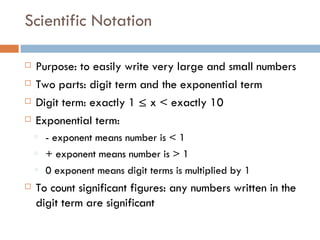
Scientific Notation Purpose: to easily write very large and small numbers Two parts: digit term and the exponential term Digit term: exactly 1 ≤ x < exactly 10 Exponential term:  - exponent means number is < 1 + exponent means number is > 1 0 exponent means digit terms is multiplied by 1 To count significant figures: any numbers written in the digit term are significant
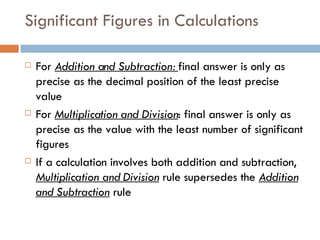
Significant Figures in Calculations For  Addition and Subtraction:  final answer is only as precise as the decimal position of the least precise value For  Multiplication and Division : final answer is only as precise as the value with the least number of significant figures If a calculation involves both addition and subtraction,  Multiplication and Division  rule supersedes the  Addition and Subtraction  rule

Lecture 1 Significant Figures, Scientific Notation, Significant Figures In Calculations

  • 1.
    REVIEW OF SIGNIFICANTFIGURES, SCIENTIFIC NOTATION, AND SIGNIFICANT FIGURES IN CALCULATIONS
  • 2.
    Exact numbers vs.Measured numbers Exact numbers are numbers that are defined Infinite number of significant figures present in exact numbers Zero uncertainty Measured numbers are an estimated amount – dependent on the measuring tool Limited number of significant figures present in measured numbers Always some uncertainty in the measurement
  • 3.
    Why do significantfigures matter? Show how precisely the data has been measured Greater number of significant figures means the measuring tool is more precise Incorrectly adding more significant figures makes it seem that you have more precision than truly exists Not having enough significant figures makes it seem that you have less precision than the measuring tools provided If a measurement is truly accurate What do significant figures not tell us?
  • 4.
    Rules to countthe number of significant figures in a measured number: Rule 1: All non-zero digits are always significant Rule 2: Zeros in between significant figures are always significant Rule 3: Space holder zeros in numbers < 1 are never significant Rule 4: Zeros at the end of a number are only significant when a decimal is in the number
  • 5.
    Scientific Notation Purpose:to easily write very large and small numbers Two parts: digit term and the exponential term Digit term: exactly 1 ≤ x < exactly 10 Exponential term: - exponent means number is < 1 + exponent means number is > 1 0 exponent means digit terms is multiplied by 1 To count significant figures: any numbers written in the digit term are significant
  • 6.
    Significant Figures inCalculations For Addition and Subtraction: final answer is only as precise as the decimal position of the least precise value For Multiplication and Division : final answer is only as precise as the value with the least number of significant figures If a calculation involves both addition and subtraction, Multiplication and Division rule supersedes the Addition and Subtraction rule