PRINCIPLES OF AMPLIFICATION
CONCEPTS AND PRINCIPLES BASIC TO
UNDERSTANDING THE ACOUSTIC, BIOLOGICAL, AND
PSYCHOLOGICAL BASES OF HUMAN HEARING.
DR. GHULAM SAQULAIN
M.B.B.S., D.L.O., F.C.P.S
HEAD OF DEPARTMENT OF ENT
CAPITAL HOSPITAL, ISLAMABAD
PRINCIPLES UNDERLYING EFFECTIVE AMPLIFICATION
Objective
 Many decisions must be made prior to
selecting amplification for a child.
 These decisions are based on individualized
needs and abilities, diagnostic information
(e.g., degree of hearing loss, physical
characteristics, etc.), environment in which
the individual functions, empirical evidence,
and/or clinician experience.
 The overarching goal is to match the
technology/features of the amplification
system to the needs and abilities of the
SELECTING ROUTING OF SIGNAL
The routing of the signal may include air conduction, bone conduction,
electrical stimulation or some combination of these methods.
In addition, the signal may be routed to one ear, both ears or in the case of
bone conduction to both cochleae with the better cochlea utilizing the signal
Bilateral amplification is recommended unless contraindicated.
 Sound transmission is chosen based on type and severity of the hearing loss
and physical features of the outer ear.
 Bi-modal sound transmission (CI on one side and hearing aid on the other) is
recommended for children unilaterally implanted unless contraindicated.
 Standard BTEs may provide appropriate coupling to a variety of assistive
listening devices that may assist in educational and social settings.
 Tubing size, occlusion, and receiver placement are individual choices based on
patient communication needs, ear canal dimensions, hearing loss severity and
configuration, and patient preferences.
 For a child with unilateral deafness, an FM system with the wireless remote
microphone receiver coupled to the open, good ear may be preferable to a
CROS configuration in classroom situations.
 Use of a bone conducted signal may be an effective means of amplification
for children with permanent bilateral conductive hearing loss.
 Use of a bone conducted signal may be considered an option with children
who have unilateral hearing loss.
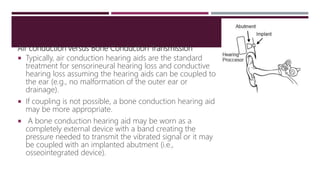
Air conduction versus Bone Conduction Transmission
 Typically, air conduction hearing aids are the standard
treatment for sensorineural hearing loss and conductive
hearing loss assuming the hearing aids can be coupled to
the ear (e.g., no malformation of the outer ear or
drainage).
 If coupling is not possible, a bone conduction hearing aid
may be more appropriate.
 A bone conduction hearing aid may be worn as a
completely external device with a band creating the
pressure needed to transmit the vibrated signal or it may
be coupled with an implanted abutment (i.e.,
osseointegrated device).
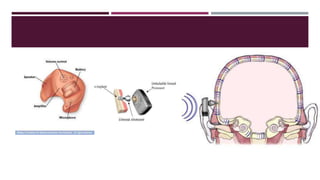
 The implantation and support of a bone anchored hearing aid requires
collaboration between the audiologist and otolaryngologist/ otologist.
 The FDA has approved the use of the bone anchored hearing aids for children
five years and older, though bone conducted amplification is often used
without implantation via a soft headband in children younger than 5.
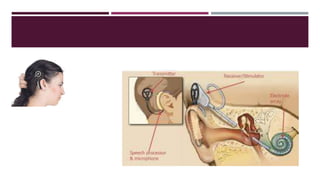
Electrical Stimulation
 Individuals with severe to profound sensorineural hearing loss in both ears are
candidates for cochlear implants.
 A cochlear implant provides electrical stimulation to the auditory nerve.
 Some children may use a hearing aid in one ear and a cochlear implant in the other
(bi-modal).
 Hybrid amplification devices are a combination of hearing aids and cochlear
and provide acoustic amplification to the low frequencies and electrical stimulation
to the higher frequencies. These devices are not currently approved for use in the
United States, nor with children.
Unilateral Hearing Loss
 Contralateral routing of the signal (CROS) and Bilateral routing of the signal
(BICROS) fittings are specially designed for patients having either unilateral
hearing loss or bilateral asymmetrical hearing loss where one ear is
respectively.
 If the unilateral hearing loss is aidable then a monaural fitting would be
considered
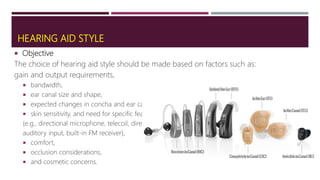
HEARING AID STYLE
 Objective
The choice of hearing aid style should be made based on factors such as:
gain and output requirements,
 bandwidth,
 ear canal size and shape,
 expected changes in concha and ear canal size,
 skin sensitivity, and need for specific features
(e.g., directional microphone, telecoil, direct
auditory input, built-in FM receiver),
 comfort,
 occlusion considerations,
 and cosmetic concerns.
 BTEs are the style of choice while the child’s ear is still growing.
 BTEs may provide needed features for the pediatric patient.
 Standard BTEs may provide appropriate coupling to a variety of assistive
listening devices that may assist in educational and social settings.
 Tubing size, occlusion, and receiver placement are individual choices based on
patient communication needs, ear canal dimensions, hearing loss severity and
configuration, and patient preferences.
BTE TERMINOLOGY
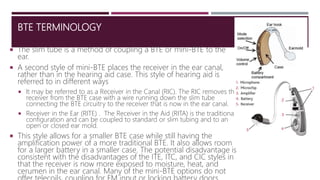
 The slim tube is a method of coupling a BTE or mini-BTE to the
ear.
 A second style of mini-BTE places the receiver in the ear canal,
rather than in the hearing aid case. This style of hearing aid is
referred to in different ways
 It may be referred to as a Receiver in the Canal (RIC). The RIC removes the
receiver from the BTE case with a wire running down the slim tube
connecting the BTE circuitry to the receiver that is now in the ear canal.
 Receiver in the Ear (RITE) . The Receiver in the Aid (RITA) is the traditional
configuration and can be coupled to standard or slim tubing and to an
open or closed ear mold.
 This style allows for a smaller BTE case while still having the
amplification power of a more traditional BTE. It also allows room
for a larger battery in a smaller case. The potential disadvantage is
consistent with the disadvantages of the ITE, ITC, and CIC styles in
that the receiver is now more exposed to moisture, heat, and
cerumen in the ear canal. Many of the mini-BTE options do not
ADEQUACY OF EARMOLD
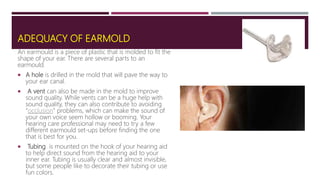
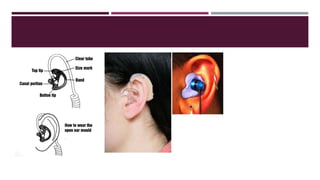
An earmould is a piece of plastic that is molded to fit the
shape of your ear. There are several parts to an
earmould.
 A hole is drilled in the mold that will pave the way to
your ear canal.
 A vent can also be made in the mold to improve
sound quality. While vents can be a huge help with
sound quality, they can also contribute to avoiding
“occlusion” problems, which can make the sound of
your own voice seem hollow or booming. Your
hearing care professional may need to try a few
different earmould set-ups before finding the one
that is best for you.
 Tubing is mounted on the hook of your hearing aid
to help direct sound from the hearing aid to your
inner ear. Tubing is usually clear and almost invisible,
but some people like to decorate their tubing or use
fun colors.
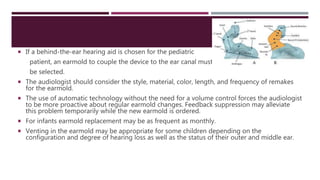
 If a behind-the-ear hearing aid is chosen for the pediatric
patient, an earmold to couple the device to the ear canal must
be selected.
 The audiologist should consider the style, material, color, length, and frequency of remakes
for the earmold.
 The use of automatic technology without the need for a volume control forces the audiologist
to be more proactive about regular earmold changes. Feedback suppression may alleviate
this problem temporarily while the new earmold is ordered.
 For infants earmold replacement may be as frequent as monthly.
 Venting in the earmold may be appropriate for some children depending on the
configuration and degree of hearing loss as well as the status of their outer and middle ear.
 The sound channel consists of the ear hook and tube that leads through the earmold and
sends sound into the ear canal.
 Just as a horn (increased diameter at the end of the sound channel) increases the high
frequency response, a reverse horn will roll off the high frequencies.
 These are often the frequencies where the child needs the most amplification.
 A reverse horn is a common concern in an infant or young child because the ear canal is so
small that the sound channel decreases in diameter from the tubing to the sound bore. It is
essential that the end of the sound channel be checked visually for crimping.
 It may be necessary to not “tube through” an infant’s earmold to avoid crimping or
unnecessarily restricting the diameter of the sound channel.
 An electroacoustic measure that includes the earmold or probe microphone measures with
the earmold connected to the hearing aid will reveal any roll off in high frequency response.
RECOMMENDATION
 Be proactive regarding earmold replacement due to the child’s growth.
 Use automatic feedback suppression in order to resolve feedback issues,
either temporarily while awaiting new earmolds or permanently if needed
to achieve the prescribed gains.
 Approach venting cautiously in pediatric earmolds because of space
limitations.
 For infants, the only way to fully eliminate feedback may be to use an
offsite/remote microphone. Caution must be used when considering this
as a full time option because the child may not hear his/her own
babbling/ speech sounds if the microphone is not near the child’s mouth.
 Provide a long, but comfortable earmold canal length to reduce the occlusion
effect and to provide increased output in the ear canal due to decreased
volume between the earmold and eardrum.
 Use pediatric ear hooks to promote retention of BTEs.
SAFETY CONSIDERATIONS
 Battery door:
 Specific risks of battery ingestion include toxicity and asphyxiation.
 Children under age 6 are at greater risk for battery ingestion.
 Volume Control:
 A volume control may come in the form of a wheel, toggle, touch sensor or button.
 Adjustment of a volume control can provide a short-term solution to feedback caused by poorly fitting
earmolds, but reductions in volume to minimize feedback will reduce the overall audibility of the hearing
aid fitting.
 If a volume control is present, the clinician must decide if the child should have access to manipulating
the control or if a locking volume control is preferred
 Over amplification:
 The gain-frequency response and maximum output of the hearing aid should be set according to
published, independent prescriptive fitting formulae in conjunction with the measured real-ear-to-
coupler difference Excessive output may be especially damaging for children with severe to profound
hearing loss (i.e., thresholds of approximately 90 dB HL or higher).
 Exceeding the safety limit is unlikely when hearing aids are fit to independent prescriptive formulae
 Prescriptive targets have a degree of caution built in to the suggested
 Parental anxiety, training, and resulting device use:
 Effective counseling and coaching are required to ensure that parents are prepared, technically and emotionally,
to provide hearing aid use support for infants and young children.
 Support in various forms (e.g. device retention, coaching/counseling regarding developmentally appropriate
expectations) is required to work with families to promote appropriate use across environments and
developmental stages.
 Parents of children with hearing loss may exhibit concerns at the time of hearing aid fitting regarding hearing
maintenance, appearance and potential benefit.
 Parents may experience anxiety resulting from the hearing aid fitting, apart from anxiety specific to the
identification of hearing loss.
 Consistency of device use varies across families, environments, degree of hearing loss and developmental
 Nonfunctioning hearing aids:
 An overall loss (i.e., the combination of loss of open ear canal resonance and earmold attenuation) of a
nonfunctioning hearing aid can range from 25-30 dB. This is equivalent to that of noise attenuation devices,
represents a significant loss of sound compared to either the unaided or aided listening condition.
 Regular checks by caregivers are needed to ensure that hearing aids are functional.
 Care should be taken to ensure that parents are skilled at monitoring device function and
troubleshooting.
 The specific mechanism for achieving these goals will vary with the child’s caregivers,
environments, and abilities over time.
 Ear impressions and contact dermatitis:
 Ear impression taking carries several risks including:
 impaction of cerumen,
 injury to the ear canal or tympanic membrane,
 injection of material into the middle ear space,
 or contact dermatitis.
RECOMMENDATION Utilize tamper resistant battery doors to decrease the likelihood of battery
ingestion.
 De-activate or lock volume controls
 Use a validated, pediatric-focused prescriptive formula when prescribing gain
or output for a child in order to avoid over amplification.
 Attempt to reduce parental/caregiver anxiety through counseling and
instruction
 Provide parents/caregivers with tools and instructions to ensure functioning
hearing aids.
 Identify prior skin reactions in order to minimize incidence of contact
dermatitis with earmold impression and/or earmolds.

Lecture 1 c principles of amplification

  • 1.
    PRINCIPLES OF AMPLIFICATION CONCEPTSAND PRINCIPLES BASIC TO UNDERSTANDING THE ACOUSTIC, BIOLOGICAL, AND PSYCHOLOGICAL BASES OF HUMAN HEARING. DR. GHULAM SAQULAIN M.B.B.S., D.L.O., F.C.P.S HEAD OF DEPARTMENT OF ENT CAPITAL HOSPITAL, ISLAMABAD
  • 2.
    PRINCIPLES UNDERLYING EFFECTIVEAMPLIFICATION Objective  Many decisions must be made prior to selecting amplification for a child.  These decisions are based on individualized needs and abilities, diagnostic information (e.g., degree of hearing loss, physical characteristics, etc.), environment in which the individual functions, empirical evidence, and/or clinician experience.  The overarching goal is to match the technology/features of the amplification system to the needs and abilities of the
  • 3.
    SELECTING ROUTING OFSIGNAL The routing of the signal may include air conduction, bone conduction, electrical stimulation or some combination of these methods. In addition, the signal may be routed to one ear, both ears or in the case of bone conduction to both cochleae with the better cochlea utilizing the signal Bilateral amplification is recommended unless contraindicated.
  • 5.
     Sound transmissionis chosen based on type and severity of the hearing loss and physical features of the outer ear.  Bi-modal sound transmission (CI on one side and hearing aid on the other) is recommended for children unilaterally implanted unless contraindicated.  Standard BTEs may provide appropriate coupling to a variety of assistive listening devices that may assist in educational and social settings.
  • 6.
     Tubing size,occlusion, and receiver placement are individual choices based on patient communication needs, ear canal dimensions, hearing loss severity and configuration, and patient preferences.  For a child with unilateral deafness, an FM system with the wireless remote microphone receiver coupled to the open, good ear may be preferable to a CROS configuration in classroom situations.  Use of a bone conducted signal may be an effective means of amplification for children with permanent bilateral conductive hearing loss.  Use of a bone conducted signal may be considered an option with children who have unilateral hearing loss.
  • 7.
    Air conduction versusBone Conduction Transmission  Typically, air conduction hearing aids are the standard treatment for sensorineural hearing loss and conductive hearing loss assuming the hearing aids can be coupled to the ear (e.g., no malformation of the outer ear or drainage).  If coupling is not possible, a bone conduction hearing aid may be more appropriate.  A bone conduction hearing aid may be worn as a completely external device with a band creating the pressure needed to transmit the vibrated signal or it may be coupled with an implanted abutment (i.e., osseointegrated device).
  • 8.
     The implantationand support of a bone anchored hearing aid requires collaboration between the audiologist and otolaryngologist/ otologist.  The FDA has approved the use of the bone anchored hearing aids for children five years and older, though bone conducted amplification is often used without implantation via a soft headband in children younger than 5.
  • 9.
    Electrical Stimulation  Individualswith severe to profound sensorineural hearing loss in both ears are candidates for cochlear implants.  A cochlear implant provides electrical stimulation to the auditory nerve.  Some children may use a hearing aid in one ear and a cochlear implant in the other (bi-modal).  Hybrid amplification devices are a combination of hearing aids and cochlear and provide acoustic amplification to the low frequencies and electrical stimulation to the higher frequencies. These devices are not currently approved for use in the United States, nor with children.
  • 11.
    Unilateral Hearing Loss Contralateral routing of the signal (CROS) and Bilateral routing of the signal (BICROS) fittings are specially designed for patients having either unilateral hearing loss or bilateral asymmetrical hearing loss where one ear is respectively.  If the unilateral hearing loss is aidable then a monaural fitting would be considered
  • 12.
    HEARING AID STYLE Objective The choice of hearing aid style should be made based on factors such as: gain and output requirements,  bandwidth,  ear canal size and shape,  expected changes in concha and ear canal size,  skin sensitivity, and need for specific features (e.g., directional microphone, telecoil, direct auditory input, built-in FM receiver),  comfort,  occlusion considerations,  and cosmetic concerns.
  • 13.
     BTEs arethe style of choice while the child’s ear is still growing.  BTEs may provide needed features for the pediatric patient.  Standard BTEs may provide appropriate coupling to a variety of assistive listening devices that may assist in educational and social settings.  Tubing size, occlusion, and receiver placement are individual choices based on patient communication needs, ear canal dimensions, hearing loss severity and configuration, and patient preferences.
  • 14.
    BTE TERMINOLOGY  Theslim tube is a method of coupling a BTE or mini-BTE to the ear.  A second style of mini-BTE places the receiver in the ear canal, rather than in the hearing aid case. This style of hearing aid is referred to in different ways  It may be referred to as a Receiver in the Canal (RIC). The RIC removes the receiver from the BTE case with a wire running down the slim tube connecting the BTE circuitry to the receiver that is now in the ear canal.  Receiver in the Ear (RITE) . The Receiver in the Aid (RITA) is the traditional configuration and can be coupled to standard or slim tubing and to an open or closed ear mold.  This style allows for a smaller BTE case while still having the amplification power of a more traditional BTE. It also allows room for a larger battery in a smaller case. The potential disadvantage is consistent with the disadvantages of the ITE, ITC, and CIC styles in that the receiver is now more exposed to moisture, heat, and cerumen in the ear canal. Many of the mini-BTE options do not
  • 15.
    ADEQUACY OF EARMOLD Anearmould is a piece of plastic that is molded to fit the shape of your ear. There are several parts to an earmould.  A hole is drilled in the mold that will pave the way to your ear canal.  A vent can also be made in the mold to improve sound quality. While vents can be a huge help with sound quality, they can also contribute to avoiding “occlusion” problems, which can make the sound of your own voice seem hollow or booming. Your hearing care professional may need to try a few different earmould set-ups before finding the one that is best for you.  Tubing is mounted on the hook of your hearing aid to help direct sound from the hearing aid to your inner ear. Tubing is usually clear and almost invisible, but some people like to decorate their tubing or use fun colors.
  • 17.
     If abehind-the-ear hearing aid is chosen for the pediatric patient, an earmold to couple the device to the ear canal must be selected.  The audiologist should consider the style, material, color, length, and frequency of remakes for the earmold.  The use of automatic technology without the need for a volume control forces the audiologist to be more proactive about regular earmold changes. Feedback suppression may alleviate this problem temporarily while the new earmold is ordered.  For infants earmold replacement may be as frequent as monthly.  Venting in the earmold may be appropriate for some children depending on the configuration and degree of hearing loss as well as the status of their outer and middle ear.
  • 18.
     The soundchannel consists of the ear hook and tube that leads through the earmold and sends sound into the ear canal.  Just as a horn (increased diameter at the end of the sound channel) increases the high frequency response, a reverse horn will roll off the high frequencies.  These are often the frequencies where the child needs the most amplification.  A reverse horn is a common concern in an infant or young child because the ear canal is so small that the sound channel decreases in diameter from the tubing to the sound bore. It is essential that the end of the sound channel be checked visually for crimping.  It may be necessary to not “tube through” an infant’s earmold to avoid crimping or unnecessarily restricting the diameter of the sound channel.  An electroacoustic measure that includes the earmold or probe microphone measures with the earmold connected to the hearing aid will reveal any roll off in high frequency response.
  • 19.
    RECOMMENDATION  Be proactiveregarding earmold replacement due to the child’s growth.  Use automatic feedback suppression in order to resolve feedback issues, either temporarily while awaiting new earmolds or permanently if needed to achieve the prescribed gains.  Approach venting cautiously in pediatric earmolds because of space limitations.  For infants, the only way to fully eliminate feedback may be to use an offsite/remote microphone. Caution must be used when considering this as a full time option because the child may not hear his/her own babbling/ speech sounds if the microphone is not near the child’s mouth.
  • 20.
     Provide along, but comfortable earmold canal length to reduce the occlusion effect and to provide increased output in the ear canal due to decreased volume between the earmold and eardrum.  Use pediatric ear hooks to promote retention of BTEs.
  • 21.
    SAFETY CONSIDERATIONS  Batterydoor:  Specific risks of battery ingestion include toxicity and asphyxiation.  Children under age 6 are at greater risk for battery ingestion.  Volume Control:  A volume control may come in the form of a wheel, toggle, touch sensor or button.  Adjustment of a volume control can provide a short-term solution to feedback caused by poorly fitting earmolds, but reductions in volume to minimize feedback will reduce the overall audibility of the hearing aid fitting.  If a volume control is present, the clinician must decide if the child should have access to manipulating the control or if a locking volume control is preferred  Over amplification:  The gain-frequency response and maximum output of the hearing aid should be set according to published, independent prescriptive fitting formulae in conjunction with the measured real-ear-to- coupler difference Excessive output may be especially damaging for children with severe to profound hearing loss (i.e., thresholds of approximately 90 dB HL or higher).  Exceeding the safety limit is unlikely when hearing aids are fit to independent prescriptive formulae  Prescriptive targets have a degree of caution built in to the suggested
  • 22.
     Parental anxiety,training, and resulting device use:  Effective counseling and coaching are required to ensure that parents are prepared, technically and emotionally, to provide hearing aid use support for infants and young children.  Support in various forms (e.g. device retention, coaching/counseling regarding developmentally appropriate expectations) is required to work with families to promote appropriate use across environments and developmental stages.  Parents of children with hearing loss may exhibit concerns at the time of hearing aid fitting regarding hearing maintenance, appearance and potential benefit.  Parents may experience anxiety resulting from the hearing aid fitting, apart from anxiety specific to the identification of hearing loss.  Consistency of device use varies across families, environments, degree of hearing loss and developmental  Nonfunctioning hearing aids:  An overall loss (i.e., the combination of loss of open ear canal resonance and earmold attenuation) of a nonfunctioning hearing aid can range from 25-30 dB. This is equivalent to that of noise attenuation devices, represents a significant loss of sound compared to either the unaided or aided listening condition.
  • 23.
     Regular checksby caregivers are needed to ensure that hearing aids are functional.  Care should be taken to ensure that parents are skilled at monitoring device function and troubleshooting.  The specific mechanism for achieving these goals will vary with the child’s caregivers, environments, and abilities over time.  Ear impressions and contact dermatitis:  Ear impression taking carries several risks including:  impaction of cerumen,  injury to the ear canal or tympanic membrane,  injection of material into the middle ear space,  or contact dermatitis.
  • 24.
    RECOMMENDATION Utilize tamperresistant battery doors to decrease the likelihood of battery ingestion.  De-activate or lock volume controls  Use a validated, pediatric-focused prescriptive formula when prescribing gain or output for a child in order to avoid over amplification.  Attempt to reduce parental/caregiver anxiety through counseling and instruction  Provide parents/caregivers with tools and instructions to ensure functioning hearing aids.  Identify prior skin reactions in order to minimize incidence of contact dermatitis with earmold impression and/or earmolds.