Measurement and
Instrumentation (ME-331)
INSTRUCTOR: DR. WAQAR AHMED
MECHANICAL ENGINEERING DEPARTMENT
UNIVERSITY OF ENGINEERING & TECHNOLOGY, TAXILA
waqaraq@gmail.com
2
Learning Outcomes
1. Identify the major components of a general measurement system, and state
the function of each
2. Develop an experimental test plan
3. Distinguish between random and systematic errors
4. Describe and define the various error types
5. Define a standard and distinguish among primary, secondary, and transfer
standards
6. Clearly delineate defined and derived dimensions in various unit systems.
DR. WAQAR AHMED, MED, UET TAXILA
3
1.1 Introduction
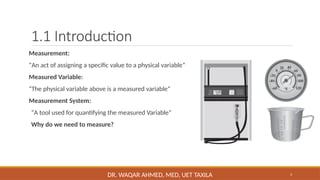
Measurement:
“An act of assigning a specific value to a physical variable”
Measured Variable:
“The physical variable above is a measured variable”
Measurement System:
“A tool used for quantifying the measured Variable”
Why do we need to measure?
DR. WAQAR AHMED, MED, UET TAXILA
4
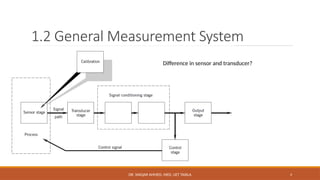
1.2 General Measurement System
DR. WAQAR AHMED, MED, UET TAXILA
Difference in sensor and transducer?
5
1.3 Experimental Test Plan
Purpose of an Experimental Test:
“To answer a question”
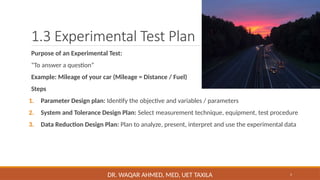
Example: Mileage of your car (Mileage = Distance / Fuel)
Steps
1. Parameter Design plan: Identify the objective and variables / parameters
2. System and Tolerance Design Plan: Select measurement technique, equipment, test procedure
3. Data Reduction Design Plan: Plan to analyze, present, interpret and use the experimental data
DR. WAQAR AHMED, MED, UET TAXILA
6
Variables
1. Independent Variables
2. Dependent Variables
3. Extraneous Variables
a) Continuous extraneous variables
b) Discrete extraneous variables
4. Control of Variables
5. Control Parameters
6. Noise and Interference
DR. WAQAR AHMED, MED, UET TAXILA
7
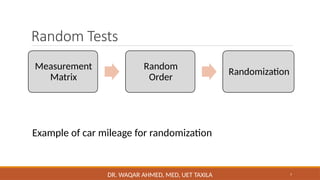
Random Tests
Measurement
Matrix
Random
Order
Randomization
DR. WAQAR AHMED, MED, UET TAXILA
Example of car mileage for randomization
8
DR. WAQAR AHMED, MED, UET TAXILA
𝑥
Power
Source
Voltmeter
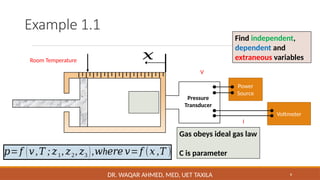
Find independent,
dependent and
extraneous variables
Gas obeys ideal gas law
C is parameter
Example 1.1
Pressure
Transducer
𝑝=𝑓 (𝑣,𝑇 ; 𝑧1, 𝑧2, 𝑧3 ), h
𝑤 𝑒𝑟𝑒 𝑣=𝑓 (𝑥 ,𝑇 )
V
Room Temperature
I
9
Randomization of Example 1.1 (Ex 1.2)
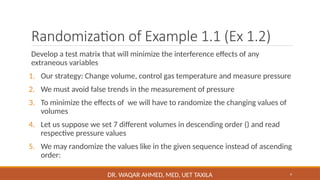
Develop a test matrix that will minimize the interference effects of any
extraneous variables
1. Our strategy: Change volume, control gas temperature and measure pressure
2. We must avoid false trends in the measurement of pressure
3. To minimize the effects of we will have to randomize the changing values of
volumes
4. Let us suppose we set 7 different volumes in descending order () and read
respective pressure values
5. We may randomize the values like in the given sequence instead of ascending
order:
DR. WAQAR AHMED, MED, UET TAXILA
DR. WAQAR AHMED, MED, UET TAXILA 10
Another Example
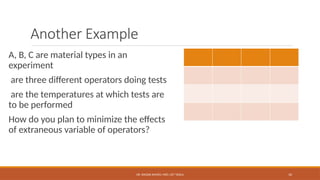
A, B, C are material types in an
experiment
are three different operators doing tests
are the temperatures at which tests are
to be performed
How do you plan to minimize the effects
of extraneous variable of operators?
DR. WAQAR AHMED, MED, UET TAXILA 11
Replication and Repetition
1. What is Replication?
2. What is Repetition?
3. What is the advantage of both?
4. What do they signify?
DR. WAQAR AHMED, MED, UET TAXILA 12
Concomitant Methods
Obtain two or more estimates
Use a different method for each estimate
This approach increases the trust in measurement
Present and discuss few examples
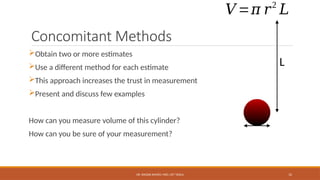
How can you measure volume of this cylinder?
How can you be sure of your measurement?
L
𝑉 =𝜋 𝑟2
𝐿
DR. WAQAR AHMED, MED, UET TAXILA 13
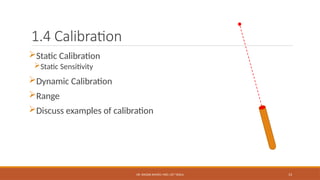
1.4 Calibration
Static Calibration
Static Sensitivity
Dynamic Calibration
Range
Discuss examples of calibration
DR. WAQAR AHMED, MED, UET TAXILA 14
Conclusion
1. Rest of the chapter is reading assignment of class
2. After reviewing the whole chapter every student has to solve one problem
each from the problems at the end of Chapter 1
3. Sequence of problems assignment: Roll # 1 => Q # 1.1 and so on
4. When questions finish, the repetition will start
5. Assignment does not have to be submitted

Lecture 1 (Basic Concepts of Measurement Methods).pptx

  • 1.
    Measurement and Instrumentation (ME-331) INSTRUCTOR:DR. WAQAR AHMED MECHANICAL ENGINEERING DEPARTMENT UNIVERSITY OF ENGINEERING & TECHNOLOGY, TAXILA waqaraq@gmail.com
  • 2.
    2 Learning Outcomes 1. Identifythe major components of a general measurement system, and state the function of each 2. Develop an experimental test plan 3. Distinguish between random and systematic errors 4. Describe and define the various error types 5. Define a standard and distinguish among primary, secondary, and transfer standards 6. Clearly delineate defined and derived dimensions in various unit systems. DR. WAQAR AHMED, MED, UET TAXILA
  • 3.
    3 1.1 Introduction Measurement: “An actof assigning a specific value to a physical variable” Measured Variable: “The physical variable above is a measured variable” Measurement System: “A tool used for quantifying the measured Variable” Why do we need to measure? DR. WAQAR AHMED, MED, UET TAXILA
  • 4.
    4 1.2 General MeasurementSystem DR. WAQAR AHMED, MED, UET TAXILA Difference in sensor and transducer?
  • 5.
    5 1.3 Experimental TestPlan Purpose of an Experimental Test: “To answer a question” Example: Mileage of your car (Mileage = Distance / Fuel) Steps 1. Parameter Design plan: Identify the objective and variables / parameters 2. System and Tolerance Design Plan: Select measurement technique, equipment, test procedure 3. Data Reduction Design Plan: Plan to analyze, present, interpret and use the experimental data DR. WAQAR AHMED, MED, UET TAXILA
  • 6.
    6 Variables 1. Independent Variables 2.Dependent Variables 3. Extraneous Variables a) Continuous extraneous variables b) Discrete extraneous variables 4. Control of Variables 5. Control Parameters 6. Noise and Interference DR. WAQAR AHMED, MED, UET TAXILA
  • 7.
    7 Random Tests Measurement Matrix Random Order Randomization DR. WAQARAHMED, MED, UET TAXILA Example of car mileage for randomization
  • 8.
    8 DR. WAQAR AHMED,MED, UET TAXILA 𝑥 Power Source Voltmeter Find independent, dependent and extraneous variables Gas obeys ideal gas law C is parameter Example 1.1 Pressure Transducer 𝑝=𝑓 (𝑣,𝑇 ; 𝑧1, 𝑧2, 𝑧3 ), h 𝑤 𝑒𝑟𝑒 𝑣=𝑓 (𝑥 ,𝑇 ) V Room Temperature I
  • 9.
    9 Randomization of Example1.1 (Ex 1.2) Develop a test matrix that will minimize the interference effects of any extraneous variables 1. Our strategy: Change volume, control gas temperature and measure pressure 2. We must avoid false trends in the measurement of pressure 3. To minimize the effects of we will have to randomize the changing values of volumes 4. Let us suppose we set 7 different volumes in descending order () and read respective pressure values 5. We may randomize the values like in the given sequence instead of ascending order: DR. WAQAR AHMED, MED, UET TAXILA
  • 10.
    DR. WAQAR AHMED,MED, UET TAXILA 10 Another Example A, B, C are material types in an experiment are three different operators doing tests are the temperatures at which tests are to be performed How do you plan to minimize the effects of extraneous variable of operators?
  • 11.
    DR. WAQAR AHMED,MED, UET TAXILA 11 Replication and Repetition 1. What is Replication? 2. What is Repetition? 3. What is the advantage of both? 4. What do they signify?
  • 12.
    DR. WAQAR AHMED,MED, UET TAXILA 12 Concomitant Methods Obtain two or more estimates Use a different method for each estimate This approach increases the trust in measurement Present and discuss few examples How can you measure volume of this cylinder? How can you be sure of your measurement? L 𝑉 =𝜋 𝑟2 𝐿
  • 13.
    DR. WAQAR AHMED,MED, UET TAXILA 13 1.4 Calibration Static Calibration Static Sensitivity Dynamic Calibration Range Discuss examples of calibration
  • 14.
    DR. WAQAR AHMED,MED, UET TAXILA 14 Conclusion 1. Rest of the chapter is reading assignment of class 2. After reviewing the whole chapter every student has to solve one problem each from the problems at the end of Chapter 1 3. Sequence of problems assignment: Roll # 1 => Q # 1.1 and so on 4. When questions finish, the repetition will start 5. Assignment does not have to be submitted

Editor's Notes

  • #3 Why we need measurement systems? Because humans can’t measure very accurately. They can mostly make qualitative measurements but not quantitative.
  • #4 Sensors are almost always transducers but transducers are not always sensors. Transducers basically converts signals from one form to another
  • #8 If temperature can be kept constant, it will also be controlled to some extent. Extraneous variables could be noise effects due to changes in room temperature z1, voltage variations z2 and electrical interference of wires z3.