Topics
Presentation title
• InternationalLaw – Municipal Law
• Public Law - Private Law
• Substantive Law – Procedural Law
• Civil Law – Criminal Law
• Civil Law – Common Law
2023 2
Introduction
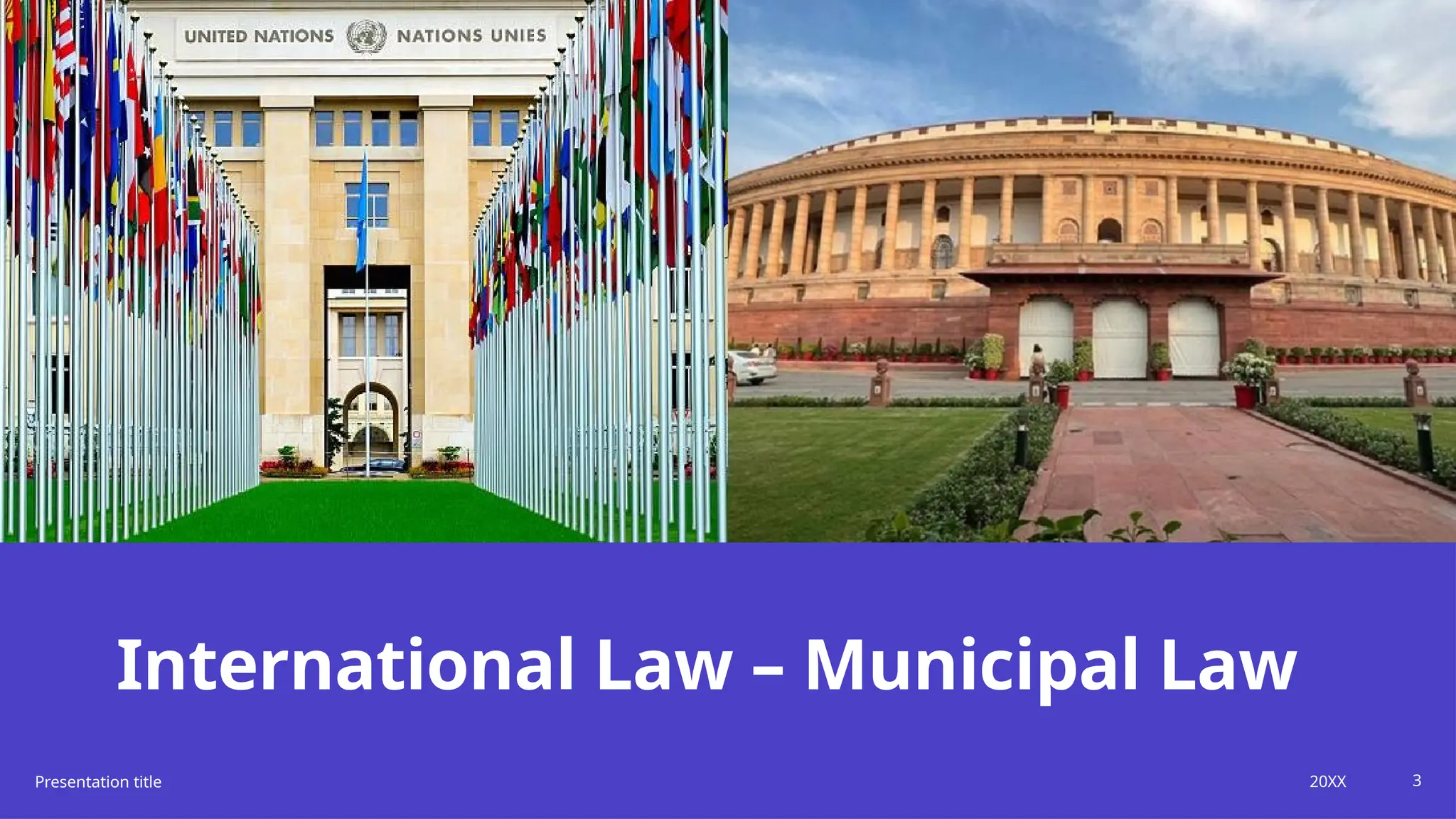
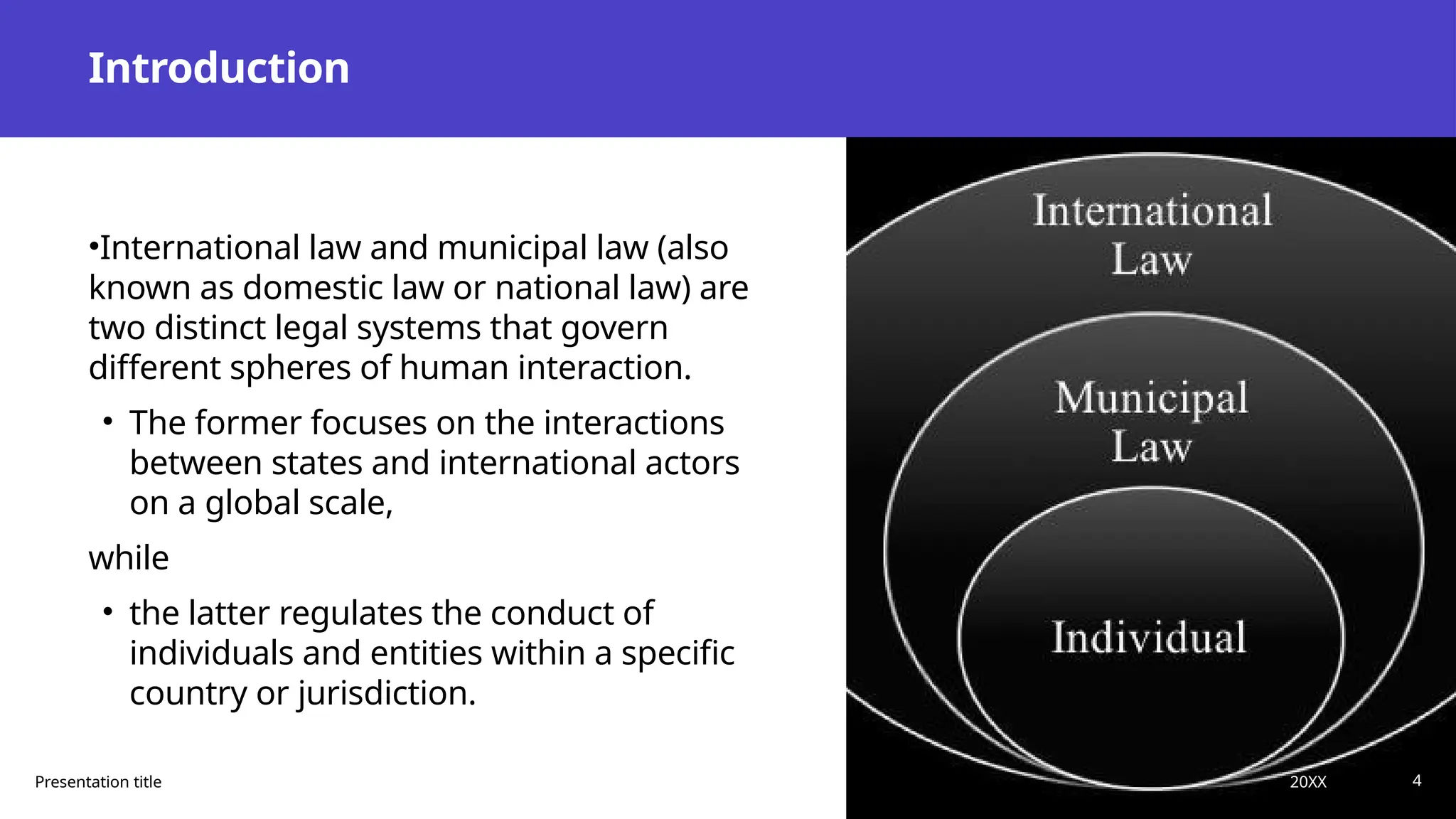
•International law andmunicipal law (also
known as domestic law or national law) are
two distinct legal systems that govern
different spheres of human interaction.
• The former focuses on the interactions
between states and international actors
on a global scale,
while
• the latter regulates the conduct of
individuals and entities within a specific
country or jurisdiction.
Presentation title 20XX 4
5.
Table of
Differences
Presentation title20XX 5
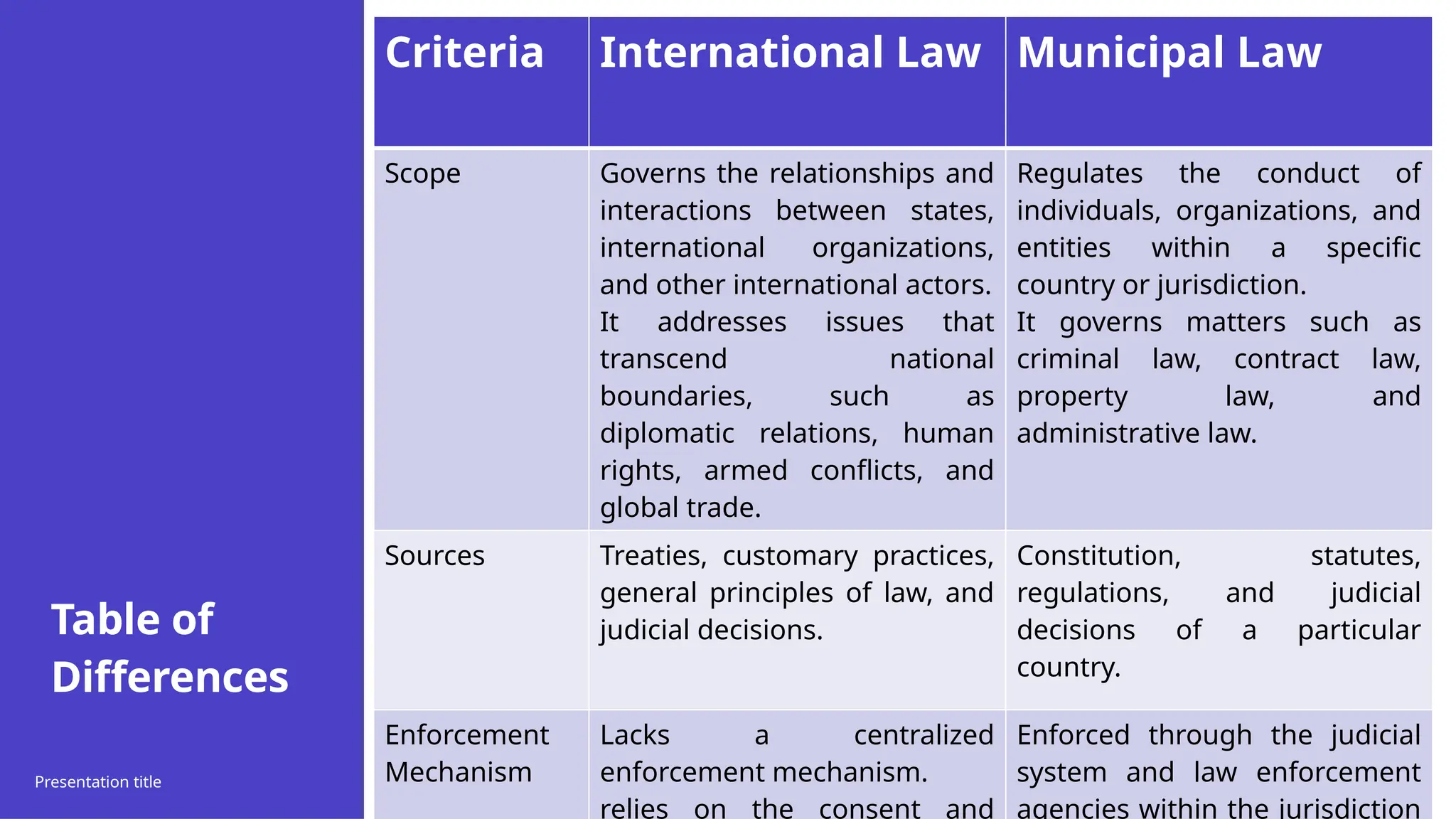
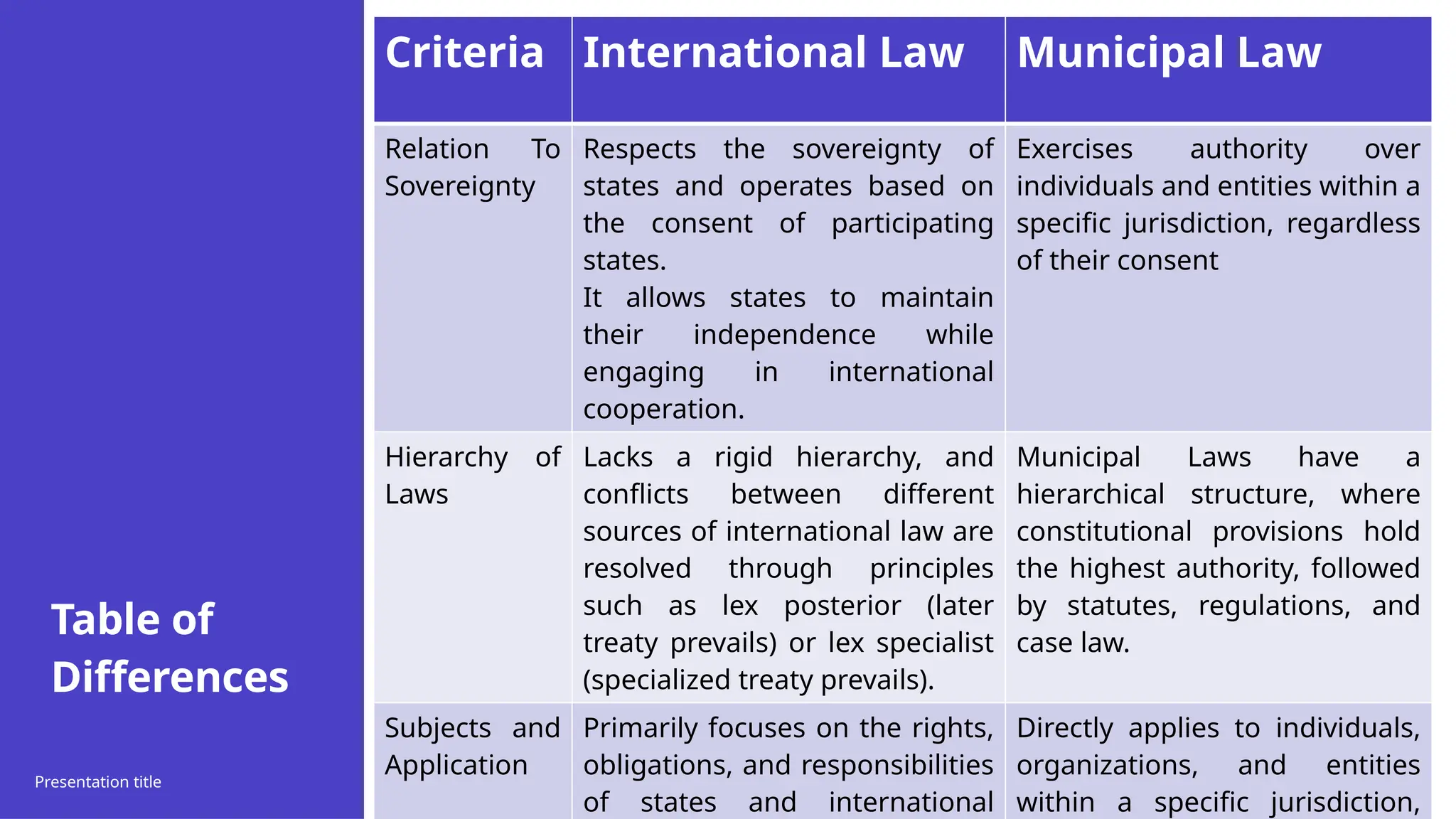
Criteria International Law Municipal Law
Scope Governs the relationships and
interactions between states,
international organizations,
and other international actors.
It addresses issues that
transcend national
boundaries, such as
diplomatic relations, human
rights, armed conflicts, and
global trade.
Regulates the conduct of
individuals, organizations, and
entities within a specific
country or jurisdiction.
It governs matters such as
criminal law, contract law,
property law, and
administrative law.
Sources Treaties, customary practices,
general principles of law, and
judicial decisions.
Constitution, statutes,
regulations, and judicial
decisions of a particular
country.
Enforcement
Mechanism
Lacks a centralized
enforcement mechanism.
relies on the consent and
Enforced through the judicial
system and law enforcement
agencies within the jurisdiction
6.
Table of
Differences
Presentation title20XX 6
Criteria International Law Municipal Law
Relation To
Sovereignty
Respects the sovereignty of
states and operates based on
the consent of participating
states.
It allows states to maintain
their independence while
engaging in international
cooperation.
Exercises authority over
individuals and entities within a
specific jurisdiction, regardless
of their consent
Hierarchy of
Laws
Lacks a rigid hierarchy, and
conflicts between different
sources of international law are
resolved through principles
such as lex posterior (later
treaty prevails) or lex specialist
(specialized treaty prevails).
Municipal Laws have a
hierarchical structure, where
constitutional provisions hold
the highest authority, followed
by statutes, regulations, and
case law.
Subjects and
Application
Primarily focuses on the rights,
obligations, and responsibilities
of states and international
Directly applies to individuals,
organizations, and entities
within a specific jurisdiction,
7.
International Law isthe
vanishing point of
Jurisprudence.
Holland
Presentation title 20XX 7
8.
Summary
•International law andmunicipal law
operate in different spheres and govern
distinct aspects of legal relations.
•The differences in scope, sources of law,
enforcement mechanisms, relationship
to sovereignty, hierarchy of laws, and
subjects highlight the distinct nature
and application of these two legal
systems.
Presentation title 20XX 8
Introduction
•Public law andprivate law are two main
branches of law that govern different aspects of
society and relationships between individuals
and entities.
•Public law is concerned with the legal
relationship between individuals and the state
•While
•Private law, also known as civil law, governs the
relationships and interactions between
individuals
Presentation title 20XX 10
11.
Table of
Differences
Presentation title20XX 11
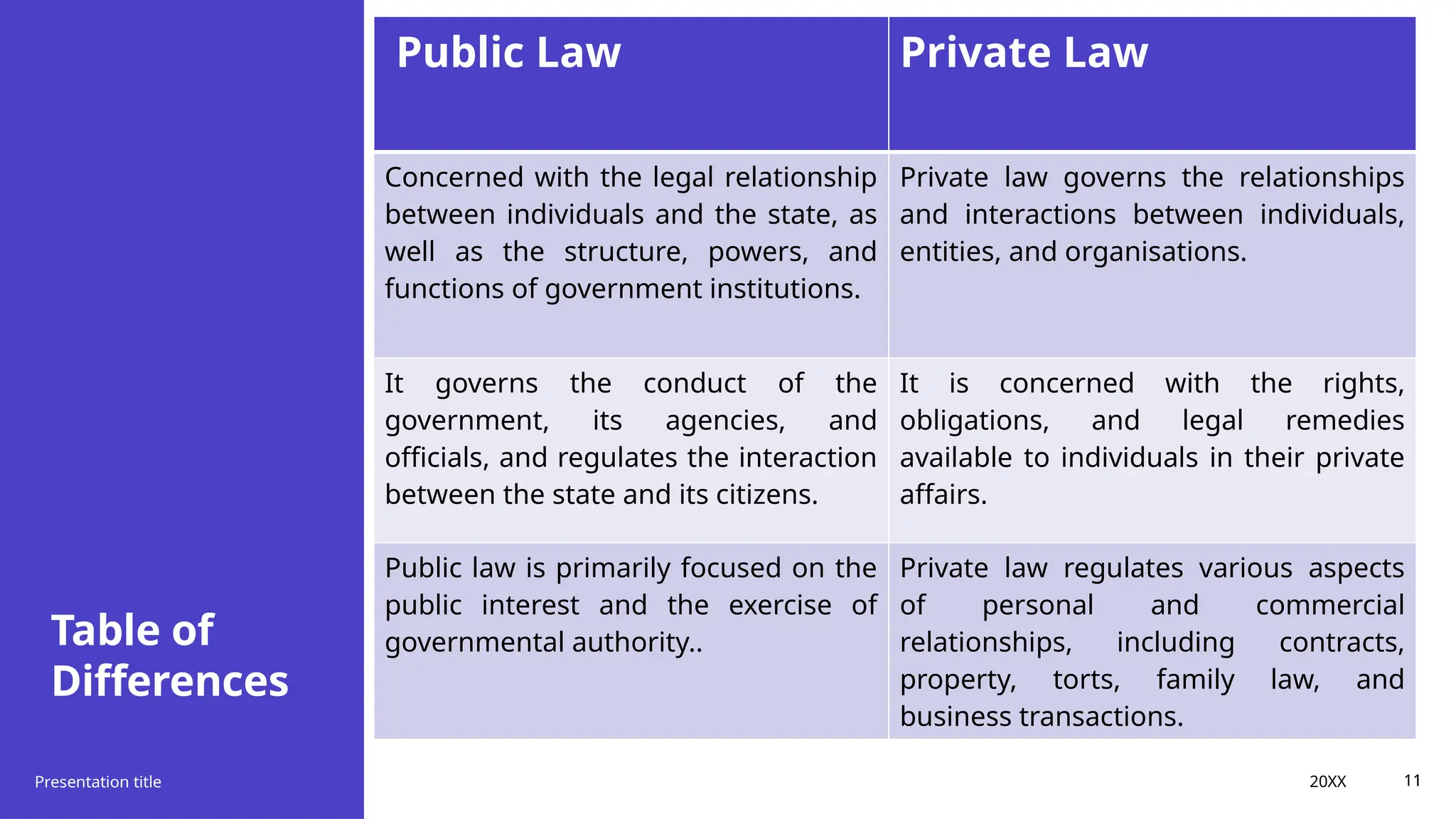
Public Law Private Law
Concerned with the legal relationship
between individuals and the state, as
well as the structure, powers, and
functions of government institutions.
Private law governs the relationships
and interactions between individuals,
entities, and organisations.
It governs the conduct of the
government, its agencies, and
officials, and regulates the interaction
between the state and its citizens.
It is concerned with the rights,
obligations, and legal remedies
available to individuals in their private
affairs.
Public law is primarily focused on the
public interest and the exercise of
governmental authority..
Private law regulates various aspects
of personal and commercial
relationships, including contracts,
property, torts, family law, and
business transactions.
12.
Table of
Differences
Presentation title20XX 12
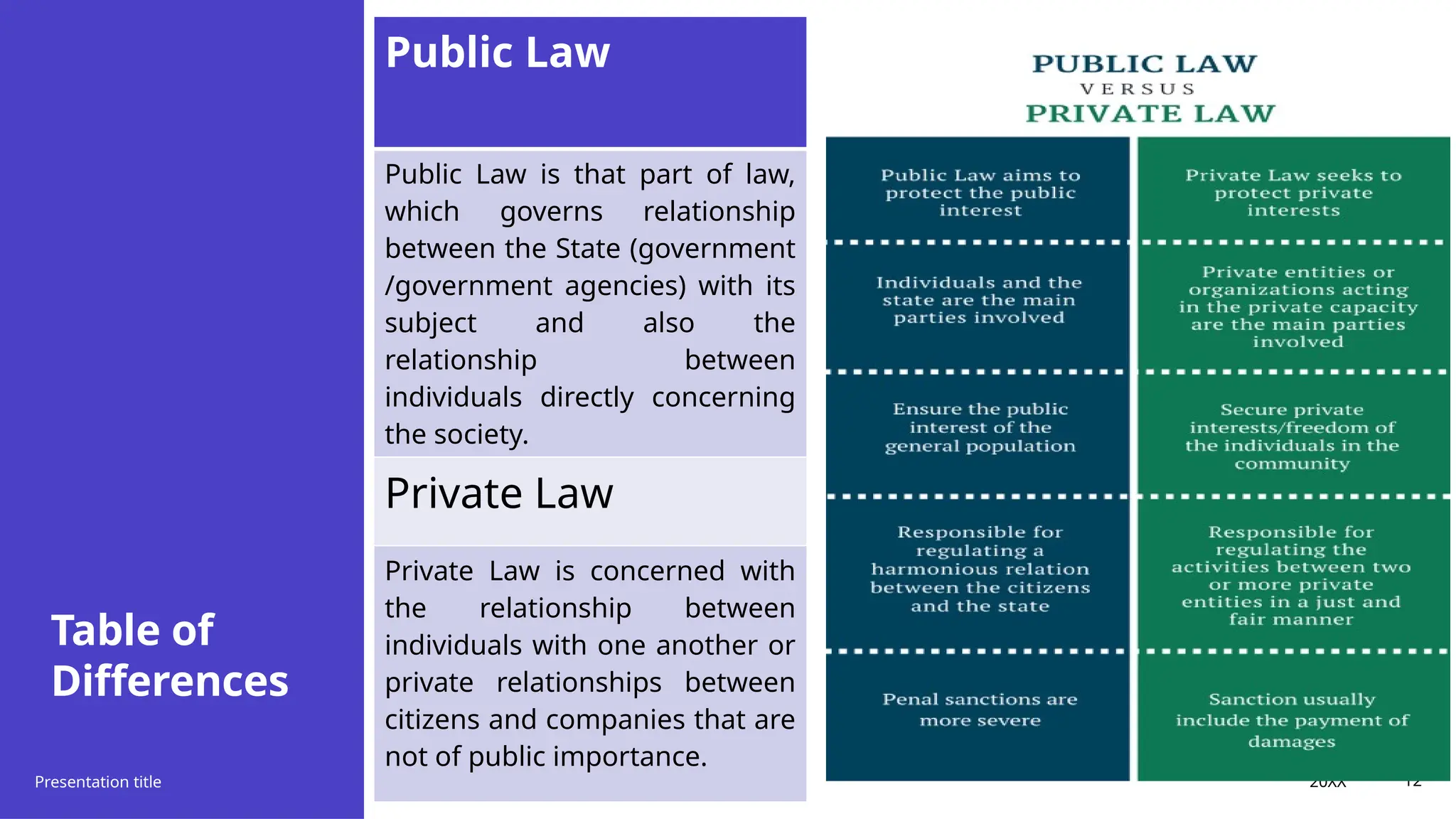
Public Law
Public Law is that part of law,
which governs relationship
between the State (government
/government agencies) with its
subject and also the
relationship between
individuals directly concerning
the society.
Private Law
Private Law is concerned with
the relationship between
individuals with one another or
private relationships between
citizens and companies that are
not of public importance.
13.
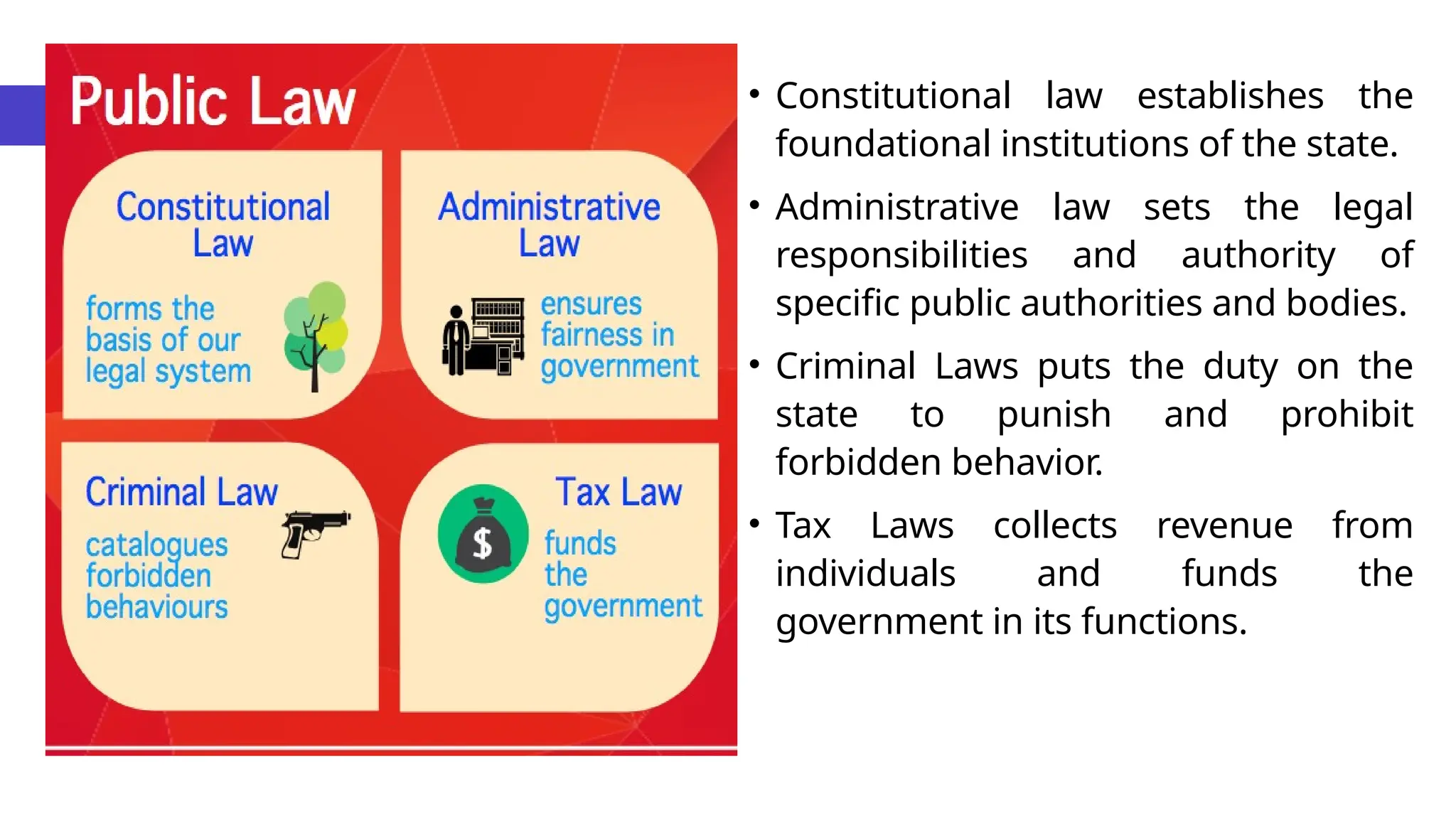
• Constitutional lawestablishes the
foundational institutions of the state.
• Administrative law sets the legal
responsibilities and authority of
specific public authorities and bodies.
• Criminal Laws puts the duty on the
state to punish and prohibit
forbidden behavior.
• Tax Laws collects revenue from
individuals and funds the
government in its functions.
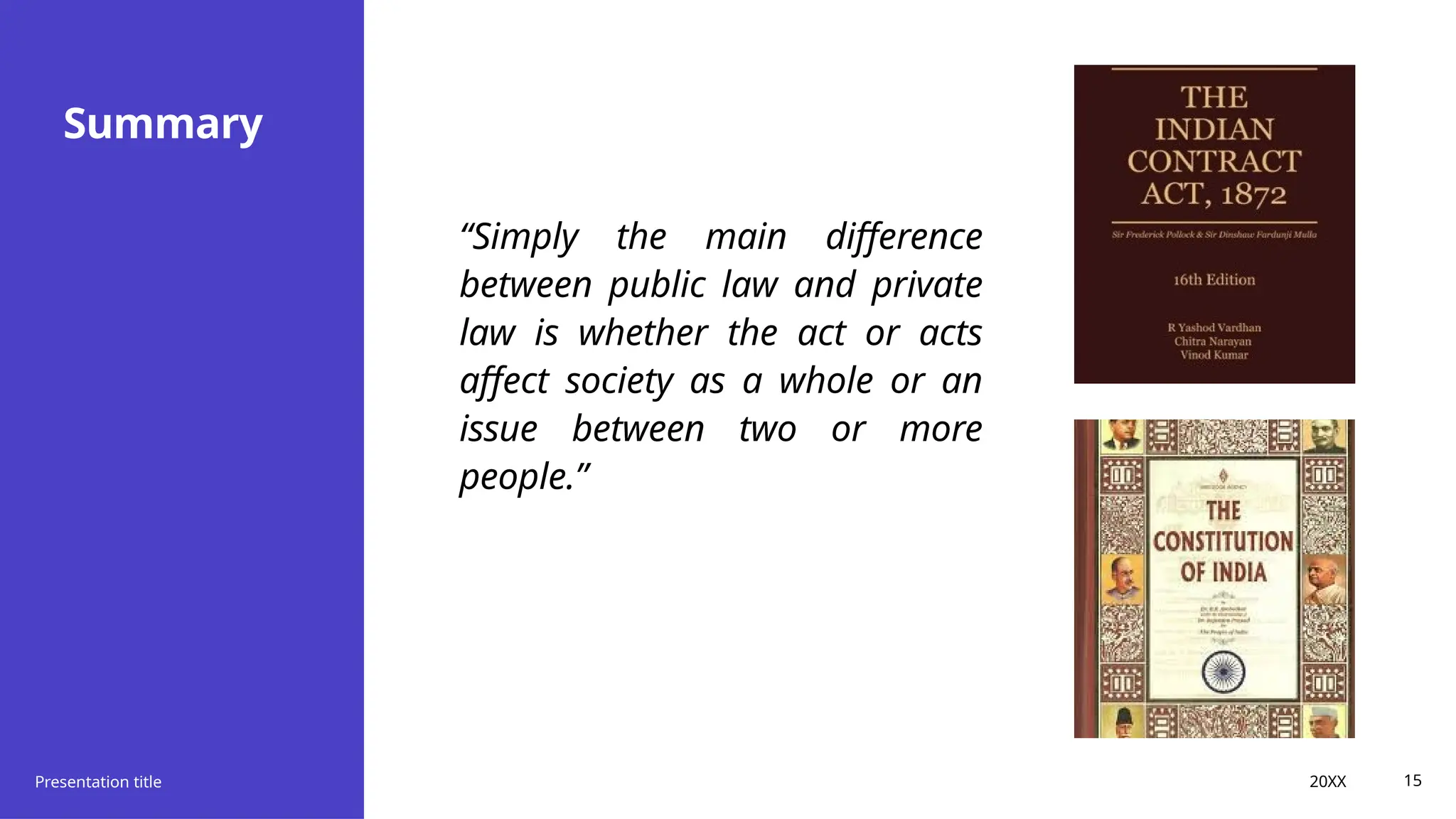
Summary
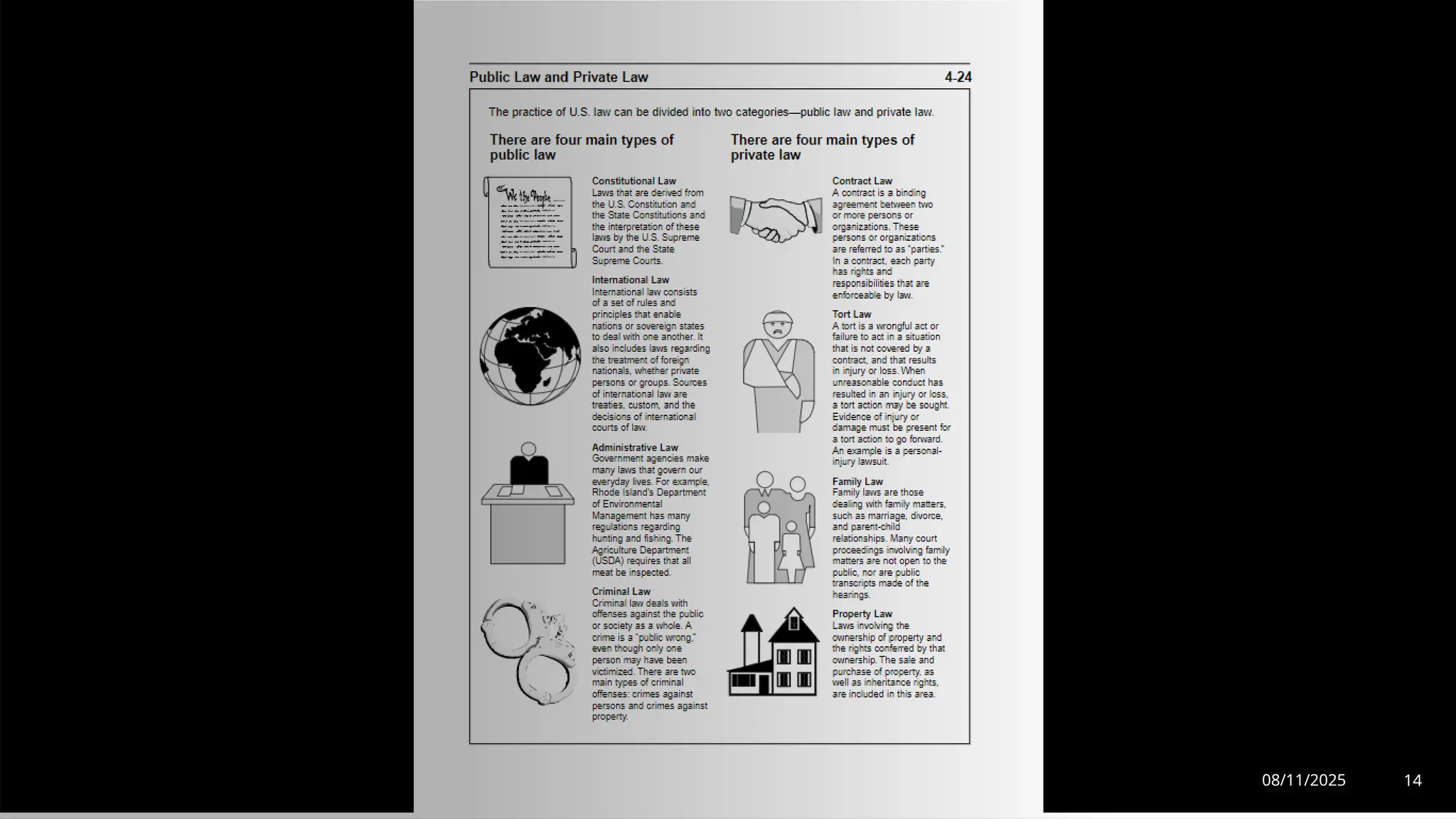
“Simply the maindifference
between public law and private
law is whether the act or acts
affect society as a whole or an
issue between two or more
people.”
Presentation title 20XX 15
Introduction
•Laws are classifiedinto two groups procedural law and
substantive law.
•The Procedural law administers the operation of a
particular case, by conforming to the step-by-step
process through which the case passes.
•On the contrary, the substantive law can be defined as
one that comprises of statutory rules passed by the
legislature, through the process of enactment,
regulating the conduct of citizens. It talks about the
structure and facts of the lawsuit.
Presentation title 20XX 17
18.
Table of
Differences
Presentation title20XX 18
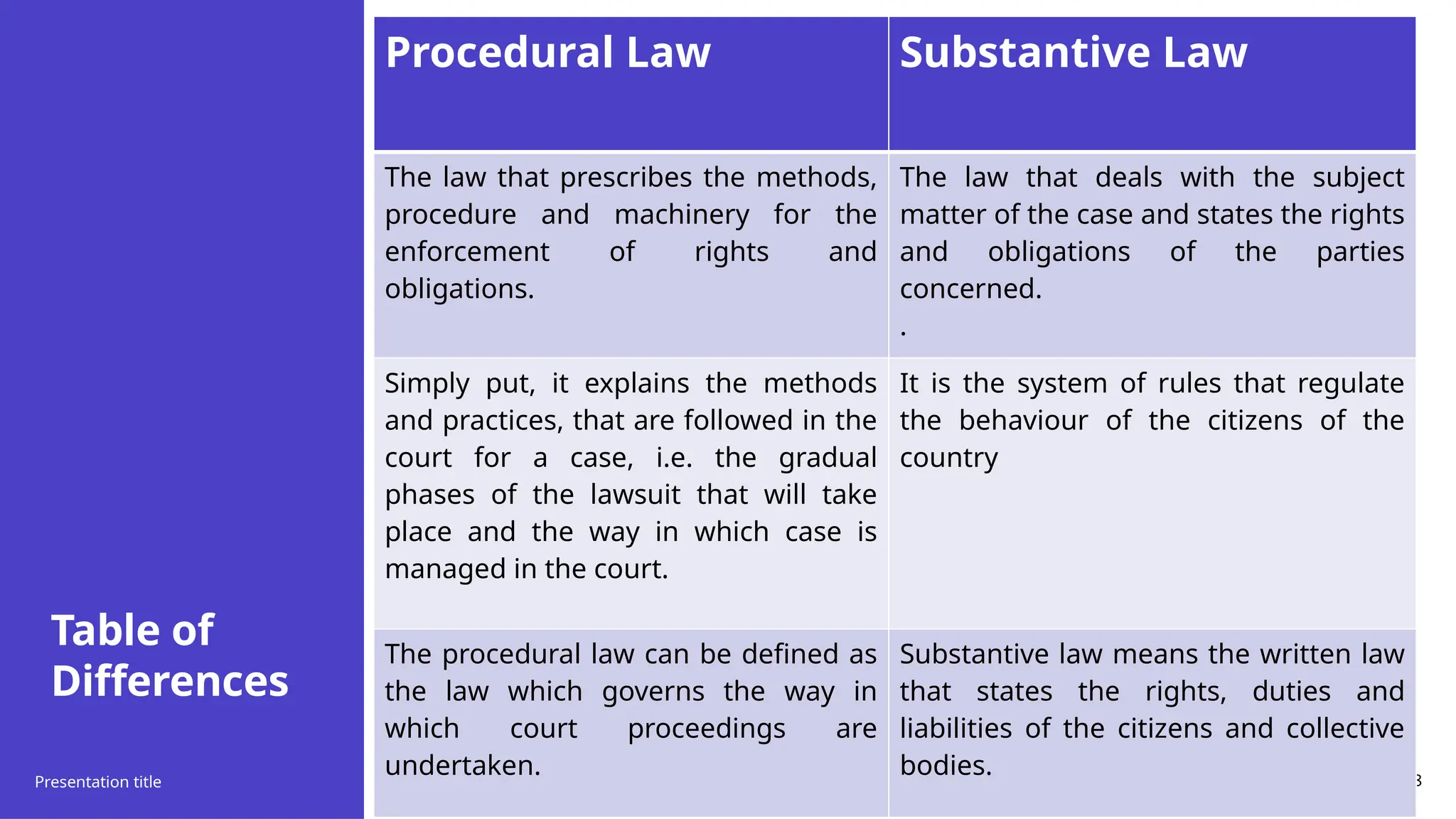
Procedural Law Substantive Law
The law that prescribes the methods,
procedure and machinery for the
enforcement of rights and
obligations.
The law that deals with the subject
matter of the case and states the rights
and obligations of the parties
concerned.
.
Simply put, it explains the methods
and practices, that are followed in the
court for a case, i.e. the gradual
phases of the lawsuit that will take
place and the way in which case is
managed in the court.
It is the system of rules that regulate
the behaviour of the citizens of the
country
The procedural law can be defined as
the law which governs the way in
which court proceedings are
undertaken.
Substantive law means the written law
that states the rights, duties and
liabilities of the citizens and collective
bodies.
19.
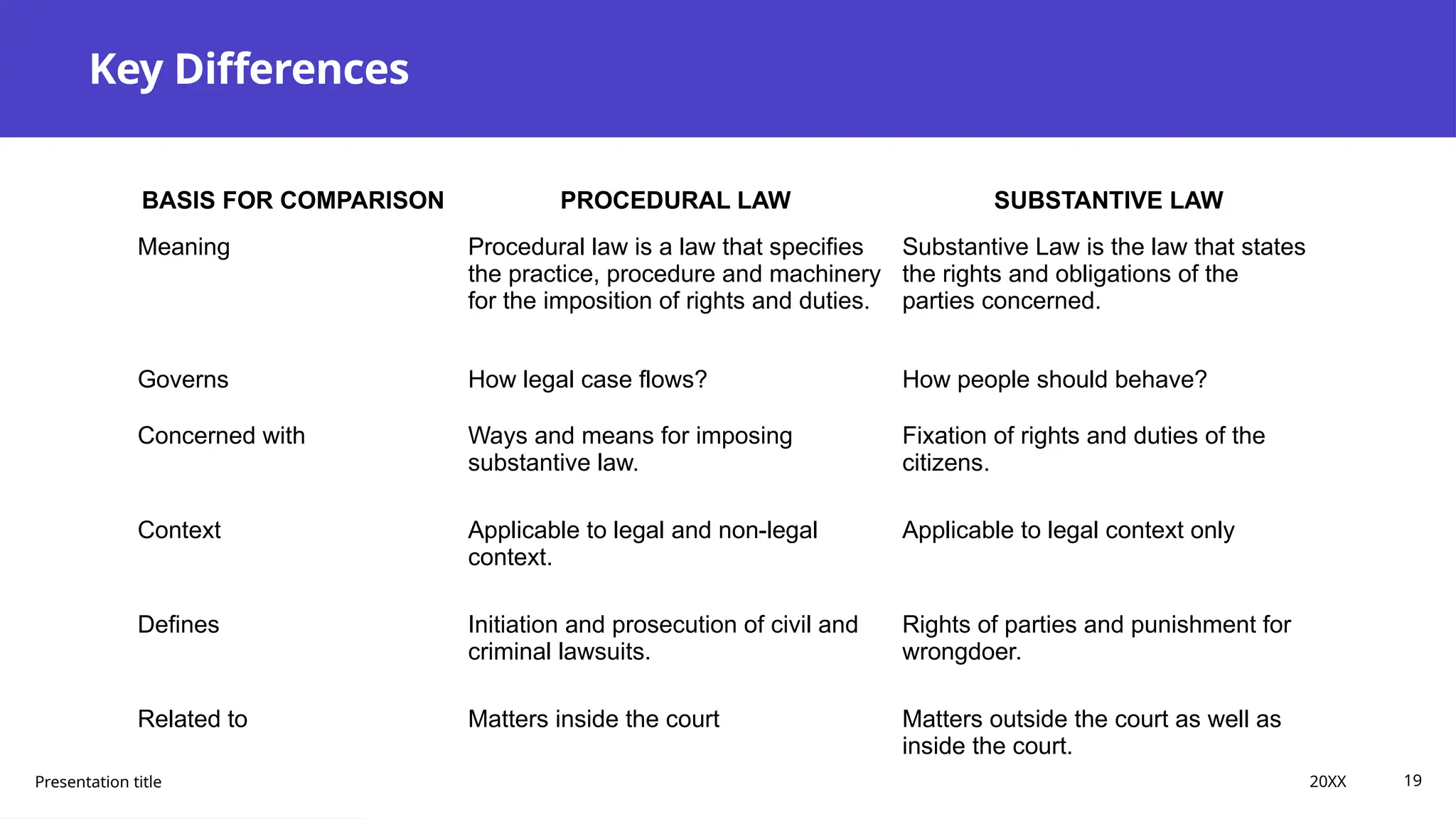
Key Differences
Presentation title20XX 19
BASIS FOR COMPARISON PROCEDURAL LAW SUBSTANTIVE LAW
Meaning Procedural law is a law that specifies
the practice, procedure and machinery
for the imposition of rights and duties.
Substantive Law is the law that states
the rights and obligations of the
parties concerned.
Governs How legal case flows? How people should behave?
Concerned with Ways and means for imposing
substantive law.
Fixation of rights and duties of the
citizens.
Context Applicable to legal and non-legal
context.
Applicable to legal context only
Defines Initiation and prosecution of civil and
criminal lawsuits.
Rights of parties and punishment for
wrongdoer.
Related to Matters inside the court Matters outside the court as well as
inside the court.
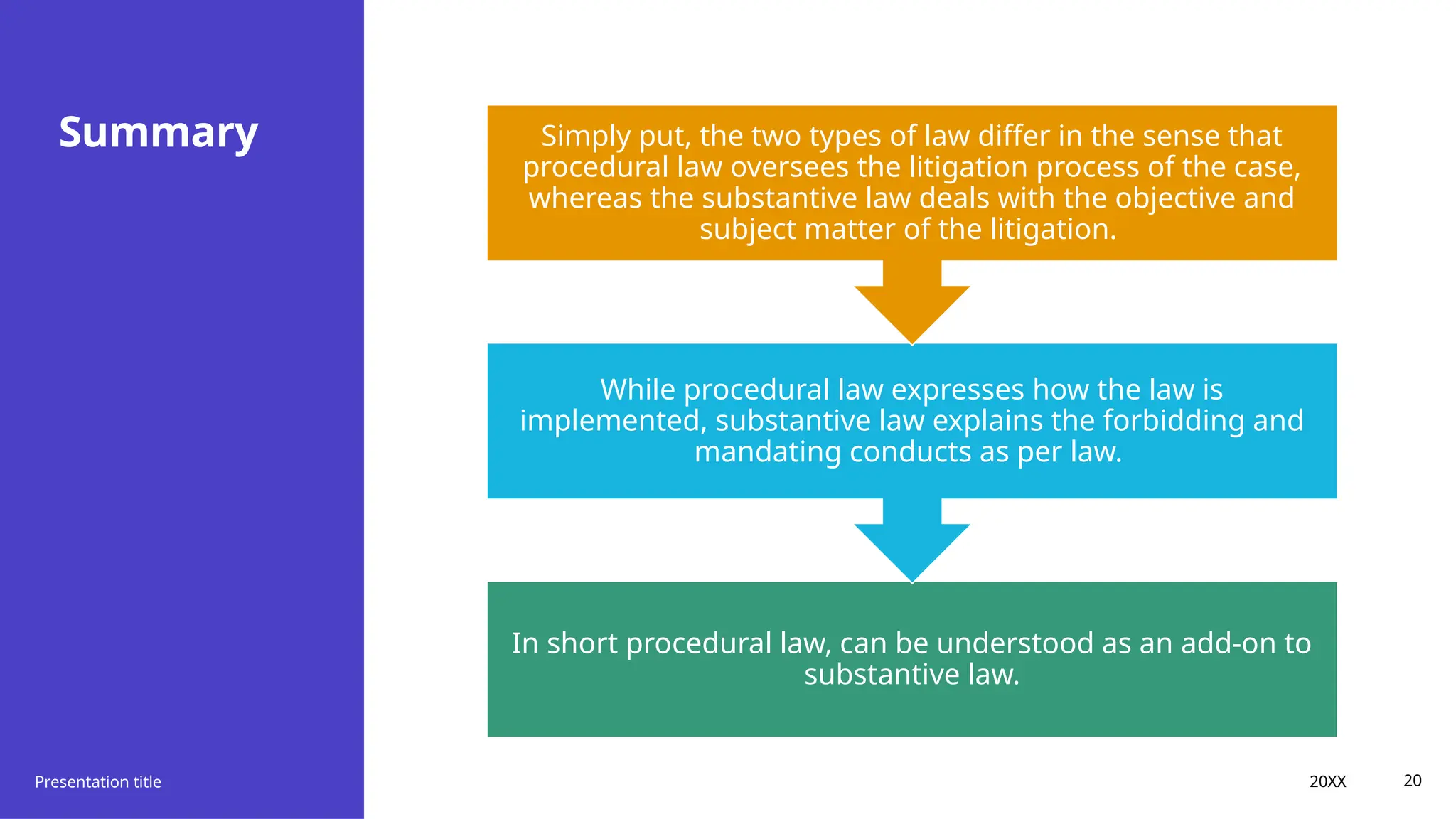
20.
Summary
Presentation title 20XX20
In short procedural law, can be understood as an add-on to
substantive law.
While procedural law expresses how the law is
implemented, substantive law explains the forbidding and
mandating conducts as per law.
Simply put, the two types of law differ in the sense that
procedural law oversees the litigation process of the case,
whereas the substantive law deals with the objective and
subject matter of the litigation.
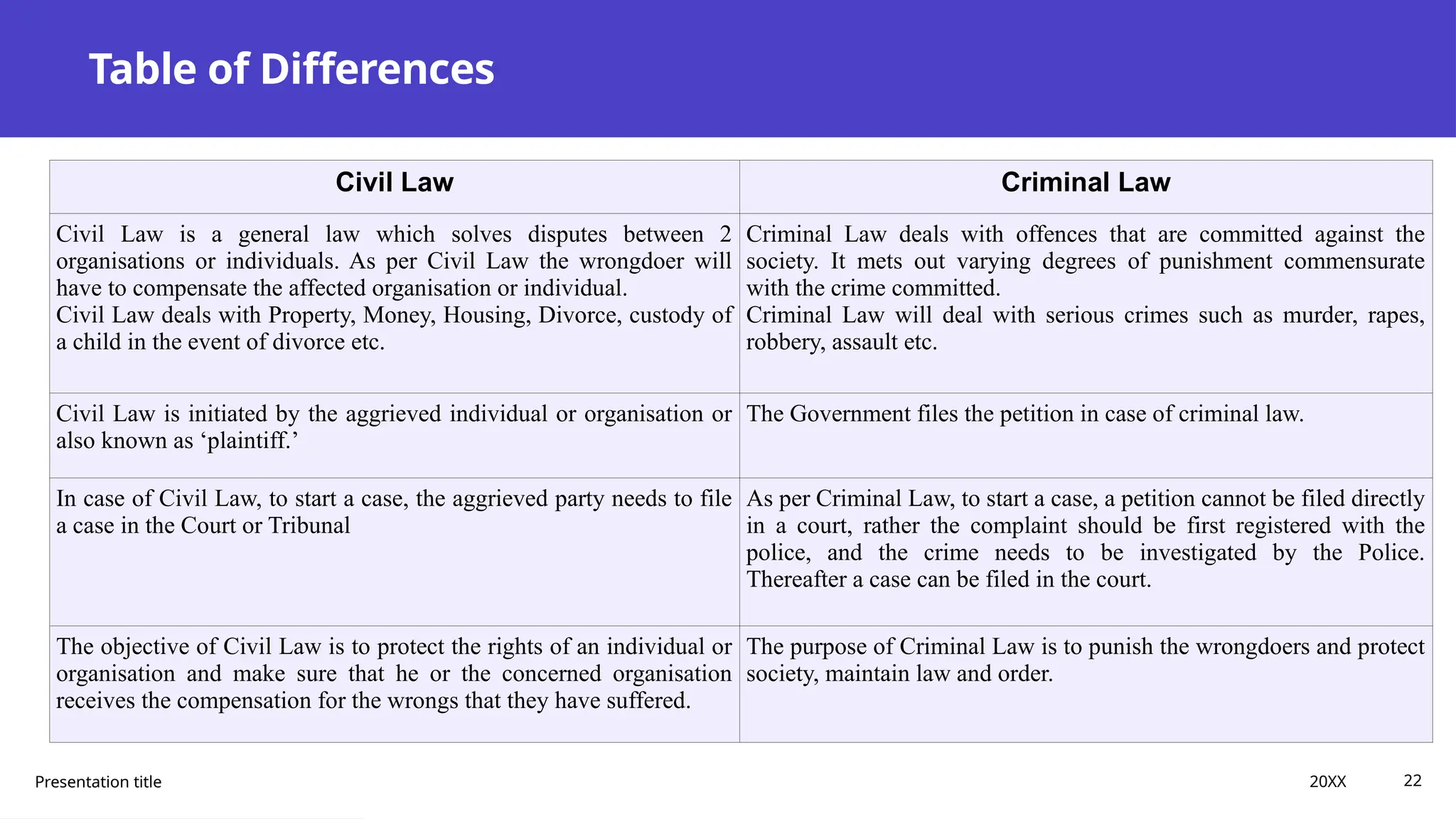
Table of Differences
Presentationtitle 20XX 22
Civil Law Criminal Law
Civil Law is a general law which solves disputes between 2
organisations or individuals. As per Civil Law the wrongdoer will
have to compensate the affected organisation or individual.
Civil Law deals with Property, Money, Housing, Divorce, custody of
a child in the event of divorce etc.
Criminal Law deals with offences that are committed against the
society. It mets out varying degrees of punishment commensurate
with the crime committed.
Criminal Law will deal with serious crimes such as murder, rapes,
robbery, assault etc.
Civil Law is initiated by the aggrieved individual or organisation or
also known as ‘plaintiff.’
The Government files the petition in case of criminal law.
In case of Civil Law, to start a case, the aggrieved party needs to file
a case in the Court or Tribunal
As per Criminal Law, to start a case, a petition cannot be filed directly
in a court, rather the complaint should be first registered with the
police, and the crime needs to be investigated by the Police.
Thereafter a case can be filed in the court.
The objective of Civil Law is to protect the rights of an individual or
organisation and make sure that he or the concerned organisation
receives the compensation for the wrongs that they have suffered.
The purpose of Criminal Law is to punish the wrongdoers and protect
society, maintain law and order.
23.
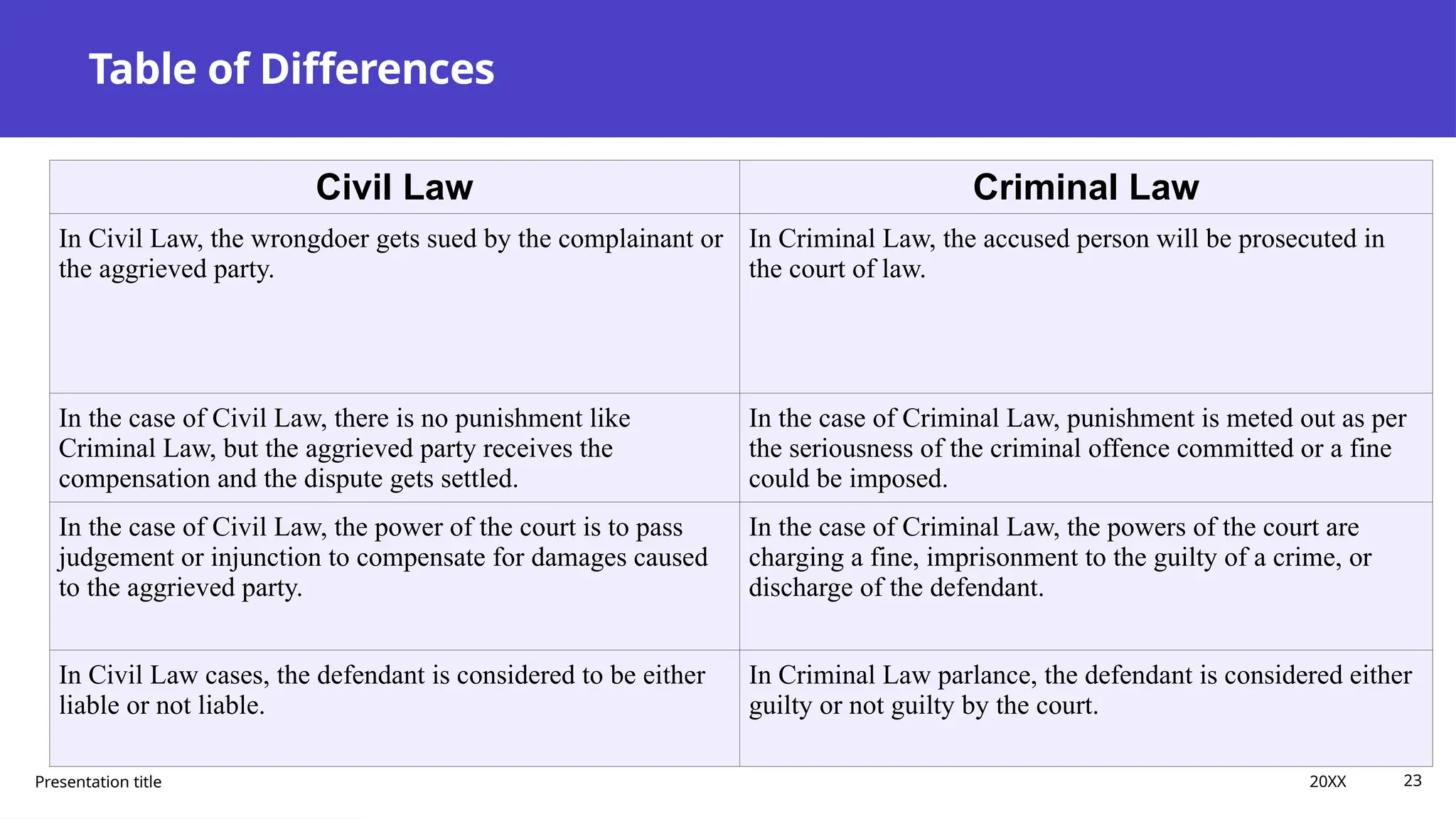
Table of Differences
Presentationtitle 20XX 23
Civil Law Criminal Law
In Civil Law, the wrongdoer gets sued by the complainant or
the aggrieved party.
In Criminal Law, the accused person will be prosecuted in
the court of law.
In the case of Civil Law, there is no punishment like
Criminal Law, but the aggrieved party receives the
compensation and the dispute gets settled.
In the case of Criminal Law, punishment is meted out as per
the seriousness of the criminal offence committed or a fine
could be imposed.
In the case of Civil Law, the power of the court is to pass
judgement or injunction to compensate for damages caused
to the aggrieved party.
In the case of Criminal Law, the powers of the court are
charging a fine, imprisonment to the guilty of a crime, or
discharge of the defendant.
In Civil Law cases, the defendant is considered to be either
liable or not liable.
In Criminal Law parlance, the defendant is considered either
guilty or not guilty by the court.
Introductio
n
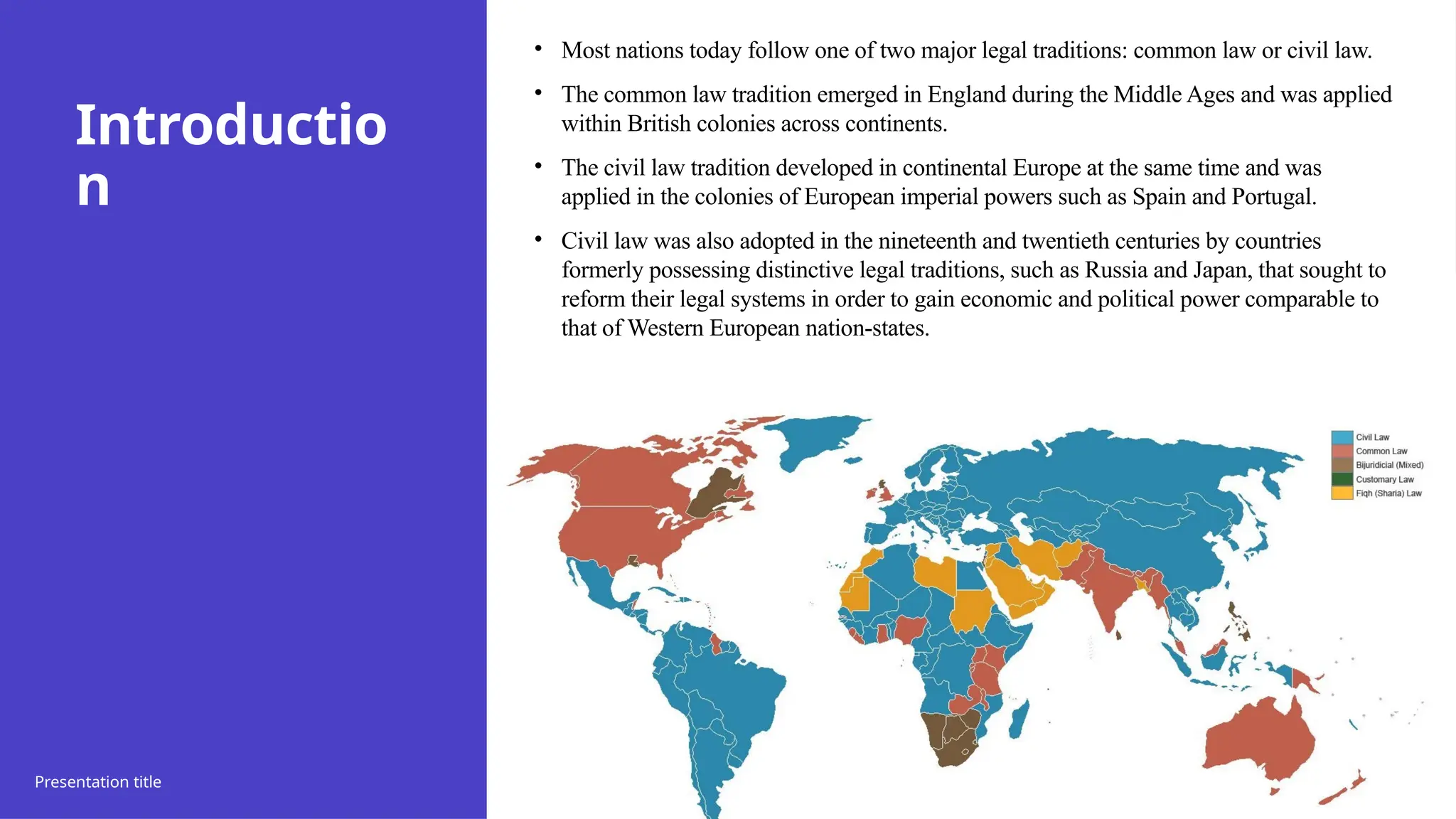
• Most nationstoday follow one of two major legal traditions: common law or civil law.
• The common law tradition emerged in England during the Middle Ages and was applied
within British colonies across continents.
• The civil law tradition developed in continental Europe at the same time and was
applied in the colonies of European imperial powers such as Spain and Portugal.
• Civil law was also adopted in the nineteenth and twentieth centuries by countries
formerly possessing distinctive legal traditions, such as Russia and Japan, that sought to
reform their legal systems in order to gain economic and political power comparable to
that of Western European nation-states.
Presentation title 20XX 25
26.
Common Law
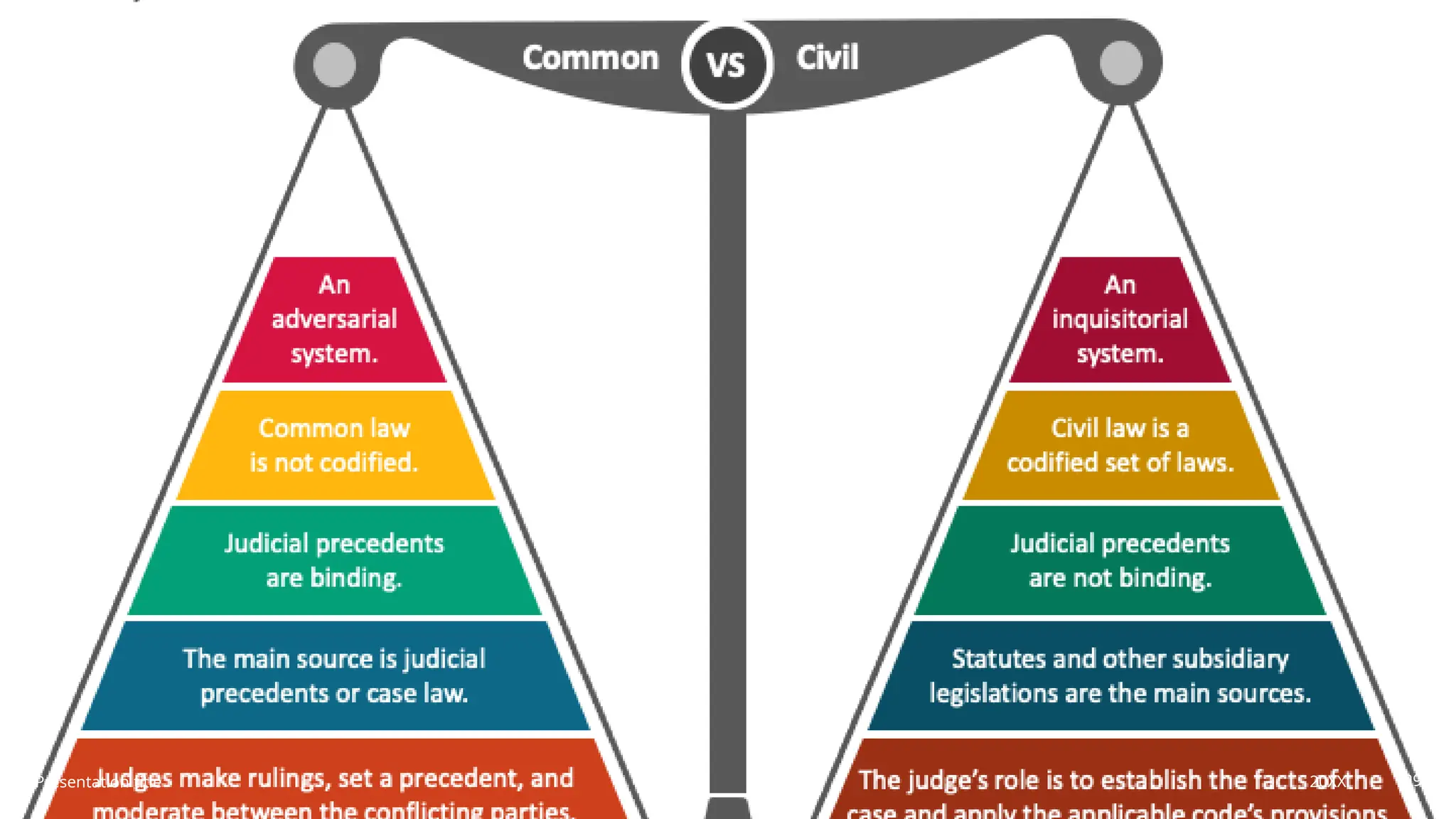
• Commonlaw is generally uncodified.
• This means that there is no comprehensive compilation of legal rules and statutes.
While common law does rely on some scattered statutes, which are legislative
decisions, it is largely based on precedent, meaning the judicial decisions that
have already been made in similar cases.
• These precedents are maintained over time through the records of the courts as
well as historically documented in collections of case law known as yearbooks
and reports. The precedents to be applied in the decision of each new case are
determined by the presiding judge.
• As a result, judges have an enormous role in shaping American and British law.
Common law functions as an adversarial system, a contest between two opposing
parties before a judge who moderates.
• A jury of ordinary people without legal training decides on the facts of the case.
The judge then determines the appropriate sentence based on the jury’s verdict.
Presentation title 20XX 26
27.
Civil Law
• CivilLaw, in contrast, is codified. Countries with civil law systems have
comprehensive, continuously updated legal codes that specify all matters
capable of being brought before a court, the applicable procedure, and the
appropriate punishment for each offense.
• Such codes distinguish between different categories of law: substantive
law establishes which acts are subject to criminal or civil prosecution,
procedural law establishes how to determine whether a particular action
constitutes a criminal act, and penal law establishes the appropriate
penalty.
• In a civil law system, the judge’s role is to establish the facts of the case
and to apply the provisions of the applicable code. Though the judge
often brings the formal charges, investigates the matter, and decides on
the case, he or she works within a framework established by a
comprehensive, codified set of laws.
• The judge’s decision is consequently less crucial in shaping civil law than
the decisions of legislators and legal scholars who draft and interpret the
codes.
Presentation title 20XX 27
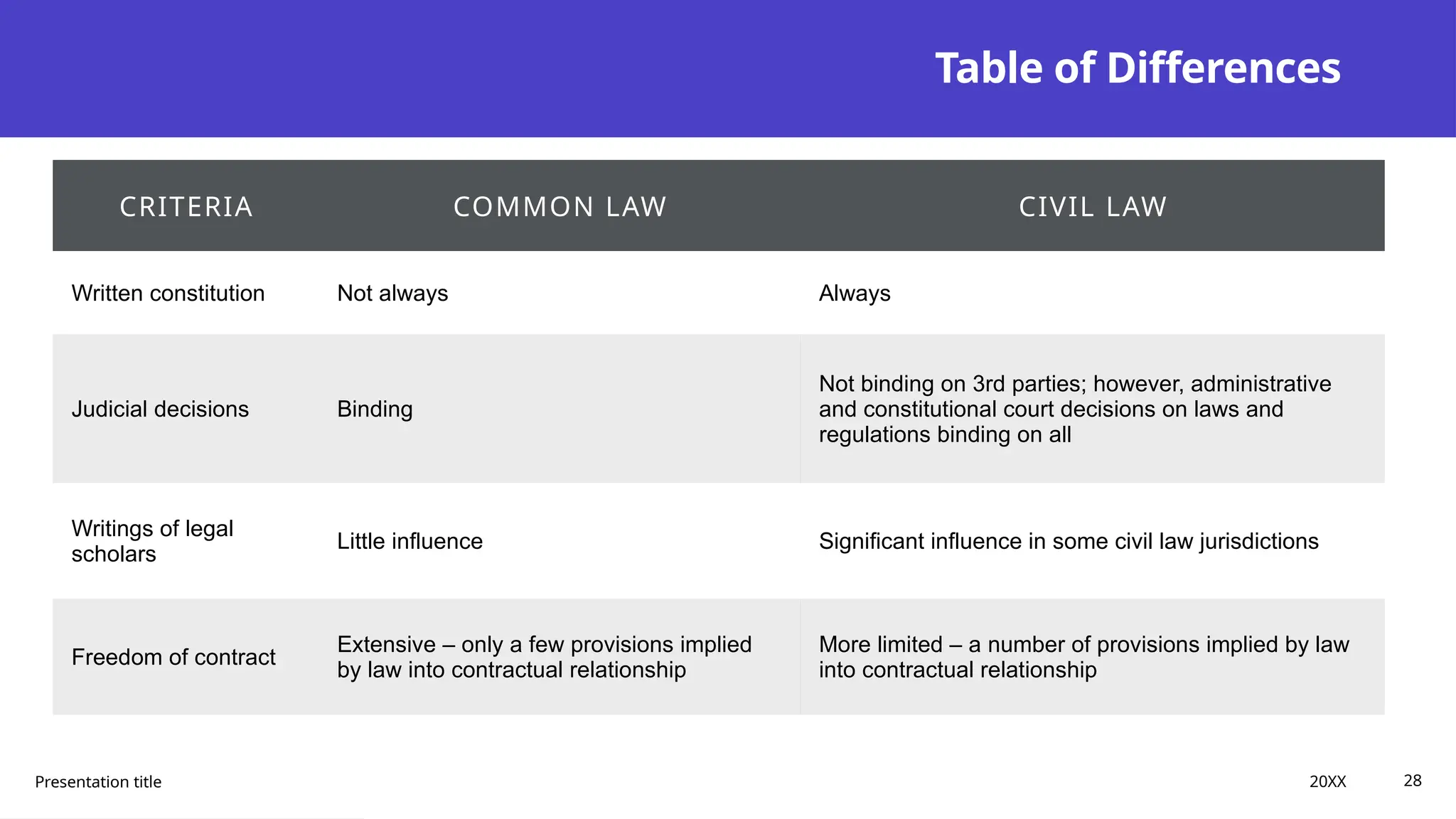
28.
Table of Differences
Presentationtitle 20XX 28
CRITERIA COMMON LAW CIVIL LAW
Written constitution Not always Always
Judicial decisions Binding
Not binding on 3rd parties; however, administrative
and constitutional court decisions on laws and
regulations binding on all
Writings of legal
scholars
Little influence Significant influence in some civil law jurisdictions
Freedom of contract
Extensive – only a few provisions implied
by law into contractual relationship
More limited – a number of provisions implied by law
into contractual relationship