University of Management and Technology (UMT)
Human Side – Cognition Framework
Human-Computer Interaction
In the Last Lecture
 Factors in HCI
 Usability and Quality
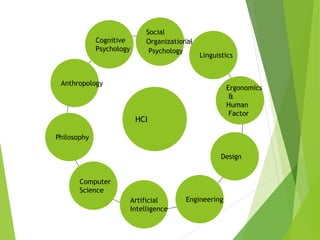
 Interdisciplinary nature of HCI
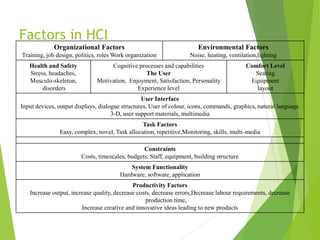
Factors in HCI
Organizational Factors
Training, job design, politics, roles Work organization
Environmental Factors
Noise, heating, ventilation,lighting
Health and Safety
Stress, headaches,
Musculo-skeleton,
disorders
Cognitive processes and capabilities
The User
Motivation, Enjoyment, Satisfaction, Personality
Experience level
Comfort Level
Seating
Equipment
layout
User Interface
Input devices, output displays, dialogue structures, User of colour, icons, commands, graphics, natural language
3-D, user support materials, multimedia
Task Factors
Easy, complex, novel, Task allocation, repetitive,Monitoring, skills, multi-media
Constraints
Costs, timescales, budgets, Staff, equipment, building structure
System Functionality
Hardware, software, application
Productivity Factors
Increase output, increase quality, decrease costs, decrease errors,Decrease labour requirements, decrease
production time,
Increase creative and innovative ideas leading to new products
Anthropology
Artificial
Intelligence
Engineering
Design
Ergonomics
&
Human
Factor
Linguistics
Social
Organizational
Psychology
Philosophy
Computer
Science
Cognitive
Psychology
HCI
Quote from Last Lecture – Terry
Winograd
“HCI is the kind of discipline which is neither the study of humans nor the study of
technology, but rather the bridging between the two. So you always have to
have one eye open to the questions:
 What can the technology do?
 How can you build it ?
 What are the possibilities?
And one eye open to the question”
 What are people doing and how would this fit in
 What would they do with it ?
If you lose sight of either of those you fail to design well .. I think the challenge is
to really keep knowledge of both the technology and the people playng ff
against each other in order to develop new things”
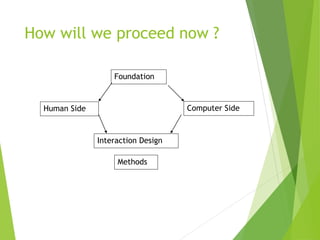
How will we proceed now ?
Foundation
Human Side Computer Side
Interaction Design
Methods
In Today’s Lecture – Human
Side
 Cognition
 Cognitive Framework
Going for a Drive
 Driving a Car with a Keyboard
 Steering with Arrow keys
 Brake – Space bar
 Acceleration – Enter
 Indicators
 Left – F1
 Right – F2
 Horn – F3
 Headlights – F4
 Windscreen Wipe – F5
Going for a Drive
 Driving along on Highway
 Suddenly a Cow comes in front
 What do you do ?
 What are your chances of survival
Cognitive Psychology
 Psychology primarily concerned with human behavior and the mental
processes that underlie it.
 It is primarily concerned with information processing
Cognition
 The process by which we became acquainted with things or in other words
gain knowledge
 Understanding
 Remembering
 Reasoning
 Attending
 Creating a new idea
 How Humans and Computers interact with one another in terms of
knowledge transmitted by them
Cognition
 Also described in terms of specific process
 Attention
 Perception
 Memory
 Learning
 Reading, speaking and listening
 Problem solving, planning, reasoning, decision making
Experiential and Reflective
 Experiential
 We perceive, act and react to events around us effectively
 Identify the cognitions shown in previous as experiential
 Driving a car, reading
 Reflective
 Involves thinking, comparing, and decision making
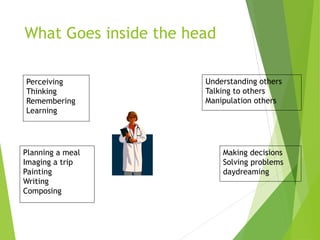
What Goes inside the head
Perceiving
Thinking
Remembering
Learning
Planning a meal
Imaging a trip
Painting
Writing
Composing
Understanding others
Talking to others
Manipulation others
Making decisions
Solving problems
daydreaming
Information Processing …
 Lets look at how humans process
information
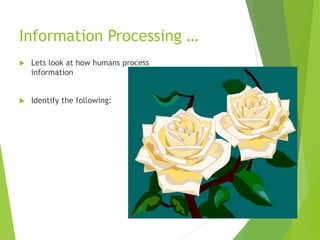
 Identify the following:
So what was it ?
 Was it :
 An elephant ?
 A Tiger
 An Apple
 Roses
 Roses Of course
Information Processing
Analysis
 Trace mental operations
 Example Retrieving a friends phone number
 Identifying friends Name
 Retrieving meaning of words
 Understanding the meaning of set of words given in the exercise
 Retrieve number from memory
 Generate plan and formulate the answer
 Recite digits or write them down
How come we all Recognized
them as Roses
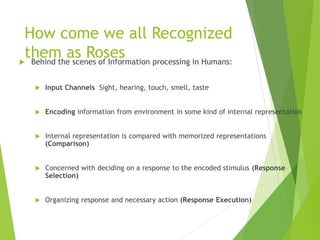
 Behind the scenes of Information processing in Humans:
 Input Channels Sight, hearing, touch, smell, taste
 Encoding information from environment in some kind of internal representation
 Internal representation is compared with memorized representations
(Comparison)
 Concerned with deciding on a response to the encoded stimulus (Response
Selection)
 Organizing response and necessary action (Response Execution)
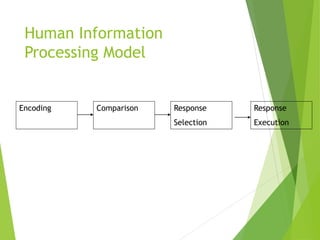
Human Information
Processing Model
Encoding Comparison Response
Selection
Response
Execution
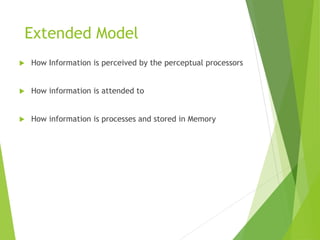
Extended Model
 How Information is perceived by the perceptual processors
 How information is attended to
 How information is processes and stored in Memory
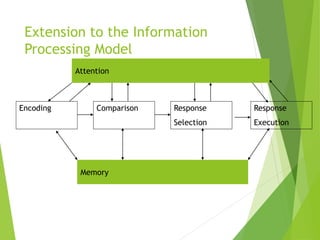
Extension to the Information
Processing Model
Encoding Comparison Response
Selection
Response
Execution
Memory
Attention
Human Processor Model
 Helps Conceptualize human behavior
 Models of users: Model human Processor
 Perceptual System
 Motor System
 Cognitive System
Models
 Human Information Processing Models
 Human Processor Models (Qualitative Model)
 These models assume that is based solely upon mental activities
GOMS (Quantitative)
 Goals
 Operators
 Methods
 Selection Rules
More Models
 Knowledge Representation Models
 Mental Models
 User Interaction Learning Models
 Apply to HCI through
 Conceptual Models
 Interface Models
Other Approaches
 Computational Approach
 Computer metaphor as theoretical framework
 Emphasis on
 What is important is processed
 What is involved when information is processed rather then how and when.
 Conceptualization of the goals planning and action in terms of task performance
is done.
More Frameworks
 External Cognition
 Language Action Framework
 Distributed Cognition
Connectionist Approach
 Neural network or parallel distributed approach
 Rejects computer metaphor
 Adopts brain metaphor
External Cognition
 Externalizing to reduce memory load
 Computational offloading
 Annotating and Cognitive tracing
External Cognition -
Externalizing
 Knowledge is transformed into external representations
 Example birthdays
 Phone numbers
 Addresses
 Appointments
 Talk about Ghalib tying knots to remember whatever verses he created at
night
External Cognition –
Computational Offload
 Computational Offloading
 Try the following
 2 X 3
 12 X 15
 12387 X 9875
External Cognition – Annotating and
Cognitive Tracing
 Annotating and Cognitive tracing
 Modify representation to reflect changes that are taking place
 Annotating
 Cognitive Tracing
Information Visualization
Beyond Cognitive framework
 Where do you think the framework lacks?
 Lack of consideration for other aspects
 How people interact with each other
 How people interact with objects other than Computer system.
 In Short Context
Distributed Cognitive
framework
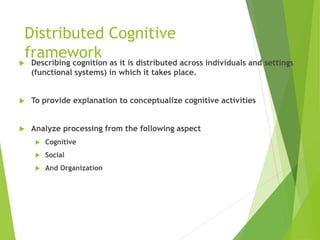
 Describing cognition as it is distributed across individuals and settings
(functional systems) in which it takes place.
 To provide explanation to conceptualize cognitive activities
 Analyze processing from the following aspect
 Cognitive
 Social
 And Organization
Distributed Cognitive
framework
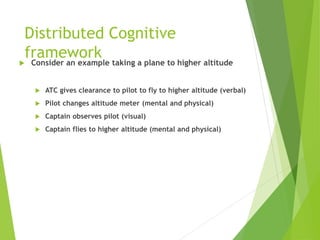
 Consider an example taking a plane to higher altitude
 ATC gives clearance to pilot to fly to higher altitude (verbal)
 Pilot changes altitude meter (mental and physical)
 Captain observes pilot (visual)
 Captain flies to higher altitude (mental and physical)
Language Action Framework
Summarize
 In the Next Lecture
 Talk about Input Channels

LEC-6.ppt

  • 1.
    University of Managementand Technology (UMT) Human Side – Cognition Framework Human-Computer Interaction
  • 2.
    In the LastLecture  Factors in HCI  Usability and Quality  Interdisciplinary nature of HCI
  • 3.
    Factors in HCI OrganizationalFactors Training, job design, politics, roles Work organization Environmental Factors Noise, heating, ventilation,lighting Health and Safety Stress, headaches, Musculo-skeleton, disorders Cognitive processes and capabilities The User Motivation, Enjoyment, Satisfaction, Personality Experience level Comfort Level Seating Equipment layout User Interface Input devices, output displays, dialogue structures, User of colour, icons, commands, graphics, natural language 3-D, user support materials, multimedia Task Factors Easy, complex, novel, Task allocation, repetitive,Monitoring, skills, multi-media Constraints Costs, timescales, budgets, Staff, equipment, building structure System Functionality Hardware, software, application Productivity Factors Increase output, increase quality, decrease costs, decrease errors,Decrease labour requirements, decrease production time, Increase creative and innovative ideas leading to new products
  • 4.
  • 5.
    Quote from LastLecture – Terry Winograd “HCI is the kind of discipline which is neither the study of humans nor the study of technology, but rather the bridging between the two. So you always have to have one eye open to the questions:  What can the technology do?  How can you build it ?  What are the possibilities? And one eye open to the question”  What are people doing and how would this fit in  What would they do with it ? If you lose sight of either of those you fail to design well .. I think the challenge is to really keep knowledge of both the technology and the people playng ff against each other in order to develop new things”
  • 6.
    How will weproceed now ? Foundation Human Side Computer Side Interaction Design Methods
  • 7.
    In Today’s Lecture– Human Side  Cognition  Cognitive Framework
  • 8.
    Going for aDrive  Driving a Car with a Keyboard  Steering with Arrow keys  Brake – Space bar  Acceleration – Enter  Indicators  Left – F1  Right – F2  Horn – F3  Headlights – F4  Windscreen Wipe – F5
  • 9.
    Going for aDrive  Driving along on Highway  Suddenly a Cow comes in front  What do you do ?  What are your chances of survival
  • 10.
    Cognitive Psychology  Psychologyprimarily concerned with human behavior and the mental processes that underlie it.  It is primarily concerned with information processing
  • 11.
    Cognition  The processby which we became acquainted with things or in other words gain knowledge  Understanding  Remembering  Reasoning  Attending  Creating a new idea  How Humans and Computers interact with one another in terms of knowledge transmitted by them
  • 12.
    Cognition  Also describedin terms of specific process  Attention  Perception  Memory  Learning  Reading, speaking and listening  Problem solving, planning, reasoning, decision making
  • 13.
    Experiential and Reflective Experiential  We perceive, act and react to events around us effectively  Identify the cognitions shown in previous as experiential  Driving a car, reading  Reflective  Involves thinking, comparing, and decision making
  • 14.
    What Goes insidethe head Perceiving Thinking Remembering Learning Planning a meal Imaging a trip Painting Writing Composing Understanding others Talking to others Manipulation others Making decisions Solving problems daydreaming
  • 15.
    Information Processing … Lets look at how humans process information  Identify the following:
  • 16.
    So what wasit ?  Was it :  An elephant ?  A Tiger  An Apple  Roses  Roses Of course
  • 17.
    Information Processing Analysis  Tracemental operations  Example Retrieving a friends phone number  Identifying friends Name  Retrieving meaning of words  Understanding the meaning of set of words given in the exercise  Retrieve number from memory  Generate plan and formulate the answer  Recite digits or write them down
  • 18.
    How come weall Recognized them as Roses  Behind the scenes of Information processing in Humans:  Input Channels Sight, hearing, touch, smell, taste  Encoding information from environment in some kind of internal representation  Internal representation is compared with memorized representations (Comparison)  Concerned with deciding on a response to the encoded stimulus (Response Selection)  Organizing response and necessary action (Response Execution)
  • 19.
    Human Information Processing Model EncodingComparison Response Selection Response Execution
  • 20.
    Extended Model  HowInformation is perceived by the perceptual processors  How information is attended to  How information is processes and stored in Memory
  • 21.
    Extension to theInformation Processing Model Encoding Comparison Response Selection Response Execution Memory Attention
  • 22.
    Human Processor Model Helps Conceptualize human behavior  Models of users: Model human Processor  Perceptual System  Motor System  Cognitive System
  • 23.
    Models  Human InformationProcessing Models  Human Processor Models (Qualitative Model)  These models assume that is based solely upon mental activities
  • 24.
    GOMS (Quantitative)  Goals Operators  Methods  Selection Rules
  • 25.
    More Models  KnowledgeRepresentation Models  Mental Models  User Interaction Learning Models  Apply to HCI through  Conceptual Models  Interface Models
  • 26.
    Other Approaches  ComputationalApproach  Computer metaphor as theoretical framework  Emphasis on  What is important is processed  What is involved when information is processed rather then how and when.  Conceptualization of the goals planning and action in terms of task performance is done.
  • 27.
    More Frameworks  ExternalCognition  Language Action Framework  Distributed Cognition
  • 28.
    Connectionist Approach  Neuralnetwork or parallel distributed approach  Rejects computer metaphor  Adopts brain metaphor
  • 29.
    External Cognition  Externalizingto reduce memory load  Computational offloading  Annotating and Cognitive tracing
  • 30.
    External Cognition - Externalizing Knowledge is transformed into external representations  Example birthdays  Phone numbers  Addresses  Appointments  Talk about Ghalib tying knots to remember whatever verses he created at night
  • 31.
    External Cognition – ComputationalOffload  Computational Offloading  Try the following  2 X 3  12 X 15  12387 X 9875
  • 32.
    External Cognition –Annotating and Cognitive Tracing  Annotating and Cognitive tracing  Modify representation to reflect changes that are taking place  Annotating  Cognitive Tracing
  • 33.
  • 34.
    Beyond Cognitive framework Where do you think the framework lacks?  Lack of consideration for other aspects  How people interact with each other  How people interact with objects other than Computer system.  In Short Context
  • 35.
    Distributed Cognitive framework  Describingcognition as it is distributed across individuals and settings (functional systems) in which it takes place.  To provide explanation to conceptualize cognitive activities  Analyze processing from the following aspect  Cognitive  Social  And Organization
  • 36.
    Distributed Cognitive framework  Consideran example taking a plane to higher altitude  ATC gives clearance to pilot to fly to higher altitude (verbal)  Pilot changes altitude meter (mental and physical)  Captain observes pilot (visual)  Captain flies to higher altitude (mental and physical)
  • 37.
  • 38.
    Summarize  In theNext Lecture  Talk about Input Channels