Download to read offline


![Rule - 1
• Casting is possible
• unsigned *pv;
– char c[5]; c[0] = ‘0’;c[1]=‘1’;c[2]=‘2’;c[3]=‘3’;
– pv = (unsigned *) c;
– printf(“%d %d %d %d %un”,
c[3],c[2],c[1],c[0],*pv);
– In x86 m/c Shall print - 51,50,48,49,858927408
– Little Endian storage of Integers
• Least significant byte in the least address - x86
representation
• Big Endian - Most significant byte in least address - Sun
Sparc
• In Sparc m/c print out shall be 51,50,48,49, 808530483](https://image.slidesharecdn.com/lec25-140303073719-phpapp01/85/Lec25-CS110-Computational-Engineering-3-320.jpg)



![Rule - 5
• One pointer variable can be subtracted from
another provided. It makes sense only if both
points to elements in the same array
–
–
–
–
–
int *pw, *pv, A[100];
pv = &A[51];
pw = &A[75];
printf(“%d”,pw - pv); Ans: 24
printf(“%d”,pv - pw); Ans: -24](https://image.slidesharecdn.com/lec25-140303073719-phpapp01/85/Lec25-CS110-Computational-Engineering-8-320.jpg)
![Rule - 5
• One pointer variable can be subtracted from
another provided. It makes sense only if both
points to elements in the same array
–
–
–
–
–
int *pw, *pv, A[100], B[100];
pv = &A[51];
pw = &B[75];
printf(“%d”,pw - pv); Ans: Not clear
printf(“%d”,pv - pw); Ans: Not clear](https://image.slidesharecdn.com/lec25-140303073719-phpapp01/85/Lec25-CS110-Computational-Engineering-9-320.jpg)
![Rule - 6
• Two pointer variables can be compared if
they point to objects of the same type
– int *pw, *pv;
– pw < pv; pw >= pv; pw <= pv; pw == pv; pw != pv;
pw == NULL
– char c[4]; if (pw < c) … ; gives a Warning
– pw < (int *) c - passes
– (char *) pw < c - also passes](https://image.slidesharecdn.com/lec25-140303073719-phpapp01/85/Lec25-CS110-Computational-Engineering-10-320.jpg)


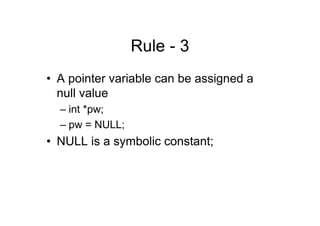
Pointer arithmetic allows pointer variables to be manipulated using arithmetic operations. Some key rules include: 1. A pointer variable can be assigned the address of an ordinary variable using the & operator. Casting is possible between different pointer types. 2. A pointer variable can be assigned the value of another pointer variable if they are of the same type. 3. A pointer variable can be assigned the null value NULL. When manipulating pointers, the type of the pointer variable determines the amount of increment or decrement from arithmetic operations like ++. Pointers can only be subtracted if they point to elements within the same array.


![Pointers [compatibility mode]](https://cdn.slidesharecdn.com/ss_thumbnails/pointerscompatibilitymode-170805133557-thumbnail.jpg?width=640&height=640&fit=bounds)


