Self-improvement for dummies (Machine Learning) COS 116 4/23/2007 Instructor: Umar Syed
Recall your final Scribbler lab Task: Program Scribbler to navigate a maze. Avoid walls, avoid “lava”, head towards the goal. Seemed simple. So why was this so challenging?
Program  Teach  Scribbler to navigate a maze Start with a simple program: Run the maze. Label this trial GOOD or BAD, depending on whether goal was reached. Submit data from the trial to a “learning algorithm”, which uses it to devise a better program. Repeat as needed. Is this how you learned to drive a car? Program Scribbler to navigate a maze
 
Spam filtering How would you define Spam to a computer?  Descriptive approach: “ Any email in ALL CAPS, unless it’s from my kid brother, or that contains the word ‘mortgage’, unless it’s from my real estate agent, …” Difficult to come up with an good description! Learning approach: “ Train” the computer with labeled examples of spam and non-spam (a.k.a. ham) email. Easy to find examples of spam – you probably get hundreds a day!
Today’s lecture: Machine Learning Machine learning = “Programming by example.” Show  the computer what to do, without explaining  how  to do it. The computer programs itself!
Machine Learning (ML): A subfield within Artificial Intelligence (AI). Algorithms that  improve their performance  with experience/data. Closely related to  Data Mining. Data mining = Finding patterns and relationships in data.
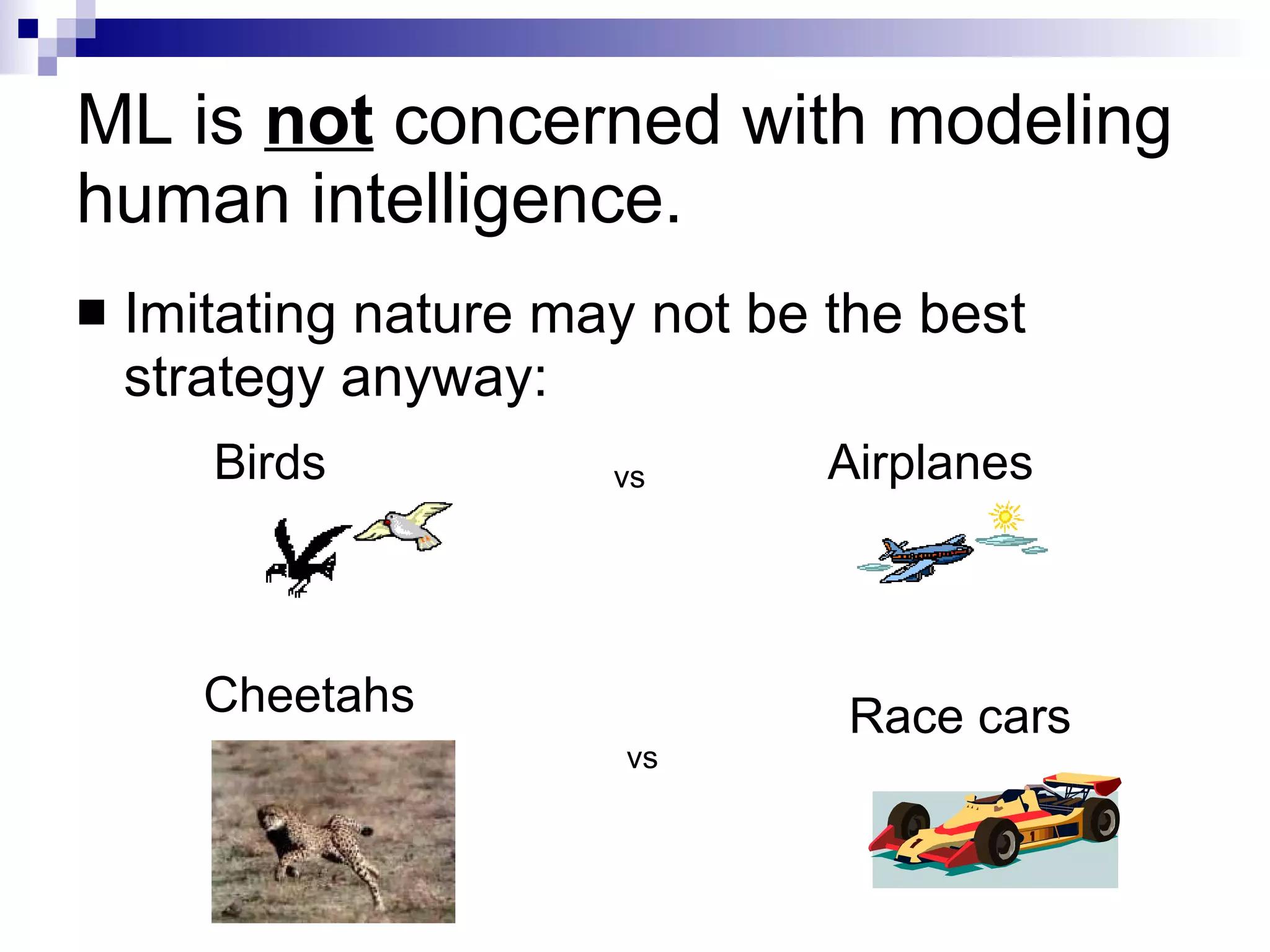
ML is  not  concerned with modeling human intelligence. Imitating nature may not be the best strategy anyway: Birds Airplanes vs Cheetahs Race cars vs
Examples of Machine Learning
Handwriting recognition  [LeCun et al, AT&T, 1998] The LeNet-5 system Trained on a database of 60,000 handwritten digits. Reads about 10% of all the checks cashed in the USA.
Handwriting recognition: LeNet-5 Can recognize weird styles:
Handwriting recognition: LeNet-5 Can handle stray marks and deformations: Mistakes are usually ambiguous anyway:
Image labeling Problem: Searching an image database is hard. How does the computer know what a “sunset” looks like? Solution: Add captions to the images. Google uses the nearby text on the web page. Remember the Image Labeling Game from Lab 1?
Image labeling  [Blei et al, 2003]   Another solution: Learn captions from examples. System trained on a Corel database of 6,000 images with captions. Applied to images without captions. Princeton prof!
 
 
Texture synthesis   [Efros and Leung 2001] Idea: Use examples of a texture to generate similar textures.
Text synthesis Idea: Use example text to generate similar text. Input: 2007 State of the Union Address. Output: “This war is more competitive by strengthening math and science skills. The lives of our nation was attacked, I ask you to make the same standards, and a prompt up-or-down vote on the work we've done and reduce gasoline usage in the NBA.” Even with  no  knowledge of grammar or semantics, output can look (sort of) sensible.
SAT Analogies Remember these? Bird : Feathers :: Fish : ____ Could a computer possibly solve these? Seems to require understanding. Douglas Hofstadter, cognitive scientist, author of  Gödel, Escher, Bach , on cognition: “ [A]nalogy is  everything ,  or very nearly so, in my view.”
SAT Analogies Bird : Feathers :: Fish : ____ Idea: Search the web to learn relationships between words.  [Turney 2004] Example: Is the answer above “water” or “scales”? Most common phrases on the web: “bird  has  feathers”, “bird  in  air”, “fish  has  scales”, “fish  in  water”. Conclusion: Right answer is “scales”.
SAT Analogies  [Turney 2004] On a set of 374 multiple-choice SAT analogies, this approach got 56% correct. High-school seniors on the same set:  57% (!) Q: So are computers intelligent now?
Image Analogies  [Hertzmann, et al 2001] ?
Species Habitat Modeling  [Dudik, Schapire, et al] Problem: Determine where these live: Solution: Use the features of their known habitats to infer new habitats. Example: If we always observe them in warm, rainy places, then infer that that’s where they tend to live. At Princeton!
 
Helicopter flight  [Abbeel et al 2005] Idea: Algorithm learns to pilot a helicopter by observing a human pilot. Results: Even  better  than the human pilot.
Twenty Questions http://www.20q.net
Machine Learning Algorithms -- Details
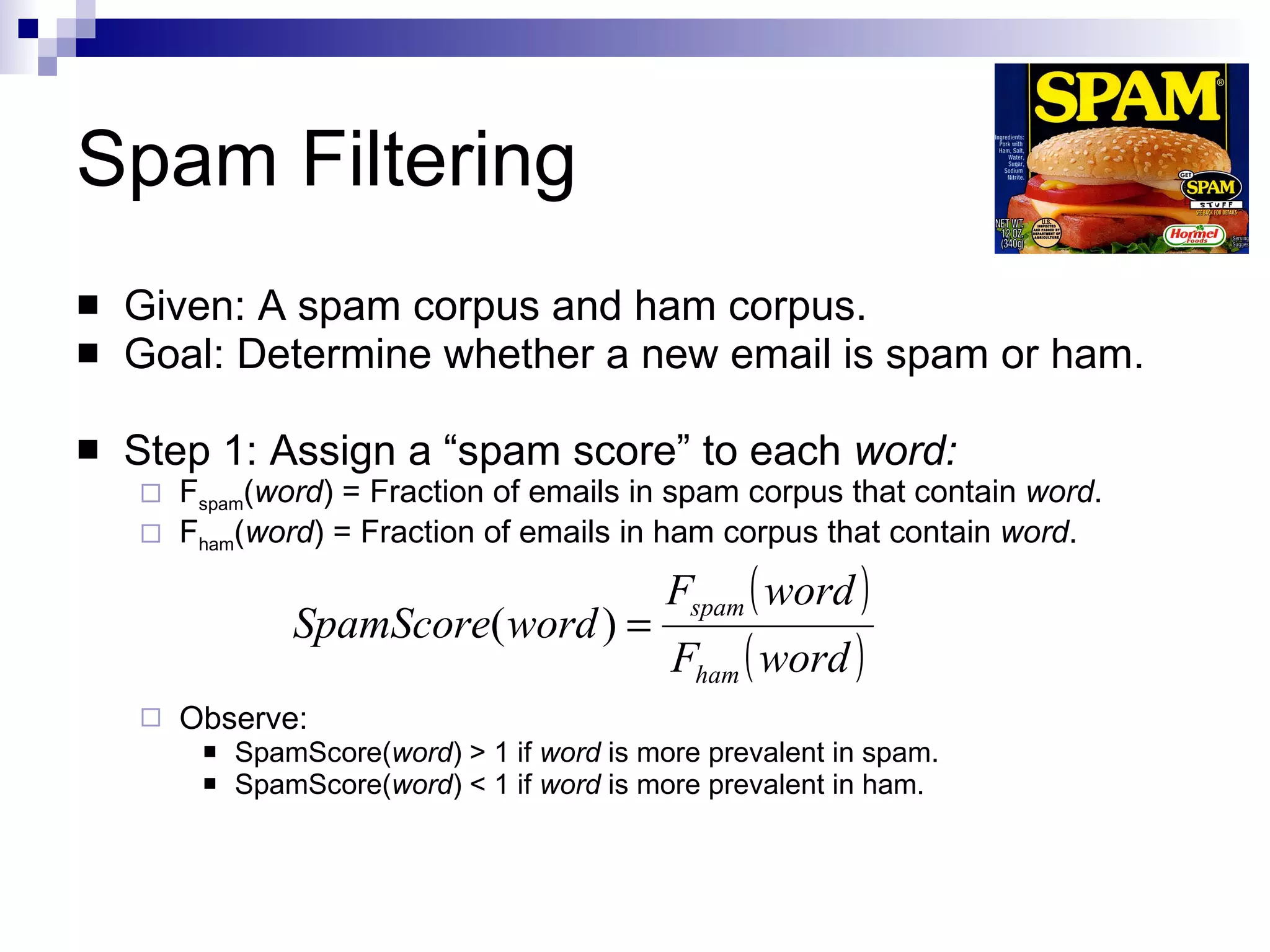
Spam Filtering Given: A spam corpus and ham corpus. Goal: Determine whether a new email is spam or ham. Step 1: Assign a “spam score” to each  word: F spam ( word ) = Fraction of emails in spam corpus that contain  word . F ham ( word ) = Fraction of emails in ham corpus that contain  word . Observe: SpamScore( word ) > 1 if  word  is more prevalent in spam. SpamScore( word ) < 1 if  word  is more prevalent in ham.
Spam Filtering Step 2: Assign a “spam score” to the  email : SpamScore( email ) = SpamScore( word 1 ) x … x SpamScore( word n ), where  word i  is the i th  word in  email . Observe: SpamScore( email ) >> 1 if  email  contains many spammy words. SpamScore( email ) << 1 if  email  contains many hammy words. Step 3: Declare  email  to be spam if SpamScore( email ) is high enough.
Spam Filtering Advantages of this type of spam filter: Though simple, catches 90+% of spam! No explicit definition of spam required. Customized for your email. Adaptive – as spam changes, so does the filter.
Text synthesis Idea: Use example text to generate similar text. Input: 2007 State of the Union Address. Output: “This war is more competitive by strengthening math and science skills. The lives of our nation was attacked, I ask you to make the same standards, and a prompt up-or-down vote on the work we've done and reduce gasoline usage in the NBA.”
Text synthesis How it works: Output one word at a time. Let (v,  w)  be the last two words outputted. Find all occurrences of (v,  w)  in the input text. Of the words following the occurrences of (v, w), output one at random. Repeat. Variants: Last  k  words instead of last two words.
Conclusion Machine learning = Pretty great. Questions? Next week’s lab: You’ll experiment with spam filtering and text generation.

lec21.ppt

  • 1.
    Self-improvement for dummies(Machine Learning) COS 116 4/23/2007 Instructor: Umar Syed
  • 2.
    Recall your finalScribbler lab Task: Program Scribbler to navigate a maze. Avoid walls, avoid “lava”, head towards the goal. Seemed simple. So why was this so challenging?
  • 3.
    Program Teach Scribbler to navigate a maze Start with a simple program: Run the maze. Label this trial GOOD or BAD, depending on whether goal was reached. Submit data from the trial to a “learning algorithm”, which uses it to devise a better program. Repeat as needed. Is this how you learned to drive a car? Program Scribbler to navigate a maze
  • 4.
  • 5.
    Spam filtering Howwould you define Spam to a computer? Descriptive approach: “ Any email in ALL CAPS, unless it’s from my kid brother, or that contains the word ‘mortgage’, unless it’s from my real estate agent, …” Difficult to come up with an good description! Learning approach: “ Train” the computer with labeled examples of spam and non-spam (a.k.a. ham) email. Easy to find examples of spam – you probably get hundreds a day!
  • 6.
    Today’s lecture: MachineLearning Machine learning = “Programming by example.” Show the computer what to do, without explaining how to do it. The computer programs itself!
  • 7.
    Machine Learning (ML):A subfield within Artificial Intelligence (AI). Algorithms that improve their performance with experience/data. Closely related to Data Mining. Data mining = Finding patterns and relationships in data.
  • 8.
    ML is not concerned with modeling human intelligence. Imitating nature may not be the best strategy anyway: Birds Airplanes vs Cheetahs Race cars vs
  • 9.
  • 10.
    Handwriting recognition [LeCun et al, AT&T, 1998] The LeNet-5 system Trained on a database of 60,000 handwritten digits. Reads about 10% of all the checks cashed in the USA.
  • 11.
    Handwriting recognition: LeNet-5Can recognize weird styles:
  • 12.
    Handwriting recognition: LeNet-5Can handle stray marks and deformations: Mistakes are usually ambiguous anyway:
  • 13.
    Image labeling Problem:Searching an image database is hard. How does the computer know what a “sunset” looks like? Solution: Add captions to the images. Google uses the nearby text on the web page. Remember the Image Labeling Game from Lab 1?
  • 14.
    Image labeling [Blei et al, 2003] Another solution: Learn captions from examples. System trained on a Corel database of 6,000 images with captions. Applied to images without captions. Princeton prof!
  • 15.
  • 16.
  • 17.
    Texture synthesis [Efros and Leung 2001] Idea: Use examples of a texture to generate similar textures.
  • 18.
    Text synthesis Idea:Use example text to generate similar text. Input: 2007 State of the Union Address. Output: “This war is more competitive by strengthening math and science skills. The lives of our nation was attacked, I ask you to make the same standards, and a prompt up-or-down vote on the work we've done and reduce gasoline usage in the NBA.” Even with no knowledge of grammar or semantics, output can look (sort of) sensible.
  • 19.
    SAT Analogies Rememberthese? Bird : Feathers :: Fish : ____ Could a computer possibly solve these? Seems to require understanding. Douglas Hofstadter, cognitive scientist, author of Gödel, Escher, Bach , on cognition: “ [A]nalogy is everything , or very nearly so, in my view.”
  • 20.
    SAT Analogies Bird: Feathers :: Fish : ____ Idea: Search the web to learn relationships between words. [Turney 2004] Example: Is the answer above “water” or “scales”? Most common phrases on the web: “bird has feathers”, “bird in air”, “fish has scales”, “fish in water”. Conclusion: Right answer is “scales”.
  • 21.
    SAT Analogies [Turney 2004] On a set of 374 multiple-choice SAT analogies, this approach got 56% correct. High-school seniors on the same set: 57% (!) Q: So are computers intelligent now?
  • 22.
    Image Analogies [Hertzmann, et al 2001] ?
  • 23.
    Image Analogies [Hertzmann, et al 2001] ?
  • 24.
    Species Habitat Modeling [Dudik, Schapire, et al] Problem: Determine where these live: Solution: Use the features of their known habitats to infer new habitats. Example: If we always observe them in warm, rainy places, then infer that that’s where they tend to live. At Princeton!
  • 25.
  • 26.
    Helicopter flight [Abbeel et al 2005] Idea: Algorithm learns to pilot a helicopter by observing a human pilot. Results: Even better than the human pilot.
  • 27.
  • 28.
  • 29.
    Spam Filtering Given:A spam corpus and ham corpus. Goal: Determine whether a new email is spam or ham. Step 1: Assign a “spam score” to each word: F spam ( word ) = Fraction of emails in spam corpus that contain word . F ham ( word ) = Fraction of emails in ham corpus that contain word . Observe: SpamScore( word ) > 1 if word is more prevalent in spam. SpamScore( word ) < 1 if word is more prevalent in ham.
  • 30.
    Spam Filtering Step2: Assign a “spam score” to the email : SpamScore( email ) = SpamScore( word 1 ) x … x SpamScore( word n ), where word i is the i th word in email . Observe: SpamScore( email ) >> 1 if email contains many spammy words. SpamScore( email ) << 1 if email contains many hammy words. Step 3: Declare email to be spam if SpamScore( email ) is high enough.
  • 31.
    Spam Filtering Advantagesof this type of spam filter: Though simple, catches 90+% of spam! No explicit definition of spam required. Customized for your email. Adaptive – as spam changes, so does the filter.
  • 32.
    Text synthesis Idea:Use example text to generate similar text. Input: 2007 State of the Union Address. Output: “This war is more competitive by strengthening math and science skills. The lives of our nation was attacked, I ask you to make the same standards, and a prompt up-or-down vote on the work we've done and reduce gasoline usage in the NBA.”
  • 33.
    Text synthesis Howit works: Output one word at a time. Let (v, w) be the last two words outputted. Find all occurrences of (v, w) in the input text. Of the words following the occurrences of (v, w), output one at random. Repeat. Variants: Last k words instead of last two words.
  • 34.
    Conclusion Machine learning= Pretty great. Questions? Next week’s lab: You’ll experiment with spam filtering and text generation.