LEC03
SIMPLE STRAIN
Is there a change of the bar length?
What is deformation?
What is stiffness?
INTRODUCTION
BAR
P P
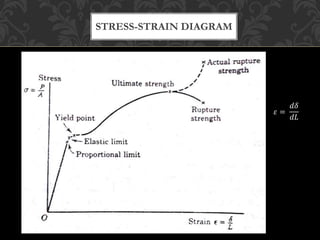
STRESS-STRAIN DIAGRAM
𝜀 =
𝑑𝛿
𝑑𝐿
DEFINITIONS
Proportional Limit
• Stress-strain diagram to be straight line.
• The stress is proportional to strain.
(Hooke’s Law)
Elastic Limit
• The stress beyond which the material will
not return to its original shape when
unloaded but will retain a permanent
deformation called the permanent set.
DEFINITIONS
Yield Point
• A point where there is an appreciable
elongation or yielding of the material without
any corresponding increase of load; indeed the
load may actually increase while the yielding
occurs.
Ultimate Stress/Ultimate Strength
• Highest ordinate in the SS curve.
Rupture Strength
• The stress at failure
HOOKE’S LAW: AXIAL
DEFORMATION
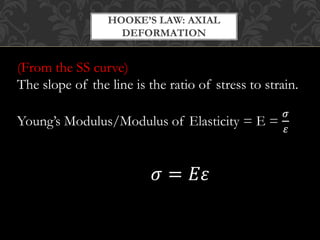
(From the SS curve)
The slope of the line is the ratio of stress to strain.
Young’s Modulus/Modulus of Elasticity = E =
𝜎
𝜀
𝜎 = 𝐸𝜀
HOOKE’S LAW: CONT…….
𝛿 =
𝑃𝐿
𝐴𝐸
=
𝜎𝐿
𝐸
(GENERAL FORMULA)
Restrictions:
• The load must be axial.
• The bar must have a constant cross section
and be homogeneous.
• The stress must not exceed the proportional
limit.
SHEARING
DEFORMATION
𝛿 =
𝑉𝐿
𝐴𝑠𝐺
Where;
G = modulus of elasticity in shear, more
commonly known as modulus of elasticity
AN ALUMINUM BAR HAVING A CROSS-SECTIONAL
AREA OF 160 MM^2 CARRIES AN AXIAL LOAD AT
THE POSITIONS SHOWN IN THE FIGURE. IF E = 70
GPA, COMPUTE THE TOTAL DEFORMATION OF
THE BAR. ASSUME THAT THE BAR IS SUITABLY
BRACED TO PREVENT BUCKLING.
ANS: 3.75 MM
EXAMPLE NO.02
The rigid bar AB, attached to two vertical rods as shown in
the figure, is horizontal before P is applied. If the load P =
50 kN, determine its vertical movement.
ANS; 1.814m
EXAMPLE NO.02

Lec03 Strain for Statically Determinate Structure.pptx

  • 1.
  • 2.
    Is there achange of the bar length? What is deformation? What is stiffness? INTRODUCTION BAR P P
  • 3.
  • 4.
    DEFINITIONS Proportional Limit • Stress-straindiagram to be straight line. • The stress is proportional to strain. (Hooke’s Law) Elastic Limit • The stress beyond which the material will not return to its original shape when unloaded but will retain a permanent deformation called the permanent set.
  • 5.
    DEFINITIONS Yield Point • Apoint where there is an appreciable elongation or yielding of the material without any corresponding increase of load; indeed the load may actually increase while the yielding occurs. Ultimate Stress/Ultimate Strength • Highest ordinate in the SS curve. Rupture Strength • The stress at failure
  • 6.
    HOOKE’S LAW: AXIAL DEFORMATION (Fromthe SS curve) The slope of the line is the ratio of stress to strain. Young’s Modulus/Modulus of Elasticity = E = 𝜎 𝜀 𝜎 = 𝐸𝜀
  • 7.
    HOOKE’S LAW: CONT……. 𝛿= 𝑃𝐿 𝐴𝐸 = 𝜎𝐿 𝐸 (GENERAL FORMULA) Restrictions: • The load must be axial. • The bar must have a constant cross section and be homogeneous. • The stress must not exceed the proportional limit.
  • 8.
    SHEARING DEFORMATION 𝛿 = 𝑉𝐿 𝐴𝑠𝐺 Where; G =modulus of elasticity in shear, more commonly known as modulus of elasticity
  • 9.
    AN ALUMINUM BARHAVING A CROSS-SECTIONAL AREA OF 160 MM^2 CARRIES AN AXIAL LOAD AT THE POSITIONS SHOWN IN THE FIGURE. IF E = 70 GPA, COMPUTE THE TOTAL DEFORMATION OF THE BAR. ASSUME THAT THE BAR IS SUITABLY BRACED TO PREVENT BUCKLING. ANS: 3.75 MM EXAMPLE NO.02
  • 10.
    The rigid barAB, attached to two vertical rods as shown in the figure, is horizontal before P is applied. If the load P = 50 kN, determine its vertical movement. ANS; 1.814m EXAMPLE NO.02