TEAM BASED APPROACH
The Role of the nurse in the Health Care team
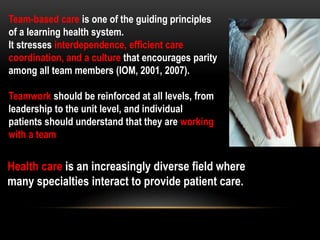
Team-based care is one of the guiding principles
of a learning health system.
It stresses interdependence, efficient care
coordination, and a culture that encourages parity
among all team members (IOM, 2001, 2007).
Teamwork should be reinforced at all levels, from
leadership to the unit level, and individual
patients should understand that they are working
with a team
Health care is an increasingly diverse field where
many specialties interact to provide patient care.
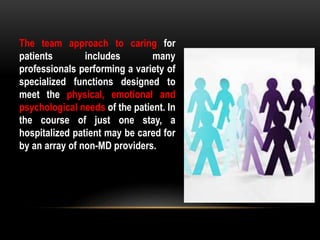
The team approach to caring for
patients includes many
professionals performing a variety of
specialized functions designed to
meet the physical, emotional and
psychological needs of the patient. In
the course of just one stay, a
hospitalized patient may be cared for
by an array of non-MD providers.
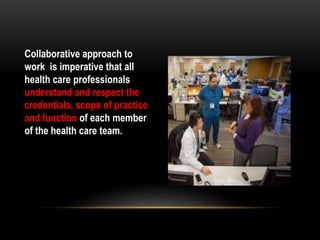
Collaborative approach to
work is imperative that all
health care professionals
understand and respect the
credentials, scope of practice
and function of each member
of the health care team.
The primary role of a nurse is to advocate
and care for individuals of all ethnic origins
and religious backgrounds and support
them through health and illness. ...
Collaborate with team to plan for patient
care. Advocate for health and wellbeing of
patient.
Nursing is an honorable profession, and
nurses are the heart and soul of the
healthcare system. ... Nurses are on the
frontlines of administering and evaluating
treatment. Nurses are the patient’s
greatest advocate. Because they spend
more time, nurses can comprehensively
moderate patient’s progress.
Nurses play a dynamic and crucial
role in healthcare. A nurse is usually
the first person a patient interacts
with. ... Nurses advocate on behalf of
their patients and the community at
large by supporting causes that help
optimize health, such as nonprofit
organizations and educational
campaigns.
Nurses Role in the Health Care System
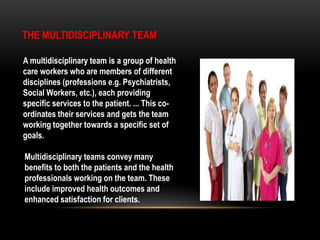
A multidisciplinary team is a group of health
care workers who are members of different
disciplines (professions e.g. Psychiatrists,
Social Workers, etc.), each providing
specific services to the patient. ... This co-
ordinates their services and gets the team
working together towards a specific set of
goals.
Multidisciplinary teams convey many
benefits to both the patients and the health
professionals working on the team. These
include improved health outcomes and
enhanced satisfaction for clients.
THE MULTIDISCIPLINARY TEAM
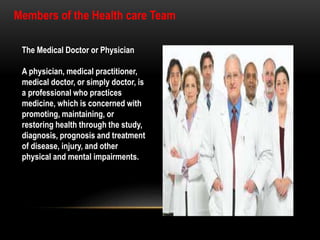
The Medical Doctor or Physician
A physician, medical practitioner,
medical doctor, or simply doctor, is
a professional who practices
medicine, which is concerned with
promoting, maintaining, or
restoring health through the study,
diagnosis, prognosis and treatment
of disease, injury, and other
physical and mental impairments.
Members of the Health care Team
The Nurse Practitioner
 Nurse practitioners are licensed registered
nurses who have completed advanced
academic and supervised clinical training
beyond their registered nurse certification.
 Most have masters degrees and many have
doctoral degrees.
 Nurse practitioners provide a number of
different health care services.
 They are trained to diagnose and treat a variety
of conditions, and can order and interpret
diagnostic tests and procedures, perform
health screenings, give immunizations, and
may prescribe most medications.
 Nurse practitioners often focus on health
promotion, disease prevention and helping
patients make healthy lifestyle choices. They
treat patients in outpatient settings and in the
hospital.
 Although most nurse practitioners focus on
primary care, many train and practice in fields
as diverse as OB/GYN, pediatrics, oncology
,dermatology and others specialties.
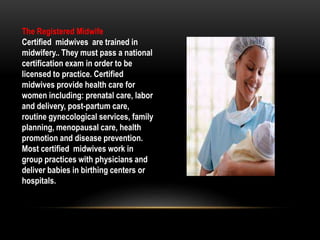
The Registered Midwife
Certified midwives are trained in
midwifery.. They must pass a national
certification exam in order to be
licensed to practice. Certified
midwives provide health care for
women including: prenatal care, labor
and delivery, post-partum care,
routine gynecological services, family
planning, menopausal care, health
promotion and disease prevention.
Most certified midwives work in
group practices with physicians and
deliver babies in birthing centers or
hospitals.
The Registered Dietitian
Registered dietitians have earned a
bachelors degree in dietetics or
nutrition.
Dietitians complete an approved
practical education program and
must pass a national examination.
The dietitian is the food and nutrition
expert on the health care team.
Dietitians help design food plans and
educate and counsel patients to help
them manage disease states such as
obesity, high cholesterol, or heart
disease. Many dietitians specialize in
areas such as pediatrics, geriatrics,
renal disease or diabetes education.
Dietitians are also involved in hospital
food service management and clinical
research.
The Registered Pharmacist
Pharmacists are medication experts,
working with physicians (or PAs) to ensure
new prescriptions do not interact with a
patient’s current medications, that the right
dosage for a particular medication has been
prescribed, and to answer any questions
patients may have.
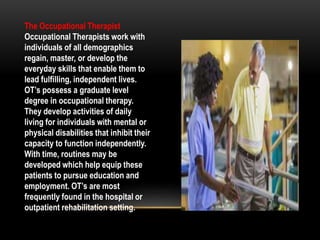
The Occupational Therapist
Occupational Therapists work with
individuals of all demographics
regain, master, or develop the
everyday skills that enable them to
lead fulfilling, independent lives.
OT’s possess a graduate level
degree in occupational therapy.
They develop activities of daily
living for individuals with mental or
physical disabilities that inhibit their
capacity to function independently.
With time, routines may be
developed which help equip these
patients to pursue education and
employment. OT’s are most
frequently found in the hospital or
outpatient rehabilitation setting.
The Physical Therapist
Similar to OT’s, a Physical Therapist works
to treat individuals whose medical problems
or other health-related conditions that
impair their ability to move and perform
activities of daily living. Treatment plans
focus on preventing further disability,
alleviating pain, and restoring function.
Educational programs for PT’s exist at both
the master’s and doctoral level.
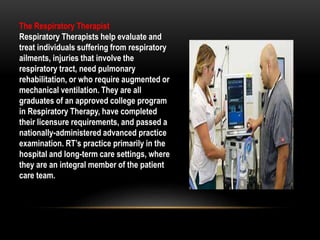
The Respiratory Therapist
Respiratory Therapists help evaluate and
treat individuals suffering from respiratory
ailments, injuries that involve the
respiratory tract, need pulmonary
rehabilitation, or who require augmented or
mechanical ventilation. They are all
graduates of an approved college program
in Respiratory Therapy, have completed
their licensure requirements, and passed a
nationally-administered advanced practice
examination. RT’s practice primarily in the
hospital and long-term care settings, where
they are an integral member of the patient
care team.
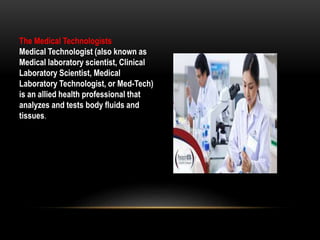
The Medical Technologists
Medical Technologist (also known as
Medical laboratory scientist, Clinical
Laboratory Scientist, Medical
Laboratory Technologist, or Med-Tech)
is an allied health professional that
analyzes and tests body fluids and
tissues.
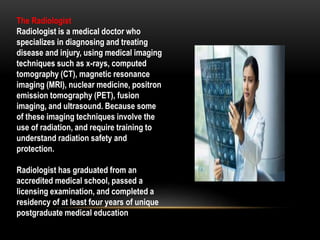
The Radiologist
Radiologist is a medical doctor who
specializes in diagnosing and treating
disease and injury, using medical imaging
techniques such as x-rays, computed
tomography (CT), magnetic resonance
imaging (MRI), nuclear medicine, positron
emission tomography (PET), fusion
imaging, and ultrasound. Because some
of these imaging techniques involve the
use of radiation, and require training to
understand radiation safety and
protection.
Radiologist has graduated from an
accredited medical school, passed a
licensing examination, and completed a
residency of at least four years of unique
postgraduate medical education
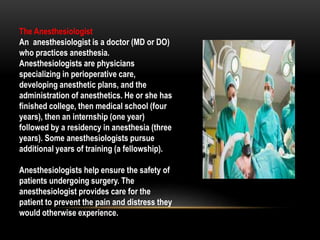
The Anesthesiologist
An anesthesiologist is a doctor (MD or DO)
who practices anesthesia.
Anesthesiologists are physicians
specializing in perioperative care,
developing anesthetic plans, and the
administration of anesthetics. He or she has
finished college, then medical school (four
years), then an internship (one year)
followed by a residency in anesthesia (three
years). Some anesthesiologists pursue
additional years of training (a fellowship).
Anesthesiologists help ensure the safety of
patients undergoing surgery. The
anesthesiologist provides care for the
patient to prevent the pain and distress they
would otherwise experience.
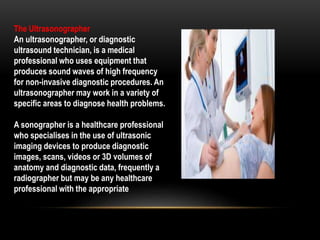
The Ultrasonographer
An ultrasonographer, or diagnostic
ultrasound technician, is a medical
professional who uses equipment that
produces sound waves of high frequency
for non-invasive diagnostic procedures. An
ultrasonographer may work in a variety of
specific areas to diagnose health problems.
A sonographer is a healthcare professional
who specialises in the use of ultrasonic
imaging devices to produce diagnostic
images, scans, videos or 3D volumes of
anatomy and diagnostic data, frequently a
radiographer but may be any healthcare
professional with the appropriate
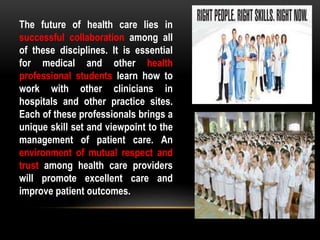
The future of health care lies in
successful collaboration among all
of these disciplines. It is essential
for medical and other health
professional students learn how to
work with other clinicians in
hospitals and other practice sites.
Each of these professionals brings a
unique skill set and viewpoint to the
management of patient care. An
environment of mutual respect and
trust among health care providers
will promote excellent care and
improve patient outcomes.