HealthEducation
Process
NCM 102
Part 1
Prof. MARIA HAZEL D. CAYENA
TREY
research
LearningObjectives:
 To define health education process
To contrast health education process with that
of nursing process
 To determine the learning needs
2
TREY
research
Health
Education
Process
3
Health education as applied to health and disease
issues is defined as "A process with intellectual,
psychological, and social dimensions relating to
activities which increase the abilities of people to
make informed decisions affecting their personal,
family, and community well being.
TREY
research
Health Education
 Is a process concerned with assessing,
designing, implementing, evaluating, and
documenting educational programs that enable
families, groups, organizations and communities to
play active roles in achieving, protecting and
sustaining health.
4
Education Process
5
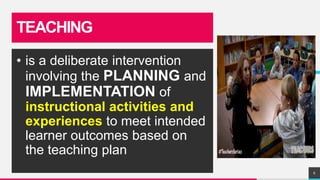
TEACHING
• is a deliberate intervention
involving the PLANNING and
IMPLEMENTATION of
instructional activities and
experiences to meet intended
learner outcomes based on
the teaching plan
6
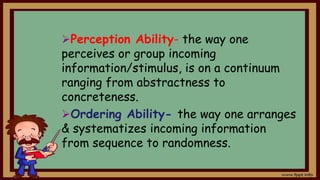
LEARNING
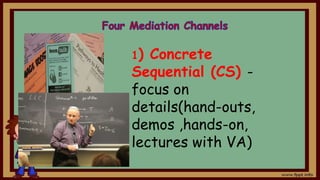
• is a CHANGE IN BEHAVIOR
(knowledge, skills and
attitudes) that can occur at any
time or in any place as a result of
EXPOSURE TO
ENVIRONMENTAL STIMULI.
7
Patient Education
• is process of assisting
people to learn health-related
behaviors and incorporate
these in everyday life.
8
Educator’s Role in Learning
• assessment of problems
• providing information
• identifying progress
•giving feed back and follow-
up
9
Educator’s Role in Learning
• reinforcing learning in the
acquisition of KSA
•Evaluating learner’s abilities
10
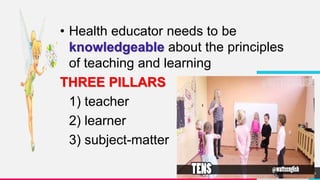
• Health educator needs to be
knowledgeable about the principles
of teaching and learning
THREE PILLARS
1) teacher
2) learner
3) subject-matter
11
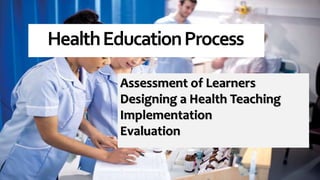
HealthEducationProcess
Assessment of Learners
Designing a Health Teaching
Implementation
Evaluation
EducationProcess
vs
NursingProcess
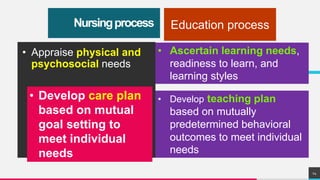
Nursingprocess
• Appraise physical and
psychosocial needs
Education process
• Ascertain learning needs,
readiness to learn, and
learning styles
• Develop teaching plan
based on mutually
predetermined behavioral
outcomes to meet individual
needs
14
• Develop care plan
based on mutual
goal setting to
meet individual
needs
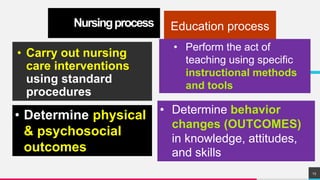
Nursingprocess
• Carry out nursing
care interventions
using standard
procedures
Education process
• Perform the act of
teaching using specific
instructional methods
and tools
15
• Determine physical
& psychosocial
outcomes
• Determine behavior
changes (OUTCOMES)
in knowledge, attitudes,
and skills
TREY
research
Determinantsto
Learning
16
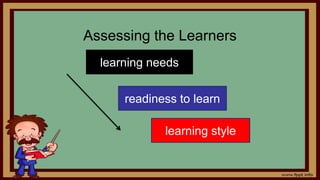
Assessing the Learners
learning needs
readiness to learn
learning style
TREY
research
18
LEARNING NEEDS
are gaps between what one
knows & what he needs to know.
“what the learners need to
learn”
Learning Needs
 The purposes of assessing learning
needs are to discover what has to
be taught and to determine the
extent of instruction or if instruction
is necessary at all.
TREY
research
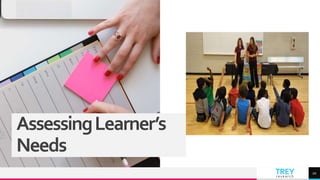
AssessingLearner’s
Needs
20
TREY
research
TREY
research
STEPS in Assessing Learning Needs
1. identify the learner
2. choose the right setting
3. collect data on the learner
4. include the learner
5. involve members of the health care
team
6. prioritize needs
Prioritization Criteria
• Mandatory Needs : Needs to be learned for
survival or when the learner’s life or safety is
threatened.
• Desirable Needs: Needs that are not life-
dependent but are related to well-being or the
overall ability
• Possible Needs: Needs for information that
are “nice to know” but not essential or
required for situations
TREY
research
C. Assessing Learning Needs
7. determine availability of
educational resources
8. assess demands of the organization
9. take time-management issues into
account
TREY
research
Methods of Assessing Learning Needs
1. Informal Conversations
2. Structured Interviews
3. Focus Group
4. Observations
5. Clients Chart
Readiness to Learn- time when learners is
“willing to learn”
TREY
research
26
READINESS TO LEARN
- time when the learner
demonstrates an interest in learning
the type or degree of information
necessary to maintain optimal health
(clients) or to become more skillful in
a job (nursing staff).
TREY
research
4 Types of Readiness to Learn
(PEEK)Lichthental,1990)
P- Physical Readiness
E- Emotional Readiness
E -Experiential Readiness
K- Knowledge Readiness
TREY
research
4 Types of Readiness to Learn
(PEEK)Lichthental,1990)
P-Physical Readiness
1.Measures of Ability
2.Complexity of the Task
3.Health Status
4.Gender
5.Environmental Effects
TREY
research
4 Types of Readiness to Learn
(PEEK)Lichthental,1990)
E- Emotional Readiness
1.Anxiety level
2. Support System
3. Motivation
4. Risk-taking behavior
5. Frame of Mind
6.Developmental Stages
TREY
research
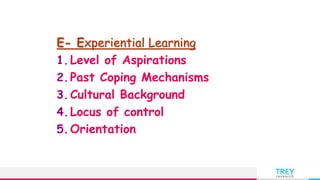
E- Experiential Learning
1.Level of Aspirations
2.Past Coping Mechanisms
3.Cultural Background
4.Locus of control
5.Orientation
TREY
research
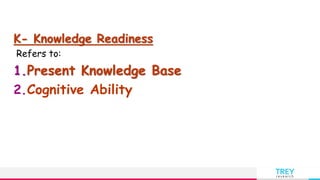
K- Knowledge Readiness
Refers to:
1.Present Knowledge Base
2.Cognitive Ability
TREY
research
LEARNINGSTYLES
Lesson 1- Part 2
32
TREY
research
33
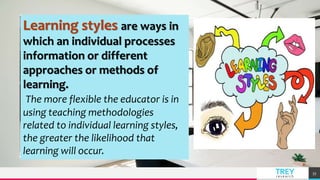
Learning styles are ways in
which an individual processes
information or different
approaches or methods of
learning.
The more flexible the educator is in
using teaching methodologies
related to individual learning styles,
the greater the likelihood that
learning will occur.
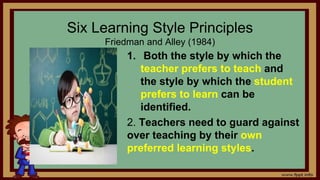
Six Learning Style Principles
Friedman and Alley (1984)
1. Both the style by which the
teacher prefers to teach and
the style by which the student
prefers to learn can be
identified.
2. Teachers need to guard against
over teaching by their own
preferred learning styles.
Six Learning Style Principles
Friedman and Alley (1984)
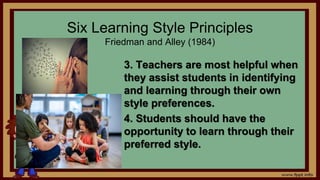
3. Teachers are most helpful when
they assist students in identifying
and learning through their own
style preferences.
4. Students should have the
opportunity to learn through their
preferred style.
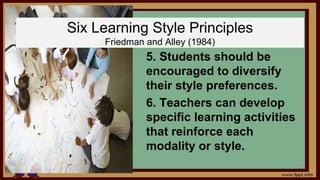
Six Learning Style Principles
Friedman and Alley (1984)
5. Students should be
encouraged to diversify
their style preferences.
6. Teachers can develop
specific learning activities
that reinforce each
modality or style.
TREY
research
37
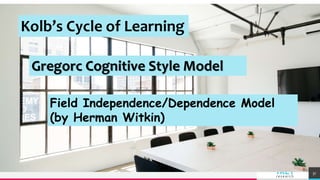
Field Independence/Dependence Model
(by Herman Witkin)
Kolb’s Cycle of Learning
Gregorc Cognitive Style Model
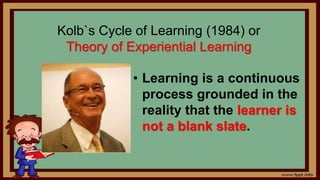
Kolb`s Cycle of Learning (1984) or
Theory of Experiential Learning
• Learning is a continuous
process grounded in the
reality that the learner is
not a blank slate.
Kolb`s Cycle of Learning (1984) or
Theory of Experiential Learning
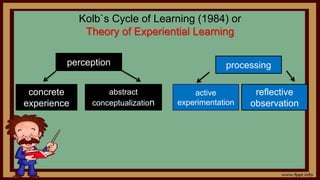
perception processing
concrete
experience
abstract
conceptualization
active
experimentation
reflective
observation
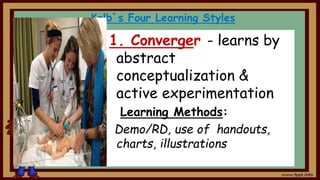
1. Converger - learns by
abstract
conceptualization &
active experimentation
Learning Methods:
Demo/RD, use of handouts,
charts, illustrations
Kolb`s Four Learning Styles
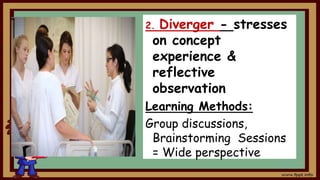
2. Diverger - stresses
on concept
experience &
reflective
observation
Learning Methods:
Group discussions,
Brainstorming Sessions
= Wide perspective
3.Accommodator-rely on concrete
experience & active
experimentation
>likes to actively accomplish
things
>uses trial and error methods to
solve problems, impatient with
other people, achiever
> acts on intuition and a risk taker
> some endanger its safety
4. Assimilator - emphasizes
on abstract
conceptualization &
reflective observation
>Learning Methods:
Lectures, One To One
Instruction,
Self- instruction Methods with
Sample Reading Materials
2.GREGORC COGNITIVE STYLES MODEL
Gregorc developed an
instrument called the
Gregorc Style Delineator
 a self-analysis instrument
 learning style consists of
distinctive and observable
behavior
2.GREGORC COGNITIVE STYLES MODEL
•The mind has mediation
abilities of perception and
ordering and this affects
how the person learns.
Perception Ability- the way one
perceives or group incoming
information/stimulus, is on a continuum
ranging from abstractness to
concreteness.
Ordering Ability- the way one arranges
& systematizes incoming information
from sequence to randomness.
1) Concrete
Sequential (CS) -
focus on
details(hand-outs,
demos ,hands-on,
lectures with VA)
Four Mediation Channels
Four Mediation
Channels
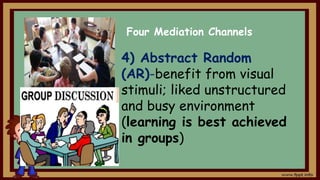
4) Abstract Random
(AR)-benefit from visual
stimuli; liked unstructured
and busy environment
(learning is best achieved
in groups)
Four Mediation Channels
Field Independence/Dependence Model
(by Herman Witkin)
Field-independent Style
• items are perceive
independently of their
surrounding field.
(seeing the parts more
than the whole)
Field-dependent Style
a person has difficulty
perceiving items aside
from their surrounding
field. (seeing the whole
more than the parts)
Field Independence/Dependence Model
(by Herman Witkin)
Characteristics:
• Mathematical reasoning
strong
• Recognizes & recalls details
• Analyzes elements of
situations
• More task oriented
• Forms attitude independently
• More pronounced identity
Characteristics:
 Difficulty with mathematical
reasoning
 Does not perceived details
 Analyzes whole picture
 More people oriented
 Attitudes guided by authority
figures or peer group
 See themselves as others see
them
Learning Style Instruments
Independent Study….
Gardner’s Seven Types of Intelligence
Right-Brain/Left-Brain and Whole-BrainThinking
Embedded Figures Test
Dunn and Dunn Learning Style Inventory
Myers-Briggs Type Indicator
4MAT System
TREY
research
ThankYou
54
TREY
research
REFERENCES:
Bastable, S. (2006). Essentials of Patient
Education. Massachusetts: Jones and Bartlett
Publishers.
Castro,C.(2011) .Health Education for Nursing
and Allied Professionals
NCM 102 Course Pack (2017)
55

Health education process lesson 1

  • 1.
  • 2.
    TREY research LearningObjectives:  To definehealth education process To contrast health education process with that of nursing process  To determine the learning needs 2
  • 3.
    TREY research Health Education Process 3 Health education asapplied to health and disease issues is defined as "A process with intellectual, psychological, and social dimensions relating to activities which increase the abilities of people to make informed decisions affecting their personal, family, and community well being.
  • 4.
    TREY research Health Education  Isa process concerned with assessing, designing, implementing, evaluating, and documenting educational programs that enable families, groups, organizations and communities to play active roles in achieving, protecting and sustaining health. 4
  • 5.
  • 6.
    TEACHING • is adeliberate intervention involving the PLANNING and IMPLEMENTATION of instructional activities and experiences to meet intended learner outcomes based on the teaching plan 6
  • 7.
    LEARNING • is aCHANGE IN BEHAVIOR (knowledge, skills and attitudes) that can occur at any time or in any place as a result of EXPOSURE TO ENVIRONMENTAL STIMULI. 7
  • 8.
    Patient Education • isprocess of assisting people to learn health-related behaviors and incorporate these in everyday life. 8
  • 9.
    Educator’s Role inLearning • assessment of problems • providing information • identifying progress •giving feed back and follow- up 9
  • 10.
    Educator’s Role inLearning • reinforcing learning in the acquisition of KSA •Evaluating learner’s abilities 10
  • 11.
    • Health educatorneeds to be knowledgeable about the principles of teaching and learning THREE PILLARS 1) teacher 2) learner 3) subject-matter 11
  • 12.
    HealthEducationProcess Assessment of Learners Designinga Health Teaching Implementation Evaluation
  • 13.
  • 14.
    Nursingprocess • Appraise physicaland psychosocial needs Education process • Ascertain learning needs, readiness to learn, and learning styles • Develop teaching plan based on mutually predetermined behavioral outcomes to meet individual needs 14 • Develop care plan based on mutual goal setting to meet individual needs
  • 15.
    Nursingprocess • Carry outnursing care interventions using standard procedures Education process • Perform the act of teaching using specific instructional methods and tools 15 • Determine physical & psychosocial outcomes • Determine behavior changes (OUTCOMES) in knowledge, attitudes, and skills
  • 16.
  • 17.
    Assessing the Learners learningneeds readiness to learn learning style
  • 18.
    TREY research 18 LEARNING NEEDS are gapsbetween what one knows & what he needs to know. “what the learners need to learn”
  • 19.
    Learning Needs  Thepurposes of assessing learning needs are to discover what has to be taught and to determine the extent of instruction or if instruction is necessary at all.
  • 20.
  • 21.
  • 22.
    TREY research STEPS in AssessingLearning Needs 1. identify the learner 2. choose the right setting 3. collect data on the learner 4. include the learner 5. involve members of the health care team 6. prioritize needs
  • 23.
    Prioritization Criteria • MandatoryNeeds : Needs to be learned for survival or when the learner’s life or safety is threatened. • Desirable Needs: Needs that are not life- dependent but are related to well-being or the overall ability • Possible Needs: Needs for information that are “nice to know” but not essential or required for situations
  • 24.
    TREY research C. Assessing LearningNeeds 7. determine availability of educational resources 8. assess demands of the organization 9. take time-management issues into account
  • 25.
    TREY research Methods of AssessingLearning Needs 1. Informal Conversations 2. Structured Interviews 3. Focus Group 4. Observations 5. Clients Chart Readiness to Learn- time when learners is “willing to learn”
  • 26.
    TREY research 26 READINESS TO LEARN -time when the learner demonstrates an interest in learning the type or degree of information necessary to maintain optimal health (clients) or to become more skillful in a job (nursing staff).
  • 27.
    TREY research 4 Types ofReadiness to Learn (PEEK)Lichthental,1990) P- Physical Readiness E- Emotional Readiness E -Experiential Readiness K- Knowledge Readiness
  • 28.
    TREY research 4 Types ofReadiness to Learn (PEEK)Lichthental,1990) P-Physical Readiness 1.Measures of Ability 2.Complexity of the Task 3.Health Status 4.Gender 5.Environmental Effects
  • 29.
    TREY research 4 Types ofReadiness to Learn (PEEK)Lichthental,1990) E- Emotional Readiness 1.Anxiety level 2. Support System 3. Motivation 4. Risk-taking behavior 5. Frame of Mind 6.Developmental Stages
  • 30.
    TREY research E- Experiential Learning 1.Levelof Aspirations 2.Past Coping Mechanisms 3.Cultural Background 4.Locus of control 5.Orientation
  • 31.
    TREY research K- Knowledge Readiness Refersto: 1.Present Knowledge Base 2.Cognitive Ability
  • 32.
  • 33.
    TREY research 33 Learning styles areways in which an individual processes information or different approaches or methods of learning. The more flexible the educator is in using teaching methodologies related to individual learning styles, the greater the likelihood that learning will occur.
  • 34.
    Six Learning StylePrinciples Friedman and Alley (1984) 1. Both the style by which the teacher prefers to teach and the style by which the student prefers to learn can be identified. 2. Teachers need to guard against over teaching by their own preferred learning styles.
  • 35.
    Six Learning StylePrinciples Friedman and Alley (1984) 3. Teachers are most helpful when they assist students in identifying and learning through their own style preferences. 4. Students should have the opportunity to learn through their preferred style.
  • 36.
    Six Learning StylePrinciples Friedman and Alley (1984) 5. Students should be encouraged to diversify their style preferences. 6. Teachers can develop specific learning activities that reinforce each modality or style.
  • 37.
    TREY research 37 Field Independence/Dependence Model (byHerman Witkin) Kolb’s Cycle of Learning Gregorc Cognitive Style Model
  • 38.
    Kolb`s Cycle ofLearning (1984) or Theory of Experiential Learning • Learning is a continuous process grounded in the reality that the learner is not a blank slate.
  • 39.
    Kolb`s Cycle ofLearning (1984) or Theory of Experiential Learning perception processing concrete experience abstract conceptualization active experimentation reflective observation
  • 40.
    1. Converger -learns by abstract conceptualization & active experimentation Learning Methods: Demo/RD, use of handouts, charts, illustrations Kolb`s Four Learning Styles
  • 41.
    2. Diverger -stresses on concept experience & reflective observation Learning Methods: Group discussions, Brainstorming Sessions = Wide perspective
  • 42.
    3.Accommodator-rely on concrete experience& active experimentation >likes to actively accomplish things >uses trial and error methods to solve problems, impatient with other people, achiever > acts on intuition and a risk taker > some endanger its safety
  • 43.
    4. Assimilator -emphasizes on abstract conceptualization & reflective observation >Learning Methods: Lectures, One To One Instruction, Self- instruction Methods with Sample Reading Materials
  • 44.
    2.GREGORC COGNITIVE STYLESMODEL Gregorc developed an instrument called the Gregorc Style Delineator  a self-analysis instrument  learning style consists of distinctive and observable behavior
  • 45.
    2.GREGORC COGNITIVE STYLESMODEL •The mind has mediation abilities of perception and ordering and this affects how the person learns.
  • 46.
    Perception Ability- theway one perceives or group incoming information/stimulus, is on a continuum ranging from abstractness to concreteness. Ordering Ability- the way one arranges & systematizes incoming information from sequence to randomness.
  • 47.
    1) Concrete Sequential (CS)- focus on details(hand-outs, demos ,hands-on, lectures with VA)
  • 48.
  • 49.
  • 50.
    4) Abstract Random (AR)-benefitfrom visual stimuli; liked unstructured and busy environment (learning is best achieved in groups) Four Mediation Channels
  • 51.
    Field Independence/Dependence Model (byHerman Witkin) Field-independent Style • items are perceive independently of their surrounding field. (seeing the parts more than the whole) Field-dependent Style a person has difficulty perceiving items aside from their surrounding field. (seeing the whole more than the parts)
  • 52.
    Field Independence/Dependence Model (byHerman Witkin) Characteristics: • Mathematical reasoning strong • Recognizes & recalls details • Analyzes elements of situations • More task oriented • Forms attitude independently • More pronounced identity Characteristics:  Difficulty with mathematical reasoning  Does not perceived details  Analyzes whole picture  More people oriented  Attitudes guided by authority figures or peer group  See themselves as others see them
  • 53.
    Learning Style Instruments IndependentStudy…. Gardner’s Seven Types of Intelligence Right-Brain/Left-Brain and Whole-BrainThinking Embedded Figures Test Dunn and Dunn Learning Style Inventory Myers-Briggs Type Indicator 4MAT System
  • 54.
  • 55.
    TREY research REFERENCES: Bastable, S. (2006).Essentials of Patient Education. Massachusetts: Jones and Bartlett Publishers. Castro,C.(2011) .Health Education for Nursing and Allied Professionals NCM 102 Course Pack (2017) 55

Editor's Notes

  • #2 Good day, my dear level 1 students… welcome to the second trinal term of NCM 102. This term you are expected to gain knowledge and apply these concepts in formulating appropriate teaching plan. Also you are expected to apply appropriate teaching methodologies as you plan for your practicum/ or the actual conduct of health teaching to identified learners/ audience via google meet. Excited? So do I?
  • #3 For the learning objectives: At the end of this VL you are expected to
  • #10 Educating clients can be one of the most challenging and essential interventions that a nurse performs. Just providing information to them does not ensure that learning will occur. There is no guarantee that the learner will learn the information given, although there is more of an opportunity to learn if the educator assesses the determinants of learning. The educator plays a crucial role in the learning process by (a) assessing problems or deficits, (b) providing appropriate information and presenting it in unique ways, (c) identifying progress being made, (d) giving feedback and follow-up,
  • #11 (e) reinforcing learning in the acquisition of knowledge, the performance of a skill, or a change in attitude, and (f) evaluating learners’ abilities
  • #12 Thus health educator needs to be knowledgeable and well versed about the principles of teaching and learning. There are 3 pillars in teaching and learning which are the teacher, learner and the subject matter. As the teacher / educator assess the learning needs of the learners that is her basis in the preparation of the subject matter / topic to be taught. Wrong assessment sometimes end up with unsuccessful effort of health education.
  • #13  Health education requires assessment of learners, designing a HTP and implementation of the HT and Evaluation of based on the learning outcomes.
  • #14 Comparison of the Nursing Process and Education Process Similarities Both consist of the basic elements of assessment, planning, implementation, and evaluation They are logical, scientifically-based frameworks for nursing processes providing for a rational basis for nursing practice rather than an intuitive one Both are methods for monitoring and judging the overall quality of nursing interventions based on objective data and scientific criteria
  • #15 The Nursing process focuses on planning and implementation of care based on assessment and diagnosis of the patient’s physical and psychosocial needs…With this development of health care plan is done based on the mutual goal set to address the individual’s identified needs while education process identifies instructional content and methods based on assessment of the client’s learning needs, readiness to learn and learning styles.
  • #16 After planning, carrying out the nsg care interventions are done using standard procedures and evaluation is done to determine the physical and psychosocial outcomes… while in the education process teaching is performed using the instructional methods and tool and evaluation is done on the behavior change in KAS.
  • #17 Whether in the hospital and community settings, nurses are responsible for the educating patients, families, nursing staff, other healthcare staff, and nursing students. The application of the principles of teaching and learning are challenging for the nurse educator to meet learners’ needs for information. Often the teachable moment is hard to capture because of shortened hospital stays and the difficulty with meeting learners’ needs arises because of the various educational and experiential levels of staff and time constraints in the assigned areas.
  • #18 Assessing the learners follow these 3 determinants to learning which are LN, RTL and LS.
  • #19 Identifying the learning needs is crucial in the conduct of health education but this is also the step most often neglected. For years nurses have been taught that any nursing intervention should be preceded by an assessment. Therefore identification of information which our client needs to learn is essential in preparing for a health teaching.
  • #20 Significant differences have been found between the perception of needs identified by patients versus the needs identified by nurses caring for them
  • #21 Prior to the conduct of Health Ed…assessing the learner’s need is important because a health teaching without assessment is merely be lip service. ..Often patients with the same condition are taught with the same materials in the same way (Haggard, 1989). The result is that information given to the patient is neither individualized nor based on the educational assessment. An example of this is the conduct of health education about “handwashing to Tertiary students” do you think this is appropriate for this kind of audience? That you will realize later as we go deeper to out lesson.
  • #22 Good assessments ensure that optimal learning will occur with the least amount of stress and anxiety for the learner. Assessment prevents needless repetition of known material, saves time and energy on the part of both the learner and the educator, and helps to establish rapport between the two parties (Haggard, 1989).
  • #23 These are the steps in assessing the learning needs: identify the learner. Who is the audience? Is the audience only a single person? Is there more than one learner? If so, are their needs congruent or diverse? The development of formal and informal education programs for patients and their families, nursing staff, or students must be based on accurate identification of the learner. Choose the right setting. Establishing a trusting environment will help learners feel a sense of security in confiding information, believe their concerns are taken seriously and considered important, and feel respected. Assuring privacy and confidentiality is essential to establishing a trusting relationship (Rankin & Stallings, 2001). Collect data on the learner. Once the learner is identified, the educator can determine characteristic needs of the population by exploring typical health problems or issues of interest to that population. 4. Remember that learner’s are not a blank slate. They often attend a health education program with pre-conceived ideas. 5. Nurses are not the sole teachers, and they must remember to collaborate with other members of the healthcare team for a richer assessment of learning needs 6. A list of needs can become endless and seemingly impossible to accomplish. Maslow’s (1970) hierarchy of human needs may help the educator prioritize identified learning needs (
  • #24 After gathering data on what the learners want to learn, you now prioritize the learning needs using this criteria. Conduct health teaching first if the need falls under Mandatory:An example of this is the conduct of HT to a client who had a previous heart attack who needs to learn the manifestations of an impending heart attack as well as its emergency measures once manifested again.….. Desirable needs are those learning needs which is needed to promote well-being…Ex is a patient with TB need to understand the importance of treatment regimen to be totally cured.… Possible: an example is a multipara mother who happens to attend a Buntis Party where the HT topic is on the importance of breastfeeding.
  • #25 >A need may be identified, but it may be useless to proceed with interventions if the proper educational resources are not available, are unrealistic to obtain, or do not match the learner’s needs. >This assessment will yield information that reflects the climate of the organization. What is the organization’s philosophy, mission, strategic plan, and goals? The educator should be familiar with standards of performance required in various employee >Because time constraints are a major impediment to the assessment process
  • #26 Often learning needs will be discovered during informal conversations that take place with other healthcare team members involved in the care of the client, and between the nurse and the patient or his or her family. The structured interview is perhaps the most common form of needs assessment to solicit the learner’s point of view. The nurse asks the learner direct and often predetermined questions to gather information about learning needs.
  • #27 Once the learning needs have been identified, the next step is to determine the learner’s readiness to receive information. Readiness to learn is defined as the time when the learner demonstrates an interest in learning the type or degree of information necessary to maintain optimal health or to become more skillful in a job
  • #28 According to Lichthental there are 4 types of readiness to Learn Using the mnemonics of PEEK P-Physical Readiness -Measures of Ability; Complexity of the Task; Health Status ; Gender; Environmental Effects E- Emotional Readiness; Anxiety level; Support System; Motivation; Risk-taking behavior; Frame of Mind; Developmental Stages E- Experiential Learning; Level of Aspirations; Past Coping Mechanisms; Cultural Background; Locus of control; Orientation K- Knowledge Readiness Refers to:Present Knowledge Base and Cognitive Ability
  • #29 In PR – assessment is done by measuring the ability of the learners, the complexity of task to be performed, client’s health status, gender when most of the women are health conscious than men. And lastly the environmental effects such as presence of noise in the surroundings. Environmental Effects- environment conducive to learning. Free from noise & distractions Health Status- Is client in a good state of health? Still motivated to learn? Gender- Women more health conscious than men
  • #30 Anxiety Level- may or may not affect. Others take it as a challenged Support System- gives increase a sense of self-security & well being if weak= despair, frustration Motivation- strongly associated with willingness to learn- when client starts to ask questions Risk-taking Behavior- to develop behavior/ strategies to minimize risk, recognize S/Sx of a disease or what to do for worst scenario Frame of Mind- priorities of learner to determine his readiness to learn Developmental Stage- “teachable moment” of learner
  • #31 previous experience which may be (+) or (-) affect willingness to learn Level of Aspirations- depends on short or long term goals set by learner that will influence his motivation to learn Past Coping Mechanisms- if still applicable to present learning situation Cultural Background- clients perspective to determine willingness to learn Locus of Control- either intrinsic or extrinsic Orientation- learners point of view parochial a (close-minded thinking) cosmopolitan (wider perspective)
  • #32  Refers to: Present Knowledge Base- stock knowledge 2. Cognitive Ability- lowest level- memorizing, recalling
  • #33 Good day once again… This video is a continuation of our lesson 1 on the determinants of Learning. We were able to identify 3 determinants of learning and these are Assessing Learning Needs, Readiness to learn and the last one is the Learning Styles. Each learner has their own unique way of learning which we nurse educator should also look into that is why part of our lesson this term is to discuss common teaching methodologies to be used in the conduct of your health teaching.
  • #34 . Recognizing that people have different approaches to learning helps the nurse educator to understand the various educational interests and needs of diverse populations. Each learner is unique and complex, with a distinct learning style preference that distinguishes one learner from another.
  • #35 There are 6 learning style Principle which nurse educators should keep in mind when planning and implementing the health teaching. 1) ------ for example: when preparing a health teaching to 3-5 years old pupils, as a teacher you may not like the idea of presenting the topic by using a puppet yet you know that in this manner you can attract their attention. 2)---- You may be is found of talking and explaining a topic for long hours yet in health teaching your time is limited.
  • #36 By giving the students different approaches to the topic you are helping them identify other learning style not just the one they know and found of. At times as a teacher you need to explore ways to deliver the lesson through the students’ preferred style
  • #37 Students should be encouraged to diversify their style preferences…. As a nurse educator you need to explain to your learners that the style you are using may not be their preferred method yet that is the best way you can impart the new knowledge. Teachers during planning and preparation of the health students can apply different activities to reinforce learning.
  • #38 The common learning style models that I will be giving you are the David Kolb`s Cycle of Learning (1984) or Theory of Experiential Learning, Anthony Gregorc`s Cognitive Styles Model (1982) and the Field Independence / Dependence Model by Herman Witkin. An all-inclusive instrument does not exist that can measure all domains of learning— cognitive, affective, and psychomotor domains. Being able to utilize any of these models will make the health teaching attractive by arousing the learner’s interests.
  • #39 Kolb believes that knowledge is a transformational process that is continuously created and recreated. Learning is a continuous process grounded in the reality that the learner is not a blank slate. Every learner approaches a topic to be learned with preconceived ideas.
  • #41 >good in decision making and problem solving & likes dealing with technical work than Interpersonal relationships
  • #42  >Excels in imagination and awareness of meaning, feeling oriented & people oriented & likes working in groups
  • #43 Learning Methods: Role Playing, Gaming & Computer Simulations -learners most challenging to educators cause learn through new & exciting learning experience
  • #44  the strength of this person are inductive reasoning, creating theoretical models and integrating ideas >concerned more with ideas than people
  • #45 Gregorc developed an instrument called the Gregorc Style Delineator. This self-analysis instrument is designed to assess a person’s learning style. Sets of words are ranked, a numerical score is derived from each of the four patterns, and the scores are then plotted on a grid scores are then plotted on a grid (Figure 4–7). Gregorc states that a learning style consists of distinctive and observable behavior that provides cues about the mediation abilities of individuals. According to him, the human mind has channels through which it receives and expresses information most efficiently and effectively. In each of these patterns, learners demonstrate perceived attitudes, motivations, and reasoned thought toward the learning environment.
  • #46 .
  • #48 According to Gregorc, everyone processes or deals with perception and ordering knowledge in all for dimension but may have preferences which may fall under the mediation channes. CS- learners highly structured, quiet learning environment & don’t like to be interrupted
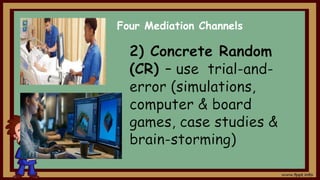
  • #49 CR-learners looks for alternative
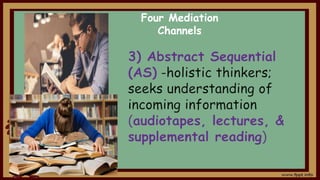
  • #50 AS- learners need consistency in the learning environment & don’t like interruptions - good verbal skills & are logical & rational
  • #51 AR- learners are holistic thinkers - focused on personal relationships
  • #54 Ma'am the focus of our lesson will be on the higlighted instruments only