LIGHT
Objective
Explain light waves and particles
Inquiry Questions: How does light combine to
form colours?
What is light?
Light is a type of energy called electromagnetic
radiation.
It behaves as both a particle and wave
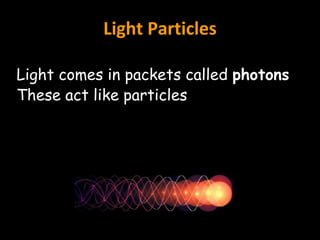
Light Particles
Light comes in packets called photons
These act like particles
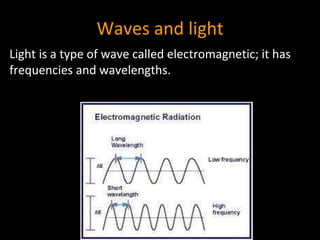
Waves and light
Light is a type of wave called electromagnetic; it has
frequencies and wavelengths.
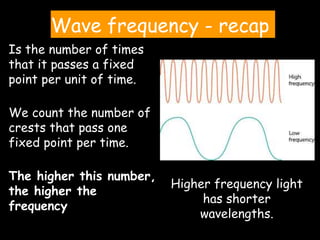
Wave frequency - recap
Is the number of times
that it passes a fixed
point per unit of time.
We count the number of
crests that pass one
fixed point per time.
The higher this number,
the higher the
frequency
Higher frequency light
has shorter
wavelengths.
Light and Energy
Light is a type of energy (electromagnetic energy)
The amount of energy depends on the
frequency and wavelength of light.
The higher the frequency and shorter
the wavelength the more energy
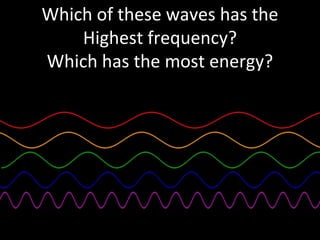
Which of these waves has the
Highest frequency?
Which has the most energy?
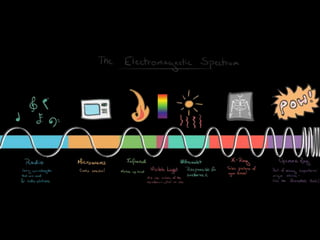
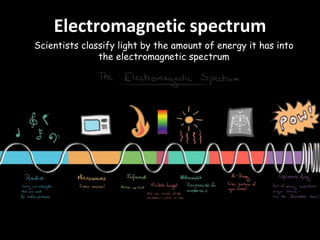
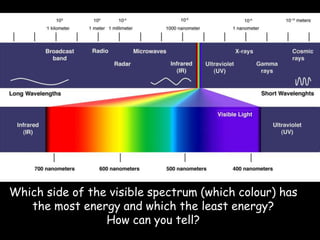
Electromagnetic spectrum
Scientists classify light by the amount of energy it has into
the electromagnetic spectrum
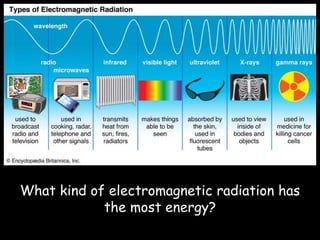
What kind of electromagnetic radiation has
the most energy?
Which side of the visible spectrum (which colour) has
the most energy and which the least energy?
How can you tell?
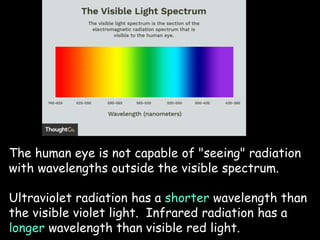
The human eye is not capable of "seeing" radiation
with wavelengths outside the visible spectrum.
Ultraviolet radiation has a shorter wavelength than
the visible violet light. Infrared radiation has a
longer wavelength than visible red light.
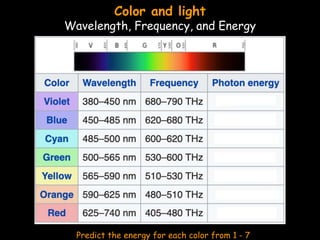
Color and light
Wavelength, Frequency, and Energy
Predict the energy for each color from 1 - 7
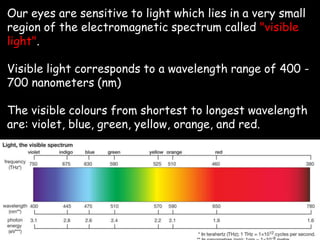
Our eyes are sensitive to light which lies in a very small
region of the electromagnetic spectrum called "visible
light".
Visible light corresponds to a wavelength range of 400 -
700 nanometers (nm)
The visible colours from shortest to longest wavelength
are: violet, blue, green, yellow, orange, and red.
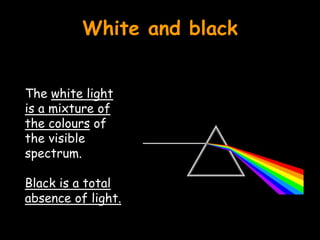
White and black
The white light
is a mixture of
the colours of
the visible
spectrum.
Black is a total
absence of light.
Colour Simulation
Please note that in art, the primary colors are
yellow, blue and red BUT for scientists, the primary
colors are RED, BLUE and GREEN.
Physics Simulation: RGB Color Addition
Worksheet for simulation

Introduction to Light Lesson for Middle School

  • 1.
  • 2.
    Objective Explain light wavesand particles Inquiry Questions: How does light combine to form colours?
  • 3.
    What is light? Lightis a type of energy called electromagnetic radiation. It behaves as both a particle and wave
  • 5.
    Light Particles Light comesin packets called photons These act like particles
  • 6.
    Waves and light Lightis a type of wave called electromagnetic; it has frequencies and wavelengths.
  • 7.
    Wave frequency -recap Is the number of times that it passes a fixed point per unit of time. We count the number of crests that pass one fixed point per time. The higher this number, the higher the frequency Higher frequency light has shorter wavelengths.
  • 8.
    Light and Energy Lightis a type of energy (electromagnetic energy) The amount of energy depends on the frequency and wavelength of light. The higher the frequency and shorter the wavelength the more energy
  • 9.
    Which of thesewaves has the Highest frequency? Which has the most energy?
  • 10.
    Electromagnetic spectrum Scientists classifylight by the amount of energy it has into the electromagnetic spectrum
  • 11.
    What kind ofelectromagnetic radiation has the most energy?
  • 12.
    Which side ofthe visible spectrum (which colour) has the most energy and which the least energy? How can you tell?
  • 13.
    The human eyeis not capable of "seeing" radiation with wavelengths outside the visible spectrum. Ultraviolet radiation has a shorter wavelength than the visible violet light. Infrared radiation has a longer wavelength than visible red light.
  • 14.
    Color and light Wavelength,Frequency, and Energy Predict the energy for each color from 1 - 7
  • 15.
    Our eyes aresensitive to light which lies in a very small region of the electromagnetic spectrum called "visible light". Visible light corresponds to a wavelength range of 400 - 700 nanometers (nm) The visible colours from shortest to longest wavelength are: violet, blue, green, yellow, orange, and red.
  • 16.
    White and black Thewhite light is a mixture of the colours of the visible spectrum. Black is a total absence of light.
  • 17.
    Colour Simulation Please notethat in art, the primary colors are yellow, blue and red BUT for scientists, the primary colors are RED, BLUE and GREEN. Physics Simulation: RGB Color Addition Worksheet for simulation