LEARNING
PSYCHOLOGY FYBPT
LEARNING
LEARNING
DEFINITION
 Learning is defined as any relatively permanent change in
behaviour that occurs as a result of practice or experience
FACTORS AFFECTING LEARNING
FACTOR RELATED TO
 Environmental
 Learner
 Teacher
 Others
THEORIES OF LEARNING
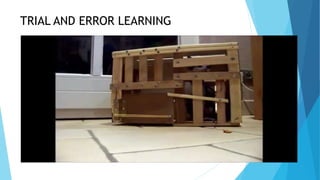
 TRIAL AND ERROR LEARNING THEORY
 THEORY OF CLASSICAL CONDITIONING
 THEORY OF OPERANT CONDITIONING
 THEORY OF INSIGHTFUL LEARNING/COGNITIVE LEARNING
 THEORY OF SOCIAL LEARNING/BANDURA’s LEARNING THEORY
TRIAL AND ERROR LEARNING
CLASSICAL CONDITIONING
OPERANT CONDITIONING
OPERANT CONDITIONING APPROACH
 SHAPING
 REINFORCEMENT SCHEDULES
Sr No CLASSICAL CONDITIONING OPERANT CONDITIONING
1 Classical conditioning works on building
associations between a conditioned stimulus
and conditioned response
Operant conditioning works on building
associations between response and the
consequence of response
2 Behaviour is elicited by unconditioned or
conditioned stimulus
Behaviour is elicited voluntarily to produce a
desirable result
3 Individual/organism is passive Individual/organism is active
4 Conditioning is stimulus oriented Conditioning is response oriented
5 Before conditioning unconditioned stimulus
leads to unconditioned response after
conditioning conditioned stimulus leads to
conditioned response
Reinforcement leads to increase in
response/behaviour and Punishment leads to
decrease in response/behaviour
6 Example-after a doctor gives a painful
injection (unconditioned stimulus) to a child
that causes the baby to cry (unconditioned
stimulus)
The child develops fear such that on sight of
injection (conditioned stimulus) the baby
starts to cry (conditioned response)
Example- a student who after studying hard earns
good marks (reinforcement) is more likely to
study hard in the future,
A student who fails in exams (punishment) after
watching movie before the exams is less likely to
watch movie before the next exam

LEARNING.pptx

  • 1.
  • 2.
  • 3.
    LEARNING DEFINITION  Learning isdefined as any relatively permanent change in behaviour that occurs as a result of practice or experience
  • 4.
    FACTORS AFFECTING LEARNING FACTORRELATED TO  Environmental  Learner  Teacher  Others
  • 5.
    THEORIES OF LEARNING TRIAL AND ERROR LEARNING THEORY  THEORY OF CLASSICAL CONDITIONING  THEORY OF OPERANT CONDITIONING  THEORY OF INSIGHTFUL LEARNING/COGNITIVE LEARNING  THEORY OF SOCIAL LEARNING/BANDURA’s LEARNING THEORY
  • 6.
  • 7.
  • 8.
  • 9.
  • 11.
  • 14.
    OPERANT CONDITIONING OPERANT CONDITIONINGAPPROACH  SHAPING  REINFORCEMENT SCHEDULES
  • 15.
    Sr No CLASSICALCONDITIONING OPERANT CONDITIONING 1 Classical conditioning works on building associations between a conditioned stimulus and conditioned response Operant conditioning works on building associations between response and the consequence of response 2 Behaviour is elicited by unconditioned or conditioned stimulus Behaviour is elicited voluntarily to produce a desirable result 3 Individual/organism is passive Individual/organism is active 4 Conditioning is stimulus oriented Conditioning is response oriented 5 Before conditioning unconditioned stimulus leads to unconditioned response after conditioning conditioned stimulus leads to conditioned response Reinforcement leads to increase in response/behaviour and Punishment leads to decrease in response/behaviour 6 Example-after a doctor gives a painful injection (unconditioned stimulus) to a child that causes the baby to cry (unconditioned stimulus) The child develops fear such that on sight of injection (conditioned stimulus) the baby starts to cry (conditioned response) Example- a student who after studying hard earns good marks (reinforcement) is more likely to study hard in the future, A student who fails in exams (punishment) after watching movie before the exams is less likely to watch movie before the next exam