Plan / Organize
Monitor / Identify
Problems
Evaluate
•Before beginning a task:
•-Set goals.
•-Plan the task or content sequence
•-Check your comprehension as you
•use the language. Do you
•understand? If not, what is the
•problem?
•-Check your production as you use
•
•-Identify changes you will make the
•next time you have a similar task
•-Decide how effective the strategies
•Think about and use what you
•already know to help you do the
•task.
•Use new information to clarify or
•modify your prior knowledge.
Use Background
Knowledge
•-Anticipate information to come.
•-Make a hypothesis (science).
•-Make an estimate (math).
Make
Predictions
•-Relate new concepts to your own
•life, to your experiences,
•knowledge, beliefs and feelings.
Personalize
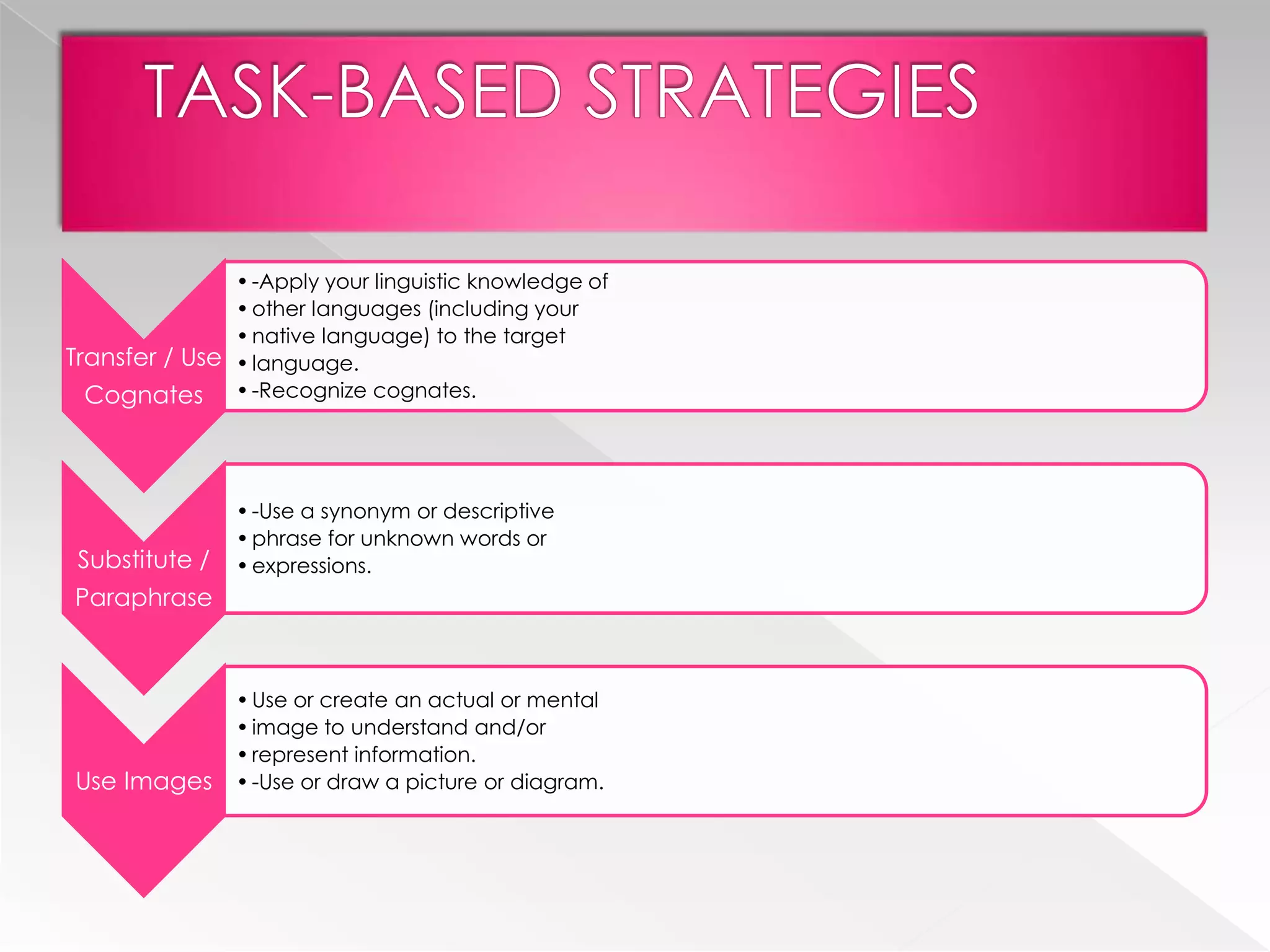
Transfer / Use
Cognates
•-Apply your linguistic knowledge of
•other languages (including your
•native language) to the target
•language.
•-Recognize cognates.
Substitute /
Paraphrase
•-Use a synonym or descriptive
•phrase for unknown words or
•expressions.
Use Images
•Use or create an actual or mental
•image to understand and/or
•represent information.
•-Use or draw a picture or diagram.
Use Your
Kinesthetic Sense
• --Act out a role, for example, in
• Readers’ Theater, or imagine
• yourself in different roles in the
• target language.
USE YOUR ORGANIZATIONAL SKILLS/Find/Apply Patterns
• -Apply a rule.
• -Make a rule.
• -Recognize and apply letter/sound,
• grammar, discourse, or register
• rules.
Take Notes
•-Write down
important words
and
•ideas while
listening or
reading.
•-List ideas or
words to include
in
•speaking or
writing
Use Graphic
Organizers
•Use or create
visual
representations
•(such as Venn
diagrams, time
lines,
•webs, and charts)
of important
•relationships
between
concepts.
Use Selective
Attention
•-Focus on specific
information,
•structures, key
words, phrases, or
•ideas.
Access
Information
Sources
-Seek out and use
sources of
information.
-Follow a model
-Ask questions
Cooperate -Work with others to
complete tasks
build confidence,
and give and
receive feedback
Talk Yourself
Through It
(Self-Talk)
- Use your inner
resources. Reduce
your anxiety by
reminding yourself
of your progress,
the resources you
have available, and
your goals.
 Cognitive strategies are one type of
learning strategy that learners use in
order to learn more successfully. These
include repetition, organizing new
language, summarizing meaning,
guessing meaning from context, using
imagery for memorization. All of these
strategies involve deliberate
manipulation of language to improve
learning
repitition
When imitatin
other
Aspecs to the life
resourcing
Havin recourses
Dictionaryo,rules
etc
translation
That is usin for
the other
langues
Using for the own
famly
For you
attention

Cognitive strategies

  • 2.
    Plan / Organize Monitor/ Identify Problems Evaluate •Before beginning a task: •-Set goals. •-Plan the task or content sequence •-Check your comprehension as you •use the language. Do you •understand? If not, what is the •problem? •-Check your production as you use • •-Identify changes you will make the •next time you have a similar task •-Decide how effective the strategies
  • 3.
    •Think about anduse what you •already know to help you do the •task. •Use new information to clarify or •modify your prior knowledge. Use Background Knowledge •-Anticipate information to come. •-Make a hypothesis (science). •-Make an estimate (math). Make Predictions •-Relate new concepts to your own •life, to your experiences, •knowledge, beliefs and feelings. Personalize
  • 4.
    Transfer / Use Cognates •-Applyyour linguistic knowledge of •other languages (including your •native language) to the target •language. •-Recognize cognates. Substitute / Paraphrase •-Use a synonym or descriptive •phrase for unknown words or •expressions. Use Images •Use or create an actual or mental •image to understand and/or •represent information. •-Use or draw a picture or diagram.
  • 5.
    Use Your Kinesthetic Sense •--Act out a role, for example, in • Readers’ Theater, or imagine • yourself in different roles in the • target language. USE YOUR ORGANIZATIONAL SKILLS/Find/Apply Patterns • -Apply a rule. • -Make a rule. • -Recognize and apply letter/sound, • grammar, discourse, or register • rules.
  • 6.
    Take Notes •-Write down importantwords and •ideas while listening or reading. •-List ideas or words to include in •speaking or writing Use Graphic Organizers •Use or create visual representations •(such as Venn diagrams, time lines, •webs, and charts) of important •relationships between concepts. Use Selective Attention •-Focus on specific information, •structures, key words, phrases, or •ideas.
  • 7.
    Access Information Sources -Seek out anduse sources of information. -Follow a model -Ask questions Cooperate -Work with others to complete tasks build confidence, and give and receive feedback Talk Yourself Through It (Self-Talk) - Use your inner resources. Reduce your anxiety by reminding yourself of your progress, the resources you have available, and your goals.
  • 8.
     Cognitive strategiesare one type of learning strategy that learners use in order to learn more successfully. These include repetition, organizing new language, summarizing meaning, guessing meaning from context, using imagery for memorization. All of these strategies involve deliberate manipulation of language to improve learning
  • 9.
    repitition When imitatin other Aspecs tothe life resourcing Havin recourses Dictionaryo,rules etc translation That is usin for the other langues Using for the own famly
  • 10.