Learning log #2
1. Interview your model teacher on how she/he lives teaching as a vocation, mission,
and profession.
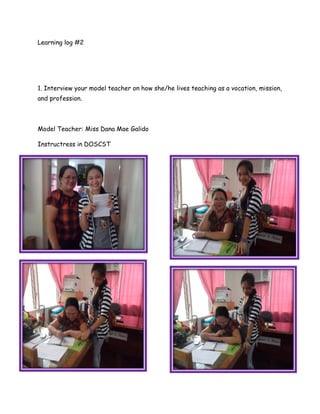
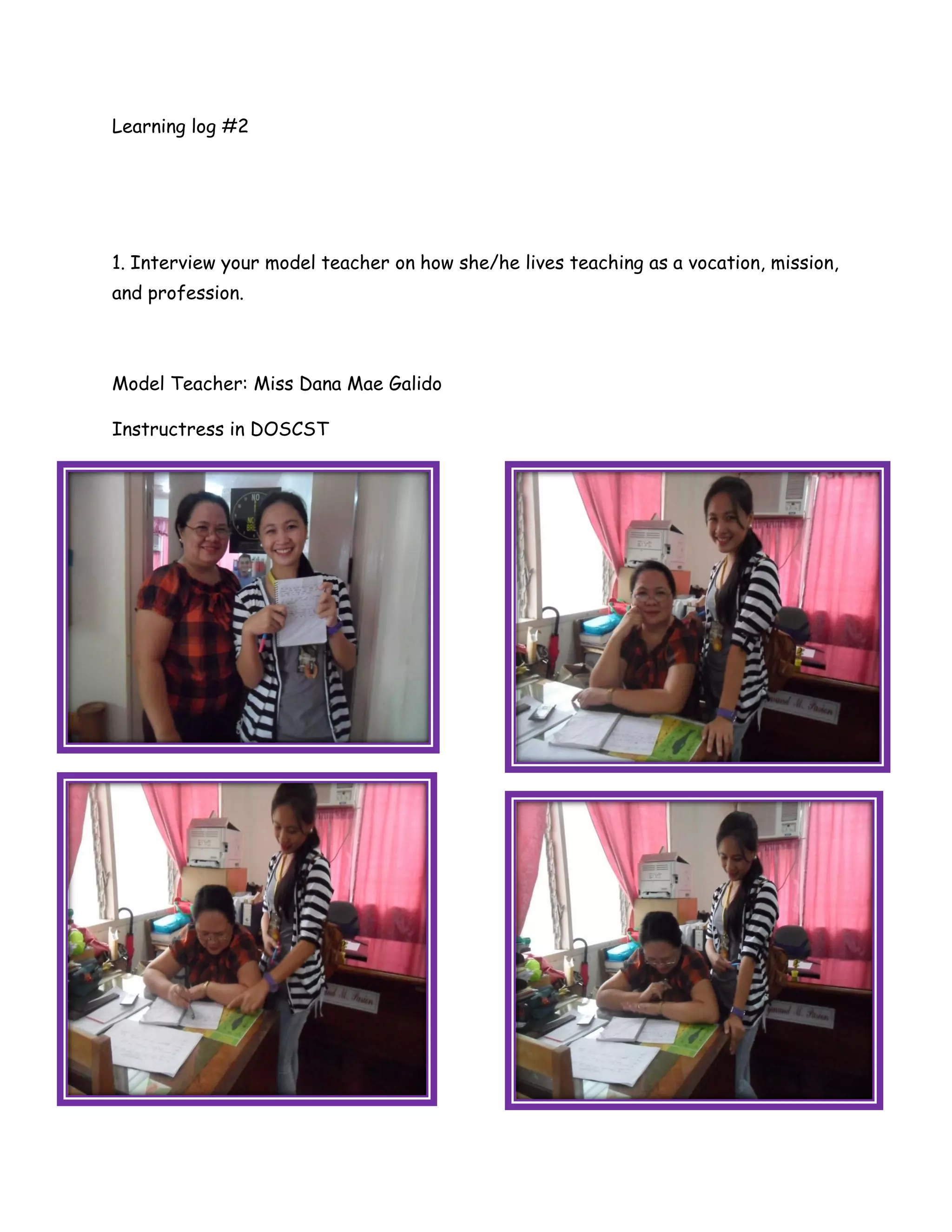
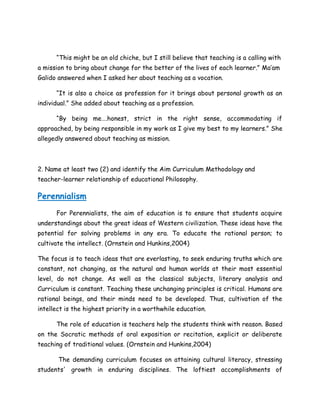
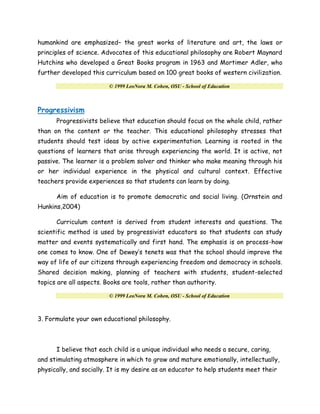
Model Teacher: Miss Dana Mae Galido
Instructress in DOSCST
“This might be an old chiche, but I still believe that teaching is a calling with
a mission to bring about change for the better of the lives of each learner.” Ma’am
Galido answered when I asked her about teaching as a vocation.
“It is also a choice as profession for it brings about personal growth as an
individual.” She added about teaching as a profession.
“By being me….honest, strict in the right sense, accommodating if
approached, by being responsible in my work as I give my best to my learners.” She
allegedly answered about teaching as mission.
2. Name at least two (2) and identify the Aim Curriculum Methodology and
teacher-learner relationship of educational Philosophy.
Perennialism
For Perennialists, the aim of education is to ensure that students acquire
understandings about the great ideas of Western civilization. These ideas have the
potential for solving problems in any era. To educate the rational person; to
cultivate the intellect. (Ornstein and Hunkins,2004)
The focus is to teach ideas that are everlasting, to seek enduring truths which are
constant, not changing, as the natural and human worlds at their most essential
level, do not change. As well as the classical subjects, literary analysis and
Curriculum is constant. Teaching these unchanging principles is critical. Humans are
rational beings, and their minds need to be developed. Thus, cultivation of the
intellect is the highest priority in a worthwhile education.
The role of education is teachers help the students think with reason. Based
on the Socratic methods of oral exposition or recitation, explicit or deliberate
teaching of traditional values. (Ornstein and Hunkins,2004)
The demanding curriculum focuses on attaining cultural literacy, stressing
students' growth in enduring disciplines. The loftiest accomplishments of
humankind are emphasized– the great works of literature and art, the laws or
principles of science. Advocates of this educational philosophy are Robert Maynard
Hutchins who developed a Great Books program in 1963 and Mortimer Adler, who
further developed this curriculum based on 100 great books of western civilization.
© 1999 LeoNora M. Cohen, OSU - School of Education
Progressivism
Progressivists believe that education should focus on the whole child, rather
than on the content or the teacher. This educational philosophy stresses that
students should test ideas by active experimentation. Learning is rooted in the
questions of learners that arise through experiencing the world. It is active, not
passive. The learner is a problem solver and thinker who make meaning through his
or her individual experience in the physical and cultural context. Effective
teachers provide experiences so that students can learn by doing.
Aim of education is to promote democratic and social living. (Ornstein and
Hunkins,2004)
Curriculum content is derived from student interests and questions. The
scientific method is used by progressivist educators so that students can study
matter and events systematically and first hand. The emphasis is on process-how
one comes to know. One of Dewey’s tenets was that the school should improve the
way of life of our citizens through experiencing freedom and democracy in schools.
Shared decision making, planning of teachers with students, student-selected
topics are all aspects. Books are tools, rather than authority.
© 1999 LeoNora M. Cohen, OSU - School of Education
3. Formulate your own educational philosophy.
I believe that each child is a unique individual who needs a secure, caring,
and stimulating atmosphere in which to grow and mature emotionally, intellectually,
physically, and socially. It is my desire as an educator to help students meet their
fullest potential in these areas by providing an environment that is safe, supports
risk-taking, and invites a sharing of ideas.
Helping students to develop a deep love and respect for themselves, others,
and their environment occurs through an open sharing of ideas and a judicious
approach to discipline. When the voice of each student is heard, and environment
evolves where students feel free to express themselves. Class meetings are one
way to encourage such dialogue. I believe children have greater respect for their
teachers, their peers, and the lessons presented when they feel safe and sure of
what is expected of them. In setting fair and consistent rules initially and stating
the importance of every activity, students are shown respect for their presence
and time. In turn they learn to respect themselves, others, and their environment.

Learning log #2

  • 1.
    Learning log #2 1.Interview your model teacher on how she/he lives teaching as a vocation, mission, and profession. Model Teacher: Miss Dana Mae Galido Instructress in DOSCST
  • 2.
    “This might bean old chiche, but I still believe that teaching is a calling with a mission to bring about change for the better of the lives of each learner.” Ma’am Galido answered when I asked her about teaching as a vocation. “It is also a choice as profession for it brings about personal growth as an individual.” She added about teaching as a profession. “By being me….honest, strict in the right sense, accommodating if approached, by being responsible in my work as I give my best to my learners.” She allegedly answered about teaching as mission. 2. Name at least two (2) and identify the Aim Curriculum Methodology and teacher-learner relationship of educational Philosophy. Perennialism For Perennialists, the aim of education is to ensure that students acquire understandings about the great ideas of Western civilization. These ideas have the potential for solving problems in any era. To educate the rational person; to cultivate the intellect. (Ornstein and Hunkins,2004) The focus is to teach ideas that are everlasting, to seek enduring truths which are constant, not changing, as the natural and human worlds at their most essential level, do not change. As well as the classical subjects, literary analysis and Curriculum is constant. Teaching these unchanging principles is critical. Humans are rational beings, and their minds need to be developed. Thus, cultivation of the intellect is the highest priority in a worthwhile education. The role of education is teachers help the students think with reason. Based on the Socratic methods of oral exposition or recitation, explicit or deliberate teaching of traditional values. (Ornstein and Hunkins,2004) The demanding curriculum focuses on attaining cultural literacy, stressing students' growth in enduring disciplines. The loftiest accomplishments of
  • 3.
    humankind are emphasized–the great works of literature and art, the laws or principles of science. Advocates of this educational philosophy are Robert Maynard Hutchins who developed a Great Books program in 1963 and Mortimer Adler, who further developed this curriculum based on 100 great books of western civilization. © 1999 LeoNora M. Cohen, OSU - School of Education Progressivism Progressivists believe that education should focus on the whole child, rather than on the content or the teacher. This educational philosophy stresses that students should test ideas by active experimentation. Learning is rooted in the questions of learners that arise through experiencing the world. It is active, not passive. The learner is a problem solver and thinker who make meaning through his or her individual experience in the physical and cultural context. Effective teachers provide experiences so that students can learn by doing. Aim of education is to promote democratic and social living. (Ornstein and Hunkins,2004) Curriculum content is derived from student interests and questions. The scientific method is used by progressivist educators so that students can study matter and events systematically and first hand. The emphasis is on process-how one comes to know. One of Dewey’s tenets was that the school should improve the way of life of our citizens through experiencing freedom and democracy in schools. Shared decision making, planning of teachers with students, student-selected topics are all aspects. Books are tools, rather than authority. © 1999 LeoNora M. Cohen, OSU - School of Education 3. Formulate your own educational philosophy. I believe that each child is a unique individual who needs a secure, caring, and stimulating atmosphere in which to grow and mature emotionally, intellectually, physically, and socially. It is my desire as an educator to help students meet their
  • 4.
    fullest potential inthese areas by providing an environment that is safe, supports risk-taking, and invites a sharing of ideas. Helping students to develop a deep love and respect for themselves, others, and their environment occurs through an open sharing of ideas and a judicious approach to discipline. When the voice of each student is heard, and environment evolves where students feel free to express themselves. Class meetings are one way to encourage such dialogue. I believe children have greater respect for their teachers, their peers, and the lessons presented when they feel safe and sure of what is expected of them. In setting fair and consistent rules initially and stating the importance of every activity, students are shown respect for their presence and time. In turn they learn to respect themselves, others, and their environment.