Learning Games
Design Framework
What is a Learning Games Design
Framework?
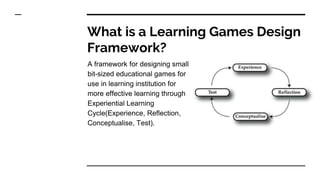
A framework for designing small
bit-sized educational games for
use in learning institution for
more effective learning through
Experiential Learning
Cycle(Experience, Reflection,
Conceptualise, Test).
Main Components
- Objective System
- Actions System
- Feedback System
- Analysis System
Objectives System
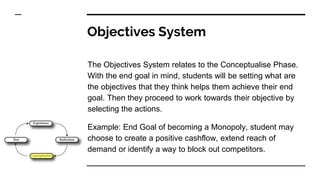
The Objectives System relates to the Conceptualise Phase.
With the end goal in mind, students will be setting what are
the objectives that they think helps them achieve their end
goal. Then they proceed to work towards their objective by
selecting the actions.
Example: End Goal of becoming a Monopoly, student may
choose to create a positive cashflow, extend reach of
demand or identify a way to block out competitors.
Actions System
The Actions System are the key decisions that the students
select in order to achieve the objectives that they have set.
There will be a variety of options that the students will be
presented with in order to assess their thinking process in a
non-linear manner.
Feedback System
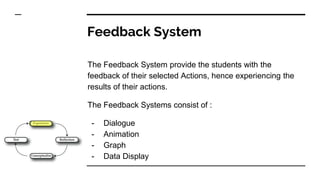
The Feedback System provide the students with the
feedback of their selected Actions, hence experiencing the
results of their actions.
The Feedback Systems consist of :
- Dialogue
- Animation
- Graph
- Data Display
Analysis System
Analysis System provides the students with means of
reflecting upon the outcomes of their actions through
measuring the progress of their objectives and showing hints
to help them understand the underlying concepts.
Example
Objective : Understanding the MC = MR for maximising
profits
Actions : Change in no. of Workers in production
Feedback : Change in production output, cost of production
and revenue
Analysis : Observe the relationship in the changes in order
to locate the optimal no. of workers for maximising profits
Twine
Use Twine to create the prototype to test out the defined
sets of learning objectives. This will allow for easy replication
of Arcademy games and tested before production starts.
Twine
Sample of Twine that is being used to teach concepts
- Teaches about copyright
https://dl.dropboxusercontent.com/u/21128153/copylitwi
zwebinar.html
- Story on Depression
http://www.depressionquest.com/dqfinal.html#2n.1e.52.
1e.4s.55.1d.u.4z.q
Pros of this approach
- Can be highly adaptable to various topic and complexity
levels.
- Easy for non-gamers to play
- Focused on learning objectives
Cons of this approach
- Lack of depth in gameplay
- Might not appeal to certain group of gamers
Learning Analytics
Framework
Learning Analytics Framework
The main data that we will be tracking are as follow:
- Engagement
- Retention
- Achievement/Objective
- Key Decision Points
- Quiz Scores
Engagement
For engagement, we will be looking at
Average Sessions per User and Average
Session Length. This will inform us how
much time the students are spending in
the game.
Retention
For retention, we will be looking at the
cohort .
Achievement/Objective
Achievement/Objective will be a key data
points to measure the performance level of
the students. Here we can see an overview
of what are the objectives that are most
achieved by the students and which are the
least.
Key Decision Points
To measure the behaviour of the
students when they are making key
decisions, we will use a Funnel to
capture the various decision points and
at each point, what are the drop-off
rates for the students.
Quiz Scores
Using a leaderboard, we can consolidate an
overview of the quiz scores of the students
and compare them with their other datas to
evaluate on their performance.

Learning Games Design Framework

  • 1.
  • 2.
    What is aLearning Games Design Framework? A framework for designing small bit-sized educational games for use in learning institution for more effective learning through Experiential Learning Cycle(Experience, Reflection, Conceptualise, Test).
  • 3.
    Main Components - ObjectiveSystem - Actions System - Feedback System - Analysis System
  • 4.
    Objectives System The ObjectivesSystem relates to the Conceptualise Phase. With the end goal in mind, students will be setting what are the objectives that they think helps them achieve their end goal. Then they proceed to work towards their objective by selecting the actions. Example: End Goal of becoming a Monopoly, student may choose to create a positive cashflow, extend reach of demand or identify a way to block out competitors.
  • 5.
    Actions System The ActionsSystem are the key decisions that the students select in order to achieve the objectives that they have set. There will be a variety of options that the students will be presented with in order to assess their thinking process in a non-linear manner.
  • 6.
    Feedback System The FeedbackSystem provide the students with the feedback of their selected Actions, hence experiencing the results of their actions. The Feedback Systems consist of : - Dialogue - Animation - Graph - Data Display
  • 7.
    Analysis System Analysis Systemprovides the students with means of reflecting upon the outcomes of their actions through measuring the progress of their objectives and showing hints to help them understand the underlying concepts.
  • 8.
    Example Objective : Understandingthe MC = MR for maximising profits Actions : Change in no. of Workers in production Feedback : Change in production output, cost of production and revenue Analysis : Observe the relationship in the changes in order to locate the optimal no. of workers for maximising profits
  • 9.
    Twine Use Twine tocreate the prototype to test out the defined sets of learning objectives. This will allow for easy replication of Arcademy games and tested before production starts.
  • 10.
    Twine Sample of Twinethat is being used to teach concepts - Teaches about copyright https://dl.dropboxusercontent.com/u/21128153/copylitwi zwebinar.html - Story on Depression http://www.depressionquest.com/dqfinal.html#2n.1e.52. 1e.4s.55.1d.u.4z.q
  • 11.
    Pros of thisapproach - Can be highly adaptable to various topic and complexity levels. - Easy for non-gamers to play - Focused on learning objectives
  • 12.
    Cons of thisapproach - Lack of depth in gameplay - Might not appeal to certain group of gamers
  • 13.
  • 14.
    Learning Analytics Framework Themain data that we will be tracking are as follow: - Engagement - Retention - Achievement/Objective - Key Decision Points - Quiz Scores
  • 15.
    Engagement For engagement, wewill be looking at Average Sessions per User and Average Session Length. This will inform us how much time the students are spending in the game.
  • 16.
    Retention For retention, wewill be looking at the cohort .
  • 17.
    Achievement/Objective Achievement/Objective will bea key data points to measure the performance level of the students. Here we can see an overview of what are the objectives that are most achieved by the students and which are the least.
  • 18.
    Key Decision Points Tomeasure the behaviour of the students when they are making key decisions, we will use a Funnel to capture the various decision points and at each point, what are the drop-off rates for the students.
  • 19.
    Quiz Scores Using aleaderboard, we can consolidate an overview of the quiz scores of the students and compare them with their other datas to evaluate on their performance.

Editor's Notes

  • #10 Possible for external developers to develop using Twine and integrate our API calls to the Dashboard?
  • #11 Possible for external developers to develop using Twine and integrate our API calls to the Dashboard?