Patterns (and Anti-Patterns) for
Developing Machine Learning Systems


               Gordon Rios
           (gparker@gmail.com)
               Zvents, Inc.
              Hypertable.org
Patterns and Anti-Patterns

•  Strategic, tactical, and operational
•  Anti-Patterns – seems obvious but is
   actually questionable or a “bad” idea
•  References: Design Patterns (Gamma, et al.) and Pattern
   Oriented Software Architecture (Buschmann, et al.)
Trapped in the Maze
•  ML projects are
   complex and disruptive
•  Ownership distributed
   across organization or
   missing completely
•  Political factors can
   create a maze of dead
   ends and hidden pitfalls
•  Familiarity with ML is
   sparse at best
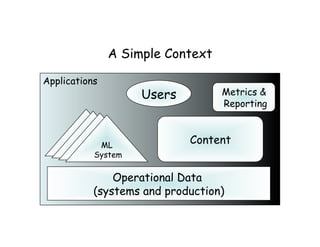
A Simple Context

Applications
                    Users         Metrics &
                                  Reporting


       ML ML
         ML ML              Content
      System
       System
           System
         System

               Operational Data
           (systems and production)
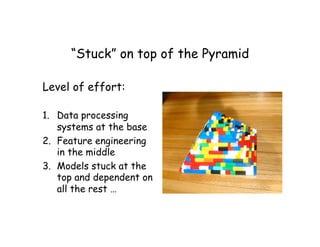
“Stuck” on top of the Pyramid

Level of effort:

1.  Data processing
    systems at the base
2.  Feature engineering
    in the middle
3.  Models stuck at the
    top and dependent on
    all the rest …
Basic Components the ML System

Applications
ML System

                              Model
    Data        Feature     Development
               Extraction
 Processing                 Production
                              Scoring
Thin Line (of Functionality)

•  Navigate safely through the negative
   metaphors
•  Encounter potential issues early enough in
   the process to manage or solve
•  Keep each piece of work manageable and
   explainable
•  Caution: if your thin ML system is “good
   enough” organization may lose interest in
   more advanced solution (80/20)
Workflow

•  Data and operations are messy – mix of relational
   database, logs, map-reduce, distributed
   databases, etc.
•  Think and plan in terms of workflows and be
   aware that job scheduling is hidden complexity
   for map-reduce
•  Use tools such as cascading (see
   http://www.cascading.org)
•  Related: Pipeline
Legacy

•  An older model or early approach needs to
   be replaced but has entrenched support
•  Use as an input to new approach
   (presumably based on ML)
•  Can be technically challenging but
   frequently can be converted to an input in
   conjunction with Pipeline
•  Related: Chop Shop, Tiers, Shadow
•  Advanced: Champion/Challenger
Shadow


•  Legacy system is an input to critical
    processes and operations
•  Develop new system and run in parallel to
    test output or regularly audit
•  Can be used as sort of Champion
   /Challenger-lite in conjunction with
    Internal Feedback
•  Also apply to upgrades to input pipeline
    components
Chop Shop

•  Legacy system represents significant
    investment of resources
•  Often rule based and capture valuable
    domain features
•  Isolate features and measure computing
    costs
•  Use selected features in new models or
    process
•  Related: Legacy, Adversarial
Internal Feedback

•  Need a low risk way to test new models
   with live users
•  Use your own product internally
•  Give internal users a way to turn on new
   models, use the product, and give
   feedback
•  Also use to develop training data
•  Related: Bathwater, Follow The Crowd
Follow The Crowd


•  Insufficient training or validation data for
    nobody to help
•  Amazon’s Mechanical Turk too low level
•  Use a service such as Dolores Labs founded
    by machine learning researchers
•  Labeling costs down to $0.05/label (source:
    http://doloreslabs.com)
•  Related: Internal Feedback, Bathwater
Bathwater

•  “Don’t throw the baby out with the
    bathwater …”
•  Subjective tasks can lead to “ML doesn’t
    work” blanket rejection
•  Isolate system elements that may be too
    subjective for ML and use human
    judgments
•  Follow the Crowd (Crowd Sourcing)
•  Related: Internal Feedback, Tiers
Pipeline
•  A mix of computing and
    human processing steps
    need to be applied in a
    sequence
•  Organize as a pipeline and
    monitor the workflow
•  Individual cases can be teed
    off from the flow for
    different processing, etc.
•  Related: Workflow,
    Handshake
Handshake or “Hand Buzzer”

•  Your system depends on inputs
   delivered outside of the normal
   release process
•  Create a “handshake”
   normalization process
•  Release handshake process as
   software associated with input
   and version
•  Regularly check for significant
   changes and send ALERTS
Replay

•  Need a way to test models on operational
    data
•  Invest in a batch test framework
•  Example: web search replay query logs and
    look at changes in rank of clicked
    documents
•  Example: recommender systems
•  Example: messaging inbox replay
Tiers

•  Processing or scoring elements have widely
    varying costs
•  Often feature inputs or processing steps
    have orders of magnitude variation in
    computing cost or editorial costs
•  Build models for each tier and only pass
    cases on to next tier if necessary
•  Related: Thin Line, Pipeline
Long Goodbye

•  Some decision classes have
    unacceptable risk or “loss”
•  Isolate the high risk classes but
    don’t remove from system
    entirely

•  Example: quarantine or Bulk mail folders in
 email to keep false positives safe
•  Delay rather than “reject” -- send uncertain
 cases to more costly processing steps rather
 than reject
Honey Trap

•  New data streams are available for
    testing classifiers but data is
    unlabeled
•  Isolate streams that are likely to be of
    one class or another
•  Example: dead domains become almost
    entirely dominated by spam traffic
•  (TN) Use to collect examples from
    examples with unknown labels like click
    fraud
Tar Pit


•  System needs to identify bad entities but
   cost to register new ones is cheap
•  Don’t reject, delete, or notify bad actors
•  Slows down adversary’s evolution
•  Example: slow down email messaging for low
   reputation IP addresses
•  Related: Honey Trap, Adversarial
Example: Honey Trap + Tar Pit?
Giveaway


•  Need low risk
    testing or new
    data
•  Give away the
    service to non
   -customers
•  Give away a
    related service
    (Google Analytics)
•  Related: Honey
    Trap
Adversarial


•  Adversaries are virulent and aggressive
    (email spam)
•  Use regularization methods judiciously
•  Parsimony can help make your adversaries’
    lives easier
•  Test regularized and non-regularized
    models using Honey Trap
•  (TN) Score by selecting from a set of
    models at random (mixed strategy?!)
Anti-Pattern Sampler

•  Golden Sets (operational)
  (+) Calibration
  (-) Validation
•  80/20 (tactical)
  (+) Design simplification
  (-) “Good enough” can lose market share long term
•  Executive Support (strategic)
  (+) Resources
  (-) Expectations
  (-) Metric choices
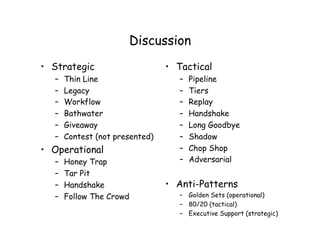
Discussion
•  Strategic                      •  Tactical
   –    Thin Line                    –    Pipeline
   –    Legacy                       –    Tiers
   –    Workflow                     –    Replay
   –    Bathwater                    –    Handshake
   –    Giveaway                     –    Long Goodbye
   –    Contest (not presented)      –    Shadow
•  Operational                       –    Chop Shop
   –    Honey Trap                   –    Adversarial
   –    Tar Pit
   –    Handshake                 •  Anti-Patterns
   –    Follow The Crowd             –  Golden Sets (operational)
                                     –  80/20 (tactical)
                                     –  Executive Support (strategic)

Patterns (and Anti-Patterns) for Developing Machine Learning Systems

  • 1.
    Patterns (and Anti-Patterns)for Developing Machine Learning Systems Gordon Rios (gparker@gmail.com) Zvents, Inc. Hypertable.org
  • 2.
    Patterns and Anti-Patterns • Strategic, tactical, and operational •  Anti-Patterns – seems obvious but is actually questionable or a “bad” idea •  References: Design Patterns (Gamma, et al.) and Pattern Oriented Software Architecture (Buschmann, et al.)
  • 3.
    Trapped in theMaze •  ML projects are complex and disruptive •  Ownership distributed across organization or missing completely •  Political factors can create a maze of dead ends and hidden pitfalls •  Familiarity with ML is sparse at best
  • 4.
    A Simple Context Applications Users Metrics & Reporting ML ML ML ML Content System System System System Operational Data (systems and production)
  • 5.
    “Stuck” on topof the Pyramid Level of effort: 1.  Data processing systems at the base 2.  Feature engineering in the middle 3.  Models stuck at the top and dependent on all the rest …
  • 6.
    Basic Components theML System Applications ML System Model Data Feature Development Extraction Processing Production Scoring
  • 7.
    Thin Line (ofFunctionality) •  Navigate safely through the negative metaphors •  Encounter potential issues early enough in the process to manage or solve •  Keep each piece of work manageable and explainable •  Caution: if your thin ML system is “good enough” organization may lose interest in more advanced solution (80/20)
  • 8.
    Workflow •  Data andoperations are messy – mix of relational database, logs, map-reduce, distributed databases, etc. •  Think and plan in terms of workflows and be aware that job scheduling is hidden complexity for map-reduce •  Use tools such as cascading (see http://www.cascading.org) •  Related: Pipeline
  • 9.
    Legacy •  An oldermodel or early approach needs to be replaced but has entrenched support •  Use as an input to new approach (presumably based on ML) •  Can be technically challenging but frequently can be converted to an input in conjunction with Pipeline •  Related: Chop Shop, Tiers, Shadow •  Advanced: Champion/Challenger
  • 10.
    Shadow •  Legacy systemis an input to critical processes and operations •  Develop new system and run in parallel to test output or regularly audit •  Can be used as sort of Champion /Challenger-lite in conjunction with Internal Feedback •  Also apply to upgrades to input pipeline components
  • 11.
    Chop Shop •  Legacysystem represents significant investment of resources •  Often rule based and capture valuable domain features •  Isolate features and measure computing costs •  Use selected features in new models or process •  Related: Legacy, Adversarial
  • 12.
    Internal Feedback •  Needa low risk way to test new models with live users •  Use your own product internally •  Give internal users a way to turn on new models, use the product, and give feedback •  Also use to develop training data •  Related: Bathwater, Follow The Crowd
  • 13.
    Follow The Crowd • Insufficient training or validation data for nobody to help •  Amazon’s Mechanical Turk too low level •  Use a service such as Dolores Labs founded by machine learning researchers •  Labeling costs down to $0.05/label (source: http://doloreslabs.com) •  Related: Internal Feedback, Bathwater
  • 14.
    Bathwater •  “Don’t throwthe baby out with the bathwater …” •  Subjective tasks can lead to “ML doesn’t work” blanket rejection •  Isolate system elements that may be too subjective for ML and use human judgments •  Follow the Crowd (Crowd Sourcing) •  Related: Internal Feedback, Tiers
  • 15.
    Pipeline •  A mixof computing and human processing steps need to be applied in a sequence •  Organize as a pipeline and monitor the workflow •  Individual cases can be teed off from the flow for different processing, etc. •  Related: Workflow, Handshake
  • 16.
    Handshake or “HandBuzzer” •  Your system depends on inputs delivered outside of the normal release process •  Create a “handshake” normalization process •  Release handshake process as software associated with input and version •  Regularly check for significant changes and send ALERTS
  • 17.
    Replay •  Need away to test models on operational data •  Invest in a batch test framework •  Example: web search replay query logs and look at changes in rank of clicked documents •  Example: recommender systems •  Example: messaging inbox replay
  • 18.
    Tiers •  Processing orscoring elements have widely varying costs •  Often feature inputs or processing steps have orders of magnitude variation in computing cost or editorial costs •  Build models for each tier and only pass cases on to next tier if necessary •  Related: Thin Line, Pipeline
  • 19.
    Long Goodbye •  Somedecision classes have unacceptable risk or “loss” •  Isolate the high risk classes but don’t remove from system entirely •  Example: quarantine or Bulk mail folders in email to keep false positives safe •  Delay rather than “reject” -- send uncertain cases to more costly processing steps rather than reject
  • 20.
    Honey Trap •  Newdata streams are available for testing classifiers but data is unlabeled •  Isolate streams that are likely to be of one class or another •  Example: dead domains become almost entirely dominated by spam traffic •  (TN) Use to collect examples from examples with unknown labels like click fraud
  • 21.
    Tar Pit •  Systemneeds to identify bad entities but cost to register new ones is cheap •  Don’t reject, delete, or notify bad actors •  Slows down adversary’s evolution •  Example: slow down email messaging for low reputation IP addresses •  Related: Honey Trap, Adversarial
  • 22.
  • 23.
    Giveaway •  Need lowrisk testing or new data •  Give away the service to non -customers •  Give away a related service (Google Analytics) •  Related: Honey Trap
  • 24.
    Adversarial •  Adversaries arevirulent and aggressive (email spam) •  Use regularization methods judiciously •  Parsimony can help make your adversaries’ lives easier •  Test regularized and non-regularized models using Honey Trap •  (TN) Score by selecting from a set of models at random (mixed strategy?!)
  • 25.
    Anti-Pattern Sampler •  GoldenSets (operational) (+) Calibration (-) Validation •  80/20 (tactical) (+) Design simplification (-) “Good enough” can lose market share long term •  Executive Support (strategic) (+) Resources (-) Expectations (-) Metric choices
  • 26.
    Discussion •  Strategic •  Tactical –  Thin Line –  Pipeline –  Legacy –  Tiers –  Workflow –  Replay –  Bathwater –  Handshake –  Giveaway –  Long Goodbye –  Contest (not presented) –  Shadow •  Operational –  Chop Shop –  Honey Trap –  Adversarial –  Tar Pit –  Handshake •  Anti-Patterns –  Follow The Crowd –  Golden Sets (operational) –  80/20 (tactical) –  Executive Support (strategic)