Learning from M&E
Virtual Learning Event on Monitoring and Evaluation for National Adaptation in
Pacific Small Island Developing States
15th September 2020.
Paddy Pringle, Climate Analytics/SPREP
Purpose of this session
• Why learning matters
• Why it is sometimes difficult to
learn
• How can we use M&E to learn?
What does learning mean?
• O’Dell and Hubert (2011) refer to it as new
knowledge that is used to shape behaviour, as
manifested in decision-taking or actions.
• To make evidence-based improvements to
systems and processes in the context of the
urgent challenge of climate change.
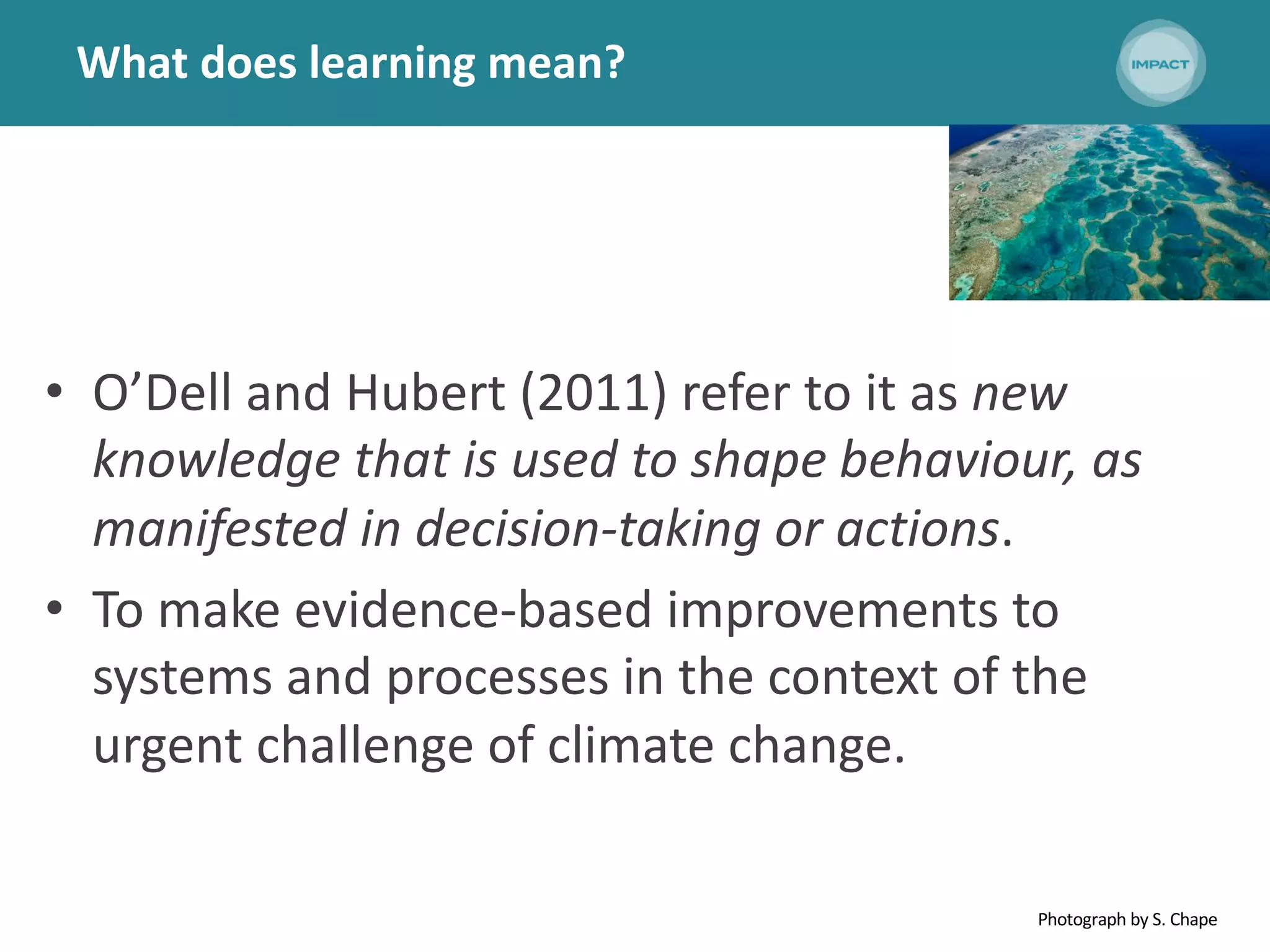
Photograph by S. Chape
Learning and M&E
• Learning is implied in M&E
– The assumption that we assess and gather
evidence in order to learn and act upon that
learning.
• Growing appreciation of the importance and
potential of M&E as a means of learning
– It does not happen automatically, how we
approach M&E can help or hinder learning
• Learning needs insights into how and why
change occurred
– This requires more than just indicators
Why learning matters for adaptation
• Significant, radical and rapid adjustments to
‘business as usual’ societal decisions are likely
to be needed
• Urgency and cost do not allow us the luxury of
a trial and error approach
• CCA is still an emerging field, effectiveness of
adaptation policies and actions is poorly
understood
• There may be winners and losers resulting
from adaptation
Barriers to learning through M&E
• M&E approaches may be shaped by
funders rather than decision-makers
such as national authorities (OECD,
2015) or communities.
• Creates tensions between accountability and
learning objectives - emphasis on reporting and
tracking agreed actions, rather than on reflection
and learning
• Pressure to spend
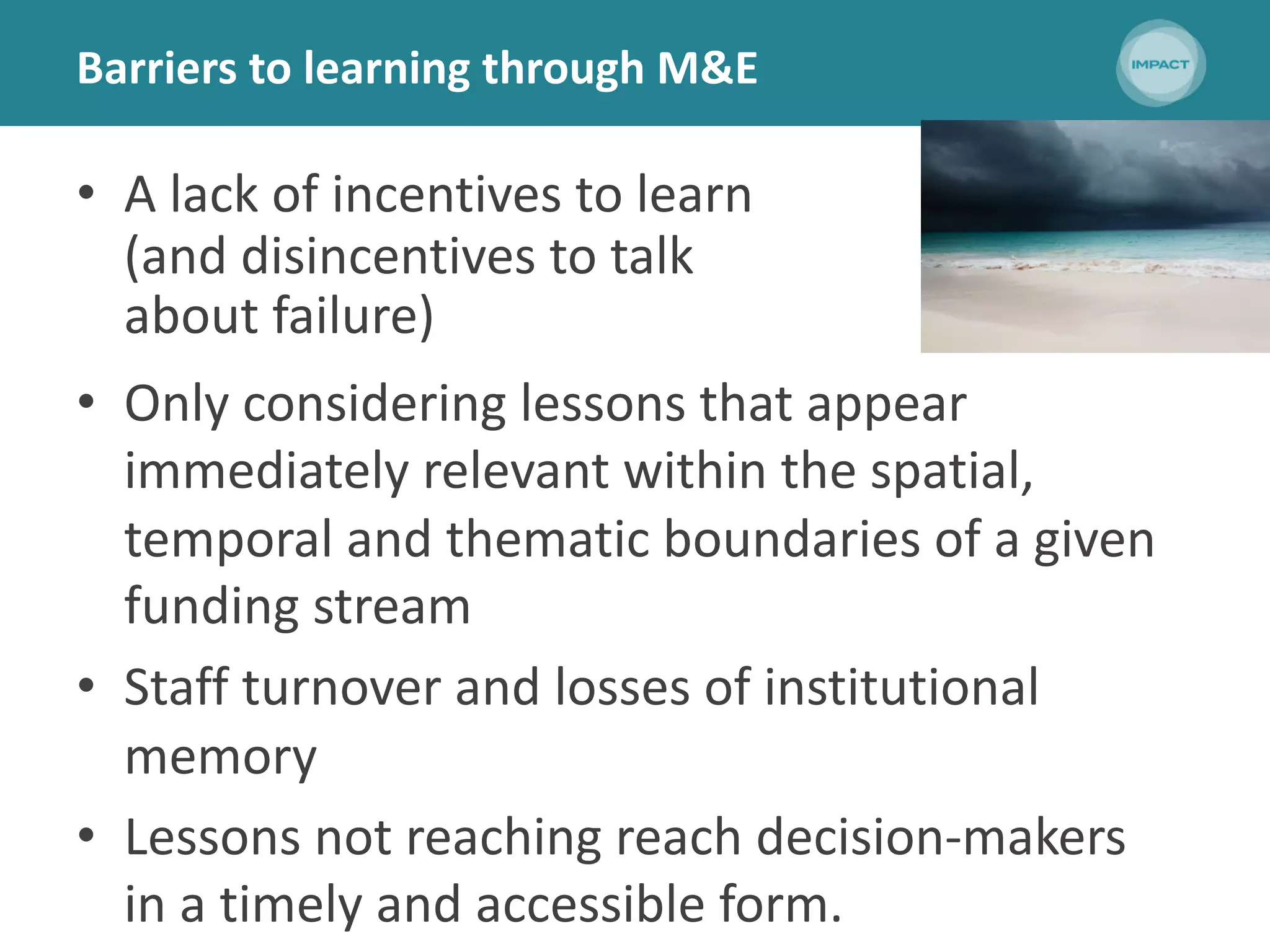
Photograph by S. Chape
Barriers to learning through M&E
• A lack of incentives to learn
(and disincentives to talk
about failure)
• Only considering lessons that appear
immediately relevant within the spatial,
temporal and thematic boundaries of a given
funding stream
• Staff turnover and losses of institutional
memory
• Lessons not reaching reach decision-makers
in a timely and accessible form.
A growing focus on learning?
• Paris Agreement (UNFCCC, 2015)
acknowledges the role of ‘Monitoring and
Evaluation and Learning from adaptation
plans, policies, programmes and actions’
(Article 7, paragraph 9d)
• DFID’s BRACED programme actively designed
learning into M&E approaches at the start
• Climate Investment Funds (CIF) have
established the Evaluation and Learning
Special Initiative
How do we learn more effectively through M&E?
• Ensure purpose/objective of M&E is clear from
the outset
– Establish learning objectives
• Improve alignment between quantifiable metrics
and qualitative narratives
– Both important tools that should be complementary.
• What we need to measure for accountability may
be quite different to what we need to learn.
• Consider multiple perspectives
– Success may look different from different perspectives
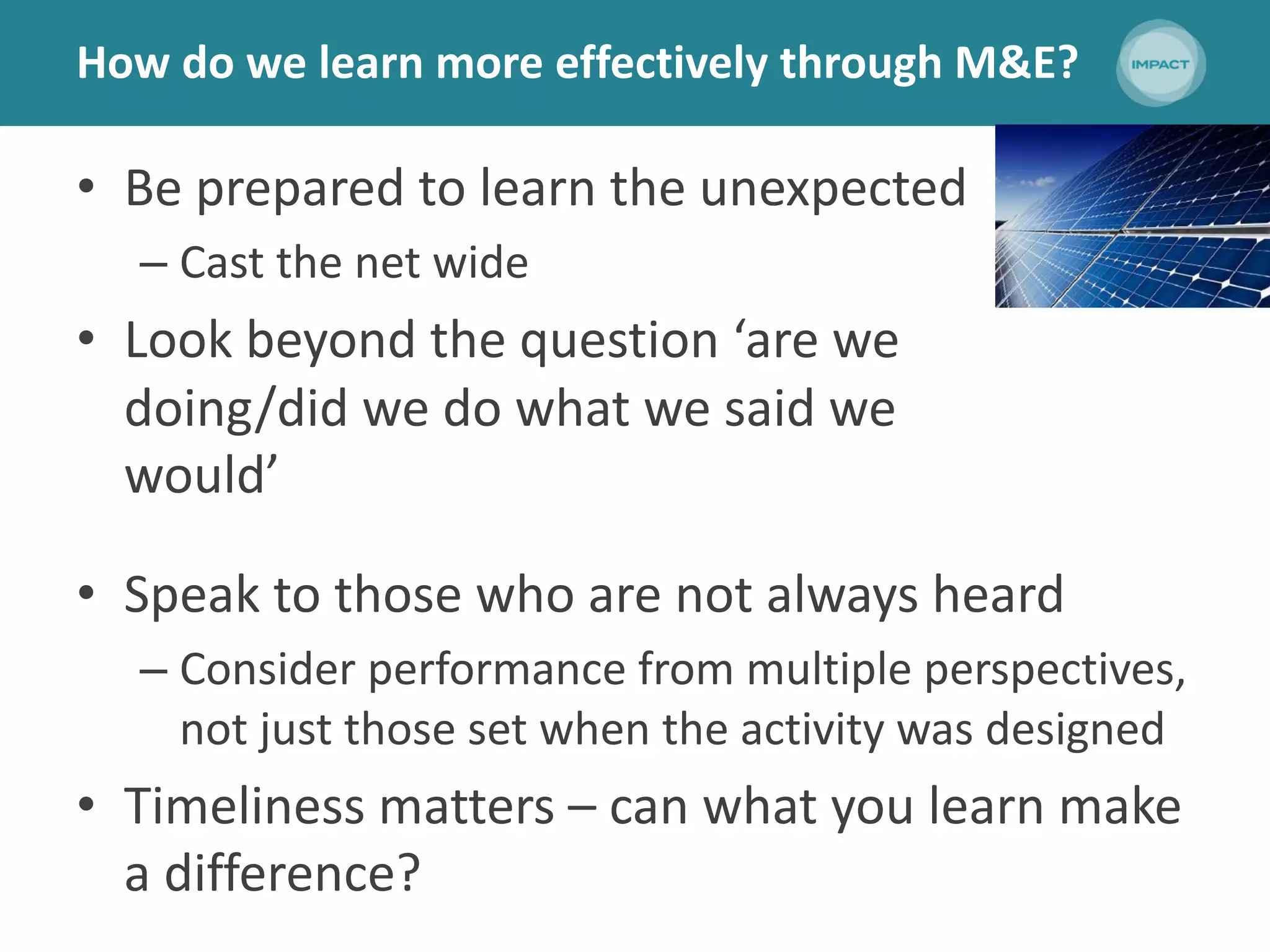
How do we learn more effectively through M&E?
• Be prepared to learn the unexpected
– Cast the net wide
• Look beyond the question ‘are we
doing/did we do what we said we
would’
• Speak to those who are not always heard
– Consider performance from multiple perspectives,
not just those set when the activity was designed
• Timeliness matters – can what you learn make
a difference?
Monitoring and evaluating learning
• Technical learning
– Ways of improving projects and programmes e.g.
irrigation techniques
• Social learning
– Creating ways of learning through sharing
knowledge and experience e.g. communities of
practice
• Systemic learning
– Improving systems, policymaking processes
• These might need to be measured in different
ways
Conclusions
• Learning seems an obvious purpose of M&E
but it doesn’t just happen!
• Learning is vital for climate change M&E given
the urgency and emergent nature of actions
• We need to make more time for learning in
M&E and consider how we communicate
lessons

Learning from M&E

  • 1.
    Learning from M&E VirtualLearning Event on Monitoring and Evaluation for National Adaptation in Pacific Small Island Developing States 15th September 2020. Paddy Pringle, Climate Analytics/SPREP
  • 2.
    Purpose of thissession • Why learning matters • Why it is sometimes difficult to learn • How can we use M&E to learn?
  • 3.
    What does learningmean? • O’Dell and Hubert (2011) refer to it as new knowledge that is used to shape behaviour, as manifested in decision-taking or actions. • To make evidence-based improvements to systems and processes in the context of the urgent challenge of climate change. Photograph by S. Chape
  • 4.
    Learning and M&E •Learning is implied in M&E – The assumption that we assess and gather evidence in order to learn and act upon that learning. • Growing appreciation of the importance and potential of M&E as a means of learning – It does not happen automatically, how we approach M&E can help or hinder learning • Learning needs insights into how and why change occurred – This requires more than just indicators
  • 5.
    Why learning mattersfor adaptation • Significant, radical and rapid adjustments to ‘business as usual’ societal decisions are likely to be needed • Urgency and cost do not allow us the luxury of a trial and error approach • CCA is still an emerging field, effectiveness of adaptation policies and actions is poorly understood • There may be winners and losers resulting from adaptation
  • 6.
    Barriers to learningthrough M&E • M&E approaches may be shaped by funders rather than decision-makers such as national authorities (OECD, 2015) or communities. • Creates tensions between accountability and learning objectives - emphasis on reporting and tracking agreed actions, rather than on reflection and learning • Pressure to spend Photograph by S. Chape
  • 7.
    Barriers to learningthrough M&E • A lack of incentives to learn (and disincentives to talk about failure) • Only considering lessons that appear immediately relevant within the spatial, temporal and thematic boundaries of a given funding stream • Staff turnover and losses of institutional memory • Lessons not reaching reach decision-makers in a timely and accessible form.
  • 8.
    A growing focuson learning? • Paris Agreement (UNFCCC, 2015) acknowledges the role of ‘Monitoring and Evaluation and Learning from adaptation plans, policies, programmes and actions’ (Article 7, paragraph 9d) • DFID’s BRACED programme actively designed learning into M&E approaches at the start • Climate Investment Funds (CIF) have established the Evaluation and Learning Special Initiative
  • 9.
    How do welearn more effectively through M&E? • Ensure purpose/objective of M&E is clear from the outset – Establish learning objectives • Improve alignment between quantifiable metrics and qualitative narratives – Both important tools that should be complementary. • What we need to measure for accountability may be quite different to what we need to learn. • Consider multiple perspectives – Success may look different from different perspectives
  • 10.
    How do welearn more effectively through M&E? • Be prepared to learn the unexpected – Cast the net wide • Look beyond the question ‘are we doing/did we do what we said we would’ • Speak to those who are not always heard – Consider performance from multiple perspectives, not just those set when the activity was designed • Timeliness matters – can what you learn make a difference?
  • 11.
    Monitoring and evaluatinglearning • Technical learning – Ways of improving projects and programmes e.g. irrigation techniques • Social learning – Creating ways of learning through sharing knowledge and experience e.g. communities of practice • Systemic learning – Improving systems, policymaking processes • These might need to be measured in different ways
  • 12.
    Conclusions • Learning seemsan obvious purpose of M&E but it doesn’t just happen! • Learning is vital for climate change M&E given the urgency and emergent nature of actions • We need to make more time for learning in M&E and consider how we communicate lessons