Learning Disabilities By Danielle Eppert Vanessa Madsen Gina Carter
The Learning Disabilities Association of Canada suggests that 1 in 10 Canadians have a learning disability. The chances of having a student with a learning disability in your class is highly likely. www.ldac-taac.ca/Defined/defined_new-e.asp
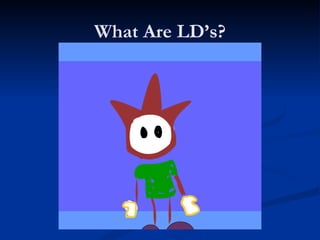
What Are LD’s?
Definition A learning disability can be any disorder that affects a person’s ability to gather, process, organize, understand and use information. These disorders may interfere with one or more of the following: Oral language Reading Written language Mathematics Leaning disabilities also may involve organizational skills, social perception, social interaction, and perspective taking. Adapted from The Learning Disabilities Association of Canada, http://www.ldac-taac.ca/Defined/defined_new-e.asp
Characteristics Specific difficulties in one or more academic areas – most common in reading Poor coordination Short attention span Hyperactivity Impulsivity Distractibility Difficulty following directions Difficulty organizing and interpreting information
Characteristics Continued Problems with speech and hearing Disorders of memory and thinking Disorganization Difficulty with social interaction and social perception Trouble making and keeping friends Poor self-concept Problems with perspective taking
Causes Genetics Tobacco, alcohol, and other drug use during pregnancy Complications during pregnancy Environmental toxins Mercury poisoning Lead poisoning Poor nutrition Maturational delay
Trends Multiple Intelligence theory as presented by Howard Gardner in the early 1980’s Appropriate Educational Programming Regulation in Manitoba Increase in the number of paraprofessionals in the classroom
Diagnosis of Learning Disabilities Developmental history Social review Observations Cognitive assessment Communication assessment Medical assessment
Implications of Diagnosis Having the resource room as a primary room for a student with a learning disability Children with learning disabilities are mainstreamed into classes to assigned times or specific periods of time such as recess, lunch, or physical education Children with different learning disabilities are lumped together Within the resource room specific skills are taught, in contrast to the holistic approach where the students are engaged completely Children with learning disabilities are pulled out of their classrooms
Impact on Social Development and Learning Social Development Difficulties understanding social cues Trouble reading facial expressions and body language Insensitive towards others Less skilled at resolving disputes Problems processing social information Lower self perception Does not accept responsibility Loss of temper
Learning In reading: Losing place while reading Jerking head from side to side Insecurity, crying, refusal to read Holding reading material very close to face Displays tension while reading – change of voice, fidgeting, biting lips Word recognition errors Comprehension errors
In mathematics: Conceptual understanding Written number symbols Procedural steps of computation Application of skills Poor strategies Counting Math language Problem solving Lack of automaticity
Strategies Positive expectations Authentic learning experiences Activity-based learning Multiple intelligences Authentic literacy strategies
Services and Supports Integrated Education Plans Students helping students Teaming School support programs Collaborative teaching Professional development
Conclusions

Learning Disabilities With Video

  • 1.
    Learning Disabilities ByDanielle Eppert Vanessa Madsen Gina Carter
  • 2.
    The Learning DisabilitiesAssociation of Canada suggests that 1 in 10 Canadians have a learning disability. The chances of having a student with a learning disability in your class is highly likely. www.ldac-taac.ca/Defined/defined_new-e.asp
  • 3.
  • 4.
    Definition A learningdisability can be any disorder that affects a person’s ability to gather, process, organize, understand and use information. These disorders may interfere with one or more of the following: Oral language Reading Written language Mathematics Leaning disabilities also may involve organizational skills, social perception, social interaction, and perspective taking. Adapted from The Learning Disabilities Association of Canada, http://www.ldac-taac.ca/Defined/defined_new-e.asp
  • 5.
    Characteristics Specific difficultiesin one or more academic areas – most common in reading Poor coordination Short attention span Hyperactivity Impulsivity Distractibility Difficulty following directions Difficulty organizing and interpreting information
  • 6.
    Characteristics Continued Problemswith speech and hearing Disorders of memory and thinking Disorganization Difficulty with social interaction and social perception Trouble making and keeping friends Poor self-concept Problems with perspective taking
  • 7.
    Causes Genetics Tobacco,alcohol, and other drug use during pregnancy Complications during pregnancy Environmental toxins Mercury poisoning Lead poisoning Poor nutrition Maturational delay
  • 8.
    Trends Multiple Intelligencetheory as presented by Howard Gardner in the early 1980’s Appropriate Educational Programming Regulation in Manitoba Increase in the number of paraprofessionals in the classroom
  • 9.
    Diagnosis of LearningDisabilities Developmental history Social review Observations Cognitive assessment Communication assessment Medical assessment
  • 10.
    Implications of DiagnosisHaving the resource room as a primary room for a student with a learning disability Children with learning disabilities are mainstreamed into classes to assigned times or specific periods of time such as recess, lunch, or physical education Children with different learning disabilities are lumped together Within the resource room specific skills are taught, in contrast to the holistic approach where the students are engaged completely Children with learning disabilities are pulled out of their classrooms
  • 11.
    Impact on SocialDevelopment and Learning Social Development Difficulties understanding social cues Trouble reading facial expressions and body language Insensitive towards others Less skilled at resolving disputes Problems processing social information Lower self perception Does not accept responsibility Loss of temper
  • 12.
    Learning In reading:Losing place while reading Jerking head from side to side Insecurity, crying, refusal to read Holding reading material very close to face Displays tension while reading – change of voice, fidgeting, biting lips Word recognition errors Comprehension errors
  • 13.
    In mathematics: Conceptualunderstanding Written number symbols Procedural steps of computation Application of skills Poor strategies Counting Math language Problem solving Lack of automaticity
  • 14.
    Strategies Positive expectationsAuthentic learning experiences Activity-based learning Multiple intelligences Authentic literacy strategies
  • 15.
    Services and SupportsIntegrated Education Plans Students helping students Teaming School support programs Collaborative teaching Professional development
  • 16.