WEB 2.0 LEARNING BY DOING Raphaëlle LAUBIE Using Technology and Constituing Structures: A practice Lens for studying Technology in Organizations (Orlikowski, 2000)
AUTHOR  Wanda J. Orlikowski Professor of Communication Sciences at MIT, Professor of Information Technologies and Organization  Studied at MIT's Sloan School of Management.  Her research focuses on the  sociological aspects of technology and work .  She is particularly interested in the dynamic relations between information technologies and organizations over time, with emphases  on organizing structures, cultural norms, communication genres, and work practices.  She recently led a multi-year project (funded by the National Science Foundation) on the social and economic implications of Internet technologies in organizations.  She is currently examining the sociomaterial entailments of distributed collaboration.
LITERATURE Organizational Researchers N otions of  innovation ,  learning , and  improvisation  to account for such dynamic and emerging patterns of organizing (Brown and Duguid 1991, Weick 1993, Hutchins  1991, Brown and Eisenhardt 1997, Hedberg et al. 1997, Barrett 1998, Hatch 1998, Lant 1999) Researchers of Technology Notions of  innovation ,  learning , and  improvisation  to understand the organizational implications of new technologies (Ciborra 1996, Cook and Brown 1999, Orlikowski  1996, Tushman et al. 1997) Wanda J. Orlikowski (2000) Continues  the development of concepts that address the role of  emergence and improvisation in technology and technology use , and in particular, seeks to extend the structurational  perspective in this direction… Do social structures determine an individual's behaviour or does  human agency   ?
CALL FOR RESEARCH Existing Structurational Models of Technology Existing models posit technology  as embodying structures, which are then appropriated by users during their use of the technology.  Human action is a central aspect of these models: Embedding structures  within a technology during its  development, Appropriating those structures  during  use  of technology Research Gap Existing models are not able to account effectively for  ongoing changes  in both technologies and their use.  This insufficiency is particularly acute in the context of internet work and reconfigurable technology (such as groupware and the Web)
Practice Lens on  Innovation, Emergence, and  Improvisation in 0rganizations Wanda J. Orlikowski  ‘ proposes an extension to the structurational perspective on technology  that develops a practice lens to examine how people, as they interact with a technology in their ongoing practices enact structures which  shape their emergent and situated use of that technology.’ As ‘both  technologies and organizations  are undergoing dramatic  changes  in form and function’,  the author argues that this specific use enables a peculiar and innovative process that underscores and allows organizations to understand  social practices  as they’re shaping the resources’ role in the workplace ->  A  recursive interaction  between people, technologies and social action ISSUE
Benefits Structurational perspective on technology has benefited from social constructivist ideas:  Interpretations,  social interests, and disciplinary conflicts shape the production of a technology through shaping its  cultural meanings  and the  social interactions  among relevant social  groups. Difficulties Technologies  become  " stabilized "  after development:  It depicts technologies as static and settled artifacts - Empirical research shows that people modify technologies and their conceptions of technology long after design and development (Rice and Rogers 1980, von Hippel 1988, Ciborra and Lanzara 1991) Technologies  “ embody "  structures which (re)present various  social  rules  and  political interests STRUCTURATIONAL MODELS OF TECHNOLOGY
Practical Proposition: Use of Technology A practice lens more easily accommodates people' s situated use of dynamic technologies: -> H umans as  constituting structures  in their recurrent use of technology (regularized engagement with a particular technology, in particular ways, in particular conditions…) -> Users choose a technology, also  choose how to interact  with that technology (in ways not anticipated  by the developers) -> It does  not  mean that it is  totally open  to any and all possibilities (boundary conditions on how we use them) -> Use of technology is strongly influenced by  users' understandings  of the properties and functionality of a technology (images,  d escriptions, rhetorics, ideologies, and demonstrations  presented by intermediaries such as vendors, journalists,  consultants, champions, trainers, managers, and ‘power’  users (Orlikowski et al. 1995)) STRUCTURATIONAL MODELS OF TECHNOLOGY
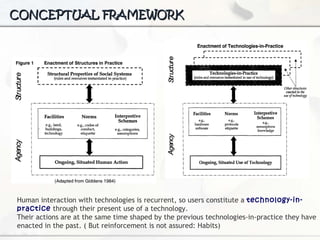
CONCEPTUAL FRAMEWORK Human interaction with technologies is recurrent, so users constitute a  technology-in-practice   through their present use of a technology. Their actions are at the same time shaped by the previous technologies-in-practice they have enacted in the past. ( But reinforcement is not assured: Habits)
EMPIRICAL EXEMPLES Lotus Notes The technology considered here is the Notes software product, released to the market in 1989 by Lotus Development Corporation, and sold to thousands of companies worldwide.  The  technologies-in-practice enacted with Notes, because they are constituted in use, cannot attain such closure. And as we will see below, multiple, different technologies-in practice were enacted by different user groups-  one  by  Iris  developers,  three   within  Alpha …
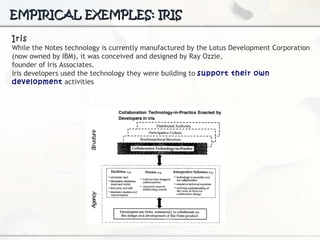
EMPIRICAL EXEMPLES: IRIS Iris While the Notes technology is currently manufactured by the Lotus Development Corporation (now owned by IBM), it was conceived and designed by Ray Ozzie, founder of Iris Associates.  Iris developers used the technology they were building to  support their own development   activities
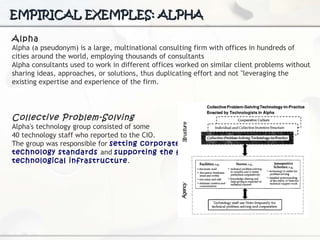
EMPIRICAL EXEMPLES: ALPHA Alpha Alpha (a pseudonym) is a large, multinational consulting firm with offices in hundreds of cities around the world, employing thousands of consultants Alpha consultants used to work in different offices worked on similar client problems without sharing ideas, approaches, or solutions, thus duplicating effort and not "leveraging the existing expertise and experience  of the firm.   Collective Problem-Solving Alpha's technology group consisted of some  40 technology staff who reported to the CIO.  The group was responsible for  setting corporate  technology standards  and  supporting the firm's  technological infrastructure .
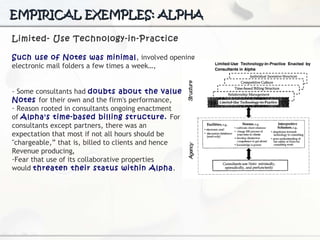
EMPIRICAL EXEMPLES: ALPHA Limited- Use Technology-in-Practice Such use of Notes was minimal , involved opening electronic mail folders a few times a week…,  -  Some consultants had  doubts about the value of Notes  for their own and the firm's performance, Reason rooted in consultants ongoing enactment  of  Alpha's time-based billing structure.  For all  consultants except partners, there was an  expectation that most if not all hours should be "chargeable,” that is, billed to clients and hence Revenue producing , Fear  that use of its collaborative properties  would  threaten their status within Alpha .
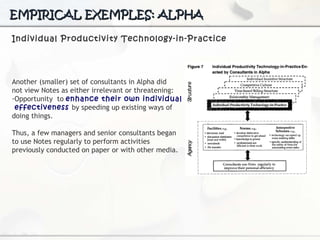
EMPIRICAL EXEMPLES: ALPHA Individual Productivity Technology-in-Practice Another (smaller) set of consultants in Alpha did  not view Notes as either irrelevant or threatening:  Opportunity  to  enhance their own individual  effectiveness  by speeding up existing ways of  doing things. Thus, a few managers and senior consultants began  to use Notes regularly to perform activities  previously conducted on paper or with other media.
CONCLUSION: OPEN MODEL Changes in Technology-in-practice As people enact modified technologies-in-practice they also change the facilities, norms, and interpretive schemes used in their use of the technology: - through  adding downloaded "plug-ins"  to a personal computer, or customizing the parameters of a software application, or adding new data to the databases, the technological artifact is altered, -  users’ knowledge of what technological properties are available  to them may be updated or made obsolete, as with the meanings, expectations, associations, and conventions they attach to the technology and its use.  - users of electronic mail within a community may evolve a  set of communication norms   about effective or sanctioned electronic mail use (Yates et al. 1999).  a  company's new policy  for use of machine safety features is likely to alter people's views and understandings of the appropriate ways of using technology in that company. The practice lens proposed here focuses on human agency and the open-ended set of emergent structures that may be enacted through recurrent  use of a technology: always ongoing accomplishments
LEARNING BY DOING Raphaëlle LAUBIE Using Technology and Constituing Structures: A practice Lens for studying Technology in Organizations (Orlikowski, 2000) twitter.com /RaphaelleLAUBIE

Learning by doing

  • 1.
    WEB 2.0 LEARNINGBY DOING Raphaëlle LAUBIE Using Technology and Constituing Structures: A practice Lens for studying Technology in Organizations (Orlikowski, 2000)
  • 2.
    AUTHOR WandaJ. Orlikowski Professor of Communication Sciences at MIT, Professor of Information Technologies and Organization Studied at MIT's Sloan School of Management. Her research focuses on the sociological aspects of technology and work . She is particularly interested in the dynamic relations between information technologies and organizations over time, with emphases on organizing structures, cultural norms, communication genres, and work practices. She recently led a multi-year project (funded by the National Science Foundation) on the social and economic implications of Internet technologies in organizations. She is currently examining the sociomaterial entailments of distributed collaboration.
  • 3.
    LITERATURE Organizational ResearchersN otions of innovation , learning , and improvisation to account for such dynamic and emerging patterns of organizing (Brown and Duguid 1991, Weick 1993, Hutchins 1991, Brown and Eisenhardt 1997, Hedberg et al. 1997, Barrett 1998, Hatch 1998, Lant 1999) Researchers of Technology Notions of innovation , learning , and improvisation to understand the organizational implications of new technologies (Ciborra 1996, Cook and Brown 1999, Orlikowski 1996, Tushman et al. 1997) Wanda J. Orlikowski (2000) Continues the development of concepts that address the role of emergence and improvisation in technology and technology use , and in particular, seeks to extend the structurational perspective in this direction… Do social structures determine an individual's behaviour or does human agency ?
  • 4.
    CALL FOR RESEARCHExisting Structurational Models of Technology Existing models posit technology as embodying structures, which are then appropriated by users during their use of the technology. Human action is a central aspect of these models: Embedding structures within a technology during its development, Appropriating those structures during use of technology Research Gap Existing models are not able to account effectively for ongoing changes in both technologies and their use. This insufficiency is particularly acute in the context of internet work and reconfigurable technology (such as groupware and the Web)
  • 5.
    Practice Lens on Innovation, Emergence, and Improvisation in 0rganizations Wanda J. Orlikowski ‘ proposes an extension to the structurational perspective on technology that develops a practice lens to examine how people, as they interact with a technology in their ongoing practices enact structures which shape their emergent and situated use of that technology.’ As ‘both technologies and organizations are undergoing dramatic changes in form and function’, the author argues that this specific use enables a peculiar and innovative process that underscores and allows organizations to understand social practices as they’re shaping the resources’ role in the workplace -> A recursive interaction between people, technologies and social action ISSUE
  • 6.
    Benefits Structurational perspectiveon technology has benefited from social constructivist ideas: Interpretations, social interests, and disciplinary conflicts shape the production of a technology through shaping its cultural meanings and the social interactions among relevant social groups. Difficulties Technologies become " stabilized " after development: It depicts technologies as static and settled artifacts - Empirical research shows that people modify technologies and their conceptions of technology long after design and development (Rice and Rogers 1980, von Hippel 1988, Ciborra and Lanzara 1991) Technologies “ embody " structures which (re)present various social rules and political interests STRUCTURATIONAL MODELS OF TECHNOLOGY
  • 7.
    Practical Proposition: Useof Technology A practice lens more easily accommodates people' s situated use of dynamic technologies: -> H umans as constituting structures in their recurrent use of technology (regularized engagement with a particular technology, in particular ways, in particular conditions…) -> Users choose a technology, also choose how to interact with that technology (in ways not anticipated by the developers) -> It does not mean that it is totally open to any and all possibilities (boundary conditions on how we use them) -> Use of technology is strongly influenced by users' understandings of the properties and functionality of a technology (images, d escriptions, rhetorics, ideologies, and demonstrations presented by intermediaries such as vendors, journalists, consultants, champions, trainers, managers, and ‘power’ users (Orlikowski et al. 1995)) STRUCTURATIONAL MODELS OF TECHNOLOGY
  • 8.
    CONCEPTUAL FRAMEWORK Humaninteraction with technologies is recurrent, so users constitute a technology-in-practice through their present use of a technology. Their actions are at the same time shaped by the previous technologies-in-practice they have enacted in the past. ( But reinforcement is not assured: Habits)
  • 9.
    EMPIRICAL EXEMPLES LotusNotes The technology considered here is the Notes software product, released to the market in 1989 by Lotus Development Corporation, and sold to thousands of companies worldwide. The technologies-in-practice enacted with Notes, because they are constituted in use, cannot attain such closure. And as we will see below, multiple, different technologies-in practice were enacted by different user groups- one by Iris developers, three within Alpha …
  • 10.
    EMPIRICAL EXEMPLES: IRISIris While the Notes technology is currently manufactured by the Lotus Development Corporation (now owned by IBM), it was conceived and designed by Ray Ozzie, founder of Iris Associates. Iris developers used the technology they were building to support their own development activities
  • 11.
    EMPIRICAL EXEMPLES: ALPHAAlpha Alpha (a pseudonym) is a large, multinational consulting firm with offices in hundreds of cities around the world, employing thousands of consultants Alpha consultants used to work in different offices worked on similar client problems without sharing ideas, approaches, or solutions, thus duplicating effort and not "leveraging the existing expertise and experience of the firm.   Collective Problem-Solving Alpha's technology group consisted of some 40 technology staff who reported to the CIO. The group was responsible for setting corporate technology standards and supporting the firm's technological infrastructure .
  • 12.
    EMPIRICAL EXEMPLES: ALPHALimited- Use Technology-in-Practice Such use of Notes was minimal , involved opening electronic mail folders a few times a week…, - Some consultants had doubts about the value of Notes for their own and the firm's performance, Reason rooted in consultants ongoing enactment of Alpha's time-based billing structure. For all consultants except partners, there was an expectation that most if not all hours should be "chargeable,” that is, billed to clients and hence Revenue producing , Fear that use of its collaborative properties would threaten their status within Alpha .
  • 13.
    EMPIRICAL EXEMPLES: ALPHAIndividual Productivity Technology-in-Practice Another (smaller) set of consultants in Alpha did not view Notes as either irrelevant or threatening: Opportunity to enhance their own individual effectiveness by speeding up existing ways of doing things. Thus, a few managers and senior consultants began to use Notes regularly to perform activities previously conducted on paper or with other media.
  • 14.
    CONCLUSION: OPEN MODELChanges in Technology-in-practice As people enact modified technologies-in-practice they also change the facilities, norms, and interpretive schemes used in their use of the technology: - through adding downloaded "plug-ins" to a personal computer, or customizing the parameters of a software application, or adding new data to the databases, the technological artifact is altered, - users’ knowledge of what technological properties are available to them may be updated or made obsolete, as with the meanings, expectations, associations, and conventions they attach to the technology and its use. - users of electronic mail within a community may evolve a set of communication norms about effective or sanctioned electronic mail use (Yates et al. 1999). a company's new policy for use of machine safety features is likely to alter people's views and understandings of the appropriate ways of using technology in that company. The practice lens proposed here focuses on human agency and the open-ended set of emergent structures that may be enacted through recurrent use of a technology: always ongoing accomplishments
  • 15.
    LEARNING BY DOINGRaphaëlle LAUBIE Using Technology and Constituing Structures: A practice Lens for studying Technology in Organizations (Orlikowski, 2000) twitter.com /RaphaelleLAUBIE

Editor's Notes

  • #3 Cofondateur de la société Intel, Gordon Moore avait affirmé dès 1965 que le nombre de transistors par circuit de même taille allait doubler, à prix constants, tous les ans. Il rectifia par la suite en portant à dix-huit mois le rythme de doublement. Il en déduisit que la puissance des ordinateurs allait croître de manière exponentielle, et ce pour des années. Il avait raison. Sa loi, fondée sur un constat empirique, a été vérifiée jusqu'à aujourd'hui. Il a cependant déclaré en 1997 que cette croissance des performances des puces se heurterait aux environ de 2017 à une limite physique : celle de la taille des atomes . D'ici là, nos ordinateurs seront environ 1 500 fois plus puissants qu'aujourd'hui ! http://www.intel.com/technology/mooreslaw/
  • #4 Cofondateur de la société Intel, Gordon Moore avait affirmé dès 1965 que le nombre de transistors par circuit de même taille allait doubler, à prix constants, tous les ans. Il rectifia par la suite en portant à dix-huit mois le rythme de doublement. Il en déduisit que la puissance des ordinateurs allait croître de manière exponentielle, et ce pour des années. Il avait raison. Sa loi, fondée sur un constat empirique, a été vérifiée jusqu'à aujourd'hui. Il a cependant déclaré en 1997 que cette croissance des performances des puces se heurterait aux environ de 2017 à une limite physique : celle de la taille des atomes . D'ici là, nos ordinateurs seront environ 1 500 fois plus puissants qu'aujourd'hui ! http://www.intel.com/technology/mooreslaw/
  • #5 Cofondateur de la société Intel, Gordon Moore avait affirmé dès 1965 que le nombre de transistors par circuit de même taille allait doubler, à prix constants, tous les ans. Il rectifia par la suite en portant à dix-huit mois le rythme de doublement. Il en déduisit que la puissance des ordinateurs allait croître de manière exponentielle, et ce pour des années. Il avait raison. Sa loi, fondée sur un constat empirique, a été vérifiée jusqu'à aujourd'hui. Il a cependant déclaré en 1997 que cette croissance des performances des puces se heurterait aux environ de 2017 à une limite physique : celle de la taille des atomes . D'ici là, nos ordinateurs seront environ 1 500 fois plus puissants qu'aujourd'hui ! http://www.intel.com/technology/mooreslaw/
  • #6 Cofondateur de la société Intel, Gordon Moore avait affirmé dès 1965 que le nombre de transistors par circuit de même taille allait doubler, à prix constants, tous les ans. Il rectifia par la suite en portant à dix-huit mois le rythme de doublement. Il en déduisit que la puissance des ordinateurs allait croître de manière exponentielle, et ce pour des années. Il avait raison. Sa loi, fondée sur un constat empirique, a été vérifiée jusqu'à aujourd'hui. Il a cependant déclaré en 1997 que cette croissance des performances des puces se heurterait aux environ de 2017 à une limite physique : celle de la taille des atomes . D'ici là, nos ordinateurs seront environ 1 500 fois plus puissants qu'aujourd'hui ! http://www.intel.com/technology/mooreslaw/
  • #7 Cofondateur de la société Intel, Gordon Moore avait affirmé dès 1965 que le nombre de transistors par circuit de même taille allait doubler, à prix constants, tous les ans. Il rectifia par la suite en portant à dix-huit mois le rythme de doublement. Il en déduisit que la puissance des ordinateurs allait croître de manière exponentielle, et ce pour des années. Il avait raison. Sa loi, fondée sur un constat empirique, a été vérifiée jusqu'à aujourd'hui. Il a cependant déclaré en 1997 que cette croissance des performances des puces se heurterait aux environ de 2017 à une limite physique : celle de la taille des atomes . D'ici là, nos ordinateurs seront environ 1 500 fois plus puissants qu'aujourd'hui ! http://www.intel.com/technology/mooreslaw/
  • #8 Cofondateur de la société Intel, Gordon Moore avait affirmé dès 1965 que le nombre de transistors par circuit de même taille allait doubler, à prix constants, tous les ans. Il rectifia par la suite en portant à dix-huit mois le rythme de doublement. Il en déduisit que la puissance des ordinateurs allait croître de manière exponentielle, et ce pour des années. Il avait raison. Sa loi, fondée sur un constat empirique, a été vérifiée jusqu'à aujourd'hui. Il a cependant déclaré en 1997 que cette croissance des performances des puces se heurterait aux environ de 2017 à une limite physique : celle de la taille des atomes . D'ici là, nos ordinateurs seront environ 1 500 fois plus puissants qu'aujourd'hui ! http://www.intel.com/technology/mooreslaw/
  • #9 Cofondateur de la société Intel, Gordon Moore avait affirmé dès 1965 que le nombre de transistors par circuit de même taille allait doubler, à prix constants, tous les ans. Il rectifia par la suite en portant à dix-huit mois le rythme de doublement. Il en déduisit que la puissance des ordinateurs allait croître de manière exponentielle, et ce pour des années. Il avait raison. Sa loi, fondée sur un constat empirique, a été vérifiée jusqu'à aujourd'hui. Il a cependant déclaré en 1997 que cette croissance des performances des puces se heurterait aux environ de 2017 à une limite physique : celle de la taille des atomes . D'ici là, nos ordinateurs seront environ 1 500 fois plus puissants qu'aujourd'hui ! http://www.intel.com/technology/mooreslaw/
  • #10 Cofondateur de la société Intel, Gordon Moore avait affirmé dès 1965 que le nombre de transistors par circuit de même taille allait doubler, à prix constants, tous les ans. Il rectifia par la suite en portant à dix-huit mois le rythme de doublement. Il en déduisit que la puissance des ordinateurs allait croître de manière exponentielle, et ce pour des années. Il avait raison. Sa loi, fondée sur un constat empirique, a été vérifiée jusqu'à aujourd'hui. Il a cependant déclaré en 1997 que cette croissance des performances des puces se heurterait aux environ de 2017 à une limite physique : celle de la taille des atomes . D'ici là, nos ordinateurs seront environ 1 500 fois plus puissants qu'aujourd'hui ! http://www.intel.com/technology/mooreslaw/
  • #11 Cofondateur de la société Intel, Gordon Moore avait affirmé dès 1965 que le nombre de transistors par circuit de même taille allait doubler, à prix constants, tous les ans. Il rectifia par la suite en portant à dix-huit mois le rythme de doublement. Il en déduisit que la puissance des ordinateurs allait croître de manière exponentielle, et ce pour des années. Il avait raison. Sa loi, fondée sur un constat empirique, a été vérifiée jusqu'à aujourd'hui. Il a cependant déclaré en 1997 que cette croissance des performances des puces se heurterait aux environ de 2017 à une limite physique : celle de la taille des atomes . D'ici là, nos ordinateurs seront environ 1 500 fois plus puissants qu'aujourd'hui ! http://www.intel.com/technology/mooreslaw/
  • #12 Cofondateur de la société Intel, Gordon Moore avait affirmé dès 1965 que le nombre de transistors par circuit de même taille allait doubler, à prix constants, tous les ans. Il rectifia par la suite en portant à dix-huit mois le rythme de doublement. Il en déduisit que la puissance des ordinateurs allait croître de manière exponentielle, et ce pour des années. Il avait raison. Sa loi, fondée sur un constat empirique, a été vérifiée jusqu'à aujourd'hui. Il a cependant déclaré en 1997 que cette croissance des performances des puces se heurterait aux environ de 2017 à une limite physique : celle de la taille des atomes . D'ici là, nos ordinateurs seront environ 1 500 fois plus puissants qu'aujourd'hui ! http://www.intel.com/technology/mooreslaw/
  • #13 Cofondateur de la société Intel, Gordon Moore avait affirmé dès 1965 que le nombre de transistors par circuit de même taille allait doubler, à prix constants, tous les ans. Il rectifia par la suite en portant à dix-huit mois le rythme de doublement. Il en déduisit que la puissance des ordinateurs allait croître de manière exponentielle, et ce pour des années. Il avait raison. Sa loi, fondée sur un constat empirique, a été vérifiée jusqu'à aujourd'hui. Il a cependant déclaré en 1997 que cette croissance des performances des puces se heurterait aux environ de 2017 à une limite physique : celle de la taille des atomes . D'ici là, nos ordinateurs seront environ 1 500 fois plus puissants qu'aujourd'hui ! http://www.intel.com/technology/mooreslaw/
  • #14 Cofondateur de la société Intel, Gordon Moore avait affirmé dès 1965 que le nombre de transistors par circuit de même taille allait doubler, à prix constants, tous les ans. Il rectifia par la suite en portant à dix-huit mois le rythme de doublement. Il en déduisit que la puissance des ordinateurs allait croître de manière exponentielle, et ce pour des années. Il avait raison. Sa loi, fondée sur un constat empirique, a été vérifiée jusqu'à aujourd'hui. Il a cependant déclaré en 1997 que cette croissance des performances des puces se heurterait aux environ de 2017 à une limite physique : celle de la taille des atomes . D'ici là, nos ordinateurs seront environ 1 500 fois plus puissants qu'aujourd'hui ! http://www.intel.com/technology/mooreslaw/
  • #15 Cofondateur de la société Intel, Gordon Moore avait affirmé dès 1965 que le nombre de transistors par circuit de même taille allait doubler, à prix constants, tous les ans. Il rectifia par la suite en portant à dix-huit mois le rythme de doublement. Il en déduisit que la puissance des ordinateurs allait croître de manière exponentielle, et ce pour des années. Il avait raison. Sa loi, fondée sur un constat empirique, a été vérifiée jusqu'à aujourd'hui. Il a cependant déclaré en 1997 que cette croissance des performances des puces se heurterait aux environ de 2017 à une limite physique : celle de la taille des atomes . D'ici là, nos ordinateurs seront environ 1 500 fois plus puissants qu'aujourd'hui ! http://www.intel.com/technology/mooreslaw/