Soheil Atashian
University of Nizwa
The Sultanate of Oman
 The current study seeks to link two significant
issues in pedagogy: Learners’ Autonomy &
Blended Learning.
 More specifically, this work sheds light on
learners’ perception of Autonomy while they
go through a blended program.
 Blended Learning: Osguthorpe and Graham
(2003) define blended learning as a combination of
a traditional face-to-face instructional method and
an online learning component with online
management tools (e-learning).
 Autonomy: is closely linked to learners’ level of
motivation which plays an integral role in the
effectiveness of learning. As Dincer et al (2012)
point out, autonomy-supportive climates facilitate
students’ learning, and is mostly related to intrinsic
motivation.
Sixty tertiary-level students, 80 per cent of whom
were females and 20 per cent males, were included
in the study. The students were taught using online
sources along with their coursebooks. At the end of
the semester, a questionnaire with 20 items was
given to them; the students were asked to express
the degree to which they agree with the statements.
The analysis of the questionnaires revealed that 88
per cent of the students felt more independent and
were motivated by the inclusion of technology
within traditional methods. According to the
learners, their autonomy was increased to a great
extent.
 Technology is an indispensible part of our life.
Including technology in the learning process seems
to be a must for the time being.
 As the current study revealed, students feel more
independent while they utilize technology.
 Given the importance of Blended Learning, there
still needs to be a great deal of research within this
domain.
 Different aspects of education, such as motivation,
might be assessed in blended programs.
 Questionnaire:
http://www.bdigital.unal.edu.co/46871/11/41821-190675-1-SP.pdf
 Osguthorpe, R. T., & Graham, C. R. (2003). Blended learning
environments: Definitions and directions.Quarterly Review of
Distance Education, 4(3), 227-233.
 Graham, C. R. (2006). Blended learning systems: Definition,
current trends, and future directions. In C. J. Bonk & C. R.
Graham (Eds.), The handbook of blended learning: Global
perspectives, local designs (pp. 3-21). San Francisco, CA: Pfeiffer.
 Soheil Atashian is a lecturer at the department of
foreign languages in the University of Nizwa,
Oman. His research interests are pragmatics,
textbooks, discourse analysis and technology in
EFL classes.
Contact Info:
Email: soheil@unizwa.edu.om
Website: www.atashian.com

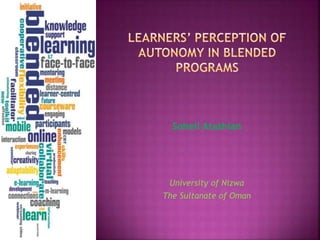
Learners’ perception of autonomy in blended programs

  • 1.
    Soheil Atashian University ofNizwa The Sultanate of Oman
  • 2.
     The currentstudy seeks to link two significant issues in pedagogy: Learners’ Autonomy & Blended Learning.  More specifically, this work sheds light on learners’ perception of Autonomy while they go through a blended program.
  • 3.
     Blended Learning:Osguthorpe and Graham (2003) define blended learning as a combination of a traditional face-to-face instructional method and an online learning component with online management tools (e-learning).  Autonomy: is closely linked to learners’ level of motivation which plays an integral role in the effectiveness of learning. As Dincer et al (2012) point out, autonomy-supportive climates facilitate students’ learning, and is mostly related to intrinsic motivation.
  • 4.
    Sixty tertiary-level students,80 per cent of whom were females and 20 per cent males, were included in the study. The students were taught using online sources along with their coursebooks. At the end of the semester, a questionnaire with 20 items was given to them; the students were asked to express the degree to which they agree with the statements.
  • 5.
    The analysis ofthe questionnaires revealed that 88 per cent of the students felt more independent and were motivated by the inclusion of technology within traditional methods. According to the learners, their autonomy was increased to a great extent.
  • 6.
     Technology isan indispensible part of our life. Including technology in the learning process seems to be a must for the time being.  As the current study revealed, students feel more independent while they utilize technology.
  • 7.
     Given theimportance of Blended Learning, there still needs to be a great deal of research within this domain.  Different aspects of education, such as motivation, might be assessed in blended programs.
  • 8.
     Questionnaire: http://www.bdigital.unal.edu.co/46871/11/41821-190675-1-SP.pdf  Osguthorpe,R. T., & Graham, C. R. (2003). Blended learning environments: Definitions and directions.Quarterly Review of Distance Education, 4(3), 227-233.  Graham, C. R. (2006). Blended learning systems: Definition, current trends, and future directions. In C. J. Bonk & C. R. Graham (Eds.), The handbook of blended learning: Global perspectives, local designs (pp. 3-21). San Francisco, CA: Pfeiffer.
  • 9.
     Soheil Atashianis a lecturer at the department of foreign languages in the University of Nizwa, Oman. His research interests are pragmatics, textbooks, discourse analysis and technology in EFL classes. Contact Info: Email: soheil@unizwa.edu.om Website: www.atashian.com