Restful Service with Java
REST
● REST stands for Representational State Transfer
-Design pattern for developing web services.
● Resource based
● Rest Style:
● Client-server
● Uniform interface
● Stateless
● Cached
● Layered system
● HATEOAS - (Hypermedia As The Engine Of Application State)
REST - not a Standard
● But it uses several standards:
o HTTP
o URL
o XML/HTML/GIF/JPEG/etc (Resource Representations)
o text/xml, text/html, image/gif, image/jpeg, etc (Resource Types, MIME Types)
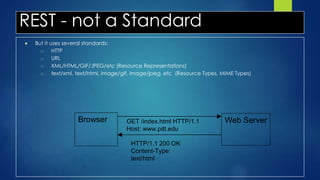
Browser Web ServerGET /index.html HTTP/1.1
Host: www.pitt.edu
HTTP/1.1 200 OK
Content-Type:
text/html
HTTP Request
• The HTTP request is sent from the client.
– Identifies the location of a resource.
– Uses nouns rather than verbs to denote simple resources.
– Specifies the verb, or HTTP method to use when accessing the resource.
– Supplies optional request headers (name-value pairs) that provide additional
information the server may need when processing the request.
– Supplies an optional request body that identifies additional data to be
uploaded to the server (e.g. form parameters, attachments, etc.)
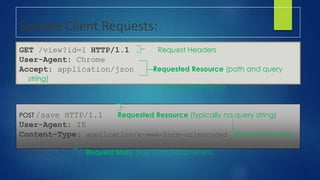
Sample Client Requests:
GET /view?id=1 HTTP/1.1 Request Headers
User-Agent: Chrome
Accept: application/json Requested Resource (path and query
string)
(no request body)
POST /save HTTP/1.1 Requested Resource (typically no query string)
User-Agent: IE
Content-Type: application/x-www-form-urlencoded Request Headers
name=x&id=2 Request Body (e.g. form parameters)
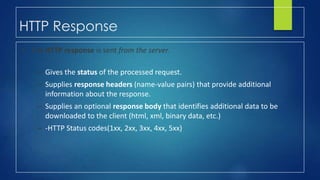
HTTP Response
• The HTTP response is sent from the server.
– Gives the status of the processed request.
– Supplies response headers (name-value pairs) that provide additional
information about the response.
– Supplies an optional response body that identifies additional data to be
downloaded to the client (html, xml, binary data, etc.)
– -HTTP Status codes(1xx, 2xx, 3xx, 4xx, 5xx)
Sample Server Responses:
HTTP/1.1 200 OK
Content-Type: text/html
Content-Length: 1337
[CRLF]
<html>
<!-- Some HTML Content. -->
</html>
HTTP/1.1 500 Internal Server Error
HTTP/1.1 201 Created
Location: /view/7
[CRLF]
Some message goes here.
Response Status
Response Headers
Response Body (content)
Response Status
Response Header
Response Body
Response Status
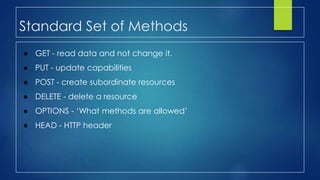
Standard Set of Methods
● GET - read data and not change it.
● PUT - update capabilities
● POST - create subordinate resources
● DELETE - delete a resource
● OPTIONS - ‘What methods are allowed’
● HEAD - HTTP header
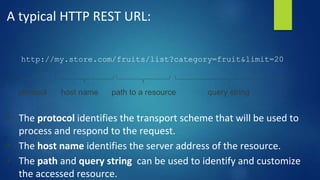
A typical HTTP REST URL:
http://my.store.com/fruits/list?category=fruit&limit=20
• The protocol identifies the transport scheme that will be used to
process and respond to the request.
• The host name identifies the server address of the resource.
• The path and query string can be used to identify and customize
the accessed resource.
protocol host name path to a resource query string
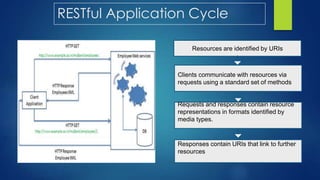
RESTful Application Cycle
Resources are identified by URIs
Clients communicate with resources via
requests using a standard set of methods
Requests and responses contain resource
representations in formats identified by
media types.
Responses contain URIs that link to further
resources
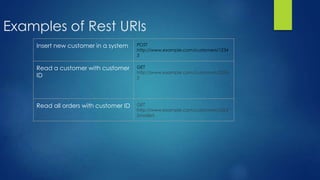
Examples of Rest URIs
Insert new customer in a system POST
http://www.example.com/customers/1234
5
Read a customer with customer
ID
GET
http://www.example.com/customers/3324
5
Read all orders with customer ID GET
http://www.example.com/customers/3324
5/orders
JAX-RS is a Java standard API for REST services:
• Services are annotation driven
• Provides support for data binding.(JAX-B)
• Provides advanced APIs for content negotiation.(@Produces/@Consumes)
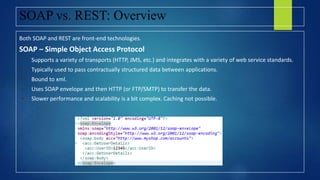
SOAP vs. REST: Overview
Both SOAP and REST are front-end technologies.
SOAP – Simple Object Access Protocol
 Supports a variety of transports (HTTP, JMS, etc.) and integrates with a variety of web service standards.
 Typically used to pass contractually structured data between applications.
 Bound to xml.
 Uses SOAP envelope and then HTTP (or FTP/SMTP) to transfer the data.
 Slower performance and scalability is a bit complex. Caching not possible.
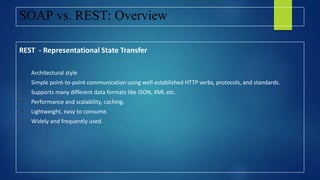
REST - Representational State Transfer
 Architectural style
 Simple point-to-point communication using well-established HTTP verbs, protocols, and standards.
 Supports many different data formats like JSON, XML etc.
 Performance and scalability, caching.
 Lightweight, easy to consume.
 Widely and frequently used.
SOAP vs. REST: Overview
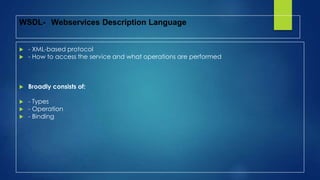
 - XML-based protocol
 - How to access the service and what operations are performed
 Broadly consists of:
 - Types
 - Operation
 - Binding
WSDL- Webservices Description Language
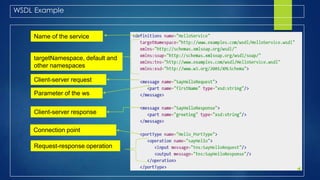
Connection point
Client-server response
Client-server request
WSDL Example

Name of the service
Parameter of the ws
Request-response operation
targetNamespace, default and
other namespaces
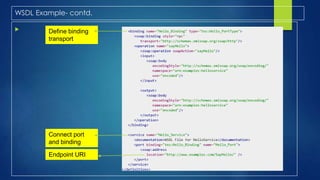
WSDL Example- contd.
 Define binding
transport
Endpoint URI
Connect port
and binding
Restful Webservices
● A RESTful Web service follows four basic design principles:
o Uses HTTP methods
o Be stateless as far as possible
o Expose directory/folder structure-like URI
o Transfer XML, JSON, or both
Java API for RESTful Web Services (JAX-RS)
vs Spring MVC
Some Guidelines for choosing your solution:
• Both JAX-RS and Spring MVC can produce REST services.
• Spring MVC is a web application framework that can be used as service framework.
– Provides better validation
– Supports internationalization
• JAX-RS is a primarily a services framework.
– Provides support for WADL generation
– Can use CXF interceptors, filters, etc.
• Match the framework to the needs and purpose of the project.
• Don’t mix both in same web application unless you need unique features from each.
– If your project needs both, consider separate web applications.
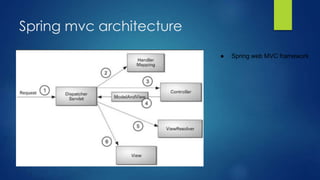
Spring mvc architecture
● Spring web MVC framework
RESTful support in Spring
● Controllers can handle requests for all HTTP methods, including the four primary REST methods: GET,
PUT, DELETE, and POST.
● The @PathVariable annotation enables controllers to handle requests for parameterized URLs (URLs
that have variable input as part of their path).
● Resources can be represented in a variety of ways using Spring views and view resolvers, including
View implementations for rendering model data as XML, JSON, Atom, and RSS.
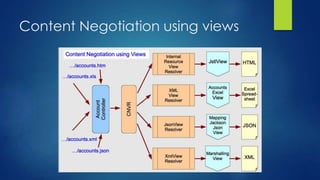
The representation best suited for the client can be chosen using ContentNegotiatingViewResolver.
● View-based rendering can be bypassed altogether using the @ResponseBody annotation and various
HttpMethodConverter implementations.
● Similarly, the @RequestBody annotation, along with HttpMethodConverter implementations, can
convert inbound HTTP data into Java objects passed in to a controller’s handler methods.
● Spring applications can consume REST resources using RestTemplate
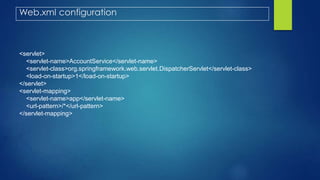
Web.xml configuration
<servlet>
<servlet-name>AccountService</servlet-name>
<servlet-class>org.springframework.web.servlet.DispatcherServlet</servlet-class>
<load-on-startup>1</load-on-startup>
</servlet>
<servlet-mapping>
<servlet-name>app</servlet-name>
<url-pattern>/*</url-pattern>
</servlet-mapping>
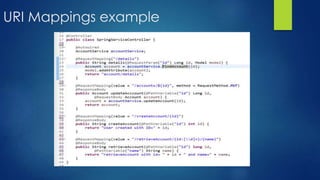
URI Mappings example
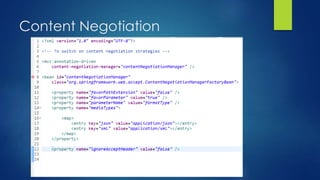
Content Negotiation
Content Negotiation using views
 DEMO
Next topics
- Securing Restful Services
- Open source frameworks JERSEY, RESTEASY
References
- Restful Webservice: Leonrard Richardson and Sam
Ruby//O’Reilly
- RESTful Web Services Cookbook: Subbu Allamraju//O’Reilly
- Roy Fieldings dissertation -
http://www.ics.uci.edu/~fielding/pubs/dissertation/top.htm
- Spring in Action, 4th Edition, Craig Walls//Manning
Questions

Restful web services with java

  • 1.
  • 2.
    REST ● REST standsfor Representational State Transfer -Design pattern for developing web services. ● Resource based ● Rest Style: ● Client-server ● Uniform interface ● Stateless ● Cached ● Layered system ● HATEOAS - (Hypermedia As The Engine Of Application State)
  • 3.
    REST - nota Standard ● But it uses several standards: o HTTP o URL o XML/HTML/GIF/JPEG/etc (Resource Representations) o text/xml, text/html, image/gif, image/jpeg, etc (Resource Types, MIME Types) Browser Web ServerGET /index.html HTTP/1.1 Host: www.pitt.edu HTTP/1.1 200 OK Content-Type: text/html
  • 4.
    HTTP Request • TheHTTP request is sent from the client. – Identifies the location of a resource. – Uses nouns rather than verbs to denote simple resources. – Specifies the verb, or HTTP method to use when accessing the resource. – Supplies optional request headers (name-value pairs) that provide additional information the server may need when processing the request. – Supplies an optional request body that identifies additional data to be uploaded to the server (e.g. form parameters, attachments, etc.)
  • 5.
    Sample Client Requests: GET/view?id=1 HTTP/1.1 Request Headers User-Agent: Chrome Accept: application/json Requested Resource (path and query string) (no request body) POST /save HTTP/1.1 Requested Resource (typically no query string) User-Agent: IE Content-Type: application/x-www-form-urlencoded Request Headers name=x&id=2 Request Body (e.g. form parameters)
  • 6.
    HTTP Response • TheHTTP response is sent from the server. – Gives the status of the processed request. – Supplies response headers (name-value pairs) that provide additional information about the response. – Supplies an optional response body that identifies additional data to be downloaded to the client (html, xml, binary data, etc.) – -HTTP Status codes(1xx, 2xx, 3xx, 4xx, 5xx)
  • 7.
    Sample Server Responses: HTTP/1.1200 OK Content-Type: text/html Content-Length: 1337 [CRLF] <html> <!-- Some HTML Content. --> </html> HTTP/1.1 500 Internal Server Error HTTP/1.1 201 Created Location: /view/7 [CRLF] Some message goes here. Response Status Response Headers Response Body (content) Response Status Response Header Response Body Response Status
  • 8.
    Standard Set ofMethods ● GET - read data and not change it. ● PUT - update capabilities ● POST - create subordinate resources ● DELETE - delete a resource ● OPTIONS - ‘What methods are allowed’ ● HEAD - HTTP header
  • 9.
    A typical HTTPREST URL: http://my.store.com/fruits/list?category=fruit&limit=20 • The protocol identifies the transport scheme that will be used to process and respond to the request. • The host name identifies the server address of the resource. • The path and query string can be used to identify and customize the accessed resource. protocol host name path to a resource query string
  • 10.
    RESTful Application Cycle Resourcesare identified by URIs Clients communicate with resources via requests using a standard set of methods Requests and responses contain resource representations in formats identified by media types. Responses contain URIs that link to further resources
  • 11.
    Examples of RestURIs Insert new customer in a system POST http://www.example.com/customers/1234 5 Read a customer with customer ID GET http://www.example.com/customers/3324 5 Read all orders with customer ID GET http://www.example.com/customers/3324 5/orders
  • 12.
    JAX-RS is aJava standard API for REST services: • Services are annotation driven • Provides support for data binding.(JAX-B) • Provides advanced APIs for content negotiation.(@Produces/@Consumes)
  • 13.
    SOAP vs. REST:Overview Both SOAP and REST are front-end technologies. SOAP – Simple Object Access Protocol  Supports a variety of transports (HTTP, JMS, etc.) and integrates with a variety of web service standards.  Typically used to pass contractually structured data between applications.  Bound to xml.  Uses SOAP envelope and then HTTP (or FTP/SMTP) to transfer the data.  Slower performance and scalability is a bit complex. Caching not possible.
  • 14.
    REST - RepresentationalState Transfer  Architectural style  Simple point-to-point communication using well-established HTTP verbs, protocols, and standards.  Supports many different data formats like JSON, XML etc.  Performance and scalability, caching.  Lightweight, easy to consume.  Widely and frequently used. SOAP vs. REST: Overview
  • 15.
     - XML-basedprotocol  - How to access the service and what operations are performed  Broadly consists of:  - Types  - Operation  - Binding WSDL- Webservices Description Language
  • 16.
    Connection point Client-server response Client-serverrequest WSDL Example  Name of the service Parameter of the ws Request-response operation targetNamespace, default and other namespaces
  • 17.
    WSDL Example- contd. Define binding transport Endpoint URI Connect port and binding
  • 18.
    Restful Webservices ● ARESTful Web service follows four basic design principles: o Uses HTTP methods o Be stateless as far as possible o Expose directory/folder structure-like URI o Transfer XML, JSON, or both
  • 19.
    Java API forRESTful Web Services (JAX-RS) vs Spring MVC Some Guidelines for choosing your solution: • Both JAX-RS and Spring MVC can produce REST services. • Spring MVC is a web application framework that can be used as service framework. – Provides better validation – Supports internationalization • JAX-RS is a primarily a services framework. – Provides support for WADL generation – Can use CXF interceptors, filters, etc. • Match the framework to the needs and purpose of the project. • Don’t mix both in same web application unless you need unique features from each. – If your project needs both, consider separate web applications.
  • 20.
    Spring mvc architecture ●Spring web MVC framework
  • 21.
    RESTful support inSpring ● Controllers can handle requests for all HTTP methods, including the four primary REST methods: GET, PUT, DELETE, and POST. ● The @PathVariable annotation enables controllers to handle requests for parameterized URLs (URLs that have variable input as part of their path). ● Resources can be represented in a variety of ways using Spring views and view resolvers, including View implementations for rendering model data as XML, JSON, Atom, and RSS. The representation best suited for the client can be chosen using ContentNegotiatingViewResolver. ● View-based rendering can be bypassed altogether using the @ResponseBody annotation and various HttpMethodConverter implementations. ● Similarly, the @RequestBody annotation, along with HttpMethodConverter implementations, can convert inbound HTTP data into Java objects passed in to a controller’s handler methods. ● Spring applications can consume REST resources using RestTemplate
  • 22.
  • 23.
  • 24.
  • 25.
  • 26.
  • 27.
    Next topics - SecuringRestful Services - Open source frameworks JERSEY, RESTEASY
  • 28.
    References - Restful Webservice:Leonrard Richardson and Sam Ruby//O’Reilly - RESTful Web Services Cookbook: Subbu Allamraju//O’Reilly - Roy Fieldings dissertation - http://www.ics.uci.edu/~fielding/pubs/dissertation/top.htm - Spring in Action, 4th Edition, Craig Walls//Manning
  • 29.

Editor's Notes

  • #2 Agenda: Overview of REST architecture, Basics of HTTP, Implementation with Spring and examples.
  • #3 CSS, Visibility, Scalability
  • #9 Patch method – partial update
  • #11 1
  • #12 Traversing the response directory structure by asking specific information based on ID.
  • #13 Why use JAX-RS. Comparisons with spring mvc implementation.
  • #16 A client program connecting to a web service can read the WSDL to determine what functions are available on the server. Any special datatypes used are embedded in the WSDL file in the form of XML Schema. The client can then use SOAP to actually call one of the functions listed in the WSDL.
  • #25 Suffix: http://example/myapp/accounts/list.html Parameter: http://myserver/myapp/accounts/list?format=xls