Downloaded 50 times
![In the name of Allah
80% of
Qur'anic Words
(Classified word lists
for easy memorization)
Compiled by
Dr. Abdulazeez Abdulraheem
(azeez1961@hotmail.com)
For more details, please visit the website
www.understandquran.com
In the name of Allah
If you master these word lists, you need to know
only 2 out of 9 in each line of the Holy Qur'an
(based on statistical average using a typical Qur'anic Mushaf
containing 600 pages, with each page having 15 lines).
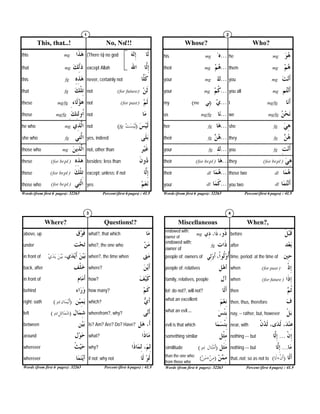
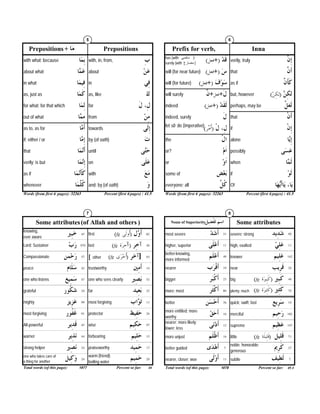
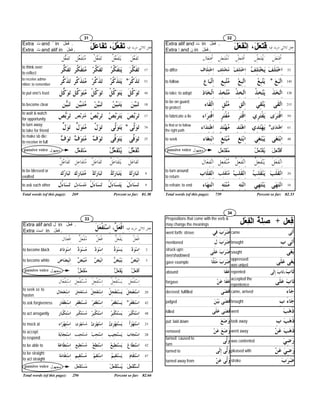
1. The words given in this booklet account for 82.6% (64282) of the total
words (approx. 77800) of the Holy Qur'an.
2. The words listed in the first six pages occur very frequently. Some of
them occur in combination with each other. They constitute a
whopping 41.5% (32263) of the total words.
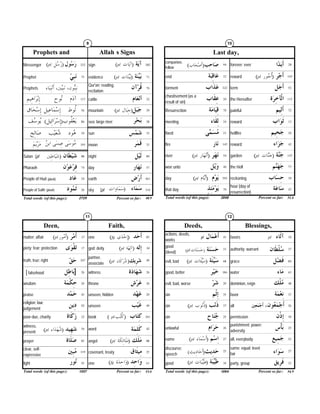
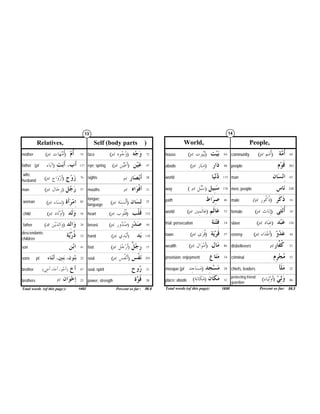
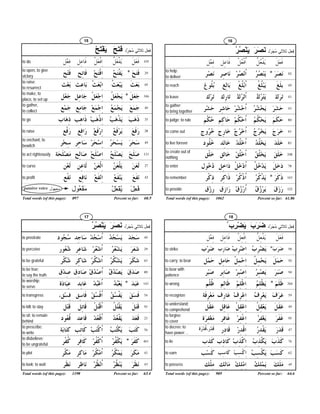
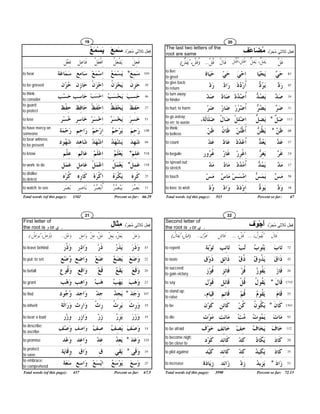
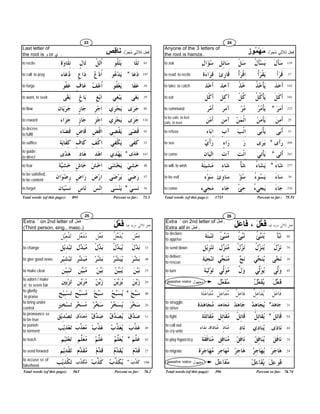
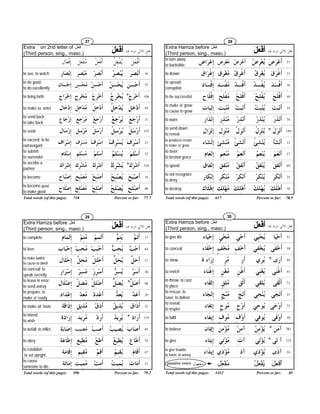
3. The number next to the noun (pages 7-14) or the verb (pages 15-33)
shows the number of times that noun or the verb (in its various forms)
has occurred in the Holy Qur'an.
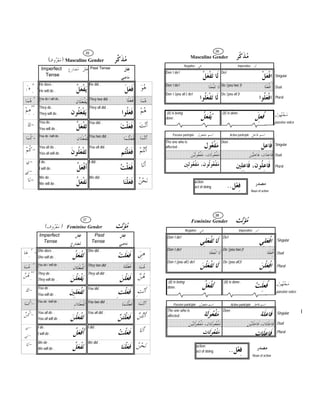
4. For each verb, the past tense, the imperfect tense, the imperative, the
active participle and the verbal noun are provided. It is assumed that
based on this information, you can reproduce the whole verb table.
Sample tables are provided at the end of this booklet.
5. For each word, the most common meanings are given. Some words
may have other meanings too, depending upon their context.
However, the number of such words is very small.
Abbreviations
mg masc. gender fg fem. gender br.pl broken plural
sg singular dl dual pl plural
sb somebody st something ss somebody or something
In the name of Allah, Most Beneficent, Most Merciful
PREFACE
All praise be to Allah, and may peace and blessings of Allah be upon his
Prophet, Muhammad. Allah says very explicitly in His Book, " (This is) a
Book (the Qur'an) which We have sent down to you, full of blessings that
they may ponder over its verses, and that men of understanding may
remember [38:29]." If we don't understand the Book, how can we ponder
on its verses! The Prophet of Allah, Muhammad, pbuh, said, "The best
among you are those who have learnt the Qur'an and teach it (to others)"
[Bukhari].
This booklet is prepared to give at least some help in fulfilling the above-
mentioned objectives. Please keep the following points in mind (in
addition to those listed on the back cover) while studying this booklet:
1. When there are more than one distinctly different meanings of a word,
a semicolon is placed between the two meanings. For similar
meanings, a comma is placed between the meanings. For example:
(eye; spring ) and (above, up ).
2. If the last letter of a word given in this booklet does not have a vowel
sign ( ٌ ٍ ً ُ ِ َ ), it indicates that any vowel sign can come on it
depending upon the context in which that word is used. if ْلا occurs
before the word, then Tanween ( ٌ ٍ ً ) is not used.
3. At the bottom left of the page, total is provided for the number of times
the words of that page have occurred in the Qur'an. The bottom right
shows the percent of the total Qur'anic words that you have learnt so
far, if you have memorized the meanings the words till that page.
4. In almost every case, the words are arranged alphabetically to make
the search easy.
5. The word forms related to dual number and feminine gender are used
sparingly in the Holy Qur'an. Therefore, these forms may be given
less emphasis in the beginning stages.
6. A star (*) is placed next to selected verbs. All the verbal forms of such
verbs are provided in detail in a separate booklet, "Some Important
Verbs Used in the Holy Qur'an."
7. For almost every verb type, samples of the وف forms (active
voice) are provided in the first line those of the ل forms (passive
voice) in the last.
8. Just like in any language, some verbs and nouns of action are always
followed by a preposition. For example, believe in: ِب َ َ .
However, in some cases, a change in preposition may change the
meanings too. for example, get; get in; get at; get by, get off, get on,
etc. A list of some important verbs along with changing prepositions
is provided on page no. 34.
Acknowledgements
Many people have contributed in the compilation of this booklet. I have
received significant help on different aspects of this work from my wife,
Tabinda Tahseen, and from my colleagues, Dr. M.A. Mohiuddin, Mr. M.
Na'eemuddin, and Mr. M. AbdulBari. May Allah reward them all.
Important References
)١(هرا ت ردو ا ن ا ظ:د.ح ا ا.ن.
ن.١٩٩٠) .٢(ا ن ا ظ س ا ا:ا دا.](https://image.slidesharecdn.com/learnquranterminologyworksheet-131004180718-phpapp01/85/Learn-qur-an-terminology-worksheet-1-320.jpg)
![In the name of Allah
80% of
Qur'anic Words
(Classified word lists
for easy memorization)
Compiled by
Dr. Abdulazeez Abdulraheem
(azeez1961@hotmail.com)
For more details, please visit the website
www.understandquran.com
In the name of Allah
If you master these word lists, you need to know
only 2 out of 9 in each line of the Holy Qur'an
(based on statistical average using a typical Qur'anic Mushaf
containing 600 pages, with each page having 15 lines).
1. The words given in this booklet account for 82.6% (64282) of the total
words (approx. 77800) of the Holy Qur'an.
2. The words listed in the first six pages occur very frequently. Some of
them occur in combination with each other. They constitute a
whopping 41.5% (32263) of the total words.
3. The number next to the noun (pages 7-14) or the verb (pages 15-33)
shows the number of times that noun or the verb (in its various forms)
has occurred in the Holy Qur'an.
4. For each verb, the past tense, the imperfect tense, the imperative, the
active participle and the verbal noun are provided. It is assumed that
based on this information, you can reproduce the whole verb table.
Sample tables are provided at the end of this booklet.
5. For each word, the most common meanings are given. Some words
may have other meanings too, depending upon their context.
However, the number of such words is very small.
Abbreviations
mg masc. gender fg fem. gender br.pl broken plural
sg singular dl dual pl plural
sb somebody st something ss somebody or something
In the name of Allah, Most Beneficent, Most Merciful
PREFACE
All praise be to Allah, and may peace and blessings of Allah be upon his
Prophet, Muhammad. Allah says very explicitly in His Book, " (This is) a
Book (the Qur'an) which We have sent down to you, full of blessings that
they may ponder over its verses, and that men of understanding may
remember [38:29]." If we don't understand the Book, how can we ponder
on its verses! The Prophet of Allah, Muhammad, pbuh, said, "The best
among you are those who have learnt the Qur'an and teach it (to others)"
[Bukhari].
This booklet is prepared to give at least some help in fulfilling the above-
mentioned objectives. Please keep the following points in mind (in
addition to those listed on the back cover) while studying this booklet:
1. When there are more than one distinctly different meanings of a word,
a semicolon is placed between the two meanings. For similar
meanings, a comma is placed between the meanings. For example:
(eye; spring ) and (above, up ).
2. If the last letter of a word given in this booklet does not have a vowel
sign ( ٌ ٍ ً ُ ِ َ ), it indicates that any vowel sign can come on it
depending upon the context in which that word is used. if ْلا occurs
before the word, then Tanween ( ٌ ٍ ً ) is not used.
3. At the bottom left of the page, total is provided for the number of times
the words of that page have occurred in the Qur'an. The bottom right
shows the percent of the total Qur'anic words that you have learnt so
far, if you have memorized the meanings the words till that page.
4. In almost every case, the words are arranged alphabetically to make
the search easy.
5. The word forms related to dual number and feminine gender are used
sparingly in the Holy Qur'an. Therefore, these forms may be given
less emphasis in the beginning stages.
6. A star (*) is placed next to selected verbs. All the verbal forms of such
verbs are provided in detail in a separate booklet, "Some Important
Verbs Used in the Holy Qur'an."
7. For almost every verb type, samples of the وف forms (active
voice) are provided in the first line those of the ل forms (passive
voice) in the last.
8. Just like in any language, some verbs and nouns of action are always
followed by a preposition. For example, believe in: ِب َ َ .
However, in some cases, a change in preposition may change the
meanings too. for example, get; get in; get at; get by, get off, get on,
etc. A list of some important verbs along with changing prepositions
is provided on page no. 34.
Acknowledgements
Many people have contributed in the compilation of this booklet. I have
received significant help on different aspects of this work from my wife,
Tabinda Tahseen, and from my colleagues, Dr. M.A. Mohiuddin, Mr. M.
Na'eemuddin, and Mr. M. AbdulBari. May Allah reward them all.
Important References
)١(هرا ت ردو ا ن ا ظ:د.ح ا ا.ن.
ن.١٩٩٠) .٢(ا ن ا ظ س ا ا:ا دا.](https://image.slidesharecdn.com/learnquranterminologyworksheet-131004180718-phpapp01/75/Learn-qur-an-terminology-worksheet-1-2048.jpg)

This document provides a summary of an 80% word list of the Quran compiled by Dr. Abdulazeez Abdulraheem. It notes that if a person masters these word lists, they would only need to know 2 out of every 9 words on average in the Quran. The first 6 pages contain words that occur very frequently and make up 41.5% of the total words in the Quran. Each word is provided with its number of occurrences and common meanings to help with memorization and understanding of the Quran. Additional information and guidelines are also included to aid in using this word list to learn the Quran.


