Lessons from the  Solomon Islands Project Launch August 13-20, 2010
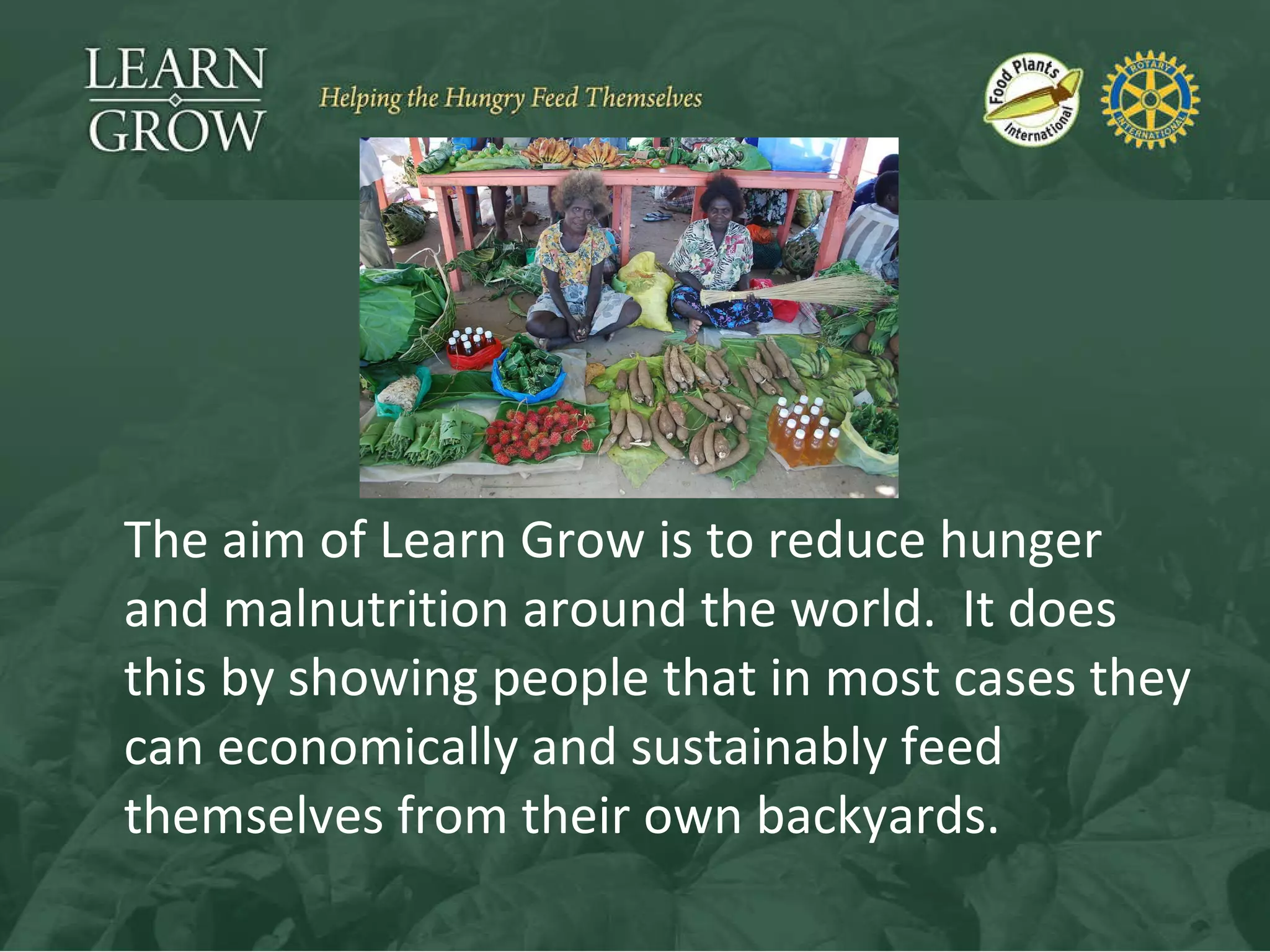
The aim of Learn Grow is to reduce hunger and malnutrition around the world.  It does this by showing people that in most cases they can economically and sustainably feed themselves from their own backyards.
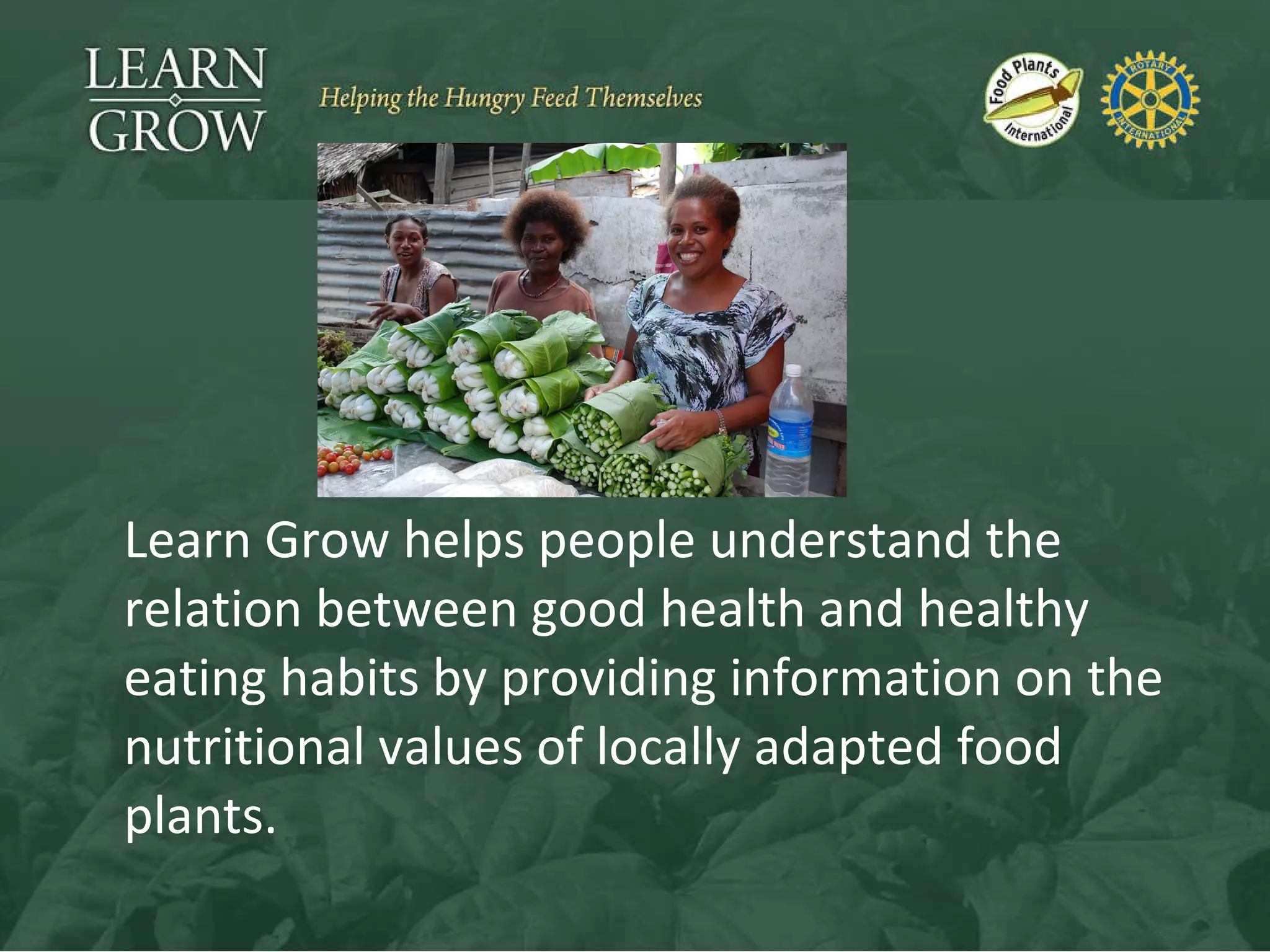
Learn Grow helps people understand the relation between good health and healthy eating habits by providing information on the nutritional values of locally adapted food plants.
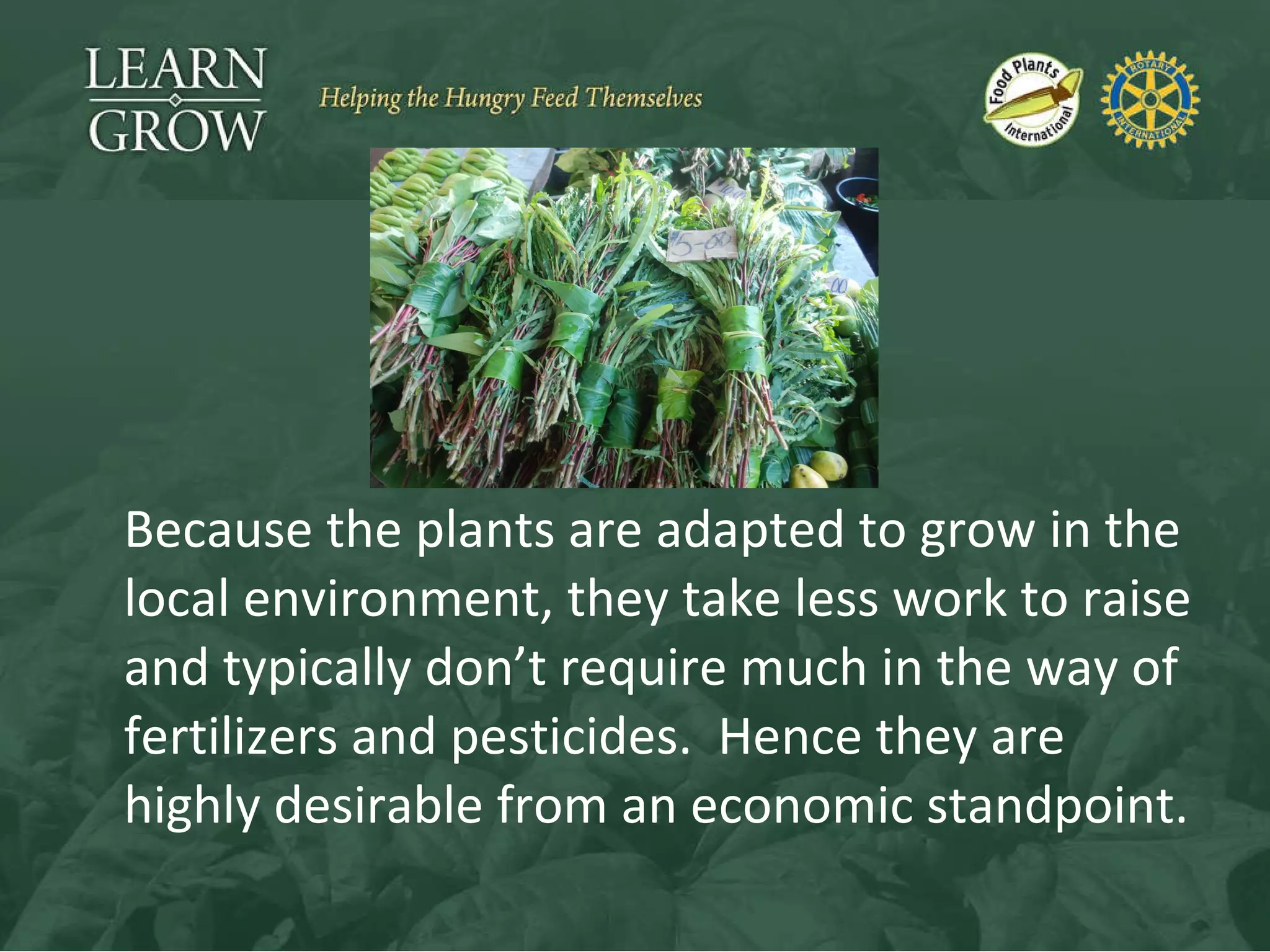
Because the plants are adapted to grow in the local environment, they take less work to raise and typically don’t require much in the way of fertilizers and pesticides.  Hence they are highly desirable from an economic standpoint.
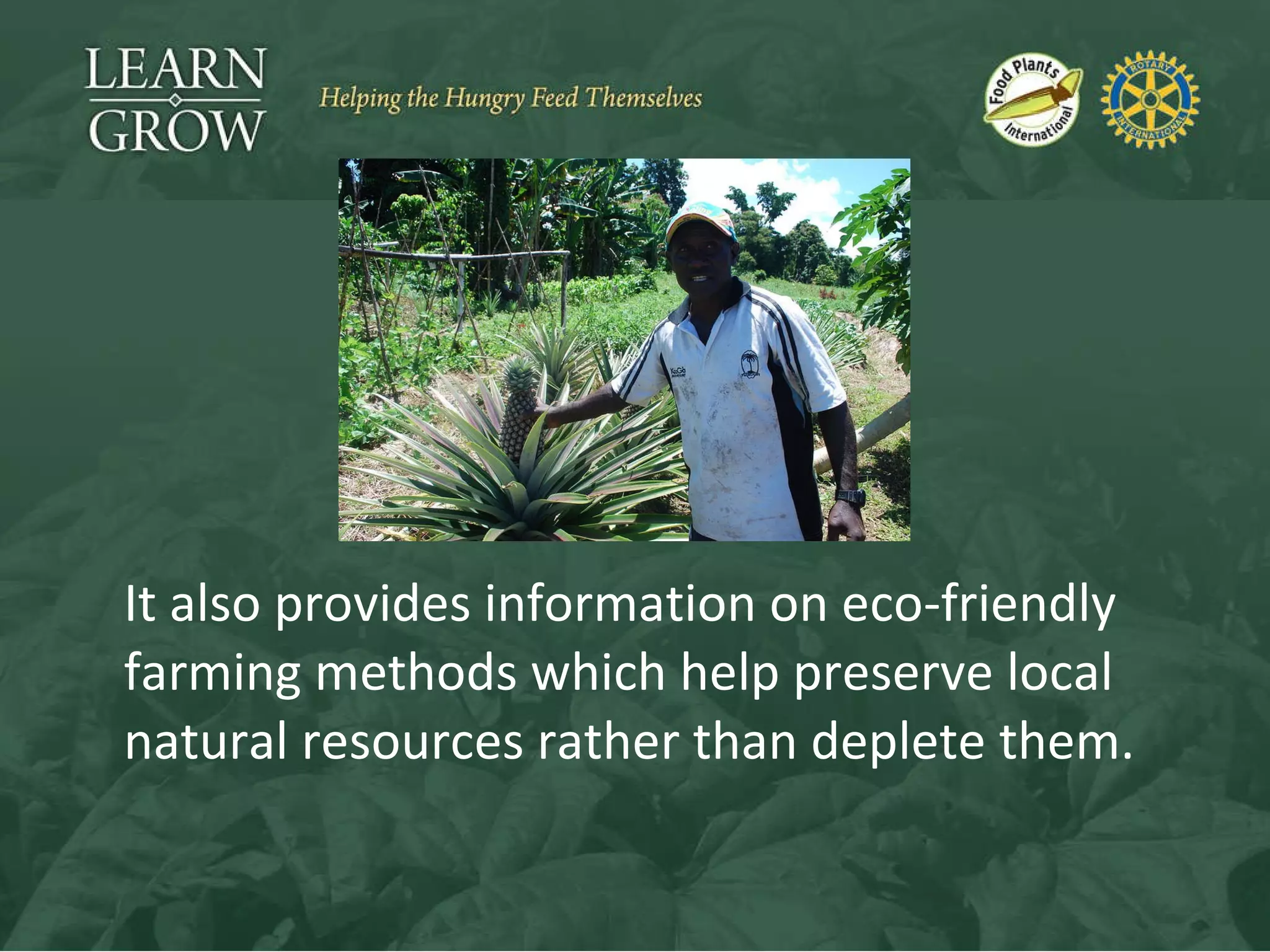
It also provides information on eco-friendly farming methods which help preserve local natural resources rather than deplete them.
Many foreign aid agencies have innocently  been giving out the WRONG INFORMATION for years!
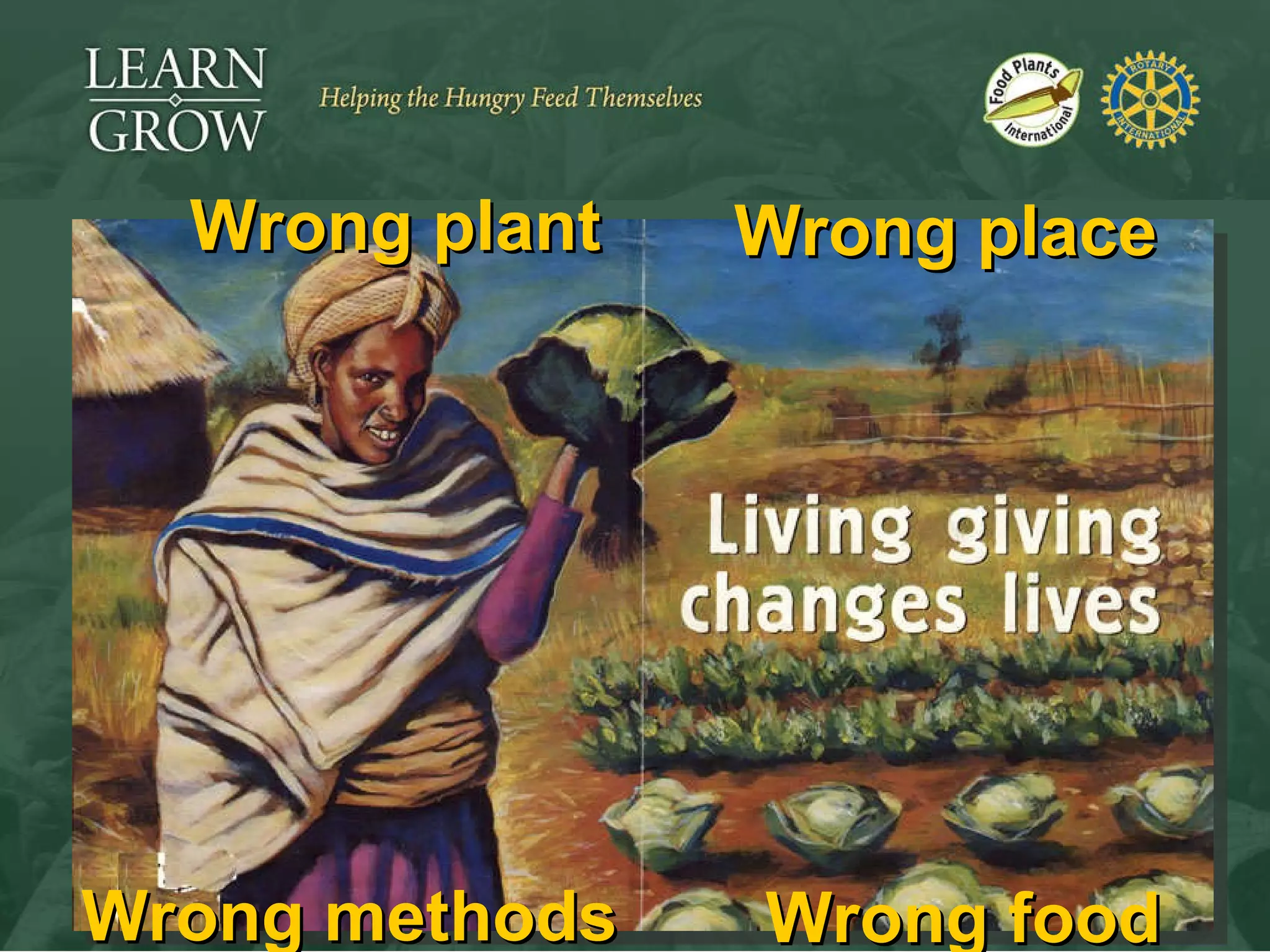
Wrong plant Wrong place Wrong methods Wrong food
Learn Grow   is one of the first organizations to  link local food plants with their nutritional information!
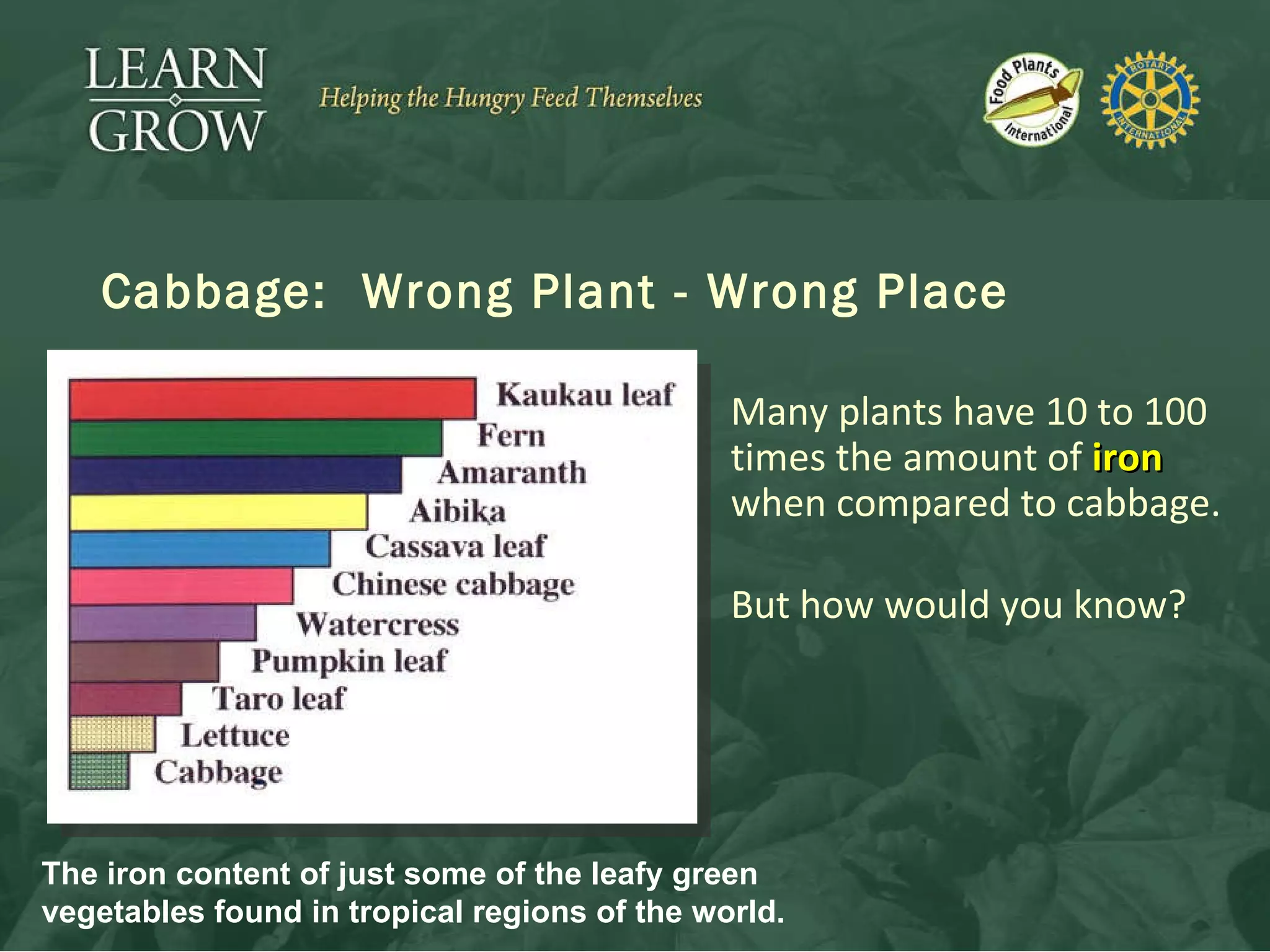
Cabbage:  Wrong Plant - Wrong Place Many plants have 10 to 100 times the amount of  iron  when compared to cabbage. But how would you know? The iron content of just some of the leafy green vegetables found in tropical regions of the world.
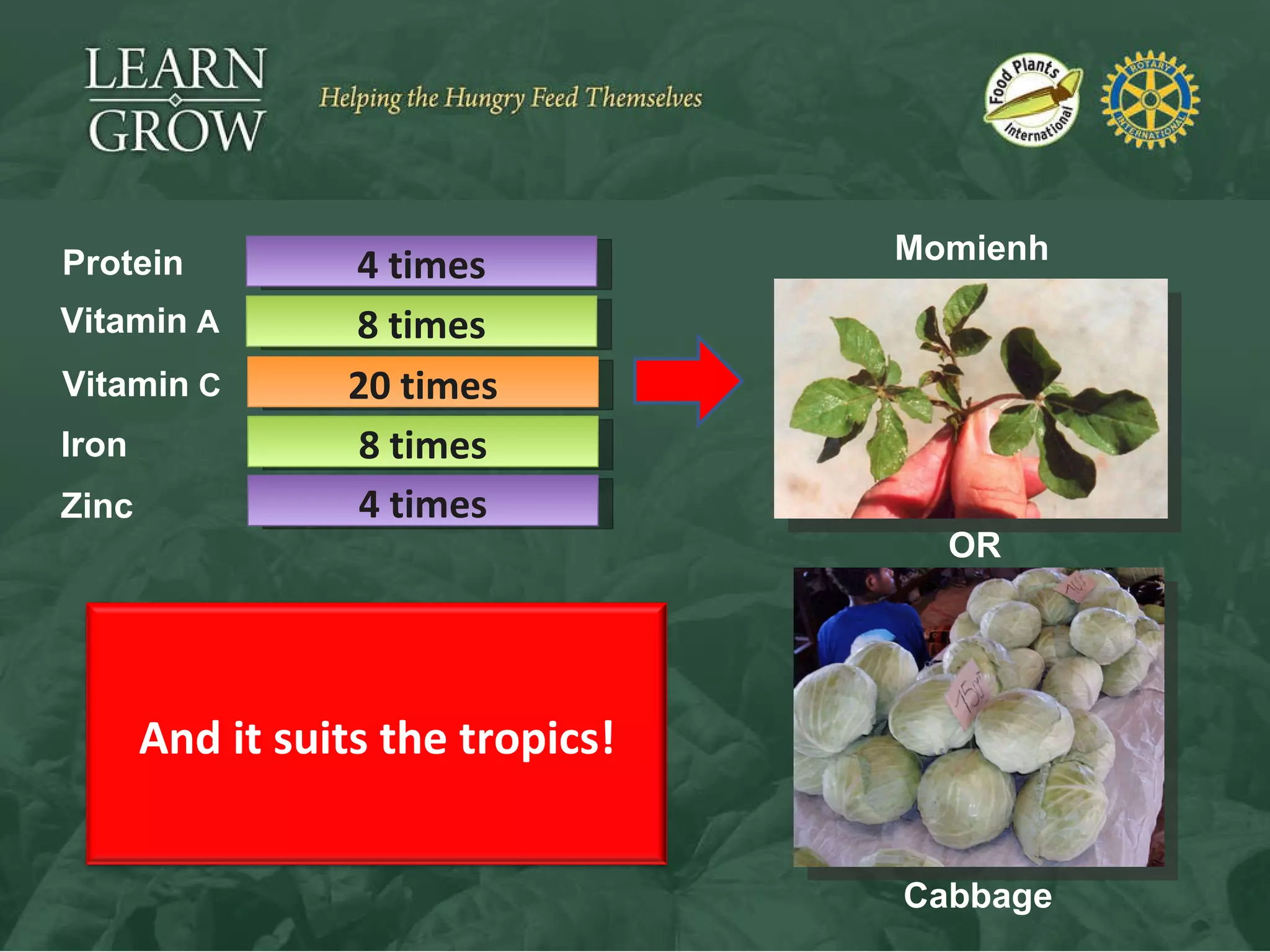
4 times Protein 8 times Vitamin   A 20   times Vitamin   C 8 times Iron 4 times Zinc Cabbage Momienh OR And it suits the tropics!
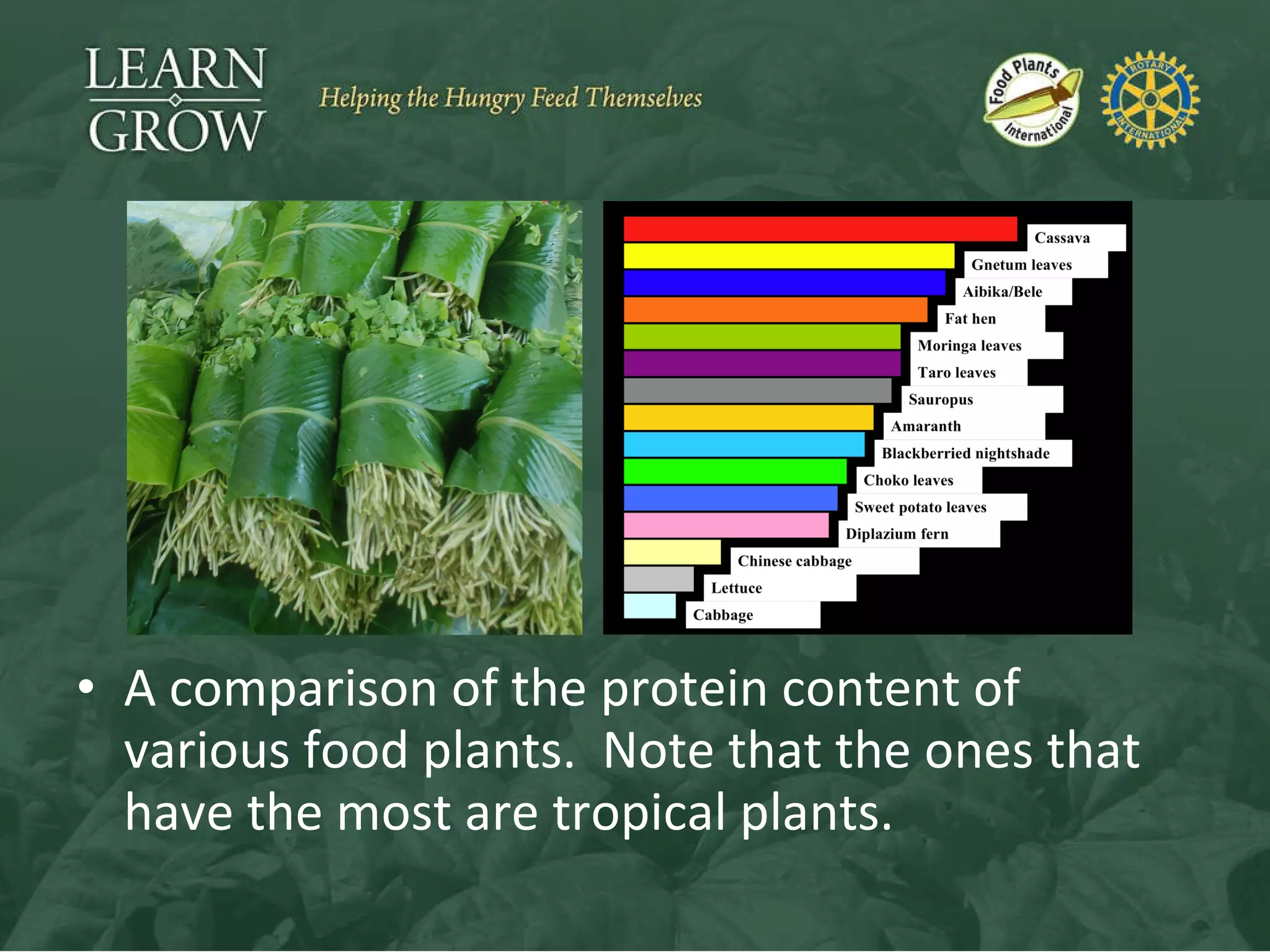
A comparison of the protein content of various food plants.  Note that the ones that have the most are tropical plants.
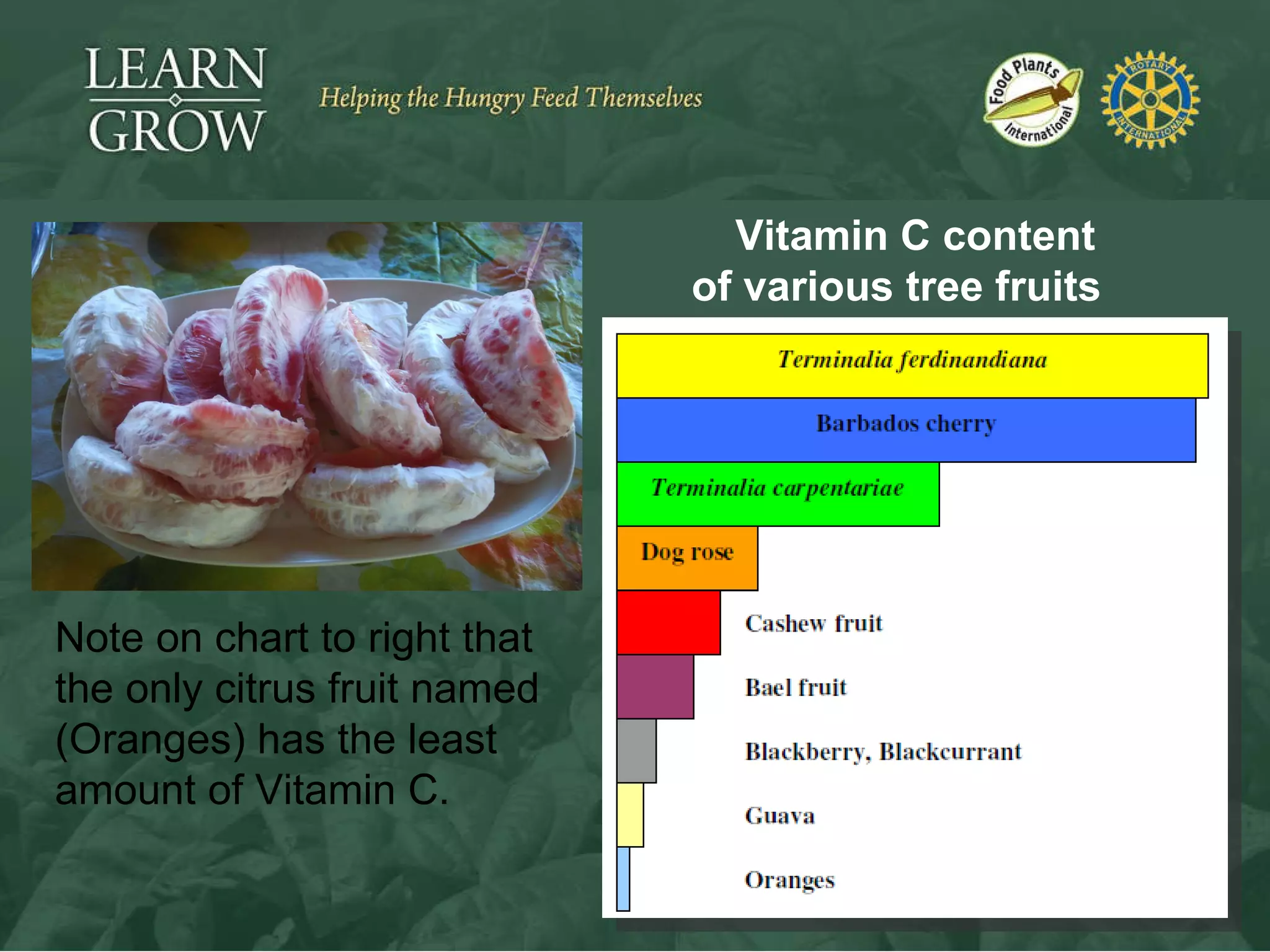
Vitamin C content of various tree fruits   Note on chart to right that the only citrus fruit named (Oranges) has the least amount of Vitamin C.
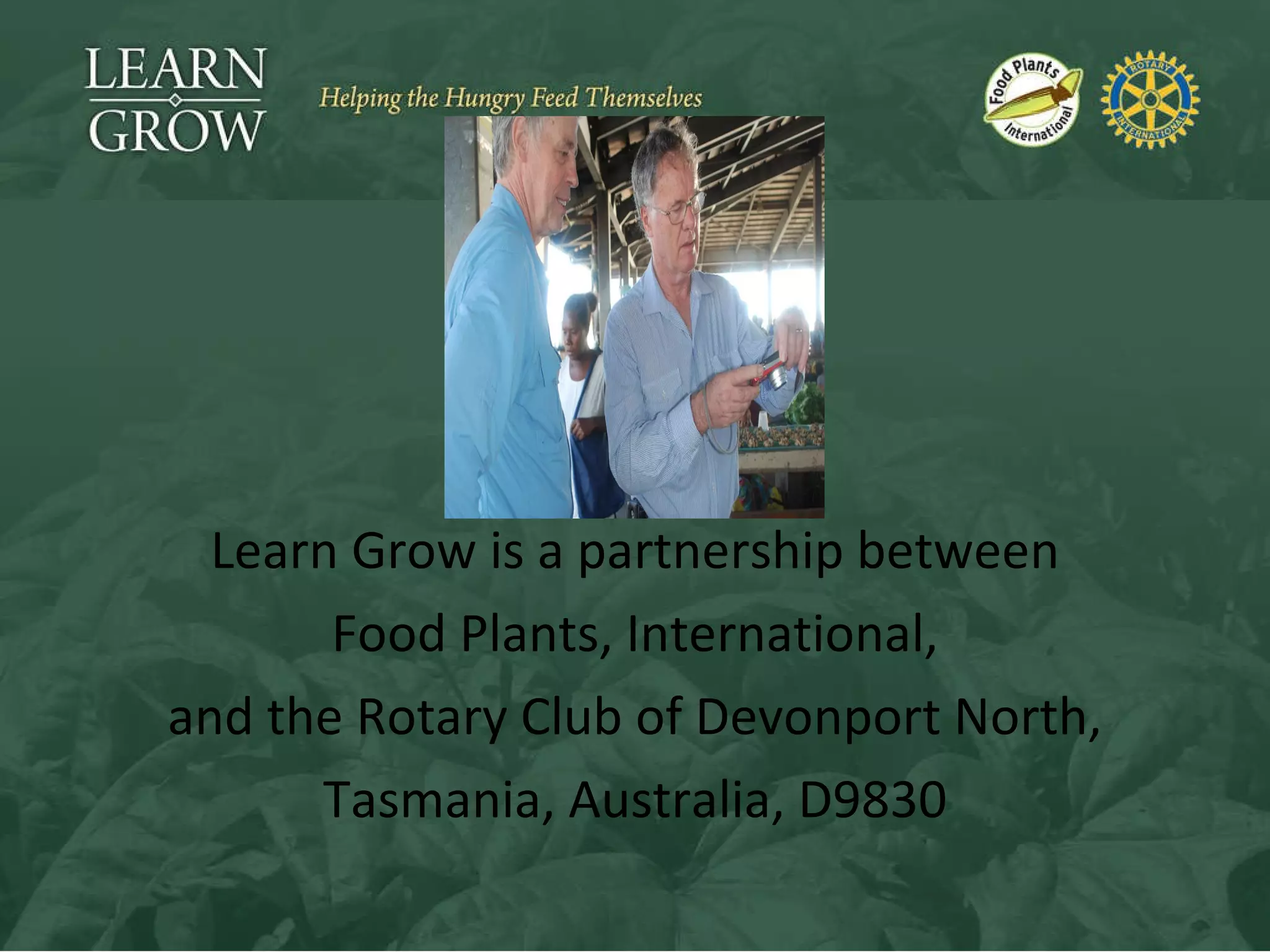
Learn Grow is a partnership between Food Plants, International, and the Rotary Club of Devonport North, Tasmania, Australia, D9830
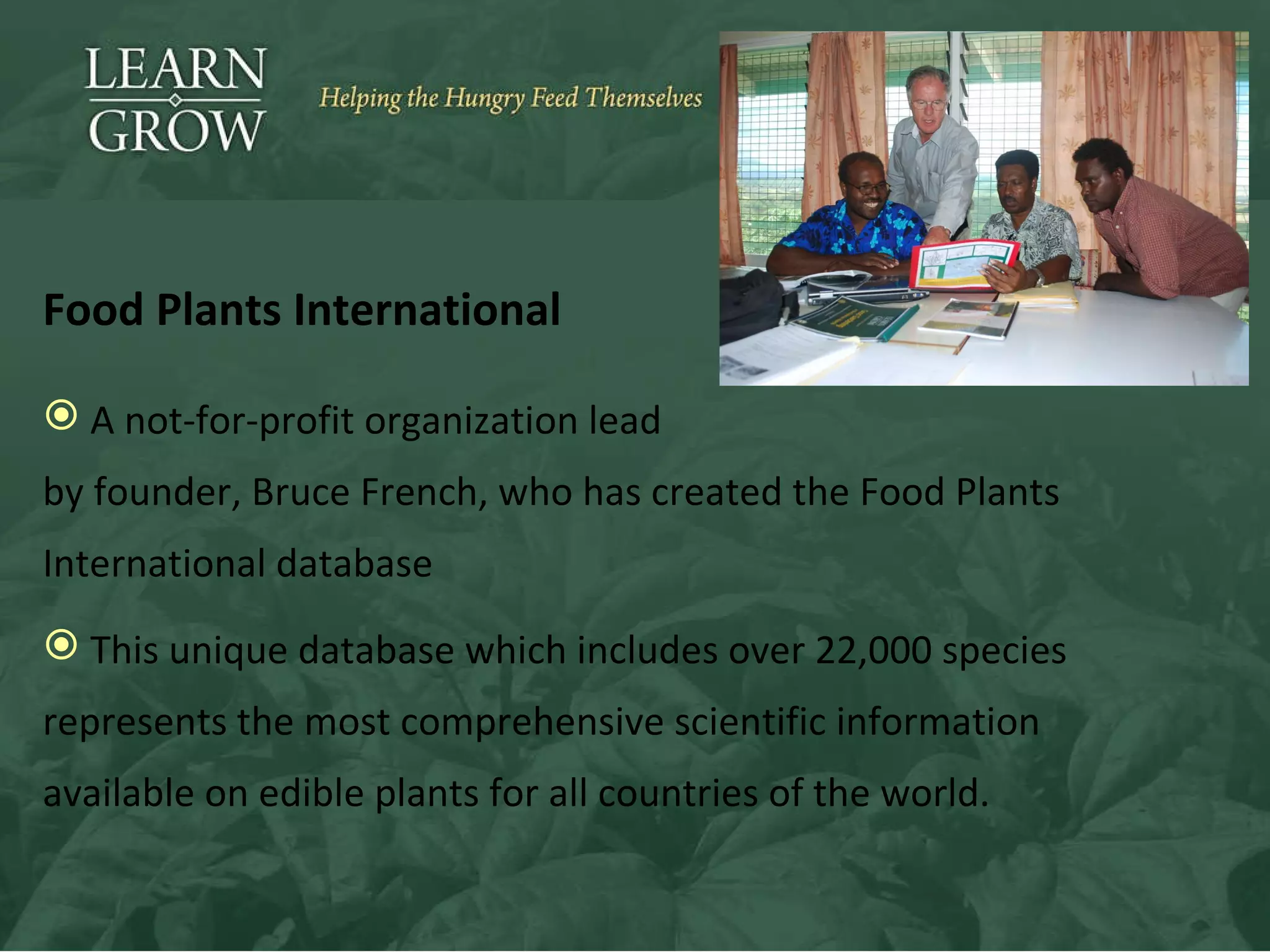
Food Plants International A not-for-profit organization lead  by  founder, Bruce French, who has created the Food Plants International database This unique database which includes over 22,000 species represents the most comprehensive scientific information available on edible plants for all countries of the world.
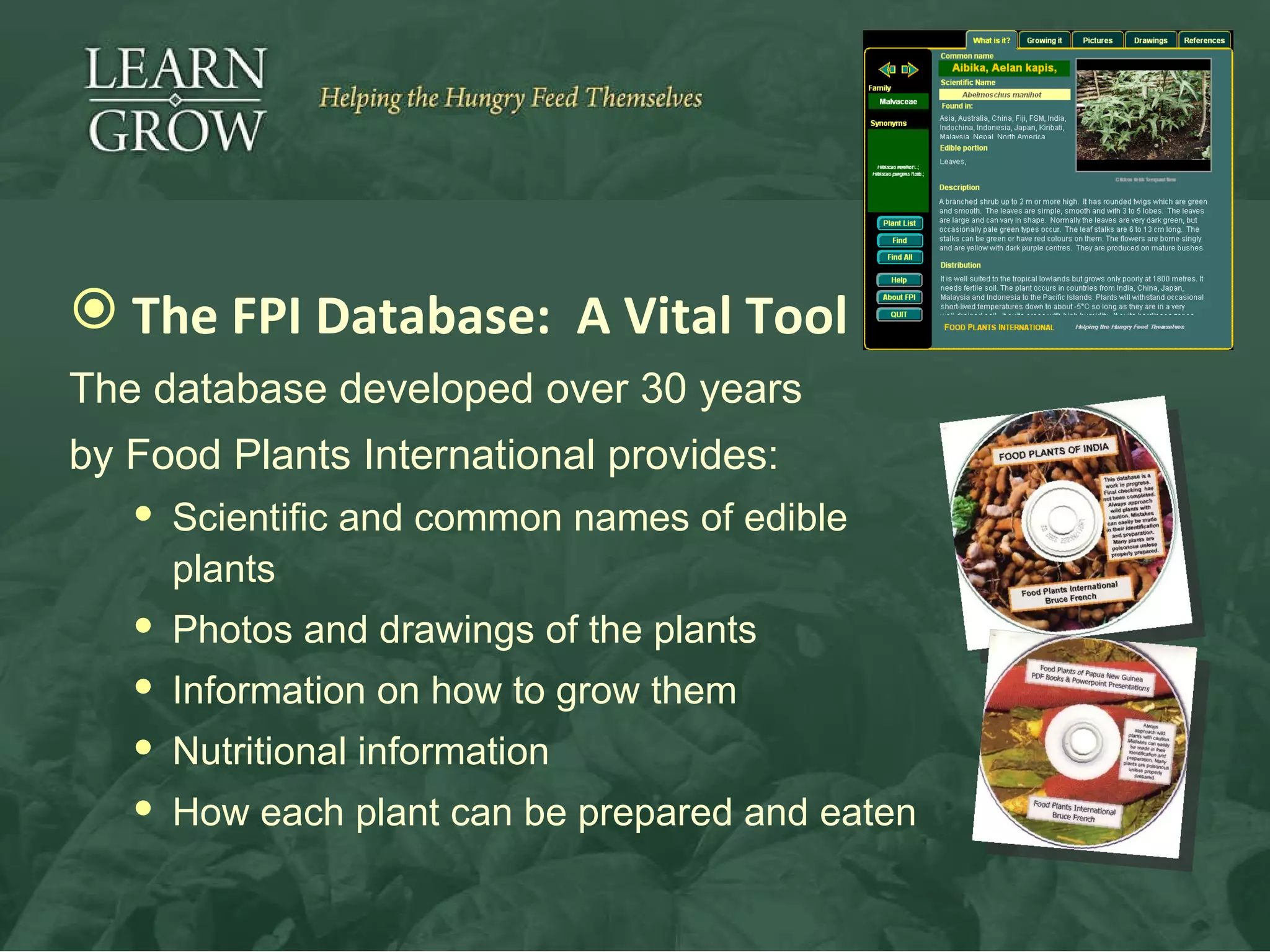
The FPI Database:  A Vital Tool The database developed over 30 years  by Food Plants International provides: Scientific and common names of edible plants Photos and drawings of the plants Information on how to grow them Nutritional information How each plant can be prepared and eaten
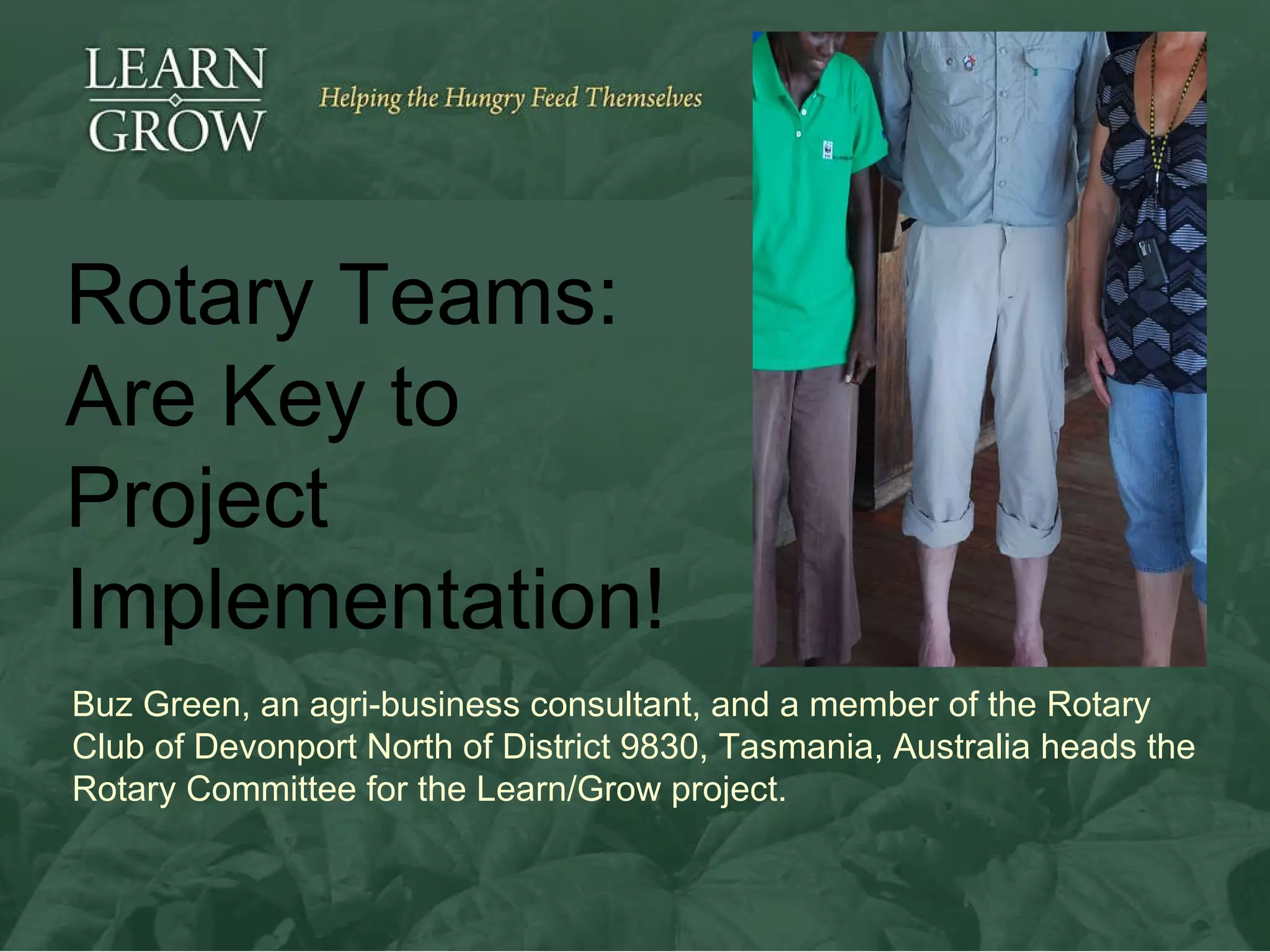
Buz Green, an agri-business consultant, and a member of  the Rotary Club of Devonport North of District 9830, Tasmania, Australia heads the Rotary Committee for the Learn/Grow project.  Rotary Teams:  Are Key to Project Implementation!
Learn Grow Aims… To sustainably reduce malnutrition in developing countries and reduce illness disease  and mortality  … caused by nutritional deficiencies.
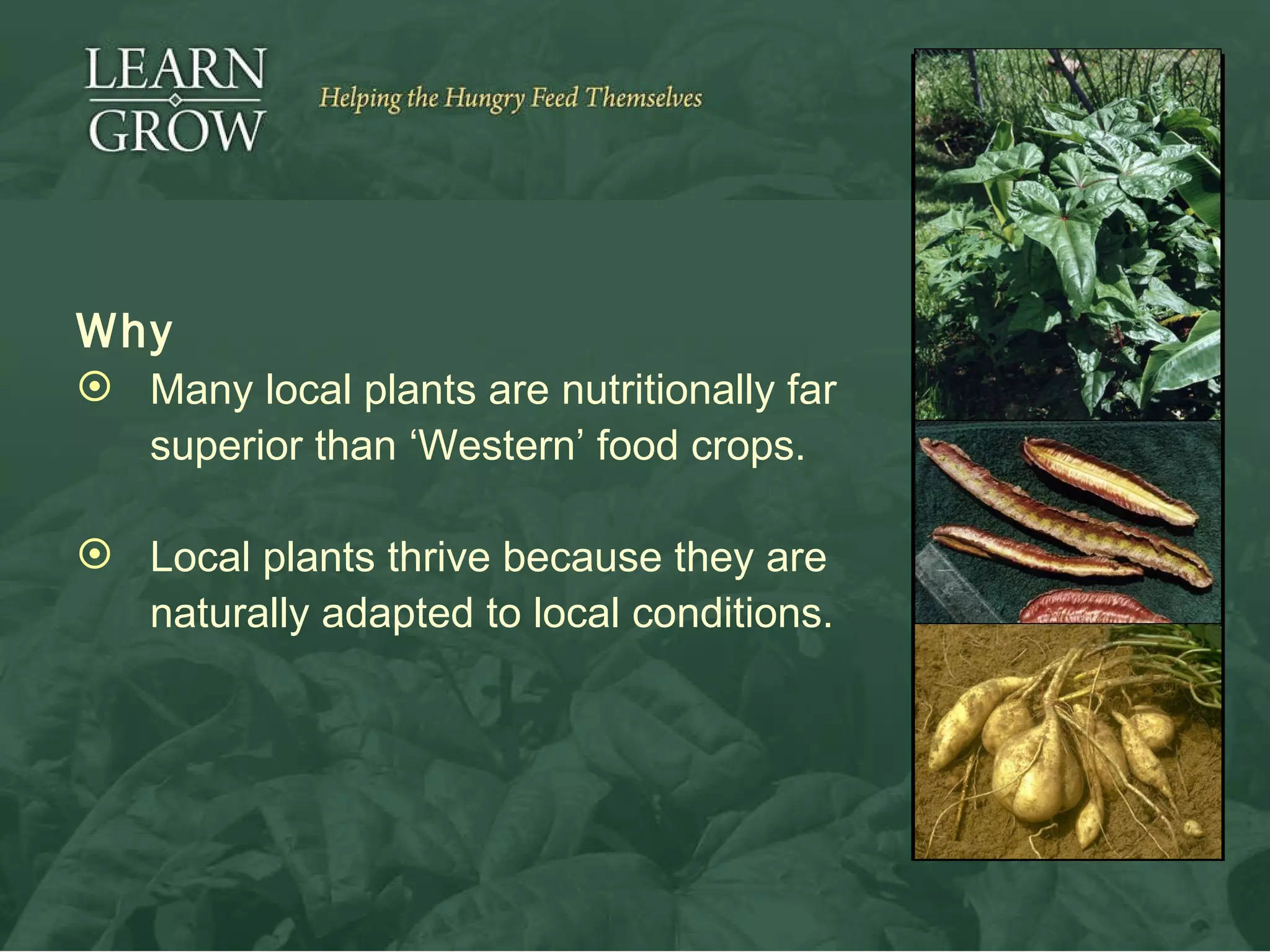
Why Many local plants are nutritionally far superior  than ‘Western’ food crops. Local plants thrive because they are naturally adapted to local conditions.
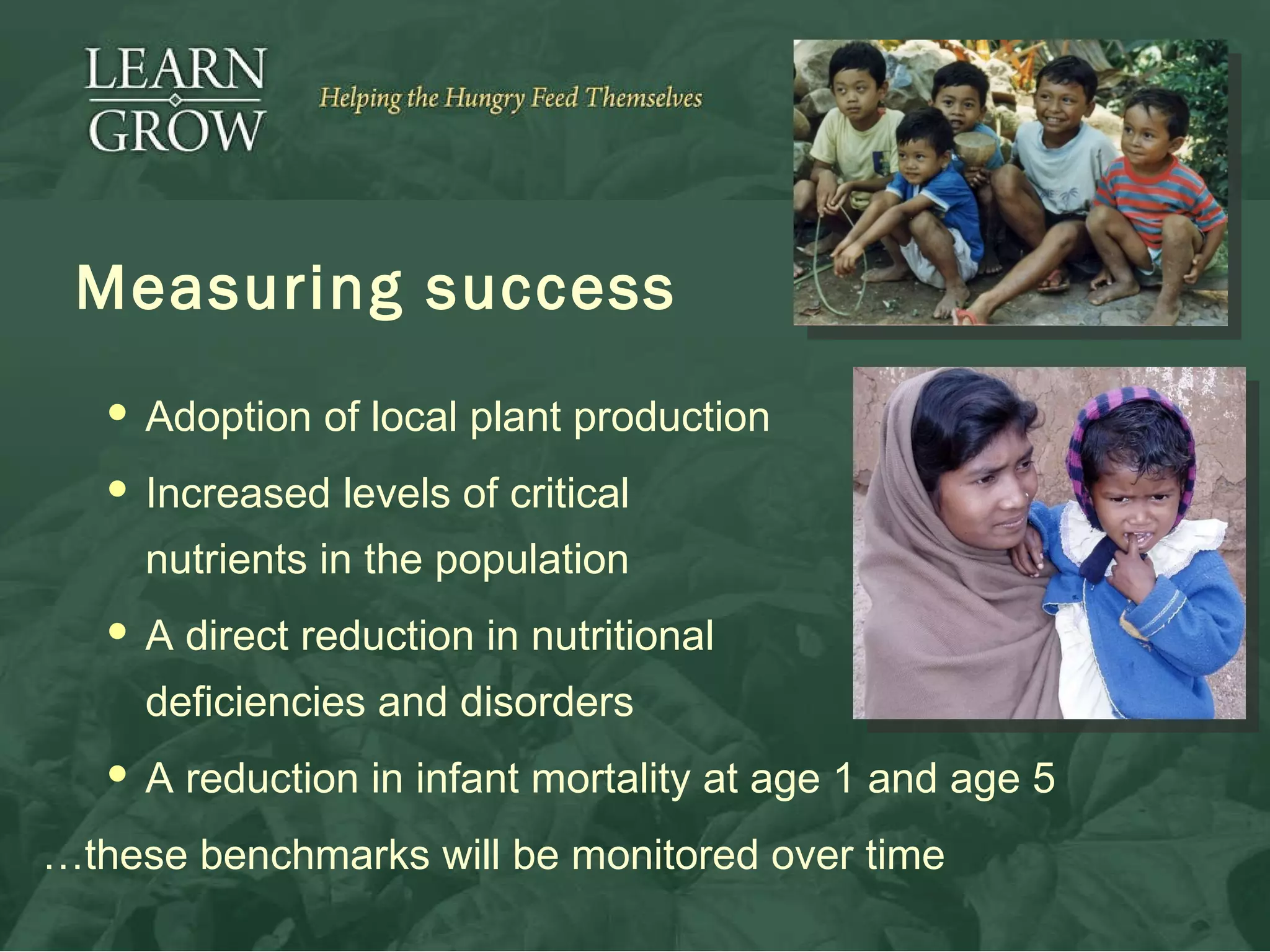
Measuring success Adoption of local plant production Increased levels of critical  nutrients in the population A direct reduction in nutritional  deficiencies and disorders A reduction in infant mortality at age 1 and age 5 … these benchmarks will be monitored over time
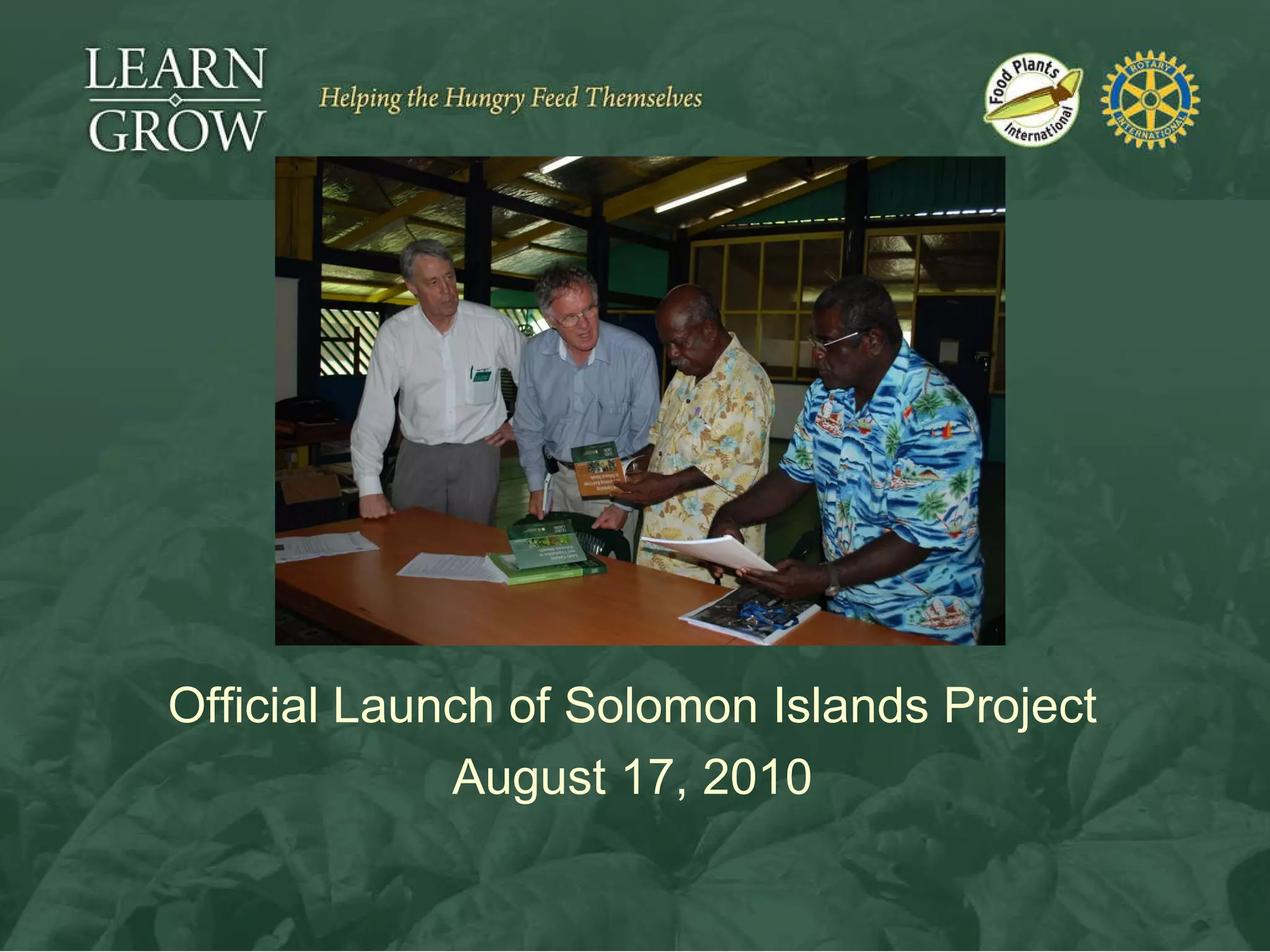
Official Launch of Solomon Islands Project August 17, 2010
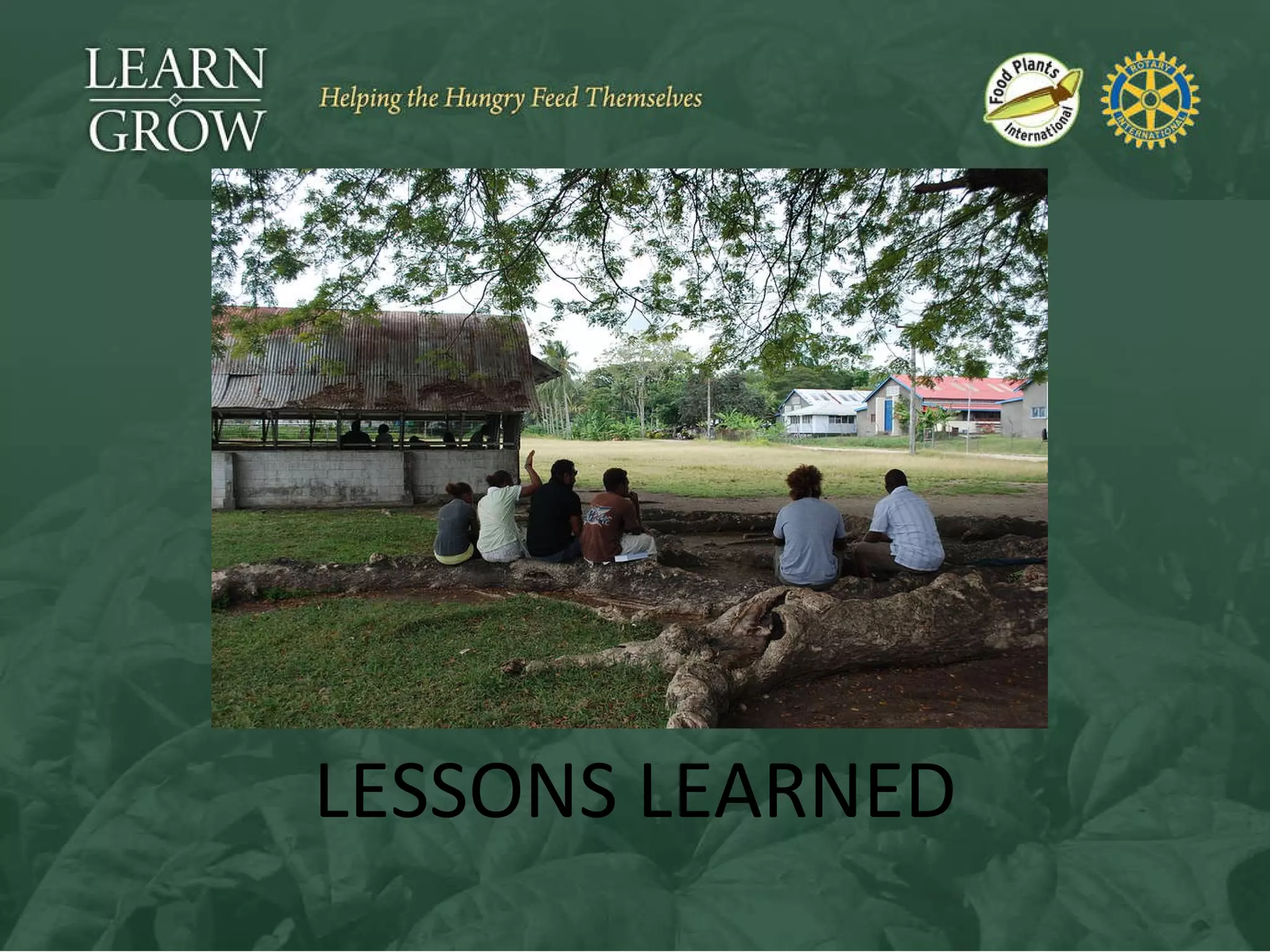
LESSONS LEARNED
Before you start, do your homework. Learn as much as you can about the country in which you plan to work. Quickly find a local (or group of locals) who will help guide you through the intricacies of local protocols, communication and dress. If you are not fluent in the language make sure someone on your team is. Travel Clinic. Passport and/or visa.
Prepare sample food plant documents specific to the country you are targeting.  (Actually, so far, FPI will do this for you!) Refer to the FPI database. Refer to at least one or two local agricultural experts. Focus on the top 40 or 50 most nutritious low-input, high-yield locally adapted or indigenous crops. Use lots of detailed color photos of selected plants. Make sure descriptions and instructions are written in clear, simple language appropriate for the greatest number of people who live there.  Though the language may be simple scientific rigor still must be maintained at all times. Make sure documents are visually appealing.
Quickly identify key potential actors. Local government agencies involved in health, nutrition, agriculture and education. Community and Faith-based organizations. NGO’s. International AID providers.
Develop a strategy that is appropriate for the country with which you have chosen to work to achieve greatest penetration of info. Top-down, bottom up, or both – depends on how stable the country is and how developed the infrastructure. Multiple channels are better than one. Tailor dissemination of information to appropriate literacy level of key audiences. Address in advance how to handle potential issues with multiple languages.
Meet with key actors and influential organizations. Identify key decision makers. Check and see if the organizations are stable and reliable. Arrange face to face meetings. Present the information in a friendly, non-threatening way. Ask open-ended rather than leading questions. Shut up and listen to the answers. Respond appropriately and honestly to questions. In the end, ask them if they did have this information how do they see the information being used.  (“Tie-Down Questions” or Closes)
Keep scrupulous written notes. Carry a journal with you at all times. First and last names as well as titles of key actors. What was said in meetings and who said it. Contact information for key actors. Write down your own thoughts and suggestions of what went well and what didn’t.
If you plan to take photos please observe certain protocols. Always ask permission of your subjects before you take photos of them. If you plan on using the photos in any work that is published for profit, you must have written permission of the subjects. If you have a digital camera and can show them what the final picture looks like, show them the picture and ask if they think it looks okay. Be careful in certain rural areas.  Many indigenous people are shy of tourists with cameras.  Some may actually believe that a camera can do more than simply take a picture.  Again, refer to #1 and ALWAYS ASK PERMISSION FIRST.
Prepare final documents for distribution Review information gathered while in country and make edits and additions accordingly. If you are addressing multiple channels and multiple levels of literacy and language, try to accommodate differences in targeted audiences with more than one version. Make sure photos are appropriate for location.  (We had people from Vanatu in photos in a Solomon Islands document.  The Solomon Islanders spotted them right away and insisted that they go.)
Enlist support from local media. Radio. Television. Newspapers. Magazines. Internet media sources.
Revisit identified actors and agencies with final documents for review. Returning with the goods shows you and your organization do what has been promised. Faces and names become familiar, and local people often become friendlier and more open. Take opportunities to visit other potential actors and agencies that you may have missed on your previous visit.
Launch! Pick a time and an appropriate venue to invite key actors and supporters to formally initiate the project in-country. Send hand-delivered or mailed invitations to all potentially interested parties. Identify the most influential and powerful individuals to speak. Invite media.
Empower and train local people in delivery and administration of Learn Grow concepts and materials! Project must be self-sustaining. Adoption of concepts by locals is key to success. Locals must be responsible for providing their own plants, planting materials, and tools.  REMEMBER: The more you give, the less likely locals are to become self-sufficient.
Funding the project. Most international aid providers are going to want requests to come in from locals.  Locals need to learn the best ways to seek out and apply for these grants on their own. Rotary Matching Grants – Again, you will need a local Rotary Club partner to help you with this. Private funds and fundraising.  Again it’s best if requests come from locals.
Act Directly It is simple for any club or district to incorporate LEARN  ♦  GROW into existing or new aid projects – identify the local nutritional deficiencies in the population and LEARN  ♦  GROW can provide the information!
The Learn Grow Team : Volunteers are being sought to join the Learn Grow team. Do you have a skill in: writing, communication, IT, project management, program leaders, marketing, sales, promotion, graphic design, agronomy, science or whatever, there is an opportunity for you in this project.
Rotary  can make a difference! www.learngrow.org

Learn Grow Lessons From The Solomon Islands Launch 2010

  • 1.
    Lessons from the Solomon Islands Project Launch August 13-20, 2010
  • 2.
    The aim ofLearn Grow is to reduce hunger and malnutrition around the world. It does this by showing people that in most cases they can economically and sustainably feed themselves from their own backyards.
  • 3.
    Learn Grow helpspeople understand the relation between good health and healthy eating habits by providing information on the nutritional values of locally adapted food plants.
  • 4.
    Because the plantsare adapted to grow in the local environment, they take less work to raise and typically don’t require much in the way of fertilizers and pesticides. Hence they are highly desirable from an economic standpoint.
  • 5.
    It also providesinformation on eco-friendly farming methods which help preserve local natural resources rather than deplete them.
  • 6.
    Many foreign aidagencies have innocently been giving out the WRONG INFORMATION for years!
  • 7.
    Wrong plant Wrongplace Wrong methods Wrong food
  • 8.
    Learn Grow is one of the first organizations to link local food plants with their nutritional information!
  • 9.
    Cabbage: WrongPlant - Wrong Place Many plants have 10 to 100 times the amount of iron when compared to cabbage. But how would you know? The iron content of just some of the leafy green vegetables found in tropical regions of the world.
  • 10.
    4 times Protein8 times Vitamin A 20 times Vitamin C 8 times Iron 4 times Zinc Cabbage Momienh OR And it suits the tropics!
  • 11.
    A comparison ofthe protein content of various food plants. Note that the ones that have the most are tropical plants.
  • 12.
    Vitamin C contentof various tree fruits Note on chart to right that the only citrus fruit named (Oranges) has the least amount of Vitamin C.
  • 13.
    Learn Grow isa partnership between Food Plants, International, and the Rotary Club of Devonport North, Tasmania, Australia, D9830
  • 14.
    Food Plants InternationalA not-for-profit organization lead by founder, Bruce French, who has created the Food Plants International database This unique database which includes over 22,000 species represents the most comprehensive scientific information available on edible plants for all countries of the world.
  • 15.
    The FPI Database: A Vital Tool The database developed over 30 years by Food Plants International provides: Scientific and common names of edible plants Photos and drawings of the plants Information on how to grow them Nutritional information How each plant can be prepared and eaten
  • 16.
    Buz Green, anagri-business consultant, and a member of the Rotary Club of Devonport North of District 9830, Tasmania, Australia heads the Rotary Committee for the Learn/Grow project. Rotary Teams: Are Key to Project Implementation!
  • 17.
    Learn Grow Aims…To sustainably reduce malnutrition in developing countries and reduce illness disease and mortality … caused by nutritional deficiencies.
  • 18.
    Why Many localplants are nutritionally far superior than ‘Western’ food crops. Local plants thrive because they are naturally adapted to local conditions.
  • 19.
    Measuring success Adoptionof local plant production Increased levels of critical nutrients in the population A direct reduction in nutritional deficiencies and disorders A reduction in infant mortality at age 1 and age 5 … these benchmarks will be monitored over time
  • 20.
    Official Launch ofSolomon Islands Project August 17, 2010
  • 21.
  • 22.
    Before you start,do your homework. Learn as much as you can about the country in which you plan to work. Quickly find a local (or group of locals) who will help guide you through the intricacies of local protocols, communication and dress. If you are not fluent in the language make sure someone on your team is. Travel Clinic. Passport and/or visa.
  • 23.
    Prepare sample foodplant documents specific to the country you are targeting. (Actually, so far, FPI will do this for you!) Refer to the FPI database. Refer to at least one or two local agricultural experts. Focus on the top 40 or 50 most nutritious low-input, high-yield locally adapted or indigenous crops. Use lots of detailed color photos of selected plants. Make sure descriptions and instructions are written in clear, simple language appropriate for the greatest number of people who live there. Though the language may be simple scientific rigor still must be maintained at all times. Make sure documents are visually appealing.
  • 24.
    Quickly identify keypotential actors. Local government agencies involved in health, nutrition, agriculture and education. Community and Faith-based organizations. NGO’s. International AID providers.
  • 25.
    Develop a strategythat is appropriate for the country with which you have chosen to work to achieve greatest penetration of info. Top-down, bottom up, or both – depends on how stable the country is and how developed the infrastructure. Multiple channels are better than one. Tailor dissemination of information to appropriate literacy level of key audiences. Address in advance how to handle potential issues with multiple languages.
  • 26.
    Meet with keyactors and influential organizations. Identify key decision makers. Check and see if the organizations are stable and reliable. Arrange face to face meetings. Present the information in a friendly, non-threatening way. Ask open-ended rather than leading questions. Shut up and listen to the answers. Respond appropriately and honestly to questions. In the end, ask them if they did have this information how do they see the information being used. (“Tie-Down Questions” or Closes)
  • 27.
    Keep scrupulous writtennotes. Carry a journal with you at all times. First and last names as well as titles of key actors. What was said in meetings and who said it. Contact information for key actors. Write down your own thoughts and suggestions of what went well and what didn’t.
  • 28.
    If you planto take photos please observe certain protocols. Always ask permission of your subjects before you take photos of them. If you plan on using the photos in any work that is published for profit, you must have written permission of the subjects. If you have a digital camera and can show them what the final picture looks like, show them the picture and ask if they think it looks okay. Be careful in certain rural areas. Many indigenous people are shy of tourists with cameras. Some may actually believe that a camera can do more than simply take a picture. Again, refer to #1 and ALWAYS ASK PERMISSION FIRST.
  • 29.
    Prepare final documentsfor distribution Review information gathered while in country and make edits and additions accordingly. If you are addressing multiple channels and multiple levels of literacy and language, try to accommodate differences in targeted audiences with more than one version. Make sure photos are appropriate for location. (We had people from Vanatu in photos in a Solomon Islands document. The Solomon Islanders spotted them right away and insisted that they go.)
  • 30.
    Enlist support fromlocal media. Radio. Television. Newspapers. Magazines. Internet media sources.
  • 31.
    Revisit identified actorsand agencies with final documents for review. Returning with the goods shows you and your organization do what has been promised. Faces and names become familiar, and local people often become friendlier and more open. Take opportunities to visit other potential actors and agencies that you may have missed on your previous visit.
  • 32.
    Launch! Pick atime and an appropriate venue to invite key actors and supporters to formally initiate the project in-country. Send hand-delivered or mailed invitations to all potentially interested parties. Identify the most influential and powerful individuals to speak. Invite media.
  • 33.
    Empower and trainlocal people in delivery and administration of Learn Grow concepts and materials! Project must be self-sustaining. Adoption of concepts by locals is key to success. Locals must be responsible for providing their own plants, planting materials, and tools. REMEMBER: The more you give, the less likely locals are to become self-sufficient.
  • 34.
    Funding the project.Most international aid providers are going to want requests to come in from locals. Locals need to learn the best ways to seek out and apply for these grants on their own. Rotary Matching Grants – Again, you will need a local Rotary Club partner to help you with this. Private funds and fundraising. Again it’s best if requests come from locals.
  • 35.
    Act Directly Itis simple for any club or district to incorporate LEARN ♦ GROW into existing or new aid projects – identify the local nutritional deficiencies in the population and LEARN ♦ GROW can provide the information!
  • 36.
    The Learn GrowTeam : Volunteers are being sought to join the Learn Grow team. Do you have a skill in: writing, communication, IT, project management, program leaders, marketing, sales, promotion, graphic design, agronomy, science or whatever, there is an opportunity for you in this project.
  • 37.
    Rotary canmake a difference! www.learngrow.org

Editor's Notes

  • #8 This an actual aid poster from Africa that highlights a key problem of western food aid Wrong plant – a plant better adapted to the location would be appropriate Wrong place – cabbage is a temperate plant not well suited to be grown in the tropics. Wrong methods – Rows are not necessary unless machines are being used and it is more sustainable to grow plants in mixed communities than in a mono-culture. Wrong food – cabbage has very low food value and is not appropriate for malnourished communities – explained in following slides.
  • #10 There are 67 plants with 10 times the amount of iron in cabbage, ....and 8 plants with 100 times the amount, out of 500 potential leafy green tropical food crops.
  • #11 Monienh is a common tropical weed. Western agricultural advisers usually do not have knowledge of its nutritional value and regularly recommend this weed be removed to grow western food crops such as cabbage. This highlights the need to re-think food production for starving communities. It is necessary to turn modern agricultural training around and in this case pull out the crop and eat the weeds!
  • #13 Ask anyone what to eat if you want to get vitamin C and most will say “Oranges”. Oranges and other citris plants do have reasonable levels of vitamin C but other food plants have much higher levels. For people deficient in any vitamin or mineral it is best to identify and grow the best available plant with the richest source of the missing nutrient. For tropical countries guava has three time the amount of Vitamin C as citrus and is much better suited to the tropical environment.