Effective Community Development
Agenda The need for community development Theory/Philosophy of development Planning your project Project cycle Practical example Ideas and suggestions Key points
The Need For Community Development
The need for community development Inequality affects your daily life – Brazil & Colombia Diarrhoea still a major killer If you’re not part of the solution, you’re part of the problem
Agenda The need for community development Theory/Philosophy of development Planning your project Project cycle Practical example Ideas and suggestions Key points
Theory/Philosophy of Development
Theory/Philosophy of development What are we trying to achieve? What is progress? What is poverty?  What is development?
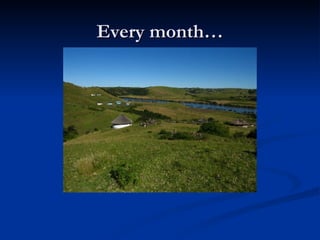
Every month…
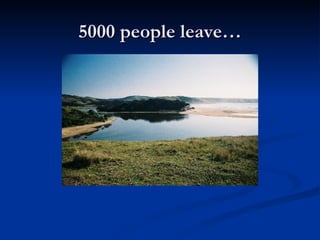
5000 people leave…
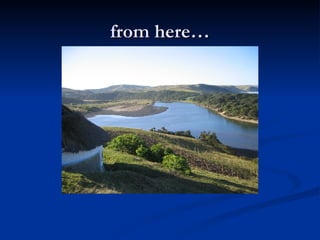
from here…
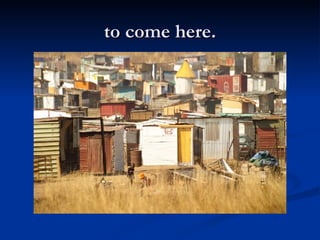
to come here.
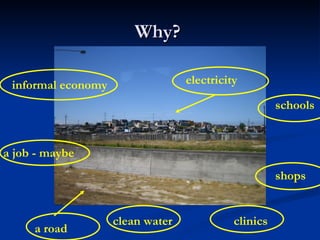
Why?  a road electricity clinics clean water schools shops informal economy a job - maybe
You could define poverty as… the absence of choices. Thus development is… giving people more choices.
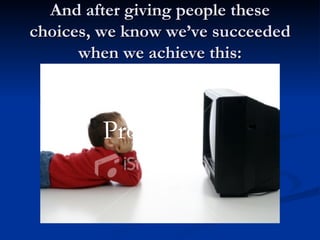
And after giving people these choices, we know we’ve succeeded when we achieve this: Progress?
Community development is complicated! There are often unintended consequences:  educating children = disrespect for illiterate adults promotion of woman’s rights = disintegration of traditional culture food aid = destruction of successful farmers Second-hand clothes = collapse of local textile/clothing manufacturers.
Why don’t  THEY  just build their own toilets?!
Why don’t  YOU  use a solar water heater?
So how is all this stuff useful?  I just want to give warm jerseys to cold kids on a rainy winter’s day. What’s all this fuzzy nonsense?   I just wanna help! I don’t need all this confusing stuff. Why is it so complicated?
You have a responsibility to try as best you can, not to make things  WORSE!   You must  analyse  the problem carefully and  plan  your project properly.
The need for community development Theory/Philosophy of development Planning your project Project cycle Practical example Ideas and suggestions Key points Agenda
Planning your Community Development Project
Planning your project Identify the  Problem  and the  Causative Factors Set measurable  Goals   Develop an  Action Plan Is it  Sustainable ? (Analyse the possibilities to  integrate/link  this project with your existing backpacker  business .) Develop a  Budget  - what resources are needed? Monitoring and Evaluation
Planning your Community Development Project a practical example
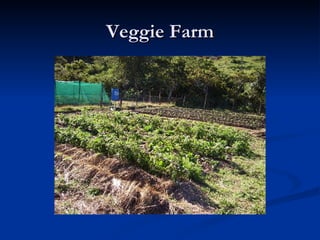
Chronic malnutrition in Bulungula village, especially amongst children. (Many children’s brains are irreparably stunted by the time they are 2 years old.) Problem
Old farming skills have been lost Causative factors Very limited range of crops grown  Very dependant on rainfall Seedlings can only be purchased in Mthatha (requiring R100 in taxi fares). Farming not “sexy” anymore – especially for young people. Not regarded as a  real  job. Social grants provide cash and thus a disincentive to farm - and no fresh veg for sale in local spaza shops. General apathy – waiting for things to change.
40% of households to be self-sufficient with vegetables by the end of 2008. Project Goals 30 new child farmers by the end of 2007 Develop two role model  Star Farmers  who make a good living from vegetable farming Increase the variety of vegetable crops grown/purchased from 4 to 8 varieties in 25% of households. Ensure that 100% of households who want veggie seedlings can access them affordably by June 2007.
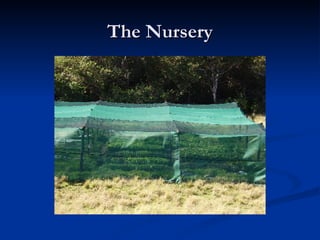
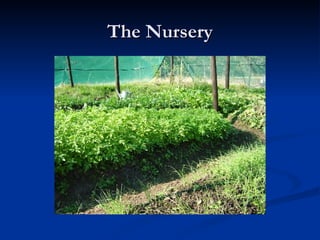
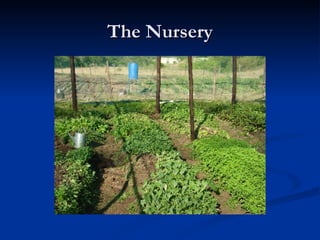
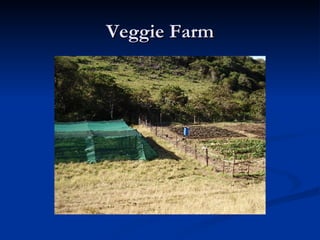
Research the current state of farming in the village. Need stats to measure and evaluate against. Action Plan Build a community-run nursery growing seedlings from seeds for sale in the village. Create 1 permanent job. Train two members to become Star Farmers and create a village “farm” that produces veggies for the Lodge restaurant. Farm to buy seedlings from nursery. Create 2 permanent jobs.
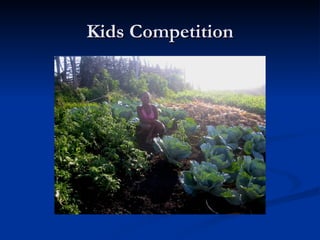
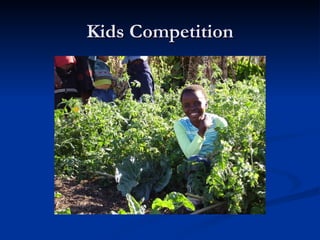
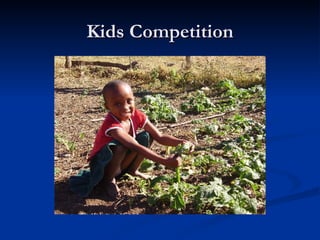
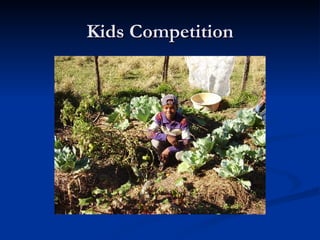
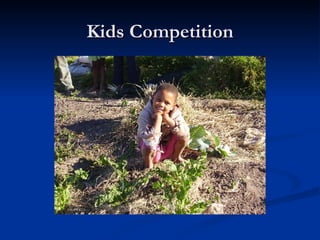
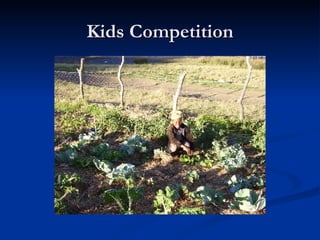
Action Plan Start a children’s farming competition. Each child gets seedlings from the nursery and after 2 months the top three “farmers” get great prizes. Those who don’t win still have some nice nutritious veggies and see the winners wearing cool, brand new clothes… =  status . Cooking lessons with tasty recipes using new types of nutritious veggies. If people like the vegetable’s taste, they’ll grow and eat it.
Sustainability Answer the question “if I die tomorrow, will the project continue?” Good  sustainability elements: Lodge restaurant needs vegetables. Can link with other lodges/restaurants in the area. Farmers who sell their veggies to the lodge will have to buy their seedlings at the nursery. Sponsoring kids farming competitions very attractive to guests/donors which will means more business for the nursery.
Sustainability Good  sustainability elements ( continued ): Existing veggie farmers will also buy seedlings at the nursery. There will be some local demand for veggies from the farm. Kids will never stop wanting new clothes Seedlings and veggies grown organically, so environmentally the project is sustainable.
Sustainability Bad  sustainability elements: If lodge goes out of business, there’ll be collapse in the market for veggies with a knock-on effect on the nursery and the competitions… Which means that the project is very dependant on tourism. A big bomb in Jhb… (Fortunately backpackers are  the most resilient tourists.)
Linking the project with the Lodge Buying veggies locally means no 6 hour drive to buy lettuce. Less fridge space needed as veggies picked same day. Invite guests to join the judging process for the Kids’ Competition. Offer 1 – 3 day volunteering opportunity for guests to work on the veggie farm: more bed nights, guests return to see how “their” project is doing and raises status/image of farming.
Linking the project with the Lodge Advertise that all restaurant veggies are local & organic. Recruit donors and skilled volunteers through the lodge’s website and notice boards. Offer free accommodation to volunteers (they still drink   ) in off season. Publicize the project in the media including its links to the lodge. This entire project was funded by donations totaling R30,000 from guests and assisted by 4 volunteers.
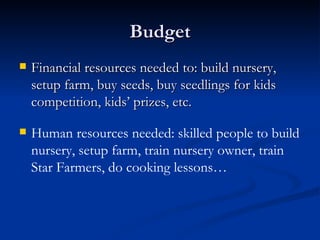
Budget Financial resources needed to: build nursery, setup farm, buy seeds, buy seedlings for kids competition, kids’ prizes, etc. Human resources needed: skilled people to build nursery, setup farm, train nursery owner, train Star Farmers, do cooking lessons…
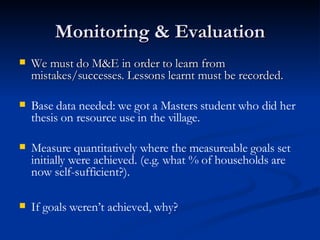
Monitoring & Evaluation We must do M&E in order to learn from mistakes/successes. Lessons learnt must be recorded. Base data needed: we got a Masters student who did her thesis on resource use in the village. Measure quantitatively where the measureable goals set initially were achieved. (e.g. what % of households are now self-sufficient?).  If goals weren’t achieved, why?
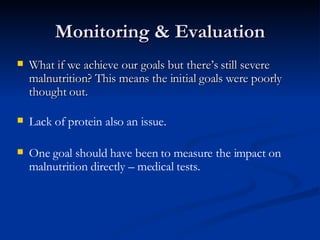
Monitoring & Evaluation What if we achieve our goals but there’s still severe malnutrition? This means the initial goals were poorly thought out. Lack of protein also an issue. One goal should have been to measure the impact on malnutrition directly – medical tests.
The Nursery
The Nursery
The Nursery
Veggie Farm
Veggie Farm
Kids Competition
Kids Competition
Kids Competition
Kids Competition
Kids Competition
Kids Competition
The need for community development Theory/ Philosophy of development Planning your project Project cycle Practical example Ideas and suggestions Key points Agenda
Ideas and Suggestions
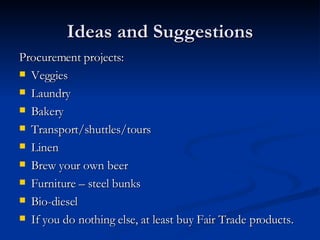
Ideas and Suggestions Procurement projects:  Veggies Laundry Bakery Transport/shuttles/tours Linen Brew your own beer Furniture – steel bunks Bio-diesel If you do nothing else, at least buy Fair Trade products.
The need for community development Theory/ Philosophy of development Planning your project Project cycle Practical example Ideas and suggestions Key points Agenda
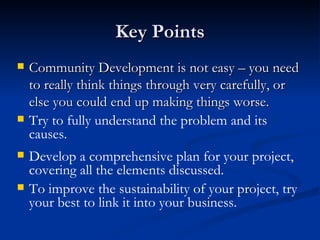
Key Points Community Development is not easy – you need to really think things through very carefully, or else you could end up making things worse. Try to fully understand the problem and its causes. Develop a comprehensive plan for your project, covering all the elements discussed. To improve the sustainability of your project, try your best to link it into your business.

Dave Martin

  • 1.
  • 2.
    Agenda The needfor community development Theory/Philosophy of development Planning your project Project cycle Practical example Ideas and suggestions Key points
  • 3.
    The Need ForCommunity Development
  • 4.
    The need forcommunity development Inequality affects your daily life – Brazil & Colombia Diarrhoea still a major killer If you’re not part of the solution, you’re part of the problem
  • 5.
    Agenda The needfor community development Theory/Philosophy of development Planning your project Project cycle Practical example Ideas and suggestions Key points
  • 6.
  • 7.
    Theory/Philosophy of developmentWhat are we trying to achieve? What is progress? What is poverty? What is development?
  • 8.
  • 9.
  • 10.
  • 11.
  • 12.
    Why? aroad electricity clinics clean water schools shops informal economy a job - maybe
  • 13.
    You could definepoverty as… the absence of choices. Thus development is… giving people more choices.
  • 14.
    And after givingpeople these choices, we know we’ve succeeded when we achieve this: Progress?
  • 15.
    Community development iscomplicated! There are often unintended consequences: educating children = disrespect for illiterate adults promotion of woman’s rights = disintegration of traditional culture food aid = destruction of successful farmers Second-hand clothes = collapse of local textile/clothing manufacturers.
  • 16.
    Why don’t THEY just build their own toilets?!
  • 17.
    Why don’t YOU use a solar water heater?
  • 18.
    So how isall this stuff useful? I just want to give warm jerseys to cold kids on a rainy winter’s day. What’s all this fuzzy nonsense? I just wanna help! I don’t need all this confusing stuff. Why is it so complicated?
  • 19.
    You have aresponsibility to try as best you can, not to make things WORSE! You must analyse the problem carefully and plan your project properly.
  • 20.
    The need forcommunity development Theory/Philosophy of development Planning your project Project cycle Practical example Ideas and suggestions Key points Agenda
  • 21.
    Planning your CommunityDevelopment Project
  • 22.
    Planning your projectIdentify the Problem and the Causative Factors Set measurable Goals Develop an Action Plan Is it Sustainable ? (Analyse the possibilities to integrate/link this project with your existing backpacker business .) Develop a Budget - what resources are needed? Monitoring and Evaluation
  • 23.
    Planning your CommunityDevelopment Project a practical example
  • 24.
    Chronic malnutrition inBulungula village, especially amongst children. (Many children’s brains are irreparably stunted by the time they are 2 years old.) Problem
  • 25.
    Old farming skillshave been lost Causative factors Very limited range of crops grown Very dependant on rainfall Seedlings can only be purchased in Mthatha (requiring R100 in taxi fares). Farming not “sexy” anymore – especially for young people. Not regarded as a real job. Social grants provide cash and thus a disincentive to farm - and no fresh veg for sale in local spaza shops. General apathy – waiting for things to change.
  • 26.
    40% of householdsto be self-sufficient with vegetables by the end of 2008. Project Goals 30 new child farmers by the end of 2007 Develop two role model Star Farmers who make a good living from vegetable farming Increase the variety of vegetable crops grown/purchased from 4 to 8 varieties in 25% of households. Ensure that 100% of households who want veggie seedlings can access them affordably by June 2007.
  • 27.
    Research the currentstate of farming in the village. Need stats to measure and evaluate against. Action Plan Build a community-run nursery growing seedlings from seeds for sale in the village. Create 1 permanent job. Train two members to become Star Farmers and create a village “farm” that produces veggies for the Lodge restaurant. Farm to buy seedlings from nursery. Create 2 permanent jobs.
  • 28.
    Action Plan Starta children’s farming competition. Each child gets seedlings from the nursery and after 2 months the top three “farmers” get great prizes. Those who don’t win still have some nice nutritious veggies and see the winners wearing cool, brand new clothes… = status . Cooking lessons with tasty recipes using new types of nutritious veggies. If people like the vegetable’s taste, they’ll grow and eat it.
  • 29.
    Sustainability Answer thequestion “if I die tomorrow, will the project continue?” Good sustainability elements: Lodge restaurant needs vegetables. Can link with other lodges/restaurants in the area. Farmers who sell their veggies to the lodge will have to buy their seedlings at the nursery. Sponsoring kids farming competitions very attractive to guests/donors which will means more business for the nursery.
  • 30.
    Sustainability Good sustainability elements ( continued ): Existing veggie farmers will also buy seedlings at the nursery. There will be some local demand for veggies from the farm. Kids will never stop wanting new clothes Seedlings and veggies grown organically, so environmentally the project is sustainable.
  • 31.
    Sustainability Bad sustainability elements: If lodge goes out of business, there’ll be collapse in the market for veggies with a knock-on effect on the nursery and the competitions… Which means that the project is very dependant on tourism. A big bomb in Jhb… (Fortunately backpackers are the most resilient tourists.)
  • 32.
    Linking the projectwith the Lodge Buying veggies locally means no 6 hour drive to buy lettuce. Less fridge space needed as veggies picked same day. Invite guests to join the judging process for the Kids’ Competition. Offer 1 – 3 day volunteering opportunity for guests to work on the veggie farm: more bed nights, guests return to see how “their” project is doing and raises status/image of farming.
  • 33.
    Linking the projectwith the Lodge Advertise that all restaurant veggies are local & organic. Recruit donors and skilled volunteers through the lodge’s website and notice boards. Offer free accommodation to volunteers (they still drink  ) in off season. Publicize the project in the media including its links to the lodge. This entire project was funded by donations totaling R30,000 from guests and assisted by 4 volunteers.
  • 34.
    Budget Financial resourcesneeded to: build nursery, setup farm, buy seeds, buy seedlings for kids competition, kids’ prizes, etc. Human resources needed: skilled people to build nursery, setup farm, train nursery owner, train Star Farmers, do cooking lessons…
  • 35.
    Monitoring & EvaluationWe must do M&E in order to learn from mistakes/successes. Lessons learnt must be recorded. Base data needed: we got a Masters student who did her thesis on resource use in the village. Measure quantitatively where the measureable goals set initially were achieved. (e.g. what % of households are now self-sufficient?). If goals weren’t achieved, why?
  • 36.
    Monitoring & EvaluationWhat if we achieve our goals but there’s still severe malnutrition? This means the initial goals were poorly thought out. Lack of protein also an issue. One goal should have been to measure the impact on malnutrition directly – medical tests.
  • 37.
  • 38.
  • 39.
  • 40.
  • 41.
  • 42.
  • 43.
  • 44.
  • 45.
  • 46.
  • 47.
  • 48.
    The need forcommunity development Theory/ Philosophy of development Planning your project Project cycle Practical example Ideas and suggestions Key points Agenda
  • 49.
  • 50.
    Ideas and SuggestionsProcurement projects: Veggies Laundry Bakery Transport/shuttles/tours Linen Brew your own beer Furniture – steel bunks Bio-diesel If you do nothing else, at least buy Fair Trade products.
  • 51.
    The need forcommunity development Theory/ Philosophy of development Planning your project Project cycle Practical example Ideas and suggestions Key points Agenda
  • 52.
    Key Points CommunityDevelopment is not easy – you need to really think things through very carefully, or else you could end up making things worse. Try to fully understand the problem and its causes. Develop a comprehensive plan for your project, covering all the elements discussed. To improve the sustainability of your project, try your best to link it into your business.