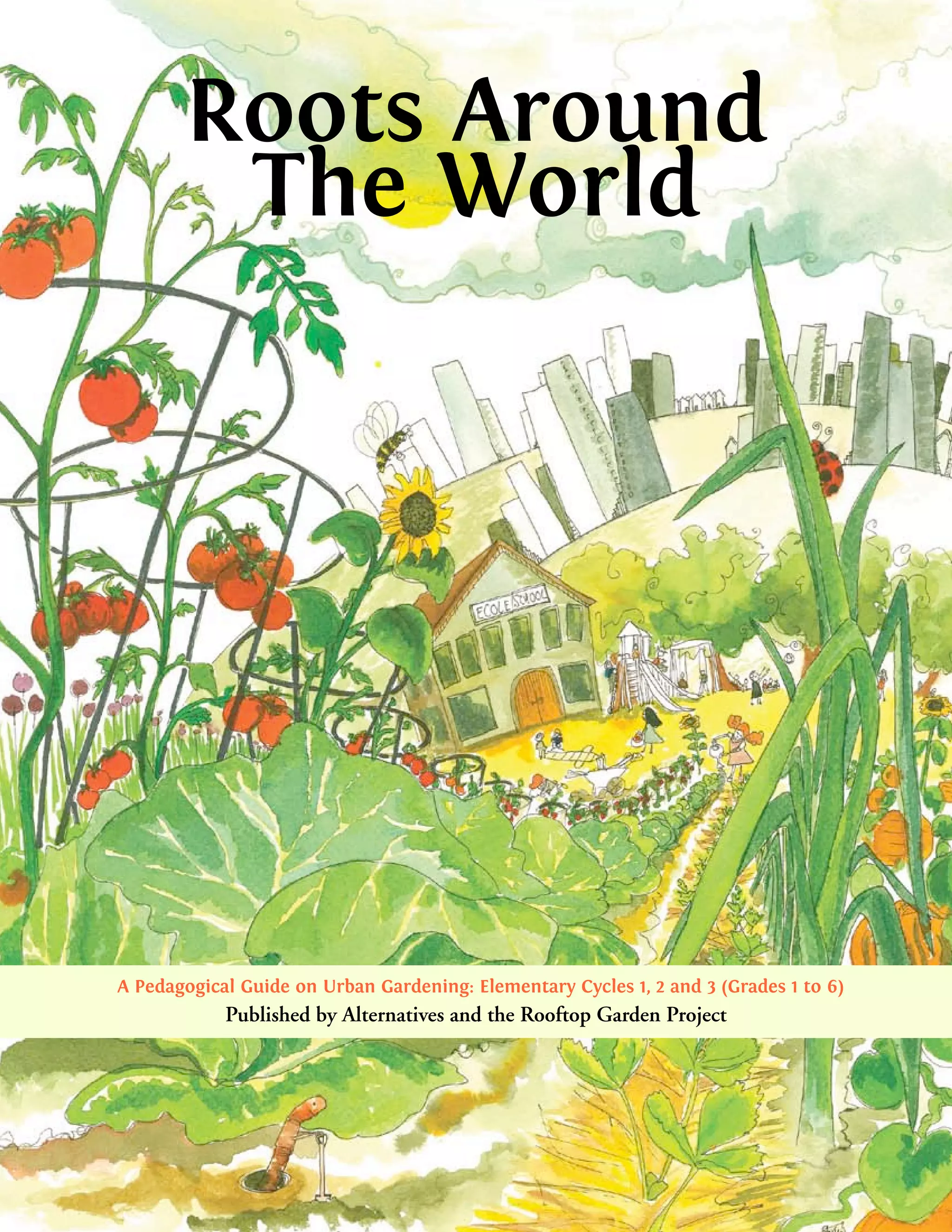
Roots Around
        The World


A Pedagogical Guide on Urban Gardening: Elementary Cycles 1, 2 and 3 (Grades 1 to 6)
            Published by Alternatives and the Rooftop Garden Project
Roots Around the World
   Pedagogical Guide
       CIDA Global Classroom Initiative Project
      Elementary Cycles 1, 2 and 3 (Grades 1 to 6)


  Published by Alternatives and the Rooftop Garden Project
Published by Alternatives and the Rooftop Garden Project
3720, avenue du Parc, suite 300
Montreal, Quebec
H2X 2J1
www.alternatives.ca / www.rooftopgardens.ca


Created by: Rotem Ayalon, Marianne Guilmette, Ismael Hautecoeur and Anna Lee-Popham
Illustrations: Fanchon Esquieu (www.fanchon.net)
Photography: Rooftop Garden Project
Layout: Todd Stewart (www.breeree.com)
Correction: Jamie Herd (English), Gilles MacMillan (French)
Translation: Myriam Bouchard
Special thanks to Veronique Gauthier, Vikram Bhatt, Penny Kaill-Vinish, Danielle Stevenson, Solange
Guilbert, Kristi DeBonville, Carole Marcoux, Dominique Chouinard and Linton Garner.

A warm thank you as well to our collaborators and partner - teachers and students at FACE, Lucie Sauvé
and the students from UQAM: Chaire de recherche en education relative a l’environnment, the McGill
Minimum Cost Housing Group, Santropol Roulant, EnJeu, Etablissement Vert Brundtland, Community
Learning Centers, AQPERE, and REPAQ - who helped the Rooftop Garden Project take root in the
educational sector.


Produced with the support of the Government of Canada through the
Canadian International Development Agency (CIDA)

© 2009. Any reproduction, in part or total, is desirable on the condition that the source is indicated.
AN INVITATION

The Rooftop Garden Project team is proud to present the pedagogical guide Roots Around the World. Through
a series of practical, critical and creative educational activities, it allows students in the three cycles of primary
school to discover and reflect upon what is at stake in urban agriculture. Beautifully illustrated, this guide will
take you from the fridge to the garden, from local action to global thinking.
The Rooftop Garden Project has been encouraging citizens to get involved in creating new green, edible
spaces for communities, both locally and internationally. At the heart of these communities are their schools,
a fertile ground where young citizens “grow”. Because of the generous and creative nature of edible gardening,
we believe it is an excellent way to get students to think about their relationship with their physical and social
environment.
Beyond explaining how our food goes “from field to table”, we would like to foster a culture of citizen involve-
ment and solidarity. We sincerely hope these educational activities sow the seeds of a community garden
project in your schoolyard. A garden that reflects the rich diversity in which plants from all horizons may be
cultivated and shared. We would be happy to work with you as you set down deep roots in your community.


Looking forward to gardening with you!


The Rooftop Garden Project team
www.rooftopgardens.ca
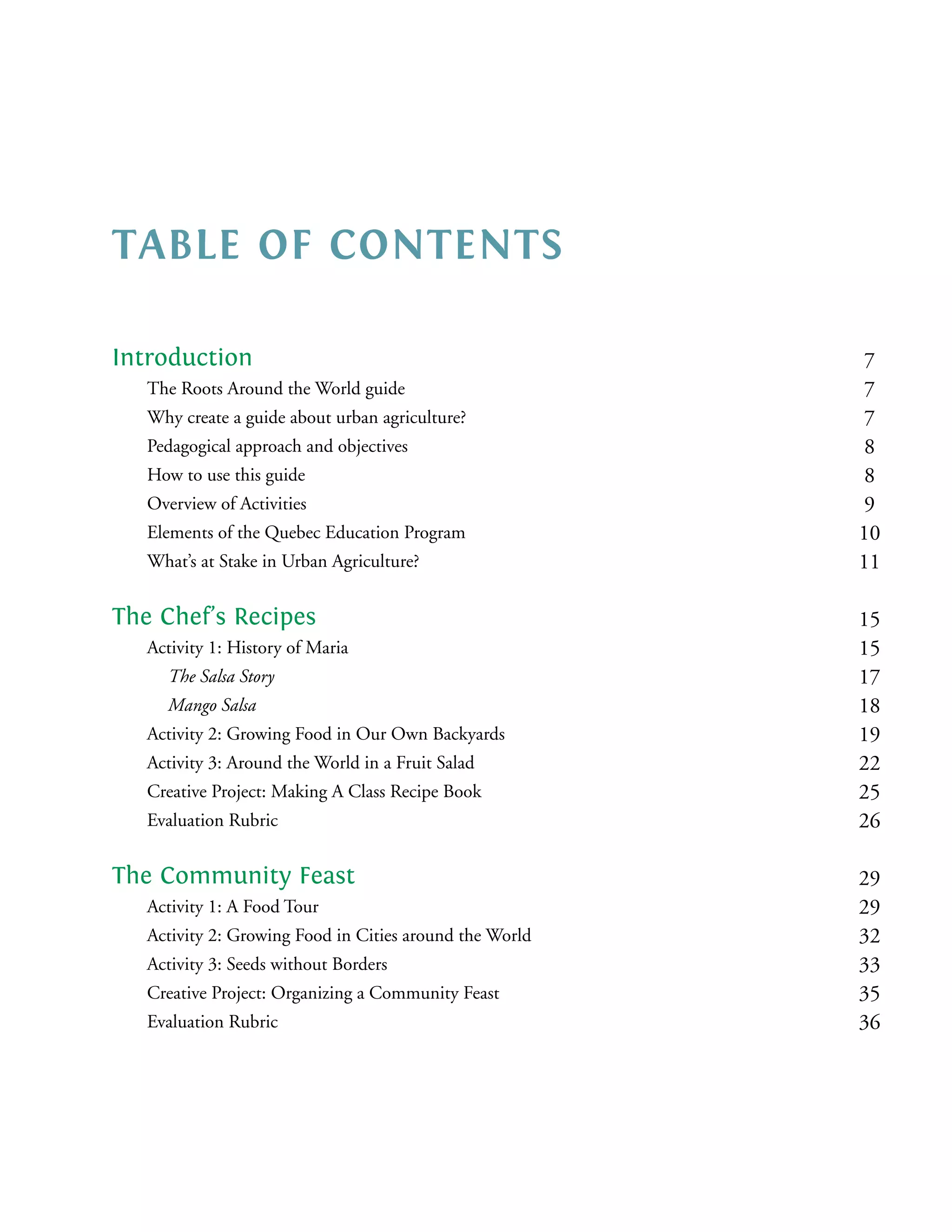
TABLE OF CONTENTS

Introduction                                              7
   The Roots Around the World guide                       7
   Why create a guide about urban agriculture?            7
   Pedagogical approach and objectives                    8
   How to use this guide                                  8
   Overview of Activities                                 9
   Elements of the Quebec Education Program              10
   What’s at Stake in Urban Agriculture?                 11

The Chef’s Recipes                                       15
   Activity 1: History of Maria                          15
     The Salsa Story                                     17
     Mango Salsa                                         18
   Activity 2: Growing Food in Our Own Backyards         19
   Activity 3: Around the World in a Fruit Salad         22
   Creative Project: Making A Class Recipe Book          25
   Evaluation Rubric                                     26

The Community Feast                                      29
   Activity 1: A Food Tour                               29
   Activity 2: Growing Food in Cities around the World   32
   Activity 3: Seeds without Borders                     33
   Creative Project: Organizing a Community Feast        35
   Evaluation Rubric                                     36
The Transformation of Waste to Compost                    39
   Activity 1: A Tomato’s Journey                         39
   Activity 2: Where Have the Melons Gone?                43
      Tale of a Long Distance Industrial Farm Melon       45
   Activity 3: The People in Our Food Chain               48
   Activity 4: In the Garden at Last!                     54
   Creative Project: Composting Organic Waste             58
   Evaluation Rubric                                      60

Annex                                                     61
   Seed Starting Activity                                 61
   Seeding Calendar                                       66
   The Rooftop Garden Project                             67
   Urban Agriculture Around the World Information Cards   69

Resources                                                 75
INTRODUCTION

The Roots Around the World guide
The Roots Around the World guide is a collection of activities and projects geared towards students in the three
cycles of elementary school and the first year of high school that highlights the role urban agriculture plays in
the Southern and Northern hemisphere. Through learning about the production and consumption of food in
urban areas, youth discover that simple daily actions have a large impact on people’s health, their communities
and the environment, on a local and international scale.
     This educational guide is inspired by Alternatives’ urban agriculture project: the Rooftop Garden Project
(www.rooftopgardens.ca). Alternatives supports community-based initiatives that work to promote the eco-
nomic, social, and political rights of people and communities in the North and South that are affected by
poverty, discrimination, exploitation and violence. Together with volunteers and institutional and community
partners, the Rooftop Garden Project has started urban agriculture initiatives in Montreal and around the
world: South Africa, Mali, Brazil, Senegal, Morocco and Cuba. These urban agriculture initiatives are oriented
towards citizen involvement in the creation of edible, green, community-based urban spaces.


                  WHY CREATE A GUIDE ABOUT URBAN AGRICULTURE?
       Around the world as many people live in urban as in rural areas. It is predicted that urban popu-
       lations will surpass rural populations within twenty-five years. With this rapid global urbanization
       comes increased urban poverty and urban food insecurity. Urban agriculture is one strategy that
       provides opportunities for people to learn how to produce food, promotes local economic develop-
       ment and builds community across differences in income, race, class, gender and other social,
       political and economic divisions, while reusing urban wastes and greening the city.
       The Roots Around the World teaching guide creates opportunities for students to learn about food
       insecurity (amidst an overabundance of food) in Quebec and internationally, develop relationships with
       their community and with the world around them, and enjoy the great outdoors – all within their city!


Pedagogical approach and objectives
This guide uses a systemic pedagogical approach. This enables teachers to adopt the broad areas of learning
of the Quebec education program in a concrete manner within the classroom. The activities focus on nutri-
tion, health and the environment and situate the student in their family, their community and the world. The
practical, community-based projects root the learning in the life experience of the youth. The creation of a
collective garden, at the school or in the neighborhood, will further reinforce connections between the class,
the school and the community.
                                                                                                   Introduction   7
Through the activities and practical projects, students will:
 •    be introduced to urban agriculture and other options within the global food system;
 •    understand where food comes form, the method used to grow the food, the impacts of importing food, and
      the waste generated by importation;
 •    learn about the nutritional and environmental benefits of growing food locally;
 •    become familiar with recipes and meals from different cultures;
 •    bring together different members of the community for a shared meal;
 •    understand the food cycle and ways to reduce and reuse our waste;
 •    start seeds and use them to the benefit of the community.
    The activities proposed in this guide serve to integrate knowledge from different disciplines, including
geography, history, ecology and civic education.


How to use this guide
Look over the Activities and Creative Projects
The Roots Around the World guide includes three modules, each containing three activities, geared towards the
elementary cycles and the first year of high school (or junior high school outside of Quebec). Each module of
three activities is each geared towards a specific learning cycle and builds towards a creative project. All of the
activities and creative projects can be easily adjusted to fit the needs of any learning cycle. As such, it is sug-
gested that teachers look over the activities and creative projects and use or adapt those they find most interest-
ing and useful for the learning styles, needs, and interests of their students.
Plan when you will be planting seeds
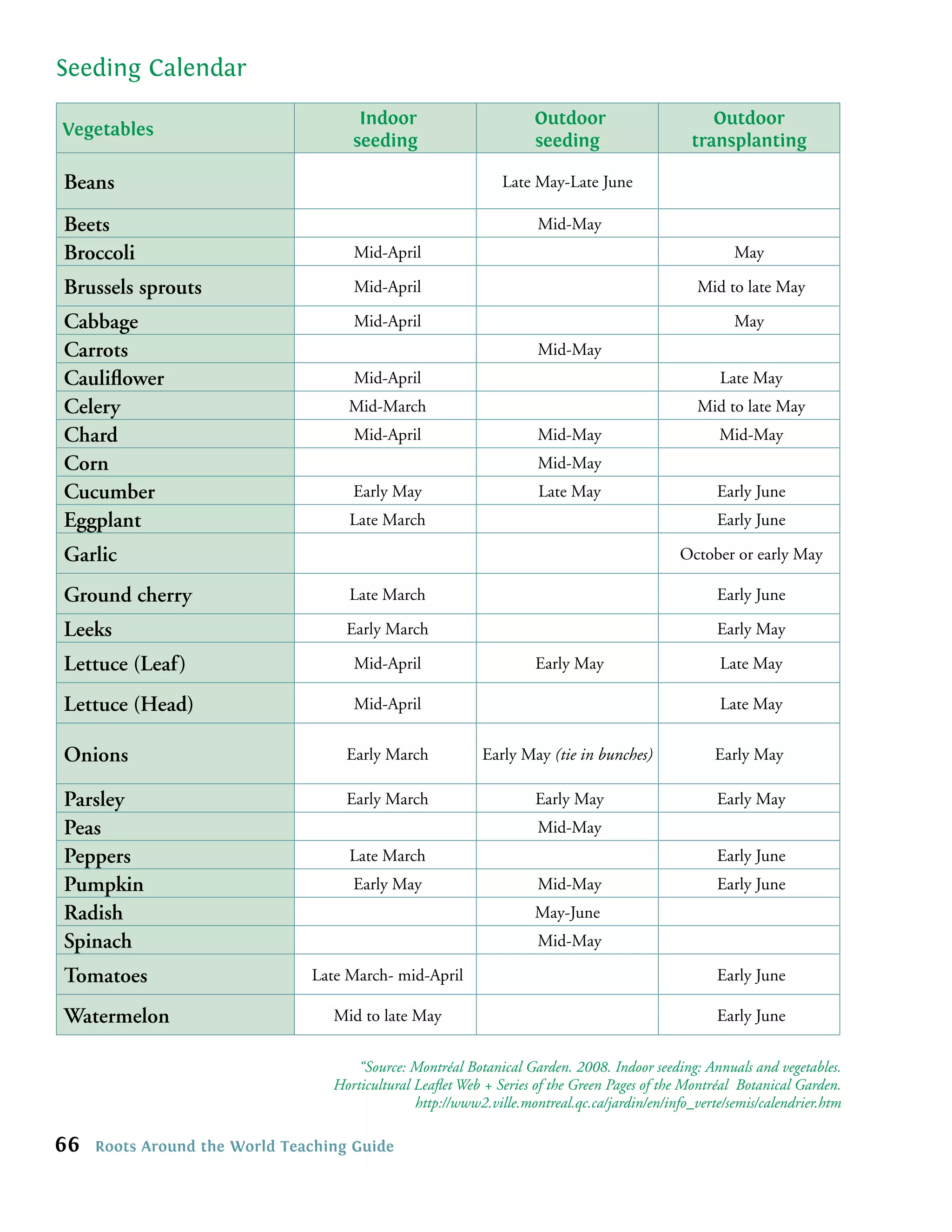
The Roots Around the World guide also includes a Seed Starting Activity. This activity (in the annex) provides
information necessary for students to learn how to start seeds and care for seedlings, and includes three ways
to use the seedlings to benefit the surrounding community. It is important that this Seed Starting Activity is
begun in the spring so that the seedlings are ready to be planted outside in warmer weather. See the Seeding
Calendar (on page 66) for dates to start specific seeds. It is recommended that the other activities start in the
fall or winter and build towards the Seed Starting Activity. A harvest party could be held at the beginning of
the following school year.
Talk about the suggestions in the “What Can I Do?” boxes with the students
There is a “What Can I Do?” box at the end of each activity. Talk with the students about these suggestions.
Ask the students which things they would be able to do and to add other ideas. Suggest these ideas as things
that the students can work on at home, or find ways that the class can engage in these actions together.
Use the Rooftop Garden Project as a resource
The Rooftop Garden Project and other local organizations are available should you need assistance. Be sure
to contact us if you have any questions about urban agriculture, container gardening, rooftop gardens or any
other parts of this guide!


8    Roots Around the World Teaching Guide
Overview of Activities
The Chef ’s Recipe Book (For Cycles One and Two)
Activity 1: History of Maria.
Students learn about different family food traditions and recipes.
Activity 2: Growing Food in Our Own Backyards.
Students create a recipe with ingredients that they can grow in their neighbourhood.
Activity 3: Around the World in a Fruit Salad.
Students make a fruit salad with ingredients from around the world.
Creative Project: Making A Class Recipe Book.
The class prepares a recipe book with their own favorite recipes and others they have learned about.
Seed Starting Activity (See page 61)

The Community Feast (For Cycle Three)
Activity 1: A Food Tour.
Students take a walking tour of their school neighborhood to examine the places that food is grown, sold, consumed
and distributed.
Activity 2: Growing Food in Cities Around the World.
Students explore recipes and food preparation techniques of families from around the world.
Activity 3: Seeds Without Borders.
Students learn that populations have always carried seeds with them when they migrate.
Creative Project: Organizing a Community Feast.
The class prepares a community event with student performances and a community meal.
Seed Starting Activity (See page 61)

The Transformation of Waste to Compost (For Cycle Three)
Activity 1: A Tomato’s Journey.
Students learn about different agricultural production methods by following the journey of a tomato.
Activity 2: Where Have the Melons Gone?
Students learn about ways food is wasted by the current food system and learn about ways that waste can be reduced
and reused.
Activity 3: The People in Our Food Chain.
Students learn about the many different people involved in current food production and distribution, and compare that
to ways that food was produced fifty years ago.
Activity 4: In the Garden at Last!
After analyzing the schoolyard, students are invited to draft a plan of a vegetable garden and present it to the community
at a kick off celebration at the school.
Creative Project: Composting Organic Waste.
Students start an indoor worm compost bin or an outdoor compost bin.
Seed Starting Activity (See page 61)


                                                                                                       Introduction     9
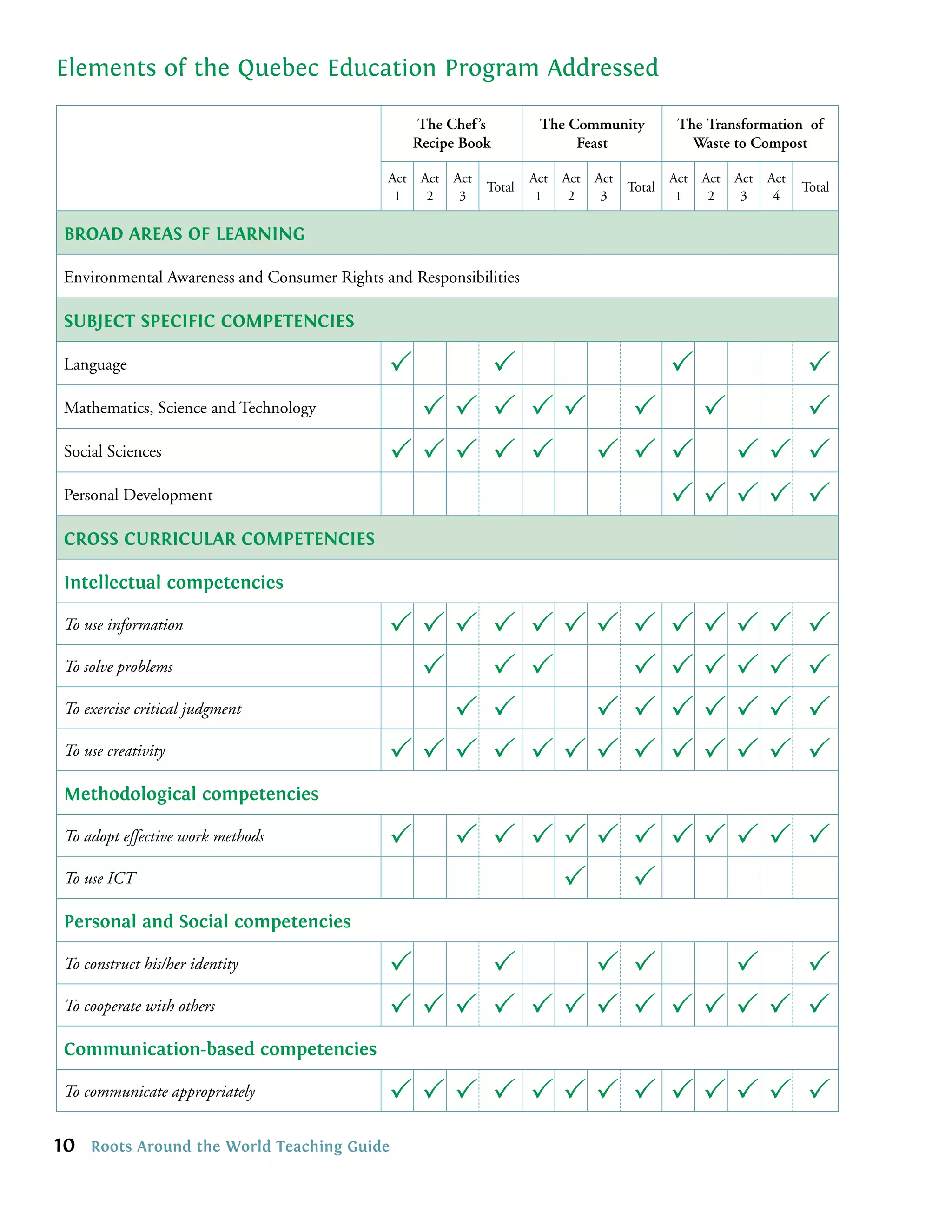
Elements of the Quebec Education Program Addressed

                                                   The Chef ’s           The Community             The Transformation of
                                                   Recipe Book                Feast                  Waste to Compost

                                             Act    Act   Act           Act   Act   Act           Act   Act   Act   Act
                                                                Total                     Total                           Total
                                              1      2     3             1     2     3             1     2     3     4

BROAD AREAS OF LEARNING

Environmental Awareness and Consumer Rights and Responsibilities

SUBJECT SPECIFIC COMPETENCIES

Language                                     P   P       P                                                                P
Mathematics, Science and Technology           PP P PP P P                                                                 P
Social Sciences                              PPP P P P P P PP                                                             P
Personal Development                                     PPPP                                                             P
CROSS CURRICULAR COMPETENCIES

Intellectual competencies

To use information                           PPP                 P PPP                    P       PPPP                    P
To solve problems                             P                  P P                      P       PPPP                    P
To exercise critical judgment                   P                P   P                    P       PPPP                    P
To use creativity                            PPP                 P PPP                    P       PPPP                    P
Methodological competencies

To adopt effective work methods              P            P P PPP P PPPP P
To use ICT                                                     P P
Personal and Social competencies

To construct his/her identity                P   P   P P   P  P
To cooperate with others                     PPP P PPP P PPPP P
Communication-based competencies

To communicate appropriately                 PPP P PPP P PPPP P
10   Roots Around the World Teaching Guide
What’s at Stake in Urban Agriculture

Urban agriculture is the cultivation of plants, fruit trees, medicinal and aromatic herbs and the raising of
animals in cities to increase food access and/or generate income for urban households. In the 1990’s more than
800 million people around the world were involved in urban agriculture. Food grown in cities accounted for
15-20 percent of the food eaten by the world population. While in urban centers within low-income countries
urban agriculture is widespread, there is much room for further advancement of food production initiatives in
Western cities. Through urban agriculture initiatives, people learn to how grow their food and create different
structures within which agricultural activities happen on a smaller scale, closer to people’s homes.
This guide covers the following themes:

Social Aspects of Urban Agriculture
Health and Nutrition
Much of the food we eat is highly processed and contains many chemical additives. Eating processed foods
leads to cardiovascular diseases, which are a major cause of death in Canada. A number of other diseases,
including diabetes, high blood pressure and food allergies, occur more often in families who don’t have access
to enough food. Urban agriculture increases access to healthy food through fresh, local, unprocessed and inex-
pensive (or free) alternatives to current food trends.
Food Security
Food insecurity happens when people do not have safe, nutritious and culturally appropriate food. Food
insecurity exits in countries considered “developing” and “developed”. There is enough food produced to
feed everyone in the world with at least 3500 kilocalories every day (which is enough calories for everyone).
Yet 12.6 % of the world’s population (or over 850 million people) is currently undernourished. Through
growing food in the city, people who would otherwise not have access to fresh fruit and vegetables are able
to do so.
Education
Many people around the world do not know how to grow their own food. Nor do they know where their
food came from, or the ways that the food was grown. This is largely because of a shift away from family farms
towards industrial agriculture (which uses machines as opposed to human power to grow food). Through
learning how to grow food, people become less dependent on fruits and vegetables that come from industrial
farms, food banks or food aid programs.
Community Building
From Cairo and Nairobi to London people have become more involved in their communities through working
in gardens and other urban agriculture initiatives. Many urban agriculture projects, be they located in “devel-
oped” or “developing” countries not only provide food for people, but also provide a place for people to gather,
get to know one another, and work towards creating a neighborhood that they want.


Ecological Aspects of Urban Agriculture
Less Use of Fossil Fuels
Unlike industrial agriculture, urban agriculture methods produce food (a renewable resource) without using
fossil fuels (a non-renewable resource). This is in part because there is less distance between where food is
produced and where it is consumed and so less use of cars, trucks, planes and boats (which run on fossil fuels)

                                                                                              Introduction   11
for transportation. Also, most urban agriculture initiatives use organic fertilizers that come from the city (such
as animal droppings, tree clippings, kitchen waste, ashes and sand) instead of chemical fertilizers, which are
made using fossil fuels (Nugent, 2007).
Organic Fertilizers and Pest Control
Industrial agriculture methods use chemical fertilizers to provide plants with nutrients. These fertilizers leach
into water bodies and, because they contain excess amounts of phosphorus, encourage algae to grow very
quickly. When quick-growing algae decompose in great quantities, it removes oxygen from the body of water.
This kills fish and other water creatures that need oxygen to survive.
Industrial agriculture methods also use chemical pesticides. These pesticides kill not only the insects that are
harmful to the plant, but also those that are beneficial and even necessary to the plant, including bees and
other pollinating insects. Without these insects, the plants will not be pollinated. Without pollination, fruits
and vegetables cannot be not produced. Also insects are quickly becoming resistant to chemical pesticides. As
such, farmers are continually using larger quantities, or more powerful and more toxic chemicals. This leads
to more environmental and agriculture-related problems.
Green Space
The respiratory cycle of plants is opposite to those of humans. While humans breathe in oxygen and breathe
out carbon dioxide, plants breathe in carbon dioxide and breathe out oxygen. This is very helpful for humans
because too much carbon dioxide causes air pollution. Urban agriculture initiatives also create engaging and
calming places to be in the middle of busy cities (Mougeot, 2006).


Economic Aspects of Urban Agriculture
In urban agriculture initiatives everything happens within or close to the city. The production, transforma-
tion, trade and/or exchange of the fruits and vegetables, and disposal of the wastes (all of which affect the local
economy) happen at the local level. Through selling locally-grown food, people generate income which can
be used to benefit local residents and the community. This creates very different ways of operating than those
that currently exist, where both food and waste products are shipped long distances and local communities
are not often able determine the job opportunities, food options or community-organizing strategies that are
available to them (Smit and Nasr, 1992).


Cities and Urbanization
Within twenty-five years more of the world’s population will live in urban than in rural areas (UN-HABITAT,
2004). Urban agriculture ensures that as urban populations grow, people living in cities have local, fresh and
inexpensive (if not free) fruits and vegetables.


12   Roots Around the World Teaching Guide
Introduction   13
THE CHEF’S RECIPES

                                                   The three following activities are geared towards students
                                                   in Cycles One and Two.
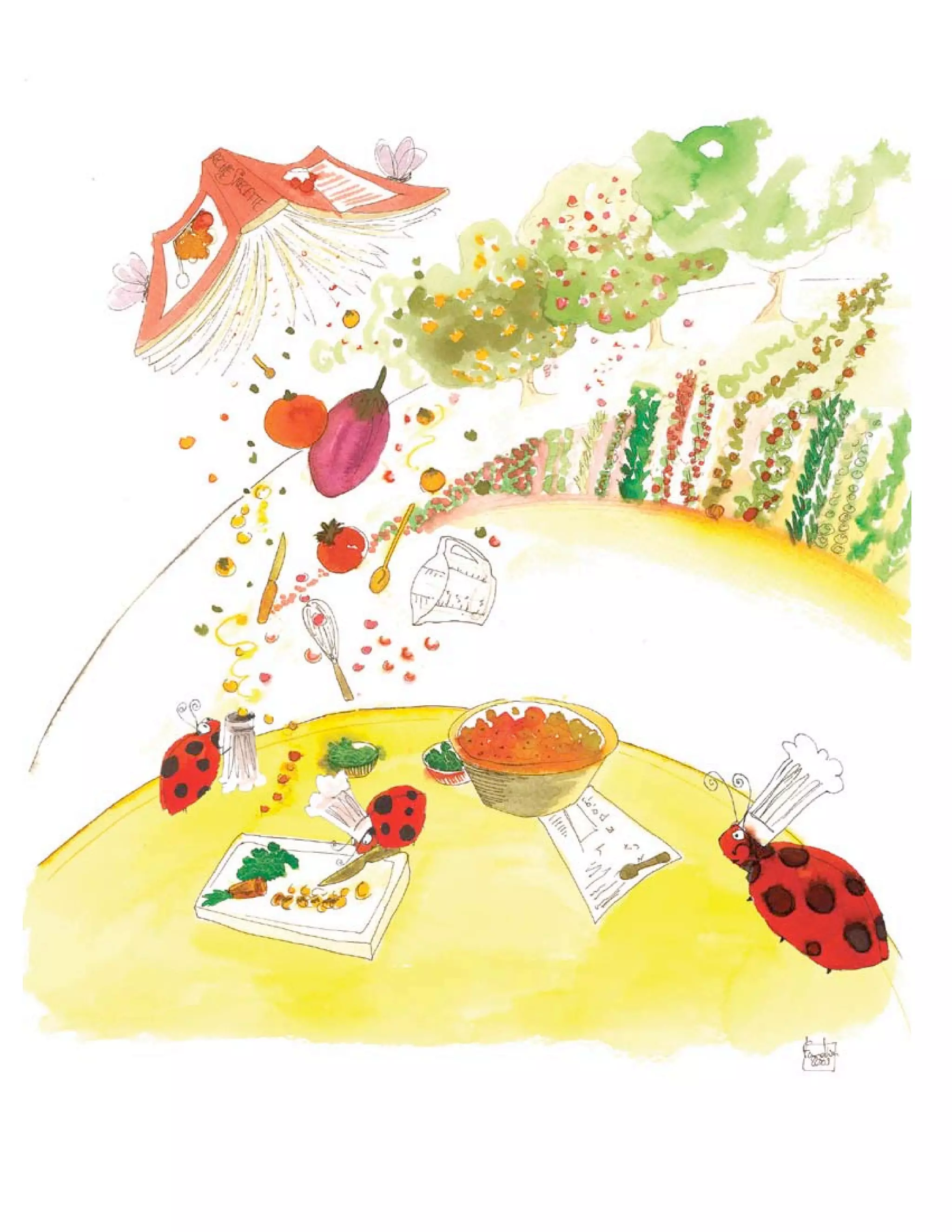
                                                   A ladybug will follow us through the three following
                                                   three Activities and Creative Project. People like lady-
                                                   bugs, the little creature that often makes a home in our
                                                   gardens. Ladybugs like the diversity of pollen and nectar-
                                                   filled plants in the garden. They also eat aphids, which
                                                   attack plants. Ladybugs spend the winter underneath
                                                   dead leaves or rocks. Over 5000 species of yellow, red
                                                   or orange ladybugs exist around the world. In North
                                                   America, there are 450 different ladybug species!


Activity 1: History of Maria

Summary of activity
The class reads a story about a child in Mexico and her family’s food traditions. The students share one of their
favorite meals with the rest of the class and begin creating the class recipe book.

Objectives
     • Introduce students to urban agriculture
     • Develop students’ understanding that family food cultures are different around the world
     • Start to create a recipe book by sharing some of the food that students eat at home

                      Required materials
                           The Salsa Story (page 17)
                           Salsa Recipe (page 18)
                           Ingredients for salsa
                      Length of activity
                           Two hours, over two class days


                                                                              The Chef’s Recipes   15
Advance preparation
You will be asking the students to talk about a meal that they eat at home. The students probably eat very
different meals. This could be because of differences in income, which may prevent families from being able
to afford certain foods (including fresh fruits and vegetables), or differences in culture. It is important to
approach this activity with sensitivity such that the different meals are appreciated regardless of if they contain
fruits and vegetables that are grown in a garden.
Gather salsa ingredients (see “Salsa Recipe”) and prepare salsa in advance. If there is enough class time, the
salsa can be prepared with the students.

Steps
1    Begin by introducing the activity to the students. Explain that they                      WHAT CAN
     will be learning about food and food cultures, and over the next                            I DO?
     couple of classes they will be making a recipe book!
                                                                                  Cook with my parents, grandpar-
2    Next, tell the class that you will read a story about a child their age in   ents or other family members;
     Mexico and her favorite food, salsa. The salsa is made from mangoes.
     Mangoes grow on trees. They are juicy and sweet. Read “The Salsa             Learn about meals that are eaten
     Story”.                                                                      in cultures other than my own;

3    After reading the story, ask the students what they noticed about            Encourage my family to eat
     the story. Bring out the following points, and ask the following             together and with other people.
     questions:
4    Maria helps her parents in the garden. Have you seen a garden where
     fruits or vegetables are growing? Have you worked in a garden before?
     If so, what is your favorite activity to do in the garden?
5    Maria and her family go to their garden to get the fruit and vegetables
     that they eat. Where are other places that we get our fruits and veg-
     etables? If we get them from a grocery store, where did they come
     from before that?
6    When we think of where fruits and vegetables grow, we often think
     of a farm in the country. Yet, there are also a lot of places in the city
     where we can grow food. Have you seen many gardens where people
     are growing fruits and vegetables in the city? Where in the city have
     you seen them?
7    Tell the students that they are going to make, and/or eat some salsa
     similar to Maria’s salsa. At this time, it could be fun to prepare and
     eat salsa with tortilla chips with the class. If time or space is limited,
     the salsa may be prepared in advance.
8    Follow-up questions to ask the students:
9    What is your favorite meal?
10   Why is this your favorite meal?
11   Have you seen any of the ingredients in the recipe growing in a garden?
     If so, which ones? If not, why not? (Are the ingredients from far away
     places? Do you know where they are from?)
12   Write all of the examples of meals that the students mention on the
     board. Be sure to appreciate all of the meals, regardless if the ingredi-
     ents can be grown in a garden.


16   Roots Around the World Teaching Guide
13   Ask the class to nominate five meals to include in their class recipe
     book. Find the recipes for these meals in books or in the Internet.                Children between 5-8
14   Ask students to create an illustration for their favorite meal. The                years old are recom-
     drawing could show the ingredients of the recipe and/or the meal                   mended to eat five
     being eaten.                                                            servings of fruits and vegetables
15   Save the illustrations to assemble into a recipe book (along with the   everyday. Yet fruits and veg-
     art that will be created in Activities Two and Three)                   etables are not always the most
16   (Optional) Send a letter home with the students asking the parents if   appetizing food for kids. Growing
     they would like to contribute a recipe to the class recipe book.        fruits and vegetables themselves
                                                                             lets students develop a fun, edu-
                                                                             cational and interactive relation-
INFORMATION CAPSULE                                                          ship with the food they eat.
                                                                             Materials
The Salsa Story
Maria is a 7 year-old girl who lives in Mexico City,
the capital of Mexico. Maria is a curious and helpful
child. After school and on the weekends, she likes to
help her parents with everything they do. Maria likes
to garden with her father in the backyard. She helps
him water the plants a couple times a week, pull out
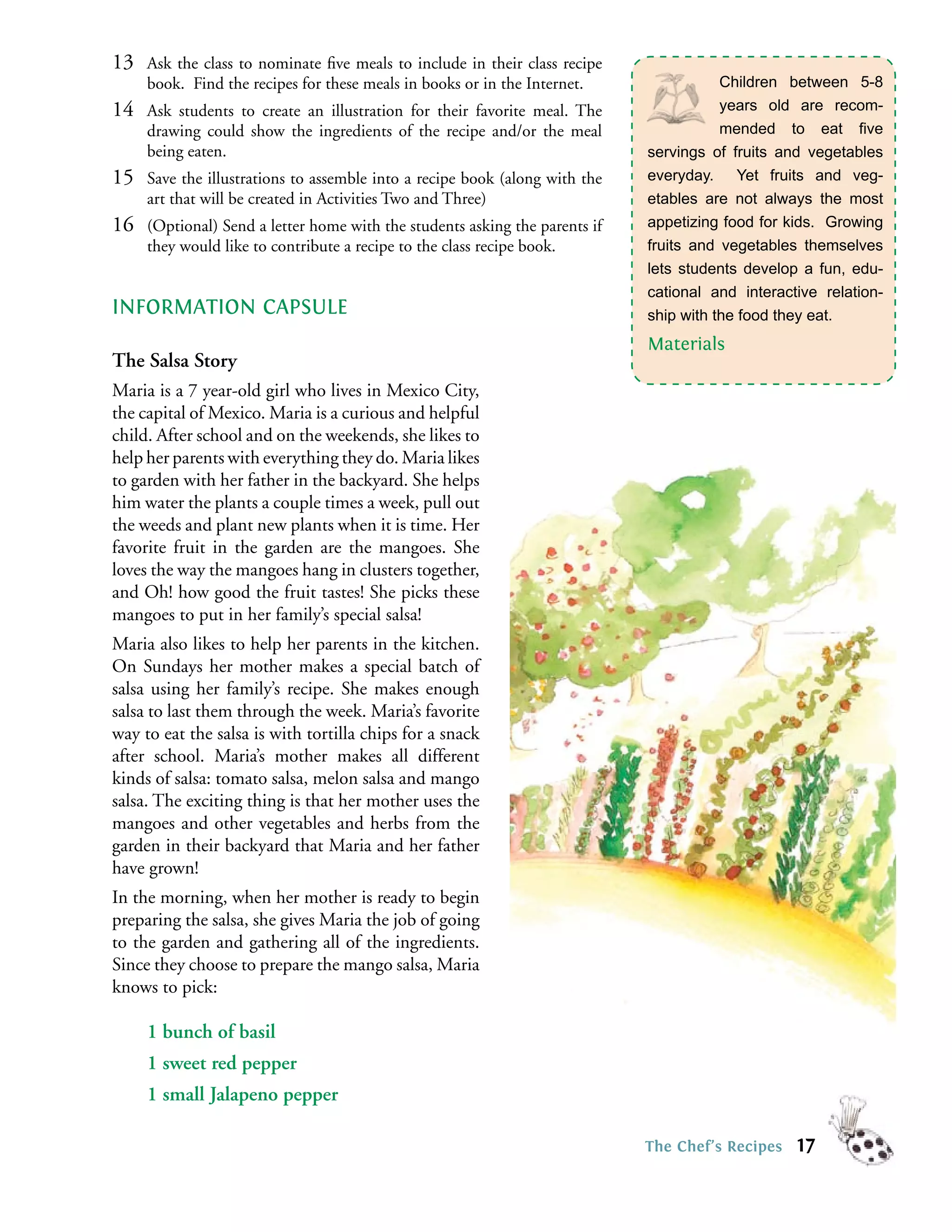
the weeds and plant new plants when it is time. Her
favorite fruit in the garden are the mangoes. She
loves the way the mangoes hang in clusters together,
and Oh! how good the fruit tastes! She picks these
mangoes to put in her family’s special salsa!
Maria also likes to help her parents in the kitchen.
On Sundays her mother makes a special batch of
salsa using her family’s recipe. She makes enough
salsa to last them through the week. Maria’s favorite
way to eat the salsa is with tortilla chips for a snack
after school. Maria’s mother makes all different
kinds of salsa: tomato salsa, melon salsa and mango
salsa. The exciting thing is that her mother uses the
mangoes and other vegetables and herbs from the
garden in their backyard that Maria and her father
have grown!
In the morning, when her mother is ready to begin
preparing the salsa, she gives Maria the job of going
to the garden and gathering all of the ingredients.
Since they choose to prepare the mango salsa, Maria
knows to pick:

     1 bunch of basil
     1 sweet red pepper
     1 small Jalapeno pepper

                                                                             The Chef’s Recipes   17
Maria climbs up on a ladder to pick a mango from the mango tree in her backyard. She can tell by the color
and the smell of the fruit which one is ready to be picked. She asks her father to pick a lime from the lime tree
that is beside the mango tree. The limes are high in the tree, and Maria isn’t tall enough to reach them, even on
the ladder. When Maria brings the ingredients into the kitchen for her mother, they begin preparing the salsa
together. Maria helps by washing the basil and the peppers. Then she begins pulling the leaves off the basil so
that her mother can chop them up. Maria’s mother cuts up the mangoes and red pepper into small chunks and
dices up the Jalapeno peppers so that the salsa will be nice and spicy! Maria adds:

       1/2 teaspoon of sugar

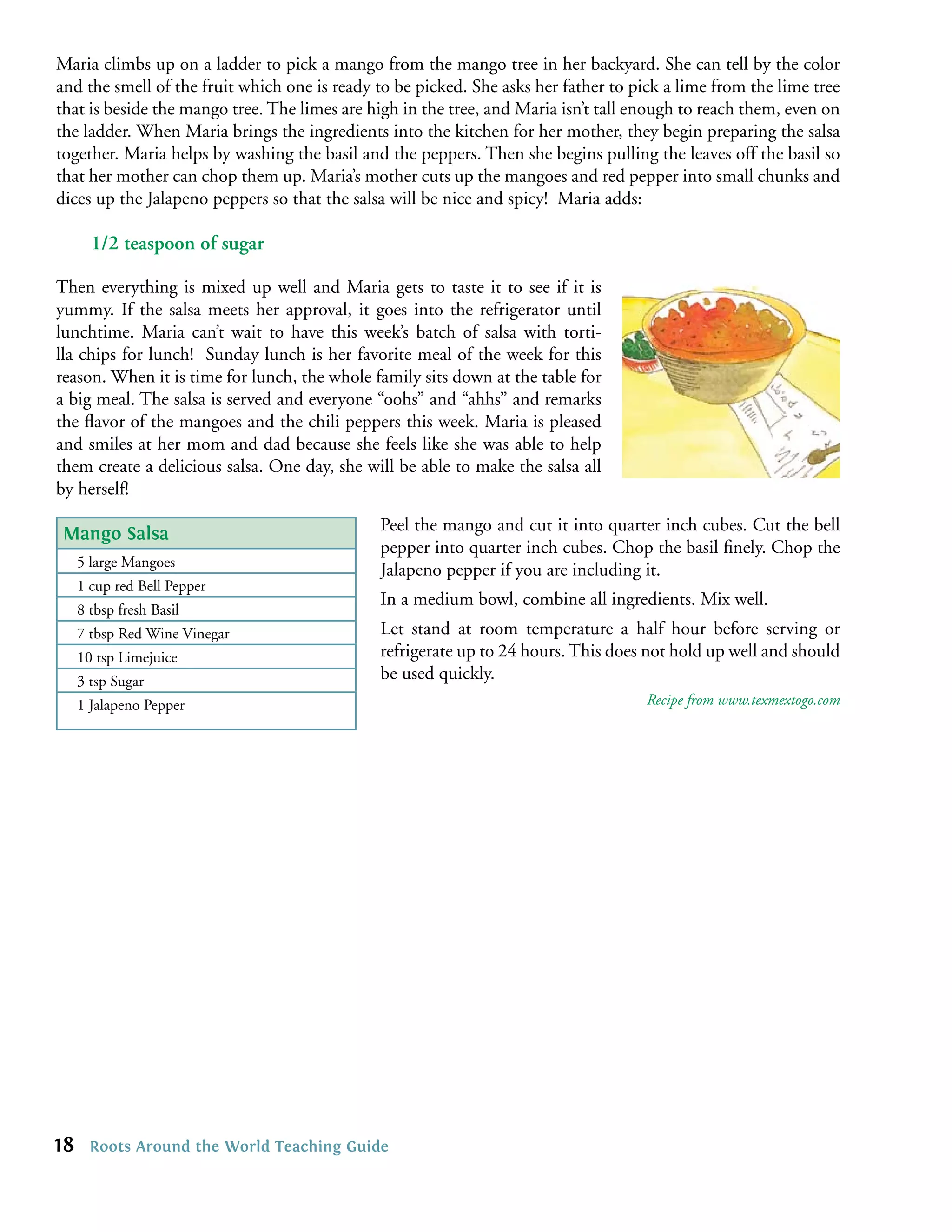
Then everything is mixed up well and Maria gets to taste it to see if it is
yummy. If the salsa meets her approval, it goes into the refrigerator until
lunchtime. Maria can’t wait to have this week’s batch of salsa with torti-
lla chips for lunch! Sunday lunch is her favorite meal of the week for this
reason. When it is time for lunch, the whole family sits down at the table for
a big meal. The salsa is served and everyone “oohs” and “ahhs” and remarks
the flavor of the mangoes and the chili peppers this week. Maria is pleased
and smiles at her mom and dad because she feels like she was able to help
them create a delicious salsa. One day, she will be able to make the salsa all
by herself!

 Mango Salsa                                  Peel the mango and cut it into quarter inch cubes. Cut the bell
                                              pepper into quarter inch cubes. Chop the basil finely. Chop the
     5 large Mangoes
                                              Jalapeno pepper if you are including it.
     1 cup red Bell Pepper
                                              In a medium bowl, combine all ingredients. Mix well.
     8 tbsp fresh Basil
     7 tbsp Red Wine Vinegar                  Let stand at room temperature a half hour before serving or
     10 tsp Limejuice                         refrigerate up to 24 hours. This does not hold up well and should
     3 tsp Sugar                              be used quickly.
     1 Jalapeno Pepper                                                               Recipe from www.texmextogo.com


18     Roots Around the World Teaching Guide
Activity 2: Growing Food in Our Own Backyards

Summary of activity
The class reads a story about a child in Mexico and her family’s food traditions. The students share one of their
favorite meals with the rest of the class and begin creating the class recipe book.

Objectives
     • Learn about fruits and vegetables that can be grown locally
     • Create recipes/meals using locally grown ingredients to add to the recipe book


                     Required materials
                                                                                        INFORMATION
                           List of local and imported fruits, for
                           teacher referral                                             CAPSULE
                           Photos of two cities around the                   The daily pleasures of gardening
                           world, one from a warm climate                    are simple, inexpensive and pro-
                           (e.g. Kampala, Uganda; Mexico
                                                                             foundly satisfying: eating a head
                           City, Mexico) and one from a cold
                           climate (e.g. Montreal, Canada).                  of lettuce that was cultivated with
                           Find these images from magazines                  care among friends, taking in
                           such as National Geographic, or on                the morning perfume of a flower
                           the Internet.
                                                                             clinging to the banister of a balcony,
                           Fruit and vegetable cards. Cut out
                                                                             biting into a strawberry warmed
                           15-20 images of fruits and vegetables
                           from magazines or grocery store flyers             by the sun. Urban agriculture is a
                           (or have students do this). Be sure               veritable way of life and enables
                           that this includes fruits and vegeta-             the population, collectively or indi-
                           bles from both lists (that which can
                                                                             vidually, to take pleasure in new,
                           be grown in Quebec and that which
                           cannot be grown in Quebec)                        green spaces that meet its needs
                           An image of a plane, cut out from a               for relaxation and leisure.
                           magazine or other source.
                     Length of activity
                           One hour


Advance preparation
Collect and cut out photos of fruits and vegetables and cities.


                                                                            The Chef’s Recipes      19
Steps
1    Ask the students if they have seen any places where food is grown in                     WHAT CAN
     their neighborhoods? Where? During what part of the year can food                          I DO?
     be grown in our city?
                                                                                Learn about how to cook with
2    Discuss what plants need in order to grow: soil, nutrients, water, air,    local foods with my parents;
     sun and space.
                                                                                Visit a farmers market to learn
3    Show students photos of two cities around the world. One from a            about the foods that can be
     warm climate and one from a cold climate. Discuss the differences          grown locally with my parents;
     that they see, specifically differences in the vegetation. Ask the class:
                                                                                Ask my parents if we can become
4    Why are there different types of plants that grow in a warm climate as     members of a Community Sup-
     opposed to a cold climate? Highlight the fact that we live in a colder     ported Agriculture farm;
     climate where we can only grow fruit and vegetables during the warm
                                                                                Learn about the foods that are
     parts of the year and that we cannot grow certain tropical fruits and
                                                                                grown and the meals eaten in a
     vegetables.
                                                                                country far away;
5    Divide the chalkboard or section of a wall into two sections:
                                                                                Celebrate unusual meals.
         1-Fruits and vegetables that can be grown in our city
         2-Fruits and vegetables that cannot be grown in our city
6    Go through the fruits and vegetables with the class, asking the students
     to place the fruits or vegetables into the corresponding category.                    INFORMATION
                                                                                           CAPSULE
Discussion                                                                      Many fruits and vegetables can be
                                                                                grown outdoors in Quebec from
Ask the students the following questions:
                                                                                May through October. In warmer
     How are fruits and vegetables from outside of Quebec trans-                climates (in countries that are to
     ported here? (Plane, train, truck, boat) Put the picture of a plane        the South of Quebec), there are
     between the images of food that can be grown in our city and
                                                                                longer and hotter growing seasons.
     the food that cannot be grown in our city.
                                                                                Fruits and vegetables that need a
     Why is this not good for the environment? (The planes, trains,             long time and a lot of heat can only
     trucks and boats use energy. When this energy is used, it causes           be grown in these areas.
     pollution in the air and water. Planes particularly use a lot of
     energy and so cause a lot of pollution. Pollution is not good              Fruits and vegetables that can
     for animals, people and the environment because, amongst                   be grown outdoors in Quebec
     other things, it makes the air harder to breathe and the water             (between May and October)
     unhealthy to drink).                                                       include: Apples, Asparagus, Beets,
     If the fruit did not come from Quebec, do you think that it                Blueberries, Broccoli, Cabbage,
     could have been grown here? (For example, oranges cannot                   Carrots, Cauliflower, Celery, Corn,
     grow in the Canadian climate, but tomatoes can.)                           Cucumber, Eggplant, Garlic, Leeks,
                                                                                Lettuce, Melons, Mushrooms, Onion,
                                                                                Parsnip, Peas, Peppers, Potatoes,
                                                                                Radishes, Raspberries, Spinach,
                                                                                Sprouts, Squash, Strawberries,
                                                                                Tomatoes, Zucchini.
                                                                                Fruits and vegetables that cannot be
                                                                                grown in Quebec include: Avocado,
                                                                                Cashews, Kiwi, Mango, Papaya,
                                                                                Pineapple, Oranges, and Bananas.


20   Roots Around the World Teaching Guide
Ask students to name their favorite foods. Point out the fruits and vegetables that are used to make these foods.
Vote on one favorite meal to include in the recipe book that contains as many local fruits and vegetables as
possible.
Ask the students what solutions they can think of so that less food is transported from far away. Discuss the
following options:
     Buying local food
     Buying food directly from farms
     Growing food in a garden


Follow-up
Make a large collage on the wall of a garden including fruits and vegetables that are growing locally and fruits
and vegetables that imported by plane or boat.


                                                                            The Chef’s Recipes    21
Activity 3: Around the World in a Fruit Salad

Summary of activity
The class makes and eats a fruit salad using fruit from around the world. Students learn that the foods we eat
connect us to the world.


Objectives
     • Create recipes/meals using locally grown ingredients
     • Inspire students to think about where their food comes from
     • Introduce students to world geography through the creation of a fruit salad


                     Required materials
                                                                                      INFORMATION
                          A variety of fresh fruit, includ-
                          ing some fruit that can be grown                            CAPSULE
                          in Québec (e.g. apples, blueberries,
                                                                           Urban agriculture initiatives have
                          raspberries, strawberries) and some
                          fruit that cannot be grown in Québec             been noted for the important role
                          (e.g. mangoes, bananas, oranges)                 that they play in people’s health
                          Cutting board                                    and wellbeing. The gardens
                          Knives to cut fruit – be sure that there         provide opportunities to learn
                          are some knives that are not too sharp           how to garden. They also engage
                          that the students can use                        people in discussions about food
                          Large mixing bowl                                and environmental issues and
                          Re-usable cups and spoons for stu-               provide inspiration to participate
                          dents to eat salad                               in the community. People who
                          Large world map placed on classroom              become involved in projects
                          wall
                                                                           like the Rooftop Garden Project
                          Paper
                                                                           mention how happy the garden
                          Markers, crayons or colored pencils              makes them, how it provides them
                          Scissors                                         with a place to relax, and get
                          Tape                                             physical exercise, and how it gives
                          List of fruits grown in Quebec                   them hope.
                     Length of activity
                          One hour


Advance preparation
Ask a few parents or other people in the community to act as class-assistants as this activity involves cutting
fruit.
Purchase enough pieces of fruit for groups of three students to have one piece each. Take note of the origin of
the fruit (which can usually be found on a sticker on the fruit, on a sign above the fruit or on the box).
Write the name of the country where each piece of fruit comes from on a piece of paper.


22   Roots Around the World Teaching Guide
Steps
1    Divide the class into groups of three students. Distribute one piece of                      WHAT CAN
     fruit and the accompanying piece of paper indicating the country it is                         I DO?
     from to every group.
                                                                                     Ask my parents if I can help them
2    Ask each group to draw a life-sized image of their fruit on paper. Ask          cook;
     the students to write the name inside the fruit and color and cut out
     the fruit.                                                                      Encourage my parents to have
                                                                                     potluck dinners where people
3    Ask each group to present their fruit to the class and say where it was         each contribute a meal and learn
     grown. As a class, with help from the teacher and the class-assistants,         about different foods;
     locate the country on the world map and ask students to tape the
     piece of fruit to its country of origin for everyone to see.                    Encourage my parents to buy
                                                                                     local food.
4    After each group presents their fruit, ask the class the following questions:
         How many fruits came from Quebec?
         How many fruits came from outside of Quebec?
5    In the summer, we can grow all of the ingredients that we need for
     this salad in our own gardens. In the winter, these fruits and veg-
     etables are shipped to Quebec from hotter countries where the fruit
     and vegetables can be grown all year round. Do you know the names
     of some of the countries that can grow fruit and vegetables all year
     round? (e.g. states in the United States: California, Florida; countries
     in Latin America: Chili, Mexico, Argentina, Brazil, and Colombia;
     South Africa and South East Asia, Japan, and China).
6    After each group presents their fruit, ask them to peel their fruit. Ask
     the class assistants to help the students cut their fruit and add it to the
     large bowl.
7    Present the idea that they will be eating the world in a fruit salad and
     that our food comes from all over the world.
8    Serve the salad to the students.
9    Eat and enjoy!
10   After eating the salad ask the students what kind of fruit salad we
     could eat with fruits grown in Quebec.
11   After the class, assemble the fruit that students have drawn. These
     drawings can be included in the recipe book (see Creative Project:
     Making A Class Recipe Book, page 25).

Discussion Points
Since the winters get so cold in Quebec, we are not able to grow
vegetables year round. It is helpful for people living in Quebec to get
fruits and vegetables from other countries because it means that we
can eat fresh fruit and vegetables in the winter.
Sometimes fruits and vegetables from countries with warmer climates
are sent to Quebec, instead of feeding people living in the countries
where the food came from. Often there are people living in these
countries who are going hungry. Ideally, everyone around the world
would have enough food. It would be good to find ways to make that
happen. This does not mean not eating any food that has come from

                                                                                     The Chef’s Recipes   23
far away, but it does mean thinking about the food that
we are eating and seeing if there are ways to eat food that
comes from nearby instead.
    There are different ways to make sure that people
around the world have enough food. These include:
     Supporting local and international organiza-
     tions working on food security and food sov-
     ereignty (see Resource section)
     Contributing to food banks and helping out
     at soup kitchens
     Growing fruits and vegetables in our own
     gardens and making sure that people around
     the world can do the same


24   Roots Around the World Teaching Guide
Creative Project: Making A Class Recipe Book

Photocopy and assemble the materials produced in the three previous activities into a class recipe book. These
materials include:
    The Favorite Class Recipes (Activity One)
    The List of Fruits and Vegetables that come from Quebec and the List of Favorite Class Recipes
    that can be made with these fruits and vegetables (Activity Two)
    The World Map indicating the origins of different fruits and vegetables (Activity Three)
    The Fruit Salad Recipe (Activity Three)
    Student drawings of food, gardens and people preparing and eating meals.
With parental approval, use the recipe book as a fundraiser. See www.fundraiserhelp.com/school-fundraisers.
htm for fundraising suggestions.
Raise money to create a class garden, with proceeds going to purchase all necessary supplies.
Raise money to donate to a community organization that is working on issues of food sovereignty, locally or
internationally, of the classes choosing. (See the Resources section for a list of organizations working on food
sovereignty and other food related issues.)
Or, display the recipe book at the Community Feast (page 35)


                                                                           The Chef’s Recipes    25
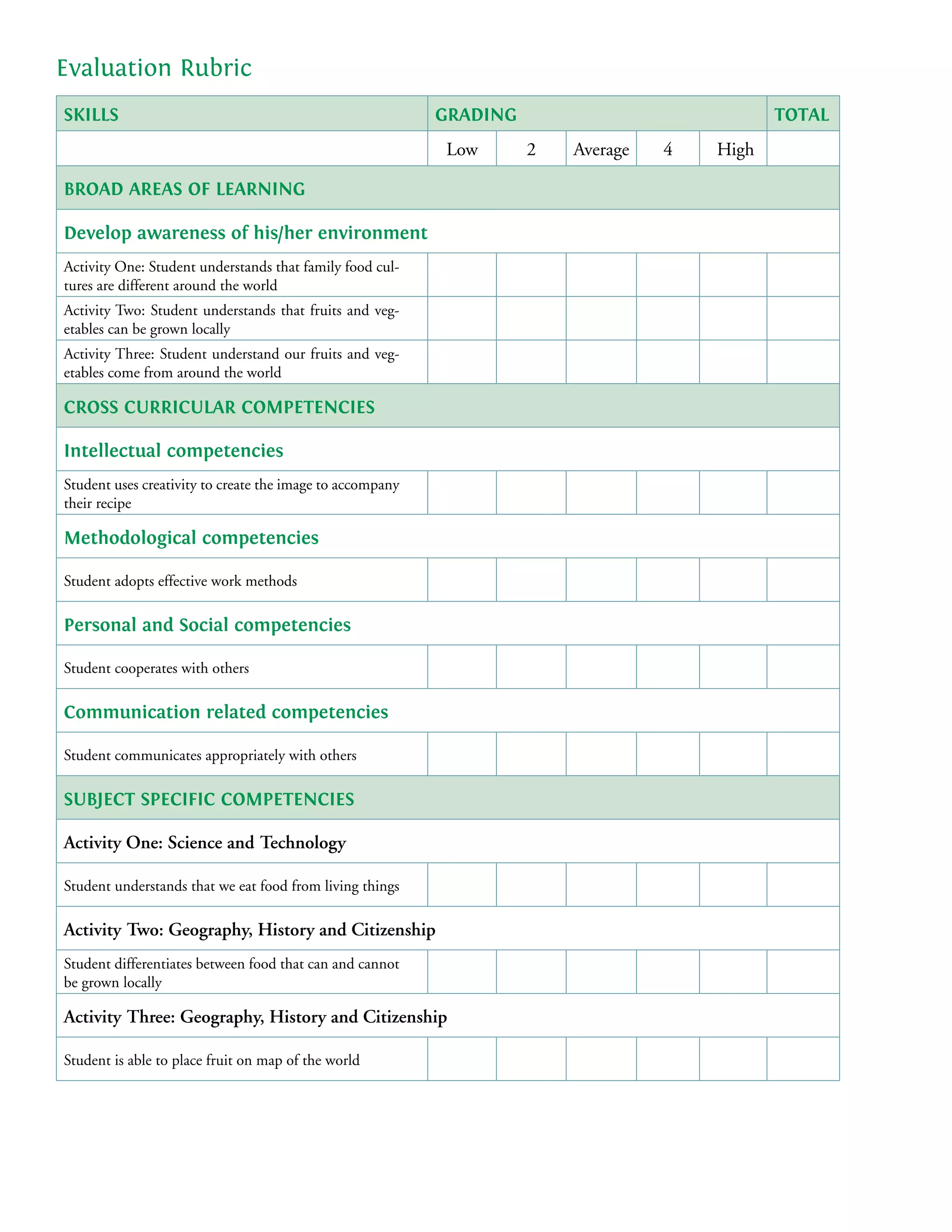
Evaluation Rubric
SKILLS                                                     GRADING                            TOTAL
                                                           Low       2   Average   4   High

BROAD AREAS OF LEARNING

Develop awareness of his/her environment
Activity One: Student understands that family food cul-
tures are different around the world
Activity Two: Student understands that fruits and veg-
etables can be grown locally
Activity Three: Student understand our fruits and veg-
etables come from around the world

CROSS CURRICULAR COMPETENCIES

Intellectual competencies
Student uses creativity to create the image to accompany
their recipe

Methodological competencies

Student adopts effective work methods

Personal and Social competencies

Student cooperates with others

Communication related competencies

Student communicates appropriately with others

SUBJECT SPECIFIC COMPETENCIES

Activity One: Science and Technology

Student understands that we eat food from living things

Activity Two: Geography, History and Citizenship
Student differentiates between food that can and cannot
be grown locally

Activity Three: Geography, History and Citizenship

Student is able to place fruit on map of the world
The Chef’s Recipes   27
28   Roots Around the World Teaching Guide
THE COMMUNITY FEAST
                                         The three following activities are geared toward students in
                                         Cycle Three.
                                         A honeybee will follow us through the following three Activities
                                         and Creative Project. The bee is especially appreciated for its
                                         honey. This insect visits 50-100 flowers in one trip; yet one
                                         bee will only produce an average of one twelve of a teaspoon
                                         of honey throughout its lifetime. As a pollinator, the bee plays
                                         the most important role in nature; the distribution of pollen
                                         from flowering plants. This work is essential for agriculture,
                                         farmer’s fields, gardens, orchards, etc. Bees are indispensable to
                                         our food harvest. There are 500 species of bees. Yet, presently,
                                         many bee colonies are disappearing. This death of millions of
                                         bees is mysterious. Pollution is very likely one of the causes.

Activity 1: A Food Tour
Summary of activity
The class takes a walking tour of the school neighborhood. They visit different places where fruits and vegetables are
grown (gardens, backyards), purchased (large supermarkets, corner stores, fruit stores, markets, local farms), consumed
(restaurants, fast-food places, cafés, homes), and distributed (food banks, soup kitchens, community kitchens).

Objectives
     • Introduce students to the different places where people get food in the city
     • Provide an opportunity for students to get to know the neighborhood around the school

                       Required materials
                            A map of the walking route for each
                            student
                            Pencils for each student
                            A large piece of paper
                            Cardboard, glue, markers etc.
                       Length of activity
                            Two hours

                                                                           The Community Feast        29
Advance preparation
Before touring the neighborhood with the class, do so alone to determine places where fruits and vegetables
can be grown (gardens, backyards), sold (large supermarkets, corner stores, fruit stores, markets), consumed
(restaurants, fast-food places, cafés) and distributed (food banks, soup kitchens, community kitchens). Plan
the route that the class will take on the walking tour. Draw a map of the route that will be taken and mark a
few landmarks on the map. Photocopy the map for each student.

Steps
1    Tell the class that they will be going on a walking tour of the school                WHAT CAN
     neighborhood to find the places where fruits and vegetables are grown,
     sold, consumed and distributed in the area.
                                                                                             I DO?
                                                                              Look around my neighborhood
2    Ask the students to name possible places where fruits and vegetables
                                                                              to find gardens in people’s
     can be grown, sold, consumed and distributed.
                                                                              backyards;
3    Give each student the map of the route, and instruct the class to mark
                                                                              Ask my parents to shop at local
     the places that they notice while walking on the map.
                                                                              farmers markets when it is
4    Go for the walk, and ask students to point out places where fruits and   possible;
     vegetables can be grown, sold, consumed and distributed.
                                                                              Ask my parents if there is a com-
5    When the class returns, ask students what they noticed from the walk     munity garden in our neighbor-
     and the maps that they drew.                                             hood and if we could visit it (or
6    Ask the students the following questions:                                even have our own plot!)
     What are some places that we saw on our walk where food is
     consumed? What did you learn about some of these places? If you
     didn’t have money, would you be able to get the food that is sold at
     these places?
     What are some places that we saw on our walk where food is sold?
     What were the differences between these places? If you didn’t have
     money, would you be able to get the food that is sold at these
     places?
     What are some places that we saw on our walk where food is
     grown? What did you learn about these places? If you didn’t have
     money, how would having a garden be helpful?
     What are some places that we saw on our walk where food is
     distributed? What did you learn about these places? How do these
     places help people who do not have very much money?


Discussion Points
Inform the students that even though there are a lot of places where
food is consumed, sold, grown and distributed, there are still many
people who are going hungry.
     Talk about the importance of ensuring that people have access
to food, regardless of their income. Explain that there are different
options available to people who do not have money to buy food.
Some of these are food banks, soup kitchens and community kitch-
ens. These initiatives are important. Yet, ideally people would be able
to choose the food that they eat.

30   Roots Around the World Teaching Guide
INFORMATION
                                                                                         CAPSULE
                                                                              Community Supported Agriculture
                                                                              (CSA) farms are partnerships
                                                                              between local organic farms
                                                                              and consumers.          Consumers
                                                                              or “farm members” purchase a
                                                                              season’s worth of vegetables in
                                                                              the spring and receive a weekly
                                                                              organic vegetable basket deliv-
                                                                              ered to their neighborhood. Farm
                                                                              members agree to take the risk
                                                                              of the season – as farmers do
                                                                              every year. In abundant years
One way to ensure that people have choice about the food that they            farm members receive more than
eat is to make sure there are gardens in the city where people can grow       they were expecting, and in overly
their own food. Talk about the different ways that our city could benefit      dry or cold, wet or hot years, farm
from having more gardens:                                                     members receive less. The farmer
    More green space                                                          benefits from a steady income at
                                                                              the beginning of the season when
    Less air pollution (plants take in carbon dioxide)
                                                                              most of the purchases on the farm
     Local food (means less pollution because of reduced                      must be made. Farm members
transportation)                                                               receive a diverse range of fresh
    A community gathering place                                               organic vegetables, developing a
    More fresh fruits and vegetables for people living in the city            relationship with their farmer and
                                                                              supporting a local step towards
Discuss the fact that people need to have enough time to put towards          sustainability. See www.equiterre.
the garden and that people who work a lot do not always have time to          org for more information.
put towards gardening. This sometimes makes it difficult for people
who most need more food (but who work a lot) to put time towards
the garden.
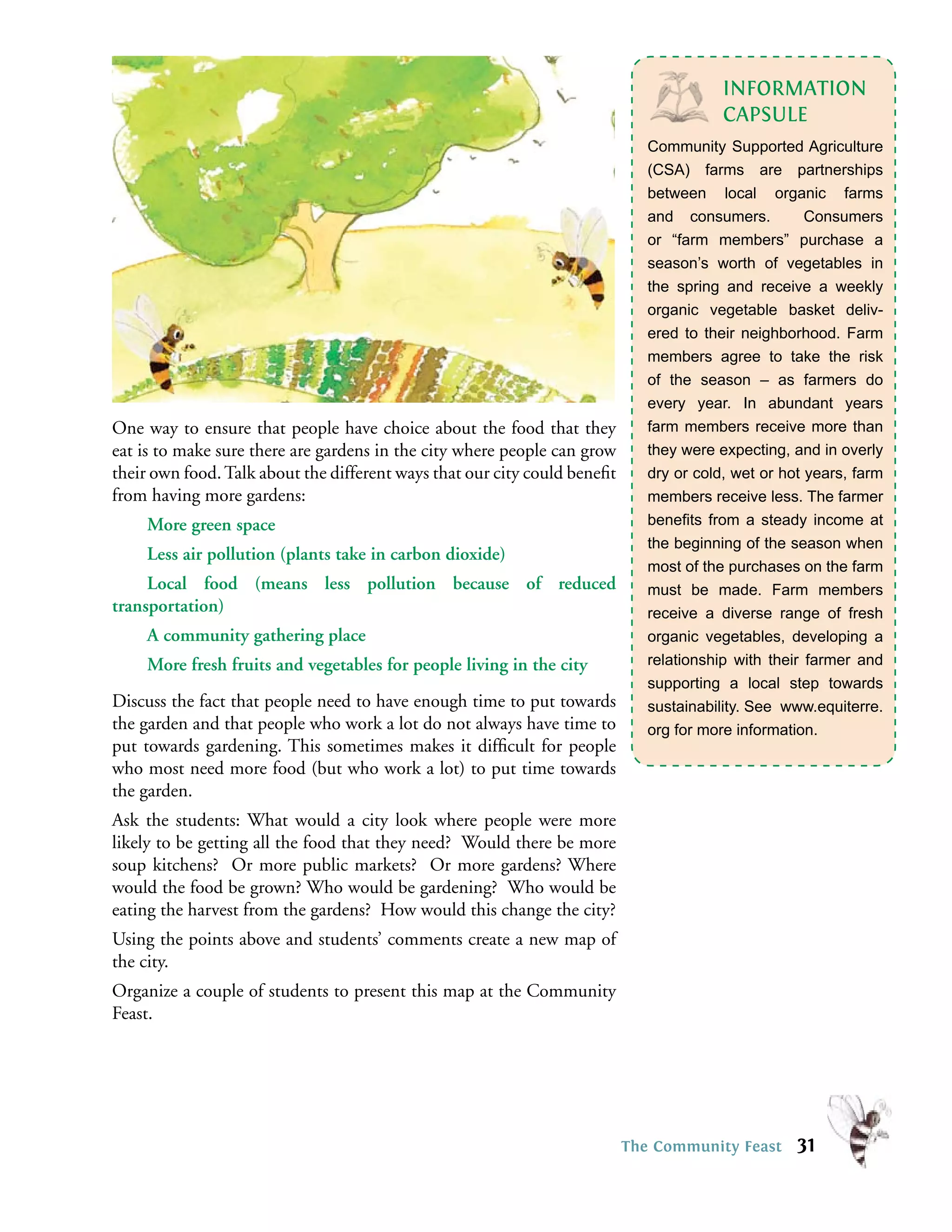
Ask the students: What would a city look where people were more
likely to be getting all the food that they need? Would there be more
soup kitchens? Or more public markets? Or more gardens? Where
would the food be grown? Who would be gardening? Who would be
eating the harvest from the gardens? How would this change the city?
Using the points above and students’ comments create a new map of
the city.
Organize a couple of students to present this map at the Community
Feast.


                                                                           The Community Feast      31
Activity 2: Growing Food in Cities around the World

Summary of activity
Students learn about examples of urban agriculture around the world in order to organize a Community
Feast.

Objectives
     • Introduce students to international examples of urban agriculture
     • Offer students an opportunity to share the information that they have learned at a Community Feast

                       Required materials
                                                                                           INFORMATION
                             “Urban Agriculture around the
                             World” information sheets (page 69)                           CAPSULE
                       Length of activity                                       Urban agriculture is destined
                             It is recommended that this activity               to play an ever greater role in
                             be carried out over one week, or five               feeding city dwellers. It currently
                             class days: one or two class periods               feeds 700 million people, a fourth
                             in the library/computer lab, two or                of the world’s urban population. It
                             three class periods for students to
                             prepare for the Community Feast and                provides an answer to food inse-
                             one class period for the Community                 curity and an avenue for cultural
                             Feast.                                             expression and citizen involve-
                                                                                ment. It also enables people to get
Steps                                                                           a taste of the pure enchantment of
                                                                                growing food for themselves and
1    Divide the class into groups of four students. Give each group a differ-
     ent Urban Agriculture around the World information sheet.                  for the community. In this time of
                                                                                climatic changes and the multiple,
2    Ask the groups to read their information sheets.
                                                                                harmful consequences of urban
3    Take students to the library or the computer lab to research the city
                                                                                living on health and the environ-
     on their information sheet.
                                                                                ment, we need to rethink the way
4    Return to the classroom. Ask each group to prepare a presentation
                                                                                we live. In light of this, urban gar-
     to the class to explain the information on their Urban Agriculture
     Around the World sheets and to share the information that they             dening is a powerful agent for
     found about the city.                                                      change.
5    Organize a Community Feast where each group presents the informa-
     tion that they have gathered and the class gets a chance to be trans-
     ported to urban agriculture initiatives in cities around the world. Tell                 WHAT CAN
     students that this is practice for the Community Feast. Parents, other
     students and other teachers as well as other community members will
                                                                                                I DO?
     be invited to this feast.                                                  Ask my teacher to organize a
                                                                                class trip to a local farm or a
6    Ask students which examples of urban agriculture they learned about
                                                                                community garden;
     could be applied in our city.
                                                                                Encourage my parents to visit
                                                                                farms if we are taking a trip
                                                                                outside of the city.


32   Roots Around the World Teaching Guide
Activity 3: Seeds Without Borders

Summary of activity
Students learn that populations have always carried seeds with them when they migrate. The effect is that

today we have gardens that are rich and diversified. They discover Native American food heritage and bring it
to bear fruit with sunflower seedlings.


Goals
    • Realize that a large part of our diet comes from seeds.
    • Discover the food heritage of Native Americans and other cultures in our daily diet.
    • Introduce students to raising seeds.


                      Required materials
                            A bag of sunflower seeds
                            A seed flat
                            Potting soil
                            Dark space (closet)
                      Length of activity
                            Two hours


Advance preparation
     • Ask students to bring in seeds from their pantry, to identify
                                                                                                WHAT CAN
the plant that produces them and its origin. Ask them to find an                                   I DO?
image or a drawing of the plant.                                                   In organic seed catalogues,
     • Buy a bag of bulk sunflower sees (with the husk, unsalted) to                chose plants that you are going
plant seedlings.                                                                   to plant in your garden or on your
     • Before the activity, soak the seeds for 24 hours in water.                  balcony.
                                                                                   Visit the Botanical Garden to
Steps                                                                              discover plants from other places
1   Ask students which seeds they chose.                                           and how they are used in other
2   Ask students what forms the seeds are used in foods (cereals, popcorn,         cultures (e.g., Chinese garden,
    sunflower seeds; raw, cooked, grilled, dried, popped). They can also            American Indian garden).
    be used to make oil when pressed, butter when crushed, flour when
    ground, seedlings when germinated, etc.).                                      With your parents, germinate
                                                                                   seeds at home.
3   Ask students what purpose the seed serves in the plant’s lifecycle.
4   Ask students if they know how seeds are transported from one region
    to another: by the plants themselves when they burst open, by travel-
    ing by wind, by clinging to animal fur (thistles), in animal feces (bears
    and blueberries), by drifting on water (coconuts).
5   Following this discussion, ask students if they haven’t forgotten an
    important factor for dispersal... human beings! For example, tomatoes
    come from Mexico, rice from China, apples from Asia, cacao from
    Mexico and wheat from the Middle East.

                                                                                The Community Feast      33
6    Explain to students that the European explorers that “discovered”
     America, like Jacques Cartier, were looking for highly valued plants:                INFORMATION
     spices, sugar. When they crossed the ocean, they expected to find
     India, and that is why they called the indigenous people of America                  CAPSULE
     Indians.                                                                  If seeds from many other places
7    Ask students if they know vegetables that were used by American           can be found in our gardens, plants
     Indians and discovered by Europeans when they came here (squash,          from Canada have also enchanted
     maple water, beans, corn, Jerusalem artichokes, etc.)                     people from the entire world. This is
8    Without the American Indians, there would be no maple syrup, jack-        true of the sunflower, a plant native
     o-lanterns or popcorn!                                                    to North America that explorers dis-
9    Point out to students that with cultural mixing, the landscape was        covered during their long voyages
     enriched by new plants and eating habits diversified. Urban gardens        and that they brought back to
     have no borders. Seeds from around the world can be planted in            Europe and Asia. For more than
     them.
                                                                               3,000 years, Native American grew
10   1Ask students to display their drawings or images of their plants at      this plant to feed and heal them-
     the board and to present the country plants come from (situate the        selves. The sunflower is a large
     countries on a world map).
                                                                               annual plant from the composite
                                                                               family. The same family as the
Taking it a Step Further                                                       daisy! Its Latin name is Helianthus
1    Tell students that they are going to sow a field of sunflowers in the       annuus. Like all the other plants in
     closet;                                                                   this family, the sunflower’s bloom
2    Put soil in the seed tray (about 4 cm deep);                              is, in fact, made up of a multitude
                                                                               of small flowers that have been
3    Place seeds on the soil and add 6 mm of soil on the surface;
                                                                               grouped together. All the flowers in
4    Moisten with a spray bottle;
                                                                               its center are produced by seeds.
5    Put the seeds in the dark for a few days until the seedlings have grown   The growth of the sunflower is
     to 10 cm;
                                                                               somewhat special as its stems
6    Check soil moisture regularly (2 times a day);                            have developed the ability to turn
7    When the seedlings have reached the desired size (10 cm), put them in     towards light. This phenomenon is
     sun light for a few days, the time it takes for them to turn green;       called “phototropism”. When the
8    Cut the sprouts with a scissors and taste them!                           sunflower is young, it grows very
9    Repeat the experiment with other seeds (wheat, corn, barley).             quickly. As it grows, it turns toward
                                                                               the sun. This can be explained by
                                                                               the fact that its stem grows more
                                                                               quickly on the side that is facing
                                                                               away from the sun.


34   Roots Around the World Teaching Guide
Creative Project: Organizing a Community Feast

This project pulls together the learning and activities from the previous three activities to create a Community
Feast.

Create a meal.
Make a meal (e.g. a salad) as a class using vegetables that are the same as the seeds that the class is growing (if
they have started seeds), a meal inspired by the urban agriculture initiatives that the class has learned about, or
ask parents to bring in a meal that they enjoy.
If another class in the school is doing the activities in Cycle One, they could provide some food (e.g. fruit
salad) for the Community Feast (they could also display their recipe books).
Invite people from the community.
Distribute invitations in the neighborhood. Invite parents, teachers, other students, school administra-
tors and other community members (including the people who worked at the places you stopped at in the
community).

Present urban agriculture initiatives around the world. (Activity One)
Display the pamphlets or posters created by the students in the classroom. Ask students to present their posters
as people walk around the room.

Present the map of a city where people are getting the food that they need. (Activity Two)
Ask five students to prepare a presentation of the city, including explanations of their reasons for how they
designed the city.

Display the students’ drawings or images (Activity Three)
Ask the students to show their drawing of the plant they found in their food pantry. If they planted sunflower
seeds in class, share them during the meal, and ask them to tell what they learned about this seed’s story.


                                                                          The Community Feast       35
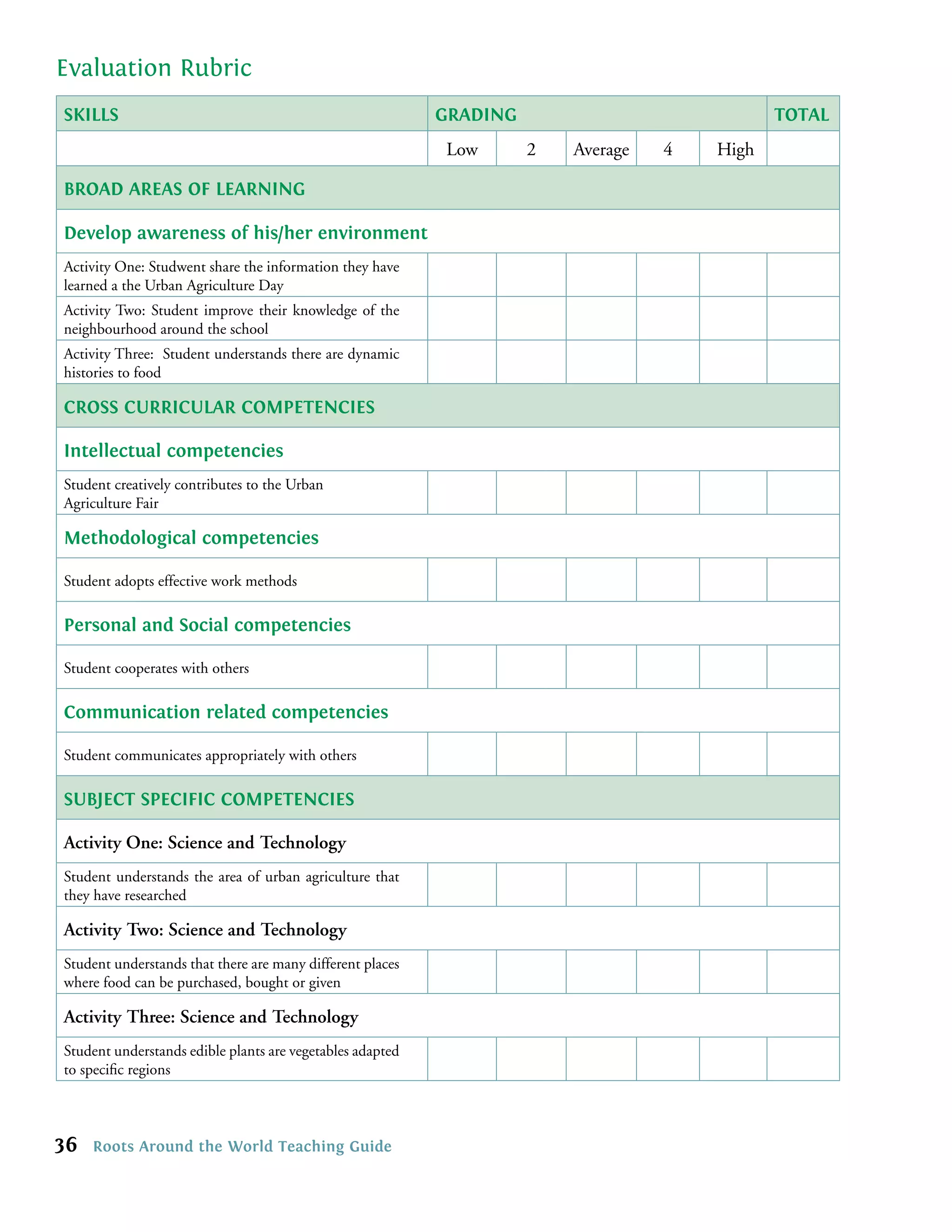
Evaluation Rubric
SKILLS                                                     GRADING                            TOTAL
                                                           Low       2   Average   4   High

BROAD AREAS OF LEARNING

Develop awareness of his/her environment
Activity One: Studwent share the information they have
learned a the Urban Agriculture Day
Activity Two: Student improve their knowledge of the
neighbourhood around the school
Activity Three: Student understands there are dynamic
histories to food

CROSS CURRICULAR COMPETENCIES

Intellectual competencies
Student creatively contributes to the Urban
Agriculture Fair

Methodological competencies

Student adopts effective work methods

Personal and Social competencies

Student cooperates with others

Communication related competencies

Student communicates appropriately with others

SUBJECT SPECIFIC COMPETENCIES

Activity One: Science and Technology
Student understands the area of urban agriculture that
they have researched

Activity Two: Science and Technology
Student understands that there are many different places
where food can be purchased, bought or given

Activity Three: Science and Technology
Student understands edible plants are vegetables adapted
to specific regions


36   Roots Around the World Teaching Guide
The Community Feast   37
THE TRANSFORMATION OF WASTE
TO COMPOST

                                    The three following activities are geared toward students in
                                    Cycle Three.
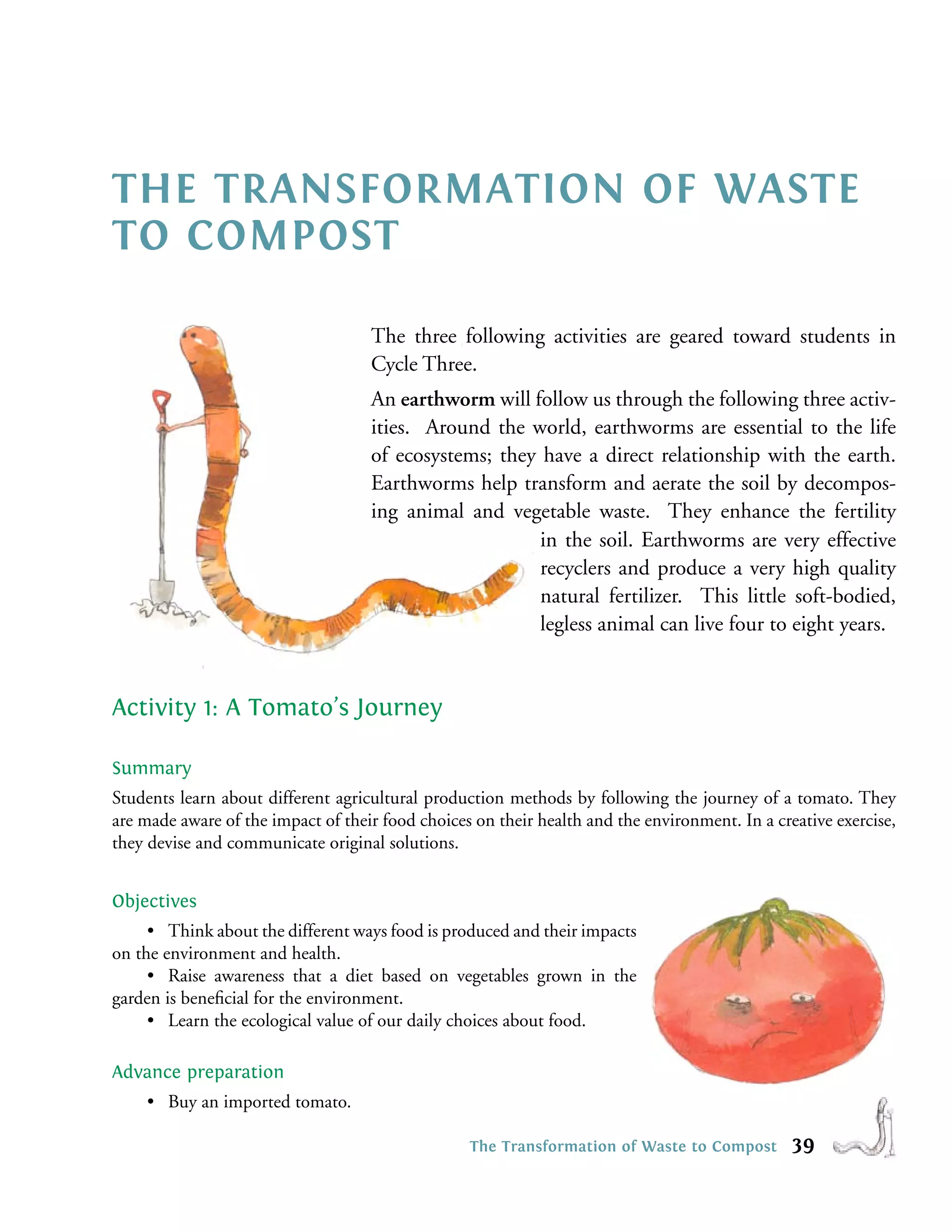
                                    An earthworm will follow us through the following three activ-
                                    ities. Around the world, earthworms are essential to the life
                                    of ecosystems; they have a direct relationship with the earth.
                                    Earthworms help transform and aerate the soil by decompos-
                                    ing animal and vegetable waste. They enhance the fertility
                                                        in the soil. Earthworms are very effective
                                                        recyclers and produce a very high quality
                                                        natural fertilizer. This little soft-bodied,
                                                        legless animal can live four to eight years.


Activity 1: A Tomato’s Journey

Summary
Students learn about different agricultural production methods by following the journey of a tomato. They
are made aware of the impact of their food choices on their health and the environment. In a creative exercise,
they devise and communicate original solutions.


Objectives
     • Think about the different ways food is produced and their impacts
on the environment and health.
     • Raise awareness that a diet based on vegetables grown in the
garden is beneficial for the environment.
     • Learn the ecological value of our daily choices about food.

Advance preparation
    • Buy an imported tomato.

                                                  The Transformation of Waste to Compost        39
Steps
1    Introduce your tomato. Explain that it was grown in x country
     and that it traveled over 3,500 km (exact distance to Mexico and
     California) before arriving in class. Ask them to locate the country or
     region on a world map.
2    Tell students that this tomato comes from a very large industrial farm
     where chemical fertilizers and pesticides are used.
3    Ask them if they know the environmental and health impacts of this
     type of agriculture. Write the answers in a column on the board.
     Discuss the points covered in the information capsule.
4    Next, ask them if they know alternatives to this kind of agriculture
     and the benefits that come from other methods of cultivating the
     land. Write their answers on the board. These points are covered in
     the information capsule.
5    Tell them that the character in the next story knows a lot about the
     advantages of urban agriculture. Read the City Tomato story to them,
     asking them to participate as indicated in the text.
6    Once you have read the story, ask the following questions:
     What differences are there between the tomato I brought in and
     City Tomato? Confirm or add points to the list already on the                           WHAT CAN
     board. What did you learn from this story?
                                                                                              I DO?
7    Ask the students the following question: How can you tell where
                                                                               Ask your grocery story to sell
     the food we buy comes from and how it was grown? At the grocery
     store: thanks to signs on the bins and to labels. At the public market:   food grown in a healthy and eco-
     by asking farmers. By producing your own food!                            logical way.
8    To move from thinking to action, ask students to imagine and design       Garden in the backyard or in a
     a labeling system where you could find the necessary information to        nearby garden with your family
     make good choices about food.
                                                                               Participate in the “Youth Gardens”
9    In some countries, for example, labels show the number of kilome-
                                                                               day camp at the Botanical
     ters traveled, GMOs, organic certification, the region of the country,
     etc. All these ideas are welcome! Thinking may be done as a class, and    Garden.
     creation in small groups.


The Story of City Tomato
We are in a community garden in our city. It is spring and gardeners are working the soil and preparing the
garden. They have fun working together outdoors in the sun in their neighborhood a few times a week. They
are very lucky. They have free time to work in the garden. (Student – gardeners act out the situation.)
They plant a seed, water it every week and give it compost as food; and it grows into City Tomato. (One or
some student-tomato(es) act out the situation.)
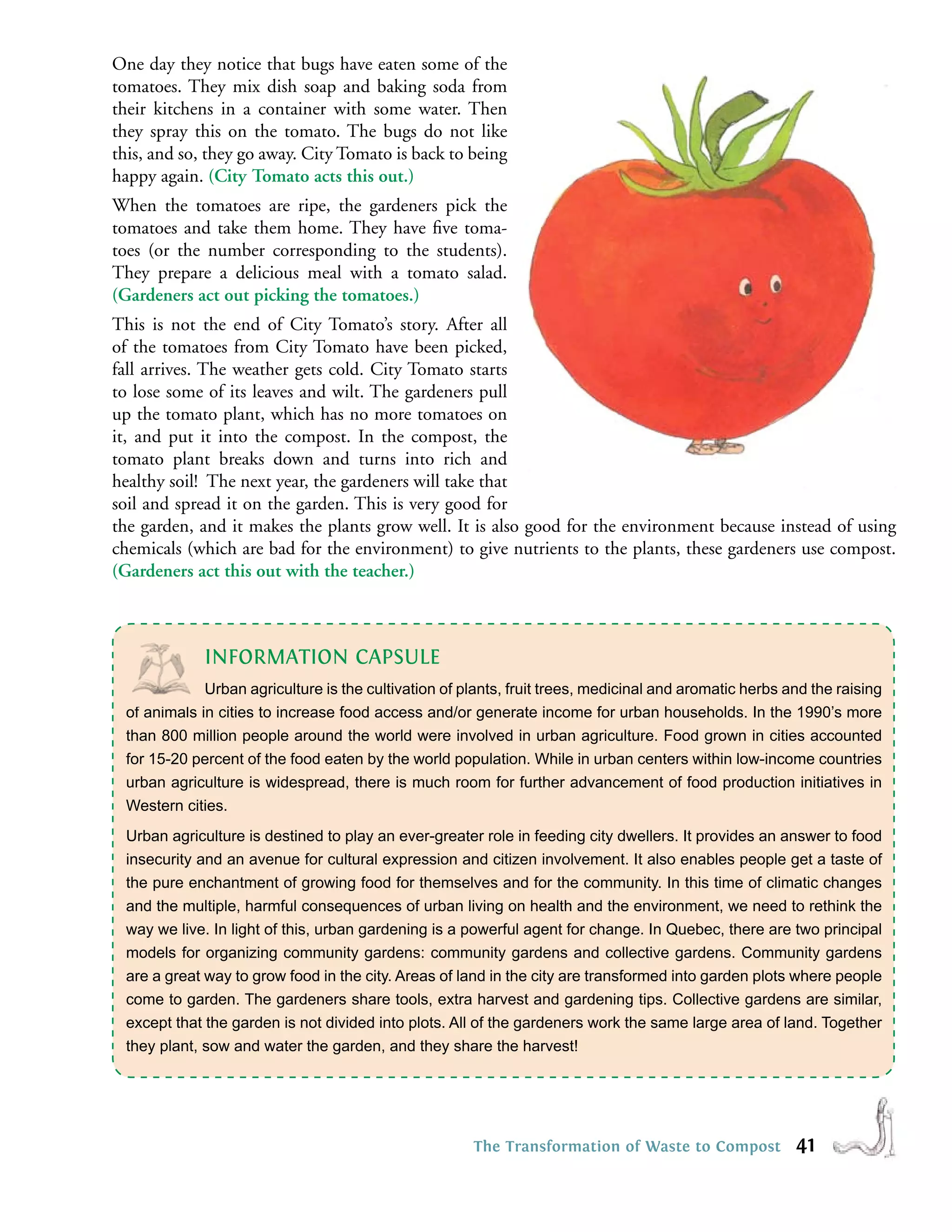
City Tomato is a happy plant. It has all the sun, water and food it needs to grow healthy and strong. The gar-
deners don’t rush City Tomato. They give it enough time to grow big, red, juicy tomatoes. In fact they have a
lot of time to put towards the garden. Every plant is important to them. This means that the plants grow big
and strong. The gardeners spend most of their free time tending to the plants. When they ask their friend Jane
to join them in the garden, she says that she cannot. She has to work to make money for her family. The two
gardeners are sad. Not everyone has the time that they do to be able to work in a garden. (The gardeners act
out this situation.)

40   Roots Around the World Teaching Guide
One day they notice that bugs have eaten some of the
tomatoes. They mix dish soap and baking soda from
their kitchens in a container with some water. Then
they spray this on the tomato. The bugs do not like
this, and so, they go away. City Tomato is back to being
happy again. (City Tomato acts this out.)
When the tomatoes are ripe, the gardeners pick the
tomatoes and take them home. They have five toma-
toes (or the number corresponding to the students).
They prepare a delicious meal with a tomato salad.
(Gardeners act out picking the tomatoes.)
This is not the end of City Tomato’s story. After all
of the tomatoes from City Tomato have been picked,
fall arrives. The weather gets cold. City Tomato starts
to lose some of its leaves and wilt. The gardeners pull
up the tomato plant, which has no more tomatoes on
it, and put it into the compost. In the compost, the
tomato plant breaks down and turns into rich and
healthy soil! The next year, the gardeners will take that
soil and spread it on the garden. This is very good for
the garden, and it makes the plants grow well. It is also good for the environment because instead of using
chemicals (which are bad for the environment) to give nutrients to the plants, these gardeners use compost.
(Gardeners act this out with the teacher.)


             INFORMATION CAPSULE
             Urban agriculture is the cultivation of plants, fruit trees, medicinal and aromatic herbs and the raising
 o animals inf cities to increase food iaccess and/orogenerate income foraurban co / se ro ob the n hrm a a9 e se
 of a       i cinn t i oni t f m ao cre a             cce s n e i de n fd u on households. In t 1990’s more
                                                        ga              l   s         h    ss e I
                                                                                            r            1 r smu       n
 than 800 million people around the world were involved in urban agriculture. Food grown in cities accounted
 for 15-20 percent of the food eaten by the world population. While in urban centers within low-income countries
 urban agriculture is widespread, there is much room for further advancement of food production initiatives in
 Western cities.
 Urban agriculture is destined to play an ever-greater role in feeding city dwellers. It provides an answer to food
 insecurity and an avenue for cultural expression and citizen involvement. It also enables people get a taste of
 the pure enchantment of growing food for themselves and for the community. In this time of climatic changes
 and the multiple, harmful consequences of urban living on health and the environment, we need to rethink the
 way we live. In light of this, urban gardening is a powerful agent for change. In Quebec, there are two principal
 models for organizing community gardens: community gardens and collective gardens. Community gardens
 are a great way to grow food in the city. Areas of land in the city are transformed into garden plots where people
 come to garden. The gardeners share tools, extra harvest and gardening tips. Collective gardens are similar,
 except that the garden is not divided into plots. All of the gardeners work the same large area of land. Together
 they plant, sow and water the garden, and they share the harvest!


                                                     The Transformation of Waste to Compost          41
Follow-up
Using the thoughts students shared during the activity, ask students to create an advertisement for growing
your own food.
The exercise can take the form of a written advertisement that will be displayed on the a message board or a
TV ad acted out with an original script.


             INFORMATION CAPSULE
             With the development of large exporting farms, industrial agriculture practices intensified and with
 t
 them, h harmful impacts on the environment, health and thef livingct
        t
        the h h      ie a e o t m e r h n p nh e , a tvi l h nu vi r e of many people.nh eg d mh o
                           m                  m            a    e      i conditions o l m s pn t fn The subject is n
                                                                         co a        d o l              T sua       i  s   i   e bpe
                                                                                                                               t y
 vast and complex, but here are some points that can be raised in class. Chemical fertilizers spread over soils
 in large quantities contaminate waterways and the living creatures that make their homes there. Repetitive
 application of fertilizers exhausts soil and makes it less productive. In some countries, this farming practice
 contributes to desertification. Single-crop farming practiced on factory farms requires the use of numerous pes-
 ticides. Herbicides, insecticides and fungicides are all poisons designed to kill certain life forms (weeds, insects,
 funguses). Yet, these products also have an impact in the short and long terms on human health. The role they
 play in causing cancers, poisoning and certain chronic diseases is now recognized. Beyond the agricultural
 impact of applying chemicals, their fabrication is also something to think about. As products made from petro-
 leum, they help generate greenhouse gases. The factories where these products are produced are highly toxic,
 veritable biological bombs. Most of them are located in countries in the South where labor is cheap and safety
 is hard to control. Other, more ecological and responsible ways of farming to produce food exist.
 Four basic principles exist to guide our thinking on this issue: Bare, Close, Natural and Fair. These basic rules
 can help us realize that it is possible to cultivate the land and to distribute food without packaging (Bare), with
 less transportation (Close), without chemical products (Natural) and that are fair for everyone (Fair), in the North
 and in the South.
 There are many advantages to using these principles: human health, reducing water and air pollution, raising
 animals, soil conservation, healthy and pleasant living environment for workers and farmers, job creation, pro-
 tection of rural landscapes. Several factors of these solutions are presented to us when it is time to choose:
 promotion of organic agriculture, favoring of diversified farming methods, cultivating of our own fruits and veg-
 etables, eating seasonal products, canning food, buying in bulk, buying local food at the market or directly from
 a family farmer. Many other factors can help us rethink farming and diet.


42   Roots Around the World Teaching Guide
Activity 2: Where Have the Melons Gone?

Summary of activity
Students learn about the food wasted by the global food system and explore an alternative that reduces and
reuses waste.


Objectives
    • Introduce students to the ways food is wasted through the global food system
    • Examine alternatives that reduce food waste

                     Required materials
                         One map of the world for each group
                                                                                     INFORMATION
                         of 4 students                                               CAPSULE
                         One atlas for each group of 4                    Fifty percent of food is wasted in
                         students
                                                                          the United States. While there is
                         Paper to draw pictures of the canned
                                                                          no statistic available for Quebec
                         fruits or vegetables
                                                                          or Canada, one could assume
                         Scotch tape
                                                                          that the statistics would be similar
                         Fruits and vegetables from the grocery
                                                                          as the agriculture, manufacturing,
                         store. Purchase the following items
                         (or find images of them if they cannot            and retail practices are similar.
                         be purchased):                                   Much of this wasted food is left in
                         • Grapefruit (or other fruit from                fields, not harvested, because of
                           Argentina)                                     a surplus of a certain crop on the
                         • Star Fruit, Litchi Nut (or other               market, or because of small blem-
                           fruit from Vietnam)
                                                                          ishes that dissatisfy picky consum-
                         • Avocado (or other fruit from Peru)
                                                                          ers. Fifteen percent of food that
                         • Pineapple (or other fruit from Sri
                           Lanka)                                         Americans bring into their homes
                         • Whale, Seal, Caribou, Arctic Char,             is thrown out. Reducing food waste
                           berries (or other food from Iqaluit)           would not only lower farming and
                         • Raspberries (or other food from                manufacturing costs, it would also
                           Toronto)
                                                                          reduce the use of chemical fertil-
                         • Apples (or other food from
                           Vancouver)                                     izers and pesticides, the deteriora-
                         • Montreal Melons (or other food                 tion of the soil and other negative
                           from Montreal)                                 environmental impacts of industrial
                         • Tomatoes (or other food eaten in               agriculture.
                           Chicago, e.g. on pizza)
                         Urban Agriculture Around the World
                         Cards
                     Length of activity
                         One hour


                                                     The Transformation of Waste to Compost     43
Advance Preparation
Figure out the number of students that correspond to 10 percent, 15                      WHAT CAN
percent and 25 percent of the class. For example, if there are 30 stu-                     I DO?
dents in your class, 10 percent of them would be three students, 15         Try to not waste food that is in
percent would be five students and 25 percent would be eight students.       my fridge (help my parents make
These numbers will be used when you read the Tale of a Long Distance        a soup stock with food that is
Industrial Farm Melon.                                                      less fresh);

   Find out where your local garbage gets taken. Contact your               Compost my vegetable scraps
municipality or city council. Try to answer the following questions:        in an outdoor compost bin or a
                                                                            vermicompost;
     Where is garbage disposed of?
                                                                            Ask my parents to help me
     Does the garbage leave the local area? The province? The
                                                                            make jams and preserves with
     country?                                                               products that are in season.
     What do the areas / communities do with the garbage?
     Why are these communities receiving the garbage?

Steps
1    Inform the class that, over the next few days, they are going to
     look at the waste that is created by the current way of producing
     and distributing food as well as how different ways of growing
     food can reuse and reduce waste.
2    Ask the students to read aloud the Tale of a Long Distance
     Industrial Farm Melon. The number of students in the class
     represents the number of melons that are grown. Subtract the
     number of melons in brackets in this story. After reading the story,
     ask the students the following questions:
     How many melons reached the final destination point?
     What were the reasons that prevented other melons from reach-
     ing their final destination point?
     What do the melons look and taste like when they reach the
     final destination point?
3    Ask the students to read aloud the Tale of a Local Community
     Garden Melon. After reading the story, ask the students the fol-
     lowing questions:
     How many melons reached the final destination point?
     Who got to eat the melons? How was this beneficial?
     What were the differences between the melons that were
     grown far away on an industrial farm and those grown close by
     in a community garden?
     What did the gardeners do with the waste that was created?
     How was waste turned into nutrients?
     Which melons have more of a positive impact on people and
     the environment? Why?
4    From these stories, draw out the following points:
     The global food system wastes nutrients that could feed
     plants.

44   Roots Around the World Teaching Guide
The global food system creates greenhouse gases by using
     harmful chemicals. Industrial agriculture pollutes air and
     water and destroys the soil balance (which results in less
     fertile and less productive soils). The global food system
     wastes food and takes it away from places where people are
     hungry.
     Community gardens provide opportunities for people to
     grow their own food. In community gardens, people come
     together to enjoy each other’s company while they learn
     about food. The food from the community gardens is fresh
     and tastes incredible!
5    Talk with the students about garbage. Ask them the following
     questions:
     Do you know where your garbage goes after you put it out on
     the curb?
     Does it leave the area? Where is it taken?
6    Tell the story you have discovered about where the garbage goes.


Tale of a Long Distance Industrial Farm Melon
This is the story of a long distance melon. The melon starts out on the vine on an industrial farm in a country
that is very far away. As the plant grows, the farmer sprays chemicals on the plant to make it grow faster and to
kill the insects that eat the plants. But the chemicals also kill insects that are good for the plants. These good
insects eat the enemy insects. Because these good insects are killed, there are more bad insects in the garden.
Also, as the farmer sprays more chemicals in the garden, the insects get used to it. This means that the next
generation of insects is born with the ability to survive the spray of the chemicals. For these reasons, there are
more fruits and vegetables lost to insects now then there were fifty years ago. This is true even though there
are more chemicals being used! Today, even with of the use of chemicals, insects eat 15 percent of fruits and
vegetables before they are even harvested. This 15 percent is wasted. (Ask the class to calculate the number of
melons that have been wasted (by calculating fifteen percent of the students) and ask one student to write
this number on the blackboard.)
After the fruits and vegetables are harvested, they are sent to the market. This involves many different steps.
The fruits and vegetables are sent to a large factory to be packaged, then to another large factory to be dis-
tributed to different stores, after which they are transported to the different supermarkets and other places
that sell food. The fruits and vegetables are often transported long distances, by plane, boat and truck. Along
the bumpy round, the fruits and vegetables are often bruised and damaged. So much so that, after all of these
rides, another 15 percent of the fruits and vegetables are considered too damaged to sell. This 15 percent is also
wasted. (Ask the class to calculate the number of melons that have been wasted and ask another student to
write this number on the blackboard.)
When the fruits and vegetables that have survived the journey arrive in town, they are distributed to different
locations. These locations include supermarkets, convenience stores and fast food restaurant chains. (Ask the
students to divide into three groups. Tell the first group that they have been sent to a convenience store.
Tell the second group that they have been sent to a restaurant. Tell the third group that they have been sent
to a supermarket.)


                                                     The Transformation of Waste to Compost        45
Many of the fruits and vegetables that go to convenience stores do not actually get eaten. People often come
to convenience stores wanting to find something that they can eat right away. They are not willing to buy any-
thing that has the littlest blemish on it. More than 25 percent of the food that comes into convenience stores
is lost! This food is also wasted. (Ask the class to calculate the number of melons that have been wasted and
ask a third student to write this number on the blackboard.)
The fruits and vegetables that go to fast food restaurant chains have a somewhat better chance of getting eaten.
This is because the fruits and vegetables are good even when there are blemishes. These parts can be cut out
and the rest of the fruit or vegetable can be used. Even so, ten percent of the fruits and vegetables that come
into fast food restaurant chains are thrown out. (Ask the class to calculate the number of melons that have
been wasted and ask a third student to write this number on the blackboard.)
Of the fruits and vegetables that are sent to supermarkets, one percent is thrown away. However, this does not
that mean that these fruits and vegetables will be used once people take them home. Often fruits and veg-
etables are not refrigerated, or people throw a whole piece of fruit or vegetable out when there is a little bruise
on a part of it. Because of these practices and others, people waste 15 percent of the food they buy. (Ask the
class to calculate the number of melons that have been wasted and ask a third student to write this number
on the blackboard.)
(Ask the students to count the number of melons that are left.) How many melons will be able to be eaten?


Tale of a Local Community Garden Melon
This melon also starts out on a vine, but this vine is in a very different place. This vine is in a community
garden in our neighborhood. This could be a neighborhood anywhere in the world. There are not nearly as
many melons around in this garden. (Ask 5 students to stand up and act out the work to do in the garden)
A group of five kids have come together to build a garden in their neighborhood on some land that was not
being used. They break up the cement that was covering the ground and they bring in soil. Then, they put a
good amount of compost down and dig it into the soil. They plant melon seeds: they plant watermelons and
cantaloupe and even a melon that has been grown in Montreal for many years, called the Montreal melon.
They plant garlic and onions close to the melons because friends of theirs told them that this would keep away
the insects that like to eat the melons. Then, they water the garden.
As the season goes on, their melon plants grow. All of the plants are strong and big! They are even producing
flowers. The kids do notice some insects in the garden, but there are many different kinds of insects, and they
all seemed to be living quite contentedly in the garden, without harming any of the plants. The kids notice
some bees in the garden. The bees brush up against the melon flower to get the nectar from inside the flower.
The bees want this nectar because they use it to make their honey. Also, when the bees brush up against the
flower, they mix different parts of the flower. When this happens, the flower will be able to turn into a fruit.
Soon the melons start to grow and the kids watch as the melons get bigger everyday!
One day, the children come to the garden and find that two of the melons have been eaten! They did not
pick them fast enough, and a squirrel had come and taken a bite out of these big beautiful melons! (Ask other
students to act as Jim and other friends who visit the garden.) The kids did not know what to do. They asked
around and found Jim, a friend of one of their neighbors who knew a lot of about gardening. They asked Jim
what they should do about the animals eating the melons. Jim was excited! He was having some hard times
in his life and felt honored to be considered useful. He taught the kids a lot about gardening, including that
the animals would not come into the garden if they sprinkled ground black pepper around the plants because
squirrels do not like to walk on the pepper flakes. It worked and the squirrels ate no more of the melons. Jim
continued to help out a lot at the garden. He taught them to water the garden everyday.

46   Roots Around the World Teaching Guide
At the end of the season, the kids harvest
a lot of the fruits and vegetables. They
haven’t lost many at all. They decide
that they want to give some of the
harvest to Jim, who helped them out so
much. They gave two of their melons
to Jim. The children heard that there
are a lot of hungry people in the world.
They know that their garden did not
produce enough food to feed many
of those people. They decided to give
three melons to the local food bank.
They invite friends to their garden
and cut open the remaining melon to
share. The melon is delicious and their
friends are amazed that they grew the
melons themselves.
They return to the garden the next day
to cut up the plants and mix them with
soil, to make compost. This will make
the soil very rich and fertile – perfect
for growing more vegetables next year!


                                             The Transformation of Waste to Compost   47
Activity 3: The People in Our Food Chain

Summary of Activity
Students examine the current, global system for producing and distributing food imported from countries
in the South. They meet the different people in the food chain and learn about inequalities between them
through a story.


Objectives
     • Introduce students to methods of producing and distributing food imported from the South
     • Develop student awareness of inequality in the dominate food system


                      Required materials
                           Text: “The Work of People in Our
                           Food Chain” (Day One)
                           “The People in Our Food Chain”
                           signs (Day One)
                      Length of activity
                           One hour (or two hours over two
                           separate days)


Advance Preparation
Make “The People in Our Food Chain” signs by writing the information on large pieces of cardboard that the
students can hold (the information can be found below). Using a graph on the board, it would be interesting
to show the difference in amount of money that different groups of people in the food chain earn.

Steps
1    What are some of the problems with the current way that food is                   WHAT CAN
     produced and distributed?
                                                                                         I DO?
2    Inform the class that they are going to examine the methods used to
     grow and distribute food. To begin, they will look at the processes    Encourage my parents to buy
     used to get food from the field to the table.                           fair trade products

3    Ask the students if they know how many people are involved in this
     process. Tell them that the following activity is going to introduce
     them to some of the people involved in the food chain.
4    Ask for seven volunteers to play the characters. The other students
     in the class can read aloud the “The Story of the People in Our Food
     Chain”. One by one, ask students to step forward and show the poster
     indicating the amount of money earned by each character.
5    After reading the text, ask the students what they noticed about the
     information on the signs being held by the students at the front of
     the room. Ask the following questions:
     What are some of the problems with the current way that food is
     produced and distributed?

48   Roots Around the World Teaching Guide
Who benefits the most through this way of growing and distribut-
     ing food? Why? Who benefits the least? Why?                                           INFORMATION
6    Discuss the following points with the students:                                      CAPSULE
     Much of the food we eat is grown on large-scale farms. These large
     farms can sell fruits and vegetables at low prices because large          Food sovereignty and
     corporations own the farms. These same corporations own many              the right to food
     other parts of the industry.                                              Food Sovereignty is a political
     Small-scale farms are being put out of business because they              approach to food security, which
     cannot compete with the low prices created by the large farms.
                                                                               emphasizes that food security is
     Many of the fruits and vegetables that are grown in less wealthy
                                                                               only possible when nations have
     countries are sold to wealthier countries. This happens even when
     people living in poorer countries do not have enough food for             the power to determine their own
     themselves. This often means that, even though a lot of food is           agricultural and food policies. This
     being grown around the world, there are people going hungry.              involves recognition by states
     The people who make the most money are not the people who                 around the world of people’s
     work on the farm but the people who own the farm and other                right to food. It also requires that
     businesses.                                                               small-scale farmers have access
     The people who make the least money are those who are actually            to resources so that they can
     doing the farm work of growing the fruits and vegetables. These           produce food and so that local
     workers usually have to go to the supermarket in the nearby town
                                                                               food networks can function sus-
     to buy their fruits and vegetables. Since they do not get paid very
     well, they often cannot afford to purchase much of the food in the        tainably. Those in support of food
     supermarkets.                                                             sovereignty advocate that when
     Many people who live in cities in both wealthy and poor countries         local populations determine how
     can also not afford to purchase the food that is sold in grocery          their community is fed, everyone
     stores and do not have land on which they can grow their own              will have food security. They also
     food.                                                                     highlight that food sovereignty is
7    Ask the students: Do you think the current way of growing and dis-        the best way to protect agro-eco-
     tributing food enables peoples in all countries to be fed? Ask stu-       logical diversity and maintain local
     dents if they can think of solutions to problems in the current system.
                                                                               food systems. Those who oppose
     Bring up the following solutions:
                                                                               food sovereignty argue that food
     Buy local, fair trade and organic products                                security cannot be achieved within
                                                                               national borders and requires inter-
Taking it a Step Further (Day 2)                                               national trade, both for access to a
                                                                               diversity of fruits and vegetables
In order to compare the current global system with the past, this activity
is greatly enhanced when a meeting is arranged with a senior member            and to bring the down the price of
of the community that cultivated the land.                                     food (through trade liberalization).

By virtue this person’s relationship to the land, the guest will attest to
the fact that that more family farms existed in his or her youth, that
more people bought their fruits and vegetables directly from the framer
or the market, and that people knew how to grow fruits and vegetables.
This information enables students to understand that the dominant
system for growing and distributing food in place today has not always
existed.


                                                       The Transformation of Waste to Compost        49
Prepare questions for the guest:
     What do your remember about how food was grown or pro-                                INFORMATION
     duced when you were young?                                                            CAPSULE
     Where did your food come from?                                            Food sovereignty is the right
     What are the main changes that have taken place since that
     time?                                                                     of all peoples to healthy food
     What were the advantages to this way of growing and produc-               that respects their cultures and
     ing food?                                                                 is produced using sustainable
     What were the disadvantages?                                              and environmentally respectful
                                                                               methods as well as their right to
                                                                               define their own food and agricul-
Steps
                                                                               tural systems.
1    Explain to the students that 50 years ago, more food was grown locally.
     Inform them that a guest speaker is going to talk to them about ways               Nyéléni Declaration, Mali,
     food used to be grown and transformed into products in his or her                           Februrary 2007
     childhood.
2    Introduce the guest speaker.
                                                                               We uphold that food sovereignty in
3    When the guest speaker has finished speaking ask the students if they
                                                                               each nation is the power to control
     have any questions.
                                                                               its agricultural policy and manage
4    When the students have finished asking their questions, ask them
                                                                               its domestic market. For us, it is the
     the following questions and write their answers on the board:
                                                                               only way to recognize the essential
     What did you learn from the guest speaker?
                                                                               importance of agriculture in each
     How has the way that food is grown and distributed changed over
     the past 50 years?                                                        society, to foster an adequate diet
     What worked well about the way that food was grown in the past?           for all populations and to stop
     What did not work well? Why?                                              dealing with the exportation and
     Do you think that we could use the same techniques now that were          importation of agricultural products
     used 50 years ago? If so, why? If not, why not?                           with regard only to the interests of
     Are there specific things that we could learn from the way that            countries in the North.
     food was grown in the past even if we can’t use the same system?
                                                                                         Declaration of Québec:
                                                                                  Responsables aussi du monde
                                                                                (Also Responsible for the World),
                                                                                       (AQOCI), November 2007


50   Roots Around the World Teaching Guide
Text: The Working Conditions of People in Our Food Chain


In your grandparents’ generation a lot of people knew how to grow the products needed to feed them because
they often lived on farms. Kids grew up helping out on the farm or in the garden and learned how to grow
food themselves. Other people lived near a farm: they could go to their neighbor’s place to pick their fruits
and vegetables or to get their eggs and milk. This has changed a lot in the past 50 years. Now, not nearly as
many people know how to grow food. This is largely because far fewer families own farms, and there are many
people involved in the process of the food chain. The food chain is all steps to bringing food from the field to
the table.
Let’s look at all the people involved in this food chain. While these people all put a lot of work into the process,
they do not all get paid equally. Let’s take the example of a can of pineapples. This can of pineapples has fol-
lowed a long path to get to our tables. The pineapples would have started either in Costa Rica, the Ivory Coast
or the Philippines. (Locate these countries on a world map.) We will assume that a can of pineapples costs one
dollar. We will see how that dollar is divided amongst the people involved in the production and distribution
of the can of pineapples.
    Ask students to name the first person involved in the produc-
    tion of pineapples, or the pineapple food chain.
The Farm Worker is the first person involved in the produc-
tion of our canned pineapples. This worker works long days (an
average of 16 hours a day… which is equal to two school days
in one!), doing hard physical work around unsafe chemicals.
They are often not able to afford to buy the food that they are
growing. In Canada, many farmer workers like this one come
from other countries to work on farms because few Canadians
choose to work on these farms. The farm worker from the South
earns an average of one cent for every dollar that is spent at the
grocery store on cans.
    Ask one student to stand up and hold the Farm Worker sign,
    which indicates that they earn one cent for every can of pine-
    apples sold.

    Ask students to name the second person involved in this chain.
The Farm Owner is the second person involved in the produc-
tion of our canned pineapples. Often farms are owned by large
businesses. These businesses buy up small farms and small busi-
nesses so that they own more and more of the businesses that
produce our food. These businesses include ones that sell seeds,
make chemical fertilizers and pesticides and build machines.
The person who owns the farm (or who owns the company that
owns the farm) does not usually do the physical farm work.
    Ask one student to stand up and hold the Farm Owner sign,
    which indicates that they earn 19 cents for every can of pine-
    apples sold.


                                                     The Transformation of Waste to Compost          51
Ask students to name the third person involved in this chain.
The Manufacturer is the third person involved in the production of our canned pineapples. This person takes
the pineapples and cuts them into little pieces, after removing the peel and the core, of course. A machine does
most of this work but a person must ensure that the machines work well.
     Ask one student to stand up and hold the Manufacturer sign, which indicates that they earn three cents for
     each can of pineapples sold.

     Ask students to name the fourth person involved in this chain.
The Packager is the fourth person involved in the production of our canned pineapples. This person packages
the pineapples into cans, the cans into boxes and the boxes into crates.
     Ask one student to stand up and hold the Packager sign, which indicates that they earn four cents for every
     can of pineapples sold.

     Ask students to name the fifth person involved in this chain.
The Wholesaler is the fifth person involved in the production of our canned pineapples. This person is the
businessperson who buys the pineapple products from the producers.
     Ask one student to stand up and hold the Wholesaler sign, which indicates that they earn 17 cents for every
     can of pineapples sold.

     Ask students to name the sixth person involved in this chain.
The Retailer is the sixth person involved in the production of our canned pineapples. This is the person
from whom we purchase the canned pineapples at the supermarket, at the corner store or at the fast food
restaurant.
     Ask one student to stand up and hold the Retailer sign, which indicates that they earn 15 cents for every
     can of pineapples sold.

     Ask students to name the seventh person involved in this chain.
The Publicist is the seventh person involved in the production of our canned pineapples. This person creates
publicity for the packages and advertisements to try to sell more canned pineapples.
     Ask one student to stand up and hold the Publicist sign, which indicates that they earn four cents for every
     can of pineapples sold.

     Ask students to name the eighth person involved in this chain.
The Consumer who purchases and eats the product is the eighth person involved in the pineapple chain.
     Ask one student to stand up and hold the Consumer sign, which indicates that they paid one dollar for the
     can of pineapples.

What happened to the rest of the money?
•    Nine cents pays for packaging.
•    Six cents pays for transportation (which includes moving raw materials to storage and processing facilities,
     distribution centers and, finally, the grocery store or restaurant).
•    Five cents pays for electricity, natural gas and other fuels used in food processing, wholesaling, retailing and
     running food service establishments.
•    Five cents pays the cost of repairing or replacing old equipment and buildings.

52   Roots Around the World Teaching Guide
•   Four cents pays rent for warehouses and other facilities for processing and selling food.
•   Eight cents pays for interest on loans, business taxes and other miscellaneous expenses.


The People in Our Food Chain Signs:
•   FARMWORKER: Earns 1 cent
•   FARM OWNER: Earns 19 cents
•   MANUFACTURER: Earns 3 cents
•   PACKAGER: Earns 4 cents
•   WHOLESALER: Earns 17 cents
•   RETAILER: Earns 15 cents
•   PUBLICIST: Earns 4 cents
•   CONSUMER: Pays 1 dollar

            This information came from “Your Food Dollar (and cents)”, an activity created by Oklahoma Ag in the Classroom.
                                                                                                See www.agclassroom.org/ok.


                                                       The Transformation of Waste to Compost             53
Activity 4: In the Garden at Last!

Summary
After analyzing the schoolyard, students are invited to draft a plan of a vegetable garden and present it to the
community at a kick off celebration at the school.


Objectives
     • Learn to design a garden, to work as a team and to give an oral presentation.
     • Encourage children to take action and to get involved in their community.

Advance Preparation
Ask students to bring in measuring tapes.

                     Required materials
                          Map of the school yard (ask the
                          school administration for one or
                          make a sketch)
                          Paper, pencil, measuring tape,
                          geometry set
                          List of plants that grow in Quebec
                     Length of activity
                          Four 2-hour periods


54   Roots Around the World Teaching Guide
Steps
Day 1
1   Explain to students that they will be drawing their plans for the ideal
    garden for the schoolyard. Name the main steps to accomplish this
    goal: analyze the schoolyard, take measurements, locate the future
    site for the garden, choose the fruits and vegetables and their place-
    ment, and finally, draw the ideal garden.
2   Divide the class into teams of five and give a blank map of the school-
    yard to each team.
3   To analyze the site, tell them to mark the following elements on their
    maps: sunshine – identify the places that are in full sun or shade (if
    the sky is cloudy that day, ask the schoolyard supervisors what they
    know about the sun’s path), dominant winds, existing vegetation,
    fences, water supply, storage spaces, high traffic zones, what they like
    and what is already in the yard and what they are less fond of.
4   Tell them to measure the elements they deem important in order
    to properly indicate them on the map (for example, the distance to
    the water supply, the storage space’s dimensions, the height of the
    fence).
5   Tell students that the location chosen for the garden must fulfill the
    following criteria:
    It must be in the calmest and sunniest part of the schoolyard;
    It must be at a reasonable distance from a water point (hoses are 25
    or 50 feet long);
    It must be out of range of balls;
    Ideally, there must be an outside storage space nearby (a salt box
    that can be closed is enough);
6   Accompany students to the schoolyard and help them do the analy-
    sis, write down their observations on the map and choose the loca-
    tion for the garden;
7   After doing the work, return to class and ask each team to present
    their analysis and their choices of locations. Display the analyses on
    the wall for everyone to see the locations chosen by other teams.


Day 2
1   In class, inform students that after carrying out the analysis of the
    schoolyard and choosing the site of the future garden, they must now
    draw and plan their vegetable garden;
2   Distribute paper on which to draw the garden to the teams;
3   Ask the same teams to work from their analysis, their plan and their
    choices for location;
4   Ask the students for guidelines for drawing the garden: if the chosen
    site is in the grass, explain to students that it is better to grow plants
    in mounded rows that are as wide as two lengths of a child’s arm (this
    way, children can access the center of the row without walking on the
    mound). Pathways between mounded rows should be left to avoid
    stepping on plants;

                                                         The Transformation of Waste to Compost   55
5    If the site is paved, suggest students use containers with a water reser-
     voir. With containers, they can decide to arrange the garden as they
     like;
6    Ask students to list the plants they will need as well as to chose the
     varieties of fruits and vegetables in the list that grow in Quebec (see
     the information capsule on page 20);
7    Ask students to draw their garden on a piece of paper and to make a
     list of plants and the necessary quantities on another piece of paper;
8    Display the drawings with the lists of vegetables in a visible area at
     school.


Day 3
1    Inform students that they have to organize a vernissage to present the
     garden plans exposition;
2    Ask students to vote for their favorite plan. The team that drew the
     chosen plan must present its ideas in an oral presentation at the
     garden kickoff celebration;
3    Choose another team to present the analysis.
4    Invite the school administrators, parents, people from the neighbor-
     hood and elected officials to come to the kickoff;
5    Ask the class to decide who will take care of the garden over the
     summer and who will get the harvest.


Day 4
1    Prepare the vernissage with the class. Don’t forget to decorate and to
     provide juice;
2    At the kickoff, ask the people present if there are volunteers to take
     part in a garden committee that will work to carry out the project.


Taking it a Step Further
1    Creating a garden committee.
2    Read Guide to Setting up Your Own Edible Rooftop Garden (avail-
     able for free on our website www.lesjardins.ca) for a better under-
     standing of the potentials of container gardening.
3    Set up your garden with the help of the committee and outside
     groups.
4    Plant the seedlings grown in class in the grower with a water reservoir
     (see the file in the annex).
5    Look for financing for greening the schoolyard.
6    Once the garden has become a reality, cook the harvest when school
     starts in the fall.


56   Roots Around the World Teaching Guide
INFORMATION CAPSULE
            As students are absent during summer vacation, setting up a vegetable garden in the schoolyard
r
requires t
        e the entire community’s uinvolvement. Collective e
              e h co q     ne s i        t
                                         n     m C rrvo
                                               ii           e
                                                            g
                                                            gardens’ community organizationm n ct entirely ma ni y’
                                                                 m co s
                                                                  o       a l l o lu r e d rmodel g em i
                                                                                   ve          m     i
                                                                                                     is e s      o n
                                                                                                                 t
appropriate in this context as it allows for shared learning (see the information capsule on page 31). In caring
for a vegetable garden, parents and children are often on equal footing.
The involvement of parents, neighbors and children in the collective garden project and the authorization of
access to the schoolyard during summer favors the school’s influence in the community, and therefore, good
social development for children. To insure the garden’s durability, it is important that one individual not shoulder
the project. It is essential to create a permanent garden committee (or to appoint the school’s green committee
to do so) so that the garden continues to play its educational role year after year. This committee should be
made up of a minimum of two teachers, two parents and two students.
If the school does not wish to take responsibility for the garden during summer vacation, it can also offer the
garden space to outside gardeners. The participants may then divide the garden into lots or garden individu-
ally. Don’t forget to involve the maintenance staff, who are indispensable in insuring the success of any project
in the schoolyard. For more information, consult the Regroupement des jardins collectifs du Québec’s website
(www.rjcq.ca).


                                                     The Transformation of Waste to Compost           57
Creative Project: Composting Organic Waste

Start a vermicompost or an outdoor compost bin to reduce and reuse school waste.


Materials
     •   Vermicompost bin (see Resource section)                                   INFORMATION
     •   Worms                                                                     CAPSULE
     •   Vegetable scraps
                                                                         Compost Resources
     •   Newspaper or leaves
                                                                         See the following resources for
     Or:                                                                 information about vermicompost:

     • Exterior compost bin (see Resource section)                       Your local Eco-Quartier
     • Vegetable Scraps                                                  Local environmental groups
     • Leaves or Straw                                                   Evergreen: www.evergreen.ca
                                                                         EnJeu: enjeu.qc.ca
Preparation
                                                                         Recyc-Quebec:
Read the compost or vermicompost section of the “Compost                 www.recyc-quebec.gouv.qc.ca
and Mulch” resource put out by Evergreen: www.evergreen.
ca/en/lg/resources/design/design-2.pdf                                   Écoles Vert Brundtland:
                                                                         www.evb.csq.qc
If you are building an outdoor compost bin, you will need to contact
the school administration. It may also be helpful to inform local
neighbors, who can help in the construction and/or add their vegeta-
ble scraps to the compost. A community meeting will be important
to ensure that everyone using the compost is informed about what to
include and how to care for it.
If you are building a vermicompost, you might want to discuss it
with other teachers and/or the cafeteria in order to reuse more of the
school vegetable waste.
Prepare the vermicompost or compost bin.


Information for students
Plants need healthy and fertile soil.
Healthy and fertile soil comes from putting compost or manure into
the soil.


58   Roots Around the World Teaching Guide
Compost can come from our kitchen scraps, which decompose into
the ingredients that soil needs to become more fertile.
This creates a cycle in which the nutrients a plant needs can be sup-
plied through compost. The cycle is completed at the end of a plant’s
life when it is put into the compost.
Unfortunately, that cycle doesn’t happen very often. Instead, plants
are fed with chemical fertilizers, which cause pollution, and much
of the food waste we create is thrown away instead of being used as
compost.


Care
The compost will need to be cared for. All of the necessary informa-
tion is included in the Evergreen resource. See the Compost Resources
for further information.


              INFORMATION CAPSULE

  Wasted Nutrients
  The average Quebecer generates 1.5 tons of waste per year but transforms only 43% of it. About one third of
  residential waste could be composted. In a sanitary landfill, this biodegradable matter decays anaerobically,
  producing greenhouse gases and toxic liquids capable of contaminating our sub-surface water tables. On the
  contrary, when these precious resources are composted, they are transformed into a quality supplement for
  your garden. Reduce your ecological footprint now by taking up the art of home composting.
  The Life of Soil
  Soil is very important to the health of the plant. Soil contains the nutrients that are needed for the plant.
  Industrial agriculture methods give nutrients to the soil through chemical fertilizers. Plants take up much of
  these nutrients. Sometimes plants are left in the field at the end of the season, in which case some nutrients
  go back into the soil. Often plant stalks are removed at the end of season to make it easier for the farmer
  to plant seeds first thing the next spring. When manure and compost are used to give nutrients and fertility,
  plants take up the nutrients they need but leave some for other plants and for other seasons. At the end of the
  season plants break down and turn into compost. This creates a cycle where plants both take nutrients from
  the soil and provide nutrients to the soil.


                                                    The Transformation of Waste to Compost          59
Evaluation Rubric
SKILLS                                                         GRADING                            TOTAL
                                                               Low       2   Average   4   High

BROAD AREAS OF LEARNING

Develop awareness of his/her environment
Activity One: Student understand the major environ-
mental impacts of the global food system
Activity Two: Student understands the negative social
and environmental impacts of food waste
Activity Three: Student is aware of the inequities in the
distribution of food
Activity Four: Student realizes he or she can have an
impact on their environment

CROSS CURRICULAR COMPETENCIES

Intellectual competencies
Student uses creativity to portray an urban agriculture
initiative

Methodological competencies
Student adopts effective work methods

Personal and Social competencies
Student cooperates with others

Communication related competencies
Student communicates appropriately with others

SUBJECT SPECIFIC COMPETENCIES

Activity One: Science and Technology
Student begins to understand the impact that people
have on the environment
Activity Two: Moral Education
Student understands issue of food waste and an alterna-
tive strategy
Activity Three: Moral Education
Student understands the impacts of the global food
chain on people involved
Activity Four: Moral Education
Student realizes that a collective urban agriculture project
requires cooperation

60   Roots Around the World Teaching Guide
ANNEX
Seed Starting Activity

Note: This activity must be started between February and June, depending on the seeds that you are planting.
See the Seeding Calendar on page 66.


Summary of activity
    Students plant seeds and learn about plant needs and the life cycle of a plant.


Objectives
    • Introduce students to the needs and life cycle of a plant
    • Start seeds with students

                     Required materials
                          Soil
                          Planting containers for each student
                          (e.g. a small pot, a small milk con-
                          tainer, etc.)
                          Seeds for each student (recom-
                          mended: tomato, lettuce, sunflower,
                          ground cherry, depending on if you
                          are planting the seeds early or late
                          in the spring. See Seeding Calendar
                          page 66 for details.)
                          Spray bottle for watering
                          A flat (container) to place the plant-
                          ing containers in. The flat should be
                          long and no taller than the height of
                          the planting containers.
                          Large container to mix soil
                          Popsicle sticks for each student
                     Length of activity
                          One hour


                                                                                                Annex    61
Advance preparation
     Place the soil in the large container and moisten it. Ensure that all of the soil is moist.
     Prepare one area of the classroom for seeding. Lay newspaper or a sheet on a table.

Steps and procedure
1    Inform the students that the class is going to start seeds today.
2    Ask the students what a plant needs to survive.
3    Ask the students to list the life cycle of a plant, starting with a seed.
4    With younger students, ask the class to act out the lifecycle of the
     plant, starting as a seed and ending as a plant that is decomposing.
     With older students, ask them to name all the different kinds of (and
     largest and smallest) seeds they know.
5    Ask the class to get into groups of four to five students. One by one
     ask each group to come up to the seed planting area. While one group
     is planting seeds, have the rest of the class draw a picture of the needs
     or the lifecycle of a plant.
6    As each group of four to five students comes up to the seed planting
     area, give each student a pot. One by one have each student fill his or
     her container up with soil. Give each student a seed. Instruct them to
     put a hole in the middle of the pot of soil with their finger. The hole
     should be two times as deep as the seed is large. Instruct the students
     to place their seed in the soil, then to cover the seed up with soil.
7    Give each student a popsicle stick, and instruct them to write their
     name on one side and the name of the seed on the other side (both
     on the same end). Instruct them to place the stick in the soil at the
     edge of the pot.
8    After all of the groups have planted their seeds, place them in the flat
     container, mark the date that they were planted on a piece of tape on
     the container and have a volunteer student water the pots with a spray
     bottle.
9    Place the pots in a window where they will get as much light as
     possible.
10   Every day ask a different student to water the plants. The soil should
     stay moist.
11   Keep the plants in the classroom at least until they have developed a
     set of true leaves (these are the second set of leaves that grow, the first
     are the cotyledon leaves).
12   Before the plants are planted outdoors, they need to be acclimatized
     to get used to being outdoors. This means putting the plants outside
     for approximately fifteen minutes the first day, an hour the second day
     and a little longer every day for a week. Be sure to not put the plants
     in direct sun or rain or heavy wind.
13   Follow one of the three options below of what to do with the plants,
     or create your own plan!
14   See suggestions for other activities in Information Capsules on pages
     64-65.


62   Roots Around the World Teaching Guide
Option One: Take the Seedlings Home
As the plants grow in the classroom, prepare a booklet about growing their plant for the students to take home
to help them (and their parents) take care of the plants.
When they are big enough, send the plants (and the booklet) home with the students. (Alternatively, give them
to the parents to take home after the Community Feast see page 35.)


Option Two: Plant the Seedlings in the Community
As the plants grow in the classroom, contact organizations, groups and stores in the community to see who is
interested in receiving the plants. Suggestions for who to contact include: CSSS, community centers, youth
drop-in centers, retirement homes, day cares, food banks, community-minded businesses. When you have
found 3 to 5 places that are interested in receiving the plants, bring the list (and some background information
about them) to the students. Alternatively, invite a representative to come and speak to the class. Let the class
decide which place will receive the plants.
Prepare a booklet about growing their plant to give along with the plants.


Option Three: Start a Collective Garden in the neighborhood
See the following resources about starting a garden in the schoolyard or the neighborhood.
     Evergreen: (“A Crack in the Pavement”: a film produced by Evergreen about schoolyard gardens in Toronto)
     Edible Schoolyard: www.edibleschoolyard.org
     Jeunes Pousses: www.jeunespousses.ca
     Maison du Quartier Villeray: www.mqv.qc.ca


                                                                                                    Annex    63
Here are a few very good guides about how to start a schoolyard garden.
     “How to Start a School Garden” by the Marin Food Systems Project.
     Retrievable at www.sustainabletable.org/schools/projects
     “Le guide Pedagogique” by Jeunes Pousses.
     Retrievable at http://www.jeunespousses.ca/ressources/guides/potager
     Happy growing!


Other Seeding Activities
Bring in seeds of all kinds, shapes and sizes and get the students to guess what plant they come from and what
fruit/vegetable they produce (e.g. avocado pits, peach pits, tomato seeds, bean seeds, radish seeds, squash seeds,
etc.)
Sprout a seed in a glass jar a couple of weeks before this class. Line the glass jar with moist paper towel and
place the seeds (beans or other larger seeds are recommended) between the paper towel and the glass of the jar.
Cover the outside of the jar with dark paper so the sun does not enter. Keep the paper towel moist. The seeds
will germinate; and when you remove the paper from around the jar, you will be able to see the roots growing
down and the stem growing up. Bring this into the class to show the students how roots and stems grow.
Set the plants up in a station. Bring in cameras and ask the students to photograph the different stages of the
seed sprouting. Make an album of the growth of the plant.


              INFORMATION CAPSULE

  Soil
  “Growing mix is a lightweight alternative to soil sold in the spring at gardening centers, hardware stores and
  supermarkets. It is comes in two categories: garden soil and potting soil.
  Garden soil is composed mainly of black soil and is not recommended for containers since it tends to get
  compacted. It is sold under the names black soil, miracle soil and peat moss.
  Potting soil is a mixture of peat moss, vermiculite, perlite and compost that is specially formulated to ensure
  good water retention and good drainage in pots and containers. This product is also sold under the names
  potting mix, starting mix, growing mix or transplanting mix. Give priority to mixtures that are very lightweight
  and do not contain chemical fertilizers.
  Compost is a fertilizer made from the decomposition of organic waste. Homemade compost or vermicompost
  is the ideal addition to your new grower since it will allow you to complete the food cycle in your own home.
  Many commercial varieties are also available (shrimp, sea weed, sheep and cow manure, etc.), and all of
  them are effective. Compost should make up 50% to 30% of the mixture’s volume in order to ensure sufficient
  fertilization in micronutrients. A small quality of perlite (5 to 10%) can be added to guarantee good drainage if
  the compost is very dense”.


64   Roots Around the World Teaching Guide
Planting information
Follow the Seeding Calendar on page 72 to determine when to start the seeds and when they can be planted
outdoors.
Purchase local, organic seeds since seeds that have been sprayed with fungicide can be toxic and harmful
to skin.
Choose resistant varieties that are adapted to your climate (this information will be in the seed catalogue or
can be obtained from the distributor)
Seeds should be planted 2-3 times as deep as the seed is large.
The soil should be gently tamped down (but not compacted) after the seed has been planted. It is important
that the seed is in contact with soil, yet it is also important that the air is not completely pushed out of the
soil.
The pots should be watered every day. Depending on how hot the classroom is, spray the pots with water 5-10
times. If the pots dry out by the end of the day, spray them again with water.
As soon as the seeds germinate (which happens when the stem appears at the soil level), the pots need to
be in as much sunlight as possible.
Before the plants are transplanted outside, they need to be acclimatized. See page 58 for an explanation.
Further information about planting is provided by the Botanical Garden at: HYPERLINK “http://www2.ville.
montreal.qc.ca/jardin/en/info_verte/potager/legumes.htm”     http://www2.ville.montreal.qc.ca/jardin/en/info_
verte/potager/legumes.htm


Plant Needs
Plants need soil, nutrients, water, air, sun and space to grow. They take nutrients and minerals from the soil
and use water to carry nutrients from the soil up the stem of the plant. Plants use the energy from the sun to
transform carbon dioxide from the air and water into the food that they need. Plants also need space for their
roots and branches to grow.


Plant Lifecycle
A plant starts as a seed (it also ends as a seed, which explains why this is a ‘cycle’). When the seed gets
moist, it expands and a root begins to push down into the soil. Then a stem starts to grow through the soil
towards the light. When the stem reaches the surface of the soil, it needs sunlight. The stem continues to
grow and leaves and branches grow from the stem. The plant continues to need sunlight and moisture as well
as nutrients from the soil. Next, flowers form on the end of the branches. These flowers grow into fruit. Inside
the fruits are the seeds of the plant. When the fruit falls to the ground, the seeds touch the soil. This begins
the cycle again the following year. For further information and activities see: www.evergreen.ca/en/lg/lessons/
seed-prod.html


                                                                                                      Annex    65
Seeding Calendar
                                      Indoor                        Outdoor                        Outdoor
Vegetables
                                     seeding                        seeding                     transplanting

Beans                                                          Late May-Late June

Beets                                                                Mid-May
Broccoli                             Mid-April                                                         May

Brussels sprouts                     Mid-April                                                   Mid to late May

Cabbage                              Mid-April                                                         May
Carrots                                                              Mid-May
Cauliflower                           Mid-April                                                       Late May
Celery                              Mid-March                                                    Mid to late May
Chard                                Mid-April                       Mid-May                        Mid-May
Corn                                                                 Mid-May
Cucumber                             Early May                       Late May                       Early June
Eggplant                            Late March                                                      Early June

Garlic                                                                                        October or early May

Ground cherry                       Late March                                                      Early June

Leeks                               Early March                                                     Early May

Lettuce (Leaf)                       Mid-April                       Early May                       Late May

Lettuce (Head)                       Mid-April                                                       Late May


Onions                              Early March            Early May (tie in bunches)               Early May

Parsley                             Early March                      Early May                      Early May
Peas                                                                 Mid-May
Peppers                             Late March                                                      Early June
Pumpkin                              Early May                       Mid-May                        Early June
Radish                                                              May-June
Spinach                                                              Mid-May

Tomatoes                       Late March- mid-April                                                Early June

Watermelon                        Mid to late May                                                   Early June

                                      “Source: Montréal Botanical Garden. 2008. Indoor seeding: Annuals and vegetables.
                                  Horticultural Leaflet Web + Series of the Green Pages of the Montréal Botanical Garden.
                                                http://www2.ville.montreal.qc.ca/jardin/en/info_verte/semis/calendrier.htm

66   Roots Around the World Teaching Guide
The Rooftop Garden Project

With innovative partnerships, mobilized citizens and simple gardening techniques, The Rooftop Garden
Project has been inspiring the development of new green, edible spaces for the community in Montreal and
around the world since 2004. From the beginning of the initiative, over twenty garden projects have sprouted
up, not counting over two hundred flowered balconies. The participation of citizens and the rapid develop-
ment of new gardens demonstrate that this new type of green space is relevant and packs social, ecological and
educational potential. Turning paved spaces into luxurious gardens is indeed a powerful way to make the city
greener and its communities healthier.
In September 2003, the City of Montreal’s Department of Social Development mandated Alternatives to
evaluate and develop rooftop vegetable gardens. After many experiments, the project adopted gardening with
growers. Thanks to a 14-litre water reservoir, our Ready-to-Grow kits facilitate the rapid development of
gardens while optimizing the growth potential of plants with a constant supply of water and oxygen. This
system has numerous advantages for the urban gardener: it encourages home composting, has two to four
days of water autonomy, is mobile and adaptable and allows soil quality to be tested at a reasonable price. Our
Guide to Setting up Your Own Edible Rooftop Garden, available on our website www.lesjardins.ca, shows you
how to build your own grower with a water reservoir using recycled materials. From an educational standpoint,
the results are remarkable. Numerous youths from day camps have come to put their hands in the earth of our
gardens. The Patro le Prévost, the ITHQ, the FACE School and the École Buissonière all took advantage of
our gardens to let the children discover the pleasure of gardening in the city. Students from McGill University
and the UQAM also had the chance to garden in the city thanks to the gardens planted on the roofs of their
institutions. We sincerely hope these experiences will multiply, particularly in educational institutions.
To inspire collective gardens to be set up in schoolyards, here are just a few examples of our models:

Santropol Roulant Garden, Montreal
This large vegetable garden has been the main demonstration garden
for the project since 2004. It is intimately linked to the Santropol
Roulant activities, a meals-on-wheels program in the Plateau Mont-
Royal borough. All food production is used to supply the meal-on-
wheels kitchen. Managed by a team member, it is maintained by a
socially engaged volunteer community that comes to garden in small
groups at set times, three times per week. A site for food production
and edible rooftop gardening experimentation, it is also a place used
for project promotion and public activities. Thanks to the garden’s size
and visibility, we can hold large events there. This luxuriant, produc-
tive green space attracts many visitors and inquisitive people.


                                                                                                   Annex   67
Jardin le Prévost, Montreal
This linear garden has been set up on the terrace at the Patro le Prévost,
a community and recreational center situated in the underprivileged
Villeray neighborhood in Montreal.
The garden has transformed a previously unused space. Visible from
the library and accessible to the numerous visitors that come to the
center, the garden is cared for by volunteers. It is part of the collective
gardens of Villeray at the Maison de quartier Villeray (which is respon-
sible for food security projects in the neighborhood) and activities at
the Patro le Prévost. Both a collective garden and an activity area for day
camps, the site provides fresh vegetables to a meals-on-wheels program
and offers stimulating and educational activities for the neighborhood’s
young people. As an addition to the traditional collective gardens, con-
tainer gardens have great potential to inspire participants who would
like to raise vegetables at home.


Jardin les Pénates, Quebec
This garden is a model for the self-managed, residential rooftop garden.
Easily accessible by way of an outdoor staircase, it is also the ideal dem-
onstration garden for Quebec City. The garden has proven to be a
complete success by becoming a site of experimentation and discovery
for participants with no concrete gardening experience prior to the
project. The experiment was to see how a group of residents active in
their social setting would organize themselves and ensure the garden’s
upkeep. Many children also participate in activities on the roof. A com-
munity composting project is in the works.


Golden Age Gardens
Golden age gardens give elderly residents the chance to get involved
and be active in a community by participating in a collective activity
that brings about social cohesion, a sense of belonging to a project and
to a group as well as the feeling of being useful.
The production of fresh and organic fruits and vegetables is also at
the heart of the program. For some residents, it’s a way to “get back to
the land” and the opportunity to share and transmit their agricultural
knowledge to younger generations. Gardening also provides physical
benefits as it is good exercise in itself. Finally, seniors take pleasure in
gardening outdoors with the community and participating in a project
focused on cultivating plants, adding life to the residence.


68   Roots Around the World Teaching Guide
Urban Agriculture Around the World Information Cards


Public Markets
                                The Rosario Habitat Program: Rosario, Argentina
                                In the city of Rosario there are both very poor and very
                                rich neighborhoods. The Rosario Habitat program works
                                in the poorer neighborhoods. This program helps set up
                                gardens and public markets in the poor neighborhoods.
                                People in the community come together to garden.
                                They make jams and preserves from the harvest in the
                                gardens. The fruits (such as apples, peaches, pears, kiwi
                                and oranges) are made into spreads and jams. Fruits, veg-
                                etables and jams and preserves are sold at these markets.
                                People earn money from selling the products that they
                                grow and make. This is a way for people to make money
                                from products that they grow and make fruits and veg-
                                etables into delicious preserves.
                                                          Making the Edible Landscape project,
                                                              Minimum Cost Housing Group.


Public Markets
                                Nourrir Montreal: Montreal, Canada
                                There are many neighborhoods in Montreal where
                                people cannot buy fresh fruits and vegetables. It costs
                                over $6 per person each day to eat healthy food. This
                                adds up to a lot of money. Nourrir Montreal is an
                                organization trying to find ways to make healthy food
                                available to people who do not have much money. This
                                organization has organized public markets in September
                                and October in schoolyards in nine less wealthy neigh-
                                borhoods around Montreal. The fruits and vegetables
                                are sold directly from the farmer at lower prices. The
                                markets include games for kids, information kiosks
                                for community organizations and live music. They are
                                a great opportunity to learn about local food and buy
                                some inexpensive fresh fruits and vegetables.


                                                                               Annex     69
Vegetables
                                             Greenhouses: Inuvik, North West Territories
                                             In Inuvik, the weather is cold. In July the warmest tempera-
                                             ture is around 20’C. In January the temperature drops to
                                             -30’C. There are only a few months when the temperature
                                             is warm enough to grow fresh vegetables. Inuvik is also far
                                             away and can only be accessed by plane. Due to this, the
                                             cost of transporting fruits and vegetables there is high. A
                                             community greenhouse has been built so that people living
                                             in Inuvik can have more fresh fruits and vegetables. There
                                             are two areas in the greenhouse: community garden plots,
                                             where Inuvik residents (including Elders and people from
                                             community groups) come to grow vegetables for themselves,
                                             and a commercial greenhouse, where vegetables are produced
                                             for sale. There are classrooms for workshops and gardening
                                             classes. The greenhouses are helpful because Inuvik residents
                                             have more fruits and vegetables to eat. The problem is that
                                             the Inuvik diet does not traditionally include many fresh
                                             fruits and vegetables. People living in Inuvik have always
                                             eaten mostly seal, whale, caribou and arctic char. In the
                                             summer months they would also eat some berries. Some
                                             people living in Inuvik are concerned that the greenhouses
                                             will encourage people to eat less traditional foods. These
                                             foods are an essential part of the Inuvik culture.
                                                      Information available at www.cityfarmer.org/inuvik.html


Vegetables
                                             Rooftop Gardens: Montreal, Canada
                                             Everywhere you look in cities you see concrete buildings.
                                             Rooftop Garden projects see this as an opportunity to grow
                                             food on the flat roofs of urban buildings. This creates lush,
                                             productive, calm areas for gardening. Rooftop gardens reuse
                                             containers and rainwater to grow plants and produce healthy
                                             organic food. The Rooftop Garden Project has a garden at
                                             McGill University in downtown Montreal. All of the veg-
                                             etables harvested from this garden are given to the Santropol
                                             Roulant meals-on-wheels program. This program prepares
                                             and delivers food to elderly people and others who cannot
                                             leave their homes. Volunteers at the garden learn how to
                                             grow food and about how the food chain works. Rooftop
                                             gardening helps people, communities and the environment.
                                             In the long term, the Rooftop Garden Project hopes to turn
                                             the city into a garden and city residents into gardeners.
                                                                    Information available at rooftopgardens.ca


70   Roots Around the World Teaching Guide
Animals
                   Raising Guinea Pigs: Lima, Peru
                   In Lima, guinea pigs are raised for food, to sell and to
                   keep as pets. This is an ancient tradition in Peru. Families
                   produce10-30 guinea pigs, on average, for the family to eat
                   and to sell. They sell them to neighbors and friends in the
                   area. There are also small guinea pig farms in the area around
                   the city. These farms hold thirty to fifty small animals. The
                   guinea pigs are fed kitchen waste scraps and some grass. The
                   guinea pigs, and other small animals (like quail) are kept on
                   the flat roofs of houses and in backyards.
                                     Information available at www.ruaf.org/node/83


Medicinal Plants
                   Traditional Medicinal Plants:
                   Colombo, Sri Lanka
                   In Sri Lanka, growing edible plants is a tradition. Knowing
                   of how to use plants as medicine is also part of Sri Lankan
                   tradition. Many people in cities grow medicinal plants and
                   herbs. This creates an income for poor urban residents and
                   so helps the communities. It also provides natural and inex-
                   pensive remedies for people living in the area. Growing
                   medicinal plants in the city also helps restore the lands.
                   There are many different medicinal herbs that grow in Sri
                   Lanka. Polpala leaves are used as a tea to help kidney trou-
                   bles. Gotu Kola leaves are prepared as a tea that provides
                   many different necessary vitamins. The gel from inside the
                   leaf of the Komarika (Aloe Vera) plant is used to moisturize
                   skin and heal wounds.
                   Information available from Making the Edible Landscapes brochure
                                      (p.7) – Minimal Cost Housing Group (McGill)


                                                                      Annex    71
Nut and Fruit Trees
                                             The Fruit Tree Project: Vancouver, Canada
                                             Many people in Vancouver, British Colombia have fruit trees
                                             in their backyards. Unfortunately they do not always have
                                             time to harvest it and so, much of these delicious and nutri-
                                             tious fruits go to waste. Through the Fruit Tree Project in
                                             Vancouver, British Colombia people who have lots of fruit
                                             on their backyard fruit trees are paired with people who have
                                             the time and energy to harvest it. Most of the fruit harvested
                                             is donated to community organizations and people who do
                                             not have enough fresh fruit. The Fruit Tree Project works
                                             with local community kitchens to offer canning workshops
                                             so that people can learn how to preserve the fruits in the
                                             jams and sauces.
                                                      Information available at www.vcn.bc.ca/fruit/home.html,
                                                      www.vcn.bc.ca/fruit/images/vftp_2006_harvest_report.pdf


Aquaculture
                                             Family Ponds: Cuba
                                             In Cuba, families build small ponds to produce fish.
                                             Sometimes a couple of families work together to build the
                                             ponds and produce the fish. The ponds are dug in their back-
                                             yard (or on common land of the people who are involved) or
                                             made out of concrete. Water in the ponds must flow in and
                                             out. Sewage or industrial farms must not pollute the water
                                             coming in. Sometimes people collect rainwater in barrels
                                             and feed this water into the ponds. This is a simple, effective
                                             and environmentally friendly way of providing water to the
                                             pond. The fish eat animals and water vegetables that live in
                                             the pond. There are enough fish produced to feed the fami-
                                             lies (and provide them with a constant source of protein,
                                             which is needed to stay healthy). Children, family members
                                             and neighbors often come together to work on the ponds,
                                             harvest the fish and share meals.
                                                              Information available at www.ruaf.org/node/608


72   Roots Around the World Teaching Guide
Aquaculture
              Fish-Production Systems: Hanoi, Vietnam
              In Hanoi, Vietnam people produce fish in areas just outside
              of the city. These fish-production systems create jobs for
              poorer people living in these areas. The fish produced is a
              nutritious and inexpensive source of food for people living
              in Hanoi. Ten to twenty percent of the freshwater fish
              that is eaten in Hanoi, Vietnam comes these fish-produc-
              tion systems. These systems are good for the environment
              because they reuse and recycle urban waste and wastewater.
                    Information available at www.papussa.org/publications.html


Bread
              The Dufferin Bread Ovens and Farmer’s Market:
              Toronto, Canada
              The Dufferin Bread Ovens and Farmer’s Market in down-
              town Toronto is a place where people can come to bake
              their own bread, create and eat fresh pizzas and leave with
              free sourdough starter (to make their own bread at home).
              People watch and learn about how to bake bread and come
              to the space to create festivals and hold community events.
              Nursery schools come to visit and birthday parties are often
              held next to the ovens. People have picnics in the summer
              time and the bread and pizza making continues through the
              winter! Once a week, people can come and bake their own
              pizzas, with tomato and cheese toppings.
                       Information available at dufferinpark.ca/oven/wiki/wiki.
                                                    php?n=Overview.FrontPage


                                                                 Annex     73
Bees

                                             The Chicago Honey Coop: Chicago, U.S.A.
                                             There has been much concern lately about the number of
                                             bees dying for unknown reasons. Bees are essential to agri-
                                             culture because they pollinate plants. Without pollination,
                                             plants will not produce fruits and vegetables. In Chicago,
                                             Illinois a group of beekeepers came together to create the
                                             Chicago Honey Coop. This cooperative trains under-
                                             employed people to work in the small business of raising
                                             bees and selling honey. The Chicago Honey Coop has over
                                             100 hives on the west side of the city and on the roof of City
                                             Hall. The honey coop has been operating for three years.
                                             It does not use chemicals and produces natural honey. The
                                             members own the coop. The honey is sold at local farmers
                                             markets where the people buying the honey get to meet the
                                             beekeepers. Raising bees in the city is one way of “greening”
                                             the city and ensuring that bees continue to survive.
                                                                Information available at chicagohoneycoop.com


74   Roots Around the World Teaching Guide
RESOURCES
Urban Agriculture
Bhatt, Vikram and Rune Kongshaug. (2005). “Making the Edible Landscape: A Study of Urban Agriculture in Montreal.”
Montreal: Design group for low cost housing.
Levensten, M. (2005). Farming in the city. www.cityfarmer.org
Centre d’ecologie urbaine: www.urbanecology.net
Maison de Quartier Villeray: www.mqv.qc.ca
Toitures végétales. Implantation de toits verts en milieu institutionnel.
Étude de cas : UQAM (contacter http://www.urbanecology.net/)


Rooftop and Container Gardens
Alternatives. (2008). Guide to Setting Up Your Own Edible Rooftop Garden. www.rooftopgardens.ca
Perrier, Yves. (2006). Toits-jardins : Comment transformer un toit plat résidentiel en oasis urbain. http://guidesperrier.com
McGee, Rose Marie Nichols and Maggie Stuckey. (2002). The Bountiful Container. New York: Workman Publishing
Company, Inc.


Ecological Gardening
Gagnon, Yves. (2003). La culture écologique pour petites et grandes surfaces. Saint-Didace, Quebec: Les Éditions
Colloïdales.
Ellis, Barbara W. and Fern Marshall Bradley. (1996). The Organic Gardener’s Handbook of Natural Insect and Disease
Control. Emmaus, Pennsylvania: Rodale Press.
Montreal Botanical Garden. http://www2.ville.montreal.qc.ca/jardin/biblio/carnet.htm.
Equiterre: www.equiterre.org


Greening Schoolyards
Evergreen: www.evergreen.ca
LifeCycles Project: www.lifecyclesproject.ca
The Edible Schoolyard: www.edibleschoolyard.org


Compost
Martin, Deborah L. and Grace Gershuny. (1992). Rodale Book of Composting: Easy Methods for Every Gardener. Emmaus,
Pennsylvania: Rodale Press.
La ferme pousse-menu. www.pousse-menu.com
Recyc-Quebec: www.recyc-quebec.gouv.qc.ca
Écoles Vert Brundtland: www.evb.csq.qc

                                                                                                           Resources     75
Community and Collective Gardens
Stiegman, Martha. (2004). Au coeur de notre quartier, un guide pratique pour le démarrage et l’animation d’un jardin col-
lectif. www.actioncommuniterre.qc.ca


Education
Capra, F. (1999). Ecoliteracy: The Challenge for Education in the Next Century. www.ecoliteracy.org/publications/pdf/
challenge.pdf
Dawson, Justine. (2002). Where in the World…does your food come from? A series of lessons on the global food system and
local alternatives for the elementary school level. Lifecycles Project Society. www.lifecyclesproject.ca/resources/where_in_
the_world.php


Farm Issues
Justicia for Migrant Workers. www.justicia4migrantworkers.org.
Equiterre. www.equiterre.org.
Union Paysanne. www.unionpaysanne.com.


Global Issues
Lappé, F.M., Collins, J. and Rosset, P. (1998). World Hunger: 12 Myths. 2nd Edition. New York, NY: Grove/Atlantic
and Oakland, CA: Food First Books
LifeCycles Project. Food Miles. www.lifecyclesproject.ca/initiatives/food_miles


Organic seed suppliers in Quebec
Les jardins du Grand-Portage (Y. Gagnon) http://www.intermonde.net/colloidales/
La Société des plantes: http://www.lasocietedesplantes.com/
Les jardins de l’écoumène: http://www.ecoumene.com/


Food Security and Food Sovereignty
Alternatives: www.alternatives.ca
Equiterre: www.equiterre.org
Food First: www.foodfirst.org
Inter Pares: www.interpares.ca
L’union des producteurs agricoles: www.upa.qc.ca


Other Quebecois and Canadian Organizations
CIDA (Canadian International Development agency): www.acdi-cida.gc.ca
City Farmer: cityfarm@interchange.ubc.ca


76   Roots Around the World Teaching Guide
Resources   77
The Rooftop Garden Project
            liberating spaces for healthy cities


The Rooftop Garden project allows citizens to produce their own
food, green their neighborhoods and build healthy communities.

If you would like to get involved in our gardens or obtain more
information about the project and gardening, visit our website:

                       www.rooftopgardens.ca


                        Action and communication network
                           for international development
             3720 avenue du Parc, suite 300, Montréal (Québec) H2X 2J1
                                www.alternatives.ca

Roots Around the World

  • 1.
    Roots Around The World A Pedagogical Guide on Urban Gardening: Elementary Cycles 1, 2 and 3 (Grades 1 to 6) Published by Alternatives and the Rooftop Garden Project
  • 3.
    Roots Around theWorld Pedagogical Guide CIDA Global Classroom Initiative Project Elementary Cycles 1, 2 and 3 (Grades 1 to 6) Published by Alternatives and the Rooftop Garden Project
  • 4.
    Published by Alternativesand the Rooftop Garden Project 3720, avenue du Parc, suite 300 Montreal, Quebec H2X 2J1 www.alternatives.ca / www.rooftopgardens.ca Created by: Rotem Ayalon, Marianne Guilmette, Ismael Hautecoeur and Anna Lee-Popham Illustrations: Fanchon Esquieu (www.fanchon.net) Photography: Rooftop Garden Project Layout: Todd Stewart (www.breeree.com) Correction: Jamie Herd (English), Gilles MacMillan (French) Translation: Myriam Bouchard Special thanks to Veronique Gauthier, Vikram Bhatt, Penny Kaill-Vinish, Danielle Stevenson, Solange Guilbert, Kristi DeBonville, Carole Marcoux, Dominique Chouinard and Linton Garner. A warm thank you as well to our collaborators and partner - teachers and students at FACE, Lucie Sauvé and the students from UQAM: Chaire de recherche en education relative a l’environnment, the McGill Minimum Cost Housing Group, Santropol Roulant, EnJeu, Etablissement Vert Brundtland, Community Learning Centers, AQPERE, and REPAQ - who helped the Rooftop Garden Project take root in the educational sector. Produced with the support of the Government of Canada through the Canadian International Development Agency (CIDA) © 2009. Any reproduction, in part or total, is desirable on the condition that the source is indicated.
  • 5.
    AN INVITATION The RooftopGarden Project team is proud to present the pedagogical guide Roots Around the World. Through a series of practical, critical and creative educational activities, it allows students in the three cycles of primary school to discover and reflect upon what is at stake in urban agriculture. Beautifully illustrated, this guide will take you from the fridge to the garden, from local action to global thinking. The Rooftop Garden Project has been encouraging citizens to get involved in creating new green, edible spaces for communities, both locally and internationally. At the heart of these communities are their schools, a fertile ground where young citizens “grow”. Because of the generous and creative nature of edible gardening, we believe it is an excellent way to get students to think about their relationship with their physical and social environment. Beyond explaining how our food goes “from field to table”, we would like to foster a culture of citizen involve- ment and solidarity. We sincerely hope these educational activities sow the seeds of a community garden project in your schoolyard. A garden that reflects the rich diversity in which plants from all horizons may be cultivated and shared. We would be happy to work with you as you set down deep roots in your community. Looking forward to gardening with you! The Rooftop Garden Project team www.rooftopgardens.ca
  • 7.
    TABLE OF CONTENTS Introduction 7 The Roots Around the World guide 7 Why create a guide about urban agriculture? 7 Pedagogical approach and objectives 8 How to use this guide 8 Overview of Activities 9 Elements of the Quebec Education Program 10 What’s at Stake in Urban Agriculture? 11 The Chef’s Recipes 15 Activity 1: History of Maria 15 The Salsa Story 17 Mango Salsa 18 Activity 2: Growing Food in Our Own Backyards 19 Activity 3: Around the World in a Fruit Salad 22 Creative Project: Making A Class Recipe Book 25 Evaluation Rubric 26 The Community Feast 29 Activity 1: A Food Tour 29 Activity 2: Growing Food in Cities around the World 32 Activity 3: Seeds without Borders 33 Creative Project: Organizing a Community Feast 35 Evaluation Rubric 36
  • 8.
    The Transformation ofWaste to Compost 39 Activity 1: A Tomato’s Journey 39 Activity 2: Where Have the Melons Gone? 43 Tale of a Long Distance Industrial Farm Melon 45 Activity 3: The People in Our Food Chain 48 Activity 4: In the Garden at Last! 54 Creative Project: Composting Organic Waste 58 Evaluation Rubric 60 Annex 61 Seed Starting Activity 61 Seeding Calendar 66 The Rooftop Garden Project 67 Urban Agriculture Around the World Information Cards 69 Resources 75
  • 9.
    INTRODUCTION The Roots Aroundthe World guide The Roots Around the World guide is a collection of activities and projects geared towards students in the three cycles of elementary school and the first year of high school that highlights the role urban agriculture plays in the Southern and Northern hemisphere. Through learning about the production and consumption of food in urban areas, youth discover that simple daily actions have a large impact on people’s health, their communities and the environment, on a local and international scale. This educational guide is inspired by Alternatives’ urban agriculture project: the Rooftop Garden Project (www.rooftopgardens.ca). Alternatives supports community-based initiatives that work to promote the eco- nomic, social, and political rights of people and communities in the North and South that are affected by poverty, discrimination, exploitation and violence. Together with volunteers and institutional and community partners, the Rooftop Garden Project has started urban agriculture initiatives in Montreal and around the world: South Africa, Mali, Brazil, Senegal, Morocco and Cuba. These urban agriculture initiatives are oriented towards citizen involvement in the creation of edible, green, community-based urban spaces. WHY CREATE A GUIDE ABOUT URBAN AGRICULTURE? Around the world as many people live in urban as in rural areas. It is predicted that urban popu- lations will surpass rural populations within twenty-five years. With this rapid global urbanization comes increased urban poverty and urban food insecurity. Urban agriculture is one strategy that provides opportunities for people to learn how to produce food, promotes local economic develop- ment and builds community across differences in income, race, class, gender and other social, political and economic divisions, while reusing urban wastes and greening the city. The Roots Around the World teaching guide creates opportunities for students to learn about food insecurity (amidst an overabundance of food) in Quebec and internationally, develop relationships with their community and with the world around them, and enjoy the great outdoors – all within their city! Pedagogical approach and objectives This guide uses a systemic pedagogical approach. This enables teachers to adopt the broad areas of learning of the Quebec education program in a concrete manner within the classroom. The activities focus on nutri- tion, health and the environment and situate the student in their family, their community and the world. The practical, community-based projects root the learning in the life experience of the youth. The creation of a collective garden, at the school or in the neighborhood, will further reinforce connections between the class, the school and the community. Introduction 7
  • 10.
    Through the activitiesand practical projects, students will: • be introduced to urban agriculture and other options within the global food system; • understand where food comes form, the method used to grow the food, the impacts of importing food, and the waste generated by importation; • learn about the nutritional and environmental benefits of growing food locally; • become familiar with recipes and meals from different cultures; • bring together different members of the community for a shared meal; • understand the food cycle and ways to reduce and reuse our waste; • start seeds and use them to the benefit of the community. The activities proposed in this guide serve to integrate knowledge from different disciplines, including geography, history, ecology and civic education. How to use this guide Look over the Activities and Creative Projects The Roots Around the World guide includes three modules, each containing three activities, geared towards the elementary cycles and the first year of high school (or junior high school outside of Quebec). Each module of three activities is each geared towards a specific learning cycle and builds towards a creative project. All of the activities and creative projects can be easily adjusted to fit the needs of any learning cycle. As such, it is sug- gested that teachers look over the activities and creative projects and use or adapt those they find most interest- ing and useful for the learning styles, needs, and interests of their students. Plan when you will be planting seeds The Roots Around the World guide also includes a Seed Starting Activity. This activity (in the annex) provides information necessary for students to learn how to start seeds and care for seedlings, and includes three ways to use the seedlings to benefit the surrounding community. It is important that this Seed Starting Activity is begun in the spring so that the seedlings are ready to be planted outside in warmer weather. See the Seeding Calendar (on page 66) for dates to start specific seeds. It is recommended that the other activities start in the fall or winter and build towards the Seed Starting Activity. A harvest party could be held at the beginning of the following school year. Talk about the suggestions in the “What Can I Do?” boxes with the students There is a “What Can I Do?” box at the end of each activity. Talk with the students about these suggestions. Ask the students which things they would be able to do and to add other ideas. Suggest these ideas as things that the students can work on at home, or find ways that the class can engage in these actions together. Use the Rooftop Garden Project as a resource The Rooftop Garden Project and other local organizations are available should you need assistance. Be sure to contact us if you have any questions about urban agriculture, container gardening, rooftop gardens or any other parts of this guide! 8 Roots Around the World Teaching Guide
  • 11.
    Overview of Activities TheChef ’s Recipe Book (For Cycles One and Two) Activity 1: History of Maria. Students learn about different family food traditions and recipes. Activity 2: Growing Food in Our Own Backyards. Students create a recipe with ingredients that they can grow in their neighbourhood. Activity 3: Around the World in a Fruit Salad. Students make a fruit salad with ingredients from around the world. Creative Project: Making A Class Recipe Book. The class prepares a recipe book with their own favorite recipes and others they have learned about. Seed Starting Activity (See page 61) The Community Feast (For Cycle Three) Activity 1: A Food Tour. Students take a walking tour of their school neighborhood to examine the places that food is grown, sold, consumed and distributed. Activity 2: Growing Food in Cities Around the World. Students explore recipes and food preparation techniques of families from around the world. Activity 3: Seeds Without Borders. Students learn that populations have always carried seeds with them when they migrate. Creative Project: Organizing a Community Feast. The class prepares a community event with student performances and a community meal. Seed Starting Activity (See page 61) The Transformation of Waste to Compost (For Cycle Three) Activity 1: A Tomato’s Journey. Students learn about different agricultural production methods by following the journey of a tomato. Activity 2: Where Have the Melons Gone? Students learn about ways food is wasted by the current food system and learn about ways that waste can be reduced and reused. Activity 3: The People in Our Food Chain. Students learn about the many different people involved in current food production and distribution, and compare that to ways that food was produced fifty years ago. Activity 4: In the Garden at Last! After analyzing the schoolyard, students are invited to draft a plan of a vegetable garden and present it to the community at a kick off celebration at the school. Creative Project: Composting Organic Waste. Students start an indoor worm compost bin or an outdoor compost bin. Seed Starting Activity (See page 61) Introduction 9
  • 12.
    Elements of theQuebec Education Program Addressed The Chef ’s The Community The Transformation of Recipe Book Feast Waste to Compost Act Act Act Act Act Act Act Act Act Act Total Total Total 1 2 3 1 2 3 1 2 3 4 BROAD AREAS OF LEARNING Environmental Awareness and Consumer Rights and Responsibilities SUBJECT SPECIFIC COMPETENCIES Language P P P P Mathematics, Science and Technology PP P PP P P P Social Sciences PPP P P P P P PP P Personal Development PPPP P CROSS CURRICULAR COMPETENCIES Intellectual competencies To use information PPP P PPP P PPPP P To solve problems P P P P PPPP P To exercise critical judgment P P P P PPPP P To use creativity PPP P PPP P PPPP P Methodological competencies To adopt effective work methods P P P PPP P PPPP P To use ICT P P Personal and Social competencies To construct his/her identity P P P P P P To cooperate with others PPP P PPP P PPPP P Communication-based competencies To communicate appropriately PPP P PPP P PPPP P 10 Roots Around the World Teaching Guide
  • 13.
    What’s at Stakein Urban Agriculture Urban agriculture is the cultivation of plants, fruit trees, medicinal and aromatic herbs and the raising of animals in cities to increase food access and/or generate income for urban households. In the 1990’s more than 800 million people around the world were involved in urban agriculture. Food grown in cities accounted for 15-20 percent of the food eaten by the world population. While in urban centers within low-income countries urban agriculture is widespread, there is much room for further advancement of food production initiatives in Western cities. Through urban agriculture initiatives, people learn to how grow their food and create different structures within which agricultural activities happen on a smaller scale, closer to people’s homes. This guide covers the following themes: Social Aspects of Urban Agriculture Health and Nutrition Much of the food we eat is highly processed and contains many chemical additives. Eating processed foods leads to cardiovascular diseases, which are a major cause of death in Canada. A number of other diseases, including diabetes, high blood pressure and food allergies, occur more often in families who don’t have access to enough food. Urban agriculture increases access to healthy food through fresh, local, unprocessed and inex- pensive (or free) alternatives to current food trends. Food Security Food insecurity happens when people do not have safe, nutritious and culturally appropriate food. Food insecurity exits in countries considered “developing” and “developed”. There is enough food produced to feed everyone in the world with at least 3500 kilocalories every day (which is enough calories for everyone). Yet 12.6 % of the world’s population (or over 850 million people) is currently undernourished. Through growing food in the city, people who would otherwise not have access to fresh fruit and vegetables are able to do so. Education Many people around the world do not know how to grow their own food. Nor do they know where their food came from, or the ways that the food was grown. This is largely because of a shift away from family farms towards industrial agriculture (which uses machines as opposed to human power to grow food). Through learning how to grow food, people become less dependent on fruits and vegetables that come from industrial farms, food banks or food aid programs. Community Building From Cairo and Nairobi to London people have become more involved in their communities through working in gardens and other urban agriculture initiatives. Many urban agriculture projects, be they located in “devel- oped” or “developing” countries not only provide food for people, but also provide a place for people to gather, get to know one another, and work towards creating a neighborhood that they want. Ecological Aspects of Urban Agriculture Less Use of Fossil Fuels Unlike industrial agriculture, urban agriculture methods produce food (a renewable resource) without using fossil fuels (a non-renewable resource). This is in part because there is less distance between where food is produced and where it is consumed and so less use of cars, trucks, planes and boats (which run on fossil fuels) Introduction 11
  • 14.
    for transportation. Also,most urban agriculture initiatives use organic fertilizers that come from the city (such as animal droppings, tree clippings, kitchen waste, ashes and sand) instead of chemical fertilizers, which are made using fossil fuels (Nugent, 2007). Organic Fertilizers and Pest Control Industrial agriculture methods use chemical fertilizers to provide plants with nutrients. These fertilizers leach into water bodies and, because they contain excess amounts of phosphorus, encourage algae to grow very quickly. When quick-growing algae decompose in great quantities, it removes oxygen from the body of water. This kills fish and other water creatures that need oxygen to survive. Industrial agriculture methods also use chemical pesticides. These pesticides kill not only the insects that are harmful to the plant, but also those that are beneficial and even necessary to the plant, including bees and other pollinating insects. Without these insects, the plants will not be pollinated. Without pollination, fruits and vegetables cannot be not produced. Also insects are quickly becoming resistant to chemical pesticides. As such, farmers are continually using larger quantities, or more powerful and more toxic chemicals. This leads to more environmental and agriculture-related problems. Green Space The respiratory cycle of plants is opposite to those of humans. While humans breathe in oxygen and breathe out carbon dioxide, plants breathe in carbon dioxide and breathe out oxygen. This is very helpful for humans because too much carbon dioxide causes air pollution. Urban agriculture initiatives also create engaging and calming places to be in the middle of busy cities (Mougeot, 2006). Economic Aspects of Urban Agriculture In urban agriculture initiatives everything happens within or close to the city. The production, transforma- tion, trade and/or exchange of the fruits and vegetables, and disposal of the wastes (all of which affect the local economy) happen at the local level. Through selling locally-grown food, people generate income which can be used to benefit local residents and the community. This creates very different ways of operating than those that currently exist, where both food and waste products are shipped long distances and local communities are not often able determine the job opportunities, food options or community-organizing strategies that are available to them (Smit and Nasr, 1992). Cities and Urbanization Within twenty-five years more of the world’s population will live in urban than in rural areas (UN-HABITAT, 2004). Urban agriculture ensures that as urban populations grow, people living in cities have local, fresh and inexpensive (if not free) fruits and vegetables. 12 Roots Around the World Teaching Guide
  • 15.
  • 17.
    THE CHEF’S RECIPES The three following activities are geared towards students in Cycles One and Two. A ladybug will follow us through the three following three Activities and Creative Project. People like lady- bugs, the little creature that often makes a home in our gardens. Ladybugs like the diversity of pollen and nectar- filled plants in the garden. They also eat aphids, which attack plants. Ladybugs spend the winter underneath dead leaves or rocks. Over 5000 species of yellow, red or orange ladybugs exist around the world. In North America, there are 450 different ladybug species! Activity 1: History of Maria Summary of activity The class reads a story about a child in Mexico and her family’s food traditions. The students share one of their favorite meals with the rest of the class and begin creating the class recipe book. Objectives • Introduce students to urban agriculture • Develop students’ understanding that family food cultures are different around the world • Start to create a recipe book by sharing some of the food that students eat at home Required materials The Salsa Story (page 17) Salsa Recipe (page 18) Ingredients for salsa Length of activity Two hours, over two class days The Chef’s Recipes 15
  • 18.
    Advance preparation You willbe asking the students to talk about a meal that they eat at home. The students probably eat very different meals. This could be because of differences in income, which may prevent families from being able to afford certain foods (including fresh fruits and vegetables), or differences in culture. It is important to approach this activity with sensitivity such that the different meals are appreciated regardless of if they contain fruits and vegetables that are grown in a garden. Gather salsa ingredients (see “Salsa Recipe”) and prepare salsa in advance. If there is enough class time, the salsa can be prepared with the students. Steps 1 Begin by introducing the activity to the students. Explain that they WHAT CAN will be learning about food and food cultures, and over the next I DO? couple of classes they will be making a recipe book! Cook with my parents, grandpar- 2 Next, tell the class that you will read a story about a child their age in ents or other family members; Mexico and her favorite food, salsa. The salsa is made from mangoes. Mangoes grow on trees. They are juicy and sweet. Read “The Salsa Learn about meals that are eaten Story”. in cultures other than my own; 3 After reading the story, ask the students what they noticed about Encourage my family to eat the story. Bring out the following points, and ask the following together and with other people. questions: 4 Maria helps her parents in the garden. Have you seen a garden where fruits or vegetables are growing? Have you worked in a garden before? If so, what is your favorite activity to do in the garden? 5 Maria and her family go to their garden to get the fruit and vegetables that they eat. Where are other places that we get our fruits and veg- etables? If we get them from a grocery store, where did they come from before that? 6 When we think of where fruits and vegetables grow, we often think of a farm in the country. Yet, there are also a lot of places in the city where we can grow food. Have you seen many gardens where people are growing fruits and vegetables in the city? Where in the city have you seen them? 7 Tell the students that they are going to make, and/or eat some salsa similar to Maria’s salsa. At this time, it could be fun to prepare and eat salsa with tortilla chips with the class. If time or space is limited, the salsa may be prepared in advance. 8 Follow-up questions to ask the students: 9 What is your favorite meal? 10 Why is this your favorite meal? 11 Have you seen any of the ingredients in the recipe growing in a garden? If so, which ones? If not, why not? (Are the ingredients from far away places? Do you know where they are from?) 12 Write all of the examples of meals that the students mention on the board. Be sure to appreciate all of the meals, regardless if the ingredi- ents can be grown in a garden. 16 Roots Around the World Teaching Guide
  • 19.
    13 Ask the class to nominate five meals to include in their class recipe book. Find the recipes for these meals in books or in the Internet. Children between 5-8 14 Ask students to create an illustration for their favorite meal. The years old are recom- drawing could show the ingredients of the recipe and/or the meal mended to eat five being eaten. servings of fruits and vegetables 15 Save the illustrations to assemble into a recipe book (along with the everyday. Yet fruits and veg- art that will be created in Activities Two and Three) etables are not always the most 16 (Optional) Send a letter home with the students asking the parents if appetizing food for kids. Growing they would like to contribute a recipe to the class recipe book. fruits and vegetables themselves lets students develop a fun, edu- cational and interactive relation- INFORMATION CAPSULE ship with the food they eat. Materials The Salsa Story Maria is a 7 year-old girl who lives in Mexico City, the capital of Mexico. Maria is a curious and helpful child. After school and on the weekends, she likes to help her parents with everything they do. Maria likes to garden with her father in the backyard. She helps him water the plants a couple times a week, pull out the weeds and plant new plants when it is time. Her favorite fruit in the garden are the mangoes. She loves the way the mangoes hang in clusters together, and Oh! how good the fruit tastes! She picks these mangoes to put in her family’s special salsa! Maria also likes to help her parents in the kitchen. On Sundays her mother makes a special batch of salsa using her family’s recipe. She makes enough salsa to last them through the week. Maria’s favorite way to eat the salsa is with tortilla chips for a snack after school. Maria’s mother makes all different kinds of salsa: tomato salsa, melon salsa and mango salsa. The exciting thing is that her mother uses the mangoes and other vegetables and herbs from the garden in their backyard that Maria and her father have grown! In the morning, when her mother is ready to begin preparing the salsa, she gives Maria the job of going to the garden and gathering all of the ingredients. Since they choose to prepare the mango salsa, Maria knows to pick: 1 bunch of basil 1 sweet red pepper 1 small Jalapeno pepper The Chef’s Recipes 17
  • 20.
    Maria climbs upon a ladder to pick a mango from the mango tree in her backyard. She can tell by the color and the smell of the fruit which one is ready to be picked. She asks her father to pick a lime from the lime tree that is beside the mango tree. The limes are high in the tree, and Maria isn’t tall enough to reach them, even on the ladder. When Maria brings the ingredients into the kitchen for her mother, they begin preparing the salsa together. Maria helps by washing the basil and the peppers. Then she begins pulling the leaves off the basil so that her mother can chop them up. Maria’s mother cuts up the mangoes and red pepper into small chunks and dices up the Jalapeno peppers so that the salsa will be nice and spicy! Maria adds: 1/2 teaspoon of sugar Then everything is mixed up well and Maria gets to taste it to see if it is yummy. If the salsa meets her approval, it goes into the refrigerator until lunchtime. Maria can’t wait to have this week’s batch of salsa with torti- lla chips for lunch! Sunday lunch is her favorite meal of the week for this reason. When it is time for lunch, the whole family sits down at the table for a big meal. The salsa is served and everyone “oohs” and “ahhs” and remarks the flavor of the mangoes and the chili peppers this week. Maria is pleased and smiles at her mom and dad because she feels like she was able to help them create a delicious salsa. One day, she will be able to make the salsa all by herself! Mango Salsa Peel the mango and cut it into quarter inch cubes. Cut the bell pepper into quarter inch cubes. Chop the basil finely. Chop the 5 large Mangoes Jalapeno pepper if you are including it. 1 cup red Bell Pepper In a medium bowl, combine all ingredients. Mix well. 8 tbsp fresh Basil 7 tbsp Red Wine Vinegar Let stand at room temperature a half hour before serving or 10 tsp Limejuice refrigerate up to 24 hours. This does not hold up well and should 3 tsp Sugar be used quickly. 1 Jalapeno Pepper Recipe from www.texmextogo.com 18 Roots Around the World Teaching Guide
  • 21.
    Activity 2: GrowingFood in Our Own Backyards Summary of activity The class reads a story about a child in Mexico and her family’s food traditions. The students share one of their favorite meals with the rest of the class and begin creating the class recipe book. Objectives • Learn about fruits and vegetables that can be grown locally • Create recipes/meals using locally grown ingredients to add to the recipe book Required materials INFORMATION List of local and imported fruits, for teacher referral CAPSULE Photos of two cities around the The daily pleasures of gardening world, one from a warm climate are simple, inexpensive and pro- (e.g. Kampala, Uganda; Mexico foundly satisfying: eating a head City, Mexico) and one from a cold climate (e.g. Montreal, Canada). of lettuce that was cultivated with Find these images from magazines care among friends, taking in such as National Geographic, or on the morning perfume of a flower the Internet. clinging to the banister of a balcony, Fruit and vegetable cards. Cut out biting into a strawberry warmed 15-20 images of fruits and vegetables from magazines or grocery store flyers by the sun. Urban agriculture is a (or have students do this). Be sure veritable way of life and enables that this includes fruits and vegeta- the population, collectively or indi- bles from both lists (that which can vidually, to take pleasure in new, be grown in Quebec and that which cannot be grown in Quebec) green spaces that meet its needs An image of a plane, cut out from a for relaxation and leisure. magazine or other source. Length of activity One hour Advance preparation Collect and cut out photos of fruits and vegetables and cities. The Chef’s Recipes 19
  • 22.
    Steps 1 Ask the students if they have seen any places where food is grown in WHAT CAN their neighborhoods? Where? During what part of the year can food I DO? be grown in our city? Learn about how to cook with 2 Discuss what plants need in order to grow: soil, nutrients, water, air, local foods with my parents; sun and space. Visit a farmers market to learn 3 Show students photos of two cities around the world. One from a about the foods that can be warm climate and one from a cold climate. Discuss the differences grown locally with my parents; that they see, specifically differences in the vegetation. Ask the class: Ask my parents if we can become 4 Why are there different types of plants that grow in a warm climate as members of a Community Sup- opposed to a cold climate? Highlight the fact that we live in a colder ported Agriculture farm; climate where we can only grow fruit and vegetables during the warm Learn about the foods that are parts of the year and that we cannot grow certain tropical fruits and grown and the meals eaten in a vegetables. country far away; 5 Divide the chalkboard or section of a wall into two sections: Celebrate unusual meals. 1-Fruits and vegetables that can be grown in our city 2-Fruits and vegetables that cannot be grown in our city 6 Go through the fruits and vegetables with the class, asking the students to place the fruits or vegetables into the corresponding category. INFORMATION CAPSULE Discussion Many fruits and vegetables can be grown outdoors in Quebec from Ask the students the following questions: May through October. In warmer How are fruits and vegetables from outside of Quebec trans- climates (in countries that are to ported here? (Plane, train, truck, boat) Put the picture of a plane the South of Quebec), there are between the images of food that can be grown in our city and longer and hotter growing seasons. the food that cannot be grown in our city. Fruits and vegetables that need a Why is this not good for the environment? (The planes, trains, long time and a lot of heat can only trucks and boats use energy. When this energy is used, it causes be grown in these areas. pollution in the air and water. Planes particularly use a lot of energy and so cause a lot of pollution. Pollution is not good Fruits and vegetables that can for animals, people and the environment because, amongst be grown outdoors in Quebec other things, it makes the air harder to breathe and the water (between May and October) unhealthy to drink). include: Apples, Asparagus, Beets, If the fruit did not come from Quebec, do you think that it Blueberries, Broccoli, Cabbage, could have been grown here? (For example, oranges cannot Carrots, Cauliflower, Celery, Corn, grow in the Canadian climate, but tomatoes can.) Cucumber, Eggplant, Garlic, Leeks, Lettuce, Melons, Mushrooms, Onion, Parsnip, Peas, Peppers, Potatoes, Radishes, Raspberries, Spinach, Sprouts, Squash, Strawberries, Tomatoes, Zucchini. Fruits and vegetables that cannot be grown in Quebec include: Avocado, Cashews, Kiwi, Mango, Papaya, Pineapple, Oranges, and Bananas. 20 Roots Around the World Teaching Guide
  • 23.
    Ask students toname their favorite foods. Point out the fruits and vegetables that are used to make these foods. Vote on one favorite meal to include in the recipe book that contains as many local fruits and vegetables as possible. Ask the students what solutions they can think of so that less food is transported from far away. Discuss the following options: Buying local food Buying food directly from farms Growing food in a garden Follow-up Make a large collage on the wall of a garden including fruits and vegetables that are growing locally and fruits and vegetables that imported by plane or boat. The Chef’s Recipes 21
  • 24.
    Activity 3: Aroundthe World in a Fruit Salad Summary of activity The class makes and eats a fruit salad using fruit from around the world. Students learn that the foods we eat connect us to the world. Objectives • Create recipes/meals using locally grown ingredients • Inspire students to think about where their food comes from • Introduce students to world geography through the creation of a fruit salad Required materials INFORMATION A variety of fresh fruit, includ- ing some fruit that can be grown CAPSULE in Québec (e.g. apples, blueberries, Urban agriculture initiatives have raspberries, strawberries) and some fruit that cannot be grown in Québec been noted for the important role (e.g. mangoes, bananas, oranges) that they play in people’s health Cutting board and wellbeing. The gardens Knives to cut fruit – be sure that there provide opportunities to learn are some knives that are not too sharp how to garden. They also engage that the students can use people in discussions about food Large mixing bowl and environmental issues and Re-usable cups and spoons for stu- provide inspiration to participate dents to eat salad in the community. People who Large world map placed on classroom become involved in projects wall like the Rooftop Garden Project Paper mention how happy the garden Markers, crayons or colored pencils makes them, how it provides them Scissors with a place to relax, and get Tape physical exercise, and how it gives List of fruits grown in Quebec them hope. Length of activity One hour Advance preparation Ask a few parents or other people in the community to act as class-assistants as this activity involves cutting fruit. Purchase enough pieces of fruit for groups of three students to have one piece each. Take note of the origin of the fruit (which can usually be found on a sticker on the fruit, on a sign above the fruit or on the box). Write the name of the country where each piece of fruit comes from on a piece of paper. 22 Roots Around the World Teaching Guide
  • 25.
    Steps 1 Divide the class into groups of three students. Distribute one piece of WHAT CAN fruit and the accompanying piece of paper indicating the country it is I DO? from to every group. Ask my parents if I can help them 2 Ask each group to draw a life-sized image of their fruit on paper. Ask cook; the students to write the name inside the fruit and color and cut out the fruit. Encourage my parents to have potluck dinners where people 3 Ask each group to present their fruit to the class and say where it was each contribute a meal and learn grown. As a class, with help from the teacher and the class-assistants, about different foods; locate the country on the world map and ask students to tape the piece of fruit to its country of origin for everyone to see. Encourage my parents to buy local food. 4 After each group presents their fruit, ask the class the following questions: How many fruits came from Quebec? How many fruits came from outside of Quebec? 5 In the summer, we can grow all of the ingredients that we need for this salad in our own gardens. In the winter, these fruits and veg- etables are shipped to Quebec from hotter countries where the fruit and vegetables can be grown all year round. Do you know the names of some of the countries that can grow fruit and vegetables all year round? (e.g. states in the United States: California, Florida; countries in Latin America: Chili, Mexico, Argentina, Brazil, and Colombia; South Africa and South East Asia, Japan, and China). 6 After each group presents their fruit, ask them to peel their fruit. Ask the class assistants to help the students cut their fruit and add it to the large bowl. 7 Present the idea that they will be eating the world in a fruit salad and that our food comes from all over the world. 8 Serve the salad to the students. 9 Eat and enjoy! 10 After eating the salad ask the students what kind of fruit salad we could eat with fruits grown in Quebec. 11 After the class, assemble the fruit that students have drawn. These drawings can be included in the recipe book (see Creative Project: Making A Class Recipe Book, page 25). Discussion Points Since the winters get so cold in Quebec, we are not able to grow vegetables year round. It is helpful for people living in Quebec to get fruits and vegetables from other countries because it means that we can eat fresh fruit and vegetables in the winter. Sometimes fruits and vegetables from countries with warmer climates are sent to Quebec, instead of feeding people living in the countries where the food came from. Often there are people living in these countries who are going hungry. Ideally, everyone around the world would have enough food. It would be good to find ways to make that happen. This does not mean not eating any food that has come from The Chef’s Recipes 23
  • 26.
    far away, butit does mean thinking about the food that we are eating and seeing if there are ways to eat food that comes from nearby instead. There are different ways to make sure that people around the world have enough food. These include: Supporting local and international organiza- tions working on food security and food sov- ereignty (see Resource section) Contributing to food banks and helping out at soup kitchens Growing fruits and vegetables in our own gardens and making sure that people around the world can do the same 24 Roots Around the World Teaching Guide
  • 27.
    Creative Project: MakingA Class Recipe Book Photocopy and assemble the materials produced in the three previous activities into a class recipe book. These materials include: The Favorite Class Recipes (Activity One) The List of Fruits and Vegetables that come from Quebec and the List of Favorite Class Recipes that can be made with these fruits and vegetables (Activity Two) The World Map indicating the origins of different fruits and vegetables (Activity Three) The Fruit Salad Recipe (Activity Three) Student drawings of food, gardens and people preparing and eating meals. With parental approval, use the recipe book as a fundraiser. See www.fundraiserhelp.com/school-fundraisers. htm for fundraising suggestions. Raise money to create a class garden, with proceeds going to purchase all necessary supplies. Raise money to donate to a community organization that is working on issues of food sovereignty, locally or internationally, of the classes choosing. (See the Resources section for a list of organizations working on food sovereignty and other food related issues.) Or, display the recipe book at the Community Feast (page 35) The Chef’s Recipes 25
  • 28.
    Evaluation Rubric SKILLS GRADING TOTAL Low 2 Average 4 High BROAD AREAS OF LEARNING Develop awareness of his/her environment Activity One: Student understands that family food cul- tures are different around the world Activity Two: Student understands that fruits and veg- etables can be grown locally Activity Three: Student understand our fruits and veg- etables come from around the world CROSS CURRICULAR COMPETENCIES Intellectual competencies Student uses creativity to create the image to accompany their recipe Methodological competencies Student adopts effective work methods Personal and Social competencies Student cooperates with others Communication related competencies Student communicates appropriately with others SUBJECT SPECIFIC COMPETENCIES Activity One: Science and Technology Student understands that we eat food from living things Activity Two: Geography, History and Citizenship Student differentiates between food that can and cannot be grown locally Activity Three: Geography, History and Citizenship Student is able to place fruit on map of the world
  • 29.
  • 30.
    28 Roots Around the World Teaching Guide
  • 31.
    THE COMMUNITY FEAST The three following activities are geared toward students in Cycle Three. A honeybee will follow us through the following three Activities and Creative Project. The bee is especially appreciated for its honey. This insect visits 50-100 flowers in one trip; yet one bee will only produce an average of one twelve of a teaspoon of honey throughout its lifetime. As a pollinator, the bee plays the most important role in nature; the distribution of pollen from flowering plants. This work is essential for agriculture, farmer’s fields, gardens, orchards, etc. Bees are indispensable to our food harvest. There are 500 species of bees. Yet, presently, many bee colonies are disappearing. This death of millions of bees is mysterious. Pollution is very likely one of the causes. Activity 1: A Food Tour Summary of activity The class takes a walking tour of the school neighborhood. They visit different places where fruits and vegetables are grown (gardens, backyards), purchased (large supermarkets, corner stores, fruit stores, markets, local farms), consumed (restaurants, fast-food places, cafés, homes), and distributed (food banks, soup kitchens, community kitchens). Objectives • Introduce students to the different places where people get food in the city • Provide an opportunity for students to get to know the neighborhood around the school Required materials A map of the walking route for each student Pencils for each student A large piece of paper Cardboard, glue, markers etc. Length of activity Two hours The Community Feast 29
  • 32.
    Advance preparation Before touringthe neighborhood with the class, do so alone to determine places where fruits and vegetables can be grown (gardens, backyards), sold (large supermarkets, corner stores, fruit stores, markets), consumed (restaurants, fast-food places, cafés) and distributed (food banks, soup kitchens, community kitchens). Plan the route that the class will take on the walking tour. Draw a map of the route that will be taken and mark a few landmarks on the map. Photocopy the map for each student. Steps 1 Tell the class that they will be going on a walking tour of the school WHAT CAN neighborhood to find the places where fruits and vegetables are grown, sold, consumed and distributed in the area. I DO? Look around my neighborhood 2 Ask the students to name possible places where fruits and vegetables to find gardens in people’s can be grown, sold, consumed and distributed. backyards; 3 Give each student the map of the route, and instruct the class to mark Ask my parents to shop at local the places that they notice while walking on the map. farmers markets when it is 4 Go for the walk, and ask students to point out places where fruits and possible; vegetables can be grown, sold, consumed and distributed. Ask my parents if there is a com- 5 When the class returns, ask students what they noticed from the walk munity garden in our neighbor- and the maps that they drew. hood and if we could visit it (or 6 Ask the students the following questions: even have our own plot!) What are some places that we saw on our walk where food is consumed? What did you learn about some of these places? If you didn’t have money, would you be able to get the food that is sold at these places? What are some places that we saw on our walk where food is sold? What were the differences between these places? If you didn’t have money, would you be able to get the food that is sold at these places? What are some places that we saw on our walk where food is grown? What did you learn about these places? If you didn’t have money, how would having a garden be helpful? What are some places that we saw on our walk where food is distributed? What did you learn about these places? How do these places help people who do not have very much money? Discussion Points Inform the students that even though there are a lot of places where food is consumed, sold, grown and distributed, there are still many people who are going hungry. Talk about the importance of ensuring that people have access to food, regardless of their income. Explain that there are different options available to people who do not have money to buy food. Some of these are food banks, soup kitchens and community kitch- ens. These initiatives are important. Yet, ideally people would be able to choose the food that they eat. 30 Roots Around the World Teaching Guide
  • 33.
    INFORMATION CAPSULE Community Supported Agriculture (CSA) farms are partnerships between local organic farms and consumers. Consumers or “farm members” purchase a season’s worth of vegetables in the spring and receive a weekly organic vegetable basket deliv- ered to their neighborhood. Farm members agree to take the risk of the season – as farmers do every year. In abundant years One way to ensure that people have choice about the food that they farm members receive more than eat is to make sure there are gardens in the city where people can grow they were expecting, and in overly their own food. Talk about the different ways that our city could benefit dry or cold, wet or hot years, farm from having more gardens: members receive less. The farmer More green space benefits from a steady income at the beginning of the season when Less air pollution (plants take in carbon dioxide) most of the purchases on the farm Local food (means less pollution because of reduced must be made. Farm members transportation) receive a diverse range of fresh A community gathering place organic vegetables, developing a More fresh fruits and vegetables for people living in the city relationship with their farmer and supporting a local step towards Discuss the fact that people need to have enough time to put towards sustainability. See www.equiterre. the garden and that people who work a lot do not always have time to org for more information. put towards gardening. This sometimes makes it difficult for people who most need more food (but who work a lot) to put time towards the garden. Ask the students: What would a city look where people were more likely to be getting all the food that they need? Would there be more soup kitchens? Or more public markets? Or more gardens? Where would the food be grown? Who would be gardening? Who would be eating the harvest from the gardens? How would this change the city? Using the points above and students’ comments create a new map of the city. Organize a couple of students to present this map at the Community Feast. The Community Feast 31
  • 34.
    Activity 2: GrowingFood in Cities around the World Summary of activity Students learn about examples of urban agriculture around the world in order to organize a Community Feast. Objectives • Introduce students to international examples of urban agriculture • Offer students an opportunity to share the information that they have learned at a Community Feast Required materials INFORMATION “Urban Agriculture around the World” information sheets (page 69) CAPSULE Length of activity Urban agriculture is destined It is recommended that this activity to play an ever greater role in be carried out over one week, or five feeding city dwellers. It currently class days: one or two class periods feeds 700 million people, a fourth in the library/computer lab, two or of the world’s urban population. It three class periods for students to prepare for the Community Feast and provides an answer to food inse- one class period for the Community curity and an avenue for cultural Feast. expression and citizen involve- ment. It also enables people to get Steps a taste of the pure enchantment of growing food for themselves and 1 Divide the class into groups of four students. Give each group a differ- ent Urban Agriculture around the World information sheet. for the community. In this time of climatic changes and the multiple, 2 Ask the groups to read their information sheets. harmful consequences of urban 3 Take students to the library or the computer lab to research the city living on health and the environ- on their information sheet. ment, we need to rethink the way 4 Return to the classroom. Ask each group to prepare a presentation we live. In light of this, urban gar- to the class to explain the information on their Urban Agriculture Around the World sheets and to share the information that they dening is a powerful agent for found about the city. change. 5 Organize a Community Feast where each group presents the informa- tion that they have gathered and the class gets a chance to be trans- ported to urban agriculture initiatives in cities around the world. Tell WHAT CAN students that this is practice for the Community Feast. Parents, other students and other teachers as well as other community members will I DO? be invited to this feast. Ask my teacher to organize a class trip to a local farm or a 6 Ask students which examples of urban agriculture they learned about community garden; could be applied in our city. Encourage my parents to visit farms if we are taking a trip outside of the city. 32 Roots Around the World Teaching Guide
  • 35.
    Activity 3: SeedsWithout Borders Summary of activity Students learn that populations have always carried seeds with them when they migrate. The effect is that today we have gardens that are rich and diversified. They discover Native American food heritage and bring it to bear fruit with sunflower seedlings. Goals • Realize that a large part of our diet comes from seeds. • Discover the food heritage of Native Americans and other cultures in our daily diet. • Introduce students to raising seeds. Required materials A bag of sunflower seeds A seed flat Potting soil Dark space (closet) Length of activity Two hours Advance preparation • Ask students to bring in seeds from their pantry, to identify WHAT CAN the plant that produces them and its origin. Ask them to find an I DO? image or a drawing of the plant. In organic seed catalogues, • Buy a bag of bulk sunflower sees (with the husk, unsalted) to chose plants that you are going plant seedlings. to plant in your garden or on your • Before the activity, soak the seeds for 24 hours in water. balcony. Visit the Botanical Garden to Steps discover plants from other places 1 Ask students which seeds they chose. and how they are used in other 2 Ask students what forms the seeds are used in foods (cereals, popcorn, cultures (e.g., Chinese garden, sunflower seeds; raw, cooked, grilled, dried, popped). They can also American Indian garden). be used to make oil when pressed, butter when crushed, flour when ground, seedlings when germinated, etc.). With your parents, germinate seeds at home. 3 Ask students what purpose the seed serves in the plant’s lifecycle. 4 Ask students if they know how seeds are transported from one region to another: by the plants themselves when they burst open, by travel- ing by wind, by clinging to animal fur (thistles), in animal feces (bears and blueberries), by drifting on water (coconuts). 5 Following this discussion, ask students if they haven’t forgotten an important factor for dispersal... human beings! For example, tomatoes come from Mexico, rice from China, apples from Asia, cacao from Mexico and wheat from the Middle East. The Community Feast 33
  • 36.
    6 Explain to students that the European explorers that “discovered” America, like Jacques Cartier, were looking for highly valued plants: INFORMATION spices, sugar. When they crossed the ocean, they expected to find India, and that is why they called the indigenous people of America CAPSULE Indians. If seeds from many other places 7 Ask students if they know vegetables that were used by American can be found in our gardens, plants Indians and discovered by Europeans when they came here (squash, from Canada have also enchanted maple water, beans, corn, Jerusalem artichokes, etc.) people from the entire world. This is 8 Without the American Indians, there would be no maple syrup, jack- true of the sunflower, a plant native o-lanterns or popcorn! to North America that explorers dis- 9 Point out to students that with cultural mixing, the landscape was covered during their long voyages enriched by new plants and eating habits diversified. Urban gardens and that they brought back to have no borders. Seeds from around the world can be planted in Europe and Asia. For more than them. 3,000 years, Native American grew 10 1Ask students to display their drawings or images of their plants at this plant to feed and heal them- the board and to present the country plants come from (situate the selves. The sunflower is a large countries on a world map). annual plant from the composite family. The same family as the Taking it a Step Further daisy! Its Latin name is Helianthus 1 Tell students that they are going to sow a field of sunflowers in the annuus. Like all the other plants in closet; this family, the sunflower’s bloom 2 Put soil in the seed tray (about 4 cm deep); is, in fact, made up of a multitude of small flowers that have been 3 Place seeds on the soil and add 6 mm of soil on the surface; grouped together. All the flowers in 4 Moisten with a spray bottle; its center are produced by seeds. 5 Put the seeds in the dark for a few days until the seedlings have grown The growth of the sunflower is to 10 cm; somewhat special as its stems 6 Check soil moisture regularly (2 times a day); have developed the ability to turn 7 When the seedlings have reached the desired size (10 cm), put them in towards light. This phenomenon is sun light for a few days, the time it takes for them to turn green; called “phototropism”. When the 8 Cut the sprouts with a scissors and taste them! sunflower is young, it grows very 9 Repeat the experiment with other seeds (wheat, corn, barley). quickly. As it grows, it turns toward the sun. This can be explained by the fact that its stem grows more quickly on the side that is facing away from the sun. 34 Roots Around the World Teaching Guide
  • 37.
    Creative Project: Organizinga Community Feast This project pulls together the learning and activities from the previous three activities to create a Community Feast. Create a meal. Make a meal (e.g. a salad) as a class using vegetables that are the same as the seeds that the class is growing (if they have started seeds), a meal inspired by the urban agriculture initiatives that the class has learned about, or ask parents to bring in a meal that they enjoy. If another class in the school is doing the activities in Cycle One, they could provide some food (e.g. fruit salad) for the Community Feast (they could also display their recipe books). Invite people from the community. Distribute invitations in the neighborhood. Invite parents, teachers, other students, school administra- tors and other community members (including the people who worked at the places you stopped at in the community). Present urban agriculture initiatives around the world. (Activity One) Display the pamphlets or posters created by the students in the classroom. Ask students to present their posters as people walk around the room. Present the map of a city where people are getting the food that they need. (Activity Two) Ask five students to prepare a presentation of the city, including explanations of their reasons for how they designed the city. Display the students’ drawings or images (Activity Three) Ask the students to show their drawing of the plant they found in their food pantry. If they planted sunflower seeds in class, share them during the meal, and ask them to tell what they learned about this seed’s story. The Community Feast 35
  • 38.
    Evaluation Rubric SKILLS GRADING TOTAL Low 2 Average 4 High BROAD AREAS OF LEARNING Develop awareness of his/her environment Activity One: Studwent share the information they have learned a the Urban Agriculture Day Activity Two: Student improve their knowledge of the neighbourhood around the school Activity Three: Student understands there are dynamic histories to food CROSS CURRICULAR COMPETENCIES Intellectual competencies Student creatively contributes to the Urban Agriculture Fair Methodological competencies Student adopts effective work methods Personal and Social competencies Student cooperates with others Communication related competencies Student communicates appropriately with others SUBJECT SPECIFIC COMPETENCIES Activity One: Science and Technology Student understands the area of urban agriculture that they have researched Activity Two: Science and Technology Student understands that there are many different places where food can be purchased, bought or given Activity Three: Science and Technology Student understands edible plants are vegetables adapted to specific regions 36 Roots Around the World Teaching Guide
  • 39.
  • 41.
    THE TRANSFORMATION OFWASTE TO COMPOST The three following activities are geared toward students in Cycle Three. An earthworm will follow us through the following three activ- ities. Around the world, earthworms are essential to the life of ecosystems; they have a direct relationship with the earth. Earthworms help transform and aerate the soil by decompos- ing animal and vegetable waste. They enhance the fertility in the soil. Earthworms are very effective recyclers and produce a very high quality natural fertilizer. This little soft-bodied, legless animal can live four to eight years. Activity 1: A Tomato’s Journey Summary Students learn about different agricultural production methods by following the journey of a tomato. They are made aware of the impact of their food choices on their health and the environment. In a creative exercise, they devise and communicate original solutions. Objectives • Think about the different ways food is produced and their impacts on the environment and health. • Raise awareness that a diet based on vegetables grown in the garden is beneficial for the environment. • Learn the ecological value of our daily choices about food. Advance preparation • Buy an imported tomato. The Transformation of Waste to Compost 39
  • 42.
    Steps 1 Introduce your tomato. Explain that it was grown in x country and that it traveled over 3,500 km (exact distance to Mexico and California) before arriving in class. Ask them to locate the country or region on a world map. 2 Tell students that this tomato comes from a very large industrial farm where chemical fertilizers and pesticides are used. 3 Ask them if they know the environmental and health impacts of this type of agriculture. Write the answers in a column on the board. Discuss the points covered in the information capsule. 4 Next, ask them if they know alternatives to this kind of agriculture and the benefits that come from other methods of cultivating the land. Write their answers on the board. These points are covered in the information capsule. 5 Tell them that the character in the next story knows a lot about the advantages of urban agriculture. Read the City Tomato story to them, asking them to participate as indicated in the text. 6 Once you have read the story, ask the following questions: What differences are there between the tomato I brought in and City Tomato? Confirm or add points to the list already on the WHAT CAN board. What did you learn from this story? I DO? 7 Ask the students the following question: How can you tell where Ask your grocery story to sell the food we buy comes from and how it was grown? At the grocery store: thanks to signs on the bins and to labels. At the public market: food grown in a healthy and eco- by asking farmers. By producing your own food! logical way. 8 To move from thinking to action, ask students to imagine and design Garden in the backyard or in a a labeling system where you could find the necessary information to nearby garden with your family make good choices about food. Participate in the “Youth Gardens” 9 In some countries, for example, labels show the number of kilome- day camp at the Botanical ters traveled, GMOs, organic certification, the region of the country, etc. All these ideas are welcome! Thinking may be done as a class, and Garden. creation in small groups. The Story of City Tomato We are in a community garden in our city. It is spring and gardeners are working the soil and preparing the garden. They have fun working together outdoors in the sun in their neighborhood a few times a week. They are very lucky. They have free time to work in the garden. (Student – gardeners act out the situation.) They plant a seed, water it every week and give it compost as food; and it grows into City Tomato. (One or some student-tomato(es) act out the situation.) City Tomato is a happy plant. It has all the sun, water and food it needs to grow healthy and strong. The gar- deners don’t rush City Tomato. They give it enough time to grow big, red, juicy tomatoes. In fact they have a lot of time to put towards the garden. Every plant is important to them. This means that the plants grow big and strong. The gardeners spend most of their free time tending to the plants. When they ask their friend Jane to join them in the garden, she says that she cannot. She has to work to make money for her family. The two gardeners are sad. Not everyone has the time that they do to be able to work in a garden. (The gardeners act out this situation.) 40 Roots Around the World Teaching Guide
  • 43.
    One day theynotice that bugs have eaten some of the tomatoes. They mix dish soap and baking soda from their kitchens in a container with some water. Then they spray this on the tomato. The bugs do not like this, and so, they go away. City Tomato is back to being happy again. (City Tomato acts this out.) When the tomatoes are ripe, the gardeners pick the tomatoes and take them home. They have five toma- toes (or the number corresponding to the students). They prepare a delicious meal with a tomato salad. (Gardeners act out picking the tomatoes.) This is not the end of City Tomato’s story. After all of the tomatoes from City Tomato have been picked, fall arrives. The weather gets cold. City Tomato starts to lose some of its leaves and wilt. The gardeners pull up the tomato plant, which has no more tomatoes on it, and put it into the compost. In the compost, the tomato plant breaks down and turns into rich and healthy soil! The next year, the gardeners will take that soil and spread it on the garden. This is very good for the garden, and it makes the plants grow well. It is also good for the environment because instead of using chemicals (which are bad for the environment) to give nutrients to the plants, these gardeners use compost. (Gardeners act this out with the teacher.) INFORMATION CAPSULE Urban agriculture is the cultivation of plants, fruit trees, medicinal and aromatic herbs and the raising o animals inf cities to increase food iaccess and/orogenerate income foraurban co / se ro ob the n hrm a a9 e se of a i cinn t i oni t f m ao cre a cce s n e i de n fd u on households. In t 1990’s more ga l s h ss e I r 1 r smu n than 800 million people around the world were involved in urban agriculture. Food grown in cities accounted for 15-20 percent of the food eaten by the world population. While in urban centers within low-income countries urban agriculture is widespread, there is much room for further advancement of food production initiatives in Western cities. Urban agriculture is destined to play an ever-greater role in feeding city dwellers. It provides an answer to food insecurity and an avenue for cultural expression and citizen involvement. It also enables people get a taste of the pure enchantment of growing food for themselves and for the community. In this time of climatic changes and the multiple, harmful consequences of urban living on health and the environment, we need to rethink the way we live. In light of this, urban gardening is a powerful agent for change. In Quebec, there are two principal models for organizing community gardens: community gardens and collective gardens. Community gardens are a great way to grow food in the city. Areas of land in the city are transformed into garden plots where people come to garden. The gardeners share tools, extra harvest and gardening tips. Collective gardens are similar, except that the garden is not divided into plots. All of the gardeners work the same large area of land. Together they plant, sow and water the garden, and they share the harvest! The Transformation of Waste to Compost 41
  • 44.
    Follow-up Using the thoughtsstudents shared during the activity, ask students to create an advertisement for growing your own food. The exercise can take the form of a written advertisement that will be displayed on the a message board or a TV ad acted out with an original script. INFORMATION CAPSULE With the development of large exporting farms, industrial agriculture practices intensified and with t them, h harmful impacts on the environment, health and thef livingct t the h h ie a e o t m e r h n p nh e , a tvi l h nu vi r e of many people.nh eg d mh o m m a e i conditions o l m s pn t fn The subject is n co a d o l T sua i s i e bpe t y vast and complex, but here are some points that can be raised in class. Chemical fertilizers spread over soils in large quantities contaminate waterways and the living creatures that make their homes there. Repetitive application of fertilizers exhausts soil and makes it less productive. In some countries, this farming practice contributes to desertification. Single-crop farming practiced on factory farms requires the use of numerous pes- ticides. Herbicides, insecticides and fungicides are all poisons designed to kill certain life forms (weeds, insects, funguses). Yet, these products also have an impact in the short and long terms on human health. The role they play in causing cancers, poisoning and certain chronic diseases is now recognized. Beyond the agricultural impact of applying chemicals, their fabrication is also something to think about. As products made from petro- leum, they help generate greenhouse gases. The factories where these products are produced are highly toxic, veritable biological bombs. Most of them are located in countries in the South where labor is cheap and safety is hard to control. Other, more ecological and responsible ways of farming to produce food exist. Four basic principles exist to guide our thinking on this issue: Bare, Close, Natural and Fair. These basic rules can help us realize that it is possible to cultivate the land and to distribute food without packaging (Bare), with less transportation (Close), without chemical products (Natural) and that are fair for everyone (Fair), in the North and in the South. There are many advantages to using these principles: human health, reducing water and air pollution, raising animals, soil conservation, healthy and pleasant living environment for workers and farmers, job creation, pro- tection of rural landscapes. Several factors of these solutions are presented to us when it is time to choose: promotion of organic agriculture, favoring of diversified farming methods, cultivating of our own fruits and veg- etables, eating seasonal products, canning food, buying in bulk, buying local food at the market or directly from a family farmer. Many other factors can help us rethink farming and diet. 42 Roots Around the World Teaching Guide
  • 45.
    Activity 2: WhereHave the Melons Gone? Summary of activity Students learn about the food wasted by the global food system and explore an alternative that reduces and reuses waste. Objectives • Introduce students to the ways food is wasted through the global food system • Examine alternatives that reduce food waste Required materials One map of the world for each group INFORMATION of 4 students CAPSULE One atlas for each group of 4 Fifty percent of food is wasted in students the United States. While there is Paper to draw pictures of the canned no statistic available for Quebec fruits or vegetables or Canada, one could assume Scotch tape that the statistics would be similar Fruits and vegetables from the grocery as the agriculture, manufacturing, store. Purchase the following items (or find images of them if they cannot and retail practices are similar. be purchased): Much of this wasted food is left in • Grapefruit (or other fruit from fields, not harvested, because of Argentina) a surplus of a certain crop on the • Star Fruit, Litchi Nut (or other market, or because of small blem- fruit from Vietnam) ishes that dissatisfy picky consum- • Avocado (or other fruit from Peru) ers. Fifteen percent of food that • Pineapple (or other fruit from Sri Lanka) Americans bring into their homes • Whale, Seal, Caribou, Arctic Char, is thrown out. Reducing food waste berries (or other food from Iqaluit) would not only lower farming and • Raspberries (or other food from manufacturing costs, it would also Toronto) reduce the use of chemical fertil- • Apples (or other food from Vancouver) izers and pesticides, the deteriora- • Montreal Melons (or other food tion of the soil and other negative from Montreal) environmental impacts of industrial • Tomatoes (or other food eaten in agriculture. Chicago, e.g. on pizza) Urban Agriculture Around the World Cards Length of activity One hour The Transformation of Waste to Compost 43
  • 46.
    Advance Preparation Figure outthe number of students that correspond to 10 percent, 15 WHAT CAN percent and 25 percent of the class. For example, if there are 30 stu- I DO? dents in your class, 10 percent of them would be three students, 15 Try to not waste food that is in percent would be five students and 25 percent would be eight students. my fridge (help my parents make These numbers will be used when you read the Tale of a Long Distance a soup stock with food that is Industrial Farm Melon. less fresh); Find out where your local garbage gets taken. Contact your Compost my vegetable scraps municipality or city council. Try to answer the following questions: in an outdoor compost bin or a vermicompost; Where is garbage disposed of? Ask my parents to help me Does the garbage leave the local area? The province? The make jams and preserves with country? products that are in season. What do the areas / communities do with the garbage? Why are these communities receiving the garbage? Steps 1 Inform the class that, over the next few days, they are going to look at the waste that is created by the current way of producing and distributing food as well as how different ways of growing food can reuse and reduce waste. 2 Ask the students to read aloud the Tale of a Long Distance Industrial Farm Melon. The number of students in the class represents the number of melons that are grown. Subtract the number of melons in brackets in this story. After reading the story, ask the students the following questions: How many melons reached the final destination point? What were the reasons that prevented other melons from reach- ing their final destination point? What do the melons look and taste like when they reach the final destination point? 3 Ask the students to read aloud the Tale of a Local Community Garden Melon. After reading the story, ask the students the fol- lowing questions: How many melons reached the final destination point? Who got to eat the melons? How was this beneficial? What were the differences between the melons that were grown far away on an industrial farm and those grown close by in a community garden? What did the gardeners do with the waste that was created? How was waste turned into nutrients? Which melons have more of a positive impact on people and the environment? Why? 4 From these stories, draw out the following points: The global food system wastes nutrients that could feed plants. 44 Roots Around the World Teaching Guide
  • 47.
    The global foodsystem creates greenhouse gases by using harmful chemicals. Industrial agriculture pollutes air and water and destroys the soil balance (which results in less fertile and less productive soils). The global food system wastes food and takes it away from places where people are hungry. Community gardens provide opportunities for people to grow their own food. In community gardens, people come together to enjoy each other’s company while they learn about food. The food from the community gardens is fresh and tastes incredible! 5 Talk with the students about garbage. Ask them the following questions: Do you know where your garbage goes after you put it out on the curb? Does it leave the area? Where is it taken? 6 Tell the story you have discovered about where the garbage goes. Tale of a Long Distance Industrial Farm Melon This is the story of a long distance melon. The melon starts out on the vine on an industrial farm in a country that is very far away. As the plant grows, the farmer sprays chemicals on the plant to make it grow faster and to kill the insects that eat the plants. But the chemicals also kill insects that are good for the plants. These good insects eat the enemy insects. Because these good insects are killed, there are more bad insects in the garden. Also, as the farmer sprays more chemicals in the garden, the insects get used to it. This means that the next generation of insects is born with the ability to survive the spray of the chemicals. For these reasons, there are more fruits and vegetables lost to insects now then there were fifty years ago. This is true even though there are more chemicals being used! Today, even with of the use of chemicals, insects eat 15 percent of fruits and vegetables before they are even harvested. This 15 percent is wasted. (Ask the class to calculate the number of melons that have been wasted (by calculating fifteen percent of the students) and ask one student to write this number on the blackboard.) After the fruits and vegetables are harvested, they are sent to the market. This involves many different steps. The fruits and vegetables are sent to a large factory to be packaged, then to another large factory to be dis- tributed to different stores, after which they are transported to the different supermarkets and other places that sell food. The fruits and vegetables are often transported long distances, by plane, boat and truck. Along the bumpy round, the fruits and vegetables are often bruised and damaged. So much so that, after all of these rides, another 15 percent of the fruits and vegetables are considered too damaged to sell. This 15 percent is also wasted. (Ask the class to calculate the number of melons that have been wasted and ask another student to write this number on the blackboard.) When the fruits and vegetables that have survived the journey arrive in town, they are distributed to different locations. These locations include supermarkets, convenience stores and fast food restaurant chains. (Ask the students to divide into three groups. Tell the first group that they have been sent to a convenience store. Tell the second group that they have been sent to a restaurant. Tell the third group that they have been sent to a supermarket.) The Transformation of Waste to Compost 45
  • 48.
    Many of thefruits and vegetables that go to convenience stores do not actually get eaten. People often come to convenience stores wanting to find something that they can eat right away. They are not willing to buy any- thing that has the littlest blemish on it. More than 25 percent of the food that comes into convenience stores is lost! This food is also wasted. (Ask the class to calculate the number of melons that have been wasted and ask a third student to write this number on the blackboard.) The fruits and vegetables that go to fast food restaurant chains have a somewhat better chance of getting eaten. This is because the fruits and vegetables are good even when there are blemishes. These parts can be cut out and the rest of the fruit or vegetable can be used. Even so, ten percent of the fruits and vegetables that come into fast food restaurant chains are thrown out. (Ask the class to calculate the number of melons that have been wasted and ask a third student to write this number on the blackboard.) Of the fruits and vegetables that are sent to supermarkets, one percent is thrown away. However, this does not that mean that these fruits and vegetables will be used once people take them home. Often fruits and veg- etables are not refrigerated, or people throw a whole piece of fruit or vegetable out when there is a little bruise on a part of it. Because of these practices and others, people waste 15 percent of the food they buy. (Ask the class to calculate the number of melons that have been wasted and ask a third student to write this number on the blackboard.) (Ask the students to count the number of melons that are left.) How many melons will be able to be eaten? Tale of a Local Community Garden Melon This melon also starts out on a vine, but this vine is in a very different place. This vine is in a community garden in our neighborhood. This could be a neighborhood anywhere in the world. There are not nearly as many melons around in this garden. (Ask 5 students to stand up and act out the work to do in the garden) A group of five kids have come together to build a garden in their neighborhood on some land that was not being used. They break up the cement that was covering the ground and they bring in soil. Then, they put a good amount of compost down and dig it into the soil. They plant melon seeds: they plant watermelons and cantaloupe and even a melon that has been grown in Montreal for many years, called the Montreal melon. They plant garlic and onions close to the melons because friends of theirs told them that this would keep away the insects that like to eat the melons. Then, they water the garden. As the season goes on, their melon plants grow. All of the plants are strong and big! They are even producing flowers. The kids do notice some insects in the garden, but there are many different kinds of insects, and they all seemed to be living quite contentedly in the garden, without harming any of the plants. The kids notice some bees in the garden. The bees brush up against the melon flower to get the nectar from inside the flower. The bees want this nectar because they use it to make their honey. Also, when the bees brush up against the flower, they mix different parts of the flower. When this happens, the flower will be able to turn into a fruit. Soon the melons start to grow and the kids watch as the melons get bigger everyday! One day, the children come to the garden and find that two of the melons have been eaten! They did not pick them fast enough, and a squirrel had come and taken a bite out of these big beautiful melons! (Ask other students to act as Jim and other friends who visit the garden.) The kids did not know what to do. They asked around and found Jim, a friend of one of their neighbors who knew a lot of about gardening. They asked Jim what they should do about the animals eating the melons. Jim was excited! He was having some hard times in his life and felt honored to be considered useful. He taught the kids a lot about gardening, including that the animals would not come into the garden if they sprinkled ground black pepper around the plants because squirrels do not like to walk on the pepper flakes. It worked and the squirrels ate no more of the melons. Jim continued to help out a lot at the garden. He taught them to water the garden everyday. 46 Roots Around the World Teaching Guide
  • 49.
    At the endof the season, the kids harvest a lot of the fruits and vegetables. They haven’t lost many at all. They decide that they want to give some of the harvest to Jim, who helped them out so much. They gave two of their melons to Jim. The children heard that there are a lot of hungry people in the world. They know that their garden did not produce enough food to feed many of those people. They decided to give three melons to the local food bank. They invite friends to their garden and cut open the remaining melon to share. The melon is delicious and their friends are amazed that they grew the melons themselves. They return to the garden the next day to cut up the plants and mix them with soil, to make compost. This will make the soil very rich and fertile – perfect for growing more vegetables next year! The Transformation of Waste to Compost 47
  • 50.
    Activity 3: ThePeople in Our Food Chain Summary of Activity Students examine the current, global system for producing and distributing food imported from countries in the South. They meet the different people in the food chain and learn about inequalities between them through a story. Objectives • Introduce students to methods of producing and distributing food imported from the South • Develop student awareness of inequality in the dominate food system Required materials Text: “The Work of People in Our Food Chain” (Day One) “The People in Our Food Chain” signs (Day One) Length of activity One hour (or two hours over two separate days) Advance Preparation Make “The People in Our Food Chain” signs by writing the information on large pieces of cardboard that the students can hold (the information can be found below). Using a graph on the board, it would be interesting to show the difference in amount of money that different groups of people in the food chain earn. Steps 1 What are some of the problems with the current way that food is WHAT CAN produced and distributed? I DO? 2 Inform the class that they are going to examine the methods used to grow and distribute food. To begin, they will look at the processes Encourage my parents to buy used to get food from the field to the table. fair trade products 3 Ask the students if they know how many people are involved in this process. Tell them that the following activity is going to introduce them to some of the people involved in the food chain. 4 Ask for seven volunteers to play the characters. The other students in the class can read aloud the “The Story of the People in Our Food Chain”. One by one, ask students to step forward and show the poster indicating the amount of money earned by each character. 5 After reading the text, ask the students what they noticed about the information on the signs being held by the students at the front of the room. Ask the following questions: What are some of the problems with the current way that food is produced and distributed? 48 Roots Around the World Teaching Guide
  • 51.
    Who benefits themost through this way of growing and distribut- ing food? Why? Who benefits the least? Why? INFORMATION 6 Discuss the following points with the students: CAPSULE Much of the food we eat is grown on large-scale farms. These large farms can sell fruits and vegetables at low prices because large Food sovereignty and corporations own the farms. These same corporations own many the right to food other parts of the industry. Food Sovereignty is a political Small-scale farms are being put out of business because they approach to food security, which cannot compete with the low prices created by the large farms. emphasizes that food security is Many of the fruits and vegetables that are grown in less wealthy only possible when nations have countries are sold to wealthier countries. This happens even when people living in poorer countries do not have enough food for the power to determine their own themselves. This often means that, even though a lot of food is agricultural and food policies. This being grown around the world, there are people going hungry. involves recognition by states The people who make the most money are not the people who around the world of people’s work on the farm but the people who own the farm and other right to food. It also requires that businesses. small-scale farmers have access The people who make the least money are those who are actually to resources so that they can doing the farm work of growing the fruits and vegetables. These produce food and so that local workers usually have to go to the supermarket in the nearby town food networks can function sus- to buy their fruits and vegetables. Since they do not get paid very well, they often cannot afford to purchase much of the food in the tainably. Those in support of food supermarkets. sovereignty advocate that when Many people who live in cities in both wealthy and poor countries local populations determine how can also not afford to purchase the food that is sold in grocery their community is fed, everyone stores and do not have land on which they can grow their own will have food security. They also food. highlight that food sovereignty is 7 Ask the students: Do you think the current way of growing and dis- the best way to protect agro-eco- tributing food enables peoples in all countries to be fed? Ask stu- logical diversity and maintain local dents if they can think of solutions to problems in the current system. food systems. Those who oppose Bring up the following solutions: food sovereignty argue that food Buy local, fair trade and organic products security cannot be achieved within national borders and requires inter- Taking it a Step Further (Day 2) national trade, both for access to a diversity of fruits and vegetables In order to compare the current global system with the past, this activity is greatly enhanced when a meeting is arranged with a senior member and to bring the down the price of of the community that cultivated the land. food (through trade liberalization). By virtue this person’s relationship to the land, the guest will attest to the fact that that more family farms existed in his or her youth, that more people bought their fruits and vegetables directly from the framer or the market, and that people knew how to grow fruits and vegetables. This information enables students to understand that the dominant system for growing and distributing food in place today has not always existed. The Transformation of Waste to Compost 49
  • 52.
    Prepare questions forthe guest: What do your remember about how food was grown or pro- INFORMATION duced when you were young? CAPSULE Where did your food come from? Food sovereignty is the right What are the main changes that have taken place since that time? of all peoples to healthy food What were the advantages to this way of growing and produc- that respects their cultures and ing food? is produced using sustainable What were the disadvantages? and environmentally respectful methods as well as their right to define their own food and agricul- Steps tural systems. 1 Explain to the students that 50 years ago, more food was grown locally. Inform them that a guest speaker is going to talk to them about ways Nyéléni Declaration, Mali, food used to be grown and transformed into products in his or her Februrary 2007 childhood. 2 Introduce the guest speaker. We uphold that food sovereignty in 3 When the guest speaker has finished speaking ask the students if they each nation is the power to control have any questions. its agricultural policy and manage 4 When the students have finished asking their questions, ask them its domestic market. For us, it is the the following questions and write their answers on the board: only way to recognize the essential What did you learn from the guest speaker? importance of agriculture in each How has the way that food is grown and distributed changed over the past 50 years? society, to foster an adequate diet What worked well about the way that food was grown in the past? for all populations and to stop What did not work well? Why? dealing with the exportation and Do you think that we could use the same techniques now that were importation of agricultural products used 50 years ago? If so, why? If not, why not? with regard only to the interests of Are there specific things that we could learn from the way that countries in the North. food was grown in the past even if we can’t use the same system? Declaration of Québec: Responsables aussi du monde (Also Responsible for the World), (AQOCI), November 2007 50 Roots Around the World Teaching Guide
  • 53.
    Text: The WorkingConditions of People in Our Food Chain In your grandparents’ generation a lot of people knew how to grow the products needed to feed them because they often lived on farms. Kids grew up helping out on the farm or in the garden and learned how to grow food themselves. Other people lived near a farm: they could go to their neighbor’s place to pick their fruits and vegetables or to get their eggs and milk. This has changed a lot in the past 50 years. Now, not nearly as many people know how to grow food. This is largely because far fewer families own farms, and there are many people involved in the process of the food chain. The food chain is all steps to bringing food from the field to the table. Let’s look at all the people involved in this food chain. While these people all put a lot of work into the process, they do not all get paid equally. Let’s take the example of a can of pineapples. This can of pineapples has fol- lowed a long path to get to our tables. The pineapples would have started either in Costa Rica, the Ivory Coast or the Philippines. (Locate these countries on a world map.) We will assume that a can of pineapples costs one dollar. We will see how that dollar is divided amongst the people involved in the production and distribution of the can of pineapples. Ask students to name the first person involved in the produc- tion of pineapples, or the pineapple food chain. The Farm Worker is the first person involved in the produc- tion of our canned pineapples. This worker works long days (an average of 16 hours a day… which is equal to two school days in one!), doing hard physical work around unsafe chemicals. They are often not able to afford to buy the food that they are growing. In Canada, many farmer workers like this one come from other countries to work on farms because few Canadians choose to work on these farms. The farm worker from the South earns an average of one cent for every dollar that is spent at the grocery store on cans. Ask one student to stand up and hold the Farm Worker sign, which indicates that they earn one cent for every can of pine- apples sold. Ask students to name the second person involved in this chain. The Farm Owner is the second person involved in the produc- tion of our canned pineapples. Often farms are owned by large businesses. These businesses buy up small farms and small busi- nesses so that they own more and more of the businesses that produce our food. These businesses include ones that sell seeds, make chemical fertilizers and pesticides and build machines. The person who owns the farm (or who owns the company that owns the farm) does not usually do the physical farm work. Ask one student to stand up and hold the Farm Owner sign, which indicates that they earn 19 cents for every can of pine- apples sold. The Transformation of Waste to Compost 51
  • 54.
    Ask students toname the third person involved in this chain. The Manufacturer is the third person involved in the production of our canned pineapples. This person takes the pineapples and cuts them into little pieces, after removing the peel and the core, of course. A machine does most of this work but a person must ensure that the machines work well. Ask one student to stand up and hold the Manufacturer sign, which indicates that they earn three cents for each can of pineapples sold. Ask students to name the fourth person involved in this chain. The Packager is the fourth person involved in the production of our canned pineapples. This person packages the pineapples into cans, the cans into boxes and the boxes into crates. Ask one student to stand up and hold the Packager sign, which indicates that they earn four cents for every can of pineapples sold. Ask students to name the fifth person involved in this chain. The Wholesaler is the fifth person involved in the production of our canned pineapples. This person is the businessperson who buys the pineapple products from the producers. Ask one student to stand up and hold the Wholesaler sign, which indicates that they earn 17 cents for every can of pineapples sold. Ask students to name the sixth person involved in this chain. The Retailer is the sixth person involved in the production of our canned pineapples. This is the person from whom we purchase the canned pineapples at the supermarket, at the corner store or at the fast food restaurant. Ask one student to stand up and hold the Retailer sign, which indicates that they earn 15 cents for every can of pineapples sold. Ask students to name the seventh person involved in this chain. The Publicist is the seventh person involved in the production of our canned pineapples. This person creates publicity for the packages and advertisements to try to sell more canned pineapples. Ask one student to stand up and hold the Publicist sign, which indicates that they earn four cents for every can of pineapples sold. Ask students to name the eighth person involved in this chain. The Consumer who purchases and eats the product is the eighth person involved in the pineapple chain. Ask one student to stand up and hold the Consumer sign, which indicates that they paid one dollar for the can of pineapples. What happened to the rest of the money? • Nine cents pays for packaging. • Six cents pays for transportation (which includes moving raw materials to storage and processing facilities, distribution centers and, finally, the grocery store or restaurant). • Five cents pays for electricity, natural gas and other fuels used in food processing, wholesaling, retailing and running food service establishments. • Five cents pays the cost of repairing or replacing old equipment and buildings. 52 Roots Around the World Teaching Guide
  • 55.
    Four cents pays rent for warehouses and other facilities for processing and selling food. • Eight cents pays for interest on loans, business taxes and other miscellaneous expenses. The People in Our Food Chain Signs: • FARMWORKER: Earns 1 cent • FARM OWNER: Earns 19 cents • MANUFACTURER: Earns 3 cents • PACKAGER: Earns 4 cents • WHOLESALER: Earns 17 cents • RETAILER: Earns 15 cents • PUBLICIST: Earns 4 cents • CONSUMER: Pays 1 dollar This information came from “Your Food Dollar (and cents)”, an activity created by Oklahoma Ag in the Classroom. See www.agclassroom.org/ok. The Transformation of Waste to Compost 53
  • 56.
    Activity 4: Inthe Garden at Last! Summary After analyzing the schoolyard, students are invited to draft a plan of a vegetable garden and present it to the community at a kick off celebration at the school. Objectives • Learn to design a garden, to work as a team and to give an oral presentation. • Encourage children to take action and to get involved in their community. Advance Preparation Ask students to bring in measuring tapes. Required materials Map of the school yard (ask the school administration for one or make a sketch) Paper, pencil, measuring tape, geometry set List of plants that grow in Quebec Length of activity Four 2-hour periods 54 Roots Around the World Teaching Guide
  • 57.
    Steps Day 1 1 Explain to students that they will be drawing their plans for the ideal garden for the schoolyard. Name the main steps to accomplish this goal: analyze the schoolyard, take measurements, locate the future site for the garden, choose the fruits and vegetables and their place- ment, and finally, draw the ideal garden. 2 Divide the class into teams of five and give a blank map of the school- yard to each team. 3 To analyze the site, tell them to mark the following elements on their maps: sunshine – identify the places that are in full sun or shade (if the sky is cloudy that day, ask the schoolyard supervisors what they know about the sun’s path), dominant winds, existing vegetation, fences, water supply, storage spaces, high traffic zones, what they like and what is already in the yard and what they are less fond of. 4 Tell them to measure the elements they deem important in order to properly indicate them on the map (for example, the distance to the water supply, the storage space’s dimensions, the height of the fence). 5 Tell students that the location chosen for the garden must fulfill the following criteria: It must be in the calmest and sunniest part of the schoolyard; It must be at a reasonable distance from a water point (hoses are 25 or 50 feet long); It must be out of range of balls; Ideally, there must be an outside storage space nearby (a salt box that can be closed is enough); 6 Accompany students to the schoolyard and help them do the analy- sis, write down their observations on the map and choose the loca- tion for the garden; 7 After doing the work, return to class and ask each team to present their analysis and their choices of locations. Display the analyses on the wall for everyone to see the locations chosen by other teams. Day 2 1 In class, inform students that after carrying out the analysis of the schoolyard and choosing the site of the future garden, they must now draw and plan their vegetable garden; 2 Distribute paper on which to draw the garden to the teams; 3 Ask the same teams to work from their analysis, their plan and their choices for location; 4 Ask the students for guidelines for drawing the garden: if the chosen site is in the grass, explain to students that it is better to grow plants in mounded rows that are as wide as two lengths of a child’s arm (this way, children can access the center of the row without walking on the mound). Pathways between mounded rows should be left to avoid stepping on plants; The Transformation of Waste to Compost 55
  • 58.
    5 If the site is paved, suggest students use containers with a water reser- voir. With containers, they can decide to arrange the garden as they like; 6 Ask students to list the plants they will need as well as to chose the varieties of fruits and vegetables in the list that grow in Quebec (see the information capsule on page 20); 7 Ask students to draw their garden on a piece of paper and to make a list of plants and the necessary quantities on another piece of paper; 8 Display the drawings with the lists of vegetables in a visible area at school. Day 3 1 Inform students that they have to organize a vernissage to present the garden plans exposition; 2 Ask students to vote for their favorite plan. The team that drew the chosen plan must present its ideas in an oral presentation at the garden kickoff celebration; 3 Choose another team to present the analysis. 4 Invite the school administrators, parents, people from the neighbor- hood and elected officials to come to the kickoff; 5 Ask the class to decide who will take care of the garden over the summer and who will get the harvest. Day 4 1 Prepare the vernissage with the class. Don’t forget to decorate and to provide juice; 2 At the kickoff, ask the people present if there are volunteers to take part in a garden committee that will work to carry out the project. Taking it a Step Further 1 Creating a garden committee. 2 Read Guide to Setting up Your Own Edible Rooftop Garden (avail- able for free on our website www.lesjardins.ca) for a better under- standing of the potentials of container gardening. 3 Set up your garden with the help of the committee and outside groups. 4 Plant the seedlings grown in class in the grower with a water reservoir (see the file in the annex). 5 Look for financing for greening the schoolyard. 6 Once the garden has become a reality, cook the harvest when school starts in the fall. 56 Roots Around the World Teaching Guide
  • 59.
    INFORMATION CAPSULE As students are absent during summer vacation, setting up a vegetable garden in the schoolyard r requires t e the entire community’s uinvolvement. Collective e e h co q ne s i t n m C rrvo ii e g gardens’ community organizationm n ct entirely ma ni y’ m co s o a l l o lu r e d rmodel g em i ve m i is e s o n t appropriate in this context as it allows for shared learning (see the information capsule on page 31). In caring for a vegetable garden, parents and children are often on equal footing. The involvement of parents, neighbors and children in the collective garden project and the authorization of access to the schoolyard during summer favors the school’s influence in the community, and therefore, good social development for children. To insure the garden’s durability, it is important that one individual not shoulder the project. It is essential to create a permanent garden committee (or to appoint the school’s green committee to do so) so that the garden continues to play its educational role year after year. This committee should be made up of a minimum of two teachers, two parents and two students. If the school does not wish to take responsibility for the garden during summer vacation, it can also offer the garden space to outside gardeners. The participants may then divide the garden into lots or garden individu- ally. Don’t forget to involve the maintenance staff, who are indispensable in insuring the success of any project in the schoolyard. For more information, consult the Regroupement des jardins collectifs du Québec’s website (www.rjcq.ca). The Transformation of Waste to Compost 57
  • 60.
    Creative Project: CompostingOrganic Waste Start a vermicompost or an outdoor compost bin to reduce and reuse school waste. Materials • Vermicompost bin (see Resource section) INFORMATION • Worms CAPSULE • Vegetable scraps Compost Resources • Newspaper or leaves See the following resources for Or: information about vermicompost: • Exterior compost bin (see Resource section) Your local Eco-Quartier • Vegetable Scraps Local environmental groups • Leaves or Straw Evergreen: www.evergreen.ca EnJeu: enjeu.qc.ca Preparation Recyc-Quebec: Read the compost or vermicompost section of the “Compost www.recyc-quebec.gouv.qc.ca and Mulch” resource put out by Evergreen: www.evergreen. ca/en/lg/resources/design/design-2.pdf Écoles Vert Brundtland: www.evb.csq.qc If you are building an outdoor compost bin, you will need to contact the school administration. It may also be helpful to inform local neighbors, who can help in the construction and/or add their vegeta- ble scraps to the compost. A community meeting will be important to ensure that everyone using the compost is informed about what to include and how to care for it. If you are building a vermicompost, you might want to discuss it with other teachers and/or the cafeteria in order to reuse more of the school vegetable waste. Prepare the vermicompost or compost bin. Information for students Plants need healthy and fertile soil. Healthy and fertile soil comes from putting compost or manure into the soil. 58 Roots Around the World Teaching Guide
  • 61.
    Compost can comefrom our kitchen scraps, which decompose into the ingredients that soil needs to become more fertile. This creates a cycle in which the nutrients a plant needs can be sup- plied through compost. The cycle is completed at the end of a plant’s life when it is put into the compost. Unfortunately, that cycle doesn’t happen very often. Instead, plants are fed with chemical fertilizers, which cause pollution, and much of the food waste we create is thrown away instead of being used as compost. Care The compost will need to be cared for. All of the necessary informa- tion is included in the Evergreen resource. See the Compost Resources for further information. INFORMATION CAPSULE Wasted Nutrients The average Quebecer generates 1.5 tons of waste per year but transforms only 43% of it. About one third of residential waste could be composted. In a sanitary landfill, this biodegradable matter decays anaerobically, producing greenhouse gases and toxic liquids capable of contaminating our sub-surface water tables. On the contrary, when these precious resources are composted, they are transformed into a quality supplement for your garden. Reduce your ecological footprint now by taking up the art of home composting. The Life of Soil Soil is very important to the health of the plant. Soil contains the nutrients that are needed for the plant. Industrial agriculture methods give nutrients to the soil through chemical fertilizers. Plants take up much of these nutrients. Sometimes plants are left in the field at the end of the season, in which case some nutrients go back into the soil. Often plant stalks are removed at the end of season to make it easier for the farmer to plant seeds first thing the next spring. When manure and compost are used to give nutrients and fertility, plants take up the nutrients they need but leave some for other plants and for other seasons. At the end of the season plants break down and turn into compost. This creates a cycle where plants both take nutrients from the soil and provide nutrients to the soil. The Transformation of Waste to Compost 59
  • 62.
    Evaluation Rubric SKILLS GRADING TOTAL Low 2 Average 4 High BROAD AREAS OF LEARNING Develop awareness of his/her environment Activity One: Student understand the major environ- mental impacts of the global food system Activity Two: Student understands the negative social and environmental impacts of food waste Activity Three: Student is aware of the inequities in the distribution of food Activity Four: Student realizes he or she can have an impact on their environment CROSS CURRICULAR COMPETENCIES Intellectual competencies Student uses creativity to portray an urban agriculture initiative Methodological competencies Student adopts effective work methods Personal and Social competencies Student cooperates with others Communication related competencies Student communicates appropriately with others SUBJECT SPECIFIC COMPETENCIES Activity One: Science and Technology Student begins to understand the impact that people have on the environment Activity Two: Moral Education Student understands issue of food waste and an alterna- tive strategy Activity Three: Moral Education Student understands the impacts of the global food chain on people involved Activity Four: Moral Education Student realizes that a collective urban agriculture project requires cooperation 60 Roots Around the World Teaching Guide
  • 63.
    ANNEX Seed Starting Activity Note:This activity must be started between February and June, depending on the seeds that you are planting. See the Seeding Calendar on page 66. Summary of activity Students plant seeds and learn about plant needs and the life cycle of a plant. Objectives • Introduce students to the needs and life cycle of a plant • Start seeds with students Required materials Soil Planting containers for each student (e.g. a small pot, a small milk con- tainer, etc.) Seeds for each student (recom- mended: tomato, lettuce, sunflower, ground cherry, depending on if you are planting the seeds early or late in the spring. See Seeding Calendar page 66 for details.) Spray bottle for watering A flat (container) to place the plant- ing containers in. The flat should be long and no taller than the height of the planting containers. Large container to mix soil Popsicle sticks for each student Length of activity One hour Annex 61
  • 64.
    Advance preparation Place the soil in the large container and moisten it. Ensure that all of the soil is moist. Prepare one area of the classroom for seeding. Lay newspaper or a sheet on a table. Steps and procedure 1 Inform the students that the class is going to start seeds today. 2 Ask the students what a plant needs to survive. 3 Ask the students to list the life cycle of a plant, starting with a seed. 4 With younger students, ask the class to act out the lifecycle of the plant, starting as a seed and ending as a plant that is decomposing. With older students, ask them to name all the different kinds of (and largest and smallest) seeds they know. 5 Ask the class to get into groups of four to five students. One by one ask each group to come up to the seed planting area. While one group is planting seeds, have the rest of the class draw a picture of the needs or the lifecycle of a plant. 6 As each group of four to five students comes up to the seed planting area, give each student a pot. One by one have each student fill his or her container up with soil. Give each student a seed. Instruct them to put a hole in the middle of the pot of soil with their finger. The hole should be two times as deep as the seed is large. Instruct the students to place their seed in the soil, then to cover the seed up with soil. 7 Give each student a popsicle stick, and instruct them to write their name on one side and the name of the seed on the other side (both on the same end). Instruct them to place the stick in the soil at the edge of the pot. 8 After all of the groups have planted their seeds, place them in the flat container, mark the date that they were planted on a piece of tape on the container and have a volunteer student water the pots with a spray bottle. 9 Place the pots in a window where they will get as much light as possible. 10 Every day ask a different student to water the plants. The soil should stay moist. 11 Keep the plants in the classroom at least until they have developed a set of true leaves (these are the second set of leaves that grow, the first are the cotyledon leaves). 12 Before the plants are planted outdoors, they need to be acclimatized to get used to being outdoors. This means putting the plants outside for approximately fifteen minutes the first day, an hour the second day and a little longer every day for a week. Be sure to not put the plants in direct sun or rain or heavy wind. 13 Follow one of the three options below of what to do with the plants, or create your own plan! 14 See suggestions for other activities in Information Capsules on pages 64-65. 62 Roots Around the World Teaching Guide
  • 65.
    Option One: Takethe Seedlings Home As the plants grow in the classroom, prepare a booklet about growing their plant for the students to take home to help them (and their parents) take care of the plants. When they are big enough, send the plants (and the booklet) home with the students. (Alternatively, give them to the parents to take home after the Community Feast see page 35.) Option Two: Plant the Seedlings in the Community As the plants grow in the classroom, contact organizations, groups and stores in the community to see who is interested in receiving the plants. Suggestions for who to contact include: CSSS, community centers, youth drop-in centers, retirement homes, day cares, food banks, community-minded businesses. When you have found 3 to 5 places that are interested in receiving the plants, bring the list (and some background information about them) to the students. Alternatively, invite a representative to come and speak to the class. Let the class decide which place will receive the plants. Prepare a booklet about growing their plant to give along with the plants. Option Three: Start a Collective Garden in the neighborhood See the following resources about starting a garden in the schoolyard or the neighborhood. Evergreen: (“A Crack in the Pavement”: a film produced by Evergreen about schoolyard gardens in Toronto) Edible Schoolyard: www.edibleschoolyard.org Jeunes Pousses: www.jeunespousses.ca Maison du Quartier Villeray: www.mqv.qc.ca Annex 63
  • 66.
    Here are afew very good guides about how to start a schoolyard garden. “How to Start a School Garden” by the Marin Food Systems Project. Retrievable at www.sustainabletable.org/schools/projects “Le guide Pedagogique” by Jeunes Pousses. Retrievable at http://www.jeunespousses.ca/ressources/guides/potager Happy growing! Other Seeding Activities Bring in seeds of all kinds, shapes and sizes and get the students to guess what plant they come from and what fruit/vegetable they produce (e.g. avocado pits, peach pits, tomato seeds, bean seeds, radish seeds, squash seeds, etc.) Sprout a seed in a glass jar a couple of weeks before this class. Line the glass jar with moist paper towel and place the seeds (beans or other larger seeds are recommended) between the paper towel and the glass of the jar. Cover the outside of the jar with dark paper so the sun does not enter. Keep the paper towel moist. The seeds will germinate; and when you remove the paper from around the jar, you will be able to see the roots growing down and the stem growing up. Bring this into the class to show the students how roots and stems grow. Set the plants up in a station. Bring in cameras and ask the students to photograph the different stages of the seed sprouting. Make an album of the growth of the plant. INFORMATION CAPSULE Soil “Growing mix is a lightweight alternative to soil sold in the spring at gardening centers, hardware stores and supermarkets. It is comes in two categories: garden soil and potting soil. Garden soil is composed mainly of black soil and is not recommended for containers since it tends to get compacted. It is sold under the names black soil, miracle soil and peat moss. Potting soil is a mixture of peat moss, vermiculite, perlite and compost that is specially formulated to ensure good water retention and good drainage in pots and containers. This product is also sold under the names potting mix, starting mix, growing mix or transplanting mix. Give priority to mixtures that are very lightweight and do not contain chemical fertilizers. Compost is a fertilizer made from the decomposition of organic waste. Homemade compost or vermicompost is the ideal addition to your new grower since it will allow you to complete the food cycle in your own home. Many commercial varieties are also available (shrimp, sea weed, sheep and cow manure, etc.), and all of them are effective. Compost should make up 50% to 30% of the mixture’s volume in order to ensure sufficient fertilization in micronutrients. A small quality of perlite (5 to 10%) can be added to guarantee good drainage if the compost is very dense”. 64 Roots Around the World Teaching Guide
  • 67.
    Planting information Follow theSeeding Calendar on page 72 to determine when to start the seeds and when they can be planted outdoors. Purchase local, organic seeds since seeds that have been sprayed with fungicide can be toxic and harmful to skin. Choose resistant varieties that are adapted to your climate (this information will be in the seed catalogue or can be obtained from the distributor) Seeds should be planted 2-3 times as deep as the seed is large. The soil should be gently tamped down (but not compacted) after the seed has been planted. It is important that the seed is in contact with soil, yet it is also important that the air is not completely pushed out of the soil. The pots should be watered every day. Depending on how hot the classroom is, spray the pots with water 5-10 times. If the pots dry out by the end of the day, spray them again with water. As soon as the seeds germinate (which happens when the stem appears at the soil level), the pots need to be in as much sunlight as possible. Before the plants are transplanted outside, they need to be acclimatized. See page 58 for an explanation. Further information about planting is provided by the Botanical Garden at: HYPERLINK “http://www2.ville. montreal.qc.ca/jardin/en/info_verte/potager/legumes.htm” http://www2.ville.montreal.qc.ca/jardin/en/info_ verte/potager/legumes.htm Plant Needs Plants need soil, nutrients, water, air, sun and space to grow. They take nutrients and minerals from the soil and use water to carry nutrients from the soil up the stem of the plant. Plants use the energy from the sun to transform carbon dioxide from the air and water into the food that they need. Plants also need space for their roots and branches to grow. Plant Lifecycle A plant starts as a seed (it also ends as a seed, which explains why this is a ‘cycle’). When the seed gets moist, it expands and a root begins to push down into the soil. Then a stem starts to grow through the soil towards the light. When the stem reaches the surface of the soil, it needs sunlight. The stem continues to grow and leaves and branches grow from the stem. The plant continues to need sunlight and moisture as well as nutrients from the soil. Next, flowers form on the end of the branches. These flowers grow into fruit. Inside the fruits are the seeds of the plant. When the fruit falls to the ground, the seeds touch the soil. This begins the cycle again the following year. For further information and activities see: www.evergreen.ca/en/lg/lessons/ seed-prod.html Annex 65
  • 68.
    Seeding Calendar Indoor Outdoor Outdoor Vegetables seeding seeding transplanting Beans Late May-Late June Beets Mid-May Broccoli Mid-April May Brussels sprouts Mid-April Mid to late May Cabbage Mid-April May Carrots Mid-May Cauliflower Mid-April Late May Celery Mid-March Mid to late May Chard Mid-April Mid-May Mid-May Corn Mid-May Cucumber Early May Late May Early June Eggplant Late March Early June Garlic October or early May Ground cherry Late March Early June Leeks Early March Early May Lettuce (Leaf) Mid-April Early May Late May Lettuce (Head) Mid-April Late May Onions Early March Early May (tie in bunches) Early May Parsley Early March Early May Early May Peas Mid-May Peppers Late March Early June Pumpkin Early May Mid-May Early June Radish May-June Spinach Mid-May Tomatoes Late March- mid-April Early June Watermelon Mid to late May Early June “Source: Montréal Botanical Garden. 2008. Indoor seeding: Annuals and vegetables. Horticultural Leaflet Web + Series of the Green Pages of the Montréal Botanical Garden. http://www2.ville.montreal.qc.ca/jardin/en/info_verte/semis/calendrier.htm 66 Roots Around the World Teaching Guide
  • 69.
    The Rooftop GardenProject With innovative partnerships, mobilized citizens and simple gardening techniques, The Rooftop Garden Project has been inspiring the development of new green, edible spaces for the community in Montreal and around the world since 2004. From the beginning of the initiative, over twenty garden projects have sprouted up, not counting over two hundred flowered balconies. The participation of citizens and the rapid develop- ment of new gardens demonstrate that this new type of green space is relevant and packs social, ecological and educational potential. Turning paved spaces into luxurious gardens is indeed a powerful way to make the city greener and its communities healthier. In September 2003, the City of Montreal’s Department of Social Development mandated Alternatives to evaluate and develop rooftop vegetable gardens. After many experiments, the project adopted gardening with growers. Thanks to a 14-litre water reservoir, our Ready-to-Grow kits facilitate the rapid development of gardens while optimizing the growth potential of plants with a constant supply of water and oxygen. This system has numerous advantages for the urban gardener: it encourages home composting, has two to four days of water autonomy, is mobile and adaptable and allows soil quality to be tested at a reasonable price. Our Guide to Setting up Your Own Edible Rooftop Garden, available on our website www.lesjardins.ca, shows you how to build your own grower with a water reservoir using recycled materials. From an educational standpoint, the results are remarkable. Numerous youths from day camps have come to put their hands in the earth of our gardens. The Patro le Prévost, the ITHQ, the FACE School and the École Buissonière all took advantage of our gardens to let the children discover the pleasure of gardening in the city. Students from McGill University and the UQAM also had the chance to garden in the city thanks to the gardens planted on the roofs of their institutions. We sincerely hope these experiences will multiply, particularly in educational institutions. To inspire collective gardens to be set up in schoolyards, here are just a few examples of our models: Santropol Roulant Garden, Montreal This large vegetable garden has been the main demonstration garden for the project since 2004. It is intimately linked to the Santropol Roulant activities, a meals-on-wheels program in the Plateau Mont- Royal borough. All food production is used to supply the meal-on- wheels kitchen. Managed by a team member, it is maintained by a socially engaged volunteer community that comes to garden in small groups at set times, three times per week. A site for food production and edible rooftop gardening experimentation, it is also a place used for project promotion and public activities. Thanks to the garden’s size and visibility, we can hold large events there. This luxuriant, produc- tive green space attracts many visitors and inquisitive people. Annex 67
  • 70.
    Jardin le Prévost,Montreal This linear garden has been set up on the terrace at the Patro le Prévost, a community and recreational center situated in the underprivileged Villeray neighborhood in Montreal. The garden has transformed a previously unused space. Visible from the library and accessible to the numerous visitors that come to the center, the garden is cared for by volunteers. It is part of the collective gardens of Villeray at the Maison de quartier Villeray (which is respon- sible for food security projects in the neighborhood) and activities at the Patro le Prévost. Both a collective garden and an activity area for day camps, the site provides fresh vegetables to a meals-on-wheels program and offers stimulating and educational activities for the neighborhood’s young people. As an addition to the traditional collective gardens, con- tainer gardens have great potential to inspire participants who would like to raise vegetables at home. Jardin les Pénates, Quebec This garden is a model for the self-managed, residential rooftop garden. Easily accessible by way of an outdoor staircase, it is also the ideal dem- onstration garden for Quebec City. The garden has proven to be a complete success by becoming a site of experimentation and discovery for participants with no concrete gardening experience prior to the project. The experiment was to see how a group of residents active in their social setting would organize themselves and ensure the garden’s upkeep. Many children also participate in activities on the roof. A com- munity composting project is in the works. Golden Age Gardens Golden age gardens give elderly residents the chance to get involved and be active in a community by participating in a collective activity that brings about social cohesion, a sense of belonging to a project and to a group as well as the feeling of being useful. The production of fresh and organic fruits and vegetables is also at the heart of the program. For some residents, it’s a way to “get back to the land” and the opportunity to share and transmit their agricultural knowledge to younger generations. Gardening also provides physical benefits as it is good exercise in itself. Finally, seniors take pleasure in gardening outdoors with the community and participating in a project focused on cultivating plants, adding life to the residence. 68 Roots Around the World Teaching Guide
  • 71.
    Urban Agriculture Aroundthe World Information Cards Public Markets The Rosario Habitat Program: Rosario, Argentina In the city of Rosario there are both very poor and very rich neighborhoods. The Rosario Habitat program works in the poorer neighborhoods. This program helps set up gardens and public markets in the poor neighborhoods. People in the community come together to garden. They make jams and preserves from the harvest in the gardens. The fruits (such as apples, peaches, pears, kiwi and oranges) are made into spreads and jams. Fruits, veg- etables and jams and preserves are sold at these markets. People earn money from selling the products that they grow and make. This is a way for people to make money from products that they grow and make fruits and veg- etables into delicious preserves. Making the Edible Landscape project, Minimum Cost Housing Group. Public Markets Nourrir Montreal: Montreal, Canada There are many neighborhoods in Montreal where people cannot buy fresh fruits and vegetables. It costs over $6 per person each day to eat healthy food. This adds up to a lot of money. Nourrir Montreal is an organization trying to find ways to make healthy food available to people who do not have much money. This organization has organized public markets in September and October in schoolyards in nine less wealthy neigh- borhoods around Montreal. The fruits and vegetables are sold directly from the farmer at lower prices. The markets include games for kids, information kiosks for community organizations and live music. They are a great opportunity to learn about local food and buy some inexpensive fresh fruits and vegetables. Annex 69
  • 72.
    Vegetables Greenhouses: Inuvik, North West Territories In Inuvik, the weather is cold. In July the warmest tempera- ture is around 20’C. In January the temperature drops to -30’C. There are only a few months when the temperature is warm enough to grow fresh vegetables. Inuvik is also far away and can only be accessed by plane. Due to this, the cost of transporting fruits and vegetables there is high. A community greenhouse has been built so that people living in Inuvik can have more fresh fruits and vegetables. There are two areas in the greenhouse: community garden plots, where Inuvik residents (including Elders and people from community groups) come to grow vegetables for themselves, and a commercial greenhouse, where vegetables are produced for sale. There are classrooms for workshops and gardening classes. The greenhouses are helpful because Inuvik residents have more fruits and vegetables to eat. The problem is that the Inuvik diet does not traditionally include many fresh fruits and vegetables. People living in Inuvik have always eaten mostly seal, whale, caribou and arctic char. In the summer months they would also eat some berries. Some people living in Inuvik are concerned that the greenhouses will encourage people to eat less traditional foods. These foods are an essential part of the Inuvik culture. Information available at www.cityfarmer.org/inuvik.html Vegetables Rooftop Gardens: Montreal, Canada Everywhere you look in cities you see concrete buildings. Rooftop Garden projects see this as an opportunity to grow food on the flat roofs of urban buildings. This creates lush, productive, calm areas for gardening. Rooftop gardens reuse containers and rainwater to grow plants and produce healthy organic food. The Rooftop Garden Project has a garden at McGill University in downtown Montreal. All of the veg- etables harvested from this garden are given to the Santropol Roulant meals-on-wheels program. This program prepares and delivers food to elderly people and others who cannot leave their homes. Volunteers at the garden learn how to grow food and about how the food chain works. Rooftop gardening helps people, communities and the environment. In the long term, the Rooftop Garden Project hopes to turn the city into a garden and city residents into gardeners. Information available at rooftopgardens.ca 70 Roots Around the World Teaching Guide
  • 73.
    Animals Raising Guinea Pigs: Lima, Peru In Lima, guinea pigs are raised for food, to sell and to keep as pets. This is an ancient tradition in Peru. Families produce10-30 guinea pigs, on average, for the family to eat and to sell. They sell them to neighbors and friends in the area. There are also small guinea pig farms in the area around the city. These farms hold thirty to fifty small animals. The guinea pigs are fed kitchen waste scraps and some grass. The guinea pigs, and other small animals (like quail) are kept on the flat roofs of houses and in backyards. Information available at www.ruaf.org/node/83 Medicinal Plants Traditional Medicinal Plants: Colombo, Sri Lanka In Sri Lanka, growing edible plants is a tradition. Knowing of how to use plants as medicine is also part of Sri Lankan tradition. Many people in cities grow medicinal plants and herbs. This creates an income for poor urban residents and so helps the communities. It also provides natural and inex- pensive remedies for people living in the area. Growing medicinal plants in the city also helps restore the lands. There are many different medicinal herbs that grow in Sri Lanka. Polpala leaves are used as a tea to help kidney trou- bles. Gotu Kola leaves are prepared as a tea that provides many different necessary vitamins. The gel from inside the leaf of the Komarika (Aloe Vera) plant is used to moisturize skin and heal wounds. Information available from Making the Edible Landscapes brochure (p.7) – Minimal Cost Housing Group (McGill) Annex 71
  • 74.
    Nut and FruitTrees The Fruit Tree Project: Vancouver, Canada Many people in Vancouver, British Colombia have fruit trees in their backyards. Unfortunately they do not always have time to harvest it and so, much of these delicious and nutri- tious fruits go to waste. Through the Fruit Tree Project in Vancouver, British Colombia people who have lots of fruit on their backyard fruit trees are paired with people who have the time and energy to harvest it. Most of the fruit harvested is donated to community organizations and people who do not have enough fresh fruit. The Fruit Tree Project works with local community kitchens to offer canning workshops so that people can learn how to preserve the fruits in the jams and sauces. Information available at www.vcn.bc.ca/fruit/home.html, www.vcn.bc.ca/fruit/images/vftp_2006_harvest_report.pdf Aquaculture Family Ponds: Cuba In Cuba, families build small ponds to produce fish. Sometimes a couple of families work together to build the ponds and produce the fish. The ponds are dug in their back- yard (or on common land of the people who are involved) or made out of concrete. Water in the ponds must flow in and out. Sewage or industrial farms must not pollute the water coming in. Sometimes people collect rainwater in barrels and feed this water into the ponds. This is a simple, effective and environmentally friendly way of providing water to the pond. The fish eat animals and water vegetables that live in the pond. There are enough fish produced to feed the fami- lies (and provide them with a constant source of protein, which is needed to stay healthy). Children, family members and neighbors often come together to work on the ponds, harvest the fish and share meals. Information available at www.ruaf.org/node/608 72 Roots Around the World Teaching Guide
  • 75.
    Aquaculture Fish-Production Systems: Hanoi, Vietnam In Hanoi, Vietnam people produce fish in areas just outside of the city. These fish-production systems create jobs for poorer people living in these areas. The fish produced is a nutritious and inexpensive source of food for people living in Hanoi. Ten to twenty percent of the freshwater fish that is eaten in Hanoi, Vietnam comes these fish-produc- tion systems. These systems are good for the environment because they reuse and recycle urban waste and wastewater. Information available at www.papussa.org/publications.html Bread The Dufferin Bread Ovens and Farmer’s Market: Toronto, Canada The Dufferin Bread Ovens and Farmer’s Market in down- town Toronto is a place where people can come to bake their own bread, create and eat fresh pizzas and leave with free sourdough starter (to make their own bread at home). People watch and learn about how to bake bread and come to the space to create festivals and hold community events. Nursery schools come to visit and birthday parties are often held next to the ovens. People have picnics in the summer time and the bread and pizza making continues through the winter! Once a week, people can come and bake their own pizzas, with tomato and cheese toppings. Information available at dufferinpark.ca/oven/wiki/wiki. php?n=Overview.FrontPage Annex 73
  • 76.
    Bees The Chicago Honey Coop: Chicago, U.S.A. There has been much concern lately about the number of bees dying for unknown reasons. Bees are essential to agri- culture because they pollinate plants. Without pollination, plants will not produce fruits and vegetables. In Chicago, Illinois a group of beekeepers came together to create the Chicago Honey Coop. This cooperative trains under- employed people to work in the small business of raising bees and selling honey. The Chicago Honey Coop has over 100 hives on the west side of the city and on the roof of City Hall. The honey coop has been operating for three years. It does not use chemicals and produces natural honey. The members own the coop. The honey is sold at local farmers markets where the people buying the honey get to meet the beekeepers. Raising bees in the city is one way of “greening” the city and ensuring that bees continue to survive. Information available at chicagohoneycoop.com 74 Roots Around the World Teaching Guide
  • 77.
    RESOURCES Urban Agriculture Bhatt, Vikramand Rune Kongshaug. (2005). “Making the Edible Landscape: A Study of Urban Agriculture in Montreal.” Montreal: Design group for low cost housing. Levensten, M. (2005). Farming in the city. www.cityfarmer.org Centre d’ecologie urbaine: www.urbanecology.net Maison de Quartier Villeray: www.mqv.qc.ca Toitures végétales. Implantation de toits verts en milieu institutionnel. Étude de cas : UQAM (contacter http://www.urbanecology.net/) Rooftop and Container Gardens Alternatives. (2008). Guide to Setting Up Your Own Edible Rooftop Garden. www.rooftopgardens.ca Perrier, Yves. (2006). Toits-jardins : Comment transformer un toit plat résidentiel en oasis urbain. http://guidesperrier.com McGee, Rose Marie Nichols and Maggie Stuckey. (2002). The Bountiful Container. New York: Workman Publishing Company, Inc. Ecological Gardening Gagnon, Yves. (2003). La culture écologique pour petites et grandes surfaces. Saint-Didace, Quebec: Les Éditions Colloïdales. Ellis, Barbara W. and Fern Marshall Bradley. (1996). The Organic Gardener’s Handbook of Natural Insect and Disease Control. Emmaus, Pennsylvania: Rodale Press. Montreal Botanical Garden. http://www2.ville.montreal.qc.ca/jardin/biblio/carnet.htm. Equiterre: www.equiterre.org Greening Schoolyards Evergreen: www.evergreen.ca LifeCycles Project: www.lifecyclesproject.ca The Edible Schoolyard: www.edibleschoolyard.org Compost Martin, Deborah L. and Grace Gershuny. (1992). Rodale Book of Composting: Easy Methods for Every Gardener. Emmaus, Pennsylvania: Rodale Press. La ferme pousse-menu. www.pousse-menu.com Recyc-Quebec: www.recyc-quebec.gouv.qc.ca Écoles Vert Brundtland: www.evb.csq.qc Resources 75
  • 78.
    Community and CollectiveGardens Stiegman, Martha. (2004). Au coeur de notre quartier, un guide pratique pour le démarrage et l’animation d’un jardin col- lectif. www.actioncommuniterre.qc.ca Education Capra, F. (1999). Ecoliteracy: The Challenge for Education in the Next Century. www.ecoliteracy.org/publications/pdf/ challenge.pdf Dawson, Justine. (2002). Where in the World…does your food come from? A series of lessons on the global food system and local alternatives for the elementary school level. Lifecycles Project Society. www.lifecyclesproject.ca/resources/where_in_ the_world.php Farm Issues Justicia for Migrant Workers. www.justicia4migrantworkers.org. Equiterre. www.equiterre.org. Union Paysanne. www.unionpaysanne.com. Global Issues Lappé, F.M., Collins, J. and Rosset, P. (1998). World Hunger: 12 Myths. 2nd Edition. New York, NY: Grove/Atlantic and Oakland, CA: Food First Books LifeCycles Project. Food Miles. www.lifecyclesproject.ca/initiatives/food_miles Organic seed suppliers in Quebec Les jardins du Grand-Portage (Y. Gagnon) http://www.intermonde.net/colloidales/ La Société des plantes: http://www.lasocietedesplantes.com/ Les jardins de l’écoumène: http://www.ecoumene.com/ Food Security and Food Sovereignty Alternatives: www.alternatives.ca Equiterre: www.equiterre.org Food First: www.foodfirst.org Inter Pares: www.interpares.ca L’union des producteurs agricoles: www.upa.qc.ca Other Quebecois and Canadian Organizations CIDA (Canadian International Development agency): www.acdi-cida.gc.ca City Farmer: cityfarm@interchange.ubc.ca 76 Roots Around the World Teaching Guide
  • 79.
  • 80.
    The Rooftop GardenProject liberating spaces for healthy cities The Rooftop Garden project allows citizens to produce their own food, green their neighborhoods and build healthy communities. If you would like to get involved in our gardens or obtain more information about the project and gardening, visit our website: www.rooftopgardens.ca Action and communication network for international development 3720 avenue du Parc, suite 300, Montréal (Québec) H2X 2J1 www.alternatives.ca