What is Lean
Production?
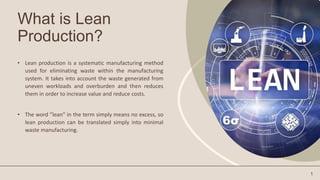
• Lean production is a systematic manufacturing method
used for eliminating waste within the manufacturing
system. It takes into account the waste generated from
uneven workloads and overburden and then reduces
them in order to increase value and reduce costs.
• The word ”lean” in the term simply means no excess, so
lean production can be translated simply into minimal
waste manufacturing.
1
Types of wastes
OVERPRODUCTION
o Production ahead of demand.
DEFECTS
o The cost of defect production and the effort required to
monitor for defects.
2
WAITING
o Production interruptions or time spent waiting for the next
step of the production process.
Types of wastes
MOTION
o When people must move more than necessary for their
part of the production process. For example, moving
pieces between a remote bin and machine.
INVENTORY
o Stocks of finished goods or work in progress not being
processed.
3
TRANSPORT
o Excessive movement of materials, work in progress or
finished goods.
OVER PROCESSING
o Processing to compensate for poor design or production
processes.
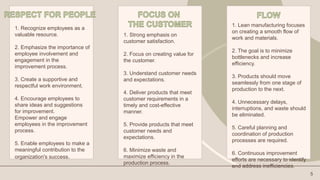
5 PRINCIPLES OF
LEAN
MANUFACTURING
4
1. Minimize waste by eliminating non-value-adding activities.
2. Make production process efficient and streamlined.
3. Use only necessary resources to meet customer
requirements.
4. Identify and remove waste in areas such as
overproduction, waiting, unnecessary motion,
overprocessing, excess inventory, unused talent, and defects.
1. Continuously improve processes to eliminate inefficiencie
2. Continuously identify and remove waste.
3. Believe in the possibility of continuous improvement.
4. Involve employees in continuous improvement efforts.
5. Create a culture of continuous improvement that empowe
employees.
5
1. Recognize employees as a
valuable resource.
2. Emphasize the importance of
employee involvement and
engagement in the
improvement process.
3. Create a supportive and
respectful work environment.
4. Encourage employees to
share ideas and suggestions
for improvement.
Empower and engage
employees in the improvement
process.
5. Enable employees to make a
meaningful contribution to the
organization's success.
1. Strong emphasis on
customer satisfaction.
2. Focus on creating value for
the customer.
3. Understand customer needs
and expectations.
4. Deliver products that meet
customer requirements in a
timely and cost-effective
manner.
5. Provide products that meet
customer needs and
expectations.
6. Minimize waste and
maximize efficiency in the
production process.
1. Lean manufacturing focuses
on creating a smooth flow of
work and materials.
2. The goal is to minimize
bottlenecks and increase
efficiency.
3. Products should move
seamlessly from one stage of
production to the next.
4. Unnecessary delays,
interruptions, and waste should
be eliminated.
5. Careful planning and
coordination of production
processes are required.
6. Continuous improvement
efforts are necessary to identify
and address inefficiencies.
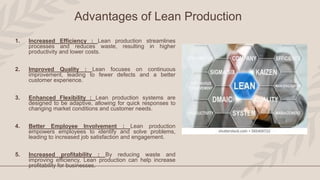
Advantages of Lean Production
1. Increased Efficiency : Lean production streamlines
processes and reduces waste, resulting in higher
productivity and lower costs.
2. Improved Quality : Lean focuses on continuous
improvement, leading to fewer defects and a better
customer experience.
3. Enhanced Flexibility : Lean production systems are
designed to be adaptive, allowing for quick responses to
changing market conditions and customer needs.
4. Better Employee Involvement : Lean production
empowers employees to identify and solve problems,
leading to increased job satisfaction and engagement.
5. Increased profitability : By reducing waste and
improving efficiency, Lean production can help increase
profitability for businesses.
Disadvantages of Lean Production
1. High Implementation Costs : Implementing a Lean
production system can be expensive, especially for
companies with established processes and
technologies.
2. Resistance to Change : Some employees may resist
change and resist the adoption of new processes and
technologies.
3. Difficulty in Sustaining Improvements : Maintaining
the improvements achieved through Lean production
requires ongoing effort and commitment from all levels
of the organization.
4. Requires High Levels of Discipline : Lean production
relies on strict adherence to processes and standards,
which may be difficult to achieve in some organizations.
5. Can be Difficult to Measure Success: Measuring the
success of Lean production can be difficult, as
improvements may not always be quantifiable or may
take time to become apparent.
5S System
Seiri
Organize
Seiton
Tidiness or orderliness
Seiso
Clean
Seiketsu
Standardize
Shitsuke
Sustain
Poka Yoka
Poka-Mistake
Yoka-Avoid
Mistake Proofing
20XX presentation title 9
Fixed-value method poka-
yoke
The fixed-value poka-yoke method involves warning a worker
when a specified number of actions has not been met. This
would be applicable in a situation where the number of actions
is clearly defined and each is critical to the end result of the
process.
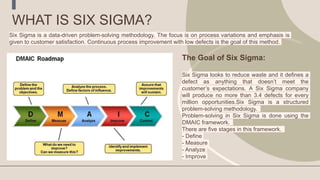
WHAT IS SIX SIGMA?
Six Sigma is a data-driven problem-solving methodology. The focus is on process variations and emphasis is
given to customer satisfaction. Continuous process improvement with low defects is the goal of this method.
The Goal of Six Sigma:
Six Sigma looks to reduce waste and it defines a
defect as anything that doesn’t meet the
customer’s expectations. A Six Sigma company
will produce no more than 3.4 defects for every
million opportunities.Six Sigma is a structured
problem-solving methodology.
Problem-solving in Six Sigma is done using the
DMAIC framework.
There are five stages in this framework.
- Define
- Measure
- Analyze
- Improve
Difference between Lean vs Six sigma
20X title 12
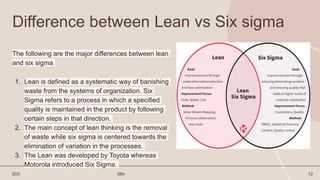
The following are the major differences between lean
and six sigma
1. Lean is defined as a systematic way of banishing
waste from the systems of organization. Six
Sigma refers to a process in which a specified
quality is maintained in the product by following
certain steps in that direction.
2. The main concept of lean thinking is the removal
of waste while six sigma is centered towards the
elimination of variation in the processes.
3. The Lean was developed by Toyota whereas
Motorola introduced Six Sigma.
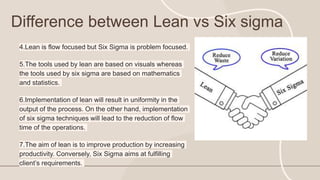
4.Lean is flow focused but Six Sigma is problem focused.
5.The tools used by lean are based on visuals whereas
the tools used by six sigma are based on mathematics
and statistics.
6.Implementation of lean will result in uniformity in the
output of the process. On the other hand, implementation
of six sigma techniques will lead to the reduction of flow
time of the operations.
7.The aim of lean is to improve production by increasing
productivity. Conversely, Six Sigma aims at fulfilling
client’s requirements.
Difference between Lean vs Six sigma
Examples
Saskatchewan, the Toyota lean management system
is used in combination with a strategic management
and policy deployment system, called Hoshin Kanri ,
and daily visual management.
Daily visual management is an approach where staff
members take the time each day to evaluate their
progress using the key elements of daily huddles and
visibility walls.
20XX presentation title 14
Toyota
MARUTI SUZUKI
Poka-yoke in Japanese means mistake-proofing and it is followed whole heartedly in the
lean manufacturing industry, not only in their land, but in India too.
And, Maruti Suzuki India (MSIL), the country’s largest passenger cars manufacturer is been
following the same system since its inception in 1984, in order to improve its productivity
and lesser defects in the products.
Lean, mean efficiency It is the implementation of lean manufacturing system at its vendors
-- based on what Maruti has in-house production systems -- based on Suzuki Motor Japan
and Toyota Quality Management (TQM), which means improving the productivity,
eliminating the waste and reducing the defects.
The company through implementing lean manufacturing systems has 720 projects
completed so far for productivity improvement, quality, inventory control and energy
conservation. MACE has worked with 146 tier-II vendors for overall improvement in
performance resulting in reduction in rejections from 10,933 to 1,180 products per month
and defect reduction from 432 to 146 per month.
20XX presentation title 15
THANK YOU
20XX presentation title 16
Efforts by:
Saransh Gera
Gunnika Gupta
Aarushi Gosain
Shiksha Jha
Adarsh Gupta
Yashita Gupta

Lean Production POM.pptx

  • 1.
    What is Lean Production? •Lean production is a systematic manufacturing method used for eliminating waste within the manufacturing system. It takes into account the waste generated from uneven workloads and overburden and then reduces them in order to increase value and reduce costs. • The word ”lean” in the term simply means no excess, so lean production can be translated simply into minimal waste manufacturing. 1
  • 2.
    Types of wastes OVERPRODUCTION oProduction ahead of demand. DEFECTS o The cost of defect production and the effort required to monitor for defects. 2 WAITING o Production interruptions or time spent waiting for the next step of the production process.
  • 3.
    Types of wastes MOTION oWhen people must move more than necessary for their part of the production process. For example, moving pieces between a remote bin and machine. INVENTORY o Stocks of finished goods or work in progress not being processed. 3 TRANSPORT o Excessive movement of materials, work in progress or finished goods. OVER PROCESSING o Processing to compensate for poor design or production processes.
  • 4.
    5 PRINCIPLES OF LEAN MANUFACTURING 4 1.Minimize waste by eliminating non-value-adding activities. 2. Make production process efficient and streamlined. 3. Use only necessary resources to meet customer requirements. 4. Identify and remove waste in areas such as overproduction, waiting, unnecessary motion, overprocessing, excess inventory, unused talent, and defects. 1. Continuously improve processes to eliminate inefficiencie 2. Continuously identify and remove waste. 3. Believe in the possibility of continuous improvement. 4. Involve employees in continuous improvement efforts. 5. Create a culture of continuous improvement that empowe employees.
  • 5.
    5 1. Recognize employeesas a valuable resource. 2. Emphasize the importance of employee involvement and engagement in the improvement process. 3. Create a supportive and respectful work environment. 4. Encourage employees to share ideas and suggestions for improvement. Empower and engage employees in the improvement process. 5. Enable employees to make a meaningful contribution to the organization's success. 1. Strong emphasis on customer satisfaction. 2. Focus on creating value for the customer. 3. Understand customer needs and expectations. 4. Deliver products that meet customer requirements in a timely and cost-effective manner. 5. Provide products that meet customer needs and expectations. 6. Minimize waste and maximize efficiency in the production process. 1. Lean manufacturing focuses on creating a smooth flow of work and materials. 2. The goal is to minimize bottlenecks and increase efficiency. 3. Products should move seamlessly from one stage of production to the next. 4. Unnecessary delays, interruptions, and waste should be eliminated. 5. Careful planning and coordination of production processes are required. 6. Continuous improvement efforts are necessary to identify and address inefficiencies.
  • 6.
    Advantages of LeanProduction 1. Increased Efficiency : Lean production streamlines processes and reduces waste, resulting in higher productivity and lower costs. 2. Improved Quality : Lean focuses on continuous improvement, leading to fewer defects and a better customer experience. 3. Enhanced Flexibility : Lean production systems are designed to be adaptive, allowing for quick responses to changing market conditions and customer needs. 4. Better Employee Involvement : Lean production empowers employees to identify and solve problems, leading to increased job satisfaction and engagement. 5. Increased profitability : By reducing waste and improving efficiency, Lean production can help increase profitability for businesses.
  • 7.
    Disadvantages of LeanProduction 1. High Implementation Costs : Implementing a Lean production system can be expensive, especially for companies with established processes and technologies. 2. Resistance to Change : Some employees may resist change and resist the adoption of new processes and technologies. 3. Difficulty in Sustaining Improvements : Maintaining the improvements achieved through Lean production requires ongoing effort and commitment from all levels of the organization. 4. Requires High Levels of Discipline : Lean production relies on strict adherence to processes and standards, which may be difficult to achieve in some organizations. 5. Can be Difficult to Measure Success: Measuring the success of Lean production can be difficult, as improvements may not always be quantifiable or may take time to become apparent.
  • 8.
    5S System Seiri Organize Seiton Tidiness ororderliness Seiso Clean Seiketsu Standardize Shitsuke Sustain
  • 9.
  • 10.
    Fixed-value method poka- yoke Thefixed-value poka-yoke method involves warning a worker when a specified number of actions has not been met. This would be applicable in a situation where the number of actions is clearly defined and each is critical to the end result of the process.
  • 11.
    WHAT IS SIXSIGMA? Six Sigma is a data-driven problem-solving methodology. The focus is on process variations and emphasis is given to customer satisfaction. Continuous process improvement with low defects is the goal of this method. The Goal of Six Sigma: Six Sigma looks to reduce waste and it defines a defect as anything that doesn’t meet the customer’s expectations. A Six Sigma company will produce no more than 3.4 defects for every million opportunities.Six Sigma is a structured problem-solving methodology. Problem-solving in Six Sigma is done using the DMAIC framework. There are five stages in this framework. - Define - Measure - Analyze - Improve
  • 12.
    Difference between Leanvs Six sigma 20X title 12 The following are the major differences between lean and six sigma 1. Lean is defined as a systematic way of banishing waste from the systems of organization. Six Sigma refers to a process in which a specified quality is maintained in the product by following certain steps in that direction. 2. The main concept of lean thinking is the removal of waste while six sigma is centered towards the elimination of variation in the processes. 3. The Lean was developed by Toyota whereas Motorola introduced Six Sigma.
  • 13.
    4.Lean is flowfocused but Six Sigma is problem focused. 5.The tools used by lean are based on visuals whereas the tools used by six sigma are based on mathematics and statistics. 6.Implementation of lean will result in uniformity in the output of the process. On the other hand, implementation of six sigma techniques will lead to the reduction of flow time of the operations. 7.The aim of lean is to improve production by increasing productivity. Conversely, Six Sigma aims at fulfilling client’s requirements. Difference between Lean vs Six sigma
  • 14.
    Examples Saskatchewan, the Toyotalean management system is used in combination with a strategic management and policy deployment system, called Hoshin Kanri , and daily visual management. Daily visual management is an approach where staff members take the time each day to evaluate their progress using the key elements of daily huddles and visibility walls. 20XX presentation title 14 Toyota
  • 15.
    MARUTI SUZUKI Poka-yoke inJapanese means mistake-proofing and it is followed whole heartedly in the lean manufacturing industry, not only in their land, but in India too. And, Maruti Suzuki India (MSIL), the country’s largest passenger cars manufacturer is been following the same system since its inception in 1984, in order to improve its productivity and lesser defects in the products. Lean, mean efficiency It is the implementation of lean manufacturing system at its vendors -- based on what Maruti has in-house production systems -- based on Suzuki Motor Japan and Toyota Quality Management (TQM), which means improving the productivity, eliminating the waste and reducing the defects. The company through implementing lean manufacturing systems has 720 projects completed so far for productivity improvement, quality, inventory control and energy conservation. MACE has worked with 146 tier-II vendors for overall improvement in performance resulting in reduction in rejections from 10,933 to 1,180 products per month and defect reduction from 432 to 146 per month. 20XX presentation title 15
  • 16.
    THANK YOU 20XX presentationtitle 16 Efforts by: Saransh Gera Gunnika Gupta Aarushi Gosain Shiksha Jha Adarsh Gupta Yashita Gupta