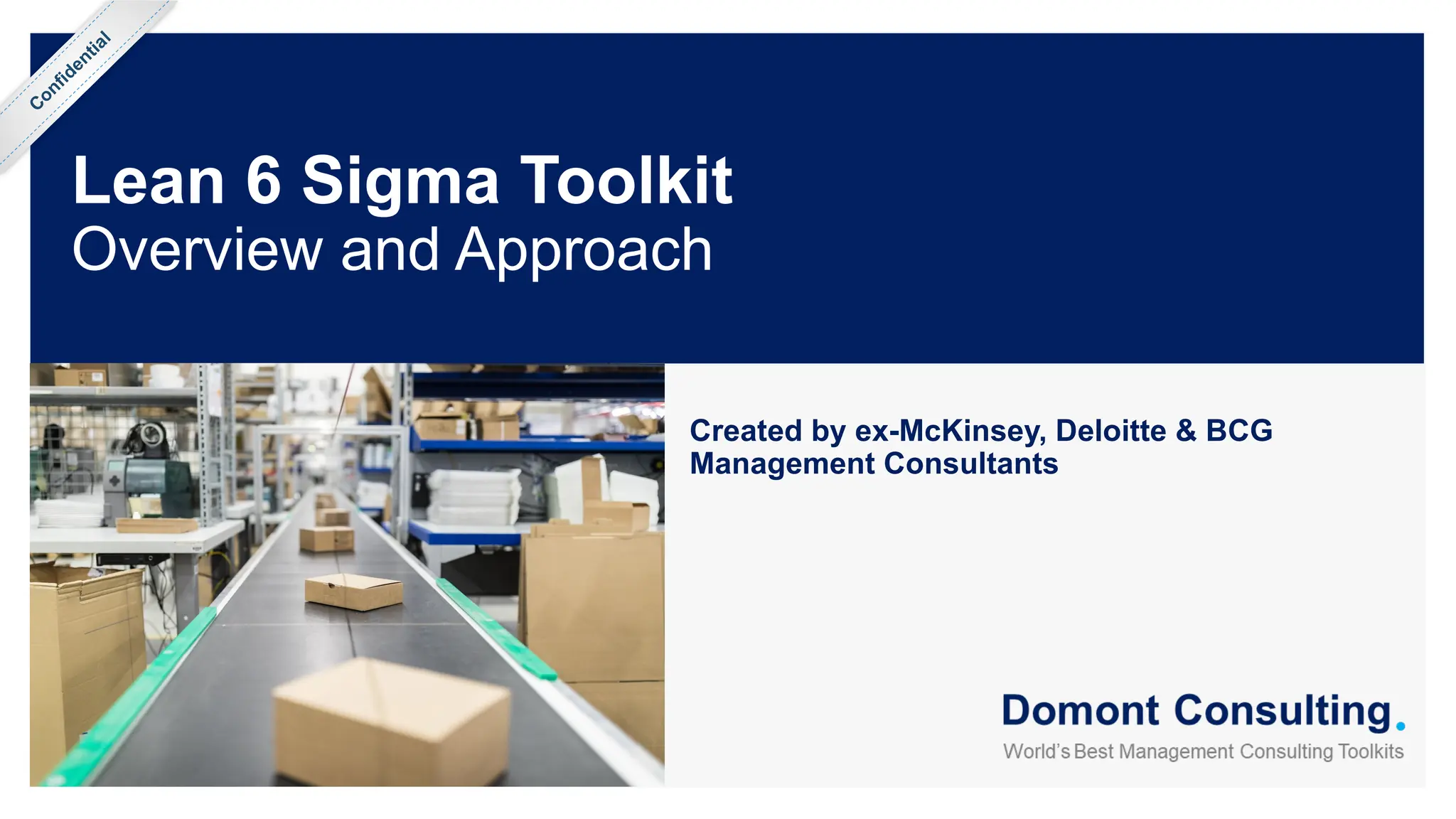
Lean 6 Sigma Toolkit
Overview and Approach
Created by ex-McKinsey, Deloitte & BCG
Management Consultants
Confidential
• “This Toolkit was created by ex-McKinsey, Deloitte and BCG Management
Consultants specialized on Lean Six Sigma. It includes all the Frameworks, Best
Practices & Templates required to adopt and implement Lean 6 Sigma within your
organization using the world-class DMAIC approach. Build success stories such
as Motorola who saved over $16 billion in costs and increased customer
satisfaction by 15% using Lean 6 Sigma.”
• Join the 200,000+ Executives, Consultants & Entrepreneurs who are already
leveraging our Management Consulting Toolkits to improve the performance of
their organization and boost their own career.
• If you have any questions, send us an email at support@domontconsulting.com
and one of our ex-McKinsey, Deloitte & BCG Management Consultants will get
back to you within 2 business days.”
Introduction
2
Aurelien Domont
Management Consultant
Domont Consulting Managing Director
Table of contents
3
1 What is Lean Six Sigma?
2 What are the key benefits of using Lean Six Sigma?
3 Lean Six Sigma Toolkit - Approach and overview
Table of contents
4
1 What is Lean Six Sigma?
2 What are the key benefits of using Lean Six Sigma?
3 Lean Six Sigma Toolkit - Approach and overview
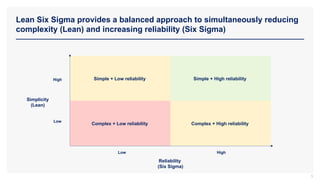
Lean Six Sigma provides a balanced approach to simultaneously reducing
complexity (Lean) and increasing reliability (Six Sigma)
5
Simplicity
(Lean)
Reliability
(Six Sigma)
Low
Low
Simple + Low reliability Simple + High reliability
Complex + Low reliability Complex + High reliability
High
High
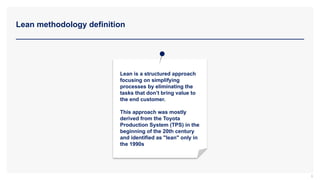
Lean methodology definition
6
Lean is a structured approach
focusing on simplifying
processes by eliminating the
tasks that don’t bring value to
the end customer.
This approach was mostly
derived from the Toyota
Production System (TPS) in the
beginning of the 20th century
and identified as "lean" only in
the 1990s
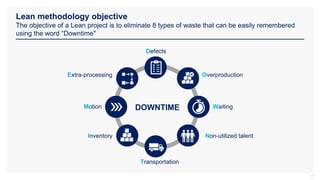
Lean methodology objective
The objective of a Lean project is to eliminate 8 types of waste that can be easily remembered
using the word “Downtime"
7
Defects
Overproduction
Waiting
Non-utilized talent
Transportation
Extra-processing
Motion
Inventory
DOWNTIME
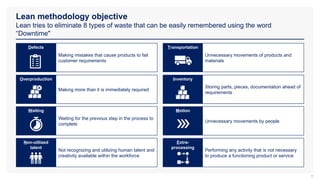
Lean methodology objective
Lean tries to eliminate 8 types of waste that can be easily remembered using the word
“Downtime"
8
Defects
Defects
Making mistakes that cause products to fail
customer requirements
Defects
Transportation
Unnecessary movements of products and
materials
Defects
Overproduction
Making more than it is immediately required
Defects
Inventory
Storing parts, pieces, documentation ahead of
requirements
Defects
Waiting
Waiting for the previous step in the process to
complete
Defects
Motion
Unnecessary movements by people
Defects
Non-utilized
talent
Not recognizing and utilizing human talent and
creativity available within the workforce
Defects
Extra-
processing
Performing any activity that is not necessary
to produce a functioning product or service
Lean methodology objective
Lean tries to eliminate 8 types of waste that can be easily remembered using the word
“Downtime"
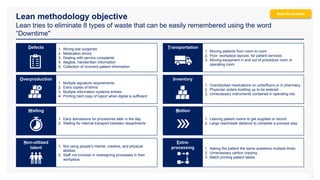
9
Defects
Defects 1. Wrong-site surgeries
2. Medication errors
3. Dealing with service complaints
4. Illegible, handwritten information
5. Collection of incorrect patient information
Defects
Transportation
1. Moving patients from room to room
2. Poor workplace layouts, for patient services
3. Moving equipment in and out of procedure room or
operating room
Defects
Overproduction
1. Multiple signature requirements
2. Extra copies of forms
3. Multiple information systems entries
4. Printing hard copy of report when digital is sufficient
Defects
Inventory
1. Overstocked medications on units/floors or in pharmacy
2. Physician orders building up to be entered
3. Unnecessary instruments contained in operating kits
Defects
Waiting
1. Early admissions for procedures later in the day
2. Waiting for internal transport between departments
Defects
Motion
1. Leaving patient rooms to get supplies or record
2. Large reach/walk distance to complete a process step
Defects
Non-utilized
talent 1. Not using people’s mental, creative, and physical
abilities
2. Staff not involved in redesigning processes in their
workplace
Defects
Extra-
processing 1. Asking the patient the same questions multiple times
2. Unnecessary carbon copying
3. Batch printing patient labels
Real-life example
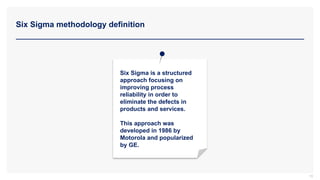
Six Sigma methodology definition
10
Six Sigma is a structured
approach focusing on
improving process
reliability in order to
eliminate the defects in
products and services.
This approach was
developed in 1986 by
Motorola and popularized
by GE.
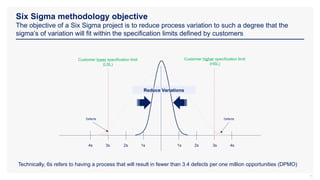
Six Sigma methodology objective
The objective of a Six Sigma project is to reduce process variation to such a degree that the
sigma’s of variation will fit within the specification limits defined by customers
11
Technically, 6s refers to having a process that will result in fewer than 3.4 defects per one million opportunities (DPMO)
1s 1s 2s 3s
2s
3s
4s 4s
Customer lower specification limit
(LSL)
Customer higher specification limit
(HSL)
Defects Defects
Reduce Variations
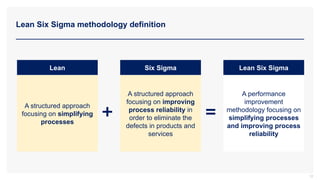
Lean Six Sigma methodology definition
12
Lean
A structured approach
focusing on simplifying
processes
Six Sigma
A structured approach
focusing on improving
process reliability in
order to eliminate the
defects in products and
services
Lean Six Sigma
A performance
improvement
methodology focusing on
simplifying processes
and improving process
reliability
+ =
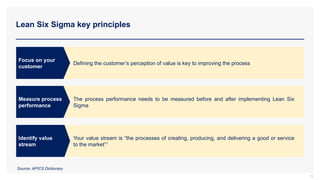
Lean Six Sigma key principles
13
Defining the customer’s perception of value is key to improving the process
Focus on your
customer
The process performance needs to be measured before and after implementing Lean Six
Sigma
Measure process
performance
Your value stream is “the processes of creating, producing, and delivering a good or service
to the market”1
Identify value
stream
Source: APICS Dictionary
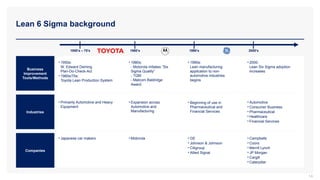
Lean 6 Sigma background
14
1950’s – 70’s 1980’s 1990’s 2000’s
• Japanese car makers • Motorola • Campbells
• Coors
• Merrill Lynch
• JP Morgan
• Cargill
• Caterpillar
• GE
• Johnson & Johnson
• Citigroup
• Allied Signal
• Primarily Automotive and Heavy
Equipment
• Expansion across
Automotive and
Manufacturing
• Automotive
• Consumer Business
• Pharmaceutical
• Healthcare
• Financial Services
• Beginning of use in
Pharmaceutical and
Financial Services
• 1950s:
W. Edward Deming
Plan-Do-Check-Act
• 1960s/70s:
Toyota Lean Production System
• 1980s:
- Motorola initiates ”Six
Sigma Quality”
- TQM
- Malcom Baldridge
Award
• 2000:
Lean Six Sigma adoption
increases
• 1990s:
Lean manufacturing
application to non-
automotive industries
begins
Business
Improvement
Tools/Methods
Industries
Companies
Table of contents
15
1 What is Lean Six Sigma?
2 What are the key benefits of using Lean Six Sigma?
3 Lean Six Sigma Toolkit - Approach and overview
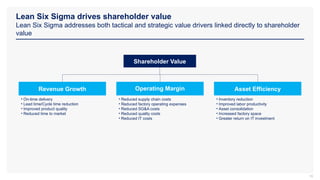
Lean Six Sigma drives shareholder value
Lean Six Sigma addresses both tactical and strategic value drivers linked directly to shareholder
value
16
• On-time delivery
• Lead time/Cycle time reduction
• Improved product quality
• Reduced time to market
• Reduced supply chain costs
• Reduced factory operating expenses
• Reduced SG&A costs
• Reduced quality costs
• Reduced IT costs
• Inventory reduction
• Improved labor productivity
• Asset consolidation
• Increased factory space
• Greater return on IT investment
Shareholder Value
Revenue Growth Operating Margin Asset Efficiency
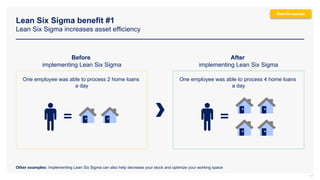
Lean Six Sigma benefit #1
Lean Six Sigma increases asset efficiency
17
One employee was able to process 2 home loans
a day
One employee was able to process 4 home loans
a day
Before
implementing Lean Six Sigma
After
implementing Lean Six Sigma
Other examples: Implementing Lean Six Sigma can also help decrease your stock and optimize your working space
= =
Real-life example
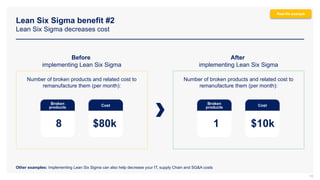
Lean Six Sigma benefit #2
Lean Six Sigma decreases cost
18
18
Number of broken products and related cost to
remanufacture them (per month):
Number of broken products and related cost to
remanufacture them (per month):
Before
implementing Lean Six Sigma
After
implementing Lean Six Sigma
Other examples: Implementing Lean Six Sigma can also help decrease your IT, supply Chain and SG&A costs
Real-life example
Broken
products Cost Broken
products Cost
8 $80k 1 $10k
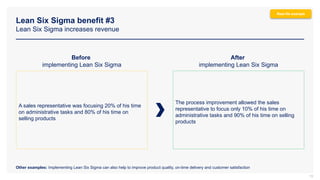
Lean Six Sigma benefit #3
Lean Six Sigma increases revenue
19
A sales representative was focusing 20% of his time
on administrative tasks and 80% of his time on
selling products
The process improvement allowed the sales
representative to focus only 10% of his time on
administrative tasks and 90% of his time on selling
products
Before
implementing Lean Six Sigma
After
implementing Lean Six Sigma
Other examples: Implementing Lean Six Sigma can also help to improve product quality, on-time delivery and customer satisfaction
Real-life example
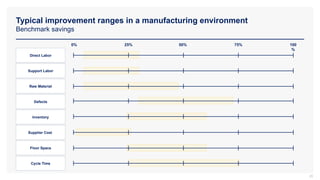
Typical improvement ranges in a manufacturing environment
Benchmark savings
20
Raw Material
Inventory
Supplier Cost
Floor Space
Cycle Time
Support Labor
Defects
Direct Labor
0% 25% 50% 75% 100
%
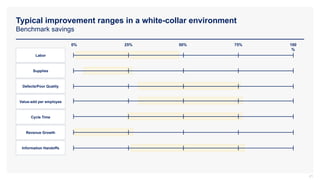
Typical improvement ranges in a white-collar environment
Benchmark savings
21
Defects/Poor Quality
Cycle Time
Revenue Growth
Information Handoffs
Supplies
Value-add per employee
Labor
0% 25% 50% 75% 100
%
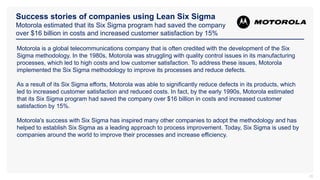
Success stories of companies using Lean Six Sigma
Motorola estimated that its Six Sigma program had saved the company
over $16 billion in costs and increased customer satisfaction by 15%
22
Motorola is a global telecommunications company that is often credited with the development of the Six
Sigma methodology. In the 1980s, Motorola was struggling with quality control issues in its manufacturing
processes, which led to high costs and low customer satisfaction. To address these issues, Motorola
implemented the Six Sigma methodology to improve its processes and reduce defects.
As a result of its Six Sigma efforts, Motorola was able to significantly reduce defects in its products, which
led to increased customer satisfaction and reduced costs. In fact, by the early 1990s, Motorola estimated
that its Six Sigma program had saved the company over $16 billion in costs and increased customer
satisfaction by 15%.
Motorola's success with Six Sigma has inspired many other companies to adopt the methodology and has
helped to establish Six Sigma as a leading approach to process improvement. Today, Six Sigma is used by
companies around the world to improve their processes and increase efficiency.
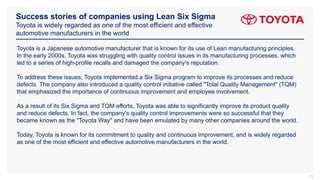
Success stories of companies using Lean Six Sigma
Toyota is widely regarded as one of the most efficient and effective
automotive manufacturers in the world
23
Toyota is a Japanese automotive manufacturer that is known for its use of Lean manufacturing principles.
In the early 2000s, Toyota was struggling with quality control issues in its manufacturing processes, which
led to a series of high-profile recalls and damaged the company's reputation.
To address these issues, Toyota implemented a Six Sigma program to improve its processes and reduce
defects. The company also introduced a quality control initiative called "Total Quality Management" (TQM)
that emphasized the importance of continuous improvement and employee involvement.
As a result of its Six Sigma and TQM efforts, Toyota was able to significantly improve its product quality
and reduce defects. In fact, the company's quality control improvements were so successful that they
became known as the "Toyota Way" and have been emulated by many other companies around the world.
Today, Toyota is known for its commitment to quality and continuous improvement, and is widely regarded
as one of the most efficient and effective automotive manufacturers in the world.
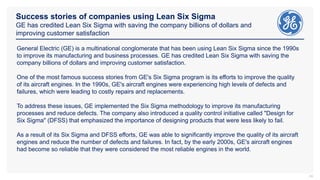
Success stories of companies using Lean Six Sigma
GE has credited Lean Six Sigma with saving the company billions of dollars and
improving customer satisfaction
24
General Electric (GE) is a multinational conglomerate that has been using Lean Six Sigma since the 1990s
to improve its manufacturing and business processes. GE has credited Lean Six Sigma with saving the
company billions of dollars and improving customer satisfaction.
One of the most famous success stories from GE's Six Sigma program is its efforts to improve the quality
of its aircraft engines. In the 1990s, GE's aircraft engines were experiencing high levels of defects and
failures, which were leading to costly repairs and replacements.
To address these issues, GE implemented the Six Sigma methodology to improve its manufacturing
processes and reduce defects. The company also introduced a quality control initiative called "Design for
Six Sigma" (DFSS) that emphasized the importance of designing products that were less likely to fail.
As a result of its Six Sigma and DFSS efforts, GE was able to significantly improve the quality of its aircraft
engines and reduce the number of defects and failures. In fact, by the early 2000s, GE's aircraft engines
had become so reliable that they were considered the most reliable engines in the world.
Table of contents
25
1 What is Lean Six Sigma?
2 What are the key benefits of using Lean Six Sigma?
3 Lean Six Sigma Toolkit - Approach and overview
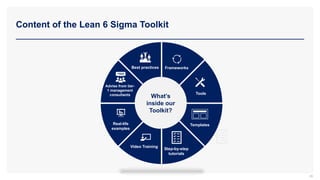
Content of the Lean 6 Sigma Toolkit
26
Frameworks
Tools
Templates
Step-by-step
tutorials
Video Training
Real-life
examples
Best practices
Advise from tier-
1 management
consultants
What’s
inside our
Toolkit?
Objectives of the Toolkit
The Lean 6 Sigma Toolkit includes frameworks, tools, templates, tutorials, real-life examples, best
practices and video training to help you:
27
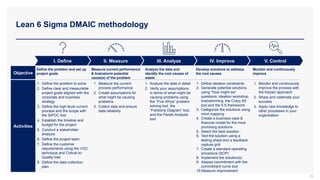
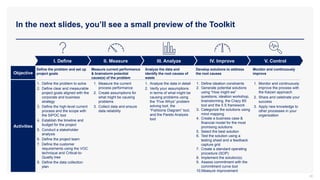
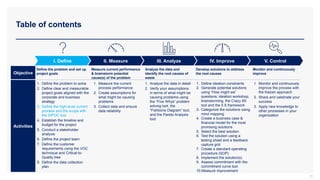
• Adopt and implement a Lean 6 Sigma methodology within your organization using the 5 phases of the world-class
DMAIC approach: (I) Define, (II) Measure, (III) Analyze, (IV) Improve, (V) Control
• (I) Define: (1) Define the problem to solve, (2) Define clear and measurable project goals aligned with the corporate and
business strategy, (3) Define the high-level current process and the scope with the SIPOC tool, (4) Establish the timeline and
budget for the project, (5) Conduct a stakeholder analysis, (6) Define the project team, (7) Define the customer requirements
using the VOC technique and Critical-to-Quality tree, (8) Define the data collection plan
• (II) Measure: (1) Measure the current process performance, (2) Create assumptions for what might be causing problems, (3)
Collect data and ensure data reliability
• (III) Analyze: (1) Analyze the data in detail, (2) Verify your assumptions in terms of what might be causing problems using the
“Five Whys” problem solving tool, the “Fishbone Diagram” tool, and the Pareto Analysis tool
• (IV) Improve: (1) Define ideation constraints, (2) Generate potential solutions using “How might we” questions, ideation
workshop, brainstorming, the Crazy 8S tool and the 5 S framework, (3) Categorize the solutions using mind mapping, (4)
Create a business case & financial model for the most promising solutions, (5) Select the best solution, (6) Test the solution
using a testing sheet and a feedback capture grid, (7) Create a standard operating procedure (SOP), (8) Implement the
solution(s), (9) Assess commitment with the commitment curve tool, (10) Measure improvement
• (V) Control: (1) Monitor and continuously improve the process with the Kaizen approach, (2) Share and celebrate your
success, (3) Apply new knowledge to other processes in your organization
• Build success stories such as Motorola who saved over $16 billion in costs and increased customer satisfaction by 15%
by applying Lean 6 Sigma
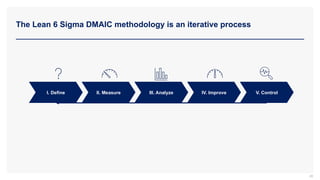
The Lean 6 Sigma DMAIC methodology is an iterative process
28
I. Define III. Analyze IV. Improve
II. Measure V. Control
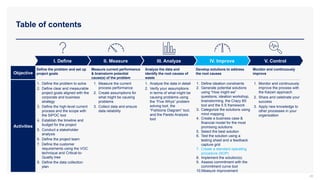
Lean 6 Sigma DMAIC methodology
29
I. Define III. Analyze IV. Improve
II. Measure V. Control
Define the problem and set up
project goals
Measure current performance
& brainstorm potential
cause(s) of the problem
Analyze the data and
identify the root causes of
waste
Develop solutions to address
the root causes
Monitor and continuously
improve
Objective
Activities
1. Measure the current
process performance
2. Create assumptions for
what might be causing
problems
3. Collect data and ensure
data reliability
1. Monitor and continuously
improve the process with
the Kaizen approach
2. Share and celebrate your
success
3. Apply new knowledge to
other processes in your
organization
1. Define the problem to solve
2. Define clear and measurable
project goals aligned with the
corporate and business
strategy
3. Define the high-level current
process and the scope with
the SIPOC tool
4. Establish the timeline and
budget for the project
5. Conduct a stakeholder
analysis
6. Define the project team
7. Define the customer
requirements using the VOC
technique and Critical-to-
Quality tree
8. Define the data collection
plan
1. Analyze the data in detail
2. Verify your assumptions
in terms of what might be
causing problems using
the “Five Whys” problem
solving tool, the
“Fishbone Diagram” tool,
and the Pareto Analysis
tool
1. Define ideation constraints
2. Generate potential solutions
using “How might we”
questions, ideation workshop,
brainstorming, the Crazy 8S
tool and the 5 S framework
3. Categorize the solutions using
mind mapping
4. Create a business case &
financial model for the most
promising solutions
5. Select the best solution
6. Test the solution using a
testing sheet and a feedback
capture grid
7. Create a standard operating
procedure (SOP)
8. Implement the solution(s)
9. Assess commitment with the
commitment curve tool
10.Measure improvement
In the next slides, you’ll see a small preview of the Toolkit
30
I. Define III. Analyze IV. Improve
II. Measure V. Control
Define the problem and set up
project goals
Measure current performance
& brainstorm potential
cause(s) of the problem
Analyze the data and
identify the root causes of
waste
Develop solutions to address
the root causes
Monitor and continuously
improve
Objective
Activities
1. Measure the current
process performance
2. Create assumptions for
what might be causing
problems
3. Collect data and ensure
data reliability
1. Monitor and continuously
improve the process with
the Kaizen approach
2. Share and celebrate your
success
3. Apply new knowledge to
other processes in your
organization
1. Define the problem to solve
2. Define clear and measurable
project goals aligned with the
corporate and business
strategy
3. Define the high-level current
process and the scope with
the SIPOC tool
4. Establish the timeline and
budget for the project
5. Conduct a stakeholder
analysis
6. Define the project team
7. Define the customer
requirements using the VOC
technique and Critical-to-
Quality tree
8. Define the data collection
plan
1. Analyze the data in detail
2. Verify your assumptions
in terms of what might be
causing problems using
the “Five Whys” problem
solving tool, the
“Fishbone Diagram” tool,
and the Pareto Analysis
tool
1. Define ideation constraints
2. Generate potential solutions
using “How might we”
questions, ideation workshop,
brainstorming, the Crazy 8S
tool and the 5 S framework
3. Categorize the solutions using
mind mapping
4. Create a business case &
financial model for the most
promising solutions
5. Select the best solution
6. Test the solution using a
testing sheet and a feedback
capture grid
7. Create a standard operating
procedure (SOP)
8. Implement the solution(s)
9. Assess commitment with the
commitment curve tool
10.Measure improvement
Table of contents
31
I. Define III. Analyze IV. Improve
II. Measure V. Control
Define the problem and set up
project goals
Measure current performance
& brainstorm potential
cause(s) of the problem
Analyze the data and
identify the root causes of
waste
Develop solutions to address
the root causes
Monitor and continuously
improve
Objective
Activities
1. Measure the current
process performance
2. Create assumptions for
what might be causing
problems
3. Collect data and ensure
data reliability
1. Monitor and continuously
improve the process with
the Kaizen approach
2. Share and celebrate your
success
3. Apply new knowledge to
other processes in your
organization
1. Define the problem to solve
2. Define clear and measurable
project goals aligned with the
corporate and business
strategy
3. Define the high-level current
process and the scope with
the SIPOC tool
4. Establish the timeline and
budget for the project
5. Conduct a stakeholder
analysis
6. Define the project team
7. Define the customer
requirements using the VOC
technique and Critical-to-
Quality tree
8. Define the data collection
plan
1. Analyze the data in detail
2. Verify your assumptions
in terms of what might be
causing problems using
the “Five Whys” problem
solving tool, the
“Fishbone Diagram” tool,
and the Pareto Analysis
tool
1. Define ideation constraints
2. Generate potential solutions
using “How might we”
questions, ideation workshop,
brainstorming, the Crazy 8S
tool and the 5 S framework
3. Categorize the solutions using
mind mapping
4. Create a business case &
financial model for the most
promising solutions
5. Select the best solution
6. Test the solution using a
testing sheet and a feedback
capture grid
7. Create a standard operating
procedure (SOP)
8. Implement the solution(s)
9. Assess commitment with the
commitment curve tool
10.Measure improvement
SIPOC tool
Description
32
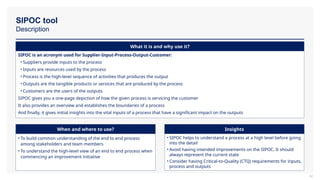
SIPOC is an acronym used for Supplier-Input-Process-Output-Customer:
• Suppliers provide inputs to the process
• Inputs are resources used by the process
• Process is the high-level sequence of activities that produces the output
• Outputs are the tangible products or services that are produced by the process
• Customers are the users of the outputs
SIPOC gives you a one-page depiction of how the given process is servicing the customer
It also provides an overview and establishes the boundaries of a process
And finally, it gives initial insights into the vital inputs of a process that have a significant impact on the outputs
What it is and why use it?
• To build common understanding of the end to end process
among stakeholders and team members
• To understand the high-level view of an end to end process when
commencing an improvement initiative
When and where to use?
• SIPOC helps to understand a process at a high level before going
into the detail
• Avoid having intended improvements on the SIPOC. It should
always represent the current state
• Consider having Critical-to-Quality (CTQ) requirements for inputs,
process and outputs
Insights
High-level current process and scope
SIPOC Tool
33
Start point: [insert your
own text]
Process Name: [Identify the process to be worked on]
Process Owner: [Confirm the process owner]
End point: [insert your
own text]
 Insert the
suppliers to the
process
Suppliers Inputs Outputs Customers
Process
 Insert inputs
provided by
suppliers
 Insert tangible
outputs
 Insert the
customers of the
process
 List what are the necessary
requirements for process
Process Requirements
 List what is critical to customer
Customer Requirements
Insert your own text
In scope
Out of scope
High-level current process and scope
SIPOC Tool
34
Start point: [insert your
own text]
Process Name: [Identify the process to be worked on]
Process Owner: [Confirm the process owner]
End point: [insert your
own text]
 Insert the
suppliers to the
process
Suppliers Inputs Outputs Customers
Process
 Insert inputs
provided by
suppliers
 Insert tangible
outputs
 Insert the
customers of the
process
 List what are the necessary
requirements for process
Process Requirements
 List what is critical to customer
Customer Requirements
Insert your own text
In scope
Out of scope
Tutorial
There should be no more than 5-7 high-level
process steps
Outputs should be tangible
There may be many inputs into the process but
use only the vital ones that are used to create to
output
High-level current process and scope
SIPOC Tool
35
Start point: the shop
orders coffee bean
Process Name: [Identify the process to be worked on]
Process Owner: [Confirm the process owner]
End point: The
customer drinks her
coffee
 Coffee bean
supplier
Suppliers Inputs Outputs Customers
Process
 Roasted coffee
beans
 Milk
 Water
 Syrup
 Cups
 Lids
 Espresso
 Latte
 Cappuccino
 Mocha
 Americano
 Hot chocolate
 In-store
customers
 Drive-thru
customers
 All the inputs have been received on
time and in the right quantity
Process Requirements
 Quality coffee beverages that taste
good
 Quick and efficient service
 Friendly and helpful customer service
Customer Requirements
Grind coffee beans
Brew coffee
Steam milk
Mix coffee, milk, and syrup
Pour into cups
In scope
Out of scope
Real-life example for
a coffee shop
Add lids
High-level current process and scope
SIPOC Tool
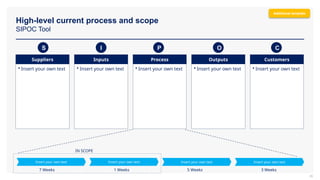
36
 Insert your own text
Suppliers Inputs Outputs Customers
Process
 Insert your own text  Insert your own text  Insert your own text  Insert your own text
IN SCOPE
S I P O C
7 Weeks 5 Weeks 3 Weeks
Insert your own text
1 Weeks
Additional template
High-level current process and scope
SIPOC Tool
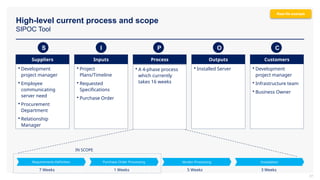
37
 Development
project manager
 Employee
communicating
server need
 Procurement
Department
 Relationship
Manager
Suppliers Inputs Outputs Customers
Process
 Project
Plans/Timeline
 Requested
Specifications
 Purchase Order
 A 4-phase process
which currently
takes 16 weeks
 Installed Server  Development
project manager
 Infrastructure team
 Business Owner
7 Weeks 5 Weeks 3 Weeks
IN SCOPE
Installation
Vendor Processing
Purchase Order Processing
Requirements Definition
1 Weeks
S I P O C
Real-life example
Table of contents
38
I. Define III. Analyze IV. Improve
II. Measure V. Control
Define the problem and set up
project goals
Measure current performance
& brainstorm potential
cause(s) of the problem
Analyze the data and
identify the root causes of
waste
Develop solutions to address
the root causes
Monitor and continuously
improve
Objective
Activities
1. Measure the current
process performance
2. Create assumptions for
what might be causing
problems
3. Collect data and ensure
data reliability
1. Monitor and continuously
improve the process with
the Kaizen approach
2. Share and celebrate your
success
3. Apply new knowledge to
other processes in your
organization
1. Define the problem to solve
2. Define clear and measurable
project goals aligned with the
corporate and business
strategy
3. Define the high-level current
process and the scope with
the SIPOC tool
4. Establish the timeline and
budget for the project
5. Conduct a stakeholder
analysis
6. Define the project team
7. Define the customer
requirements using the VOC
technique and Critical-to-
Quality tree
8. Define the data collection
plan
1. Analyze the data in detail
2. Verify your assumptions
in terms of what might be
causing problems using
the “Five Whys” problem
solving tool, the
“Fishbone Diagram” tool,
and the Pareto Analysis
tool
1. Define ideation constraints
2. Generate potential solutions
using “How might we”
questions, ideation workshop,
brainstorming, the Crazy 8S
tool and the 5 S framework
3. Categorize the solutions using
mind mapping
4. Create a business case &
financial model for the most
promising solutions
5. Select the best solution
6. Test the solution using a
testing sheet and a feedback
capture grid
7. Create a standard operating
procedure (SOP)
8. Implement the solution(s)
9. Assess commitment with the
commitment curve tool
10.Measure improvement
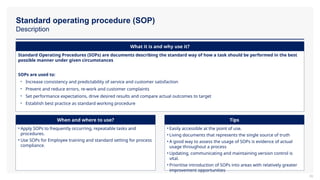
Standard operating procedure (SOP)
Description
39
Standard Operating Procedures (SOPs) are documents describing the standard way of how a task should be performed in the best
possible manner under given circumstances
SOPs are used to:
• Increase consistency and predictability of service and customer satisfaction
• Prevent and reduce errors, re-work and customer complaints
• Set performance expectations, drive desired results and compare actual outcomes to target
• Establish best practice as standard working procedure
What it is and why use it?
• Apply SOPs to frequently occurring, repeatable tasks and
procedures.
• Use SOPs for Employee training and standard setting for process
compliance.
When and where to use?
• Easily accessible at the point of use.
• Living documents that represents the single source of truth
• A good way to assess the usage of SOPs is evidence of actual
usage throughout a process
• Updating, communicating and maintaining version control is
vital.
• Prioritise introduction of SOPs into areas with relatively greater
improvement opportunities
Tips
Standard Operating Procedure (SOP)
Procedure Name: [Insert your own text]
Owner: [Insert your own text]
Version: [Insert your own text]
40
Responsibilities
[insert your own text]
Purpose
[insert your own text]
Scope
[insert your own text]
Procedure
1. [insert your own text]
• [insert your own text]
2. [insert your own text]
• [insert your own text]
3. [insert your own text]
• [insert your own text]
Template
Standard Operating Procedure (SOP)
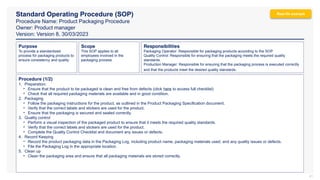
Procedure Name: Product Packaging Procedure
Owner: Product manager
Version: Version 8, 30/03/2023
41
Responsibilities
Packaging Operator: Responsible for packaging products according to the SOP.
Quality Control: Responsible for ensuring that the packaging meets the required quality
standards.
Production Manager: Responsible for ensuring that the packaging process is executed correctly
and that the products meet the desired quality standards.
Purpose
To provide a standardized
process for packaging products to
ensure consistency and quality.
Scope
This SOP applies to all
employees involved in the
packaging process.
Procedure (1/2)
1. Preparation:
• Ensure that the product to be packaged is clean and free from defects (click here to access full checklist)
• Check that all required packaging materials are available and in good condition.
2. Packaging
• Follow the packaging instructions for the product, as outlined in the Product Packaging Specification document.
• Verify that the correct labels and stickers are used for the product.
• Ensure that the packaging is secured and sealed correctly.
3. Quality control
• Perform a visual inspection of the packaged product to ensure that it meets the required quality standards.
• Verify that the correct labels and stickers are used for the product.
• Complete the Quality Control Checklist and document any issues or defects.
4. Record Keeping
• Record the product packaging data in the Packaging Log, including product name, packaging materials used, and any quality issues or defects.
• File the Packaging Log in the appropriate location.
5. Clean up
• Clean the packaging area and ensure that all packaging materials are stored correctly.
Real-life example
Standard Operating Procedure (SOP)
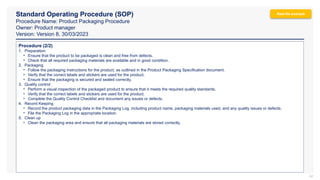
Procedure Name: Product Packaging Procedure
Owner: Product manager
Version: Version 8, 30/03/2023
42
Procedure (2/2)
1. Preparation:
• Ensure that the product to be packaged is clean and free from defects.
• Check that all required packaging materials are available and in good condition.
2. Packaging
• Follow the packaging instructions for the product, as outlined in the Product Packaging Specification document.
• Verify that the correct labels and stickers are used for the product.
• Ensure that the packaging is secured and sealed correctly.
3. Quality control
• Perform a visual inspection of the packaged product to ensure that it meets the required quality standards.
• Verify that the correct labels and stickers are used for the product.
• Complete the Quality Control Checklist and document any issues or defects.
4. Record Keeping
• Record the product packaging data in the Packaging Log, including product name, packaging materials used, and any quality issues or defects.
• File the Packaging Log in the appropriate location.
5. Clean up
• Clean the packaging area and ensure that all packaging materials are stored correctly.
Real-life example
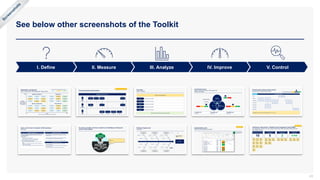
See below other screenshots of the Toolkit
43
I. Define III. Analyze IV. Improve
II. Measure V. Control
Screenshots
Structure of the Toolkit
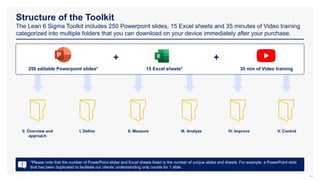
The Lean 6 Sigma Toolkit includes 250 Powerpoint slides, 15 Excel sheets and 35 minutes of Video training
categorized into multiple folders that you can download on your device immediately after your purchase.
44
*Please note that the number of PowerPoint slides and Excel sheets listed is the number of unique slides and sheets. For example, a PowerPoint slide
that has been duplicated to facilitate our clients’ understanding only counts for 1 slide.
0. Overview and
approach
250 editable Powerpoint slides*
+
I. Define II. Measure III. Analyze IV. Improve
15 Excel sheets*
+
35 min of Video training
V. Control
Key Benefits of our Management Consulting Toolkits
45
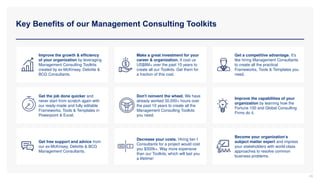
Improve the growth & efficiency
of your organization by leveraging
Management Consulting Toolkits
created by ex-McKinsey, Deloitte &
BCG Consultants.
Make a great investment for your
career & organization. It cost us
US$8M+ over the past 10 years to
create all our Toolkits. Get them for
a fraction of this cost.
Get a competitive advantage. It’s
like hiring Management Consultants
to create all the practical
Frameworks, Tools & Templates you
need.
Get the job done quicker and
never start from scratch again with
our ready-made and fully editable
Frameworks, Tools & Templates in
Powerpoint & Excel.
Improve the capabilities of your
organization by learning how the
Fortune 100 and Global Consulting
Firms do it.
Get free support and advice from
our ex-McKinsey, Deloitte & BCG
Management Consultants.
Decrease your costs. Hiring tier-1
Consultants for a project would cost
you $300k+. Way more expensive
than our Toolkits, which will last you
a lifetime!
Become your organization’s
subject matter expert and impress
your stakeholders with world-class
approaches to resolve common
business problems.
Don't reinvent the wheel. We have
already worked 30,000+ hours over
the past 10 years to create all the
Management Consulting Toolkits
you need.
46
What our clients say about our Toolkits
Reviews imported from Facebooks, Amazon and Klaviyo
See more reviews >
47
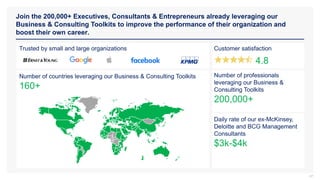
Trusted by small and large organizations Customer satisfaction
Number of countries leveraging our Business & Consulting Toolkits
160+
Number of professionals
leveraging our Business &
Consulting Toolkits
200,000+
4.8
Daily rate of our ex-McKinsey,
Deloitte and BCG Management
Consultants
$3k-$4k
Join the 200,000+ Executives, Consultants & Entrepreneurs already leveraging our
Business & Consulting Toolkits to improve the performance of their organization and
boost their own career.
Interested in more than 1 Toolkit?
Access all our Toolkits for half the price with our Gold Access
48
Gold Access
Click here to learn more
Need additional help on top of our Management Consulting Toolkits?
Send us a brief and we’ll find you the right talent from our network of 500 tier-1 Management
Consultants (the average daily rate is $3k)
Click here to send us a Project Brief
This was just a small preview.
50
www.domontconsulting.com

13._Lean_6_Sigma_Toolkit_-_Overview_and_Approach.pptx

  • 1.
    Lean 6 SigmaToolkit Overview and Approach Created by ex-McKinsey, Deloitte & BCG Management Consultants Confidential
  • 2.
    • “This Toolkitwas created by ex-McKinsey, Deloitte and BCG Management Consultants specialized on Lean Six Sigma. It includes all the Frameworks, Best Practices & Templates required to adopt and implement Lean 6 Sigma within your organization using the world-class DMAIC approach. Build success stories such as Motorola who saved over $16 billion in costs and increased customer satisfaction by 15% using Lean 6 Sigma.” • Join the 200,000+ Executives, Consultants & Entrepreneurs who are already leveraging our Management Consulting Toolkits to improve the performance of their organization and boost their own career. • If you have any questions, send us an email at support@domontconsulting.com and one of our ex-McKinsey, Deloitte & BCG Management Consultants will get back to you within 2 business days.” Introduction 2 Aurelien Domont Management Consultant Domont Consulting Managing Director
  • 3.
    Table of contents 3 1What is Lean Six Sigma? 2 What are the key benefits of using Lean Six Sigma? 3 Lean Six Sigma Toolkit - Approach and overview
  • 4.
    Table of contents 4 1What is Lean Six Sigma? 2 What are the key benefits of using Lean Six Sigma? 3 Lean Six Sigma Toolkit - Approach and overview
  • 5.
    Lean Six Sigmaprovides a balanced approach to simultaneously reducing complexity (Lean) and increasing reliability (Six Sigma) 5 Simplicity (Lean) Reliability (Six Sigma) Low Low Simple + Low reliability Simple + High reliability Complex + Low reliability Complex + High reliability High High
  • 6.
    Lean methodology definition 6 Leanis a structured approach focusing on simplifying processes by eliminating the tasks that don’t bring value to the end customer. This approach was mostly derived from the Toyota Production System (TPS) in the beginning of the 20th century and identified as "lean" only in the 1990s
  • 7.
    Lean methodology objective Theobjective of a Lean project is to eliminate 8 types of waste that can be easily remembered using the word “Downtime" 7 Defects Overproduction Waiting Non-utilized talent Transportation Extra-processing Motion Inventory DOWNTIME
  • 8.
    Lean methodology objective Leantries to eliminate 8 types of waste that can be easily remembered using the word “Downtime" 8 Defects Defects Making mistakes that cause products to fail customer requirements Defects Transportation Unnecessary movements of products and materials Defects Overproduction Making more than it is immediately required Defects Inventory Storing parts, pieces, documentation ahead of requirements Defects Waiting Waiting for the previous step in the process to complete Defects Motion Unnecessary movements by people Defects Non-utilized talent Not recognizing and utilizing human talent and creativity available within the workforce Defects Extra- processing Performing any activity that is not necessary to produce a functioning product or service
  • 9.
    Lean methodology objective Leantries to eliminate 8 types of waste that can be easily remembered using the word “Downtime" 9 Defects Defects 1. Wrong-site surgeries 2. Medication errors 3. Dealing with service complaints 4. Illegible, handwritten information 5. Collection of incorrect patient information Defects Transportation 1. Moving patients from room to room 2. Poor workplace layouts, for patient services 3. Moving equipment in and out of procedure room or operating room Defects Overproduction 1. Multiple signature requirements 2. Extra copies of forms 3. Multiple information systems entries 4. Printing hard copy of report when digital is sufficient Defects Inventory 1. Overstocked medications on units/floors or in pharmacy 2. Physician orders building up to be entered 3. Unnecessary instruments contained in operating kits Defects Waiting 1. Early admissions for procedures later in the day 2. Waiting for internal transport between departments Defects Motion 1. Leaving patient rooms to get supplies or record 2. Large reach/walk distance to complete a process step Defects Non-utilized talent 1. Not using people’s mental, creative, and physical abilities 2. Staff not involved in redesigning processes in their workplace Defects Extra- processing 1. Asking the patient the same questions multiple times 2. Unnecessary carbon copying 3. Batch printing patient labels Real-life example
  • 10.
    Six Sigma methodologydefinition 10 Six Sigma is a structured approach focusing on improving process reliability in order to eliminate the defects in products and services. This approach was developed in 1986 by Motorola and popularized by GE.
  • 11.
    Six Sigma methodologyobjective The objective of a Six Sigma project is to reduce process variation to such a degree that the sigma’s of variation will fit within the specification limits defined by customers 11 Technically, 6s refers to having a process that will result in fewer than 3.4 defects per one million opportunities (DPMO) 1s 1s 2s 3s 2s 3s 4s 4s Customer lower specification limit (LSL) Customer higher specification limit (HSL) Defects Defects Reduce Variations
  • 12.
    Lean Six Sigmamethodology definition 12 Lean A structured approach focusing on simplifying processes Six Sigma A structured approach focusing on improving process reliability in order to eliminate the defects in products and services Lean Six Sigma A performance improvement methodology focusing on simplifying processes and improving process reliability + =
  • 13.
    Lean Six Sigmakey principles 13 Defining the customer’s perception of value is key to improving the process Focus on your customer The process performance needs to be measured before and after implementing Lean Six Sigma Measure process performance Your value stream is “the processes of creating, producing, and delivering a good or service to the market”1 Identify value stream Source: APICS Dictionary
  • 14.
    Lean 6 Sigmabackground 14 1950’s – 70’s 1980’s 1990’s 2000’s • Japanese car makers • Motorola • Campbells • Coors • Merrill Lynch • JP Morgan • Cargill • Caterpillar • GE • Johnson & Johnson • Citigroup • Allied Signal • Primarily Automotive and Heavy Equipment • Expansion across Automotive and Manufacturing • Automotive • Consumer Business • Pharmaceutical • Healthcare • Financial Services • Beginning of use in Pharmaceutical and Financial Services • 1950s: W. Edward Deming Plan-Do-Check-Act • 1960s/70s: Toyota Lean Production System • 1980s: - Motorola initiates ”Six Sigma Quality” - TQM - Malcom Baldridge Award • 2000: Lean Six Sigma adoption increases • 1990s: Lean manufacturing application to non- automotive industries begins Business Improvement Tools/Methods Industries Companies
  • 15.
    Table of contents 15 1What is Lean Six Sigma? 2 What are the key benefits of using Lean Six Sigma? 3 Lean Six Sigma Toolkit - Approach and overview
  • 16.
    Lean Six Sigmadrives shareholder value Lean Six Sigma addresses both tactical and strategic value drivers linked directly to shareholder value 16 • On-time delivery • Lead time/Cycle time reduction • Improved product quality • Reduced time to market • Reduced supply chain costs • Reduced factory operating expenses • Reduced SG&A costs • Reduced quality costs • Reduced IT costs • Inventory reduction • Improved labor productivity • Asset consolidation • Increased factory space • Greater return on IT investment Shareholder Value Revenue Growth Operating Margin Asset Efficiency
  • 17.
    Lean Six Sigmabenefit #1 Lean Six Sigma increases asset efficiency 17 One employee was able to process 2 home loans a day One employee was able to process 4 home loans a day Before implementing Lean Six Sigma After implementing Lean Six Sigma Other examples: Implementing Lean Six Sigma can also help decrease your stock and optimize your working space = = Real-life example
  • 18.
    Lean Six Sigmabenefit #2 Lean Six Sigma decreases cost 18 18 Number of broken products and related cost to remanufacture them (per month): Number of broken products and related cost to remanufacture them (per month): Before implementing Lean Six Sigma After implementing Lean Six Sigma Other examples: Implementing Lean Six Sigma can also help decrease your IT, supply Chain and SG&A costs Real-life example Broken products Cost Broken products Cost 8 $80k 1 $10k
  • 19.
    Lean Six Sigmabenefit #3 Lean Six Sigma increases revenue 19 A sales representative was focusing 20% of his time on administrative tasks and 80% of his time on selling products The process improvement allowed the sales representative to focus only 10% of his time on administrative tasks and 90% of his time on selling products Before implementing Lean Six Sigma After implementing Lean Six Sigma Other examples: Implementing Lean Six Sigma can also help to improve product quality, on-time delivery and customer satisfaction Real-life example
  • 20.
    Typical improvement rangesin a manufacturing environment Benchmark savings 20 Raw Material Inventory Supplier Cost Floor Space Cycle Time Support Labor Defects Direct Labor 0% 25% 50% 75% 100 %
  • 21.
    Typical improvement rangesin a white-collar environment Benchmark savings 21 Defects/Poor Quality Cycle Time Revenue Growth Information Handoffs Supplies Value-add per employee Labor 0% 25% 50% 75% 100 %
  • 22.
    Success stories ofcompanies using Lean Six Sigma Motorola estimated that its Six Sigma program had saved the company over $16 billion in costs and increased customer satisfaction by 15% 22 Motorola is a global telecommunications company that is often credited with the development of the Six Sigma methodology. In the 1980s, Motorola was struggling with quality control issues in its manufacturing processes, which led to high costs and low customer satisfaction. To address these issues, Motorola implemented the Six Sigma methodology to improve its processes and reduce defects. As a result of its Six Sigma efforts, Motorola was able to significantly reduce defects in its products, which led to increased customer satisfaction and reduced costs. In fact, by the early 1990s, Motorola estimated that its Six Sigma program had saved the company over $16 billion in costs and increased customer satisfaction by 15%. Motorola's success with Six Sigma has inspired many other companies to adopt the methodology and has helped to establish Six Sigma as a leading approach to process improvement. Today, Six Sigma is used by companies around the world to improve their processes and increase efficiency.
  • 23.
    Success stories ofcompanies using Lean Six Sigma Toyota is widely regarded as one of the most efficient and effective automotive manufacturers in the world 23 Toyota is a Japanese automotive manufacturer that is known for its use of Lean manufacturing principles. In the early 2000s, Toyota was struggling with quality control issues in its manufacturing processes, which led to a series of high-profile recalls and damaged the company's reputation. To address these issues, Toyota implemented a Six Sigma program to improve its processes and reduce defects. The company also introduced a quality control initiative called "Total Quality Management" (TQM) that emphasized the importance of continuous improvement and employee involvement. As a result of its Six Sigma and TQM efforts, Toyota was able to significantly improve its product quality and reduce defects. In fact, the company's quality control improvements were so successful that they became known as the "Toyota Way" and have been emulated by many other companies around the world. Today, Toyota is known for its commitment to quality and continuous improvement, and is widely regarded as one of the most efficient and effective automotive manufacturers in the world.
  • 24.
    Success stories ofcompanies using Lean Six Sigma GE has credited Lean Six Sigma with saving the company billions of dollars and improving customer satisfaction 24 General Electric (GE) is a multinational conglomerate that has been using Lean Six Sigma since the 1990s to improve its manufacturing and business processes. GE has credited Lean Six Sigma with saving the company billions of dollars and improving customer satisfaction. One of the most famous success stories from GE's Six Sigma program is its efforts to improve the quality of its aircraft engines. In the 1990s, GE's aircraft engines were experiencing high levels of defects and failures, which were leading to costly repairs and replacements. To address these issues, GE implemented the Six Sigma methodology to improve its manufacturing processes and reduce defects. The company also introduced a quality control initiative called "Design for Six Sigma" (DFSS) that emphasized the importance of designing products that were less likely to fail. As a result of its Six Sigma and DFSS efforts, GE was able to significantly improve the quality of its aircraft engines and reduce the number of defects and failures. In fact, by the early 2000s, GE's aircraft engines had become so reliable that they were considered the most reliable engines in the world.
  • 25.
    Table of contents 25 1What is Lean Six Sigma? 2 What are the key benefits of using Lean Six Sigma? 3 Lean Six Sigma Toolkit - Approach and overview
  • 26.
    Content of theLean 6 Sigma Toolkit 26 Frameworks Tools Templates Step-by-step tutorials Video Training Real-life examples Best practices Advise from tier- 1 management consultants What’s inside our Toolkit?
  • 27.
    Objectives of theToolkit The Lean 6 Sigma Toolkit includes frameworks, tools, templates, tutorials, real-life examples, best practices and video training to help you: 27 • Adopt and implement a Lean 6 Sigma methodology within your organization using the 5 phases of the world-class DMAIC approach: (I) Define, (II) Measure, (III) Analyze, (IV) Improve, (V) Control • (I) Define: (1) Define the problem to solve, (2) Define clear and measurable project goals aligned with the corporate and business strategy, (3) Define the high-level current process and the scope with the SIPOC tool, (4) Establish the timeline and budget for the project, (5) Conduct a stakeholder analysis, (6) Define the project team, (7) Define the customer requirements using the VOC technique and Critical-to-Quality tree, (8) Define the data collection plan • (II) Measure: (1) Measure the current process performance, (2) Create assumptions for what might be causing problems, (3) Collect data and ensure data reliability • (III) Analyze: (1) Analyze the data in detail, (2) Verify your assumptions in terms of what might be causing problems using the “Five Whys” problem solving tool, the “Fishbone Diagram” tool, and the Pareto Analysis tool • (IV) Improve: (1) Define ideation constraints, (2) Generate potential solutions using “How might we” questions, ideation workshop, brainstorming, the Crazy 8S tool and the 5 S framework, (3) Categorize the solutions using mind mapping, (4) Create a business case & financial model for the most promising solutions, (5) Select the best solution, (6) Test the solution using a testing sheet and a feedback capture grid, (7) Create a standard operating procedure (SOP), (8) Implement the solution(s), (9) Assess commitment with the commitment curve tool, (10) Measure improvement • (V) Control: (1) Monitor and continuously improve the process with the Kaizen approach, (2) Share and celebrate your success, (3) Apply new knowledge to other processes in your organization • Build success stories such as Motorola who saved over $16 billion in costs and increased customer satisfaction by 15% by applying Lean 6 Sigma
  • 28.
    The Lean 6Sigma DMAIC methodology is an iterative process 28 I. Define III. Analyze IV. Improve II. Measure V. Control
  • 29.
    Lean 6 SigmaDMAIC methodology 29 I. Define III. Analyze IV. Improve II. Measure V. Control Define the problem and set up project goals Measure current performance & brainstorm potential cause(s) of the problem Analyze the data and identify the root causes of waste Develop solutions to address the root causes Monitor and continuously improve Objective Activities 1. Measure the current process performance 2. Create assumptions for what might be causing problems 3. Collect data and ensure data reliability 1. Monitor and continuously improve the process with the Kaizen approach 2. Share and celebrate your success 3. Apply new knowledge to other processes in your organization 1. Define the problem to solve 2. Define clear and measurable project goals aligned with the corporate and business strategy 3. Define the high-level current process and the scope with the SIPOC tool 4. Establish the timeline and budget for the project 5. Conduct a stakeholder analysis 6. Define the project team 7. Define the customer requirements using the VOC technique and Critical-to- Quality tree 8. Define the data collection plan 1. Analyze the data in detail 2. Verify your assumptions in terms of what might be causing problems using the “Five Whys” problem solving tool, the “Fishbone Diagram” tool, and the Pareto Analysis tool 1. Define ideation constraints 2. Generate potential solutions using “How might we” questions, ideation workshop, brainstorming, the Crazy 8S tool and the 5 S framework 3. Categorize the solutions using mind mapping 4. Create a business case & financial model for the most promising solutions 5. Select the best solution 6. Test the solution using a testing sheet and a feedback capture grid 7. Create a standard operating procedure (SOP) 8. Implement the solution(s) 9. Assess commitment with the commitment curve tool 10.Measure improvement
  • 30.
    In the nextslides, you’ll see a small preview of the Toolkit 30 I. Define III. Analyze IV. Improve II. Measure V. Control Define the problem and set up project goals Measure current performance & brainstorm potential cause(s) of the problem Analyze the data and identify the root causes of waste Develop solutions to address the root causes Monitor and continuously improve Objective Activities 1. Measure the current process performance 2. Create assumptions for what might be causing problems 3. Collect data and ensure data reliability 1. Monitor and continuously improve the process with the Kaizen approach 2. Share and celebrate your success 3. Apply new knowledge to other processes in your organization 1. Define the problem to solve 2. Define clear and measurable project goals aligned with the corporate and business strategy 3. Define the high-level current process and the scope with the SIPOC tool 4. Establish the timeline and budget for the project 5. Conduct a stakeholder analysis 6. Define the project team 7. Define the customer requirements using the VOC technique and Critical-to- Quality tree 8. Define the data collection plan 1. Analyze the data in detail 2. Verify your assumptions in terms of what might be causing problems using the “Five Whys” problem solving tool, the “Fishbone Diagram” tool, and the Pareto Analysis tool 1. Define ideation constraints 2. Generate potential solutions using “How might we” questions, ideation workshop, brainstorming, the Crazy 8S tool and the 5 S framework 3. Categorize the solutions using mind mapping 4. Create a business case & financial model for the most promising solutions 5. Select the best solution 6. Test the solution using a testing sheet and a feedback capture grid 7. Create a standard operating procedure (SOP) 8. Implement the solution(s) 9. Assess commitment with the commitment curve tool 10.Measure improvement
  • 31.
    Table of contents 31 I.Define III. Analyze IV. Improve II. Measure V. Control Define the problem and set up project goals Measure current performance & brainstorm potential cause(s) of the problem Analyze the data and identify the root causes of waste Develop solutions to address the root causes Monitor and continuously improve Objective Activities 1. Measure the current process performance 2. Create assumptions for what might be causing problems 3. Collect data and ensure data reliability 1. Monitor and continuously improve the process with the Kaizen approach 2. Share and celebrate your success 3. Apply new knowledge to other processes in your organization 1. Define the problem to solve 2. Define clear and measurable project goals aligned with the corporate and business strategy 3. Define the high-level current process and the scope with the SIPOC tool 4. Establish the timeline and budget for the project 5. Conduct a stakeholder analysis 6. Define the project team 7. Define the customer requirements using the VOC technique and Critical-to- Quality tree 8. Define the data collection plan 1. Analyze the data in detail 2. Verify your assumptions in terms of what might be causing problems using the “Five Whys” problem solving tool, the “Fishbone Diagram” tool, and the Pareto Analysis tool 1. Define ideation constraints 2. Generate potential solutions using “How might we” questions, ideation workshop, brainstorming, the Crazy 8S tool and the 5 S framework 3. Categorize the solutions using mind mapping 4. Create a business case & financial model for the most promising solutions 5. Select the best solution 6. Test the solution using a testing sheet and a feedback capture grid 7. Create a standard operating procedure (SOP) 8. Implement the solution(s) 9. Assess commitment with the commitment curve tool 10.Measure improvement
  • 32.
    SIPOC tool Description 32 SIPOC isan acronym used for Supplier-Input-Process-Output-Customer: • Suppliers provide inputs to the process • Inputs are resources used by the process • Process is the high-level sequence of activities that produces the output • Outputs are the tangible products or services that are produced by the process • Customers are the users of the outputs SIPOC gives you a one-page depiction of how the given process is servicing the customer It also provides an overview and establishes the boundaries of a process And finally, it gives initial insights into the vital inputs of a process that have a significant impact on the outputs What it is and why use it? • To build common understanding of the end to end process among stakeholders and team members • To understand the high-level view of an end to end process when commencing an improvement initiative When and where to use? • SIPOC helps to understand a process at a high level before going into the detail • Avoid having intended improvements on the SIPOC. It should always represent the current state • Consider having Critical-to-Quality (CTQ) requirements for inputs, process and outputs Insights
  • 33.
    High-level current processand scope SIPOC Tool 33 Start point: [insert your own text] Process Name: [Identify the process to be worked on] Process Owner: [Confirm the process owner] End point: [insert your own text]  Insert the suppliers to the process Suppliers Inputs Outputs Customers Process  Insert inputs provided by suppliers  Insert tangible outputs  Insert the customers of the process  List what are the necessary requirements for process Process Requirements  List what is critical to customer Customer Requirements Insert your own text Insert your own text Insert your own text Insert your own text Insert your own text In scope Out of scope
  • 34.
    High-level current processand scope SIPOC Tool 34 Start point: [insert your own text] Process Name: [Identify the process to be worked on] Process Owner: [Confirm the process owner] End point: [insert your own text]  Insert the suppliers to the process Suppliers Inputs Outputs Customers Process  Insert inputs provided by suppliers  Insert tangible outputs  Insert the customers of the process  List what are the necessary requirements for process Process Requirements  List what is critical to customer Customer Requirements Insert your own text Insert your own text Insert your own text Insert your own text Insert your own text In scope Out of scope Tutorial There should be no more than 5-7 high-level process steps Outputs should be tangible There may be many inputs into the process but use only the vital ones that are used to create to output
  • 35.
    High-level current processand scope SIPOC Tool 35 Start point: the shop orders coffee bean Process Name: [Identify the process to be worked on] Process Owner: [Confirm the process owner] End point: The customer drinks her coffee  Coffee bean supplier Suppliers Inputs Outputs Customers Process  Roasted coffee beans  Milk  Water  Syrup  Cups  Lids  Espresso  Latte  Cappuccino  Mocha  Americano  Hot chocolate  In-store customers  Drive-thru customers  All the inputs have been received on time and in the right quantity Process Requirements  Quality coffee beverages that taste good  Quick and efficient service  Friendly and helpful customer service Customer Requirements Grind coffee beans Brew coffee Steam milk Mix coffee, milk, and syrup Pour into cups In scope Out of scope Real-life example for a coffee shop Add lids
  • 36.
    High-level current processand scope SIPOC Tool 36  Insert your own text Suppliers Inputs Outputs Customers Process  Insert your own text  Insert your own text  Insert your own text  Insert your own text IN SCOPE S I P O C 7 Weeks 5 Weeks 3 Weeks Insert your own text Insert your own text Insert your own text Insert your own text 1 Weeks Additional template
  • 37.
    High-level current processand scope SIPOC Tool 37  Development project manager  Employee communicating server need  Procurement Department  Relationship Manager Suppliers Inputs Outputs Customers Process  Project Plans/Timeline  Requested Specifications  Purchase Order  A 4-phase process which currently takes 16 weeks  Installed Server  Development project manager  Infrastructure team  Business Owner 7 Weeks 5 Weeks 3 Weeks IN SCOPE Installation Vendor Processing Purchase Order Processing Requirements Definition 1 Weeks S I P O C Real-life example
  • 38.
    Table of contents 38 I.Define III. Analyze IV. Improve II. Measure V. Control Define the problem and set up project goals Measure current performance & brainstorm potential cause(s) of the problem Analyze the data and identify the root causes of waste Develop solutions to address the root causes Monitor and continuously improve Objective Activities 1. Measure the current process performance 2. Create assumptions for what might be causing problems 3. Collect data and ensure data reliability 1. Monitor and continuously improve the process with the Kaizen approach 2. Share and celebrate your success 3. Apply new knowledge to other processes in your organization 1. Define the problem to solve 2. Define clear and measurable project goals aligned with the corporate and business strategy 3. Define the high-level current process and the scope with the SIPOC tool 4. Establish the timeline and budget for the project 5. Conduct a stakeholder analysis 6. Define the project team 7. Define the customer requirements using the VOC technique and Critical-to- Quality tree 8. Define the data collection plan 1. Analyze the data in detail 2. Verify your assumptions in terms of what might be causing problems using the “Five Whys” problem solving tool, the “Fishbone Diagram” tool, and the Pareto Analysis tool 1. Define ideation constraints 2. Generate potential solutions using “How might we” questions, ideation workshop, brainstorming, the Crazy 8S tool and the 5 S framework 3. Categorize the solutions using mind mapping 4. Create a business case & financial model for the most promising solutions 5. Select the best solution 6. Test the solution using a testing sheet and a feedback capture grid 7. Create a standard operating procedure (SOP) 8. Implement the solution(s) 9. Assess commitment with the commitment curve tool 10.Measure improvement
  • 39.
    Standard operating procedure(SOP) Description 39 Standard Operating Procedures (SOPs) are documents describing the standard way of how a task should be performed in the best possible manner under given circumstances SOPs are used to: • Increase consistency and predictability of service and customer satisfaction • Prevent and reduce errors, re-work and customer complaints • Set performance expectations, drive desired results and compare actual outcomes to target • Establish best practice as standard working procedure What it is and why use it? • Apply SOPs to frequently occurring, repeatable tasks and procedures. • Use SOPs for Employee training and standard setting for process compliance. When and where to use? • Easily accessible at the point of use. • Living documents that represents the single source of truth • A good way to assess the usage of SOPs is evidence of actual usage throughout a process • Updating, communicating and maintaining version control is vital. • Prioritise introduction of SOPs into areas with relatively greater improvement opportunities Tips
  • 40.
    Standard Operating Procedure(SOP) Procedure Name: [Insert your own text] Owner: [Insert your own text] Version: [Insert your own text] 40 Responsibilities [insert your own text] Purpose [insert your own text] Scope [insert your own text] Procedure 1. [insert your own text] • [insert your own text] • [insert your own text] • [insert your own text] 2. [insert your own text] • [insert your own text] • [insert your own text] • [insert your own text] 3. [insert your own text] • [insert your own text] • [insert your own text] • [insert your own text] Template
  • 41.
    Standard Operating Procedure(SOP) Procedure Name: Product Packaging Procedure Owner: Product manager Version: Version 8, 30/03/2023 41 Responsibilities Packaging Operator: Responsible for packaging products according to the SOP. Quality Control: Responsible for ensuring that the packaging meets the required quality standards. Production Manager: Responsible for ensuring that the packaging process is executed correctly and that the products meet the desired quality standards. Purpose To provide a standardized process for packaging products to ensure consistency and quality. Scope This SOP applies to all employees involved in the packaging process. Procedure (1/2) 1. Preparation: • Ensure that the product to be packaged is clean and free from defects (click here to access full checklist) • Check that all required packaging materials are available and in good condition. 2. Packaging • Follow the packaging instructions for the product, as outlined in the Product Packaging Specification document. • Verify that the correct labels and stickers are used for the product. • Ensure that the packaging is secured and sealed correctly. 3. Quality control • Perform a visual inspection of the packaged product to ensure that it meets the required quality standards. • Verify that the correct labels and stickers are used for the product. • Complete the Quality Control Checklist and document any issues or defects. 4. Record Keeping • Record the product packaging data in the Packaging Log, including product name, packaging materials used, and any quality issues or defects. • File the Packaging Log in the appropriate location. 5. Clean up • Clean the packaging area and ensure that all packaging materials are stored correctly. Real-life example
  • 42.
    Standard Operating Procedure(SOP) Procedure Name: Product Packaging Procedure Owner: Product manager Version: Version 8, 30/03/2023 42 Procedure (2/2) 1. Preparation: • Ensure that the product to be packaged is clean and free from defects. • Check that all required packaging materials are available and in good condition. 2. Packaging • Follow the packaging instructions for the product, as outlined in the Product Packaging Specification document. • Verify that the correct labels and stickers are used for the product. • Ensure that the packaging is secured and sealed correctly. 3. Quality control • Perform a visual inspection of the packaged product to ensure that it meets the required quality standards. • Verify that the correct labels and stickers are used for the product. • Complete the Quality Control Checklist and document any issues or defects. 4. Record Keeping • Record the product packaging data in the Packaging Log, including product name, packaging materials used, and any quality issues or defects. • File the Packaging Log in the appropriate location. 5. Clean up • Clean the packaging area and ensure that all packaging materials are stored correctly. Real-life example
  • 43.
    See below otherscreenshots of the Toolkit 43 I. Define III. Analyze IV. Improve II. Measure V. Control Screenshots
  • 44.
    Structure of theToolkit The Lean 6 Sigma Toolkit includes 250 Powerpoint slides, 15 Excel sheets and 35 minutes of Video training categorized into multiple folders that you can download on your device immediately after your purchase. 44 *Please note that the number of PowerPoint slides and Excel sheets listed is the number of unique slides and sheets. For example, a PowerPoint slide that has been duplicated to facilitate our clients’ understanding only counts for 1 slide. 0. Overview and approach 250 editable Powerpoint slides* + I. Define II. Measure III. Analyze IV. Improve 15 Excel sheets* + 35 min of Video training V. Control
  • 45.
    Key Benefits ofour Management Consulting Toolkits 45 Improve the growth & efficiency of your organization by leveraging Management Consulting Toolkits created by ex-McKinsey, Deloitte & BCG Consultants. Make a great investment for your career & organization. It cost us US$8M+ over the past 10 years to create all our Toolkits. Get them for a fraction of this cost. Get a competitive advantage. It’s like hiring Management Consultants to create all the practical Frameworks, Tools & Templates you need. Get the job done quicker and never start from scratch again with our ready-made and fully editable Frameworks, Tools & Templates in Powerpoint & Excel. Improve the capabilities of your organization by learning how the Fortune 100 and Global Consulting Firms do it. Get free support and advice from our ex-McKinsey, Deloitte & BCG Management Consultants. Decrease your costs. Hiring tier-1 Consultants for a project would cost you $300k+. Way more expensive than our Toolkits, which will last you a lifetime! Become your organization’s subject matter expert and impress your stakeholders with world-class approaches to resolve common business problems. Don't reinvent the wheel. We have already worked 30,000+ hours over the past 10 years to create all the Management Consulting Toolkits you need.
  • 46.
    46 What our clientssay about our Toolkits Reviews imported from Facebooks, Amazon and Klaviyo See more reviews >
  • 47.
    47 Trusted by smalland large organizations Customer satisfaction Number of countries leveraging our Business & Consulting Toolkits 160+ Number of professionals leveraging our Business & Consulting Toolkits 200,000+ 4.8 Daily rate of our ex-McKinsey, Deloitte and BCG Management Consultants $3k-$4k Join the 200,000+ Executives, Consultants & Entrepreneurs already leveraging our Business & Consulting Toolkits to improve the performance of their organization and boost their own career.
  • 48.
    Interested in morethan 1 Toolkit? Access all our Toolkits for half the price with our Gold Access 48 Gold Access Click here to learn more
  • 49.
    Need additional helpon top of our Management Consulting Toolkits? Send us a brief and we’ll find you the right talent from our network of 500 tier-1 Management Consultants (the average daily rate is $3k) Click here to send us a Project Brief
  • 50.
    This was justa small preview. 50 www.domontconsulting.com