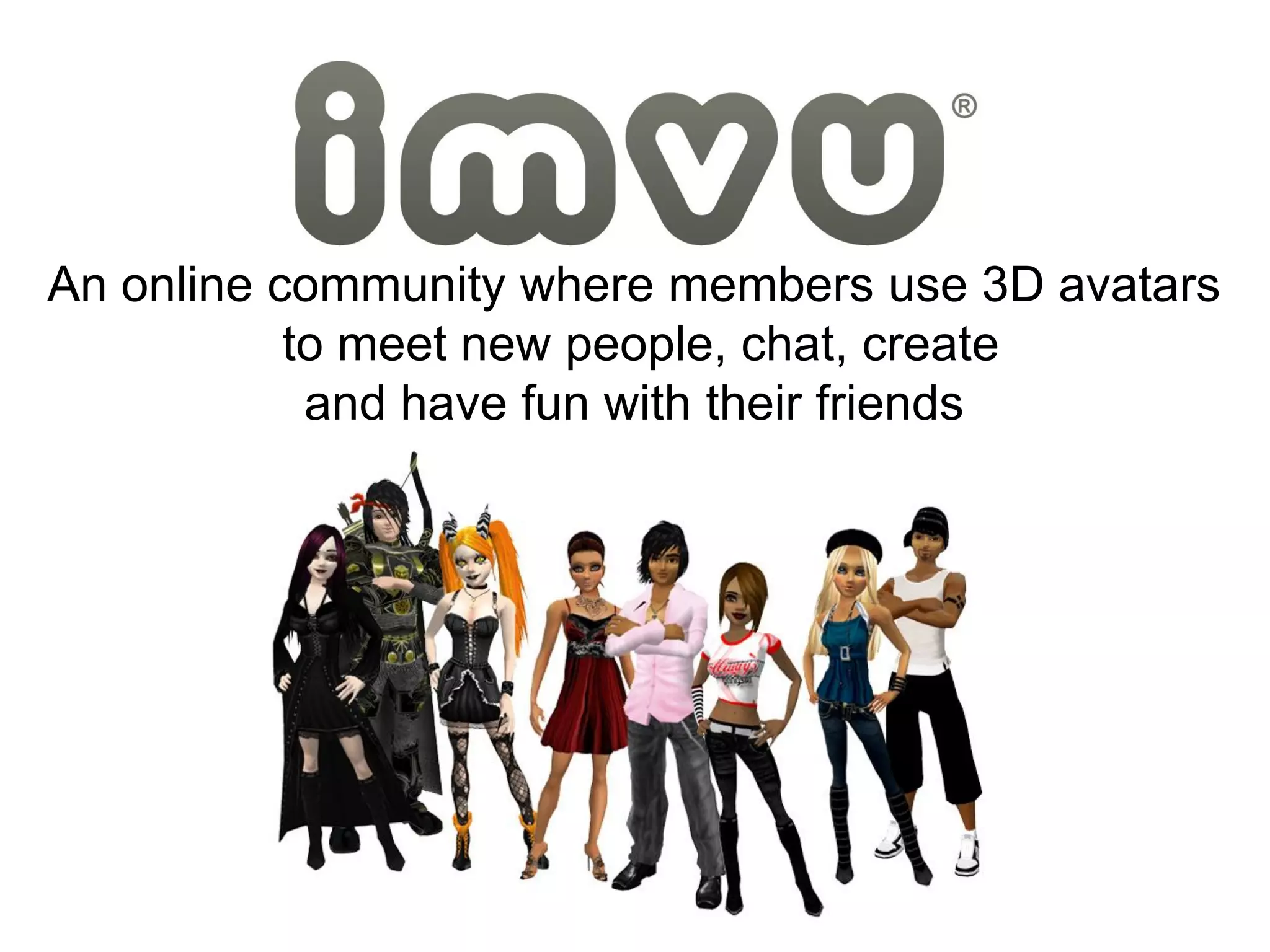
An online community where members use 3D avatars
           to meet new people, chat, create
            and have fun with their friends
Lean Startup Pitfalls Uncovered


       Brett G. Durrett (@bdurrett)
 VP, Engineering & Operations, IMVU, Inc.

      Lean Startup Meetup, San Francisco, July 21, 2010   1
Presentation PIVOT!

a word so popular right now that I had to drop it on the second slide


                                                                        2
The Transition of a Lean Startup
IMVU’s journey to becoming a Large Company


          Brett G. Durrett (@bdurrett)
         VP, Engineering & Operations
                   IMVU, Inc.

         Lean Startup Meetup, San Francisco, July 21, 2010


                                                             3
WTF?


Hey Brett… don’t Large Companies suck?


                                         4
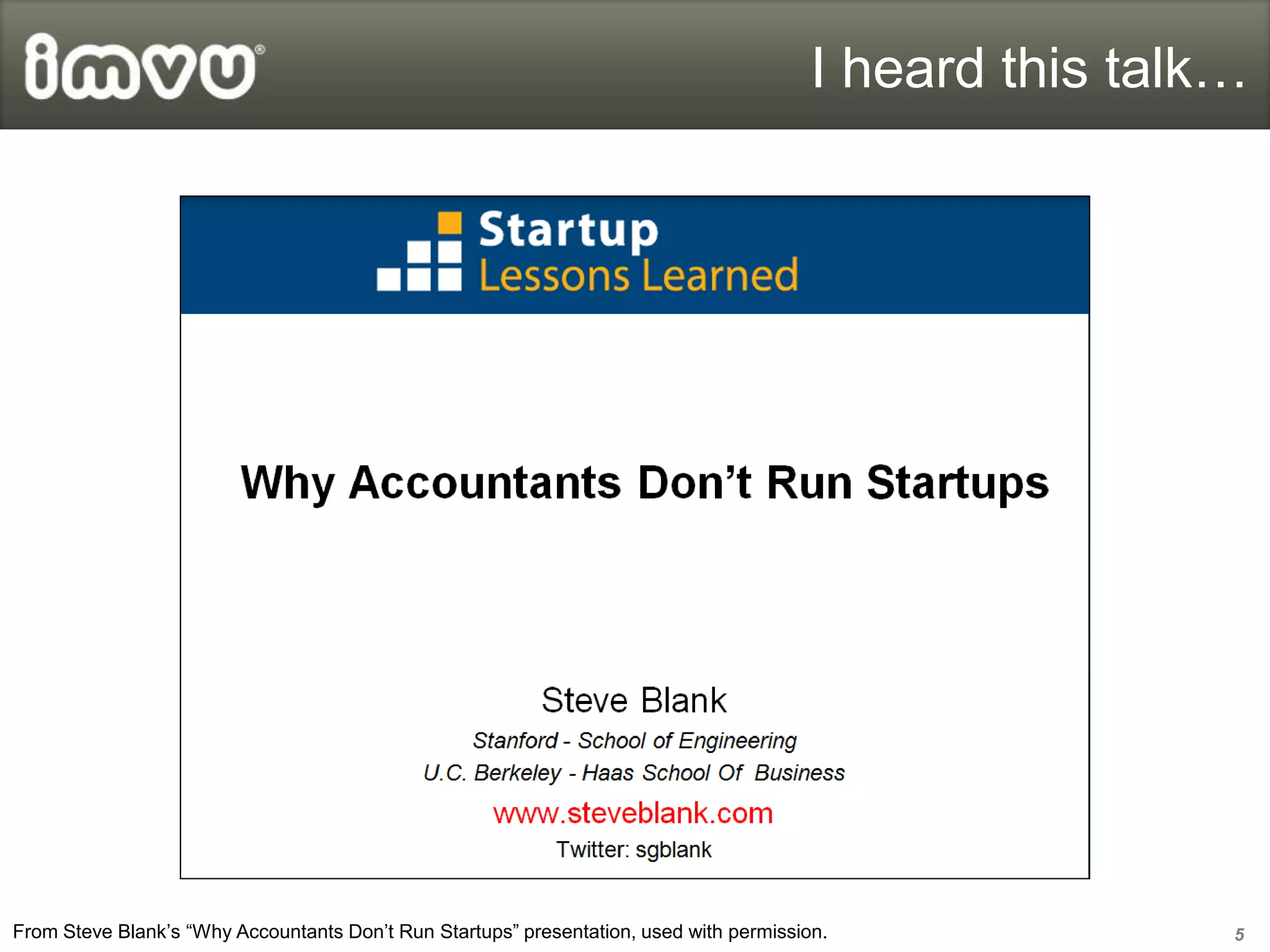
I heard this talk…


From Steve Blank’s “Why Accountants Don’t Run Startups” presentation, used with permission.               5
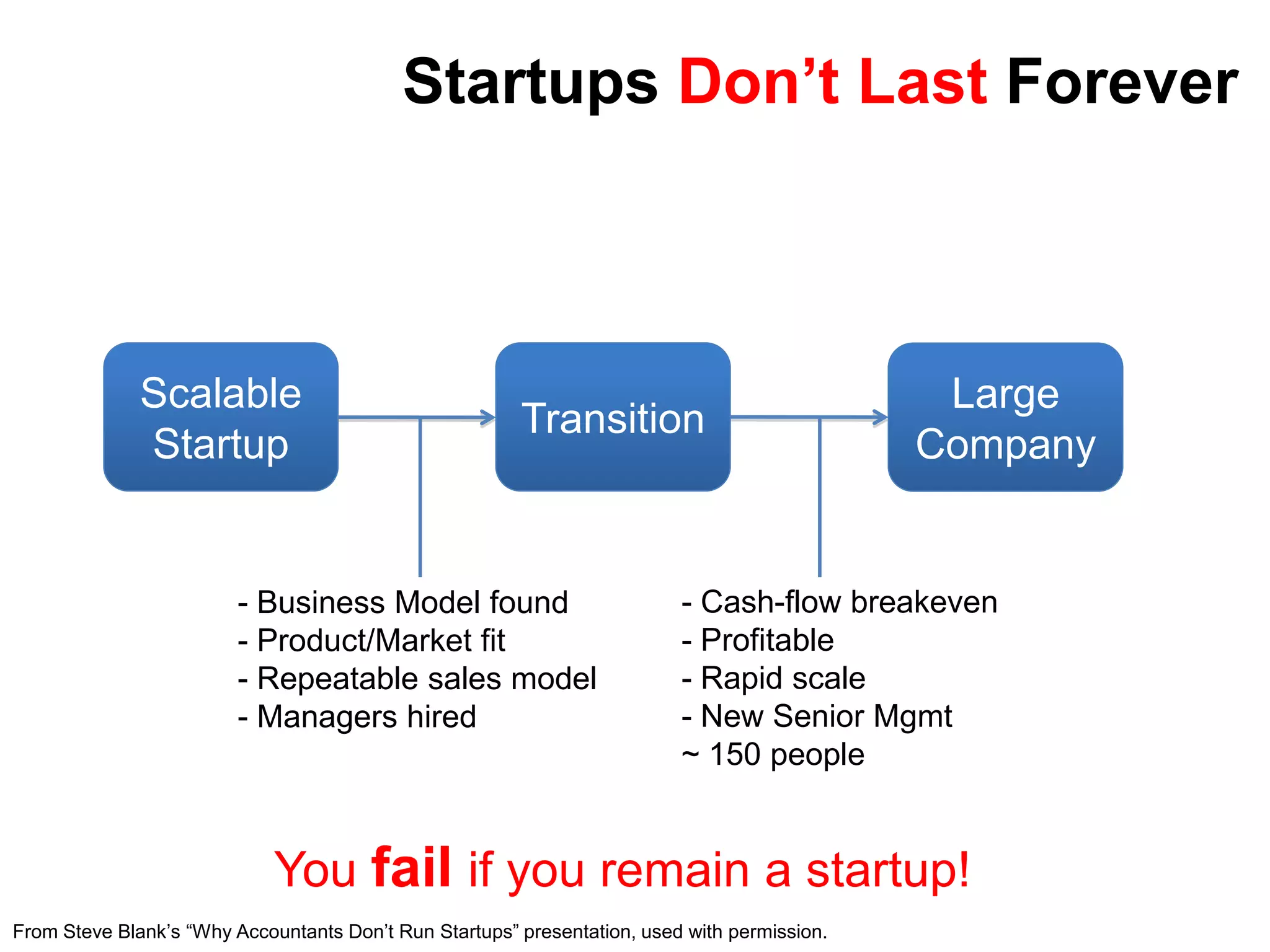
Startups Don’t Last Forever


              Scalable                                                                         Large
                                                        Transition
              Startup                                                                         Company


                         - Business Model found                           - Cash-flow breakeven
                         - Product/Market fit                             - Profitable
                         - Repeatable sales model                         - Rapid scale
                         - Managers hired                                 - New Senior Mgmt
                                                                          ~ 150 people


                             You fail if you remain a startup!
From Steve Blank’s “Why Accountants Don’t Run Startups” presentation, used with permission.
Startups Don’t Last Forever


              Scalable                                                                         Large
                                                        Transition
              Startup                                                                         Company


                         - Business Model found                           - Cash-flow breakeven
                         - Product/Market fit                             - Profitable
                         - Repeatable sales model                         - Rapid scale
                         - Managers hired                                 - New Senior Mgmt
                                                                          ~ 150 people


                             You fail if you remain a startup!
From Steve Blank’s “Why Accountants Don’t Run Startups” presentation, used with permission.
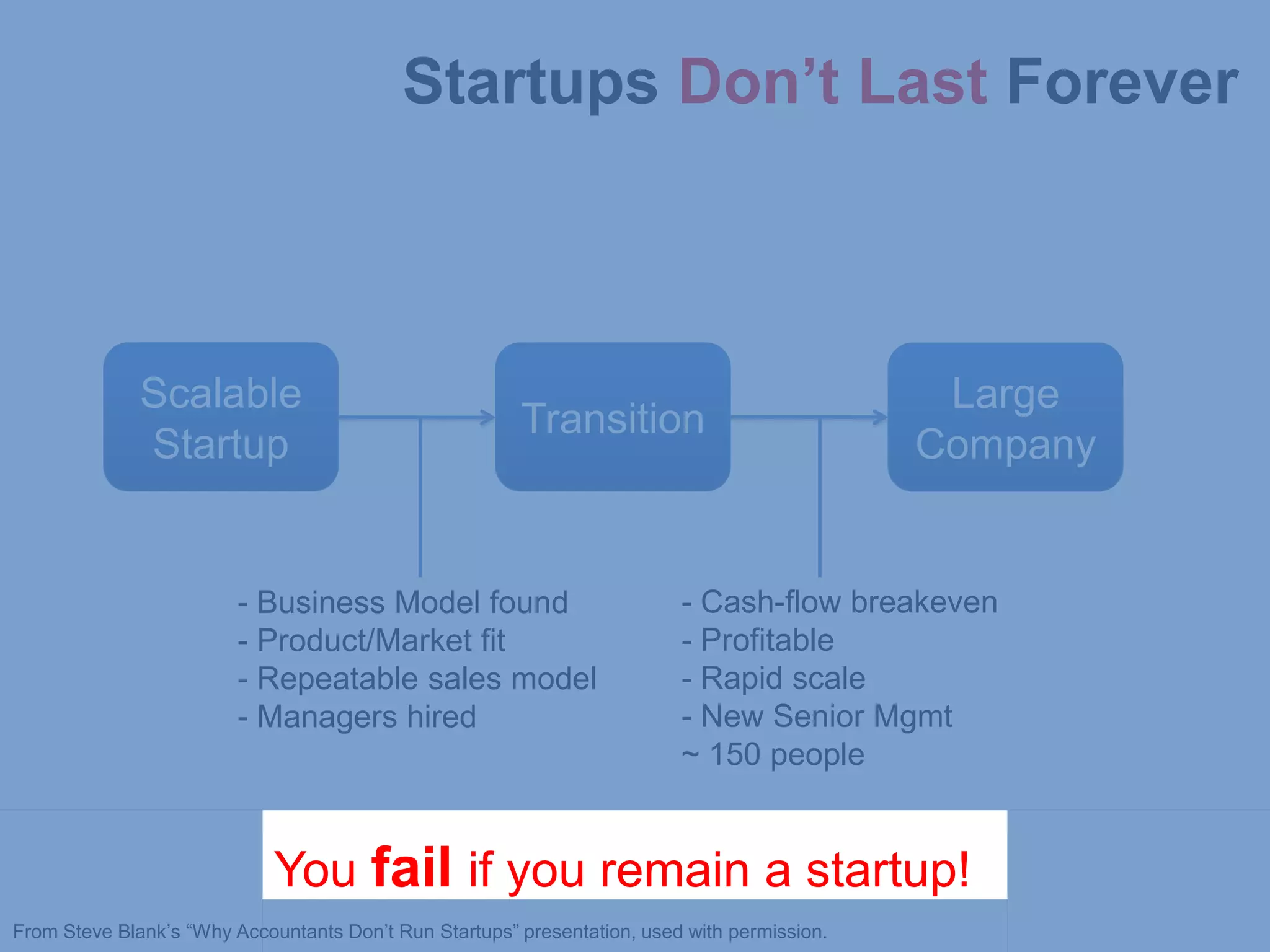
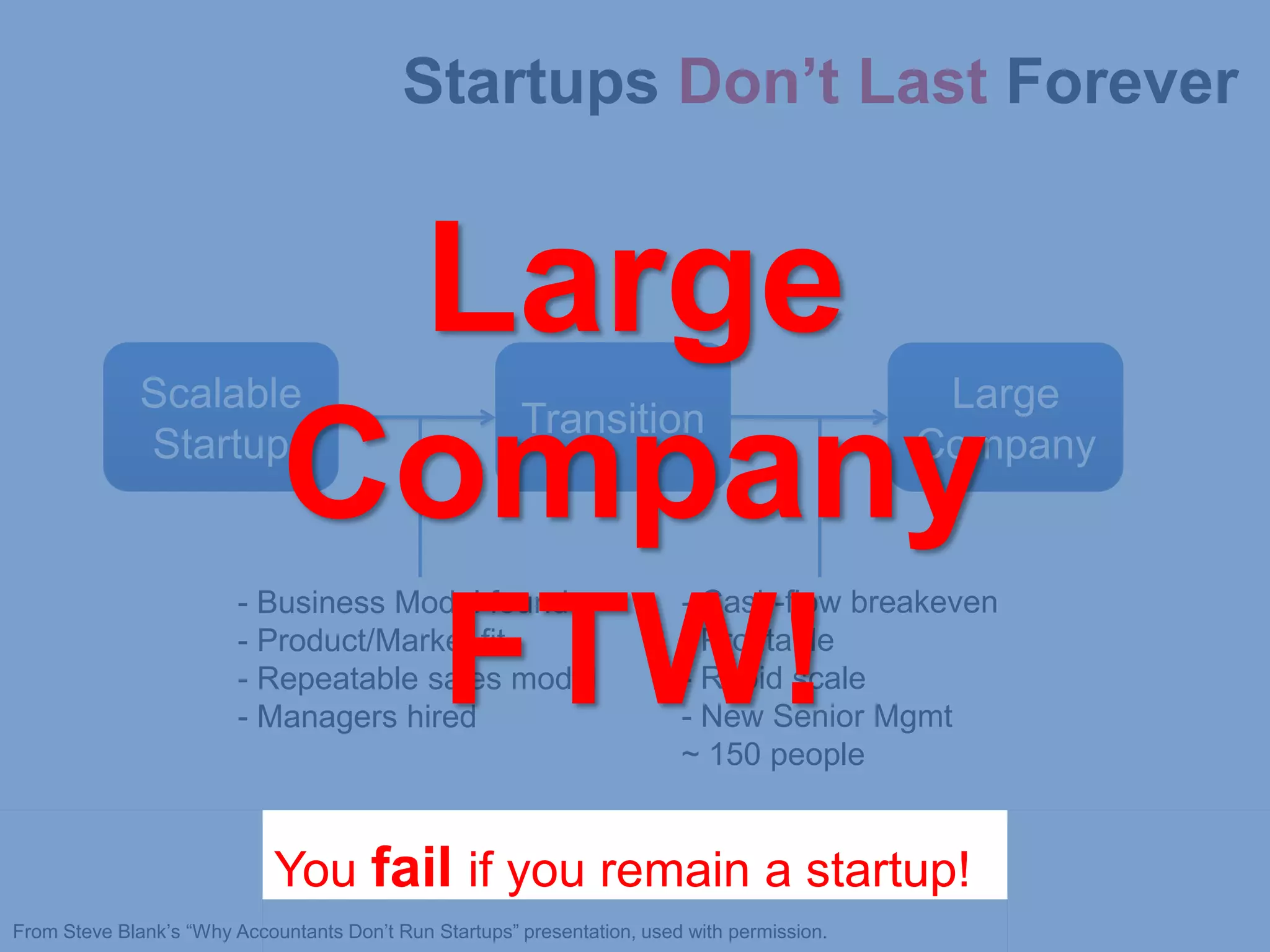
Startups Don’t Last Forever


              Scalable
                               Large                                                           Large
                                                        Transition
              Startup
                              Company                                                         Company


                         - Business Model found                           - Cash-flow breakeven

                                FTW!
                         - Product/Market fit
                         - Repeatable sales model
                         - Managers hired
                                                                          - Profitable
                                                                          - Rapid scale
                                                                          - New Senior Mgmt
                                                                          ~ 150 people


                             You fail if you remain a startup!
From Steve Blank’s “Why Accountants Don’t Run Startups” presentation, used with permission.
The Large Company is the result of a
     successful Scalable Startup


                                       9
The Large Company is the result of a
     successful Scalable Startup

  If you can survive the transition


                                       10
The Large Company is the result of a
     successful Scalable Startup

  If you can survive the transition
         (which has pitfalls)


                                       11
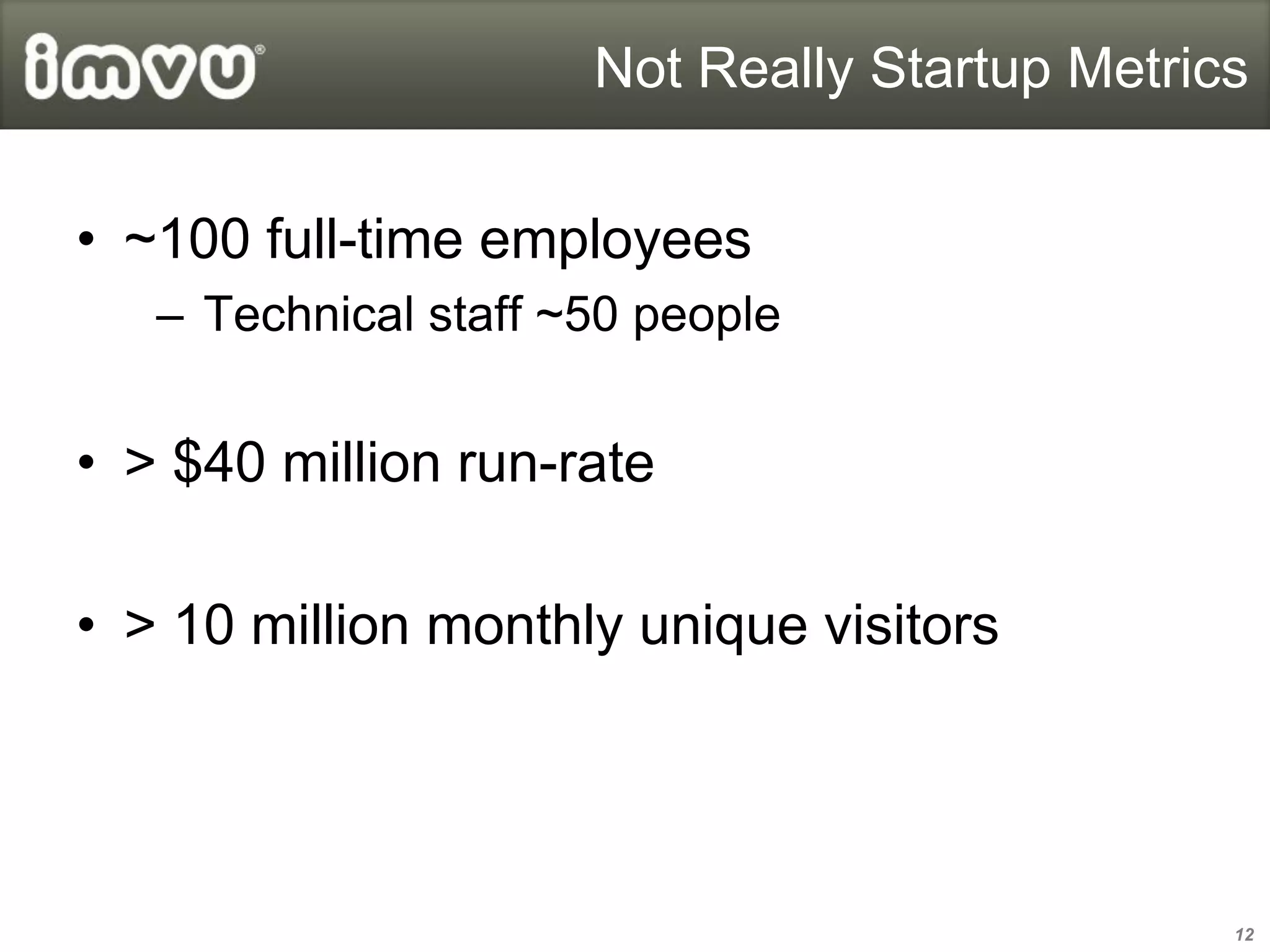
Not Really Startup Metrics


• ~100 full-time employees
   – Technical staff ~50 people


• > $40 million run-rate

• > 10 million monthly unique visitors


                                               12
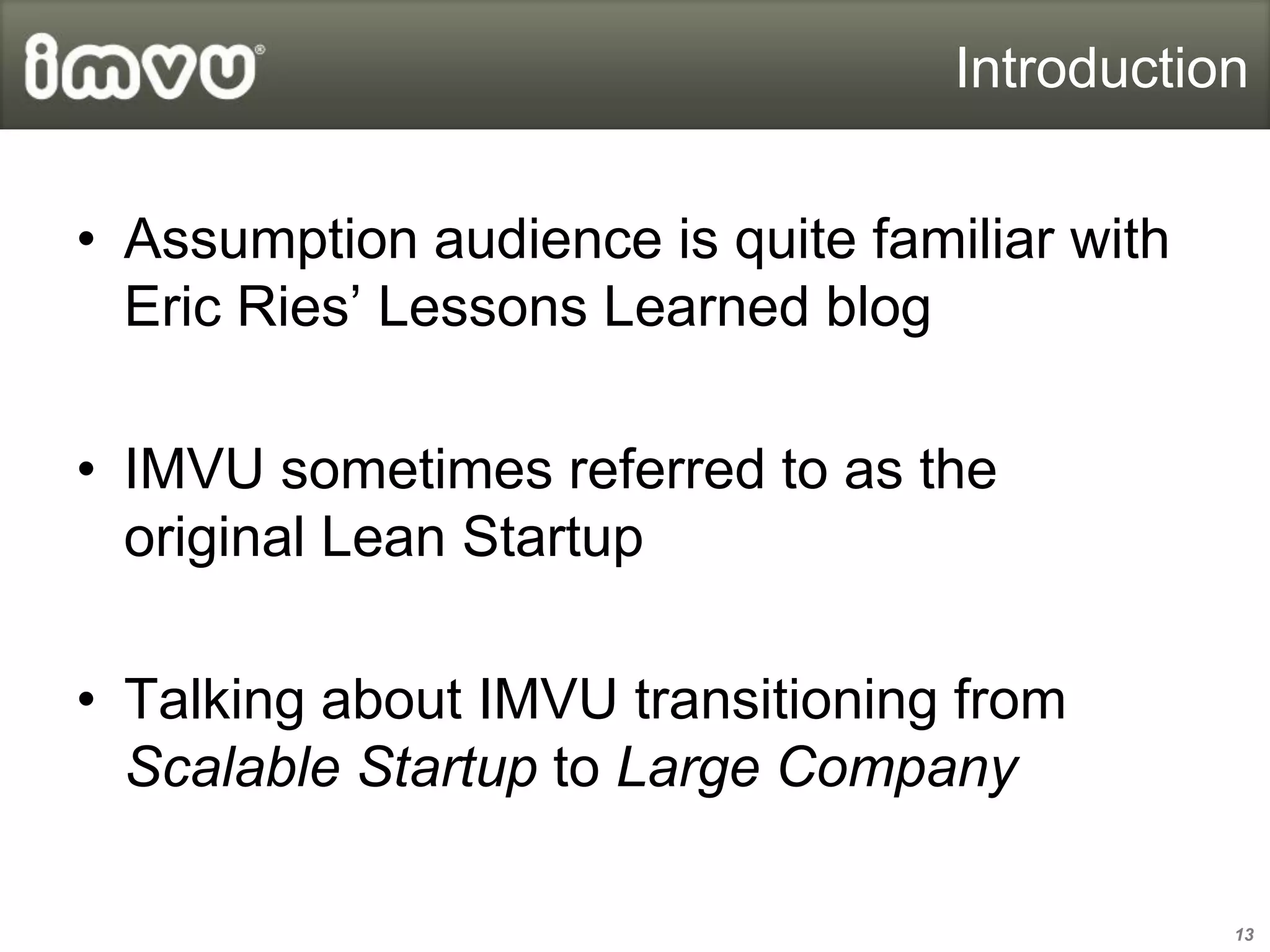
Introduction


• Assumption audience is quite familiar with
  Eric Ries’ Lessons Learned blog

• IMVU sometimes referred to as the
  original Lean Startup

• Talking about IMVU transitioning from
  Scalable Startup to Large Company

                                               13
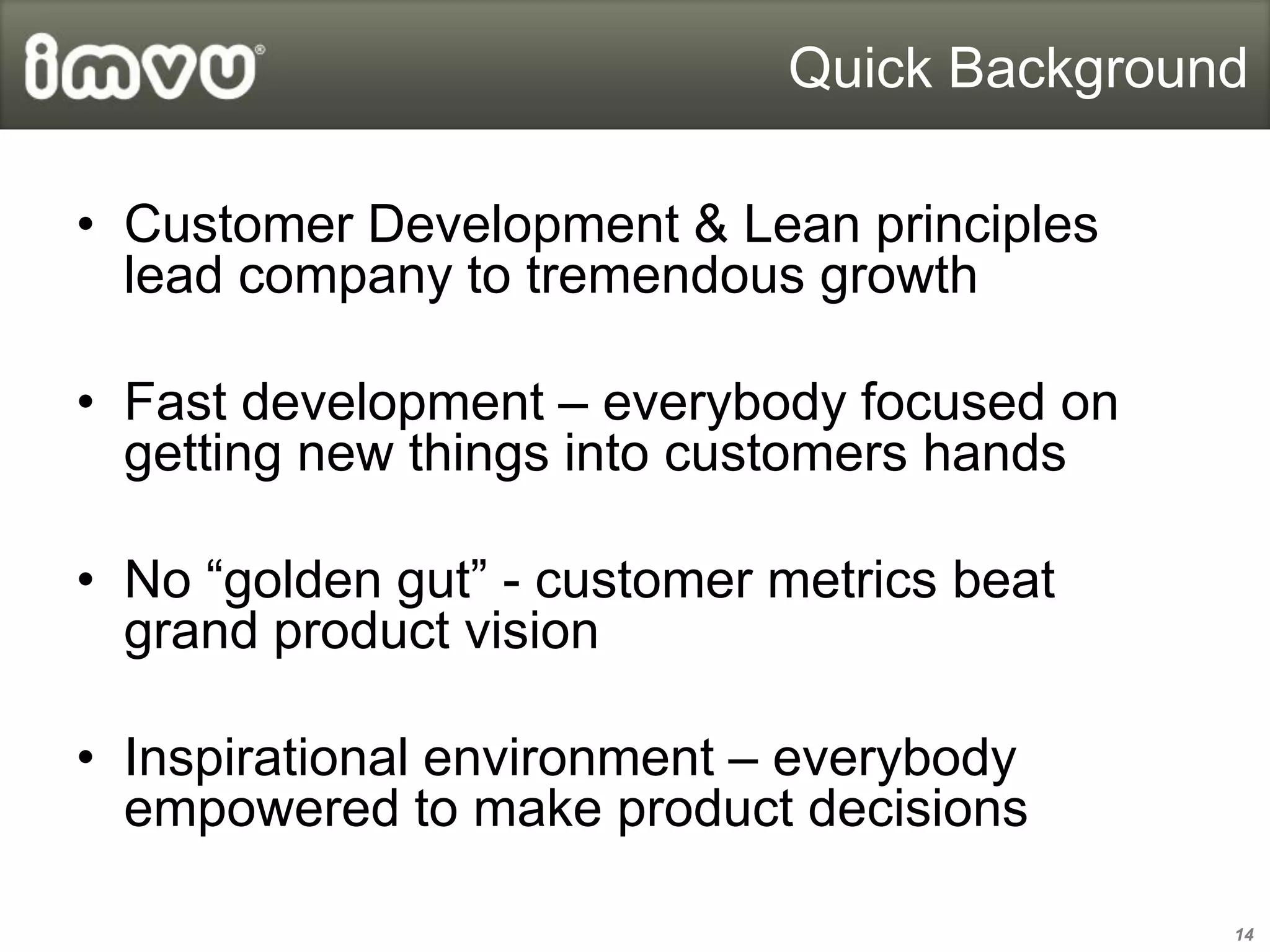
Quick Background

• Customer Development & Lean principles
  lead company to tremendous growth

• Fast development – everybody focused on
  getting new things into customers hands

• No “golden gut” - customer metrics beat
  grand product vision

• Inspirational environment – everybody
  empowered to make product decisions

                                            14
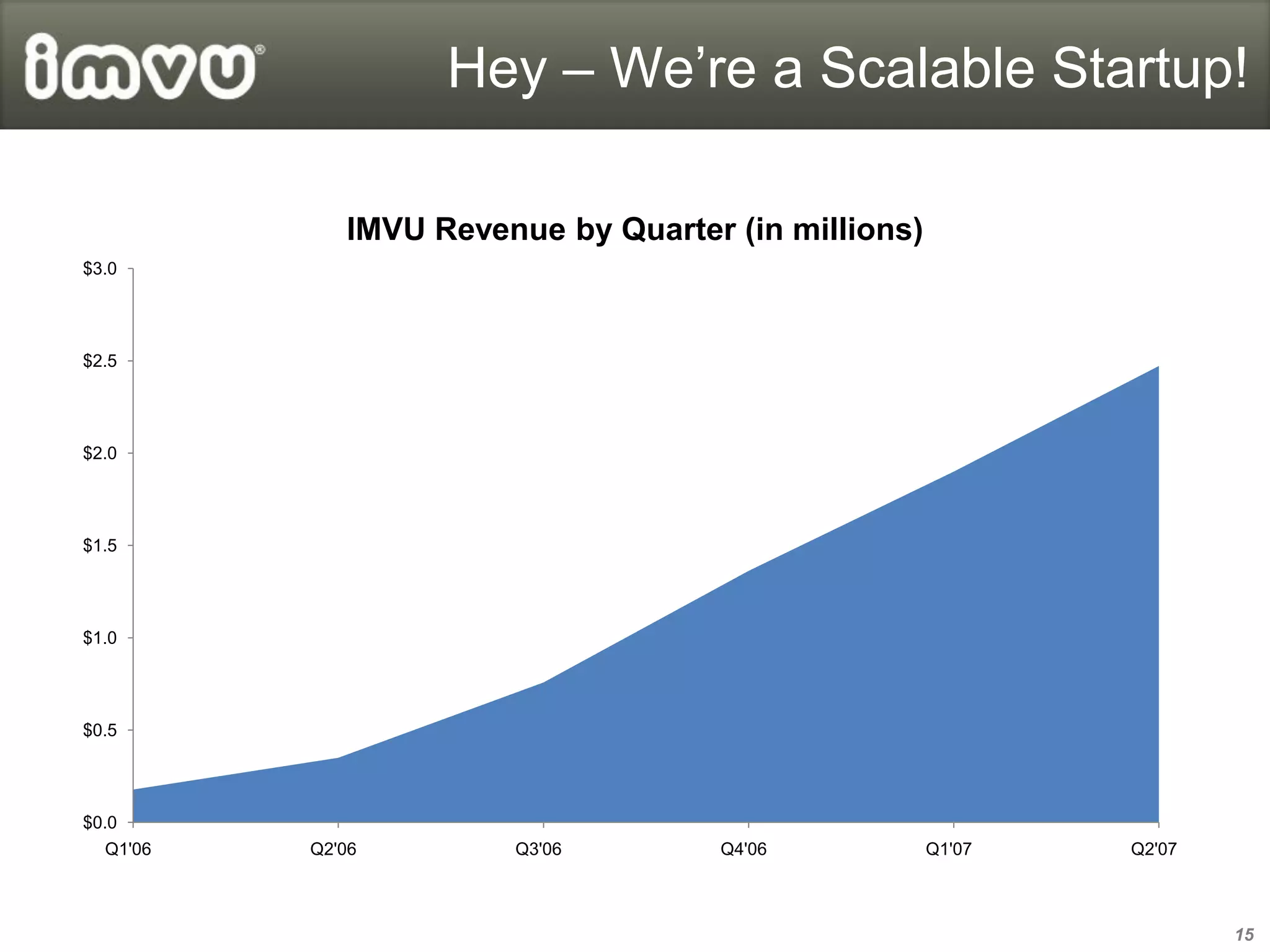
Hey – We’re a Scalable Startup!

             IMVU Revenue by Quarter (in millions)
$3.0


$2.5


$2.0


$1.5


$1.0


$0.5


$0.0
  Q1'06   Q2'06        Q3'06        Q4'06            Q1'07   Q2'07


                                                                     15
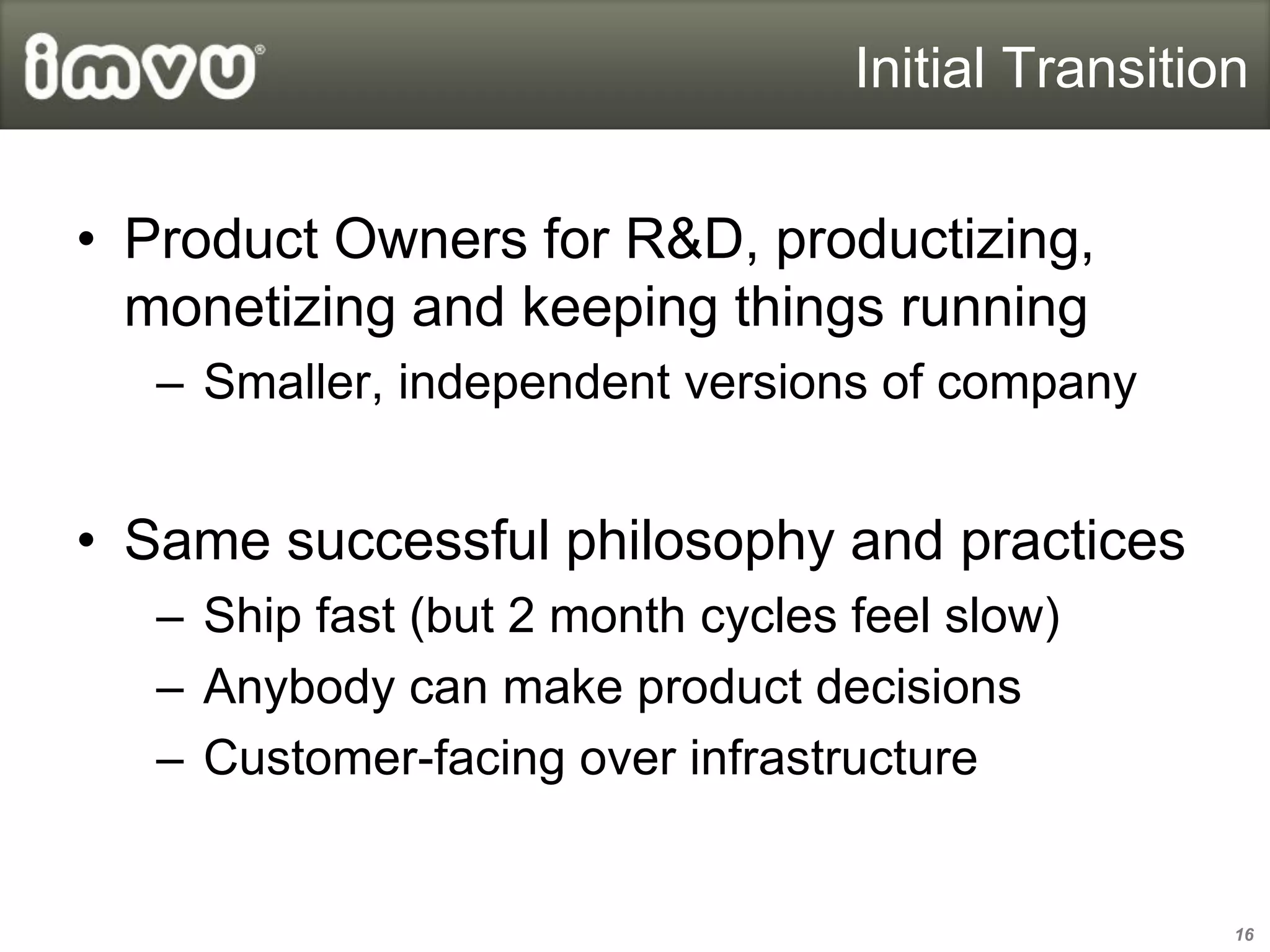
Initial Transition


• Product Owners for R&D, productizing,
  monetizing and keeping things running
   – Smaller, independent versions of company


• Same successful philosophy and practices
   – Ship fast (but 2 month cycles feel slow)
   – Anybody can make product decisions
   – Customer-facing over infrastructure


                                                    16
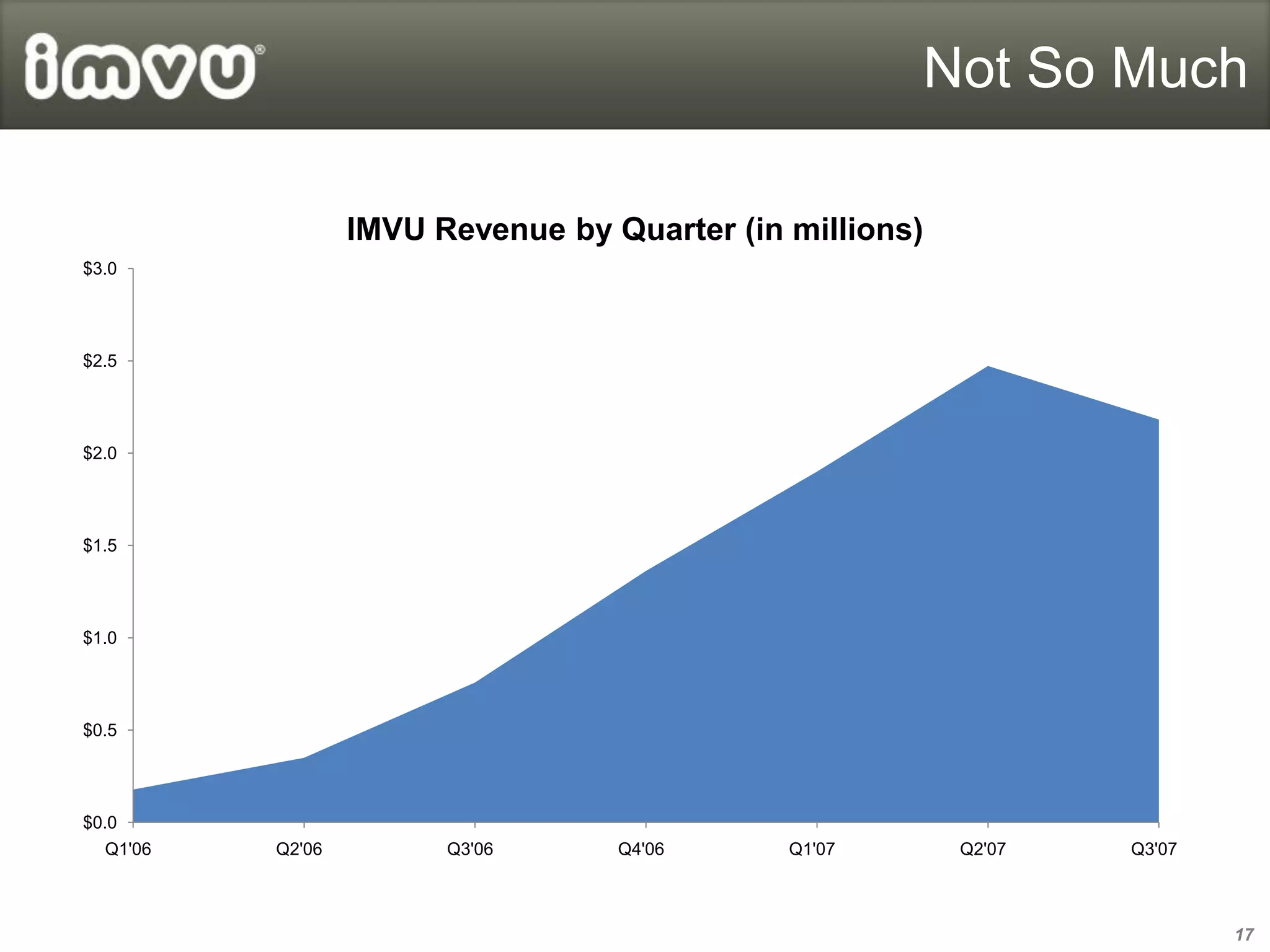
Not So Much

                  IMVU Revenue by Quarter (in millions)
$3.0


$2.5


$2.0


$1.5


$1.0


$0.5


$0.0
  Q1'06   Q2'06         Q3'06      Q4'06      Q1'07       Q2'07   Q3'07


                                                                          17
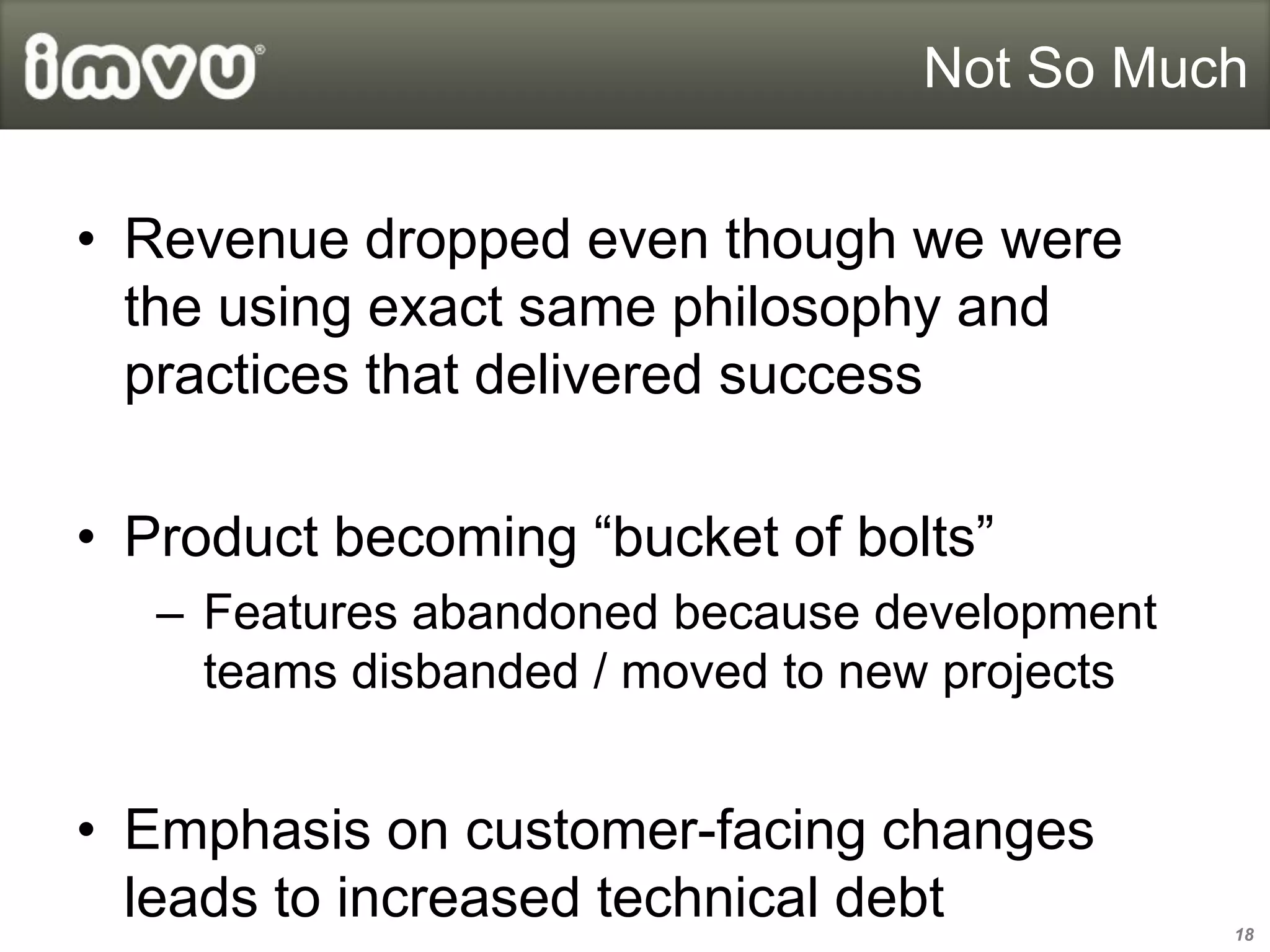
Not So Much


• Revenue dropped even though we were
  the using exact same philosophy and
  practices that delivered success

• Product becoming “bucket of bolts”
   – Features abandoned because development
     teams disbanded / moved to new projects


• Emphasis on customer-facing changes
  leads to increased technical debt            18
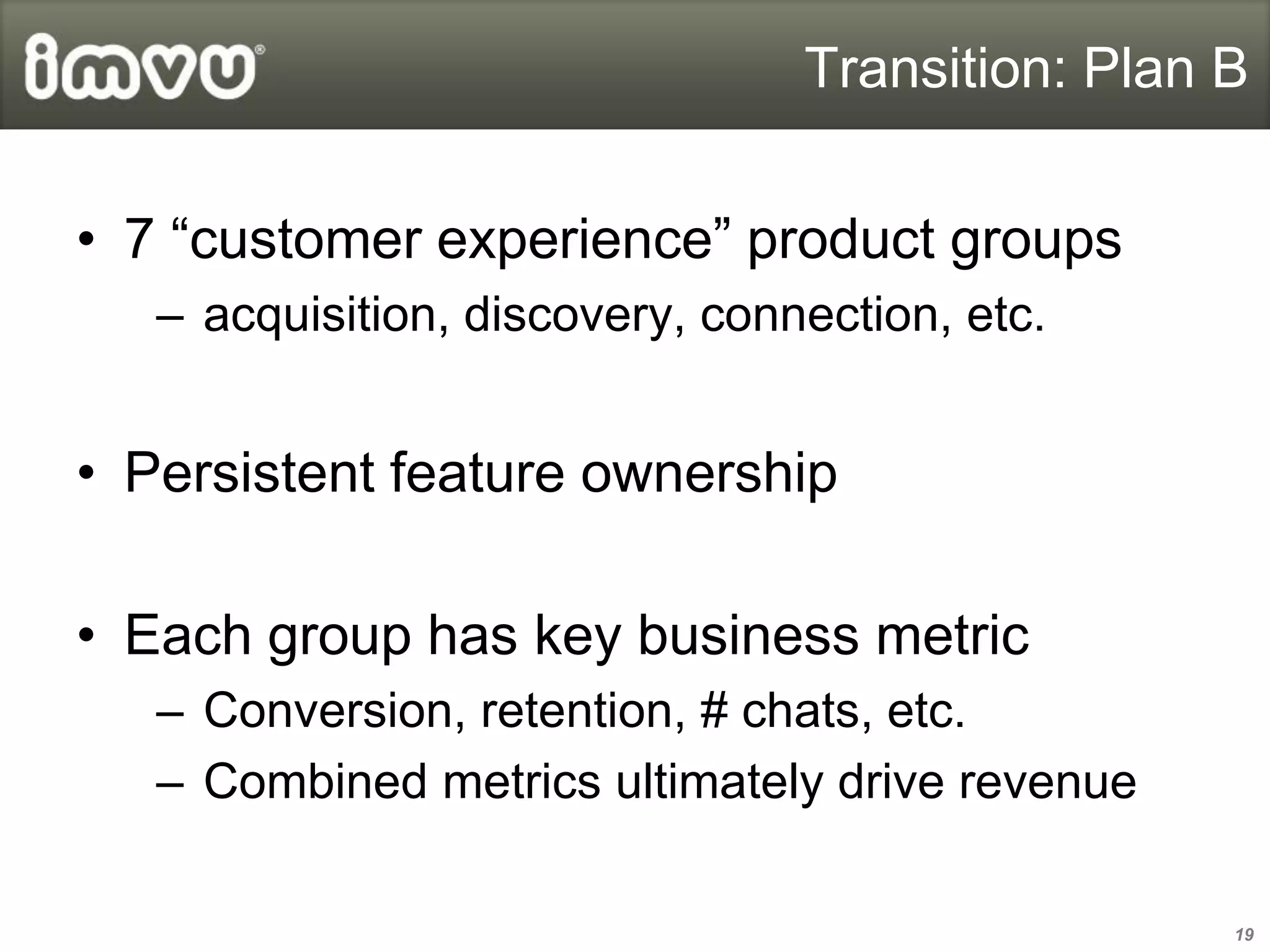
Transition: Plan B


• 7 “customer experience” product groups
   – acquisition, discovery, connection, etc.


• Persistent feature ownership

• Each group has key business metric
   – Conversion, retention, # chats, etc.
   – Combined metrics ultimately drive revenue

                                                  19
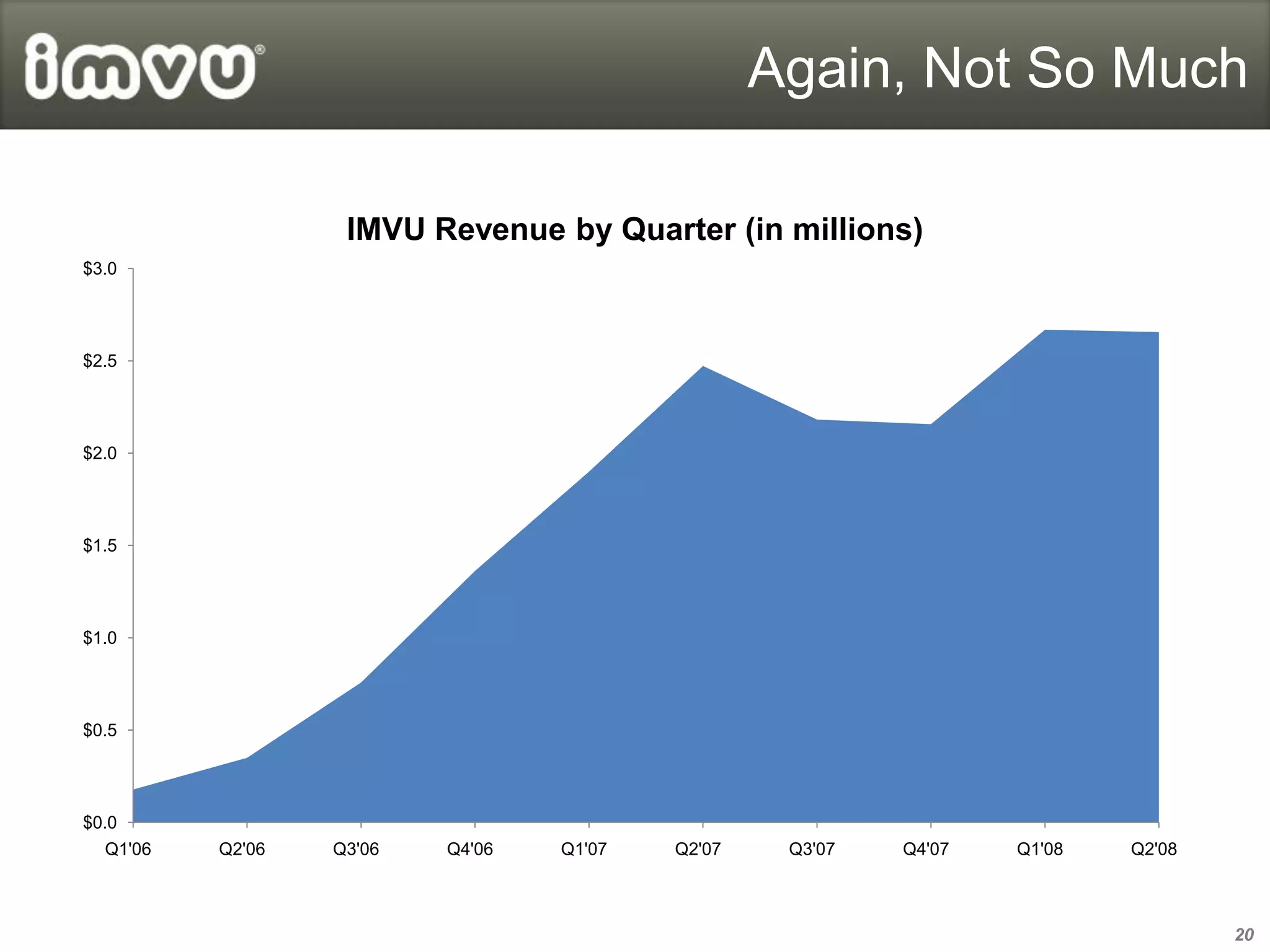
Again, Not So Much

                   IMVU Revenue by Quarter (in millions)
$3.0


$2.5


$2.0


$1.5


$1.0


$0.5


$0.0
  Q1'06   Q2'06   Q3'06   Q4'06   Q1'07   Q2'07    Q3'07   Q4'07   Q1'08   Q2'08


                                                                                   20
Again, Not So Much


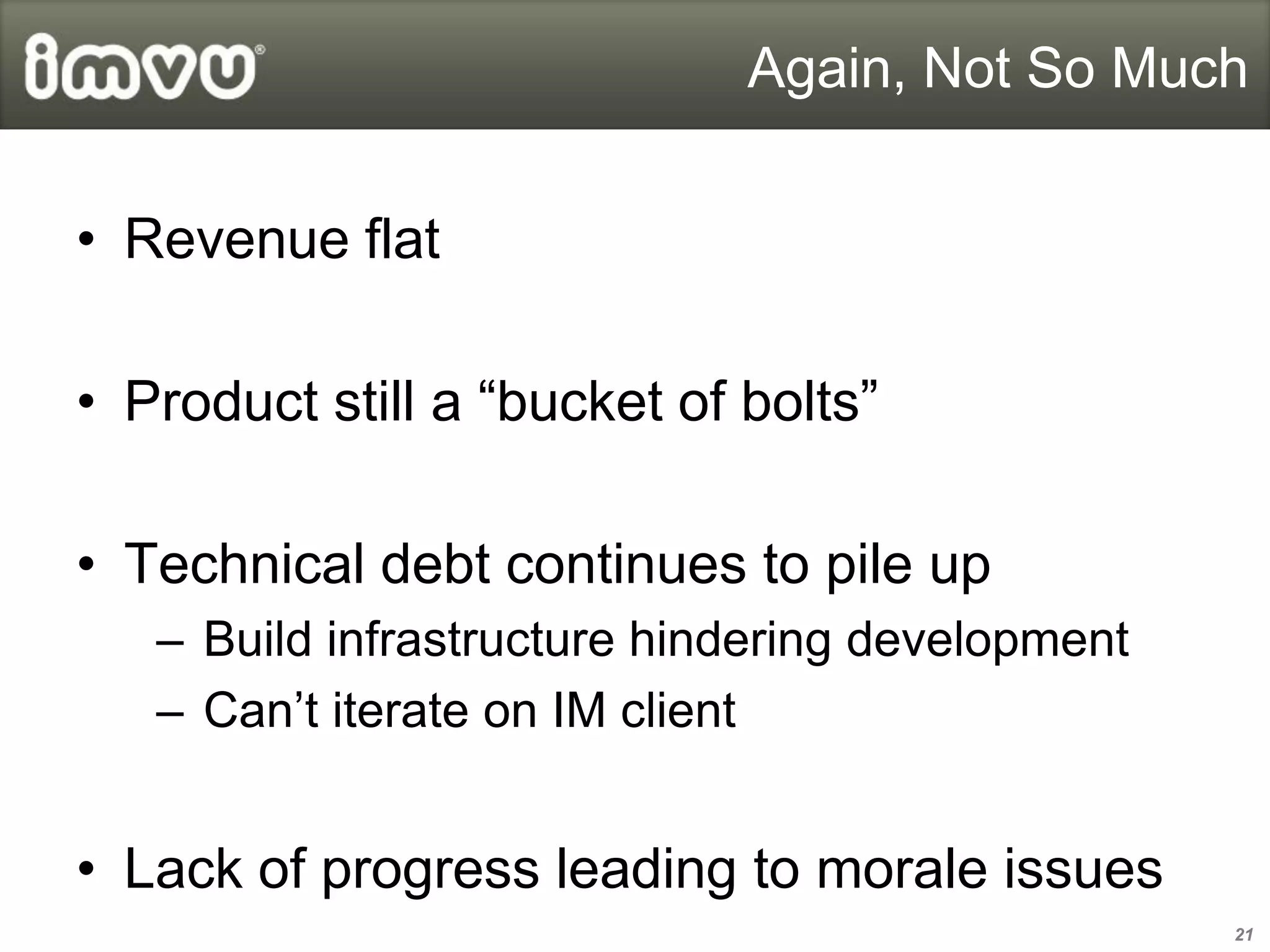
• Revenue flat

• Product still a “bucket of bolts”

• Technical debt continues to pile up
   – Build infrastructure hindering development
   – Can’t iterate on IM client


• Lack of progress leading to morale issues
                                                  21
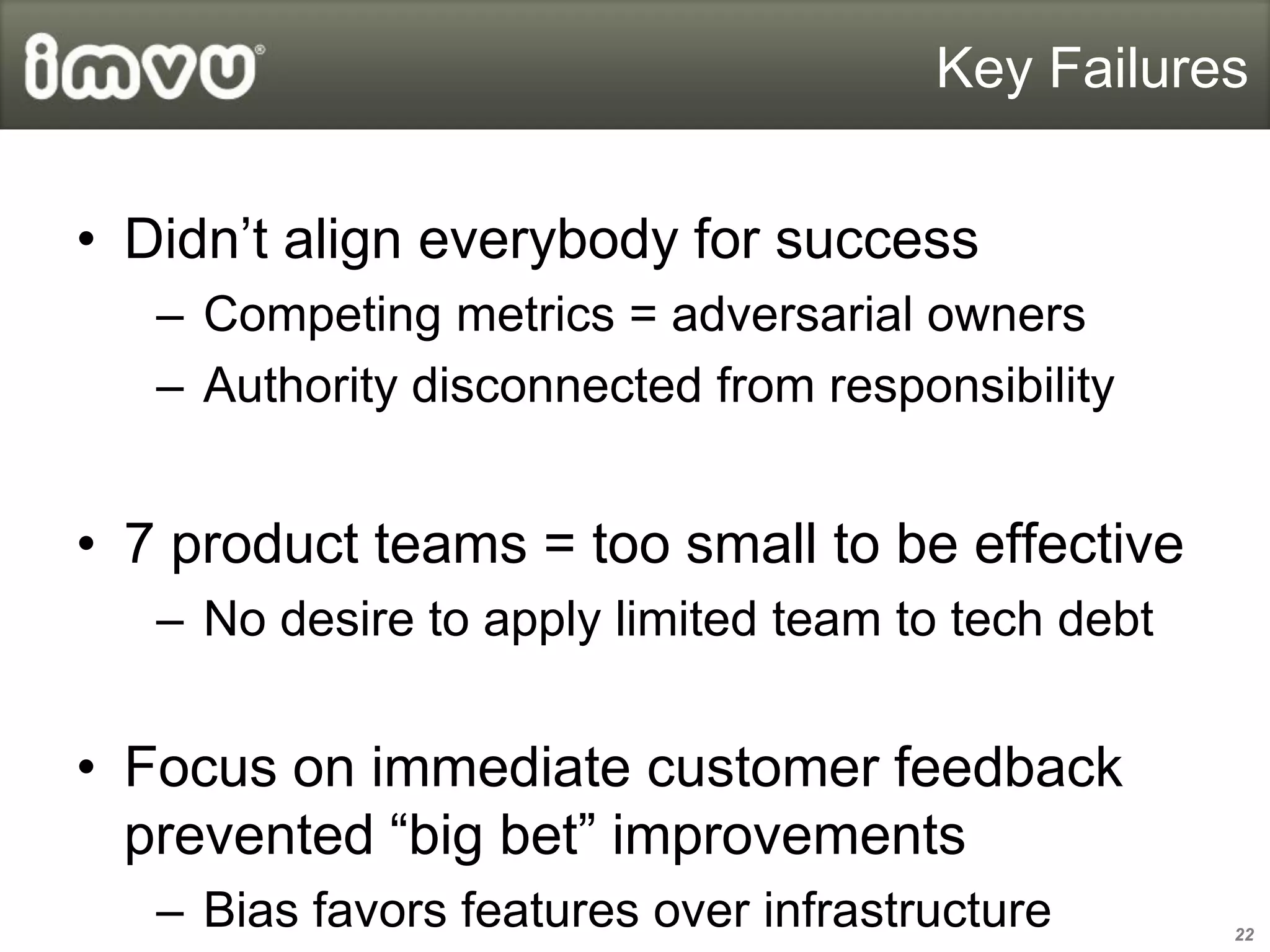
Key Failures


• Didn’t align everybody for success
   – Competing metrics = adversarial owners
   – Authority disconnected from responsibility


• 7 product teams = too small to be effective
   – No desire to apply limited team to tech debt


• Focus on immediate customer feedback
  prevented “big bet” improvements
   – Bias favors features over infrastructure       22
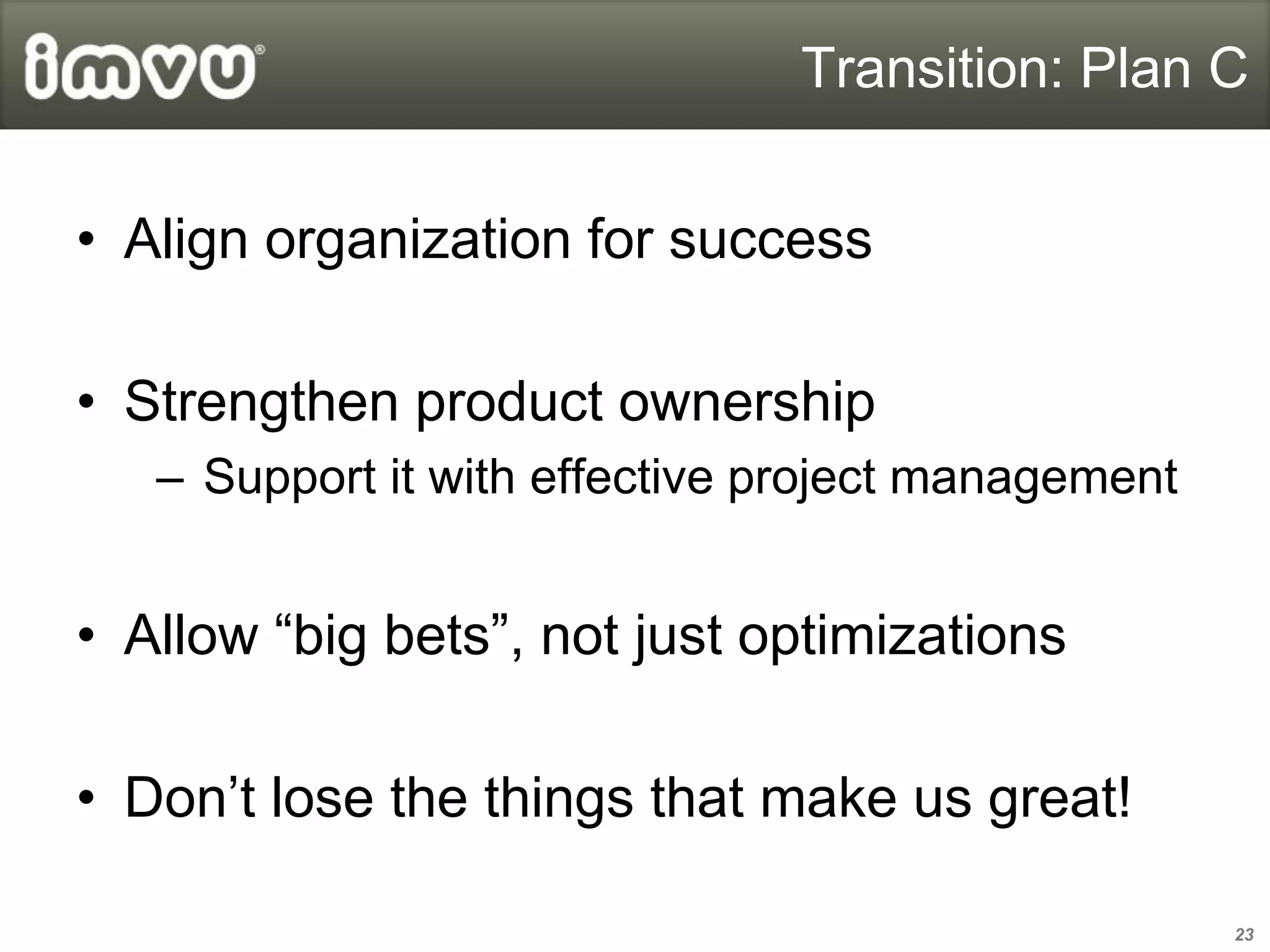
Transition: Plan C


• Align organization for success

• Strengthen product ownership
   – Support it with effective project management


• Allow “big bets”, not just optimizations

• Don’t lose the things that make us great!

                                                    23
Getting Aligned


• Officers determine business strategy
   – Shared (repeatedly) with all employees


• All employees have same incentive plan
   – 2009 targets for profitability and revenue


• Authority consistent with responsibility
   – Drive accountability
   – Required difficult changes to culture
                                                  24
Stronger Product Ownership


• VP Product clear mandate
   – Determines long-term product strategy
   – Aligns product owners to company strategy


• Product teams: product, monetization,
  keeping things running, but this changes

• Product Owners determine all product
  changes
                                                 25
Project Management

• Needed visibility into:
   – Where we spend development resources
   – Better ROI assessment when planning (the “I”)
   – What others are doing (transparency)


• Resource Allocation
   – Product decides % of resources to each area
   – Engineering determines actual people


• Variation of scrum, 2-3 week sprints

                                                     26
Seeing the Big Picture


• Passion for customer validation great

• Obsession for immediate validation can
  distract you

• Easy to lose sight of:
   – Product opportunities requiring a big bet
   – Increasing technical debt
   – Infrastructure needs
                                                 27
Customer vs. Infrastructure


• Customer facing features prioritized over
  infrastructure critical to early success

• When it compromises ability to rapidly
  iterate a key strength is lost


                                              28
How Do You Know?


“We are hiring smart people that can’t make
            changes to our code”


                                              29
Payback of Technical Debt


• Dedicated technical investment projects

• Some systems get a technical debt “tax”
  applied only when product changes

• Tech Leads can add project requirement


                                            30
Continuous Deployment Overhead


• Effective development systems require
  ongoing investment to scale
   – Impacts speed and morale


• IMVU spends >20% of engineering on
  maintenance of the tests and process
   – Even with premium we find it has high ROI


• Pain follows a square wave pattern as we
  scale the organization                         31
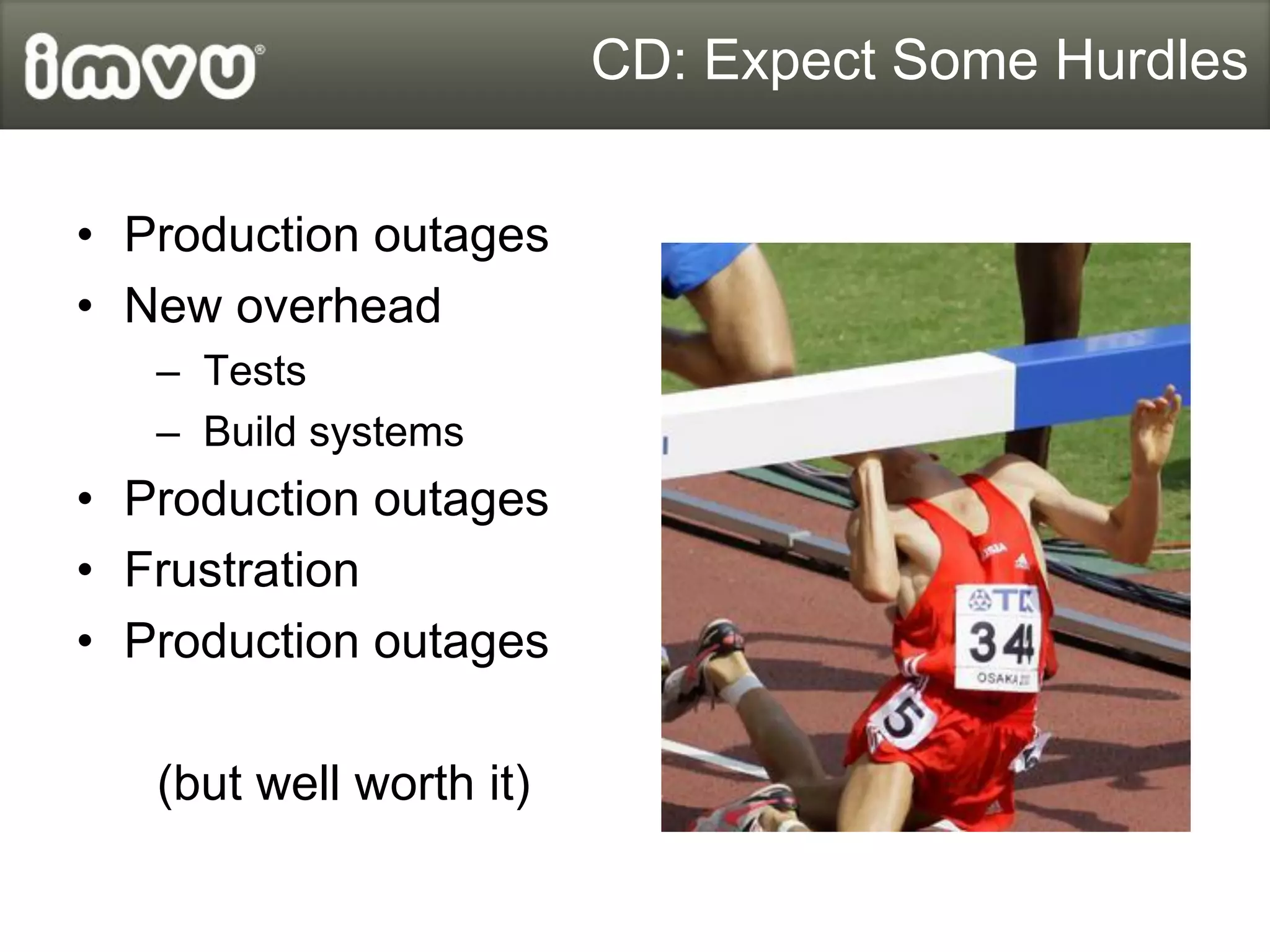
CD: Expect Some Hurdles


• Production outages
• New overhead
   – Tests
   – Build systems
• Production outages
• Frustration
• Production outages

   (but well worth it)
Cultural

• No longer possible for everybody to
  participate in every aspect of the company

• Leadership changes at all levels

• Process: too much, too little.

• Not everyone makes the transition… some
  people just love startups
                                               33
Key Cultural Values We Kept


• Entrepreneurial spirit

• Customer metrics validate our decisions

• Value everybody’s ability to contribute to
  product direction

• Accepting failures in order to learn and
  improve
                                               34
Example: New IM Client

• Not previously possible
   – 1-year design and development
   – Substantial non-customer-facing infrastructure


• Big win for customers and technical debt
   – Solved key issue confusing customers
   – Rate of development greatly accelerated


• Iterated with customer validation!

                                                      35
Example: Hack Week

• Originally few requirements
    – Anybody can develop anything
    – Have to demo it at end of week (live)

• New requirements – anything, but ship it or kill it
    –   Each person allowed 1 project at a time
    –   Product adopts it, keep building it or kill it
    –   Limit customer exposure until adoption
    –   Engineers need business data to make decisions!

• Results
    – Much higher rate of projects getting to customers
    – Many engineers choose to work on existing product plan!


                                                                36
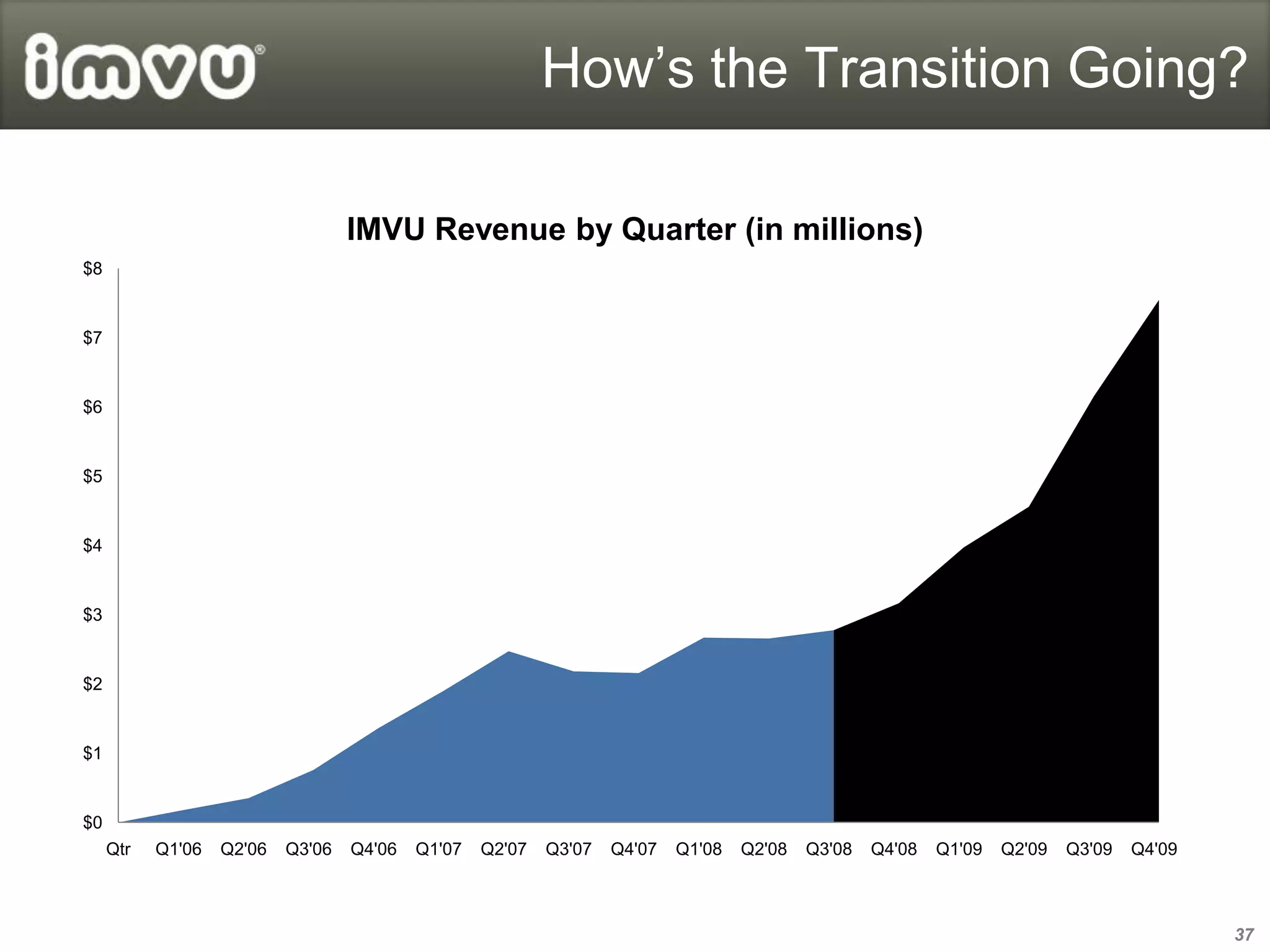
How’s the Transition Going?

                                   IMVU Revenue by Quarter (in millions)
$8


$7


$6


$5


$4


$3


$2


$1


$0
     Qtr   Q1'06   Q2'06   Q3'06   Q4'06   Q1'07   Q2'07   Q3'07   Q4'07   Q1'08   Q2'08   Q3'08   Q4'08   Q1'09   Q2'09   Q3'09   Q4'09


                                                                                                                                           37
Thank You

                  Brett G. Durrett
                 Twitter: @bdurrett
                bdurrett@imvu.com


and… many thanks to Steve Blank for use of his slides


                                                        38
Oh Yeah…


Interested in getting more experience?

            We’re hiring!

      http://www.imvu.com/jobs/


                                         39

Lean Startup Pitfalls Uncovered

  • 1.
    An online communitywhere members use 3D avatars to meet new people, chat, create and have fun with their friends
  • 2.
    Lean Startup PitfallsUncovered Brett G. Durrett (@bdurrett) VP, Engineering & Operations, IMVU, Inc. Lean Startup Meetup, San Francisco, July 21, 2010 1
  • 3.
    Presentation PIVOT! a wordso popular right now that I had to drop it on the second slide 2
  • 4.
    The Transition ofa Lean Startup IMVU’s journey to becoming a Large Company Brett G. Durrett (@bdurrett) VP, Engineering & Operations IMVU, Inc. Lean Startup Meetup, San Francisco, July 21, 2010 3
  • 5.
    WTF? Hey Brett… don’tLarge Companies suck? 4
  • 6.
    I heard thistalk… From Steve Blank’s “Why Accountants Don’t Run Startups” presentation, used with permission. 5
  • 7.
    Startups Don’t LastForever Scalable Large Transition Startup Company - Business Model found - Cash-flow breakeven - Product/Market fit - Profitable - Repeatable sales model - Rapid scale - Managers hired - New Senior Mgmt ~ 150 people You fail if you remain a startup! From Steve Blank’s “Why Accountants Don’t Run Startups” presentation, used with permission.
  • 8.
    Startups Don’t LastForever Scalable Large Transition Startup Company - Business Model found - Cash-flow breakeven - Product/Market fit - Profitable - Repeatable sales model - Rapid scale - Managers hired - New Senior Mgmt ~ 150 people You fail if you remain a startup! From Steve Blank’s “Why Accountants Don’t Run Startups” presentation, used with permission.
  • 9.
    Startups Don’t LastForever Scalable Large Large Transition Startup Company Company - Business Model found - Cash-flow breakeven FTW! - Product/Market fit - Repeatable sales model - Managers hired - Profitable - Rapid scale - New Senior Mgmt ~ 150 people You fail if you remain a startup! From Steve Blank’s “Why Accountants Don’t Run Startups” presentation, used with permission.
  • 10.
    The Large Companyis the result of a successful Scalable Startup 9
  • 11.
    The Large Companyis the result of a successful Scalable Startup If you can survive the transition 10
  • 12.
    The Large Companyis the result of a successful Scalable Startup If you can survive the transition (which has pitfalls) 11
  • 13.
    Not Really StartupMetrics • ~100 full-time employees – Technical staff ~50 people • > $40 million run-rate • > 10 million monthly unique visitors 12
  • 14.
    Introduction • Assumption audienceis quite familiar with Eric Ries’ Lessons Learned blog • IMVU sometimes referred to as the original Lean Startup • Talking about IMVU transitioning from Scalable Startup to Large Company 13
  • 15.
    Quick Background • CustomerDevelopment & Lean principles lead company to tremendous growth • Fast development – everybody focused on getting new things into customers hands • No “golden gut” - customer metrics beat grand product vision • Inspirational environment – everybody empowered to make product decisions 14
  • 16.
    Hey – We’rea Scalable Startup! IMVU Revenue by Quarter (in millions) $3.0 $2.5 $2.0 $1.5 $1.0 $0.5 $0.0 Q1'06 Q2'06 Q3'06 Q4'06 Q1'07 Q2'07 15
  • 17.
    Initial Transition • ProductOwners for R&D, productizing, monetizing and keeping things running – Smaller, independent versions of company • Same successful philosophy and practices – Ship fast (but 2 month cycles feel slow) – Anybody can make product decisions – Customer-facing over infrastructure 16
  • 18.
    Not So Much IMVU Revenue by Quarter (in millions) $3.0 $2.5 $2.0 $1.5 $1.0 $0.5 $0.0 Q1'06 Q2'06 Q3'06 Q4'06 Q1'07 Q2'07 Q3'07 17
  • 19.
    Not So Much •Revenue dropped even though we were the using exact same philosophy and practices that delivered success • Product becoming “bucket of bolts” – Features abandoned because development teams disbanded / moved to new projects • Emphasis on customer-facing changes leads to increased technical debt 18
  • 20.
    Transition: Plan B •7 “customer experience” product groups – acquisition, discovery, connection, etc. • Persistent feature ownership • Each group has key business metric – Conversion, retention, # chats, etc. – Combined metrics ultimately drive revenue 19
  • 21.
    Again, Not SoMuch IMVU Revenue by Quarter (in millions) $3.0 $2.5 $2.0 $1.5 $1.0 $0.5 $0.0 Q1'06 Q2'06 Q3'06 Q4'06 Q1'07 Q2'07 Q3'07 Q4'07 Q1'08 Q2'08 20
  • 22.
    Again, Not SoMuch • Revenue flat • Product still a “bucket of bolts” • Technical debt continues to pile up – Build infrastructure hindering development – Can’t iterate on IM client • Lack of progress leading to morale issues 21
  • 23.
    Key Failures • Didn’talign everybody for success – Competing metrics = adversarial owners – Authority disconnected from responsibility • 7 product teams = too small to be effective – No desire to apply limited team to tech debt • Focus on immediate customer feedback prevented “big bet” improvements – Bias favors features over infrastructure 22
  • 24.
    Transition: Plan C •Align organization for success • Strengthen product ownership – Support it with effective project management • Allow “big bets”, not just optimizations • Don’t lose the things that make us great! 23
  • 25.
    Getting Aligned • Officersdetermine business strategy – Shared (repeatedly) with all employees • All employees have same incentive plan – 2009 targets for profitability and revenue • Authority consistent with responsibility – Drive accountability – Required difficult changes to culture 24
  • 26.
    Stronger Product Ownership •VP Product clear mandate – Determines long-term product strategy – Aligns product owners to company strategy • Product teams: product, monetization, keeping things running, but this changes • Product Owners determine all product changes 25
  • 27.
    Project Management • Neededvisibility into: – Where we spend development resources – Better ROI assessment when planning (the “I”) – What others are doing (transparency) • Resource Allocation – Product decides % of resources to each area – Engineering determines actual people • Variation of scrum, 2-3 week sprints 26
  • 28.
    Seeing the BigPicture • Passion for customer validation great • Obsession for immediate validation can distract you • Easy to lose sight of: – Product opportunities requiring a big bet – Increasing technical debt – Infrastructure needs 27
  • 29.
    Customer vs. Infrastructure •Customer facing features prioritized over infrastructure critical to early success • When it compromises ability to rapidly iterate a key strength is lost 28
  • 30.
    How Do YouKnow? “We are hiring smart people that can’t make changes to our code” 29
  • 31.
    Payback of TechnicalDebt • Dedicated technical investment projects • Some systems get a technical debt “tax” applied only when product changes • Tech Leads can add project requirement 30
  • 32.
    Continuous Deployment Overhead •Effective development systems require ongoing investment to scale – Impacts speed and morale • IMVU spends >20% of engineering on maintenance of the tests and process – Even with premium we find it has high ROI • Pain follows a square wave pattern as we scale the organization 31
  • 33.
    CD: Expect SomeHurdles • Production outages • New overhead – Tests – Build systems • Production outages • Frustration • Production outages (but well worth it)
  • 34.
    Cultural • No longerpossible for everybody to participate in every aspect of the company • Leadership changes at all levels • Process: too much, too little. • Not everyone makes the transition… some people just love startups 33
  • 35.
    Key Cultural ValuesWe Kept • Entrepreneurial spirit • Customer metrics validate our decisions • Value everybody’s ability to contribute to product direction • Accepting failures in order to learn and improve 34
  • 36.
    Example: New IMClient • Not previously possible – 1-year design and development – Substantial non-customer-facing infrastructure • Big win for customers and technical debt – Solved key issue confusing customers – Rate of development greatly accelerated • Iterated with customer validation! 35
  • 37.
    Example: Hack Week •Originally few requirements – Anybody can develop anything – Have to demo it at end of week (live) • New requirements – anything, but ship it or kill it – Each person allowed 1 project at a time – Product adopts it, keep building it or kill it – Limit customer exposure until adoption – Engineers need business data to make decisions! • Results – Much higher rate of projects getting to customers – Many engineers choose to work on existing product plan! 36
  • 38.
    How’s the TransitionGoing? IMVU Revenue by Quarter (in millions) $8 $7 $6 $5 $4 $3 $2 $1 $0 Qtr Q1'06 Q2'06 Q3'06 Q4'06 Q1'07 Q2'07 Q3'07 Q4'07 Q1'08 Q2'08 Q3'08 Q4'08 Q1'09 Q2'09 Q3'09 Q4'09 37
  • 39.
    Thank You Brett G. Durrett Twitter: @bdurrett bdurrett@imvu.com and… many thanks to Steve Blank for use of his slides 38
  • 40.
    Oh Yeah… Interested ingetting more experience? We’re hiring! http://www.imvu.com/jobs/ 39