http://www.bized.co.uk
Copyright 2007 – Biz/ed
Leadership
http://www.bized.co.uk
Copyright 2007 – Biz/ed
A Leadership Story:
• A group of workers and their leaders are set a task
of clearing a road through a dense jungle on a remote
island to get to the coast where an estuary provides
a perfect site for a port.
• The leaders organise the labour into efficient units and
monitor the distribution and use of capital assets –
progress is excellent. The leaders continue to monitor
and evaluate progress, making adjustments along the
way to ensure the progress is maintained and efficiency
increased wherever possible.
• Then, one day amidst all the hustle and bustle and
activity, one person climbs up a nearby tree. The
person surveys the scene from the top of the tree.
http://www.bized.co.uk
Copyright 2007 – Biz/ed
A Leadership Story:
• And shouts down to the assembled
group below…
• “Wrong Way!”
• (Story adapted from Stephen Covey (2004) “The Seven Habits of
Highly Effective People” Simon & Schuster).
• “Management is doing things right, leadership
is doing the right things”
(Warren Bennis and Peter Drucker)
http://www.bized.co.uk
Copyright 2007 – Biz/ed
Leadership
http://www.bized.co.uk
Copyright 2007 – Biz/ed
Types of Leadership Style
http://www.bized.co.uk
Copyright 2007 – Biz/ed
Types of Leadership Style
• Autocratic:
– Leader makes decisions without reference
to anyone else
– High degree of dependency on the leader
– Can create de-motivation and alienation
of staff
– May be valuable in some types of business
where decisions need to be made quickly
and decisively
http://www.bized.co.uk
Copyright 2007 – Biz/ed
Types of Leadership Style
• Democratic:
• Encourages decision making
from different perspectives – leadership
may be emphasised throughout
the organisation
– Consultative: process of consultation before
decisions are taken
– Persuasive: Leader takes decision and seeks
to persuade others that the decision
is correct
http://www.bized.co.uk
Copyright 2007 – Biz/ed
Types of Leadership Style
• Democratic:
– May help motivation and involvement
– Workers feel ownership of the firm
and its ideas
– Improves the sharing of ideas
and experiences within the business
– Can delay decision making
http://www.bized.co.uk
Copyright 2007 – Biz/ed
Types of Leadership Style
• Laissez-Faire:
– ‘Let it be’ – the leadership responsibilities
are shared by all
– Can be very useful in businesses
where creative ideas are important
– Can be highly motivational,
as people have control over their working life
– Can make coordination and decision making
time-consuming and lacking in overall direction
– Relies on good team work
– Relies on good interpersonal relations
http://www.bized.co.uk
Copyright 2007 – Biz/ed
Types of Leadership Style
• Paternalistic:
• Leader acts as a ‘father figure’
• Paternalistic leader makes decision
but may consult
• Believes in the need to support
staff
http://www.bized.co.uk
Copyright 2007 – Biz/ed
Change Leadership
http://www.bized.co.uk
Copyright 2007 – Biz/ed
Change Leadership
• The most challenging aspect of business
is leading and managing change
• The business environment is subject to
fast-paced economic and social change
• Modern business must adapt
and be flexible to survive
• Problems in leading change stem mainly
from human resource management
http://www.bized.co.uk
Copyright 2007 – Biz/ed
Change Leadership
• Leaders need to be aware of how
change impacts on workers:
• Series of self-esteem states
identified by Adams et al and cited
by Garrett
– Adams, J. Hayes, J. and Hopson, B.(eds) (1976)
Transition: understanding and managing change personal
change London, Martin Robertson
– Garrett, V. (1997) Managing Change in School leadership
for the 21st
century Brett Davies and Linda Ellison, London,
Routledge
http://www.bized.co.uk
Copyright 2007 – Biz/ed
Change Leadership
Self-esteem
Time
1. Immobilisation
– as rumours of the
change circulate, the
individual feels some
sense of shock and
possible disbelief –
so much so that they
deem it worthy of
doing nothing.
1
2. Minimisation: As the
change becomes clearer,
people try to fit in the
change with their own
personal position and may
try to believe that it will
not affect them.
2
3. Depression: as reality
begins to dawn staff may
feel alienated and angry,
feelings of a lack of control
of events overtake people
and they feel depressed as
they try to reconcile what
is happening with their own
personal situation.
3
4
4. Acceptance/letting go:
The lowest point in self-
esteem finally sees people
starting to accept the
inevitable. Fear of the
future is a feature of this
stage.
5
5. Testing out:
Individuals begin to
interact with the change,
they start to ask questions
to see how they might
work with the change.
6
6. Search for meaning:
Individuals begin to work
with the change and see
how they might be able to
make the change work for
them – self esteem begins
to rise.
7
7. Internalisation:
the change is
understood and
adopted within the
individual’s own
understanding – they
now know how to
work with it and feel a
renewed sense of
confidence and self
esteem.
http://www.bized.co.uk
Copyright 2007 – Biz/ed
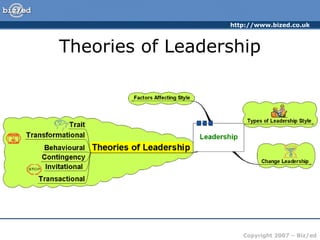
Theories of Leadership
http://www.bized.co.uk
Copyright 2007 – Biz/ed
Theories of Leadership
• Trait theories:
• Is there a set of characteristics
that determine a good leader?
– Personality?
– Dominance and personal presence?
– Charisma?
– Self confidence?
– Achievement?
– Ability to formulate a clear vision?
http://www.bized.co.uk
Copyright 2007 – Biz/ed
Theories of Leadership
• Trait theories:
– Are such characteristics
inherently gender biased?
– Do such characteristics
produce good leaders?
– Is leadership more than
just bringing about change?
– Does this imply that leaders are born
not bred?
http://www.bized.co.uk
Copyright 2007 – Biz/ed
Theories of Leadership
• Behavioural:
• Imply that leaders can be trained –
focus on the way of doing things
– Structure based behavioural theories –
focus on the leader instituting structures –
task orientated
– Relationship based behavioural theories –
focus on the development and maintenance
of relationships – process orientated
http://www.bized.co.uk
Copyright 2007 – Biz/ed
Theories of Leadership
• Contingency Theories:
• Leadership as being more flexible –
different leadership styles used at
different times depending on the
circumstance.
• Suggests leadership is not a fixed series
of characteristics that can be
transposed into different contexts
http://www.bized.co.uk
Copyright 2007 – Biz/ed
Theories of Leadership
• May depend on:
– Type of staff
– History of the business
– Culture of the business
– Quality of the relationships
– Nature of the changes needed
– Accepted norms within the institution
http://www.bized.co.uk
Copyright 2007 – Biz/ed
Theories of Leadership
• Transformational:
– Widespread changes
to a business or organisation
• Requires:
– Long term strategic planning
– Clear objectives
– Clear vision
– Leading by example – walk the walk
– Efficiency of systems and processes
http://www.bized.co.uk
Copyright 2007 – Biz/ed
Theories of Leadership
• Invitational Leadership:
– Improving the atmosphere and message
sent out by the organisation
– Focus on reducing negative messages
sent out through the everyday actions of
the business both externally and, crucially,
internally
– Review internal processes to reduce these
– Build relationships and sense of belonging
and identity with the organisation –
that gets communicated to customers, etc.
http://www.bized.co.uk
Copyright 2007 – Biz/ed
Theories of Leadership
• Transactional Theories:
– Focus on the management
of the organisation
– Focus on procedures and efficiency
– Focus on working to rules
and contracts
– Managing current issues
and problems
http://www.bized.co.uk
Copyright 2007 – Biz/ed
Factors Affecting Style
http://www.bized.co.uk
Copyright 2007 – Biz/ed
Factors Affecting Style
• Leadership style may be dependent
on various factors:
– Risk - decision making and change initiatives
based on degree of risk involved
– Type of business – creative business
or supply driven?
– How important change is –
change for change’s sake?
– Organisational culture – may be long embedded
and difficult to change
– Nature of the task – needing cooperation? Direction?
Structure?

leader types, leadership classification &

  • 1.
  • 2.
    http://www.bized.co.uk Copyright 2007 –Biz/ed A Leadership Story: • A group of workers and their leaders are set a task of clearing a road through a dense jungle on a remote island to get to the coast where an estuary provides a perfect site for a port. • The leaders organise the labour into efficient units and monitor the distribution and use of capital assets – progress is excellent. The leaders continue to monitor and evaluate progress, making adjustments along the way to ensure the progress is maintained and efficiency increased wherever possible. • Then, one day amidst all the hustle and bustle and activity, one person climbs up a nearby tree. The person surveys the scene from the top of the tree.
  • 3.
    http://www.bized.co.uk Copyright 2007 –Biz/ed A Leadership Story: • And shouts down to the assembled group below… • “Wrong Way!” • (Story adapted from Stephen Covey (2004) “The Seven Habits of Highly Effective People” Simon & Schuster). • “Management is doing things right, leadership is doing the right things” (Warren Bennis and Peter Drucker)
  • 4.
  • 5.
    http://www.bized.co.uk Copyright 2007 –Biz/ed Types of Leadership Style
  • 6.
    http://www.bized.co.uk Copyright 2007 –Biz/ed Types of Leadership Style • Autocratic: – Leader makes decisions without reference to anyone else – High degree of dependency on the leader – Can create de-motivation and alienation of staff – May be valuable in some types of business where decisions need to be made quickly and decisively
  • 7.
    http://www.bized.co.uk Copyright 2007 –Biz/ed Types of Leadership Style • Democratic: • Encourages decision making from different perspectives – leadership may be emphasised throughout the organisation – Consultative: process of consultation before decisions are taken – Persuasive: Leader takes decision and seeks to persuade others that the decision is correct
  • 8.
    http://www.bized.co.uk Copyright 2007 –Biz/ed Types of Leadership Style • Democratic: – May help motivation and involvement – Workers feel ownership of the firm and its ideas – Improves the sharing of ideas and experiences within the business – Can delay decision making
  • 9.
    http://www.bized.co.uk Copyright 2007 –Biz/ed Types of Leadership Style • Laissez-Faire: – ‘Let it be’ – the leadership responsibilities are shared by all – Can be very useful in businesses where creative ideas are important – Can be highly motivational, as people have control over their working life – Can make coordination and decision making time-consuming and lacking in overall direction – Relies on good team work – Relies on good interpersonal relations
  • 10.
    http://www.bized.co.uk Copyright 2007 –Biz/ed Types of Leadership Style • Paternalistic: • Leader acts as a ‘father figure’ • Paternalistic leader makes decision but may consult • Believes in the need to support staff
  • 11.
  • 12.
    http://www.bized.co.uk Copyright 2007 –Biz/ed Change Leadership • The most challenging aspect of business is leading and managing change • The business environment is subject to fast-paced economic and social change • Modern business must adapt and be flexible to survive • Problems in leading change stem mainly from human resource management
  • 13.
    http://www.bized.co.uk Copyright 2007 –Biz/ed Change Leadership • Leaders need to be aware of how change impacts on workers: • Series of self-esteem states identified by Adams et al and cited by Garrett – Adams, J. Hayes, J. and Hopson, B.(eds) (1976) Transition: understanding and managing change personal change London, Martin Robertson – Garrett, V. (1997) Managing Change in School leadership for the 21st century Brett Davies and Linda Ellison, London, Routledge
  • 14.
    http://www.bized.co.uk Copyright 2007 –Biz/ed Change Leadership Self-esteem Time 1. Immobilisation – as rumours of the change circulate, the individual feels some sense of shock and possible disbelief – so much so that they deem it worthy of doing nothing. 1 2. Minimisation: As the change becomes clearer, people try to fit in the change with their own personal position and may try to believe that it will not affect them. 2 3. Depression: as reality begins to dawn staff may feel alienated and angry, feelings of a lack of control of events overtake people and they feel depressed as they try to reconcile what is happening with their own personal situation. 3 4 4. Acceptance/letting go: The lowest point in self- esteem finally sees people starting to accept the inevitable. Fear of the future is a feature of this stage. 5 5. Testing out: Individuals begin to interact with the change, they start to ask questions to see how they might work with the change. 6 6. Search for meaning: Individuals begin to work with the change and see how they might be able to make the change work for them – self esteem begins to rise. 7 7. Internalisation: the change is understood and adopted within the individual’s own understanding – they now know how to work with it and feel a renewed sense of confidence and self esteem.
  • 15.
    http://www.bized.co.uk Copyright 2007 –Biz/ed Theories of Leadership
  • 16.
    http://www.bized.co.uk Copyright 2007 –Biz/ed Theories of Leadership • Trait theories: • Is there a set of characteristics that determine a good leader? – Personality? – Dominance and personal presence? – Charisma? – Self confidence? – Achievement? – Ability to formulate a clear vision?
  • 17.
    http://www.bized.co.uk Copyright 2007 –Biz/ed Theories of Leadership • Trait theories: – Are such characteristics inherently gender biased? – Do such characteristics produce good leaders? – Is leadership more than just bringing about change? – Does this imply that leaders are born not bred?
  • 18.
    http://www.bized.co.uk Copyright 2007 –Biz/ed Theories of Leadership • Behavioural: • Imply that leaders can be trained – focus on the way of doing things – Structure based behavioural theories – focus on the leader instituting structures – task orientated – Relationship based behavioural theories – focus on the development and maintenance of relationships – process orientated
  • 19.
    http://www.bized.co.uk Copyright 2007 –Biz/ed Theories of Leadership • Contingency Theories: • Leadership as being more flexible – different leadership styles used at different times depending on the circumstance. • Suggests leadership is not a fixed series of characteristics that can be transposed into different contexts
  • 20.
    http://www.bized.co.uk Copyright 2007 –Biz/ed Theories of Leadership • May depend on: – Type of staff – History of the business – Culture of the business – Quality of the relationships – Nature of the changes needed – Accepted norms within the institution
  • 21.
    http://www.bized.co.uk Copyright 2007 –Biz/ed Theories of Leadership • Transformational: – Widespread changes to a business or organisation • Requires: – Long term strategic planning – Clear objectives – Clear vision – Leading by example – walk the walk – Efficiency of systems and processes
  • 22.
    http://www.bized.co.uk Copyright 2007 –Biz/ed Theories of Leadership • Invitational Leadership: – Improving the atmosphere and message sent out by the organisation – Focus on reducing negative messages sent out through the everyday actions of the business both externally and, crucially, internally – Review internal processes to reduce these – Build relationships and sense of belonging and identity with the organisation – that gets communicated to customers, etc.
  • 23.
    http://www.bized.co.uk Copyright 2007 –Biz/ed Theories of Leadership • Transactional Theories: – Focus on the management of the organisation – Focus on procedures and efficiency – Focus on working to rules and contracts – Managing current issues and problems
  • 24.
    http://www.bized.co.uk Copyright 2007 –Biz/ed Factors Affecting Style
  • 25.
    http://www.bized.co.uk Copyright 2007 –Biz/ed Factors Affecting Style • Leadership style may be dependent on various factors: – Risk - decision making and change initiatives based on degree of risk involved – Type of business – creative business or supply driven? – How important change is – change for change’s sake? – Organisational culture – may be long embedded and difficult to change – Nature of the task – needing cooperation? Direction? Structure?