

Continuity and Resilience
(CORE)
ISO 22301 BCM Consulting Firm
Presentations by our partners and
extended team of industry experts
Our Contact Details:
INDIA UAE
Continuity and Resilience
Level 15,Eros Corporate Tower
Nehru Place ,New Delhi-110019
Tel: +91 11 41055534/ +91 11
41613033
Fax: ++91 11 41055535
Email: neha@continuityandresili
ence.com
Continuity and Resilience
P. O. Box 127557
Abu Dhabi, United Arab Emirates
Mobile:+971 50 8460530
Tel: +971 2 8152831
Fax: +971 2 8152888
Email: info@continuityandresilie
nce.com
LEADERSHIP THROUGH
RESILIENCE
Lt Gen N C Marwah, PVSM, AVSM,
(Retd)
Member, NDMA
Government of India
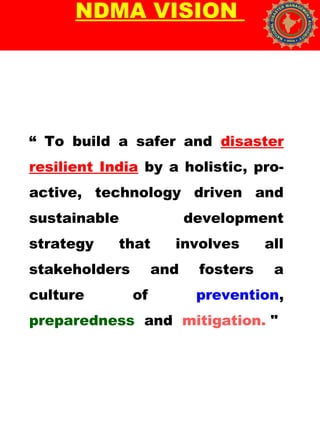
NDMA VISION
“ To build a safer and disaster
resilient India by a holistic, pro-
active, technology driven and
sustainable development
strategy that involves all
stakeholders and fosters a
culture of prevention,
preparedness and mitigation. " 
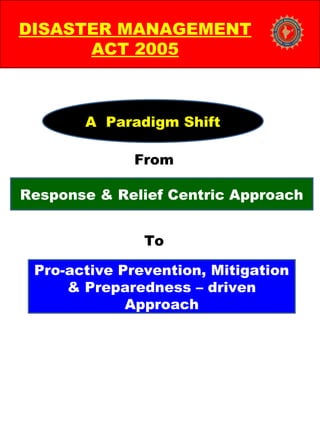
From
To
DISASTER MANAGEMENT
ACT 2005
Response & Relief Centric Approach
Pro-active Prevention, Mitigation
& Preparedness – driven
Approach
A Paradigm Shift
Earthquake
Floods
Wind & Cyclone
Landslide
VULNERABILITY PROFILE
OF INDIA
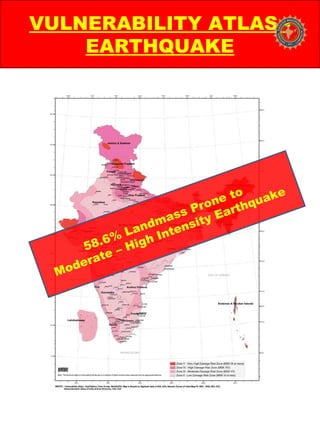
VULNERABILITY ATLAS -
EARTHQUAKE
58.6% Landmass Prone to
Moderate – High Intensity Earthquake
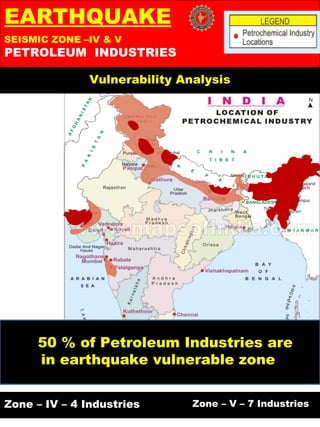
EARTHQUAKE
Vulnerability Analysis
SEISMIC ZONE –IV & V
PETROLEUM INDUSTRIES
Zone – IV – 4 Industries Zone – V – 7 Industries
50 % of Petroleum Industries are
in earthquake vulnerable zone
Himachal
Pradesh
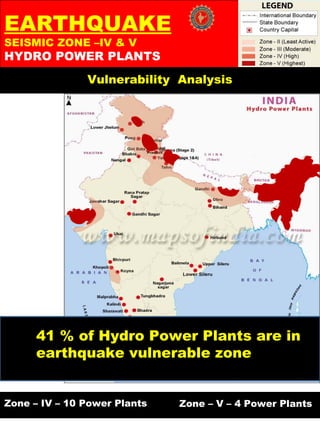
EARTHQUAKE
SEISMIC ZONE –IV & V
HYDRO POWER PLANTS
Vulnerability Analysis
Zone – IV – 10 Power Plants Zone – V – 4 Power Plants
41 % of Hydro Power Plants are in
earthquake vulnerable zone
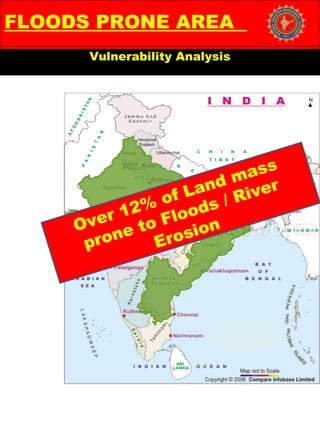
FLOODS PRONE AREA
Vulnerability Analysis
Over 12% of Land mass
prone to Floods / River
Erosion
Himachal
Pradesh
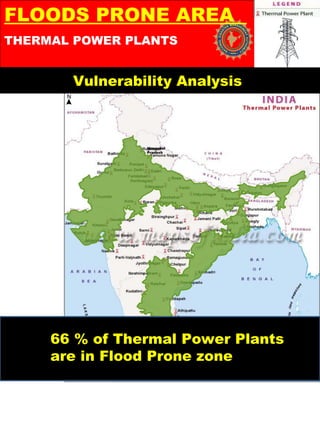
THERMAL POWER PLANTS
Vulnerability Analysis
FLOODS PRONE AREA
66 % of Thermal Power Plants
are in Flood Prone zone
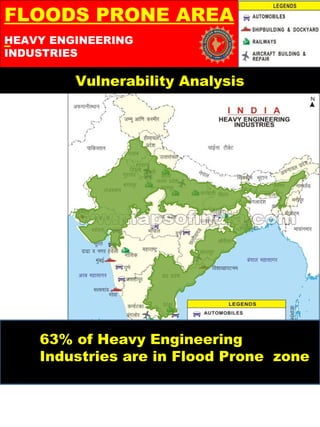
Vulnerability Analysis
HEAVY ENGINEERING
INDUSTRIES
FLOODS PRONE AREA
63% of Heavy Engineering
Industries are in Flood Prone zone
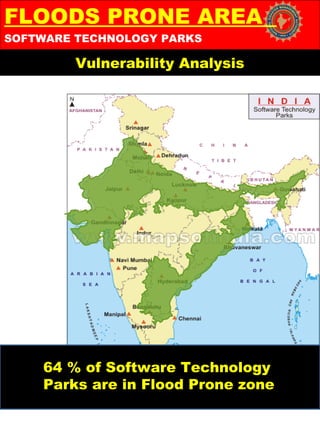
Vulnerability Analysis
SOFTWARE TECHNOLOGY PARKS
FLOODS PRONE AREA
64 % of Software Technology
Parks are in Flood Prone zone
Vulnerability Analysis
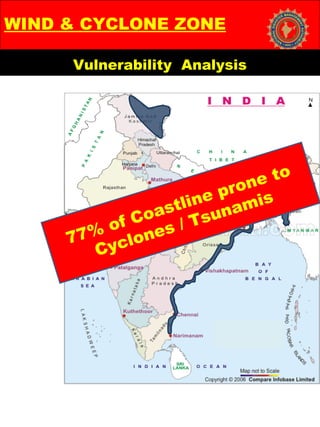
WIND & CYCLONE ZONE
77% of Coastline prone to
Cyclones / Tsunamis
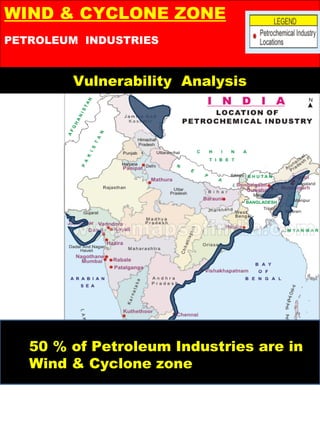
Vulnerability Analysis
PETROLEUM INDUSTRIES
WIND & CYCLONE ZONE
50 % of Petroleum Industries are in
Wind & Cyclone zone
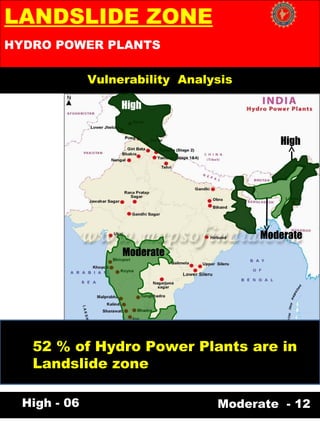
HYDRO POWER PLANTS
Vulnerability Analysis
LANDSLIDE ZONE
High
Moderate
High
Moderate
High - 06 Moderate - 12
52 % of Hydro Power Plants are in
Landslide zone
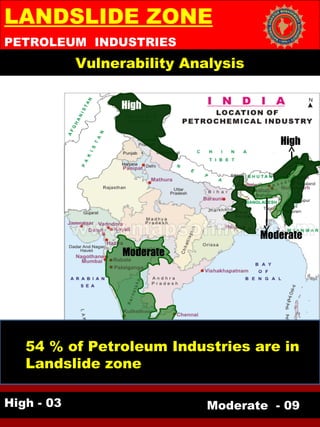
Vulnerability Analysis
PETROLEUM INDUSTRIES
LANDSLIDE ZONE
High - 03 Moderate - 09
High
Moderate
High
Moderate
54 % of Petroleum Industries are in
Landslide zone
CORPORATE SECTOR
&
DISASTERS
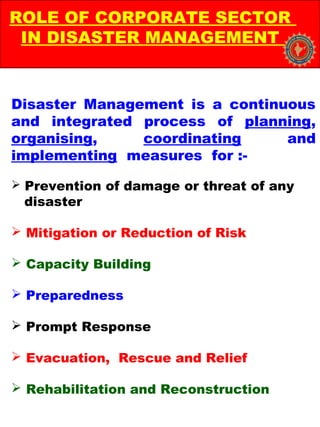
Disaster Management is a continuous
and integrated process of planning,
organising, coordinating and
implementing measures for :-
 Prevention of damage or threat of any
disaster
 Mitigation or Reduction of Risk
 Capacity Building
 Preparedness
 Prompt Response
 Evacuation, Rescue and Relief
 Rehabilitation and Reconstruction
ROLE OF CORPORATE SECTOR
IN DISASTER MANAGEMENT
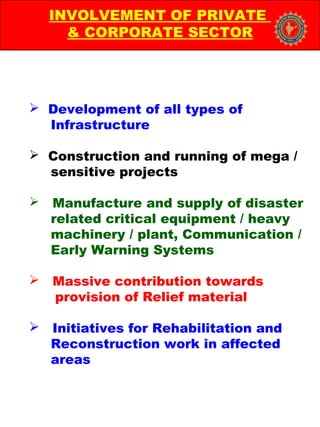
 Development of all types of
Infrastructure
 Construction and running of mega /
sensitive projects
 Manufacture and supply of disaster
related critical equipment / heavy
machinery / plant, Communication /
Early Warning Systems
 Massive contribution towards
provision of Relief material
 Initiatives for Rehabilitation and
Reconstruction work in affected
areas
INVOLVEMENT OF PRIVATE
& CORPORATE SECTOR
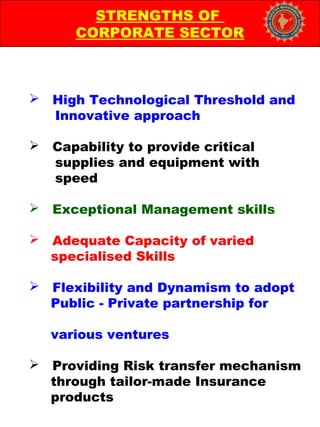
 High Technological Threshold and
Innovative approach
 Capability to provide critical
supplies and equipment with
speed
 Exceptional Management skills
 Adequate Capacity of varied
specialised Skills
 Flexibility and Dynamism to adopt
Public - Private partnership for
various ventures
 Providing Risk transfer mechanism
through tailor-made Insurance
products
STRENGTHS OF
CORPORATE SECTOR
MAINSTREAMING DRR
MEASURES
INTO DEVELOPMENTAL EFFORT
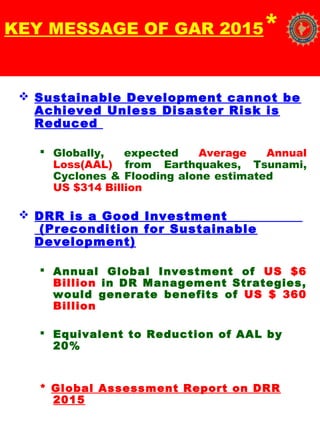
KEY MESSAGE OF GAR 2015*
 Sustainable Development cannot be
Achieved Unless Disaster Risk is
Reduced
 Globally, expected Average Annual
Loss(AAL) from Earthquakes, Tsunami,
Cyclones & Flooding alone estimated
US $314 Billion
 DRR is a Good Investment
(Precondition for Sustainable
Development)
 Annual Global Investment of US $6
Billion in DR Management Strategies,
would generate benefits of US $ 360
Billion
 Equivalent to Reduction of AAL by
20%
* Global Assessment Report on DRR
2015
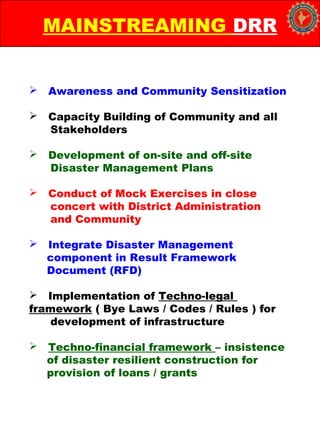
 Awareness and Community Sensitization
 Capacity Building of Community and all
Stakeholders
 Development of on-site and off-site
Disaster Management Plans
 Conduct of Mock Exercises in close
concert with District Administration
and Community
 Integrate Disaster Management
component in Result Framework
Document (RFD)
 Implementation of Techno-legal
framework ( Bye Laws / Codes / Rules ) for
development of infrastructure
 Techno-financial framework – insistence
of disaster resilient construction for
provision of loans / grants
MAINSTREAMING DRR
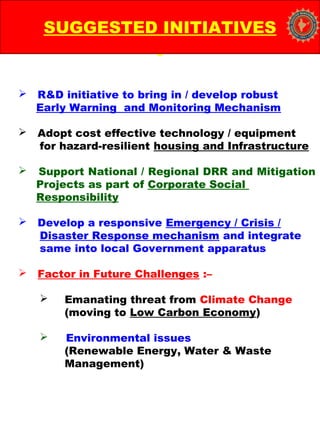
 R&D initiative to bring in / develop robust
Early Warning and Monitoring Mechanism
 Adopt cost effective technology / equipment
for hazard-resilient housing and Infrastructure
 Support National / Regional DRR and Mitigation
Projects as part of Corporate Social
Responsibility
 Develop a responsive Emergency / Crisis /
Disaster Response mechanism and integrate
same into local Government apparatus
 Factor in Future Challenges :–
 Emanating threat from Climate Change
(moving to Low Carbon Economy)
 Environmental issues
(Renewable Energy, Water & Waste
Management)
SUGGESTED INITIATIVES
 How can an Organisation be
Resilient…..?
 How does the Leadership face
various Challenges during a crisis /
setback ?
MANAGEMENT PERSPECTIVE
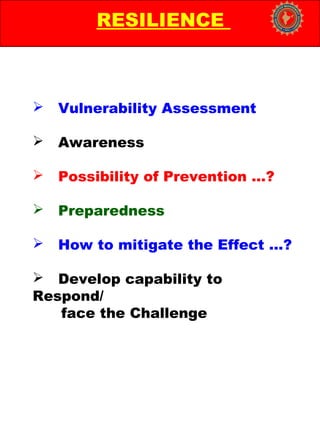
RESILIENCE
 Vulnerability Assessment
 Awareness
 Possibility of Prevention …?
 Preparedness
 How to mitigate the Effect …?
 Develop capability to
Respond/
face the Challenge
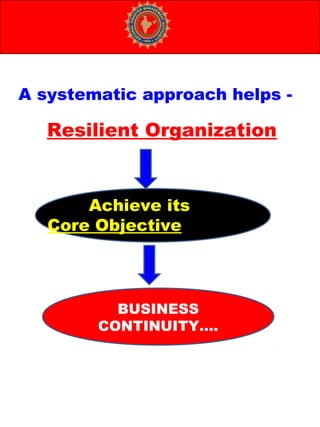
Achieve its
Core Objective
A systematic approach helps -
Resilient Organization
BUSINESS
CONTINUITY….
Thank You

LEADERSHIP THROUGH RESILIENCE

  • 1.
    Continuity and Resilience (CORE) ISO22301 BCM Consulting Firm Presentations by our partners and extended team of industry experts Our Contact Details: INDIA UAE Continuity and Resilience Level 15,Eros Corporate Tower Nehru Place ,New Delhi-110019 Tel: +91 11 41055534/ +91 11 41613033 Fax: ++91 11 41055535 Email: neha@continuityandresili ence.com Continuity and Resilience P. O. Box 127557 Abu Dhabi, United Arab Emirates Mobile:+971 50 8460530 Tel: +971 2 8152831 Fax: +971 2 8152888 Email: info@continuityandresilie nce.com
  • 2.
    LEADERSHIP THROUGH RESILIENCE Lt GenN C Marwah, PVSM, AVSM, (Retd) Member, NDMA Government of India
  • 3.
    NDMA VISION “ Tobuild a safer and disaster resilient India by a holistic, pro- active, technology driven and sustainable development strategy that involves all stakeholders and fosters a culture of prevention, preparedness and mitigation. " 
  • 4.
    From To DISASTER MANAGEMENT ACT 2005 Response& Relief Centric Approach Pro-active Prevention, Mitigation & Preparedness – driven Approach A Paradigm Shift
  • 5.
  • 6.
    VULNERABILITY ATLAS - EARTHQUAKE 58.6%Landmass Prone to Moderate – High Intensity Earthquake
  • 7.
    EARTHQUAKE Vulnerability Analysis SEISMIC ZONE–IV & V PETROLEUM INDUSTRIES Zone – IV – 4 Industries Zone – V – 7 Industries 50 % of Petroleum Industries are in earthquake vulnerable zone
  • 8.
    Himachal Pradesh EARTHQUAKE SEISMIC ZONE –IV& V HYDRO POWER PLANTS Vulnerability Analysis Zone – IV – 10 Power Plants Zone – V – 4 Power Plants 41 % of Hydro Power Plants are in earthquake vulnerable zone
  • 9.
    FLOODS PRONE AREA VulnerabilityAnalysis Over 12% of Land mass prone to Floods / River Erosion
  • 10.
    Himachal Pradesh THERMAL POWER PLANTS VulnerabilityAnalysis FLOODS PRONE AREA 66 % of Thermal Power Plants are in Flood Prone zone
  • 11.
    Vulnerability Analysis HEAVY ENGINEERING INDUSTRIES FLOODSPRONE AREA 63% of Heavy Engineering Industries are in Flood Prone zone
  • 12.
    Vulnerability Analysis SOFTWARE TECHNOLOGYPARKS FLOODS PRONE AREA 64 % of Software Technology Parks are in Flood Prone zone
  • 13.
    Vulnerability Analysis WIND &CYCLONE ZONE 77% of Coastline prone to Cyclones / Tsunamis
  • 14.
    Vulnerability Analysis PETROLEUM INDUSTRIES WIND& CYCLONE ZONE 50 % of Petroleum Industries are in Wind & Cyclone zone
  • 15.
    HYDRO POWER PLANTS VulnerabilityAnalysis LANDSLIDE ZONE High Moderate High Moderate High - 06 Moderate - 12 52 % of Hydro Power Plants are in Landslide zone
  • 16.
    Vulnerability Analysis PETROLEUM INDUSTRIES LANDSLIDEZONE High - 03 Moderate - 09 High Moderate High Moderate 54 % of Petroleum Industries are in Landslide zone
  • 17.
  • 18.
    Disaster Management isa continuous and integrated process of planning, organising, coordinating and implementing measures for :-  Prevention of damage or threat of any disaster  Mitigation or Reduction of Risk  Capacity Building  Preparedness  Prompt Response  Evacuation, Rescue and Relief  Rehabilitation and Reconstruction ROLE OF CORPORATE SECTOR IN DISASTER MANAGEMENT
  • 19.
     Development ofall types of Infrastructure  Construction and running of mega / sensitive projects  Manufacture and supply of disaster related critical equipment / heavy machinery / plant, Communication / Early Warning Systems  Massive contribution towards provision of Relief material  Initiatives for Rehabilitation and Reconstruction work in affected areas INVOLVEMENT OF PRIVATE & CORPORATE SECTOR
  • 20.
     High TechnologicalThreshold and Innovative approach  Capability to provide critical supplies and equipment with speed  Exceptional Management skills  Adequate Capacity of varied specialised Skills  Flexibility and Dynamism to adopt Public - Private partnership for various ventures  Providing Risk transfer mechanism through tailor-made Insurance products STRENGTHS OF CORPORATE SECTOR
  • 21.
  • 22.
    KEY MESSAGE OFGAR 2015*  Sustainable Development cannot be Achieved Unless Disaster Risk is Reduced  Globally, expected Average Annual Loss(AAL) from Earthquakes, Tsunami, Cyclones & Flooding alone estimated US $314 Billion  DRR is a Good Investment (Precondition for Sustainable Development)  Annual Global Investment of US $6 Billion in DR Management Strategies, would generate benefits of US $ 360 Billion  Equivalent to Reduction of AAL by 20% * Global Assessment Report on DRR 2015
  • 23.
     Awareness andCommunity Sensitization  Capacity Building of Community and all Stakeholders  Development of on-site and off-site Disaster Management Plans  Conduct of Mock Exercises in close concert with District Administration and Community  Integrate Disaster Management component in Result Framework Document (RFD)  Implementation of Techno-legal framework ( Bye Laws / Codes / Rules ) for development of infrastructure  Techno-financial framework – insistence of disaster resilient construction for provision of loans / grants MAINSTREAMING DRR
  • 24.
     R&D initiativeto bring in / develop robust Early Warning and Monitoring Mechanism  Adopt cost effective technology / equipment for hazard-resilient housing and Infrastructure  Support National / Regional DRR and Mitigation Projects as part of Corporate Social Responsibility  Develop a responsive Emergency / Crisis / Disaster Response mechanism and integrate same into local Government apparatus  Factor in Future Challenges :–  Emanating threat from Climate Change (moving to Low Carbon Economy)  Environmental issues (Renewable Energy, Water & Waste Management) SUGGESTED INITIATIVES
  • 25.
     How canan Organisation be Resilient…..?  How does the Leadership face various Challenges during a crisis / setback ? MANAGEMENT PERSPECTIVE
  • 26.
    RESILIENCE  Vulnerability Assessment Awareness  Possibility of Prevention …?  Preparedness  How to mitigate the Effect …?  Develop capability to Respond/ face the Challenge
  • 27.
    Achieve its Core Objective Asystematic approach helps - Resilient Organization BUSINESS CONTINUITY….
  • 28.

Editor's Notes

  • #3 Research input and preparation: Binaya Bhusan Gadnayak, Specialist (IRS), NDMA, Govt. f India