Communication Management and the Leadership ChallengeThe Plank Center Studies University of Leipzig, Leadership Forum 2011 (May 6, 2011)
The agenda…Importance of leadershipTheories of leadershipThe Plank Center research --Model of excellent leadership		--Overview of 20 leadership studies4.   Landscape of leader development 5.   Future research and collaborations2
Leadership is importantBecause leaders…Make important decisionsShape organizational cultureAffect communication climateContribute to image and futureInfluence employee attitudes, perceptions3
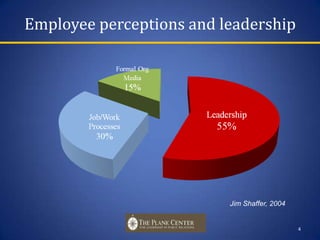
Employee perceptions and leadershipJim 4Jim Shaffer, 2004
What is leadership?Traits and characteristics (1920s)Skills: technical, human, conceptual (1940s)Styles and behaviors (1950s)Work team leadership (1960s)Contingent and situational (1960s)Ethical (servant) in nature (1970s)Transformational, charismatic (1980s)Authentic in nature (1990s)			P. G. Northouse (2007), Leadership: Theory and Practice5
Leadership is complexLeadership has been defined as …personalitya power relation       inducing compliancea set of behaviors use of influence focus of group processes form of persuasion initiation of structureinstrument to achieve goals  type of role 	effect of interaction…and many combinations of these definitions.  B. M. Bass (1990)6
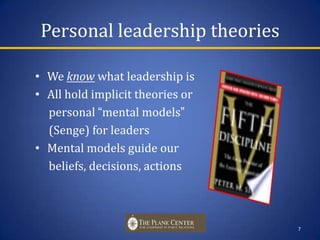
Personal leadership theoriesWe know what leadership isAll hold implicit theories or      personal “mental models”     (Senge) for leadersMental models guide our     beliefs, decisions, actions7
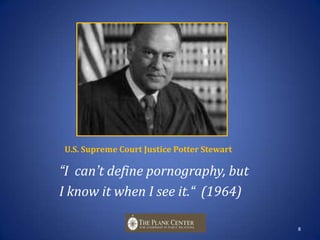
U.S. Supreme Court Justice Potter Stewart“I  can’t define pornography, but I know it when I see it.“  (1964)8
Research about leadership in communication managementIncrease knowledgeProduce better leaders Help organizations achieve goals and      increase legitimacy Improve the profession’s image and futureStrengthen education & training9
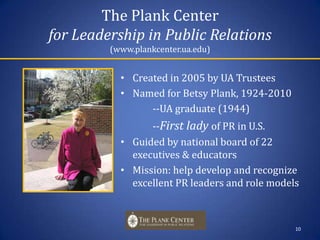
The Plank Center for Leadership in Public Relations(www.plankcenter.ua.edu)Created in 2005 by UA Trustees Named for Betsy Plank, 1924-2010		--UA graduate (1944)		--First lady of PR in U.S.Guided by national board of 22 executives & educatorsMission: help develop and recognize excellent PR leaders and role models10
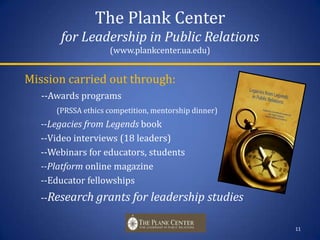
The Plank Center for Leadership in Public Relations(www.plankcenter.ua.edu)Mission carried out through:--Awards programs (PRSSA ethics competition, mentorship dinner) 	  --Legacies from Legends book	  --Video interviews (18 leaders)	  --Webinars for educators, students	  --Platform online magazine	  --Educator fellowships	  --Research grants for leadership studies11
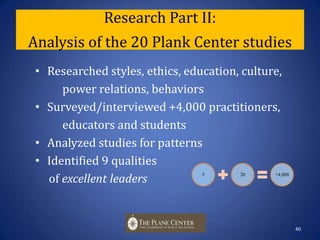
Plank Center researchSupported 20 leadership studies in 5 years+4,000  practitioners,  educators and students 9 qualities of excellentleadersA model of excellent  leadership in PR (J. Meng, 2010)Review this research today:The model process and resultsOverview of the nine qualities12
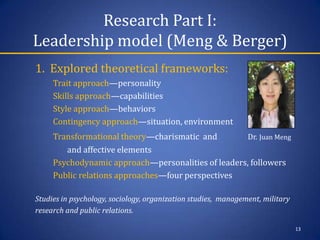
Research Part I:Leadership model (Meng & Berger)1.  Explored theoretical frameworks:	   Trait approach—personality 	   Skills approach—capabilities	   Style approach—behaviors	   Contingencyapproach—situation, environment Transformational theory—charismatic  and	       Dr.Juan Meng and affective elements	   Psychodynamic approach—personalities of leaders, followersPublic relations approaches—four perspectivesStudies in psychology, sociology, organization studies,  management, military research and public relations.13
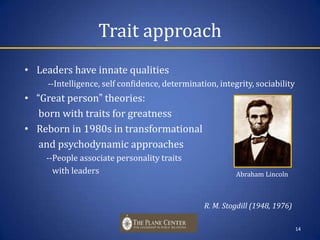
Trait approachLeaders have innate qualities             --Intelligence, self confidence, determination, integrity, sociability“Great person” theories:       born with traits for greatnessReborn in 1980s in transformational       and psychodynamic approaches   --People associate personality traits       with leaders						           R. M. Stogdill (1948, 1976)14    Abraham Lincoln
Skills approachLeaders need skills and abilities in 3 areas:Technical = knowledge in a work areaHuman = ability to work with peopleConceptual = ability to work with ideas, conceptsSkills can be learned and developedMilitary studies/programs use this approachR. Katz (1955)15
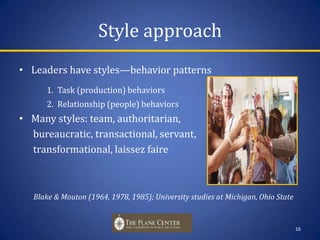
Style approachLeaders have styles—behavior patterns1.  Task (production) behaviors 	        2.  Relationship (people) behaviors Many styles: team, authoritarian,       bureaucratic, transactional, servant,       transformational, laissez faire          Blake & Mouton (1964, 1978, 1985); University studies at Michigan, Ohio State16
Situation/Contingency approachLeaders are influenced by situation and environment Adapt style to situation—environmentChange degree of directive vs. supportive style, based on situation (development continuum)Used heavily in training programs in Fortune 500 				K. H. Blanchard (1985, 1993); F. E. Fiedler (1967, 1993)17
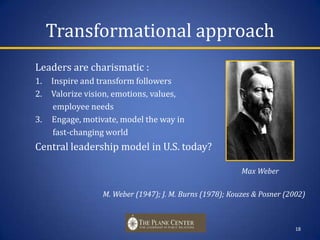
Transformational approach Leaders are charismatic : Inspire and transform followersValorize vision, emotions, values,          employee needs 3.     Engage, motivate, model the way in          fast-changing world  Central leadership model in U.S. today?                                                              				        Max Weber			  M. Weber (1947); J. M. Burns (1978); Kouzes & Posner (2002)18
4 public relations approachesExcellence, role theories (Grunig , Dozier & others)--Managerial view, company culture, dominant coalition2.   Contingency theory (Cameron & others)--Environmental influences, flexibility3.   Power relations theory (Berger & Reber)--Dominant coalition, vision, political will and intelligence4.   Gender  theory (Aldoory & Toth)--Transformational  style,  gendered perceptions19
From theories to a model20
RQsResearch Questions213.  Developed 6 research questions:RQ1:  Key dimensions of PR leadership?	RQ2:  Most important qualities of leaders?	RQ3:  Sources for leader development?	RQ4:  PR qualities different from other fields?	RQ5:  If so, how different?	RQ6:  Different by gender, other demographics?
What is excellent leadership in communication management?4. Developed this definition and construct:      “Excellent leadership in public relations is a dynamic process that encompasses a complex mix of individual traits, skills, personal values and behaviors that consistently produces ethical and effective practice. Such practice fuels and guides successful communication teams and helps organizations achieve their goals and increase their legitimacy in society.”22
Our research process5. Prepared, refined a list of leader dimensions      and item measures (BIG step):Drew from literature reviewConducted 2 pretests of item measures, dimensions		--Reduced dimensions from 8 to 6		--Reduced item measures from 89 to 45		--Used 5-8 item measures per dimensionNetemeyer et al. (2003); Spector (1992)23
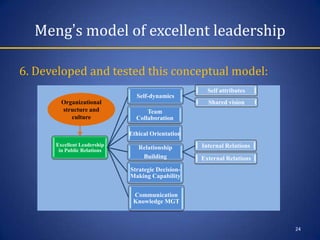
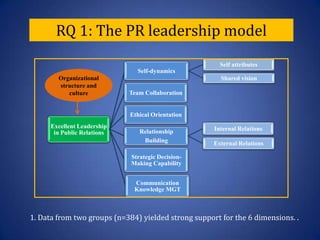
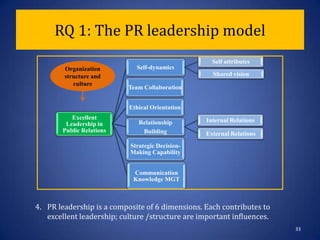
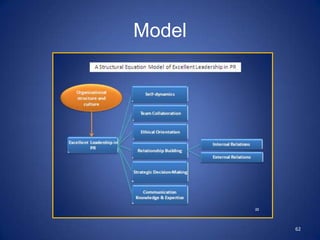
Meng’s model of excellent leadership6. Developed and tested this conceptual model:24Organizational structure and culture
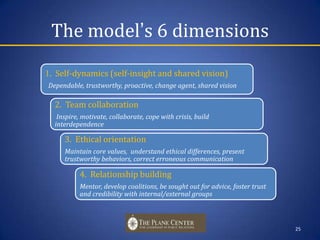
The model’s 6 dimensions25
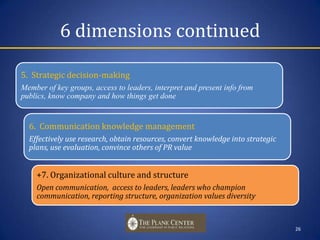
6 dimensions continued26
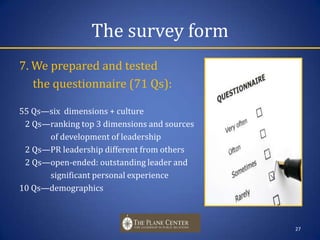
The survey form7. We prepared and tested      the questionnaire (71 Qs):55 Qs—six  dimensions + culture   2 Qs—ranking top 3 dimensions and sources 	          of development of leadership     2 Qs—PR leadership different from others   2 Qs—open-ended: outstanding leader and 	          significant personal experience10 Qs—demographics 27
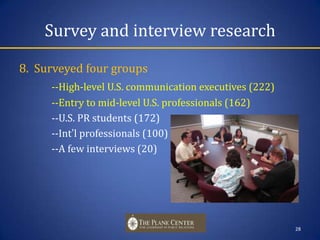
Survey and interview research8.  Surveyed four groups --High-level U.S. communication executives (222)	       --Entry to mid-level U.S. professionals (162)	       --U.S. PR students (172)	       --Int’l professionals (100)	       --A few interviews (20)28
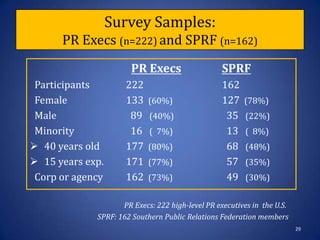
Survey Samples: PR Execs (n=222) and SPRF (n=162)PR ExecsSPRF  Participants		222			162  Female		133  (60%)		127  (78%)  Male			  89   (40%)		  35   (22%)  Minority		  16   (  7%)		  13   (  8%) 40 years old	177  (80%)		  68   (48%)
 15 years exp.	171  (77%)		  57   (35%)  Corp or agency	162  (73%)		  49   (30%)PR Execs: 222 high-level PR executives in  the U.S. 			  SPRF: 162 Southern Public Relations Federation members29
RQ 1: The PR leadership modelOrganizational structure and culture1. Data from two groups (n=384) yielded strong support for the 6 dimensions. .
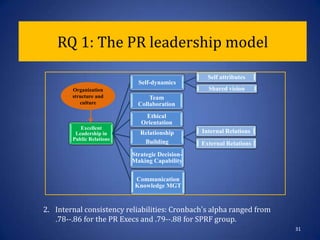
RQ 1: The PR leadership model31Organization structure and cultureInternal consistency reliabilities: Cronbach’s alpha ranged from        .78--.86 for the PR Execs and .79--.88 for SPRF group.
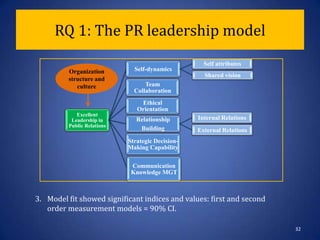
RQ 1: The PR leadership model32Organization structure and cultureModel fit showed significant indices and values: first and second  order measurement models = 90% CI.
RQ 1: The PR leadership model33Organization structure and culturePR leadership is a composite of 6 dimensions. Each contributes to excellent leadership; culture /structure are important influences.
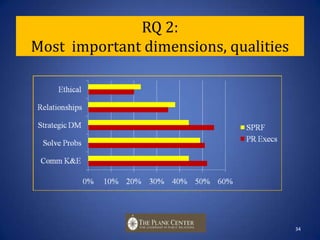
RQ 2:  Most  important dimensions, qualities34
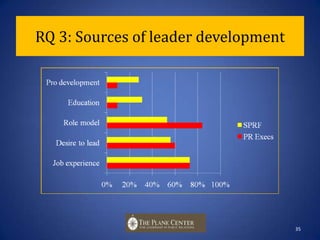
RQ 3: Sources of leader development35
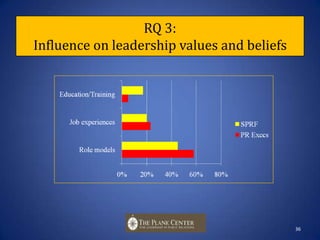
RQ 3: Influence on leadership values and beliefs36
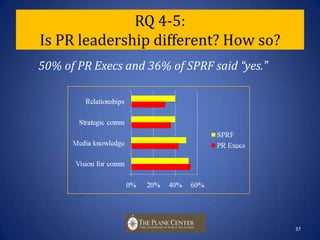
RQ 4-5:  Is PR leadership different? How so?50% of PR Execs and 36% of SPRF said “yes.”37
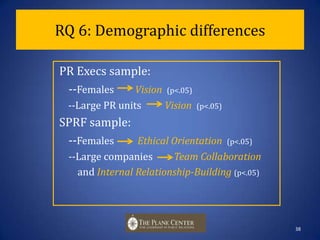
RQ 6: Demographic differences PR Execs sample:	--Females         Vision(p<.05)     --Large PR units          Vision(p<.05) SPRF sample:	--Females          Ethical Orientation (p<.05)	--Large companies         Team Collaboration and Internal Relationship-Building (p<.05)38
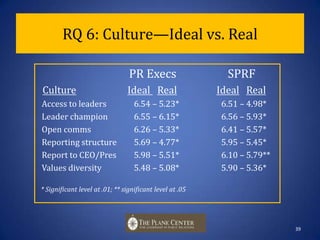
RQ 6: Culture—Ideal vs. Real			          PR Execs	           SPRFCultureIdeal RealIdealReal  Access to leaders	6.54 – 5.23*	            6.51 – 4.98*  Leader champion	6.55 – 6.15*	            6.56 – 5.93*  Open comms		6.26 – 5.33*	            6.41 – 5.57*  Reporting structure	5.69 – 4.77*	            5.95 – 5.45*  Report to CEO/Pres	5.98 – 5.51*	            6.10 – 5.79**  Values diversity		5.48 – 5.08*	            5.90 – 5.36*  * Significant level at .01; ** significant level at .0539
Research Part II:Analysis of the 20 Plank Center studiesResearched styles, ethics, education, culture,             power relations, behaviorsSurveyed/interviewed +4,000 practitioners,            educators and students Analyzed studies for patternsIdentified 9 qualities      of excellent leaders40
Qualities of excellent PR leaders#1 Role Models Lead by example through two-way communication and behaviors. Role models and mentors exert great influence on our beliefs about leadership qualities and values. 41
Qualities of excellent PR leaders#2 Strategic CounselorParticipate fully in strategic decision making, the most crucial quality of leaders, say senior executives. The ultimate PR leader is a strategic counselor in important    decision-making moments.42
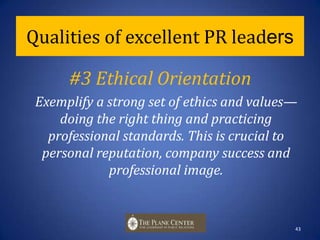
Qualities of excellent PR leaders#3 Ethical OrientationExemplify a strong set of ethics and values—doing the right thing and practicing professional standards. This is crucial to personal reputation, company success and professional image.   43
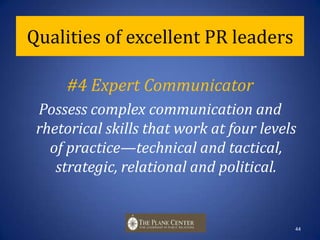
Qualities of excellent PR leaders#4 Expert CommunicatorPossess complex communication and rhetorical skills that work at four levels of practice—technical and tactical, strategic, relational and political.44
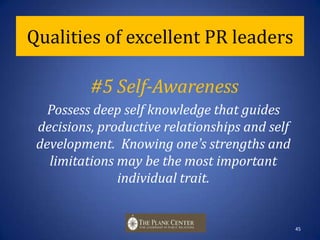
Qualities of excellent PR leaders#5 Self-Awareness    Possess deep self knowledge that guides  decisions, productive relationships and self development.  Knowing one’s strengths and limitations may be the most important individual trait. 45
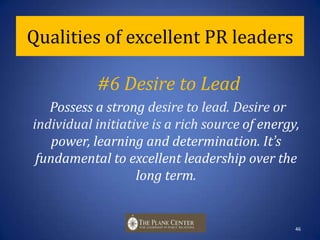
Qualities of excellent PR leaders#6 Desire to LeadPossess a strong desire to lead. Desire or individual initiative is a rich source of energy, power, learning and determination. It’s fundamental to excellent leadership over the long term. 46
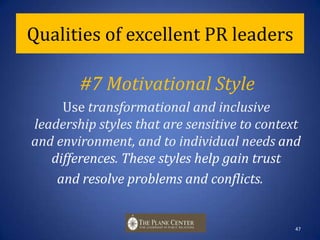
Qualities of excellent PR leaders#7 Motivational StyleUse transformational and inclusive leadership styles that are sensitive to context and environment, and to individual needs and differences. These styles help gain trust and resolve problems and conflicts.47
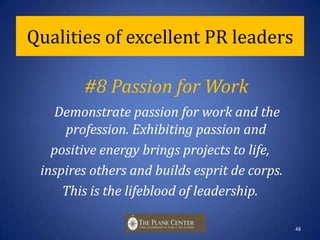
Qualities of excellent PR leaders#8 Passion for WorkDemonstrate passion for work and the profession. Exhibiting passion and positive energy brings projects to life, inspires others and builds esprit de corps. This is the lifeblood of leadership.48
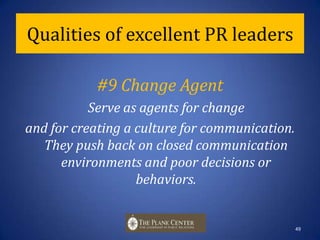
Qualities of excellent PR leaders#9 Change Agent    Serve as agents for change and for creating a culture for communication. They push back on closed communication environments and poor decisions or behaviors.49
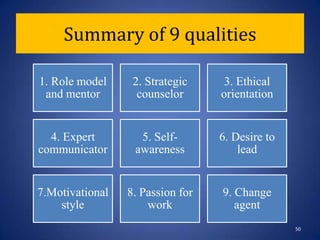
Summary of 9 qualities50
Landscape of leader development in U.S.51    1.  Diverse approaches Individual companies (Whirlpool Academy)Specialist providers (Center for Creative Leadership)Personal “coaches”(Marshall Goldsmith)Association programs(PRSA, IPR, Page Society)
Landscape of leader development in U.S.  2.  Issues and limitationsAssociations don’t represent field--21,000  vs.  350,000Quality of content, instruction vary--Networking and information loadingLearning may not be transportable--Understanding  vs.  doingNo long-term measures 52
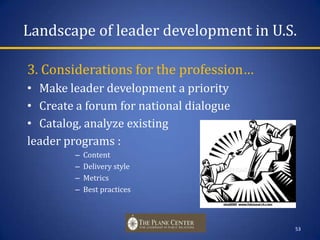
Landscape of leader development in U.S.3. Considerations for the profession…Make leader development a priorityCreate a forum for national dialogueCatalog, analyze existing leader programs :ContentDelivery styleMetricsBest practices53
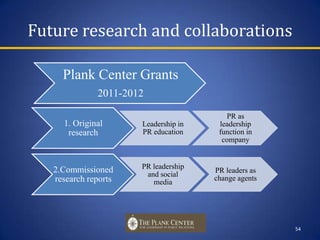
Future research and collaborations54
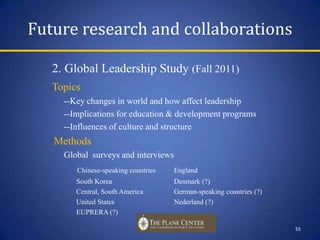
Future research and collaborations  2. Global Leadership Study (Fall 2011)Topics  	--Key changes in world and how affect leadership	--Implications for education & development programs	--Influences of culture and structure   Methods	Global  surveys and interviews		Chinese-speaking countries	England	       South Korea		Denmark (?)	       Central, South America 	German-speaking countries (?)   	       United States		Nederland (?)	       EUPRERA (?)55
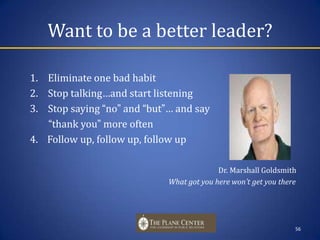
Want to be a better leader?Eliminate one bad habitStop talking…and start listeningStop saying “no” and “but”… and say  “thank you” more often4.    Follow up, follow up, follow up						                Dr. Marshall Goldsmith					      What got you here won’t get you there56
The Plank Center studies in leadership and communication management57
58
The PR Success Study (2004)MA students partnered with Heyman Associates Interviewed 97 senior PR executivesIdentified “patterns of success:”Success at many levels		Many pathways to success		Power of performance		Years & diversity of experience		Complex communication skills	Relationships, relationships!      		Passionate and proactive		Crucial intangiblesProduced professional report, journal articlehttp://www.heymanassociates.com/Spotlight/WCH_Univ_Alabama_Research_Report-06_2004.htmhttp://www.informaworld.com/smpp/content~db=all~content=a78801955059
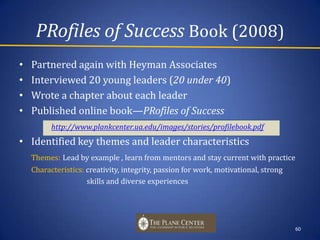
PRofiles of Success Book (2008)Partnered again with Heyman AssociatesInterviewed 20 young leaders (20 under 40)Wrote a chapter about each leaderPublished online book—PRofiles of Success http://www.plankcenter.ua.edu/images/stories/profilebook.pdfIdentified key themes and leader characteristicsThemes:Lead by example , learn from mentors and stay current with practiceCharacteristics: creativity, integrity, passion for work, motivational, strong 			  skills and diverse experiences60
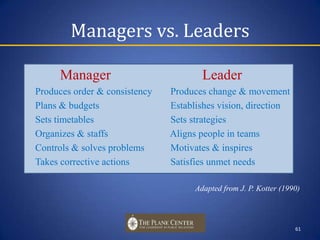
Managers vs. LeadersManager			  LeaderProduces order & consistency	   Produces change & movementPlans & budgets		   Establishes vision, directionSets timetables			   Sets strategiesOrganizes & staffs		   Aligns people in teamsControls & solves problems 	   Motivates & inspiresTakes corrective actions		   Satisfies unmet needsAdapted from J. P. Kotter (1990)61

Leadership forum2011

  • 1.
    Communication Management andthe Leadership ChallengeThe Plank Center Studies University of Leipzig, Leadership Forum 2011 (May 6, 2011)
  • 2.
    The agenda…Importance ofleadershipTheories of leadershipThe Plank Center research --Model of excellent leadership --Overview of 20 leadership studies4. Landscape of leader development 5. Future research and collaborations2
  • 3.
    Leadership is importantBecauseleaders…Make important decisionsShape organizational cultureAffect communication climateContribute to image and futureInfluence employee attitudes, perceptions3
  • 4.
    Employee perceptions andleadershipJim 4Jim Shaffer, 2004
  • 5.
    What is leadership?Traitsand characteristics (1920s)Skills: technical, human, conceptual (1940s)Styles and behaviors (1950s)Work team leadership (1960s)Contingent and situational (1960s)Ethical (servant) in nature (1970s)Transformational, charismatic (1980s)Authentic in nature (1990s) P. G. Northouse (2007), Leadership: Theory and Practice5
  • 6.
    Leadership is complexLeadershiphas been defined as …personalitya power relation inducing compliancea set of behaviors use of influence focus of group processes form of persuasion initiation of structureinstrument to achieve goals type of role effect of interaction…and many combinations of these definitions. B. M. Bass (1990)6
  • 7.
    Personal leadership theoriesWeknow what leadership isAll hold implicit theories or personal “mental models” (Senge) for leadersMental models guide our beliefs, decisions, actions7
  • 8.
    U.S. Supreme CourtJustice Potter Stewart“I can’t define pornography, but I know it when I see it.“ (1964)8
  • 9.
    Research about leadershipin communication managementIncrease knowledgeProduce better leaders Help organizations achieve goals and increase legitimacy Improve the profession’s image and futureStrengthen education & training9
  • 10.
    The Plank Centerfor Leadership in Public Relations(www.plankcenter.ua.edu)Created in 2005 by UA Trustees Named for Betsy Plank, 1924-2010 --UA graduate (1944) --First lady of PR in U.S.Guided by national board of 22 executives & educatorsMission: help develop and recognize excellent PR leaders and role models10
  • 11.
    The Plank Centerfor Leadership in Public Relations(www.plankcenter.ua.edu)Mission carried out through:--Awards programs (PRSSA ethics competition, mentorship dinner) --Legacies from Legends book --Video interviews (18 leaders) --Webinars for educators, students --Platform online magazine --Educator fellowships --Research grants for leadership studies11
  • 12.
    Plank Center researchSupported20 leadership studies in 5 years+4,000 practitioners, educators and students 9 qualities of excellentleadersA model of excellent leadership in PR (J. Meng, 2010)Review this research today:The model process and resultsOverview of the nine qualities12
  • 13.
    Research Part I:Leadershipmodel (Meng & Berger)1. Explored theoretical frameworks: Trait approach—personality Skills approach—capabilities Style approach—behaviors Contingencyapproach—situation, environment Transformational theory—charismatic and Dr.Juan Meng and affective elements Psychodynamic approach—personalities of leaders, followersPublic relations approaches—four perspectivesStudies in psychology, sociology, organization studies, management, military research and public relations.13
  • 14.
    Trait approachLeaders haveinnate qualities --Intelligence, self confidence, determination, integrity, sociability“Great person” theories: born with traits for greatnessReborn in 1980s in transformational and psychodynamic approaches --People associate personality traits with leaders R. M. Stogdill (1948, 1976)14 Abraham Lincoln
  • 15.
    Skills approachLeaders needskills and abilities in 3 areas:Technical = knowledge in a work areaHuman = ability to work with peopleConceptual = ability to work with ideas, conceptsSkills can be learned and developedMilitary studies/programs use this approachR. Katz (1955)15
  • 16.
    Style approachLeaders havestyles—behavior patterns1. Task (production) behaviors 2. Relationship (people) behaviors Many styles: team, authoritarian, bureaucratic, transactional, servant, transformational, laissez faire Blake & Mouton (1964, 1978, 1985); University studies at Michigan, Ohio State16
  • 17.
    Situation/Contingency approachLeaders areinfluenced by situation and environment Adapt style to situation—environmentChange degree of directive vs. supportive style, based on situation (development continuum)Used heavily in training programs in Fortune 500 K. H. Blanchard (1985, 1993); F. E. Fiedler (1967, 1993)17
  • 18.
    Transformational approach Leadersare charismatic : Inspire and transform followersValorize vision, emotions, values, employee needs 3. Engage, motivate, model the way in fast-changing world Central leadership model in U.S. today? Max Weber M. Weber (1947); J. M. Burns (1978); Kouzes & Posner (2002)18
  • 19.
    4 public relationsapproachesExcellence, role theories (Grunig , Dozier & others)--Managerial view, company culture, dominant coalition2. Contingency theory (Cameron & others)--Environmental influences, flexibility3. Power relations theory (Berger & Reber)--Dominant coalition, vision, political will and intelligence4. Gender theory (Aldoory & Toth)--Transformational style, gendered perceptions19
  • 20.
  • 21.
    RQsResearch Questions213. Developed 6 research questions:RQ1: Key dimensions of PR leadership? RQ2: Most important qualities of leaders? RQ3: Sources for leader development? RQ4: PR qualities different from other fields? RQ5: If so, how different? RQ6: Different by gender, other demographics?
  • 22.
    What is excellentleadership in communication management?4. Developed this definition and construct: “Excellent leadership in public relations is a dynamic process that encompasses a complex mix of individual traits, skills, personal values and behaviors that consistently produces ethical and effective practice. Such practice fuels and guides successful communication teams and helps organizations achieve their goals and increase their legitimacy in society.”22
  • 23.
    Our research process5.Prepared, refined a list of leader dimensions and item measures (BIG step):Drew from literature reviewConducted 2 pretests of item measures, dimensions --Reduced dimensions from 8 to 6 --Reduced item measures from 89 to 45 --Used 5-8 item measures per dimensionNetemeyer et al. (2003); Spector (1992)23
  • 24.
    Meng’s model ofexcellent leadership6. Developed and tested this conceptual model:24Organizational structure and culture
  • 25.
    The model’s 6dimensions25
  • 26.
  • 27.
    The survey form7.We prepared and tested the questionnaire (71 Qs):55 Qs—six dimensions + culture 2 Qs—ranking top 3 dimensions and sources of development of leadership 2 Qs—PR leadership different from others 2 Qs—open-ended: outstanding leader and significant personal experience10 Qs—demographics 27
  • 28.
    Survey and interviewresearch8. Surveyed four groups --High-level U.S. communication executives (222) --Entry to mid-level U.S. professionals (162) --U.S. PR students (172) --Int’l professionals (100) --A few interviews (20)28
  • 29.
    Survey Samples: PRExecs (n=222) and SPRF (n=162)PR ExecsSPRF Participants 222 162 Female 133 (60%) 127 (78%) Male 89 (40%) 35 (22%) Minority 16 ( 7%) 13 ( 8%) 40 years old 177 (80%) 68 (48%)
  • 30.
    15 yearsexp. 171 (77%) 57 (35%) Corp or agency 162 (73%) 49 (30%)PR Execs: 222 high-level PR executives in the U.S. SPRF: 162 Southern Public Relations Federation members29
  • 31.
    RQ 1: ThePR leadership modelOrganizational structure and culture1. Data from two groups (n=384) yielded strong support for the 6 dimensions. .
  • 32.
    RQ 1: ThePR leadership model31Organization structure and cultureInternal consistency reliabilities: Cronbach’s alpha ranged from .78--.86 for the PR Execs and .79--.88 for SPRF group.
  • 33.
    RQ 1: ThePR leadership model32Organization structure and cultureModel fit showed significant indices and values: first and second order measurement models = 90% CI.
  • 34.
    RQ 1: ThePR leadership model33Organization structure and culturePR leadership is a composite of 6 dimensions. Each contributes to excellent leadership; culture /structure are important influences.
  • 35.
    RQ 2: Most important dimensions, qualities34
  • 36.
    RQ 3: Sourcesof leader development35
  • 37.
    RQ 3: Influenceon leadership values and beliefs36
  • 38.
    RQ 4-5: Is PR leadership different? How so?50% of PR Execs and 36% of SPRF said “yes.”37
  • 39.
    RQ 6: Demographicdifferences PR Execs sample: --Females Vision(p<.05) --Large PR units Vision(p<.05) SPRF sample: --Females Ethical Orientation (p<.05) --Large companies Team Collaboration and Internal Relationship-Building (p<.05)38
  • 40.
    RQ 6: Culture—Idealvs. Real PR Execs SPRFCultureIdeal RealIdealReal Access to leaders 6.54 – 5.23* 6.51 – 4.98* Leader champion 6.55 – 6.15* 6.56 – 5.93* Open comms 6.26 – 5.33* 6.41 – 5.57* Reporting structure 5.69 – 4.77* 5.95 – 5.45* Report to CEO/Pres 5.98 – 5.51* 6.10 – 5.79** Values diversity 5.48 – 5.08* 5.90 – 5.36* * Significant level at .01; ** significant level at .0539
  • 41.
    Research Part II:Analysisof the 20 Plank Center studiesResearched styles, ethics, education, culture, power relations, behaviorsSurveyed/interviewed +4,000 practitioners, educators and students Analyzed studies for patternsIdentified 9 qualities of excellent leaders40
  • 42.
    Qualities of excellentPR leaders#1 Role Models Lead by example through two-way communication and behaviors. Role models and mentors exert great influence on our beliefs about leadership qualities and values. 41
  • 43.
    Qualities of excellentPR leaders#2 Strategic CounselorParticipate fully in strategic decision making, the most crucial quality of leaders, say senior executives. The ultimate PR leader is a strategic counselor in important decision-making moments.42
  • 44.
    Qualities of excellentPR leaders#3 Ethical OrientationExemplify a strong set of ethics and values—doing the right thing and practicing professional standards. This is crucial to personal reputation, company success and professional image. 43
  • 45.
    Qualities of excellentPR leaders#4 Expert CommunicatorPossess complex communication and rhetorical skills that work at four levels of practice—technical and tactical, strategic, relational and political.44
  • 46.
    Qualities of excellentPR leaders#5 Self-Awareness Possess deep self knowledge that guides decisions, productive relationships and self development. Knowing one’s strengths and limitations may be the most important individual trait. 45
  • 47.
    Qualities of excellentPR leaders#6 Desire to LeadPossess a strong desire to lead. Desire or individual initiative is a rich source of energy, power, learning and determination. It’s fundamental to excellent leadership over the long term. 46
  • 48.
    Qualities of excellentPR leaders#7 Motivational StyleUse transformational and inclusive leadership styles that are sensitive to context and environment, and to individual needs and differences. These styles help gain trust and resolve problems and conflicts.47
  • 49.
    Qualities of excellentPR leaders#8 Passion for WorkDemonstrate passion for work and the profession. Exhibiting passion and positive energy brings projects to life, inspires others and builds esprit de corps. This is the lifeblood of leadership.48
  • 50.
    Qualities of excellentPR leaders#9 Change Agent Serve as agents for change and for creating a culture for communication. They push back on closed communication environments and poor decisions or behaviors.49
  • 51.
    Summary of 9qualities50
  • 52.
    Landscape of leaderdevelopment in U.S.51 1. Diverse approaches Individual companies (Whirlpool Academy)Specialist providers (Center for Creative Leadership)Personal “coaches”(Marshall Goldsmith)Association programs(PRSA, IPR, Page Society)
  • 53.
    Landscape of leaderdevelopment in U.S. 2. Issues and limitationsAssociations don’t represent field--21,000 vs. 350,000Quality of content, instruction vary--Networking and information loadingLearning may not be transportable--Understanding vs. doingNo long-term measures 52
  • 54.
    Landscape of leaderdevelopment in U.S.3. Considerations for the profession…Make leader development a priorityCreate a forum for national dialogueCatalog, analyze existing leader programs :ContentDelivery styleMetricsBest practices53
  • 55.
    Future research andcollaborations54
  • 56.
    Future research andcollaborations 2. Global Leadership Study (Fall 2011)Topics --Key changes in world and how affect leadership --Implications for education & development programs --Influences of culture and structure Methods Global surveys and interviews Chinese-speaking countries England South Korea Denmark (?) Central, South America German-speaking countries (?) United States Nederland (?) EUPRERA (?)55
  • 57.
    Want to bea better leader?Eliminate one bad habitStop talking…and start listeningStop saying “no” and “but”… and say “thank you” more often4. Follow up, follow up, follow up Dr. Marshall Goldsmith What got you here won’t get you there56
  • 58.
    The Plank Centerstudies in leadership and communication management57
  • 59.
  • 60.
    The PR SuccessStudy (2004)MA students partnered with Heyman Associates Interviewed 97 senior PR executivesIdentified “patterns of success:”Success at many levels Many pathways to success Power of performance Years & diversity of experience Complex communication skills Relationships, relationships! Passionate and proactive Crucial intangiblesProduced professional report, journal articlehttp://www.heymanassociates.com/Spotlight/WCH_Univ_Alabama_Research_Report-06_2004.htmhttp://www.informaworld.com/smpp/content~db=all~content=a78801955059
  • 61.
    PRofiles of SuccessBook (2008)Partnered again with Heyman AssociatesInterviewed 20 young leaders (20 under 40)Wrote a chapter about each leaderPublished online book—PRofiles of Success http://www.plankcenter.ua.edu/images/stories/profilebook.pdfIdentified key themes and leader characteristicsThemes:Lead by example , learn from mentors and stay current with practiceCharacteristics: creativity, integrity, passion for work, motivational, strong skills and diverse experiences60
  • 62.
    Managers vs. LeadersManager LeaderProduces order & consistency Produces change & movementPlans & budgets Establishes vision, directionSets timetables Sets strategiesOrganizes & staffs Aligns people in teamsControls & solves problems Motivates & inspiresTakes corrective actions Satisfies unmet needsAdapted from J. P. Kotter (1990)61