1ER
PriCE low Carbone OF Green
Building Awards 2016 France
1ER
PRICE WOOD TROPHIES ILE-DE-
FRANCE 2016
2012- 2016
Programme : 	124 offices, 1 amphitheater, 2
meeting rom
Environmental characteristics : bâtiment RT2012 -27%,
natural ventilation , structure 100% wood, low
carbone
Site : Université de Nanterre
Client : Université Paris Nanterre
Prime contractors : Atelier Pascal Gontier
Batiserf, Inex, Lamoureux, Cabinet Mit
Budget : 11 271 905 €
Surface : 4 904 m2
BUILDING
max weber
universitY OF
NANTERRE
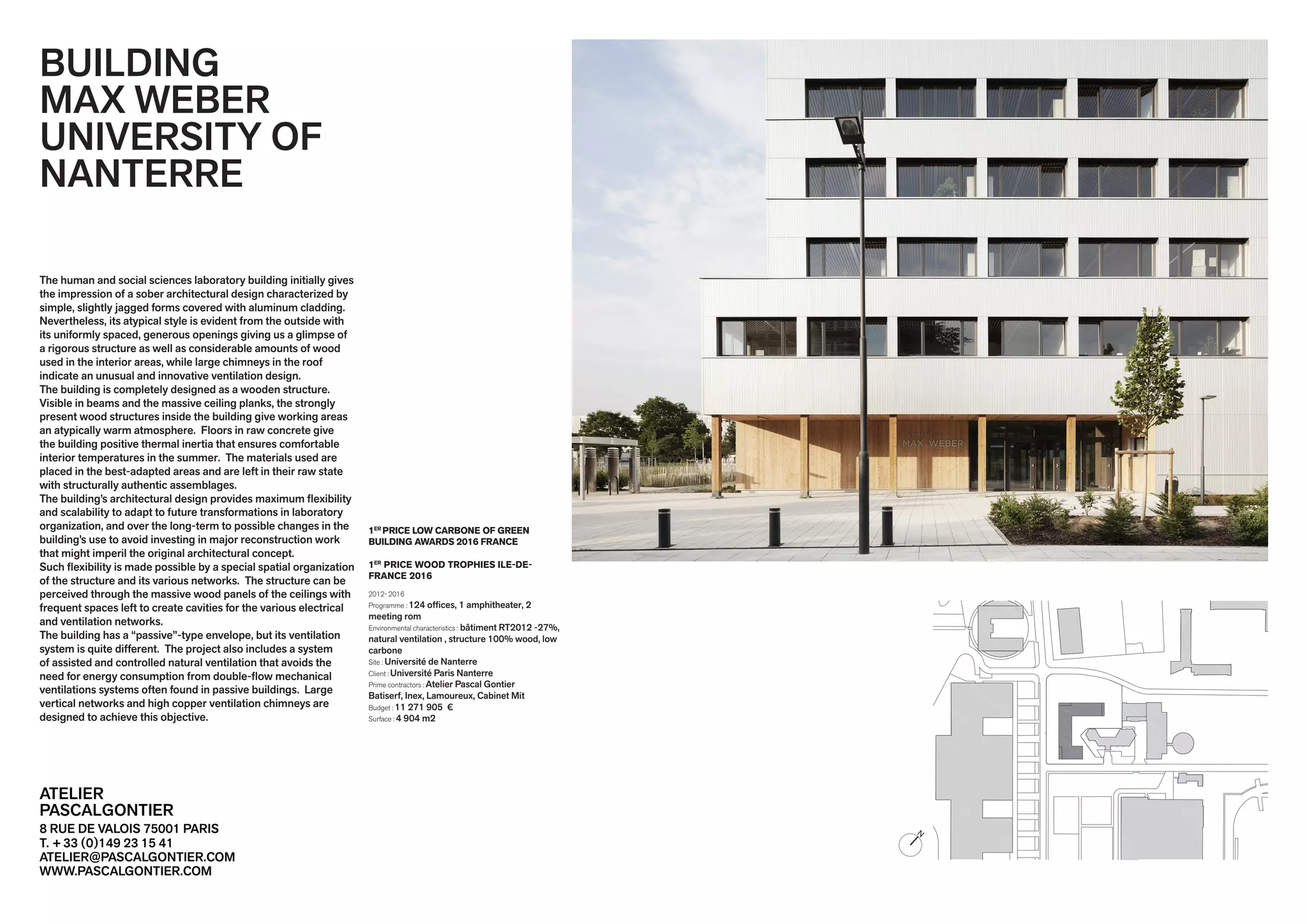
The human and social sciences laboratory building initially gives
the impression of a sober architectural design characterized by
simple, slightly jagged forms covered with aluminum cladding.
Nevertheless, its atypical style is evident from the outside with
its uniformly spaced, generous openings giving us a glimpse of
a rigorous structure as well as considerable amounts of wood
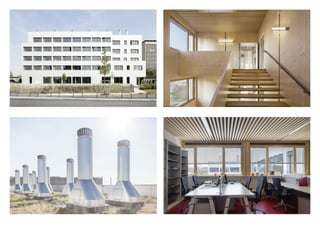
used in the interior areas, while large chimneys in the roof
indicate an unusual and innovative ventilation design.
The building is completely designed as a wooden structure.
Visible in beams and the massive ceiling planks, the strongly
present wood structures inside the building give working areas
an atypically warm atmosphere. Floors in raw concrete give
the building positive thermal inertia that ensures comfortable
interior temperatures in the summer. The materials used are
placed in the best-adapted areas and are left in their raw state
with structurally authentic assemblages.
The building’s architectural design provides maximum flexibility
and scalability to adapt to future transformations in laboratory
organization, and over the long-term to possible changes in the
building’s use to avoid investing in major reconstruction work
that might imperil the original architectural concept.
Such flexibility is made possible by a special spatial organization
of the structure and its various networks. The structure can be
perceived through the massive wood panels of the ceilings with
frequent spaces left to create cavities for the various electrical
and ventilation networks.
The building has a “passive”-type envelope, but its ventilation
system is quite different. The project also includes a system
of assisted and controlled natural ventilation that avoids the
need for energy consumption from double-flow mechanical
ventilations systems often found in passive buildings. Large
vertical networks and high copper ventilation chimneys are
designed to achieve this objective.
8 RUE DE VALOIS 75001 PARIS
T. + 33 ( 0 )149 23 15 41
ATELIER@PASCALGONTIER.COM
www.PASCALGONTIER.COM
ATELIER
PASCALGONTIER
Leaders Study Program, Paris 2019 -Nanterre en_v2

Leaders Study Program, Paris 2019 -Nanterre en_v2

  • 1.
    1ER PriCE low CarboneOF Green Building Awards 2016 France 1ER PRICE WOOD TROPHIES ILE-DE- FRANCE 2016 2012- 2016 Programme : 124 offices, 1 amphitheater, 2 meeting rom Environmental characteristics : bâtiment RT2012 -27%, natural ventilation , structure 100% wood, low carbone Site : Université de Nanterre Client : Université Paris Nanterre Prime contractors : Atelier Pascal Gontier Batiserf, Inex, Lamoureux, Cabinet Mit Budget : 11 271 905 € Surface : 4 904 m2 BUILDING max weber universitY OF NANTERRE The human and social sciences laboratory building initially gives the impression of a sober architectural design characterized by simple, slightly jagged forms covered with aluminum cladding. Nevertheless, its atypical style is evident from the outside with its uniformly spaced, generous openings giving us a glimpse of a rigorous structure as well as considerable amounts of wood used in the interior areas, while large chimneys in the roof indicate an unusual and innovative ventilation design. The building is completely designed as a wooden structure. Visible in beams and the massive ceiling planks, the strongly present wood structures inside the building give working areas an atypically warm atmosphere. Floors in raw concrete give the building positive thermal inertia that ensures comfortable interior temperatures in the summer. The materials used are placed in the best-adapted areas and are left in their raw state with structurally authentic assemblages. The building’s architectural design provides maximum flexibility and scalability to adapt to future transformations in laboratory organization, and over the long-term to possible changes in the building’s use to avoid investing in major reconstruction work that might imperil the original architectural concept. Such flexibility is made possible by a special spatial organization of the structure and its various networks. The structure can be perceived through the massive wood panels of the ceilings with frequent spaces left to create cavities for the various electrical and ventilation networks. The building has a “passive”-type envelope, but its ventilation system is quite different. The project also includes a system of assisted and controlled natural ventilation that avoids the need for energy consumption from double-flow mechanical ventilations systems often found in passive buildings. Large vertical networks and high copper ventilation chimneys are designed to achieve this objective. 8 RUE DE VALOIS 75001 PARIS T. + 33 ( 0 )149 23 15 41 ATELIER@PASCALGONTIER.COM www.PASCALGONTIER.COM ATELIER PASCALGONTIER