Study on Trade Associations and Chambers (TACs) under the LEAD ProgrammePresentation- Developed For -April 2011Developed By:Public Sector PracticeFrost & Sullivan Asia Pacific
AgendaEngagement Background and Scope1Our Consulting Approach2Insights from the Study3
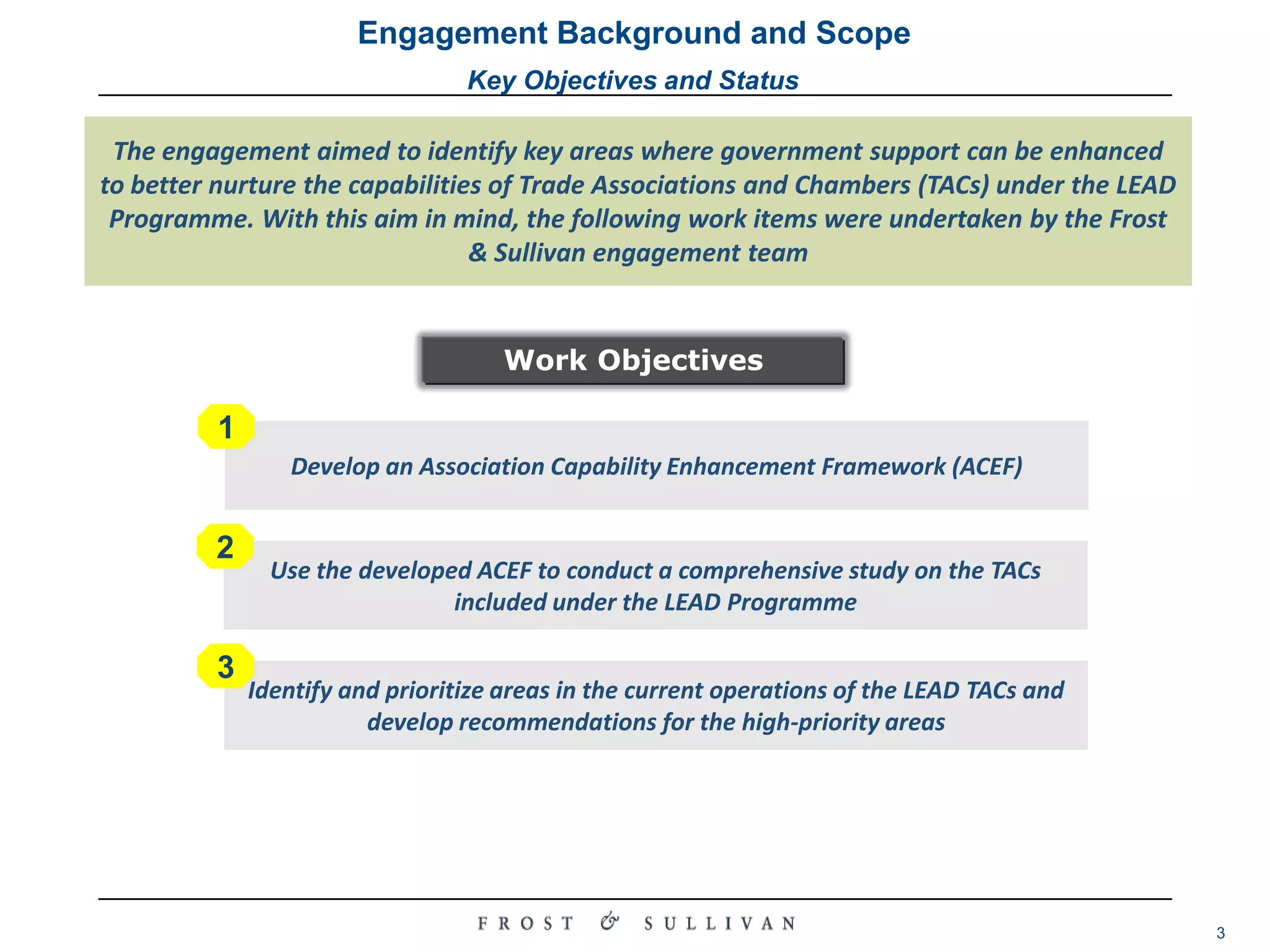
Engagement Background and ScopeKey Objectives and StatusThe engagement aimed to identify key areas where government support can be enhanced to better nurture the capabilities of Trade Associations and Chambers (TACs) under the LEAD Programme. With this aim in mind, the following work items were undertaken by the Frost & Sullivan engagement team123Develop an Association Capability Enhancement Framework (ACEF)Use the developed ACEF to conduct a comprehensive study on the TACs included under the LEAD ProgrammeIdentify and prioritize areas in the current operations of the LEAD TACs and develop recommendations for the high-priority areas Work Objectives
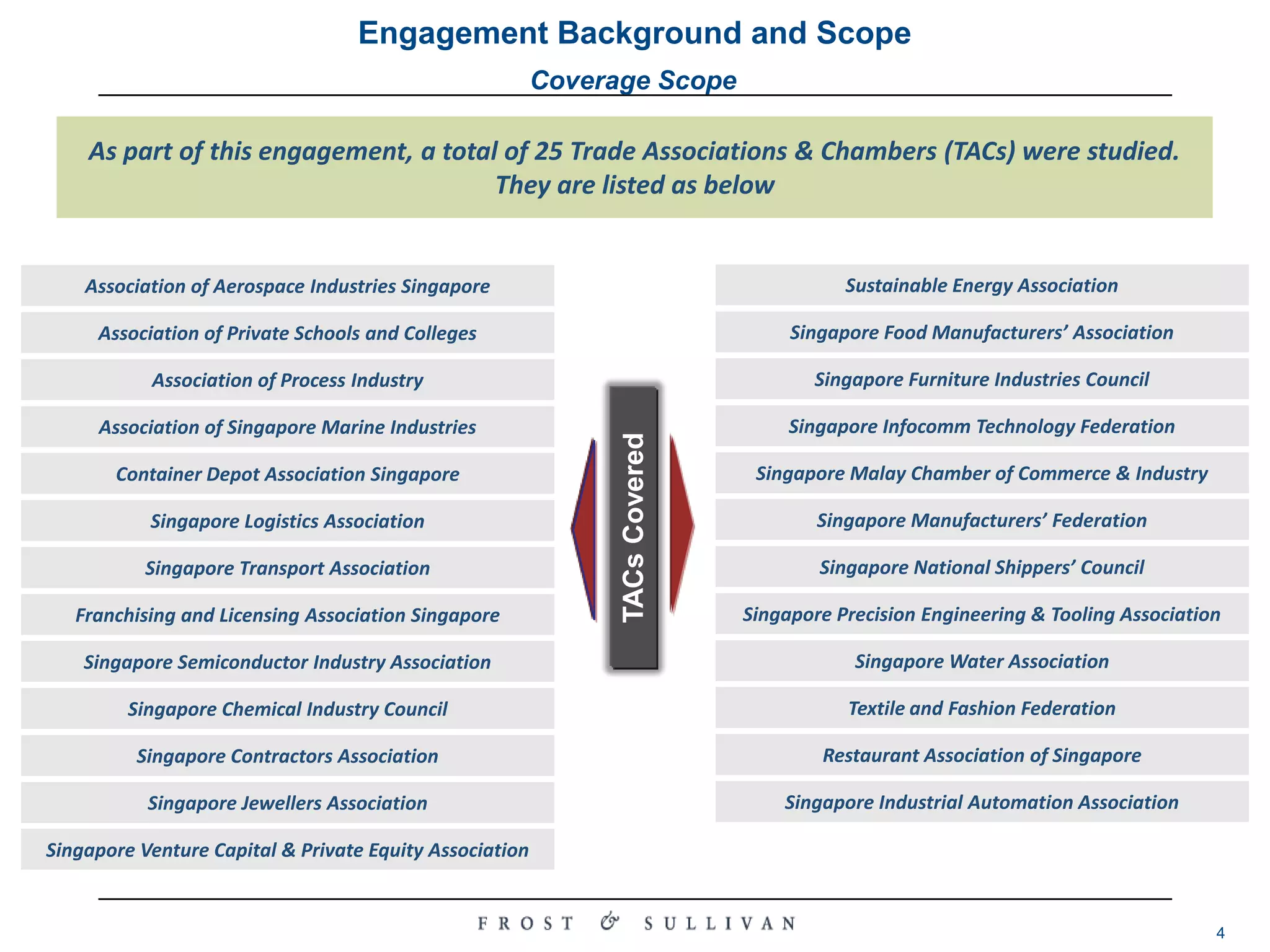
Engagement Background and ScopeCoverage ScopeAs part of this engagement, a total of 25 Trade Associations & Chambers (TACs) were studied. They are listed as belowSustainable Energy AssociationAssociation of Aerospace Industries SingaporeSingapore Food Manufacturers’ AssociationAssociation of Private Schools and CollegesSingapore Furniture Industries CouncilAssociation of Process IndustrySingapore Infocomm Technology FederationAssociation of Singapore Marine IndustriesSingapore Malay Chamber of Commerce & IndustryContainer Depot Association SingaporeSingapore Manufacturers’ FederationSingapore Logistics AssociationTACs CoveredSingapore National Shippers’ CouncilSingapore Transport AssociationSingapore Precision Engineering & Tooling Association Franchising and Licensing Association SingaporeSingapore Water AssociationSingapore Semiconductor Industry AssociationTextile and Fashion FederationSingapore Chemical Industry CouncilRestaurant Association of SingaporeSingapore Contractors AssociationSingapore Industrial Automation AssociationSingapore Jewellers AssociationSingapore Venture Capital & Private Equity Association
AgendaEngagement Background and Scope1Our Consulting Approach2Insights from the Study3
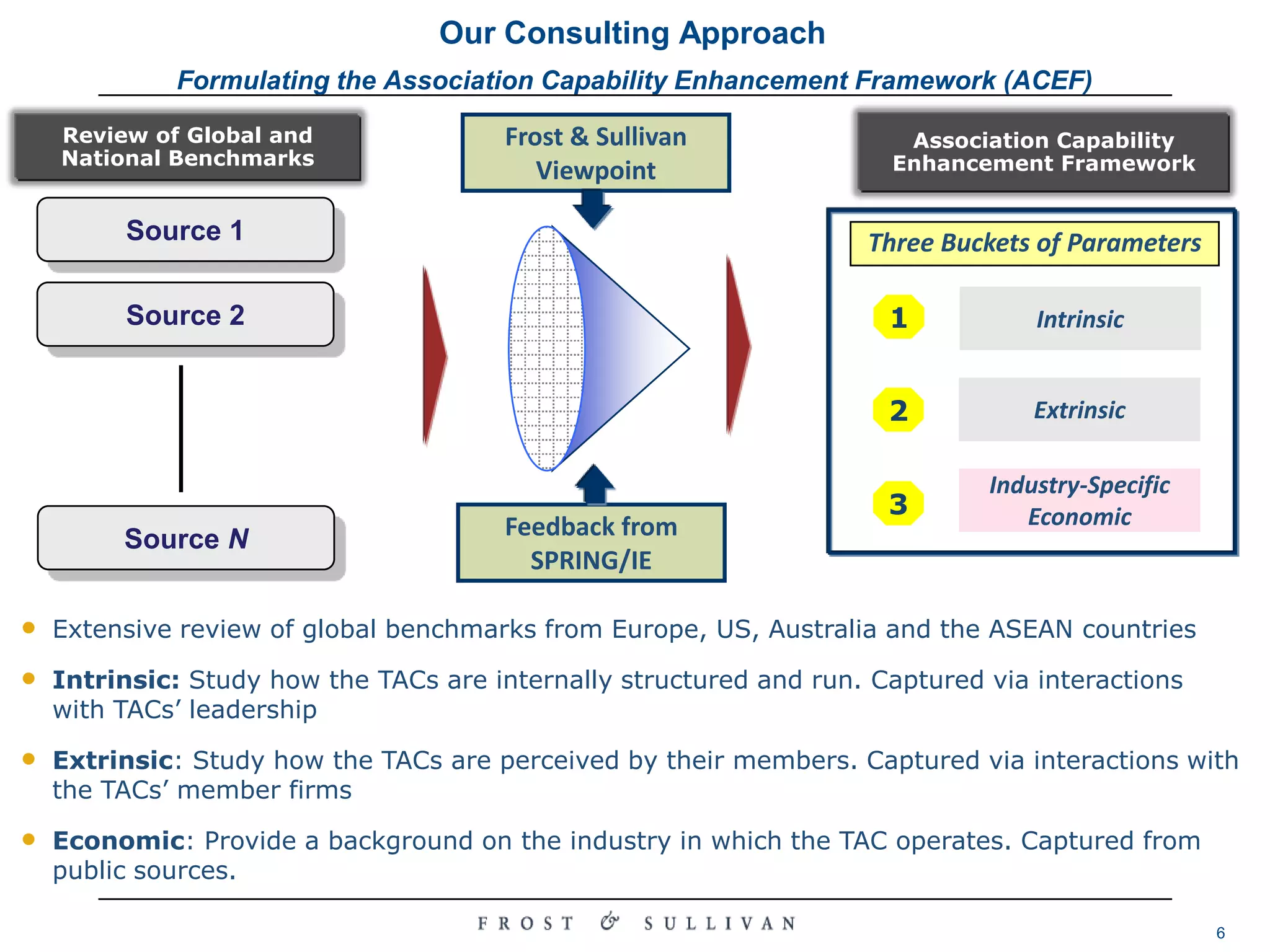
Our Consulting ApproachFormulating the Association Capability Enhancement Framework (ACEF)Association Capability Enhancement FrameworkFrost & Sullivan ViewpointReview of Global and National BenchmarksSource 1Three Buckets of ParametersSource 2Intrinsic1Extrinsic2Industry-Specific Economic3Feedback from SPRING/IESource NExtensive review of global benchmarks from Europe, US, Australia and the ASEAN countries
Intrinsic: Study how the TACs are internally structured and run. Captured via interactions with TACs’ leadership
Extrinsic: Study how the TACs are perceived by their members. Captured via interactions with the TACs’ member firms
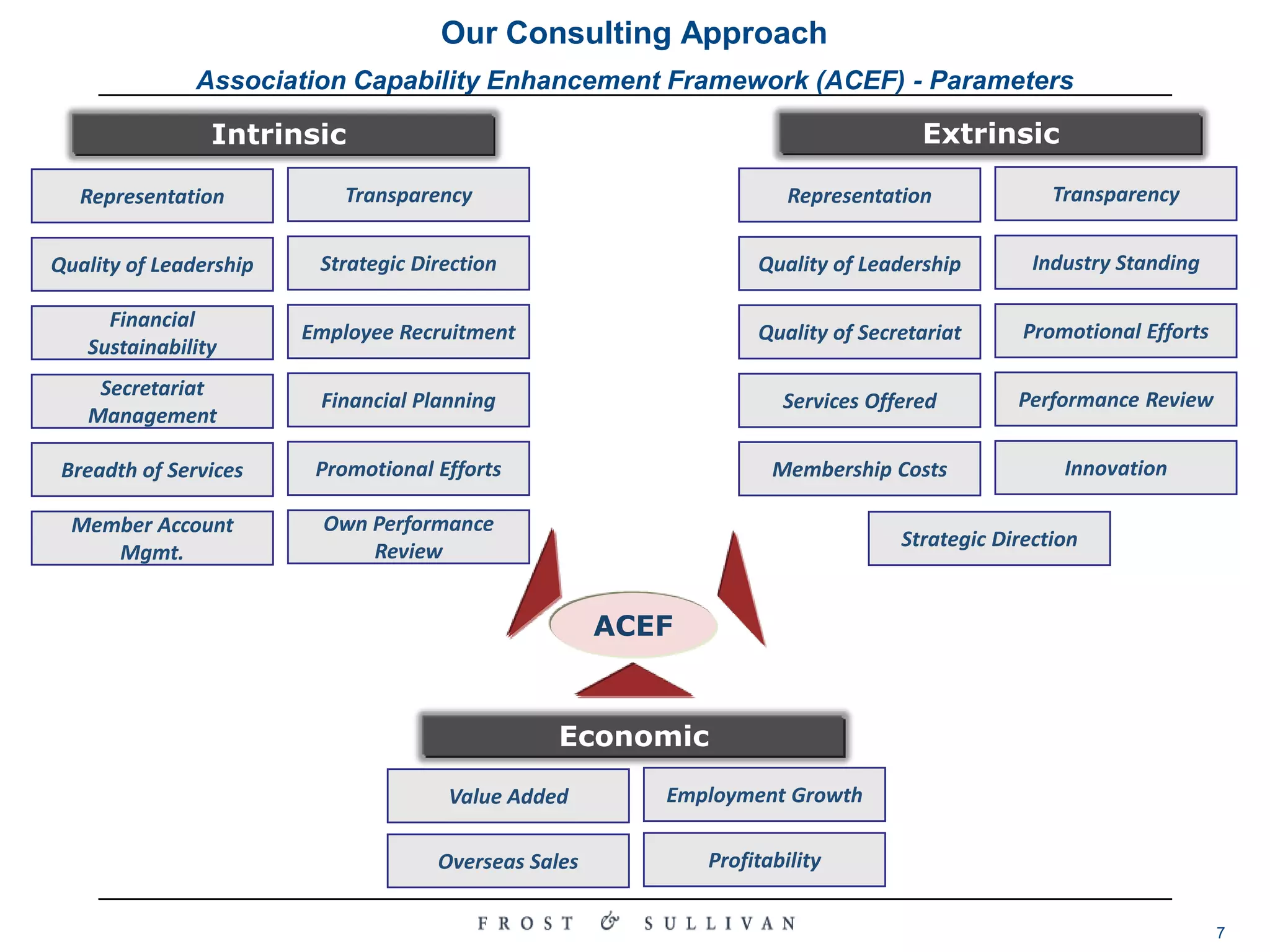
Economic: Provide a background on the industry in which the TAC operates. Captured from public sources.Our Consulting ApproachAssociation Capability Enhancement Framework (ACEF) - ParametersExtrinsicIntrinsic TransparencyTransparencyRepresentationRepresentationIndustry StandingStrategic DirectionQuality of LeadershipQuality of LeadershipPromotional EffortsEmployee RecruitmentQuality of SecretariatFinancial SustainabilityPerformance ReviewFinancial PlanningServices OfferedSecretariat ManagementInnovationPromotional EffortsMembership CostsBreadth of ServicesOwn Performance ReviewMember Account Mgmt.Strategic DirectionACEFEconomicEmployment GrowthValue AddedProfitabilityOverseas Sales
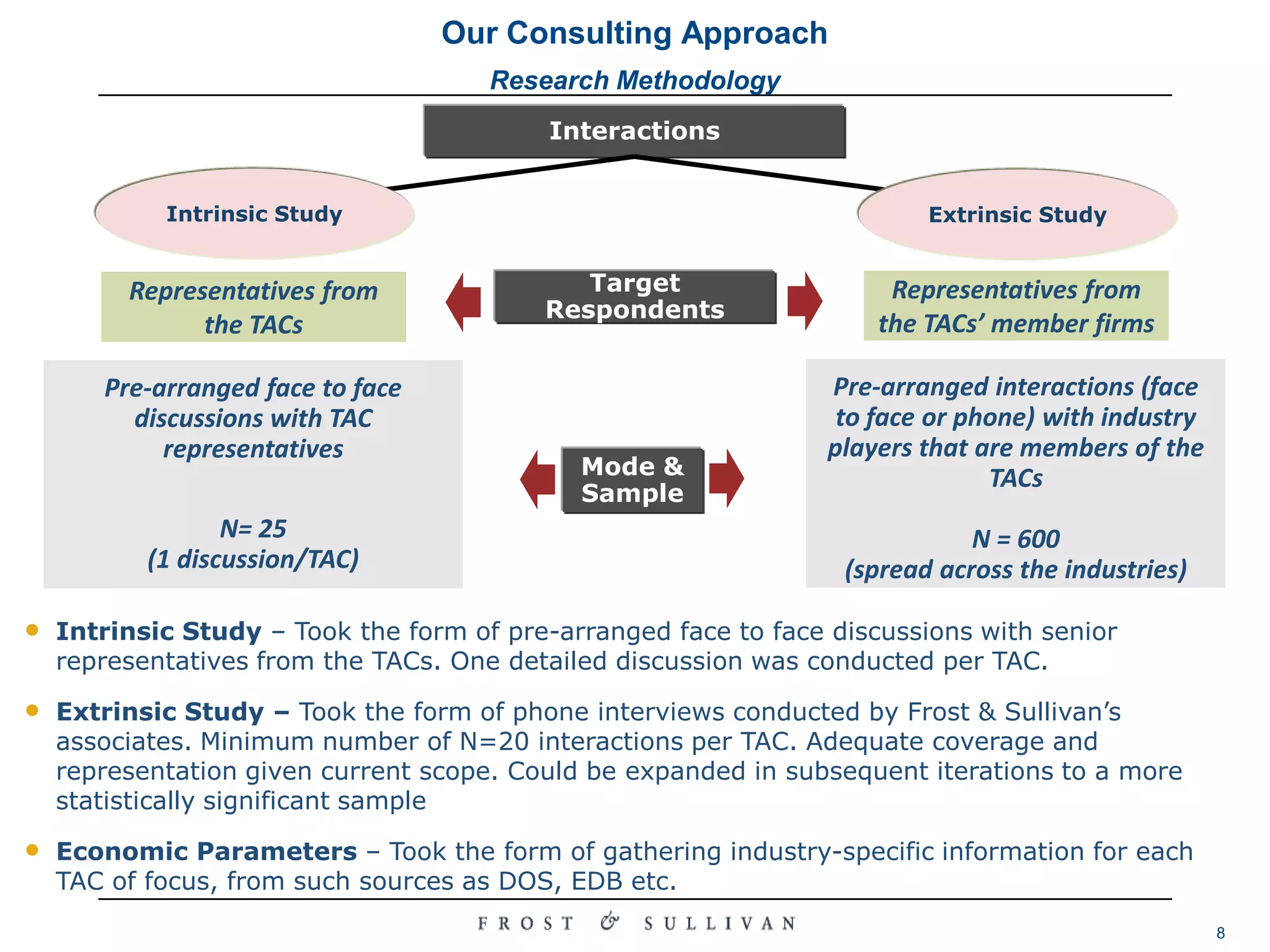
Our Consulting ApproachResearch MethodologyInteractionsIntrinsic StudyExtrinsic StudyRepresentatives from the TACs’ member firmsTarget RespondentsRepresentatives from the TACsPre-arranged interactions (face to face or phone) with industry players that are members of the TACsN = 600(spread across the industries)Pre-arranged face to face discussions with TAC representativesN= 25(1 discussion/TAC) Mode & SampleIntrinsic Study – Took the form of pre-arranged face to face discussions with senior representatives from the TACs. One detailed discussion was conducted per TAC.
Extrinsic Study – Took the form of phone interviews conducted by Frost & Sullivan’s associates. Minimum number of N=20 interactions per TAC. Adequate coverage and representation given current scope. Could be expanded in subsequent iterations to a more statistically significant sample
Economic Parameters – Took the form of gathering industry-specific information for each TAC of focus, from such sources as DOS, EDB etc.AgendaEngagement Background and Scope1Our Consulting Approach2Insights from the Study3
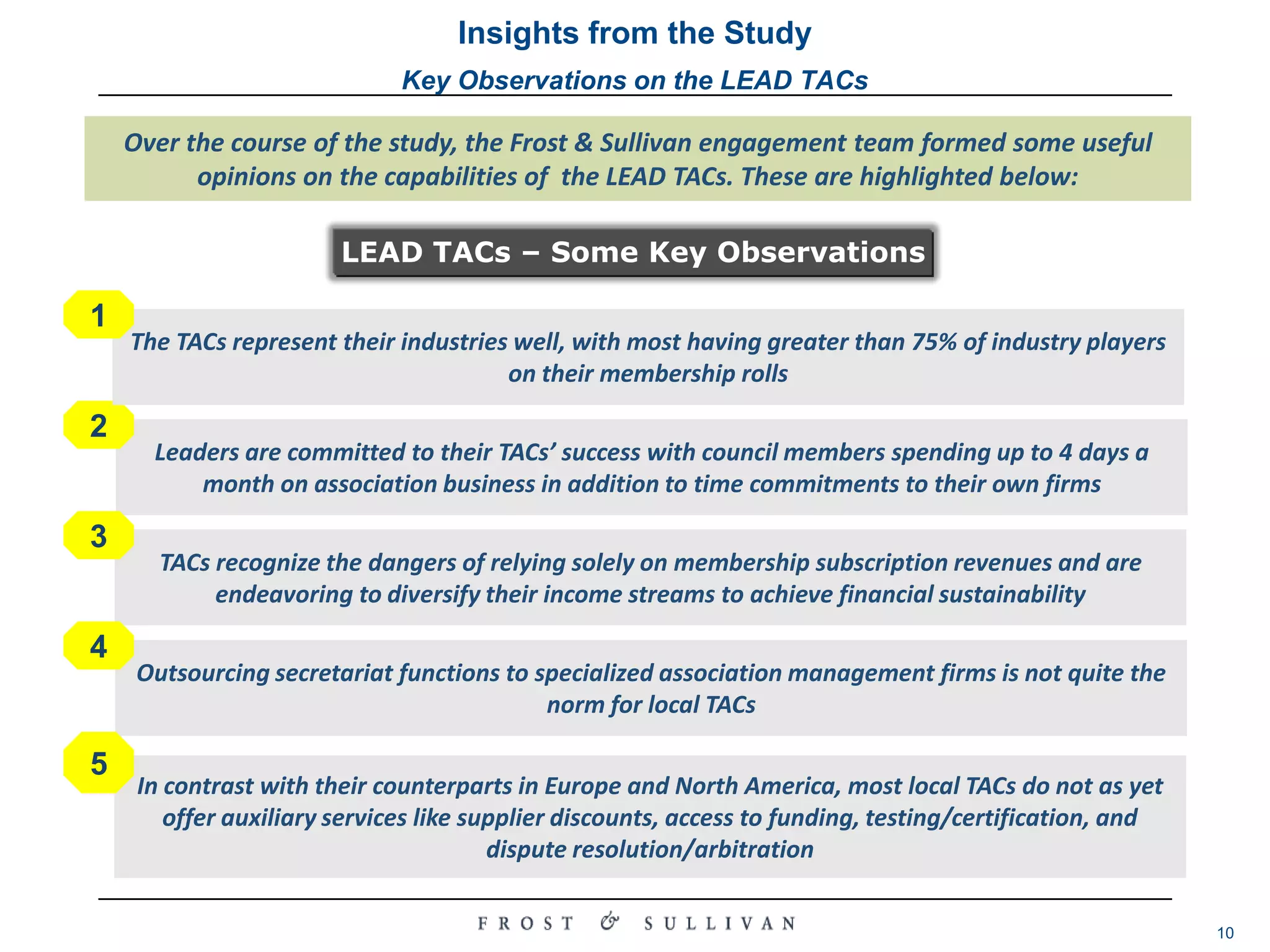
Insights from the StudyKey Observations on the LEAD TACsOver the course of the study, the Frost & Sullivan engagement team formed some useful opinions on the capabilities of  the LEAD TACs. These are highlighted below:LEAD TACs – Some Key Observations23451Leaders are committed to their TACs’ success with council members spending up to 4 days a month on association business in addition to time commitments to their own firmsTACs recognize the dangers of relying solely on membership subscription revenues and are endeavoring to diversify their income streams to achieve financial sustainabilityOutsourcing secretariat functions to specialized association management firms is not quite the norm for local TACsIn contrast with their counterparts in Europe and North America, most local TACs do not as yet offer auxiliary services like supplier discounts, access to funding, testing/certification, and dispute resolution/arbitrationThe TACs represent their industries well, with most having greater than 75% of industry players on their membership rolls
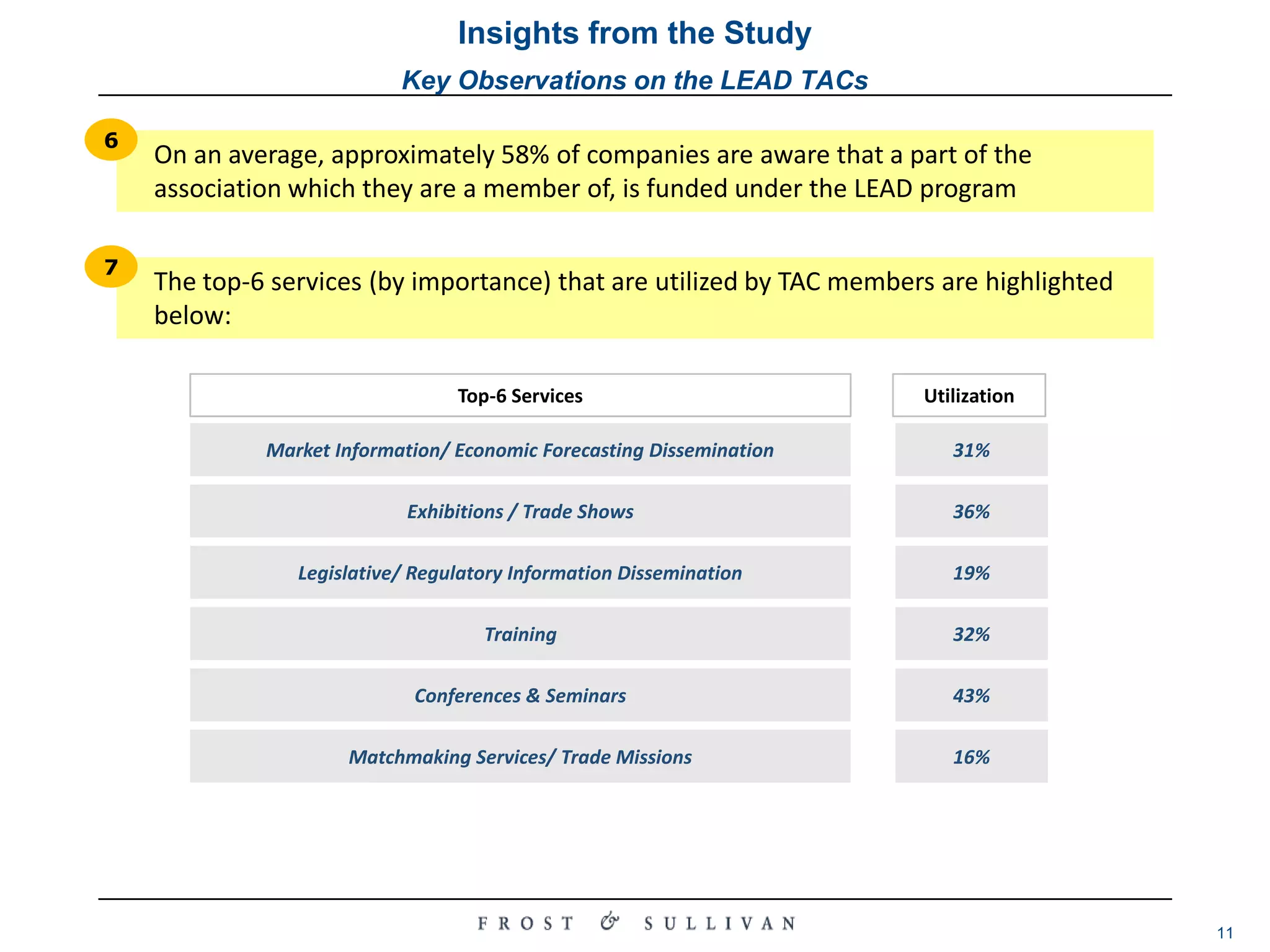
Key Insights3.2Insights from the StudySalient points about service portfolio of TACs from Extrinsic InterviewsKey Observations on the LEAD TACs6On an average, approximately 58% of companies are aware that a part of the association which they are a member of, is funded under the LEAD program7The top-6 services (by importance) that are utilized by TAC members are highlighted below:UtilizationTop-6 ServicesMarket Information/ Economic Forecasting Dissemination31%Exhibitions / Trade Shows36%Legislative/ Regulatory Information Dissemination19%Training32%Conferences & Seminars43%Matchmaking Services/ Trade Missions16%
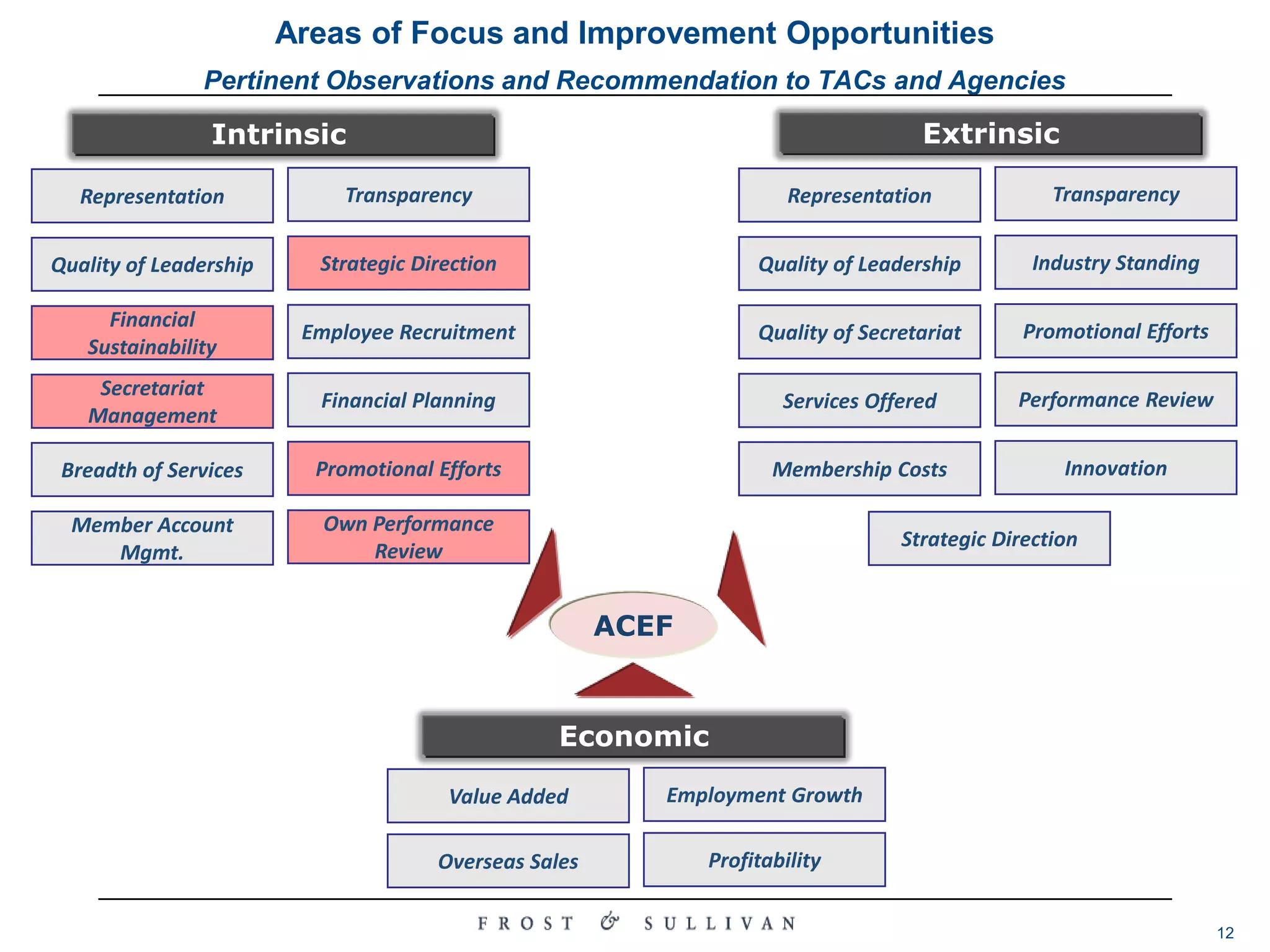
Areas of Focus and Improvement OpportunitiesPertinent Observations and Recommendation to TACs and AgenciesExtrinsicIntrinsic TransparencyTransparencyRepresentationRepresentationIndustry StandingStrategic DirectionQuality of LeadershipQuality of LeadershipPromotional EffortsEmployee RecruitmentQuality of SecretariatFinancial SustainabilityPerformance ReviewFinancial PlanningServices OfferedSecretariat ManagementInnovationPromotional EffortsMembership CostsBreadth of ServicesOwn Performance ReviewMember Account Mgmt.Strategic DirectionACEFEconomicEmployment GrowthValue AddedProfitabilityOverseas Sales
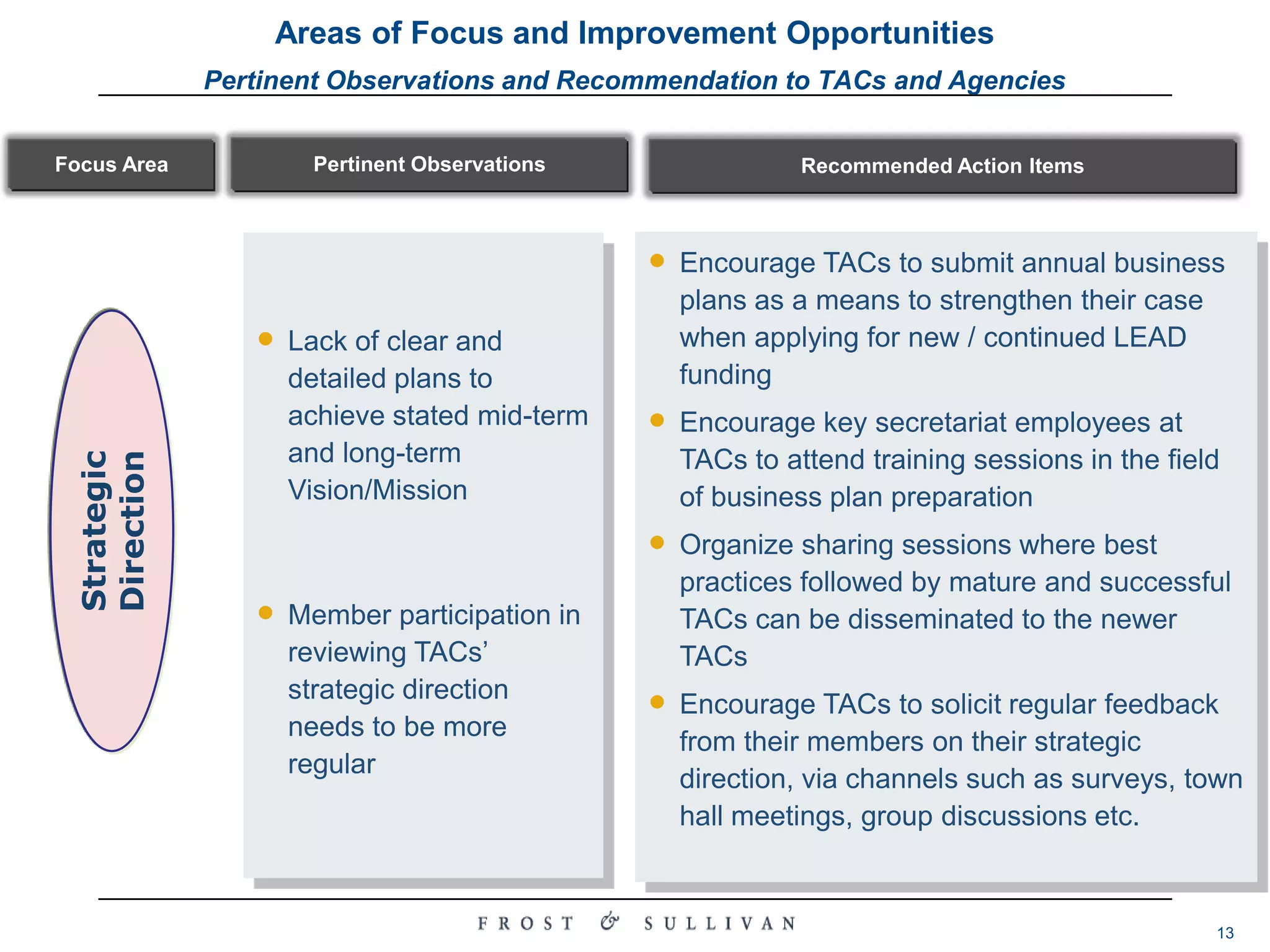
Gaps & RecommendationsAreas of Focus and Improvement OpportunitiesThe key recommendations for above-mentioned gaps are provided belowPertinent Observations and Recommendation to TACs and AgenciesPertinent ObservationsFocus AreaRecommended Action ItemsEncourage TACs to submit annual business plans as a means to strengthen their case when applying for new / continued LEAD funding
Encourage key secretariat employees at TACs to attend training sessions in the field of business plan preparation
Organize sharing sessions where best practices followed by mature and successful TACs can be disseminated to the newer TACs

Lead study presentation final

  • 1.
    Study on TradeAssociations and Chambers (TACs) under the LEAD ProgrammePresentation- Developed For -April 2011Developed By:Public Sector PracticeFrost & Sullivan Asia Pacific
  • 2.
    AgendaEngagement Background andScope1Our Consulting Approach2Insights from the Study3
  • 3.
    Engagement Background andScopeKey Objectives and StatusThe engagement aimed to identify key areas where government support can be enhanced to better nurture the capabilities of Trade Associations and Chambers (TACs) under the LEAD Programme. With this aim in mind, the following work items were undertaken by the Frost & Sullivan engagement team123Develop an Association Capability Enhancement Framework (ACEF)Use the developed ACEF to conduct a comprehensive study on the TACs included under the LEAD ProgrammeIdentify and prioritize areas in the current operations of the LEAD TACs and develop recommendations for the high-priority areas Work Objectives
  • 4.
    Engagement Background andScopeCoverage ScopeAs part of this engagement, a total of 25 Trade Associations & Chambers (TACs) were studied. They are listed as belowSustainable Energy AssociationAssociation of Aerospace Industries SingaporeSingapore Food Manufacturers’ AssociationAssociation of Private Schools and CollegesSingapore Furniture Industries CouncilAssociation of Process IndustrySingapore Infocomm Technology FederationAssociation of Singapore Marine IndustriesSingapore Malay Chamber of Commerce & IndustryContainer Depot Association SingaporeSingapore Manufacturers’ FederationSingapore Logistics AssociationTACs CoveredSingapore National Shippers’ CouncilSingapore Transport AssociationSingapore Precision Engineering & Tooling Association Franchising and Licensing Association SingaporeSingapore Water AssociationSingapore Semiconductor Industry AssociationTextile and Fashion FederationSingapore Chemical Industry CouncilRestaurant Association of SingaporeSingapore Contractors AssociationSingapore Industrial Automation AssociationSingapore Jewellers AssociationSingapore Venture Capital & Private Equity Association
  • 5.
    AgendaEngagement Background andScope1Our Consulting Approach2Insights from the Study3
  • 6.
    Our Consulting ApproachFormulatingthe Association Capability Enhancement Framework (ACEF)Association Capability Enhancement FrameworkFrost & Sullivan ViewpointReview of Global and National BenchmarksSource 1Three Buckets of ParametersSource 2Intrinsic1Extrinsic2Industry-Specific Economic3Feedback from SPRING/IESource NExtensive review of global benchmarks from Europe, US, Australia and the ASEAN countries
  • 7.
    Intrinsic: Study howthe TACs are internally structured and run. Captured via interactions with TACs’ leadership
  • 8.
    Extrinsic: Study howthe TACs are perceived by their members. Captured via interactions with the TACs’ member firms
  • 9.
    Economic: Provide abackground on the industry in which the TAC operates. Captured from public sources.Our Consulting ApproachAssociation Capability Enhancement Framework (ACEF) - ParametersExtrinsicIntrinsic TransparencyTransparencyRepresentationRepresentationIndustry StandingStrategic DirectionQuality of LeadershipQuality of LeadershipPromotional EffortsEmployee RecruitmentQuality of SecretariatFinancial SustainabilityPerformance ReviewFinancial PlanningServices OfferedSecretariat ManagementInnovationPromotional EffortsMembership CostsBreadth of ServicesOwn Performance ReviewMember Account Mgmt.Strategic DirectionACEFEconomicEmployment GrowthValue AddedProfitabilityOverseas Sales
  • 10.
    Our Consulting ApproachResearchMethodologyInteractionsIntrinsic StudyExtrinsic StudyRepresentatives from the TACs’ member firmsTarget RespondentsRepresentatives from the TACsPre-arranged interactions (face to face or phone) with industry players that are members of the TACsN = 600(spread across the industries)Pre-arranged face to face discussions with TAC representativesN= 25(1 discussion/TAC) Mode & SampleIntrinsic Study – Took the form of pre-arranged face to face discussions with senior representatives from the TACs. One detailed discussion was conducted per TAC.
  • 11.
    Extrinsic Study –Took the form of phone interviews conducted by Frost & Sullivan’s associates. Minimum number of N=20 interactions per TAC. Adequate coverage and representation given current scope. Could be expanded in subsequent iterations to a more statistically significant sample
  • 12.
    Economic Parameters –Took the form of gathering industry-specific information for each TAC of focus, from such sources as DOS, EDB etc.AgendaEngagement Background and Scope1Our Consulting Approach2Insights from the Study3
  • 13.
    Insights from theStudyKey Observations on the LEAD TACsOver the course of the study, the Frost & Sullivan engagement team formed some useful opinions on the capabilities of the LEAD TACs. These are highlighted below:LEAD TACs – Some Key Observations23451Leaders are committed to their TACs’ success with council members spending up to 4 days a month on association business in addition to time commitments to their own firmsTACs recognize the dangers of relying solely on membership subscription revenues and are endeavoring to diversify their income streams to achieve financial sustainabilityOutsourcing secretariat functions to specialized association management firms is not quite the norm for local TACsIn contrast with their counterparts in Europe and North America, most local TACs do not as yet offer auxiliary services like supplier discounts, access to funding, testing/certification, and dispute resolution/arbitrationThe TACs represent their industries well, with most having greater than 75% of industry players on their membership rolls
  • 14.
    Key Insights3.2Insights fromthe StudySalient points about service portfolio of TACs from Extrinsic InterviewsKey Observations on the LEAD TACs6On an average, approximately 58% of companies are aware that a part of the association which they are a member of, is funded under the LEAD program7The top-6 services (by importance) that are utilized by TAC members are highlighted below:UtilizationTop-6 ServicesMarket Information/ Economic Forecasting Dissemination31%Exhibitions / Trade Shows36%Legislative/ Regulatory Information Dissemination19%Training32%Conferences & Seminars43%Matchmaking Services/ Trade Missions16%
  • 15.
    Areas of Focusand Improvement OpportunitiesPertinent Observations and Recommendation to TACs and AgenciesExtrinsicIntrinsic TransparencyTransparencyRepresentationRepresentationIndustry StandingStrategic DirectionQuality of LeadershipQuality of LeadershipPromotional EffortsEmployee RecruitmentQuality of SecretariatFinancial SustainabilityPerformance ReviewFinancial PlanningServices OfferedSecretariat ManagementInnovationPromotional EffortsMembership CostsBreadth of ServicesOwn Performance ReviewMember Account Mgmt.Strategic DirectionACEFEconomicEmployment GrowthValue AddedProfitabilityOverseas Sales
  • 16.
    Gaps & RecommendationsAreasof Focus and Improvement OpportunitiesThe key recommendations for above-mentioned gaps are provided belowPertinent Observations and Recommendation to TACs and AgenciesPertinent ObservationsFocus AreaRecommended Action ItemsEncourage TACs to submit annual business plans as a means to strengthen their case when applying for new / continued LEAD funding
  • 17.
    Encourage key secretariatemployees at TACs to attend training sessions in the field of business plan preparation
  • 18.
    Organize sharing sessionswhere best practices followed by mature and successful TACs can be disseminated to the newer TACs
  • 19.
    Encourage TACs tosolicit regular feedback from their members on their strategic direction, via channels such as surveys, town hall meetings, group discussions etc.
  • 20.
    Lack of clearand detailed plans to achieve stated mid-term and long-term Vision/Mission
  • 21.
    Member participation inreviewing TACs’ strategic direction needs to be more regularStrategic Direction
  • 22.
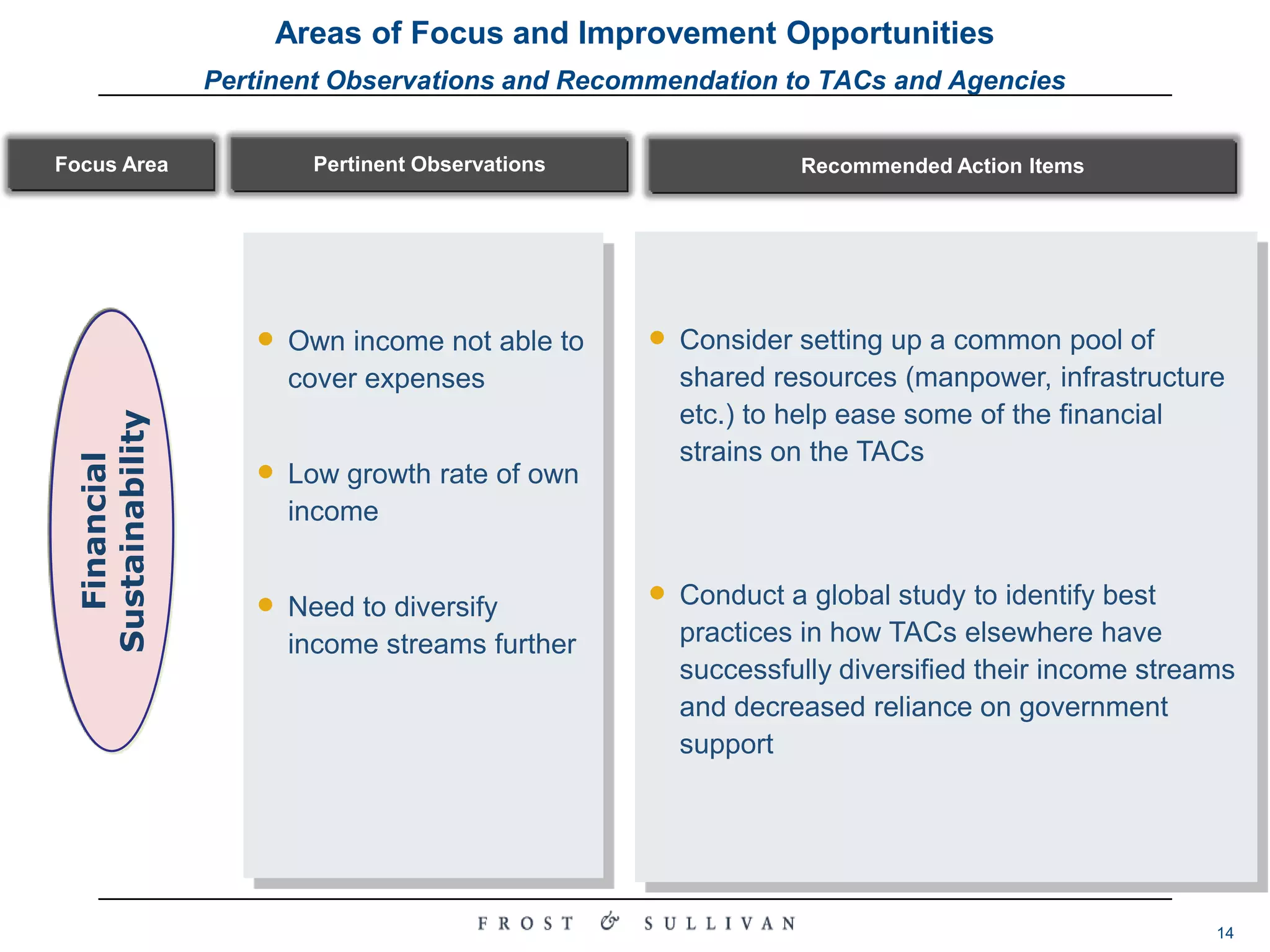
    Gaps & Recommendations3.3Areasof Focus and Improvement OpportunitiesThe key recommendations for above-mentioned gaps are provided belowPertinent Observations and Recommendation to TACs and AgenciesPertinent ObservationsFocus AreaRecommended Action ItemsConsider setting up a common pool of shared resources (manpower, infrastructure etc.) to help ease some of the financial strains on the TACs
  • 23.
    Conduct a globalstudy to identify best practices in how TACs elsewhere have successfully diversified their income streams and decreased reliance on government support
  • 24.
    Own income notable to cover expenses
  • 25.
    Low growth rateof own income
  • 26.
    Need to diversifyincome streams furtherFinancial Sustainability
  • 27.
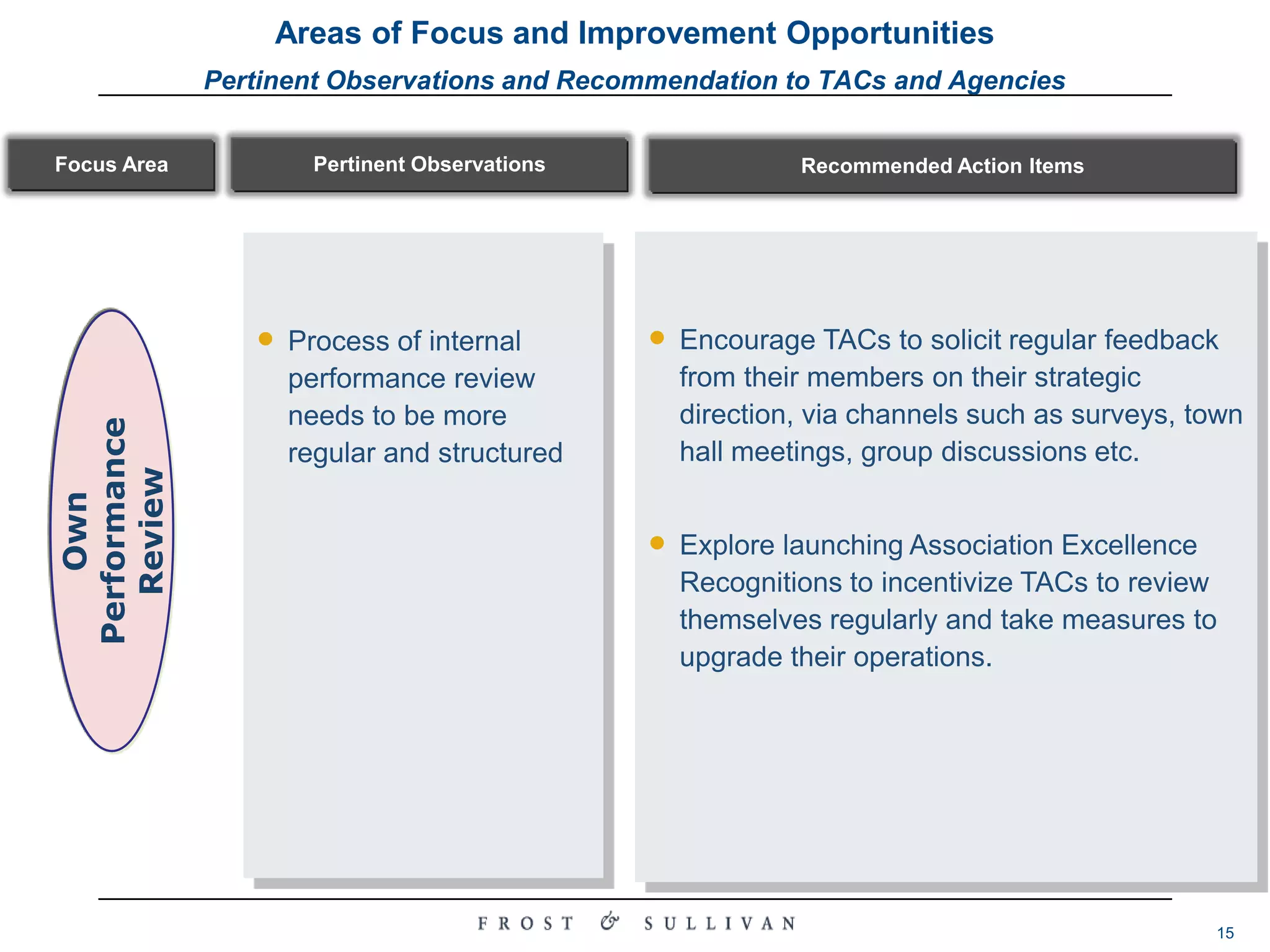
    Gaps & Recommendations3.3Areasof Focus and Improvement OpportunitiesThe key recommendations for above-mentioned gaps are provided belowPertinent Observations and Recommendation to TACs and AgenciesPertinent ObservationsFocus AreaRecommended Action ItemsEncourage TACs to solicit regular feedback from their members on their strategic direction, via channels such as surveys, town hall meetings, group discussions etc.
  • 28.
    Explore launching AssociationExcellence Recognitions to incentivize TACs to review themselves regularly and take measures to upgrade their operations.
  • 29.
    Process of internalperformance review needs to be more regular and structuredOwn Performance Review
  • 30.
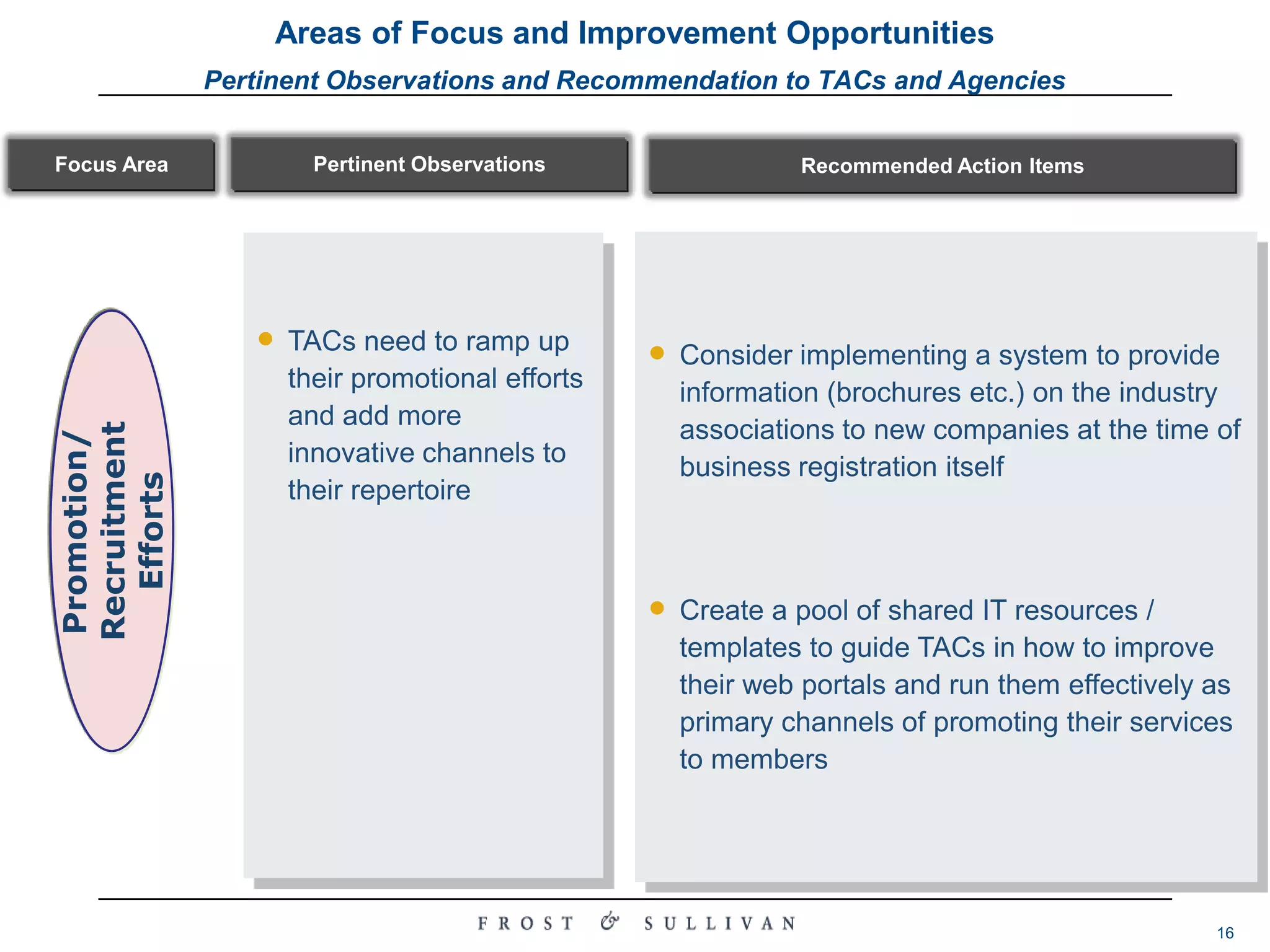
    Gaps & Recommendations3.3Areasof Focus and Improvement OpportunitiesThe key recommendations for above-mentioned gaps are provided belowPertinent Observations and Recommendation to TACs and AgenciesPertinent ObservationsFocus AreaRecommended Action ItemsConsider implementing a system to provide information (brochures etc.) on the industry associations to new companies at the time of business registration itself
  • 31.
    Create a poolof shared IT resources / templates to guide TACs in how to improve their web portals and run them effectively as primary channels of promoting their services to members
  • 32.
    TACs need toramp up their promotional efforts and add more innovative channels to their repertoirePromotion/Recruitment Efforts
  • 33.
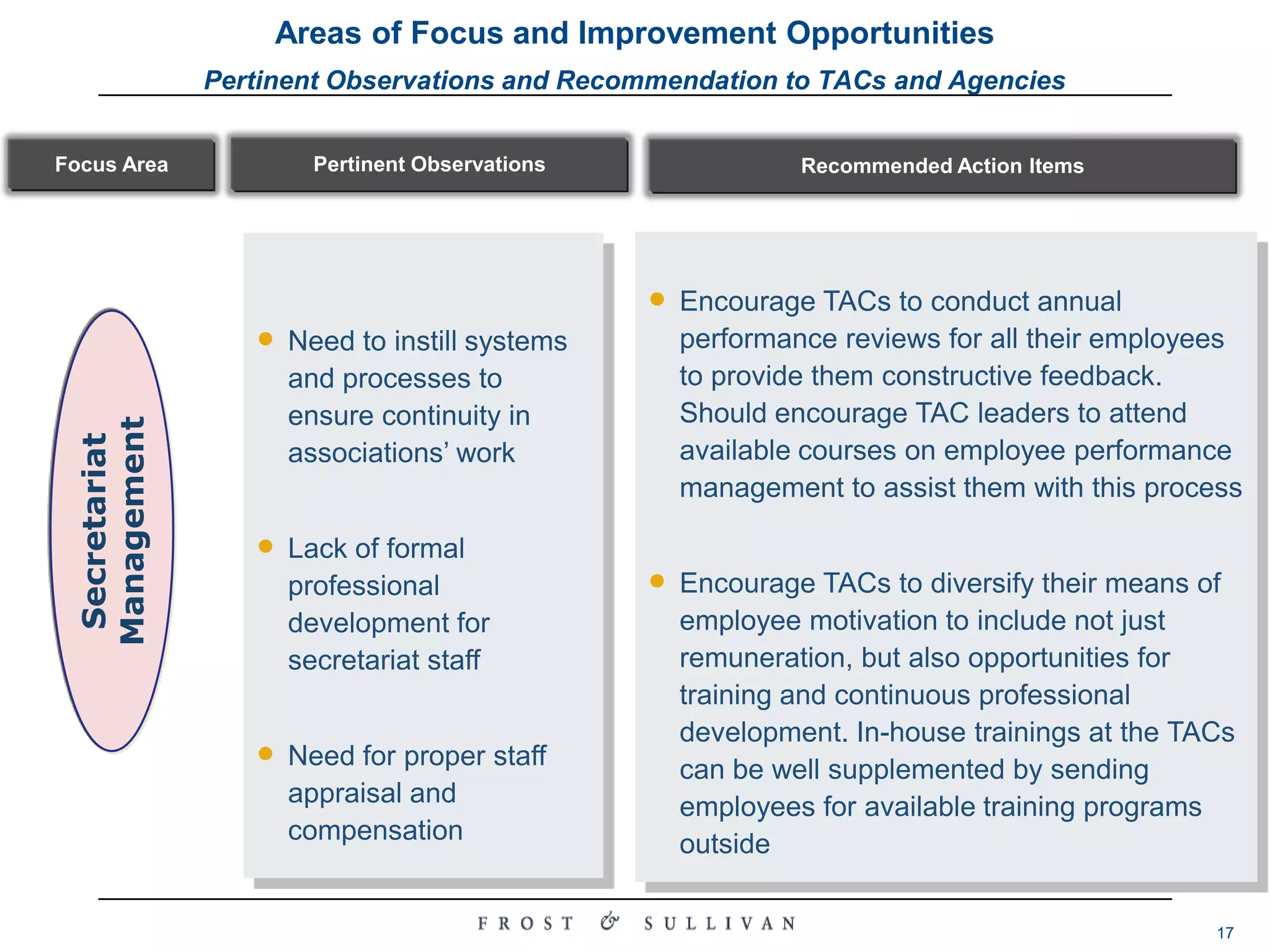
    Gaps & Recommendations3.3Areasof Focus and Improvement OpportunitiesThe key recommendations for above-mentioned gaps are provided belowPertinent Observations and Recommendation to TACs and AgenciesPertinent ObservationsFocus AreaRecommended Action ItemsEncourage TACs to conduct annual performance reviews for all their employees to provide them constructive feedback. Should encourage TAC leaders to attend available courses on employee performance management to assist them with this process
  • 34.
    Encourage TACs todiversify their means of employee motivation to include not just remuneration, but also opportunities for training and continuous professional development. In-house trainings at the TACs can be well supplemented by sending employees for available training programs outside
  • 35.
    Need to instillsystems and processes to ensure continuity in associations’ work
  • 36.
    Lack of formalprofessional development for secretariat staff
  • 37.
    Need for properstaff appraisal and compensationSecretariatManagement
  • 38.
    Vikas Sharma, PMP®PrincipalConsultantPublic Sector Practice (APAC)+65 6890 0934vsharma@frost.comFrost & Sullivan Singapore100 Beach Road#29-01/11, Shaw TowerSingapore 189702Tel: +65 (0) 6890 0999Fax: +65 (0) 6890 0988www.frost.comFrost & SullivanFrost & Sullivan, the Growth Partnership Company, enables clients to accelerate growth and achieve best in class positions in growth, innovation and leadership. The company's Growth Partnership Service provides the CEO and the CEO's Growth Team with disciplined research and best practice models to drive the generation, evaluation and implementation of powerful growth strategies. Frost & Sullivan leverages over 45 years of experience in partnering with Global 1000 companies, emerging businesses and the investment community from more than 35 offices on six continents. To join our Growth Partnership, please visit http://www.frost.com.