Call toAction
Webinar
September 17, 2015
An initiative by
Science Based Targets I Agenda
An initiative by
Agenda:
1. Introduction
2. Call to Action process
3. Eligibility criteria
4. Quality check process
5. Next steps
6. Q&A
Science Based Targets I Call to Action
An initiative by
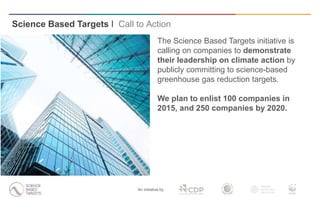
The Science Based Targets initiative is
calling on companies to demonstrate
their leadership on climate action by
publicly committing to science-based
greenhouse gas reduction targets.
We plan to enlist 100 companies in
2015, and 250 companies by 2020.
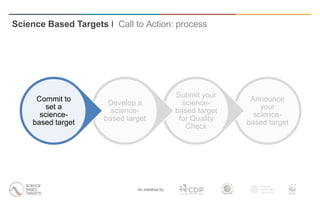
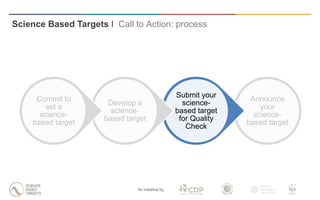
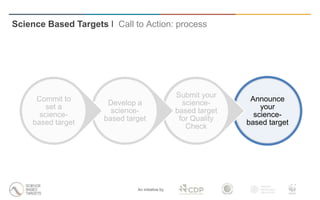
Science Based Targets I Call to Action: process
An initiative by
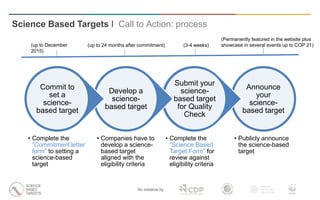
Announce
your
science-
based target
• Publicly announce
the science-based
target
Submit your
science-
based target
for Quality
Check
• Complete the
“Science Based
Target Form” for
review against
eligibility criteria
Develop a
science-
based target
• Companies have to
develop a science-
based target
aligned with the
eligibility criteria
Commit to
set a
science-
based target
• Complete the
“Commitment letter
form” to setting a
science-based
target
(up to December
2015)
(up to 24 months after commitment) (3-4 weeks)
(Permanently featured in the website plus
showcase in several events up to COP 21)
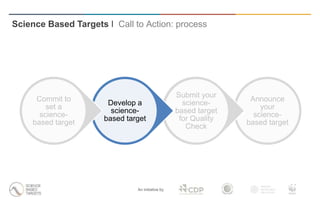
Science Based Targets I Call to Action: process
An initiative by
Announce
your
science-
based target
Submit your
science-
based target
for Quality
Check
Develop a
science-
based target
Commit to
set a
science-
based target
An initiative by
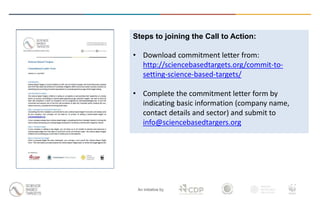
Steps to joining the Call to Action:
• Download commitment letter from:
http://sciencebasedtargets.org/commit-to-
setting-science-based-targets/
• Complete the commitment letter form by
indicating basic information (company name,
contact details and sector) and submit to
info@sciencebasedtargers.org
Science Based Targets I Call to Action: process
An initiative by
Announce
your
science-
based target
Submit your
science-
based target
for Quality
Check
Develop a
science-
based target
Commit to
set a
science-
based target
An initiative by
• If your company is setting a new target,
you will have up to 24 months to develop
and announce a science-based target from
the date of submission of the commitment
letter.
• The Science Based Targets initiative will
send you a reminder 6 months prior to
the deadline.
• If a company already has a target in place,
the target should be submitted for
quality check.
Science Based Targets I Call to Action: process
An initiative by
Announce
your
science-
based target
Submit your
science-
based target
for Quality
Check
Develop a
science-
based target
Commit to
set a
science-
based target
An initiative by
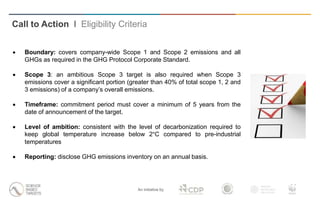
 Boundary: covers company-wide Scope 1 and Scope 2 emissions and all
GHGs as required in the GHG Protocol Corporate Standard.
 Scope 3: an ambitious Scope 3 target is also required when Scope 3
emissions cover a significant portion (greater than 40% of total scope 1, 2 and
3 emissions) of a company’s overall emissions.
 Timeframe: commitment period must cover a minimum of 5 years from the
date of announcement of the target.
 Level of ambition: consistent with the level of decarbonization required to
keep global temperature increase below 2°C compared to pre-industrial
temperatures
 Reporting: disclose GHG emissions inventory on an annual basis.
Call to Action I Eligibility Criteria
An initiative by
 Companies are encouraged to develop mid- term (e.g. 2030) and long-
term goals (e.g. 2050) along with their respective interim milestones.
 Companies are encouraged to express their targets on an absolute AND
intensity basis.
 To ensure consistent tracking of performance over time, the SBT should
be recalculated, as needed, to reflect significant changes that would
compromise its relevance and consistency. A target recalculation should
be triggered by significant changes in growth projections and other
assumptions used with SBT-setting methodologies and significant
changes to your business or data and emissions factors used in your
inventory process; the latter will also require recalculation of the base year
inventory. Companies should check the validity of their target projections
annually.
Call to Action I Additional Guidance
An initiative by
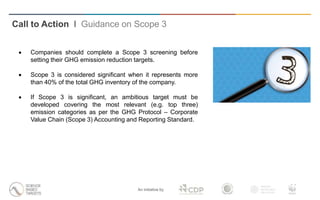
 Companies should complete a Scope 3 screening before
setting their GHG emission reduction targets.
 Scope 3 is considered significant when it represents more
than 40% of the total GHG inventory of the company.
 If Scope 3 is significant, an ambitious target must be
developed covering the most relevant (e.g. top three)
emission categories as per the GHG Protocol – Corporate
Value Chain (Scope 3) Accounting and Reporting Standard.
Call to Action I Guidance on Scope 3
An initiative by
Call to Action I Guidance on Scope 3 – best practice examples
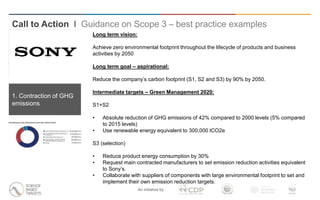
Long term vision:
Achieve zero environmental footprint throughout the lifecycle of products and business
activities by 2050
Long term goal – aspirational:
Reduce the company’s carbon footprint (S1, S2 and S3) by 90% by 2050.
Intermediate targets – Green Management 2020:
S1+S2
• Absolute reduction of GHG emissions of 42% compared to 2000 levels (5% compared
to 2015 levels)
• Use renewable energy equivalent to 300,000 tCO2e
S3 (selection)
• Reduce product energy consumption by 30%
• Request main contracted manufacturers to set emission reduction activities equivalent
to Sony’s.
• Collaborate with suppliers of components with large environmental footprint to set and
implement their own emission reduction targets.
1. Contraction of GHG
emissions
An initiative by
Call to Action I Guidance on Scope 3 – best practice examples
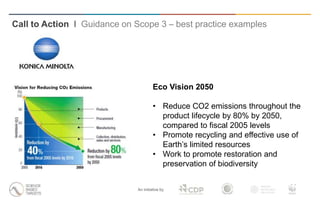
Eco Vision 2050
• Reduce CO2 emissions throughout the
product lifecycle by 80% by 2050,
compared to fiscal 2005 levels
• Promote recycling and effective use of
Earth’s limited resources
• Work to promote restoration and
preservation of biodiversity
An initiative by
Call to Action I Guidance on Scope 3 – best practice examples
An initiative by
 Financial institutions are welcome to express their
intention to set science-based targets for scope 1 and 2
and for their investment activities under the Call to Action,
through signing the commitment letter.
 However, considering that there is not sufficient
development yet as to how to assess financial institutions
against a 2°C trajectory, the partners of the Science
Based Targets initiative will not be able to assess or
confirm adequacy of the targets for the time being.
 Financial institutions that sign the commitment letter will
be invited to participate in future developments in this
area.
Call to Action I Financial Institutions
Science Based Targets I Call to Action: process
An initiative by
Announce
your
science-
based target
Submit your
science-
based target
for Quality
Check
Develop a
science-
based target
Commit to
set a
science-
based target
An initiative by
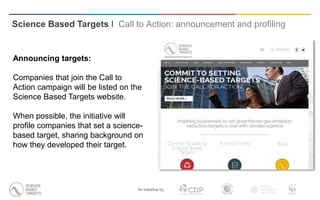
Announcing targets:
Companies that join the Call to
Action campaign will be listed on the
Science Based Targets website.
When possible, the initiative will
profile companies that set a science-
based target, sharing background on
how they developed their target.
Science Based Targets I Call to Action: announcement and profiling
An initiative by
Spokesperson opportunities:
Business leaders who take ambitious climate action
should have their voices heard.
Spokespeople may have the following opportunities to
share their company’s story over the coming months:
• Be quoted in future press releases and social media
• Speak at events
• Write blogs or op-eds
Science Based Targets I Call to Action: announcement and profiling
An initiative by
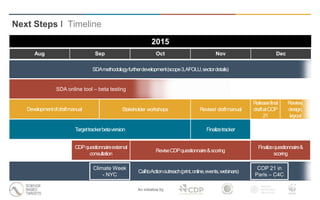
SDA online tool – beta testing
CalltoActionoutreach(print,online,events,webinars)
Releasefinal
draftatCOP
21
Finalizetracker
ReviseCDPquestionnaire&scoring
Next Steps I Timeline
2015
Targettrackerbetaversion
COP 21 in
Paris – C4C
Developmentofdraftmanual Revised draftmanual
Climate Week
- NYC
SDAmethodologyfurtherdevelopment(scope3,AFOLU,sectordetails)
Stakeholder workshops
CDPquestionnaireexternal
consultation
Review,
design,
layout
Aug Sep Oct Nov Dec
Finalizequestionnaire&
scoring
An initiative by
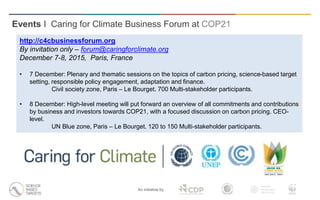
Events I Caring for Climate Business Forum at COP21
http://c4cbusinessforum.org
By invitation only – forum@caringforclimate.org
December 7-8, 2015, Paris, France
• 7 December: Plenary and thematic sessions on the topics of carbon pricing, science-based target
setting, responsible policy engagement, adaptation and finance.
Civil society zone, Paris – Le Bourget. 700 Multi-stakeholder participants.
• 8 December: High-level meeting will put forward an overview of all commitments and contributions
by business and investors towards COP21, with a focused discussion on carbon pricing. CEO-
level.
UN Blue zone, Paris – Le Bourget. 120 to 150 Multi-stakeholder participants.
An initiative by
Events I Webinars
Visit our events listing at
sciencebasedtargets.org
for more live events and
webinars.
An initiative by
Questions & Answers
info@sciencebasedtargets.org
www.sciencebasedtargets.org
An initiative by

Science Based Targets initiative Call to Action

  • 1.
  • 2.
    Science Based TargetsI Agenda An initiative by Agenda: 1. Introduction 2. Call to Action process 3. Eligibility criteria 4. Quality check process 5. Next steps 6. Q&A
  • 3.
    Science Based TargetsI Call to Action An initiative by The Science Based Targets initiative is calling on companies to demonstrate their leadership on climate action by publicly committing to science-based greenhouse gas reduction targets. We plan to enlist 100 companies in 2015, and 250 companies by 2020.
  • 4.
    Science Based TargetsI Call to Action: process An initiative by Announce your science- based target • Publicly announce the science-based target Submit your science- based target for Quality Check • Complete the “Science Based Target Form” for review against eligibility criteria Develop a science- based target • Companies have to develop a science- based target aligned with the eligibility criteria Commit to set a science- based target • Complete the “Commitment letter form” to setting a science-based target (up to December 2015) (up to 24 months after commitment) (3-4 weeks) (Permanently featured in the website plus showcase in several events up to COP 21)
  • 5.
    Science Based TargetsI Call to Action: process An initiative by Announce your science- based target Submit your science- based target for Quality Check Develop a science- based target Commit to set a science- based target
  • 6.
    An initiative by Stepsto joining the Call to Action: • Download commitment letter from: http://sciencebasedtargets.org/commit-to- setting-science-based-targets/ • Complete the commitment letter form by indicating basic information (company name, contact details and sector) and submit to info@sciencebasedtargers.org
  • 7.
    Science Based TargetsI Call to Action: process An initiative by Announce your science- based target Submit your science- based target for Quality Check Develop a science- based target Commit to set a science- based target
  • 8.
    An initiative by •If your company is setting a new target, you will have up to 24 months to develop and announce a science-based target from the date of submission of the commitment letter. • The Science Based Targets initiative will send you a reminder 6 months prior to the deadline. • If a company already has a target in place, the target should be submitted for quality check.
  • 9.
    Science Based TargetsI Call to Action: process An initiative by Announce your science- based target Submit your science- based target for Quality Check Develop a science- based target Commit to set a science- based target
  • 10.
    An initiative by Boundary: covers company-wide Scope 1 and Scope 2 emissions and all GHGs as required in the GHG Protocol Corporate Standard.  Scope 3: an ambitious Scope 3 target is also required when Scope 3 emissions cover a significant portion (greater than 40% of total scope 1, 2 and 3 emissions) of a company’s overall emissions.  Timeframe: commitment period must cover a minimum of 5 years from the date of announcement of the target.  Level of ambition: consistent with the level of decarbonization required to keep global temperature increase below 2°C compared to pre-industrial temperatures  Reporting: disclose GHG emissions inventory on an annual basis. Call to Action I Eligibility Criteria
  • 11.
    An initiative by Companies are encouraged to develop mid- term (e.g. 2030) and long- term goals (e.g. 2050) along with their respective interim milestones.  Companies are encouraged to express their targets on an absolute AND intensity basis.  To ensure consistent tracking of performance over time, the SBT should be recalculated, as needed, to reflect significant changes that would compromise its relevance and consistency. A target recalculation should be triggered by significant changes in growth projections and other assumptions used with SBT-setting methodologies and significant changes to your business or data and emissions factors used in your inventory process; the latter will also require recalculation of the base year inventory. Companies should check the validity of their target projections annually. Call to Action I Additional Guidance
  • 12.
    An initiative by Companies should complete a Scope 3 screening before setting their GHG emission reduction targets.  Scope 3 is considered significant when it represents more than 40% of the total GHG inventory of the company.  If Scope 3 is significant, an ambitious target must be developed covering the most relevant (e.g. top three) emission categories as per the GHG Protocol – Corporate Value Chain (Scope 3) Accounting and Reporting Standard. Call to Action I Guidance on Scope 3
  • 13.
    An initiative by Callto Action I Guidance on Scope 3 – best practice examples Long term vision: Achieve zero environmental footprint throughout the lifecycle of products and business activities by 2050 Long term goal – aspirational: Reduce the company’s carbon footprint (S1, S2 and S3) by 90% by 2050. Intermediate targets – Green Management 2020: S1+S2 • Absolute reduction of GHG emissions of 42% compared to 2000 levels (5% compared to 2015 levels) • Use renewable energy equivalent to 300,000 tCO2e S3 (selection) • Reduce product energy consumption by 30% • Request main contracted manufacturers to set emission reduction activities equivalent to Sony’s. • Collaborate with suppliers of components with large environmental footprint to set and implement their own emission reduction targets. 1. Contraction of GHG emissions
  • 14.
    An initiative by Callto Action I Guidance on Scope 3 – best practice examples Eco Vision 2050 • Reduce CO2 emissions throughout the product lifecycle by 80% by 2050, compared to fiscal 2005 levels • Promote recycling and effective use of Earth’s limited resources • Work to promote restoration and preservation of biodiversity
  • 15.
    An initiative by Callto Action I Guidance on Scope 3 – best practice examples
  • 16.
    An initiative by Financial institutions are welcome to express their intention to set science-based targets for scope 1 and 2 and for their investment activities under the Call to Action, through signing the commitment letter.  However, considering that there is not sufficient development yet as to how to assess financial institutions against a 2°C trajectory, the partners of the Science Based Targets initiative will not be able to assess or confirm adequacy of the targets for the time being.  Financial institutions that sign the commitment letter will be invited to participate in future developments in this area. Call to Action I Financial Institutions
  • 17.
    Science Based TargetsI Call to Action: process An initiative by Announce your science- based target Submit your science- based target for Quality Check Develop a science- based target Commit to set a science- based target
  • 18.
    An initiative by Announcingtargets: Companies that join the Call to Action campaign will be listed on the Science Based Targets website. When possible, the initiative will profile companies that set a science- based target, sharing background on how they developed their target. Science Based Targets I Call to Action: announcement and profiling
  • 19.
    An initiative by Spokespersonopportunities: Business leaders who take ambitious climate action should have their voices heard. Spokespeople may have the following opportunities to share their company’s story over the coming months: • Be quoted in future press releases and social media • Speak at events • Write blogs or op-eds Science Based Targets I Call to Action: announcement and profiling
  • 20.
    An initiative by SDAonline tool – beta testing CalltoActionoutreach(print,online,events,webinars) Releasefinal draftatCOP 21 Finalizetracker ReviseCDPquestionnaire&scoring Next Steps I Timeline 2015 Targettrackerbetaversion COP 21 in Paris – C4C Developmentofdraftmanual Revised draftmanual Climate Week - NYC SDAmethodologyfurtherdevelopment(scope3,AFOLU,sectordetails) Stakeholder workshops CDPquestionnaireexternal consultation Review, design, layout Aug Sep Oct Nov Dec Finalizequestionnaire& scoring
  • 21.
    An initiative by EventsI Caring for Climate Business Forum at COP21 http://c4cbusinessforum.org By invitation only – forum@caringforclimate.org December 7-8, 2015, Paris, France • 7 December: Plenary and thematic sessions on the topics of carbon pricing, science-based target setting, responsible policy engagement, adaptation and finance. Civil society zone, Paris – Le Bourget. 700 Multi-stakeholder participants. • 8 December: High-level meeting will put forward an overview of all commitments and contributions by business and investors towards COP21, with a focused discussion on carbon pricing. CEO- level. UN Blue zone, Paris – Le Bourget. 120 to 150 Multi-stakeholder participants.
  • 22.
    An initiative by EventsI Webinars Visit our events listing at sciencebasedtargets.org for more live events and webinars.
  • 23.
  • 24.

Editor's Notes

  • #15 Have looked at all S3 categories, except “Downstream transportation and distribution” and “Processing of sold products” due to complexity, but recognize as relevant and it is most certainly included in target.