Object::Exercise


Keeping your objects healthy.

      Steven Lembark 
<slembark@cheetahmail.com>
Objects Need Exercise
●
    Both in development and “normal” use.
    –   Error & regression testing.
    –   Benchmarking and capacity planning.
    –   Setup for normal operations.
    –   Bulk data processing.
●
    This is a description of how the 
    Object::Execute harness evolved.
Common Execution Cycle
●
    Run a command.
●
    Check $@, optionally aborting if it is set.
●
    Compare the return value to a known one or 
    run a code snipped to evaluate it, optionally 
    aborting on a mismatched value.
●
    During development, set a breakpoint if the 
    operation or comparison fails.
●
    Run the next command...
The Cycle is Repetitive
●
    We've all seen – or written – code like this:


my $object = Some::Class­>construct( @argz );
my $sanity = '';
$sanity = $object­>first_method( @more_argz );
'HASH' eq ref $sanity or die “Not a hashref...”;
$sanity = $object­>second_part( @even_more_argz );
$DB::single = 1 unless $sanity;
$sanity­>[0] eq 'foobar' or die “No foobar...”
$sanity = $object­>third_part( @yet_more_argz );
$DB::single = 1 if 'ARRAY' ne ref $sanity;
'ARRAY' eq ref $sanity or die “Not an arrayref”;
$sanity = $object­>third_part( 'a' .. 'z' );
Replacing the Cruft
●
     This is a good example MJD's “Red Flags”:
    –   Most of the code is framework, probably updated 
        via cut+paste.
    –   You can easily spend more time writing and 
        debugging the framework code than the module 
        itself.
    –   It is difficult to generate the code so you end up 
        having to code it all manuall.
●
    The trick to cleaning it up is abstracting out 
    the framework and leaving the data.
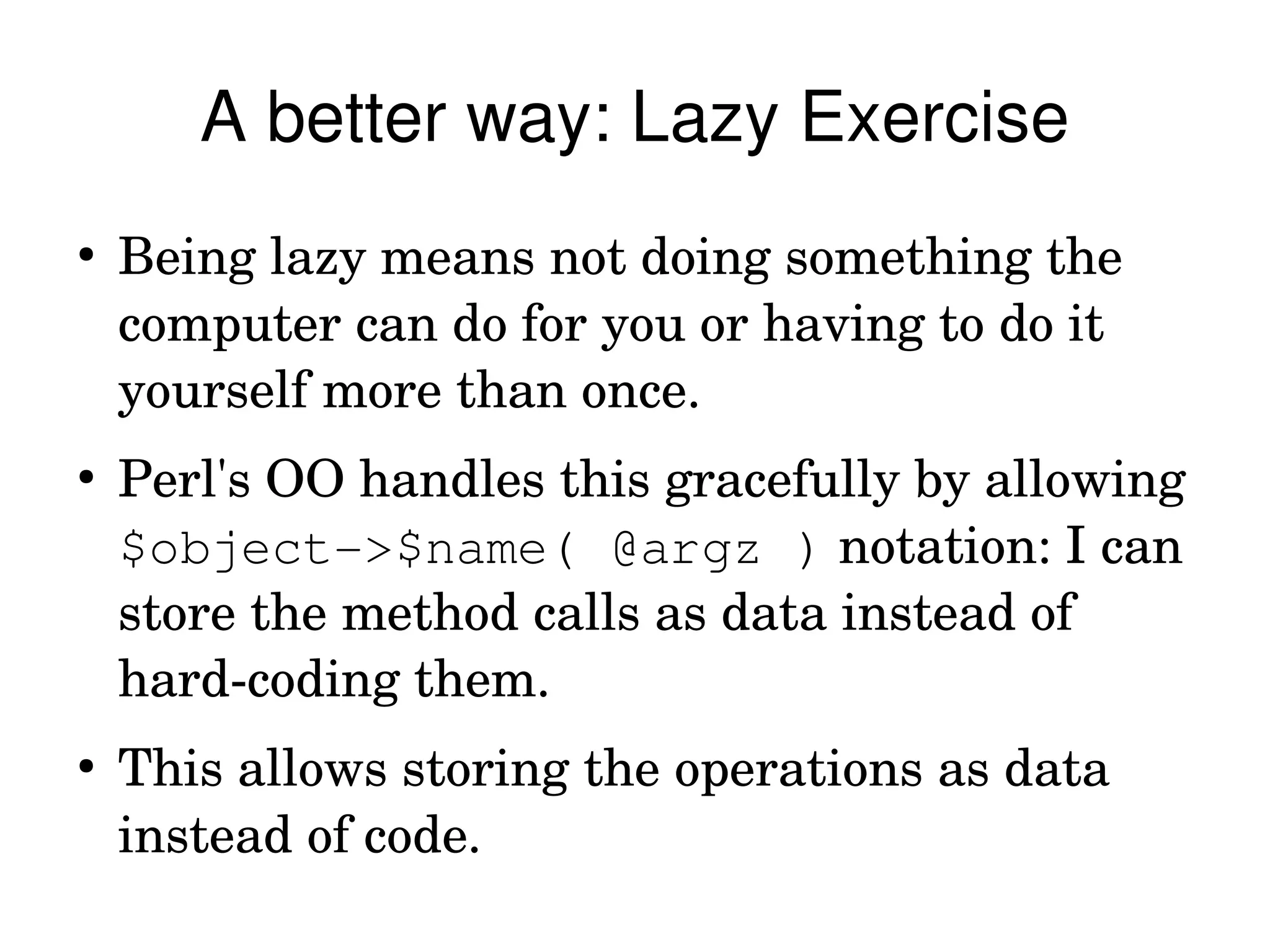
A better way: Lazy Exercise
●
    Being lazy means not doing something the 
    computer can do for you or having to do it 
    yourself more than once.
●
    Perl's OO handles this gracefully by allowing 
    $object­>$name( @argz ) notation: I can 
    store the method calls as data instead of 
    hard­coding them.
●
    This allows storing the operations as data 
    instead of code.
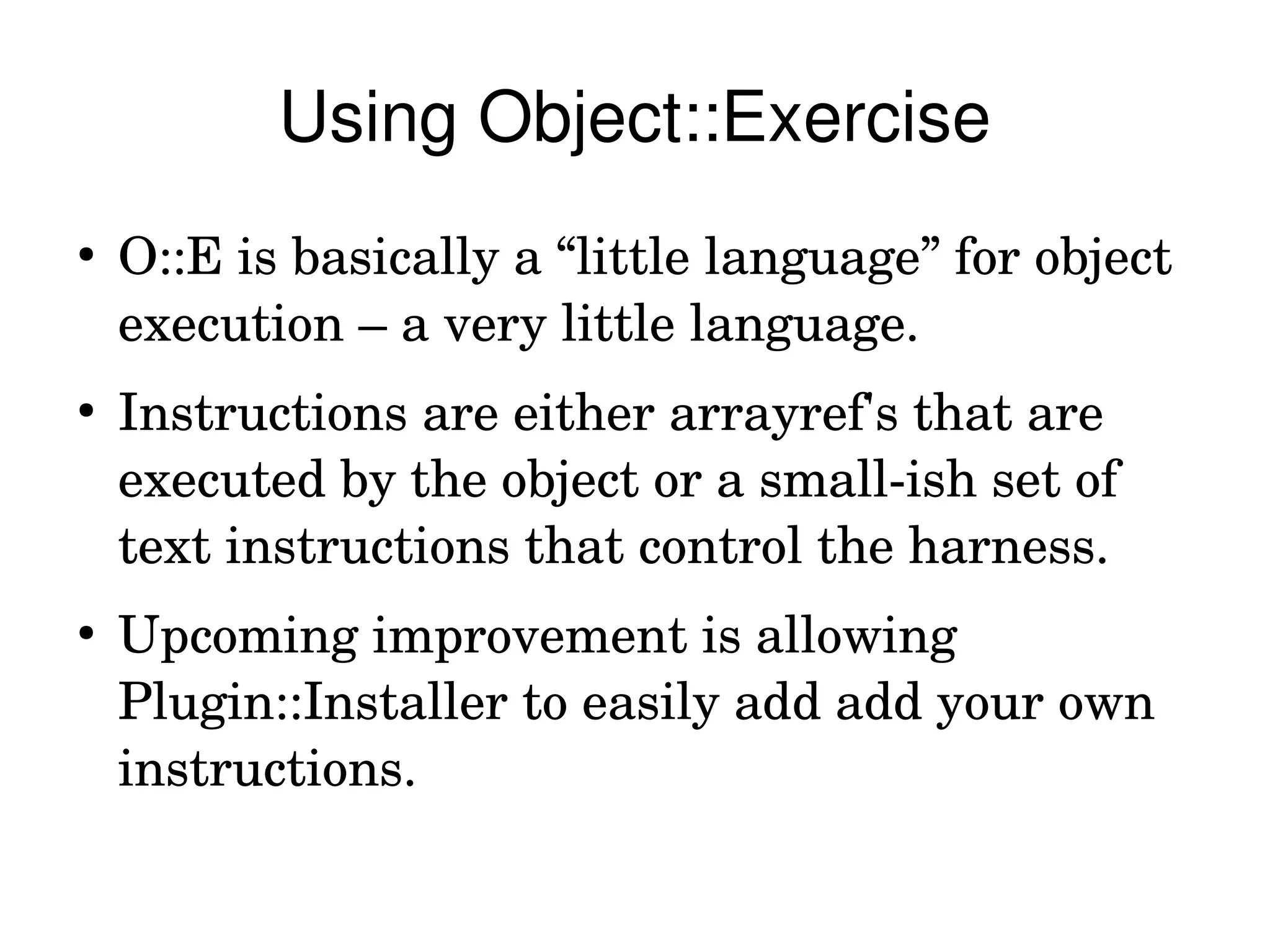
Using Object::Exercise
●
    O::E is basically a “little language” for object 
    execution – a very little language.
●
    Instructions are either arrayref's that are 
    executed by the object or a small­ish set of 
    text instructions that control the harness.
●
    Upcoming improvement is allowing 
    Plugin::Installer to easily add add your own 
    instructions.
Object Execution: Arrayref
●
    The most common thing you'll do is call a 
    method, possibly checking the results.
●
    To run a method and ignore anything other 
    than failure use: [ $method => @argz ] (i.e., a 
    method and list of arguments).
●
    $method can be either text or a coderef, 
    which allows dispatching to local handler 
    code.
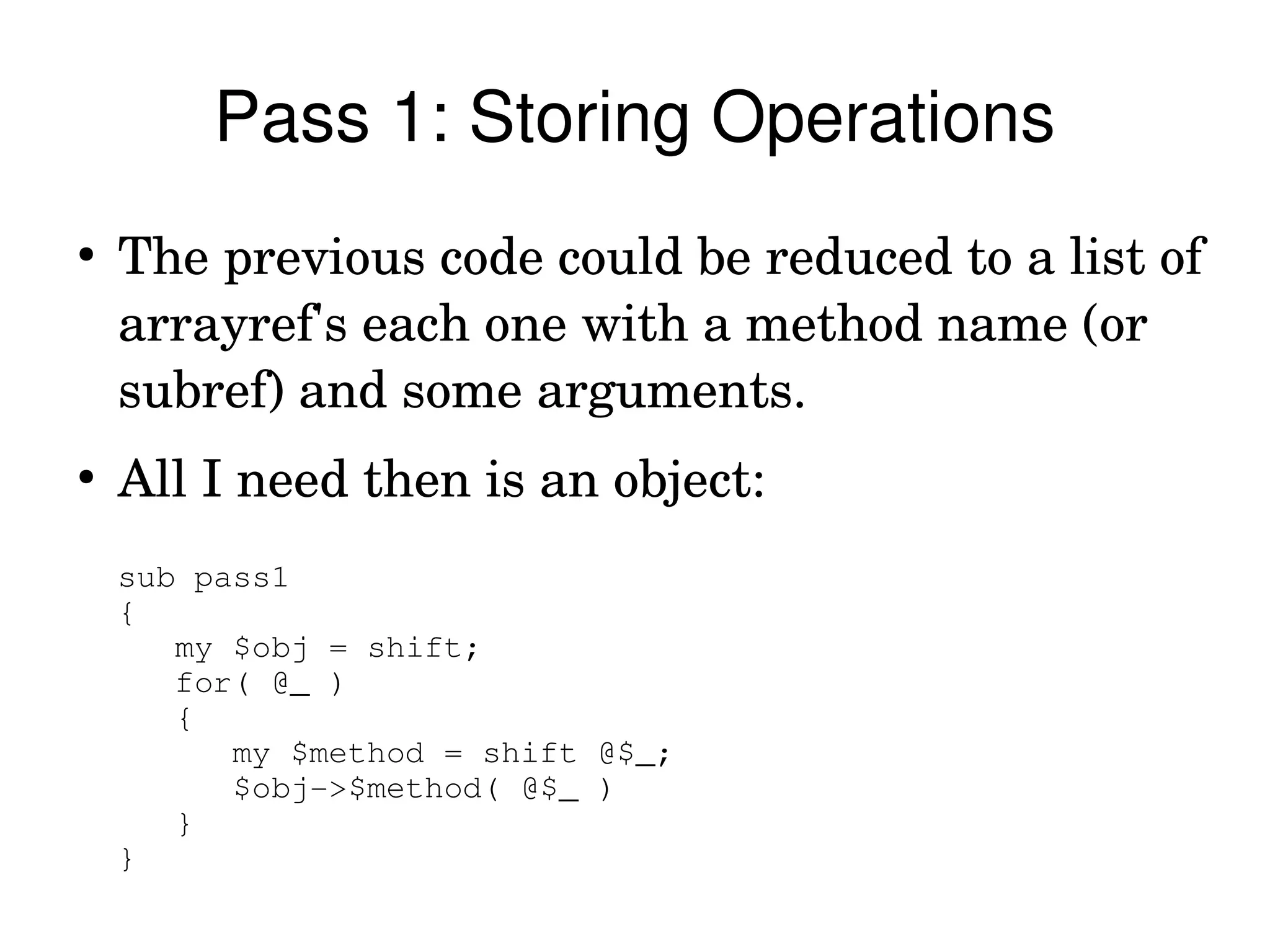
Pass 1: Storing Operations
●
    The previous code could be reduced to a list of 
    arrayref's each one with a method name (or 
    subref) and some arguments.
●
    All I need then is an object:
    sub pass1
    {
       my $obj = shift;
       for( @_ )
       {
          my $method = shift @$_;
          $obj­>$method( @$_ )
       }
    }
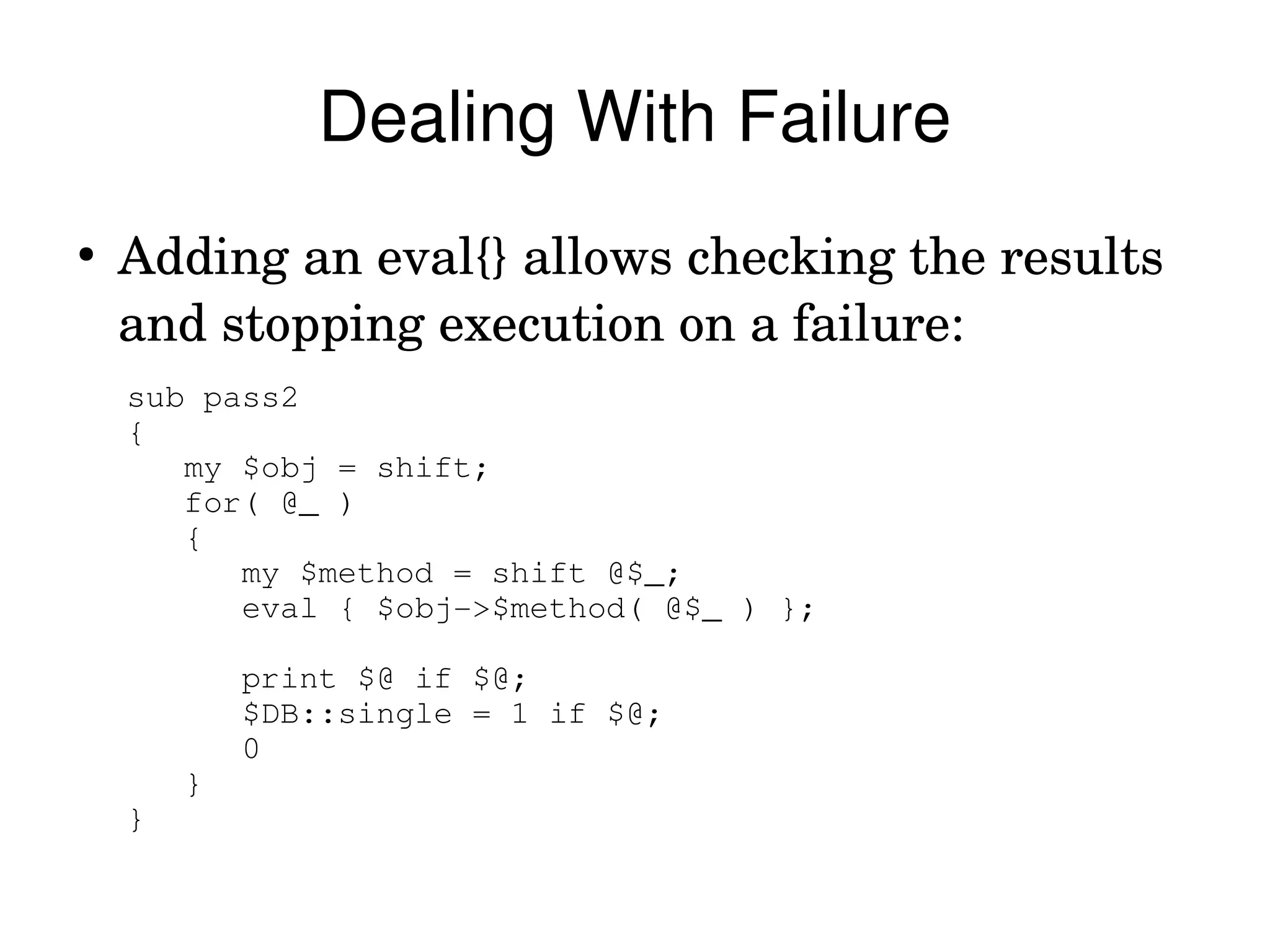
Dealing With Failure
●
    Adding an eval{} allows checking the results 
    and stopping execution on a failure:
    sub pass2
    {
       my $obj = shift;
       for( @_ )
       {
          my $method = shift @$_;
          eval { $obj­>$method( @$_ ) };

            print $@ if $@;
            $DB::single = 1 if $@;
            0
        }
    }
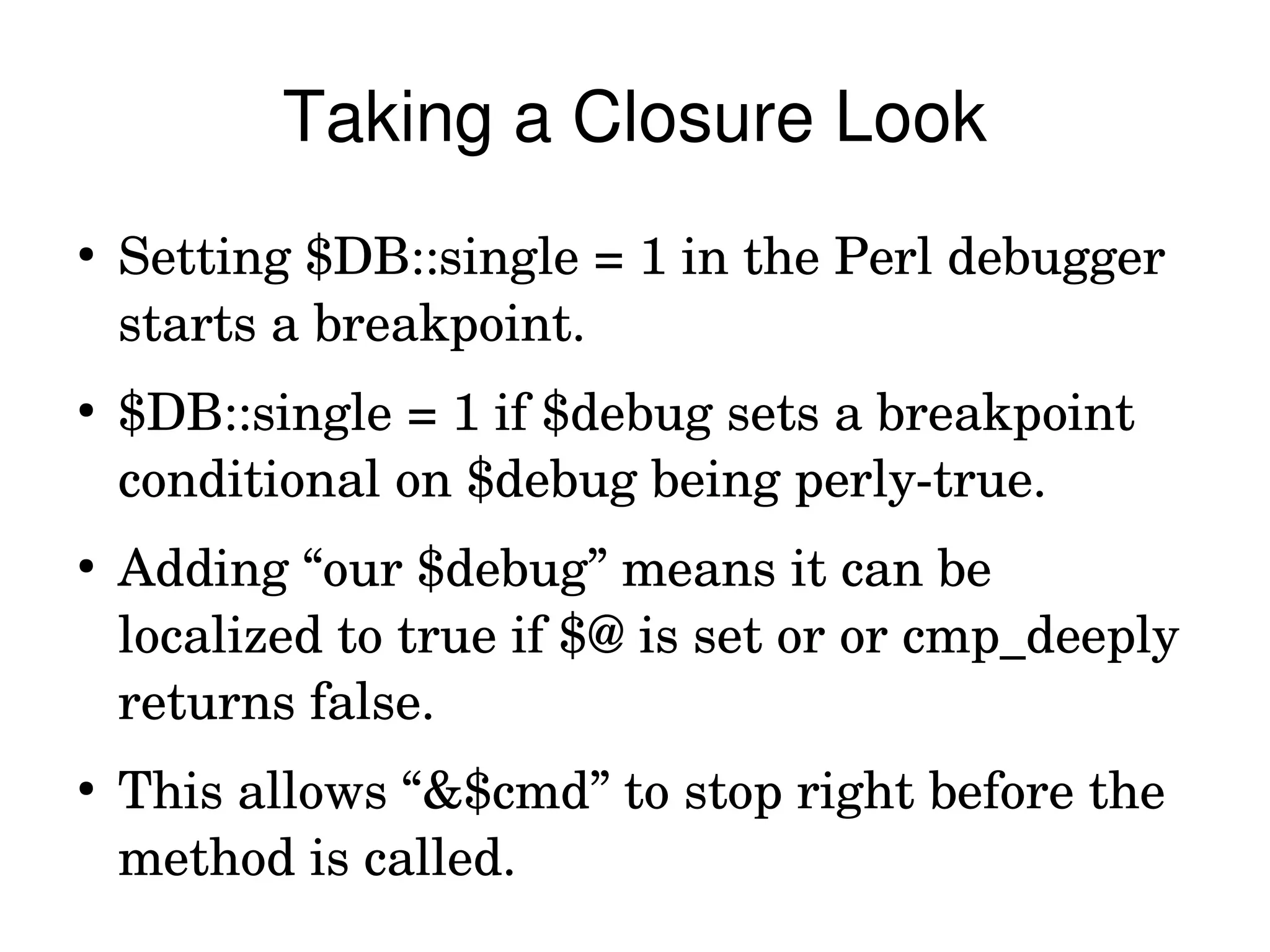
Taking a Closure Look
●
    Setting $DB::single = 1 in the Perl debugger 
    starts a breakpoint.
●
    $DB::single = 1 if $debug sets a breakpoint 
    conditional on $debug being perly­true.
●
    Adding “our $debug” means it can be 
    localized to true if $@ is set or or cmp_deeply 
    returns false.
●
    This allows “&$cmd” to stop right before the 
    method is called.
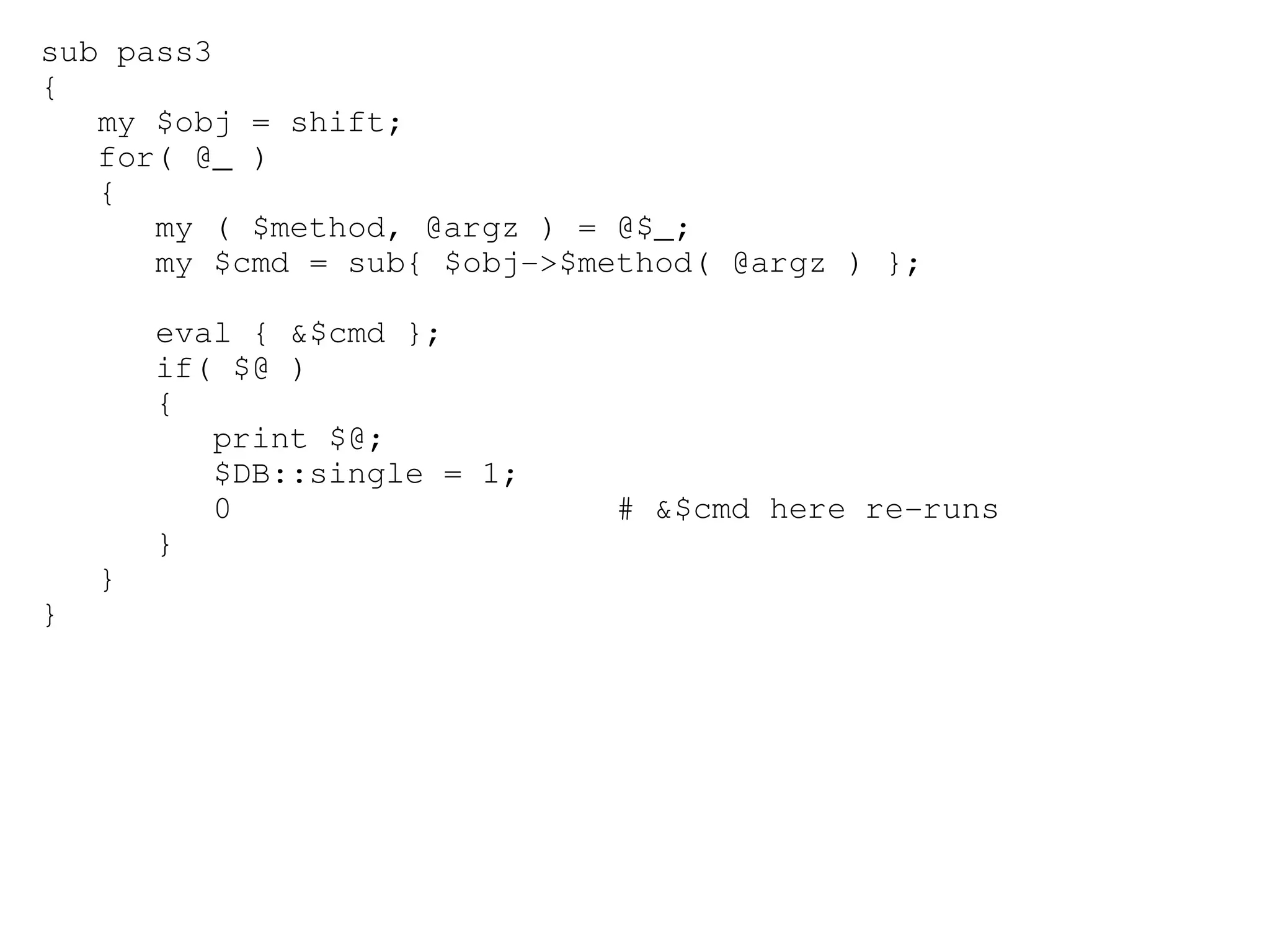
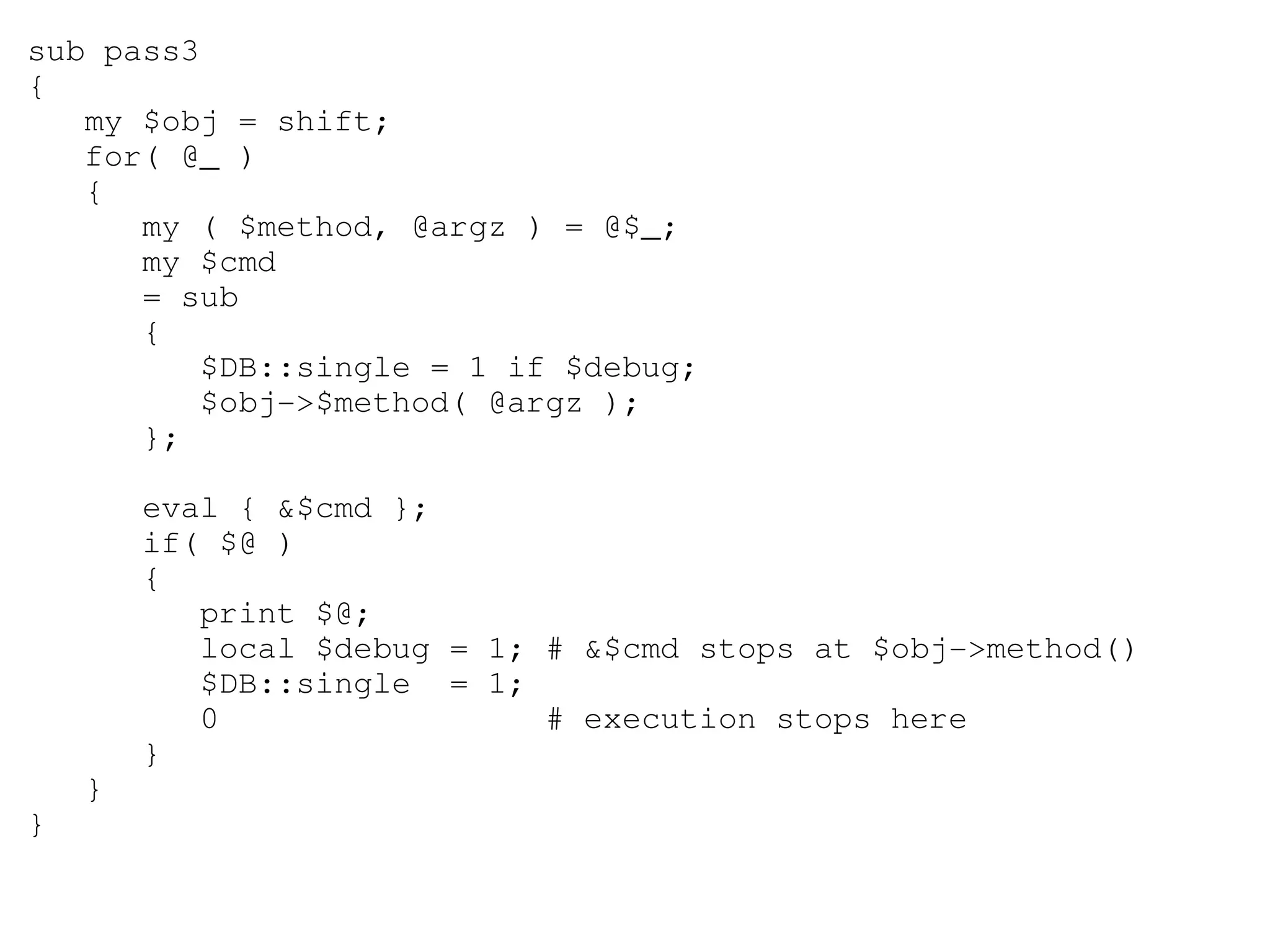
sub pass3
{
   my $obj = shift;
   for( @_ )
   {
      my ( $method, @argz ) = @$_;
      my $cmd = sub{ $obj­>$method( @argz ) };

        eval { &$cmd };
        if( $@ )
        {
           print $@;
           $DB::single = 1;
           0                  # &$cmd here re­runs
        }
    }
}
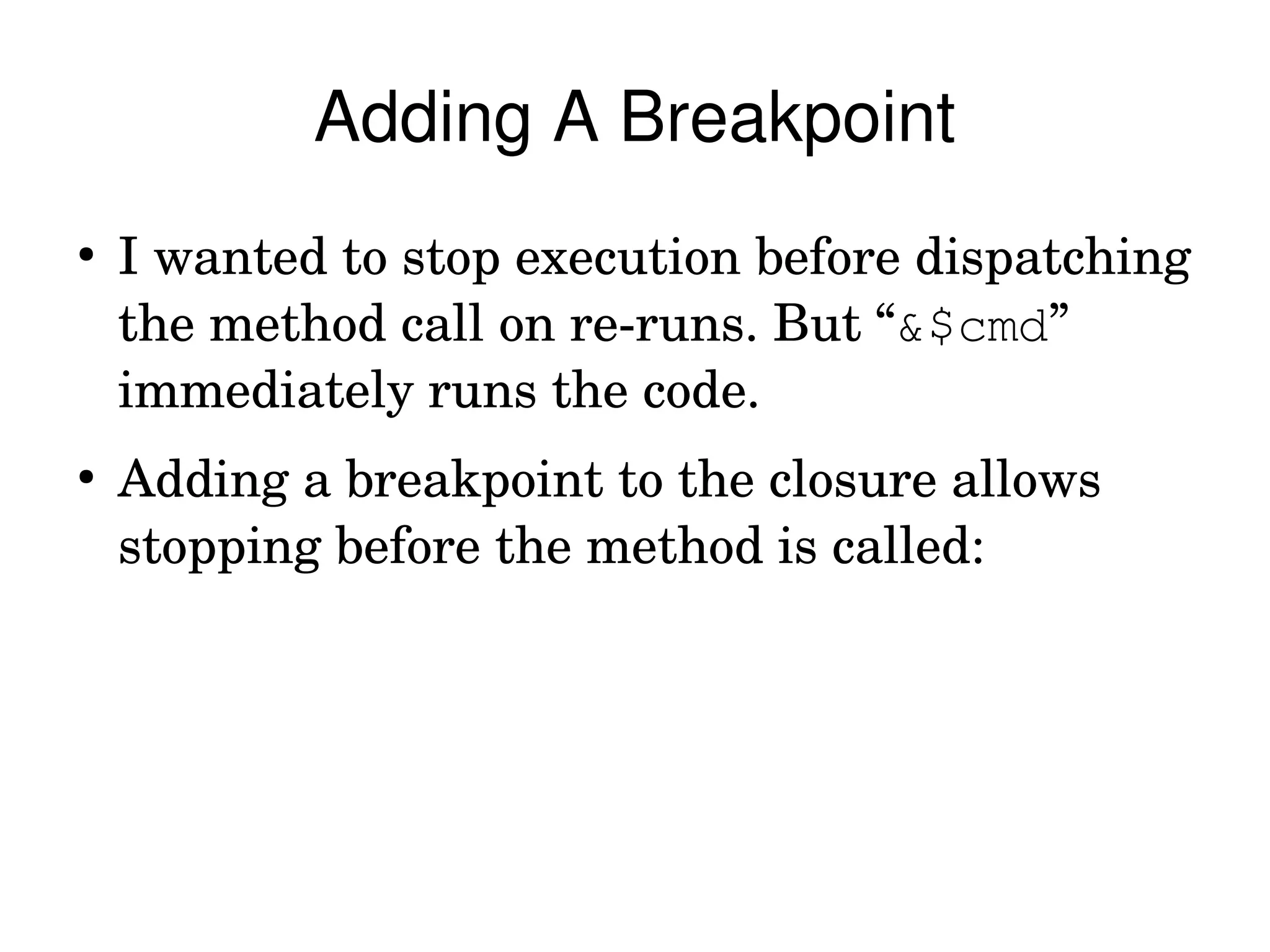
Adding A Breakpoint
●
    I wanted to stop execution before dispatching 
    the method call on re­runs. But “&$cmd” 
    immediately runs the code.
●
    Adding a breakpoint to the closure allows 
    stopping before the method is called:
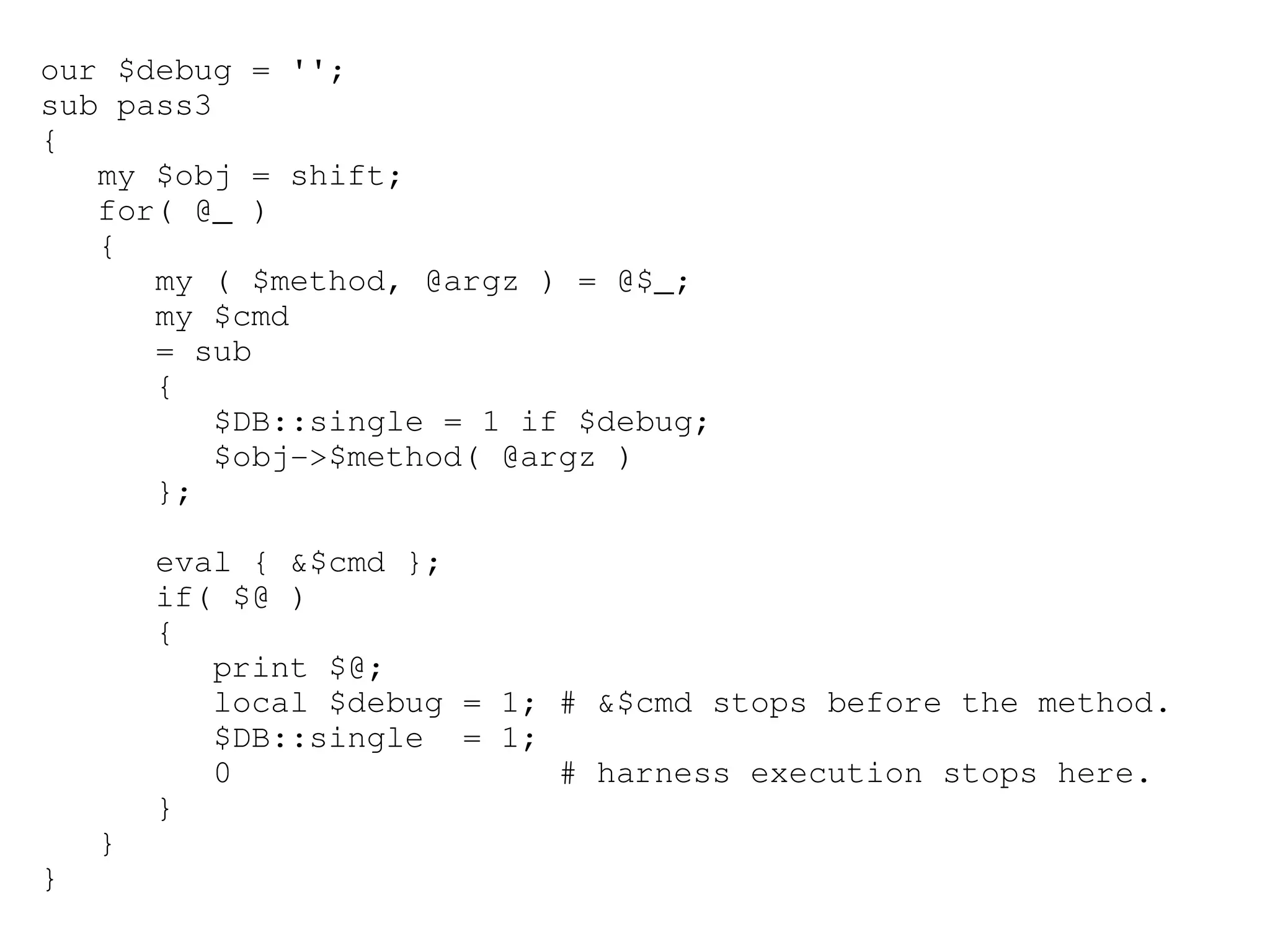
our $debug = '';
sub pass3
{
   my $obj = shift;
   for( @_ )
   {
      my ( $method, @argz ) = @$_;
      my $cmd
      = sub
      {
         $DB::single = 1 if $debug;
         $obj­>$method( @argz )
      };

        eval { &$cmd };
        if( $@ )
        {
           print $@;
           local $debug = 1; # &$cmd stops before the method.
           $DB::single  = 1; 
           0                 # harness execution stops here.
        }
    }
}
Getting Testy About It
●
    Usually you will want to  check the results of 
    execution. 
●
    Instead of a single arrayref, I nested two of 
    them: one with the method the other 
    expected results:
    [
        [ $method => @argz ],
        [ comparison value ],
    ]
How methods are executed
●
    If there is data for comparison then the 
    return is saved, otherwise it can be ignored.
    for( @_ )
    {
        my ( $operation, $compare )
        = 'ARRAY' eq ref $_­>[0] ? @{ $_ } : ( $_ );
             
        ...
             
        if( $@ )
        {
            # set $debug, $DB::single = 1.
        }
        elsif( ! cmp_deeply $result, $compare, $message )
        {
            # set $debug, $DB::single = 1.
        }
        elsif( $verbose )
        {
            print ...
        }
    }
sub pass3
{
   my $obj = shift;
   for( @_ )
   {
      my ( $method, @argz ) = @$_;
      my $cmd
      = sub
      {
         $DB::single = 1 if $debug;
         $obj­>$method( @argz );
      };

        eval { &$cmd };
        if( $@ )
        {
           print $@;
           local $debug = 1; # &$cmd stops at $obj­>method()
           $DB::single  = 1;
           0                 # execution stops here 
        }
    }
}
Doing it your way...
●
    Q: What if the execution requires more than 
    just $obj­>$method( @argz )?
●
    A: Use a coderef as the method.
●
    It will be called as $obj­>$coderef with a sanity check 
    for $@ afterward. This can be handy for updating the 
    object's internals as operations progress.
    [
         [ make_hash => ( 'a' .. 'z' ) ], [ { 'a' .. 'z' } ]
    ],
    [
         [ $reset_object_params, qw( verbose 1 )
    ],
    [
         ...
Control statements
●
    There is a [very] little language for 
    controlling execution.
●
    These are non­arrayref entries in the list of 
    operations:
    –   'break' & 'continue' set $debug to true/false.
    –   'verbose' & 'quiet' set $verbose for log messages.
The Result: Object::Exercise
●
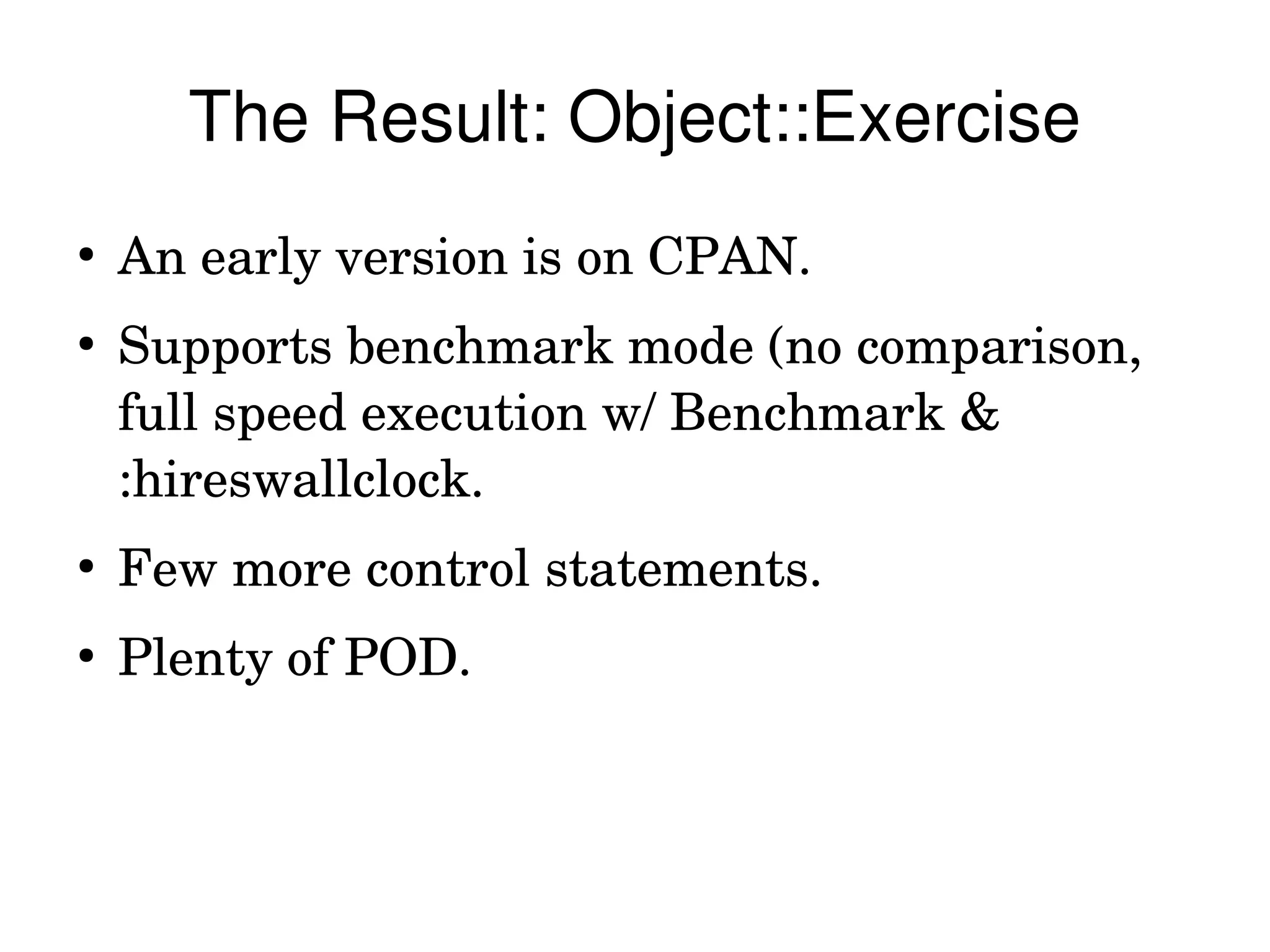
    An early version is on CPAN.
●
    Supports benchmark mode (no comparison, 
    full speed execution w/ Benchmark & 
    :hireswallclock.
●
    Few more control statements.
●
    Plenty of POD.

Object Exercise

  • 1.
    Object::Exercise Keeping your objects healthy. Steven Lembark  <slembark@cheetahmail.com>
  • 2.
    Objects Need Exercise ● Both in development and “normal” use. – Error & regression testing. – Benchmarking and capacity planning. – Setup for normal operations. – Bulk data processing. ● This is a description of how the  Object::Execute harness evolved.
  • 3.
    Common Execution Cycle ● Run a command. ● Check $@, optionally aborting if it is set. ● Compare the return value to a known one or  run a code snipped to evaluate it, optionally  aborting on a mismatched value. ● During development, set a breakpoint if the  operation or comparison fails. ● Run the next command...
  • 4.
    The Cycle is Repetitive ● We've all seen – or written – code like this: my $object = Some::Class­>construct( @argz ); my $sanity = ''; $sanity = $object­>first_method( @more_argz ); 'HASH' eq ref $sanity or die “Not a hashref...”; $sanity = $object­>second_part( @even_more_argz ); $DB::single = 1 unless $sanity; $sanity­>[0] eq 'foobar' or die “No foobar...” $sanity = $object­>third_part( @yet_more_argz ); $DB::single = 1 if 'ARRAY' ne ref $sanity; 'ARRAY' eq ref $sanity or die “Not an arrayref”; $sanity = $object­>third_part( 'a' .. 'z' );
  • 5.
    Replacing the Cruft ●  This is a good example MJD's “Red Flags”: – Most of the code is framework, probably updated  via cut+paste. – You can easily spend more time writing and  debugging the framework code than the module  itself. – It is difficult to generate the code so you end up  having to code it all manuall. ● The trick to cleaning it up is abstracting out  the framework and leaving the data.
  • 6.
    A better way: Lazy Exercise ● Being lazy means not doing something the  computer can do for you or having to do it  yourself more than once. ● Perl's OO handles this gracefully by allowing  $object­>$name( @argz ) notation: I can  store the method calls as data instead of  hard­coding them. ● This allows storing the operations as data  instead of code.
  • 7.
    Using Object::Exercise ● O::E is basically a “little language” for object  execution – a very little language. ● Instructions are either arrayref's that are  executed by the object or a small­ish set of  text instructions that control the harness. ● Upcoming improvement is allowing  Plugin::Installer to easily add add your own  instructions.
  • 8.
    Object Execution: Arrayref ● The most common thing you'll do is call a  method, possibly checking the results. ● To run a method and ignore anything other  than failure use: [ $method => @argz ] (i.e., a  method and list of arguments). ● $method can be either text or a coderef,  which allows dispatching to local handler  code.
  • 9.
    Pass 1: Storing Operations ● The previous code could be reduced to a list of  arrayref's each one with a method name (or  subref) and some arguments. ● All I need then is an object: sub pass1 { my $obj = shift; for( @_ ) { my $method = shift @$_; $obj­>$method( @$_ ) } }
  • 10.
    Dealing With Failure ● Adding an eval{} allows checking the results  and stopping execution on a failure: sub pass2 { my $obj = shift; for( @_ ) { my $method = shift @$_; eval { $obj­>$method( @$_ ) }; print $@ if $@; $DB::single = 1 if $@; 0 } }
  • 11.
    Taking a Closure Look ● Setting $DB::single = 1 in the Perl debugger  starts a breakpoint. ● $DB::single = 1 if $debug sets a breakpoint  conditional on $debug being perly­true. ● Adding “our $debug” means it can be  localized to true if $@ is set or or cmp_deeply  returns false. ● This allows “&$cmd” to stop right before the  method is called.
  • 12.
    sub pass3 { my $obj = shift; for( @_ ) { my ( $method, @argz ) = @$_; my $cmd = sub{ $obj­>$method( @argz ) }; eval { &$cmd }; if( $@ ) { print $@; $DB::single = 1; 0 # &$cmd here re­runs } } }
  • 13.
    Adding A Breakpoint ● I wanted to stop execution before dispatching  the method call on re­runs. But “&$cmd”  immediately runs the code. ● Adding a breakpoint to the closure allows  stopping before the method is called:
  • 14.
    our $debug = ''; sub pass3 { my $obj = shift; for( @_ ) { my ( $method, @argz ) = @$_; my $cmd = sub { $DB::single = 1 if $debug; $obj­>$method( @argz ) }; eval { &$cmd }; if( $@ ) { print $@; local $debug = 1; # &$cmd stops before the method. $DB::single  = 1;  0 # harness execution stops here. } } }
  • 15.
    Getting Testy About It ● Usually you will want to  check the results of  execution.  ● Instead of a single arrayref, I nested two of  them: one with the method the other  expected results: [ [ $method => @argz ], [ comparison value ], ]
  • 16.
    How methods are executed ● If there is data for comparison then the  return is saved, otherwise it can be ignored. for( @_ ) {     my ( $operation, $compare )     = 'ARRAY' eq ref $_­>[0] ? @{ $_ } : ( $_ );               ...               if( $@ )     { # set $debug, $DB::single = 1.     }     elsif( ! cmp_deeply $result, $compare, $message )     { # set $debug, $DB::single = 1.     }     elsif( $verbose )     { print ...     } }
  • 17.
    sub pass3 { my $obj = shift; for( @_ ) { my ( $method, @argz ) = @$_; my $cmd = sub { $DB::single = 1 if $debug; $obj­>$method( @argz ); }; eval { &$cmd }; if( $@ ) { print $@; local $debug = 1; # &$cmd stops at $obj­>method() $DB::single  = 1; 0 # execution stops here  } } }
  • 18.
    Doing it your way... ● Q: What if the execution requires more than  just $obj­>$method( @argz )? ● A: Use a coderef as the method. ● It will be called as $obj­>$coderef with a sanity check  for $@ afterward. This can be handy for updating the  object's internals as operations progress. [ [ make_hash => ( 'a' .. 'z' ) ], [ { 'a' .. 'z' } ] ], [ [ $reset_object_params, qw( verbose 1 ) ], [ ...
  • 19.
    Control statements ● There is a [very] little language for  controlling execution. ● These are non­arrayref entries in the list of  operations: – 'break' & 'continue' set $debug to true/false. – 'verbose' & 'quiet' set $verbose for log messages.
  • 20.
    The Result: Object::Exercise ● An early version is on CPAN. ● Supports benchmark mode (no comparison,  full speed execution w/ Benchmark &  :hireswallclock. ● Few more control statements. ● Plenty of POD.