© 2008 Prentice Hall, Inc. 9 – 1
Layout Strategies
© 2008 Prentice Hall, Inc. 9 – 2
Strategic Importance of
Layout Decisions
The objective of layout strategy
is to develop a cost-effective
layout that will meet a firm’s
competitive needs
© 2008 Prentice Hall, Inc. 9 – 3
Layout Design
Considerations
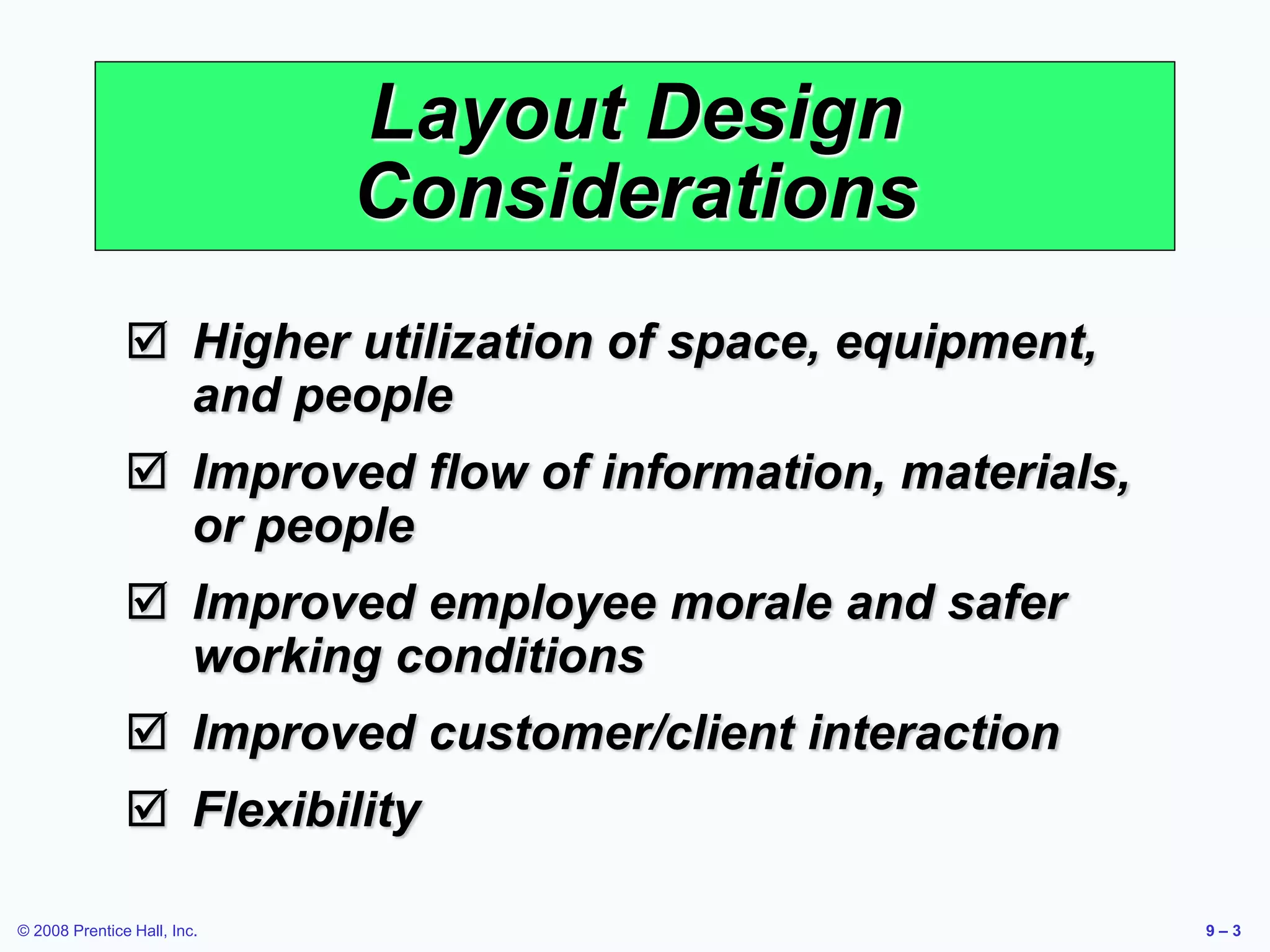
 Higher utilization of space, equipment,
and people
 Improved flow of information, materials,
or people
 Improved employee morale and safer
working conditions
 Improved customer/client interaction
 Flexibility
© 2008 Prentice Hall, Inc. 9 – 4
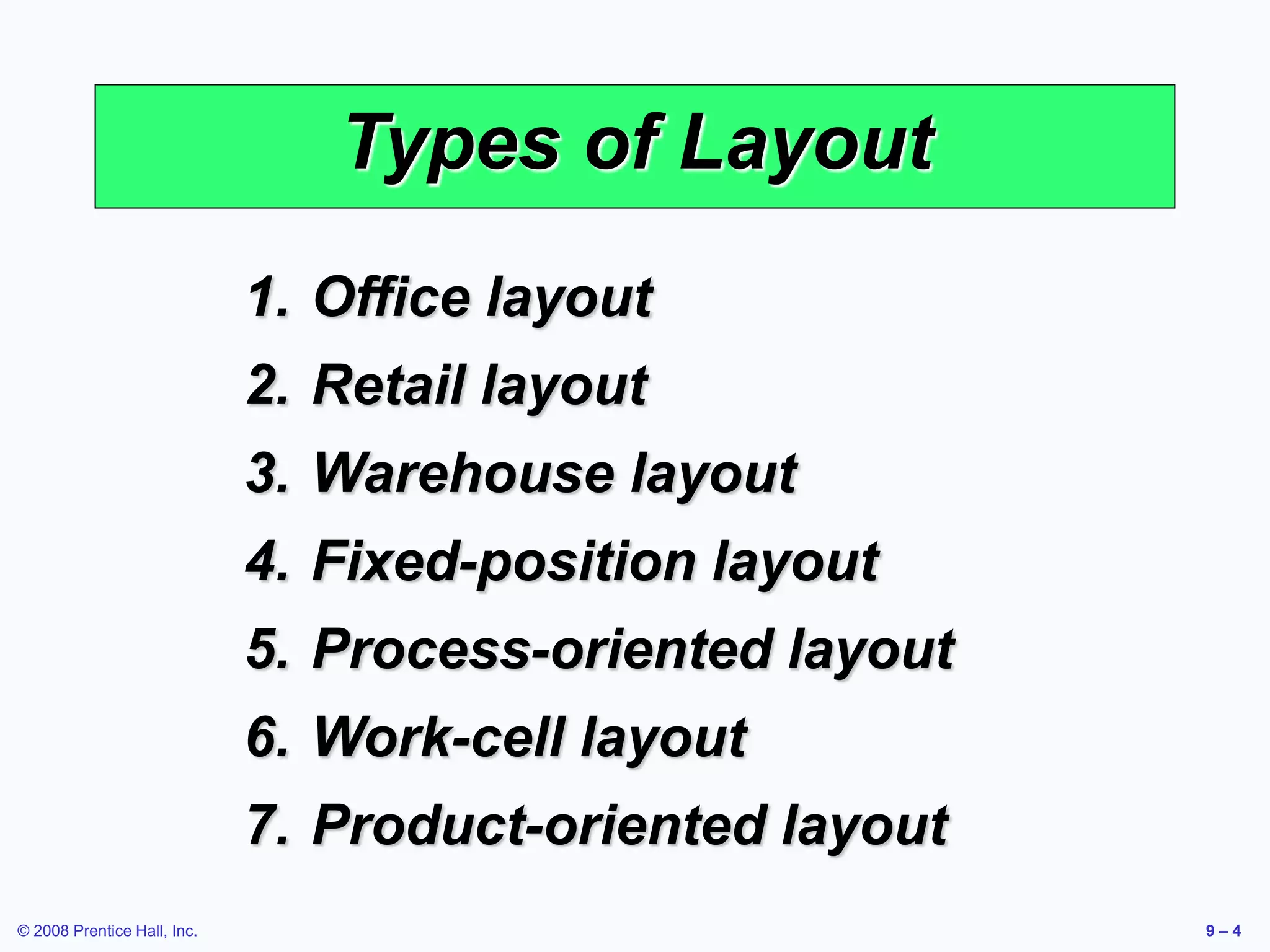
Types of Layout
1. Office layout
2. Retail layout
3. Warehouse layout
4. Fixed-position layout
5. Process-oriented layout
6. Work-cell layout
7. Product-oriented layout
© 2008 Prentice Hall, Inc. 9 – 5
Types of Layout
1. Office layout: Positions workers,
their equipment, and spaces/offices
to provide for movement of
information
2. Retail layout: Allocates shelf space
and responds to customer behavior
3. Warehouse layout: Addresses trade-
offs between space and material
handling
© 2008 Prentice Hall, Inc. 9 – 6
Types of Layout
4. Fixed-position layout: Addresses the
layout requirements of large, bulky
projects such as ships and buildings
5. Process-oriented layout: Deals with
low-volume, high-variety production
(also called job shop or intermittent
production)
© 2008 Prentice Hall, Inc. 9 – 7
Types of Layout
6. Work cell layout: Arranges
machinery and equipment to focus
on production of a single product or
group of related products
7. Product-oriented layout: Seeks the
best personnel and machine
utilizations in repetitive or
continuous production
© 2008 Prentice Hall, Inc. 9 – 8
Good Layouts Consider
1. Material handling equipment
2. Capacity and space requirements
3. Environment and aesthetics
4. Flows of information
5. Cost of moving between various
work areas
© 2008 Prentice Hall, Inc. 9 – 9
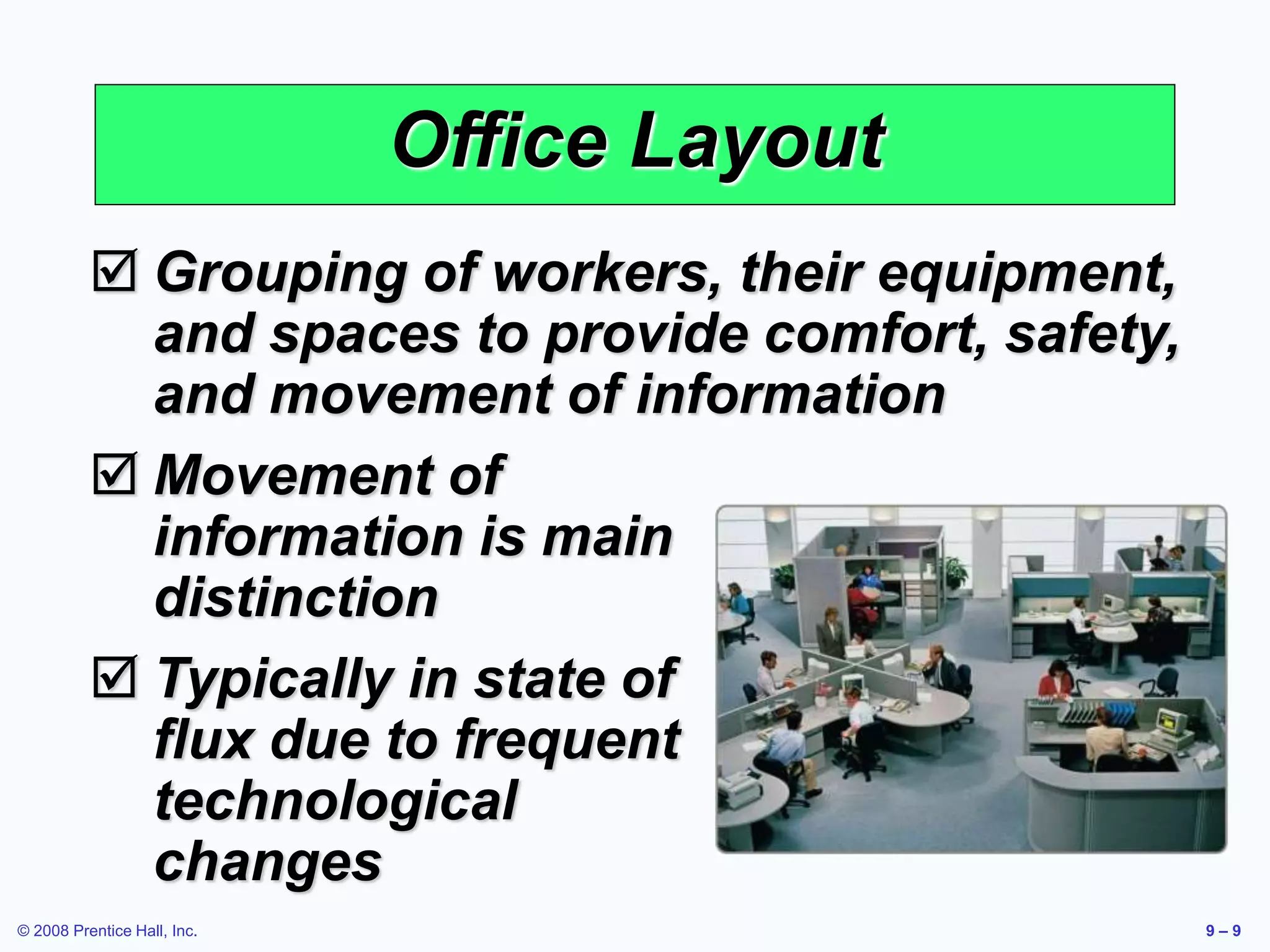
Office Layout
 Grouping of workers, their equipment,
and spaces to provide comfort, safety,
and movement of information
 Movement of
information is main
distinction
 Typically in state of
flux due to frequent
technological
changes
© 2008 Prentice Hall, Inc. 9 – 10
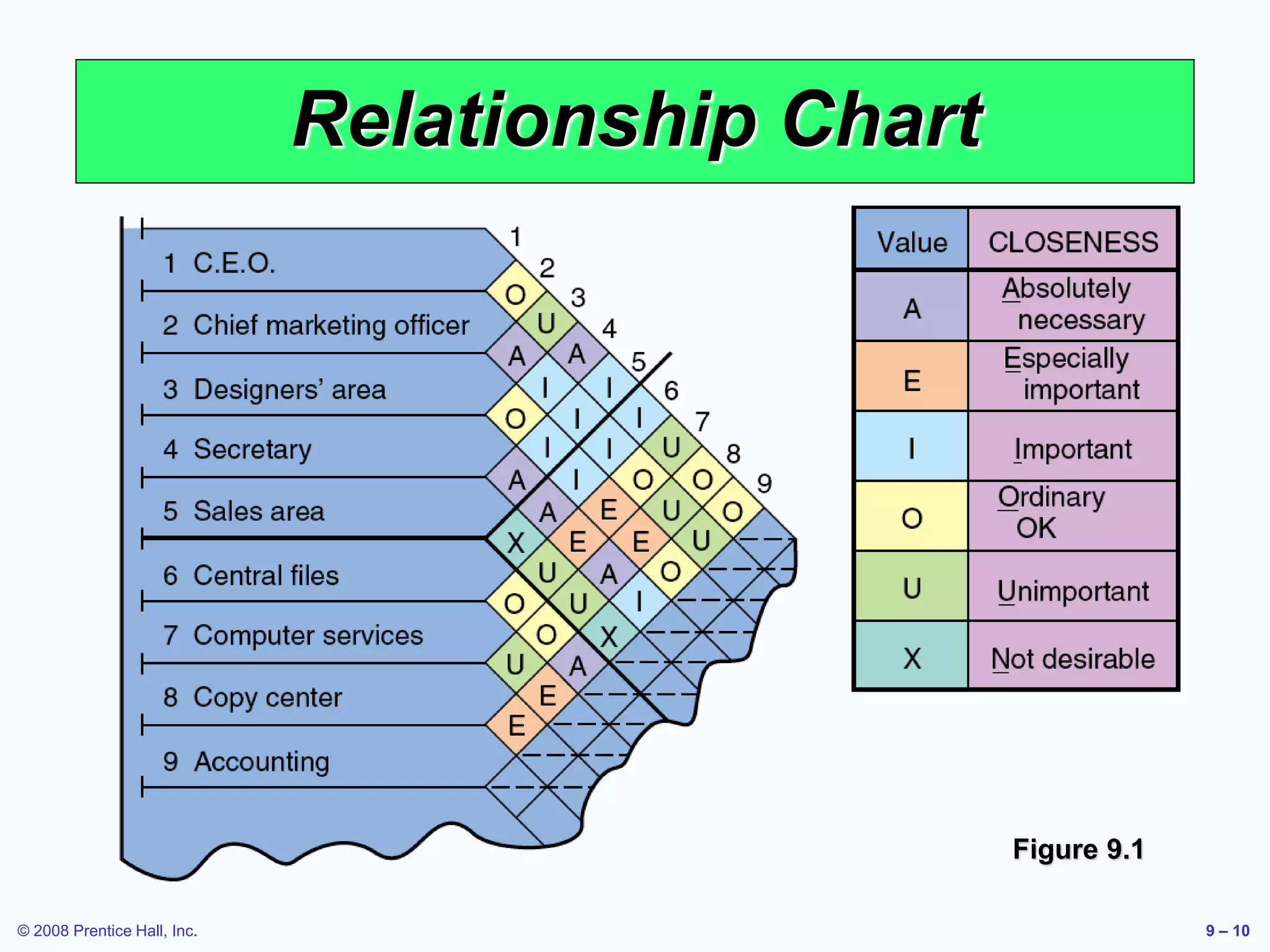
Relationship Chart
Figure 9.1
© 2008 Prentice Hall, Inc. 9 – 11
Supermarket Retail Layout
 Objective is to maximize
profitability per square foot of
floor space
 Sales and profitability vary
directly with customer exposure
© 2008 Prentice Hall, Inc. 9 – 12
Five Helpful Ideas for
Supermarket Layout
1. Locate high-draw items around the
periphery of the store
2. Use prominent locations for high-impulse
and high-margin items
3. Distribute power items to both sides of
an aisle and disperse them to increase
viewing of other items
4. Use end-aisle locations
5. Convey mission of store through careful
positioning of lead-off department
© 2008 Prentice Hall, Inc. 9 – 13
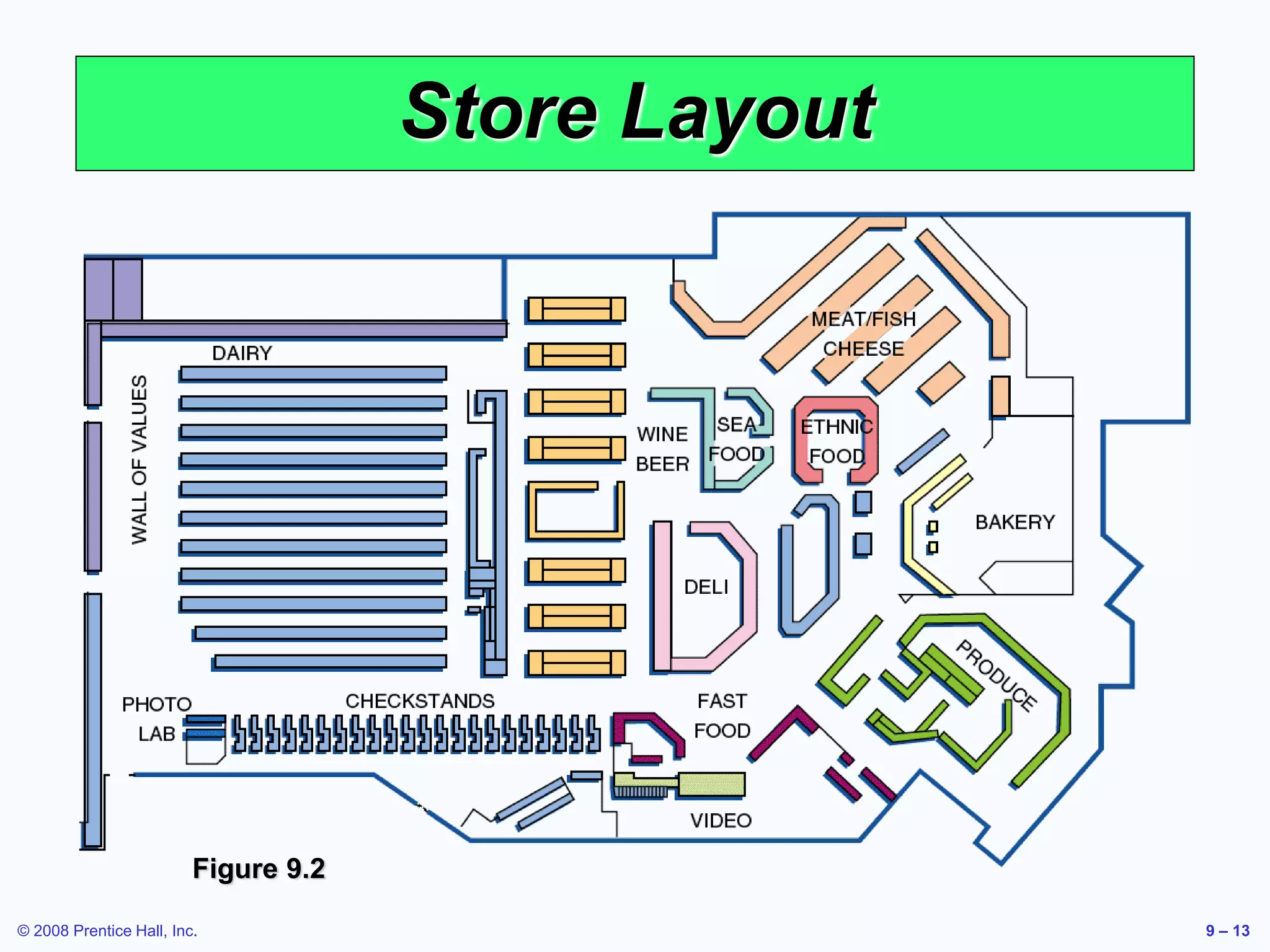
Store Layout
Figure 9.2
© 2008 Prentice Hall, Inc. 9 – 14
Retail Slotting
 Manufacturers pay fees to retailers
to get the retailers to display (slot)
their product
 Contributing factors
 Limited shelf space
 An increasing number of new
products
 Better information about sales
through POS data collection
 Closer control of inventory
© 2008 Prentice Hall, Inc. 9 – 15
Retail Store Shelf Space
Planogram
 Computerized
tool for shelf-
space
management
 Generated from
store’s scanner
data on sales
 Often supplied
by manufacturer
5 facings
Shampoo
Shampoo
Shampoo
Shampoo
Shampoo
Conditioner
Conditioner
Shampoo
Shampoo
Shampoo
Shampoo
Conditioner
2 ft.
© 2008 Prentice Hall, Inc. 9 – 16
Warehousing and Storage
Layouts
 Objective is to optimize trade-offs
between handling costs and costs
associated with warehouse space
 Maximize the total “cube” of the
warehouse – utilize its full volume
while maintaining low material
handling costs
© 2008 Prentice Hall, Inc. 9 – 17
Warehousing and Storage
Layouts
 All costs associated with the transaction
 Incoming transport
 Storage
 Finding and moving material
 Outgoing transport
 Equipment, people, material, supervision,
insurance, depreciation
 Minimize damage and spoilage
Material Handling Costs
© 2008 Prentice Hall, Inc. 9 – 18
Warehousing and Storage
Layouts
 Warehouse density tends to vary
inversely with the number of different
items stored
 Automated Storage and
Retrieval Systems (ASRSs)
can significantly improve
warehouse productivity by
an estimated 500%
 Dock location is a key
design element
© 2008 Prentice Hall, Inc. 9 – 19
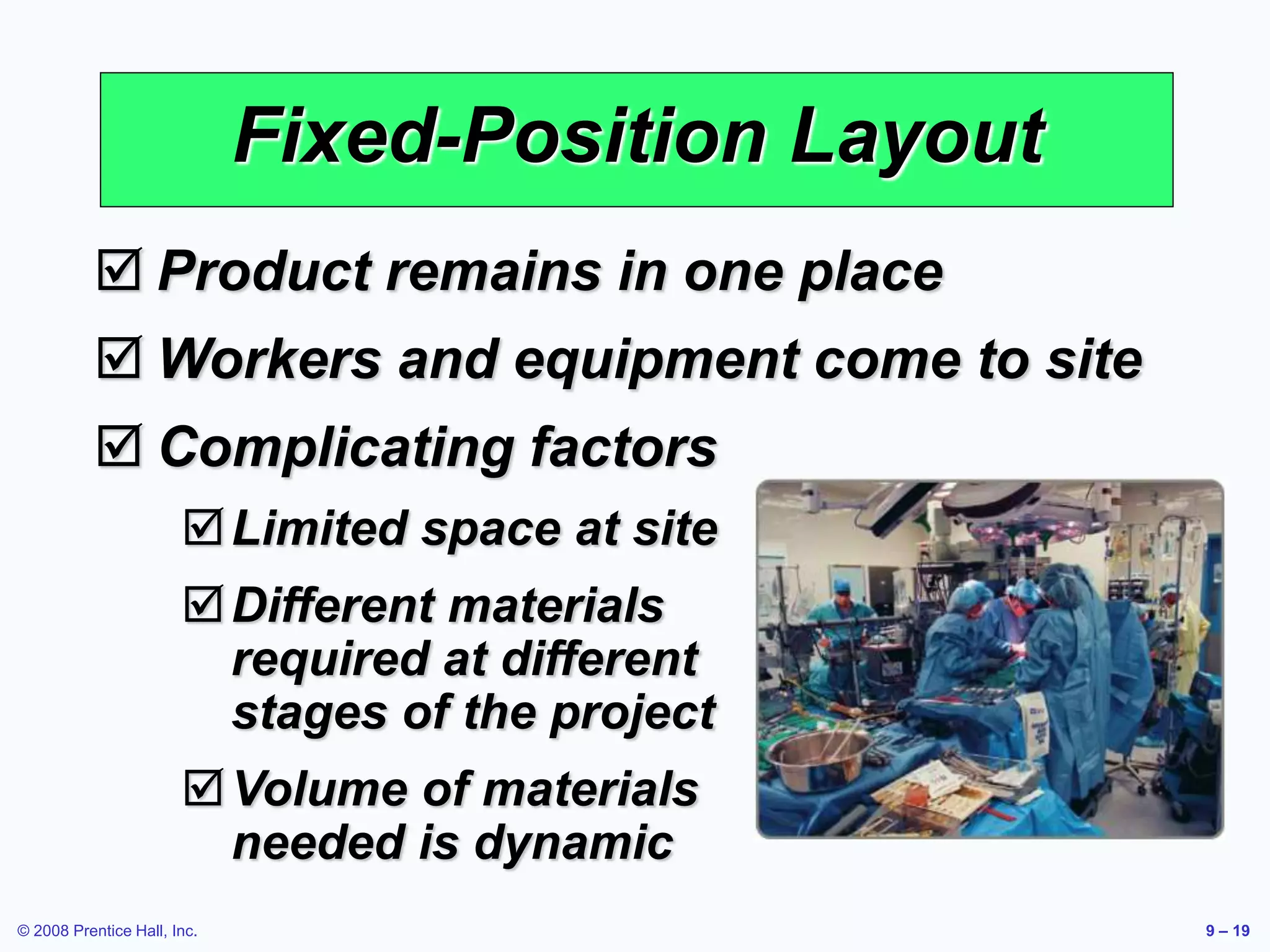
Fixed-Position Layout
 Product remains in one place
 Workers and equipment come to site
 Complicating factors
Limited space at site
Different materials
required at different
stages of the project
Volume of materials
needed is dynamic
© 2008 Prentice Hall, Inc. 9 – 20
Process-Oriented Layout
 Like machines and equipment are
grouped together
 Flexible and capable of handling a
wide variety of products or
services
 Scheduling can be difficult and
setup, material handling, and labor
costs can be high
© 2008 Prentice Hall, Inc. 9 – 21
Surgery
Radiology
ER
triage
room
ER Beds Pharmacy
Emergency room admissions
Billing/exit
Laboratories
Process-Oriented Layout
Patient A - broken leg
Patient B - erratic heart
pacemaker
Figure 9.3
© 2008 Prentice Hall, Inc. 9 – 22
Process-Oriented Layout
 Arrange work centers so as to
minimize the costs of material
handling
 Basic cost elements are
 Number of loads (or people) moving
between centers
 Distance loads (or people) move
between centers
© 2008 Prentice Hall, Inc. 9 – 23
Improving Layouts Using
Work Cells
Current layout - workers
in small closed areas.
Cannot increase output
without a third worker and
third set of equipment. Improved layout - cross-trained
workers can assist each other.
May be able to add a third worker
as additional output is needed.
Figure 9.10 (a)
© 2008 Prentice Hall, Inc. 9 – 24
Improving Layouts Using
Work Cells
Current layout - straight
lines make it hard to balance
tasks because work may not
be divided evenly
Improved layout - in U
shape, workers have better
access. Four cross-trained
workers were reduced.
Figure 9.10 (b)
U-shaped line may reduce employee movement
and space requirements while enhancing
communication, reducing the number of
workers, and facilitating inspection
© 2008 Prentice Hall, Inc. 9 – 25
Repetitive and Product-
Oriented Layout
1. Volume is adequate for high equipment
utilization
2. Product demand is stable enough to justify high
investment in specialized equipment
3. Product is standardized or approaching a phase
of life cycle that justifies investment
4. Supplies of raw materials and components are
adequate and of uniform quality
Organized around products or families of
similar high-volume, low-variety products
© 2008 Prentice Hall, Inc. 9 – 26
Product-Oriented Layouts
 Fabrication line
 Builds components on a series of machines
 Machine-paced
 Require mechanical or engineering changes
to balance
 Assembly line
 Puts fabricated parts together at a series of
workstations
 Paced by work tasks
 Balanced by moving tasks
Both types of lines must be balanced so that the
time to perform the work at each station is the same
© 2008 Prentice Hall, Inc. 9 – 27
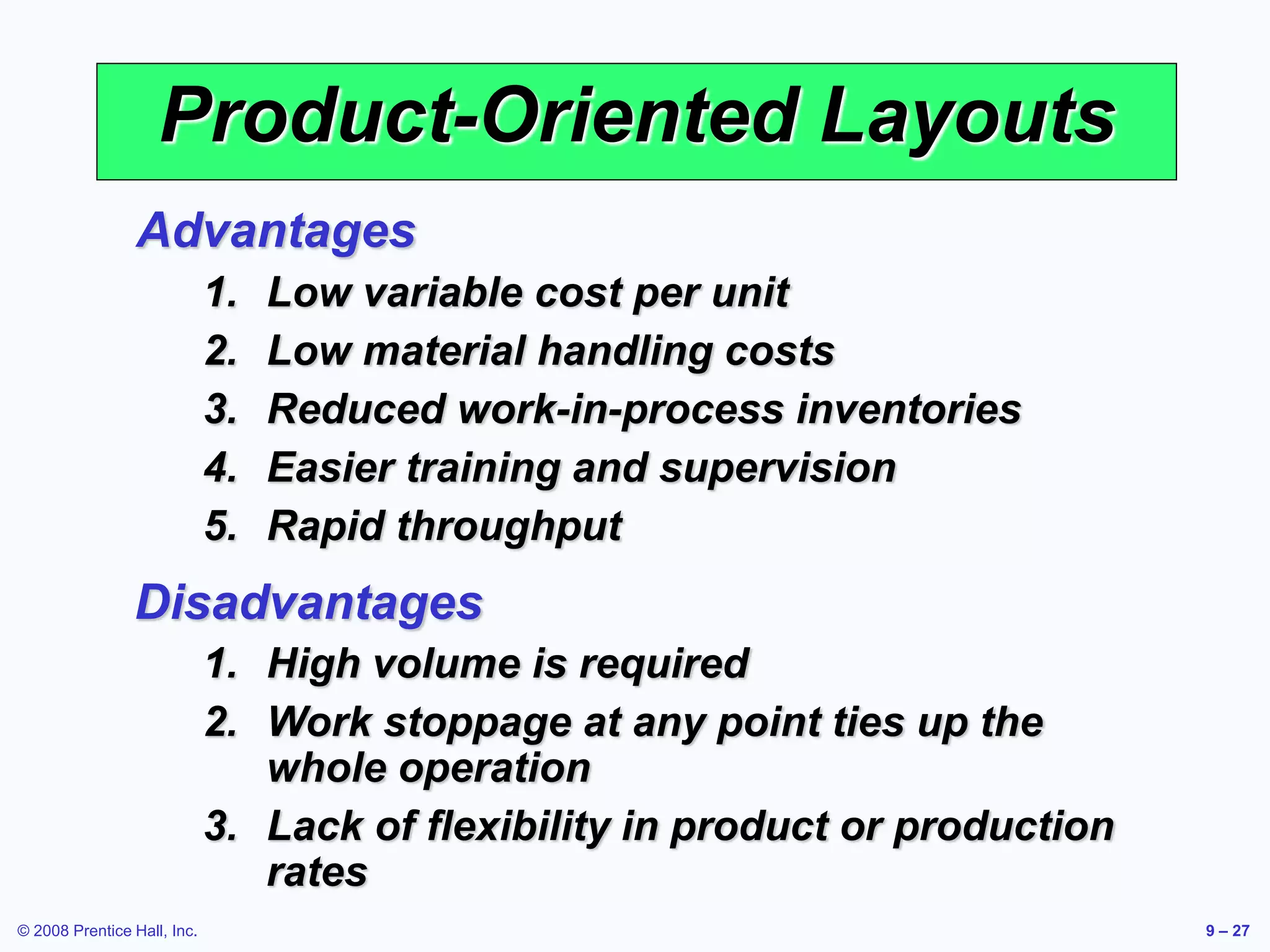
Product-Oriented Layouts
1. Low variable cost per unit
2. Low material handling costs
3. Reduced work-in-process inventories
4. Easier training and supervision
5. Rapid throughput
Advantages
1. High volume is required
2. Work stoppage at any point ties up the
whole operation
3. Lack of flexibility in product or production
rates
Disadvantages
© 2008 Prentice Hall, Inc. 9 – 28
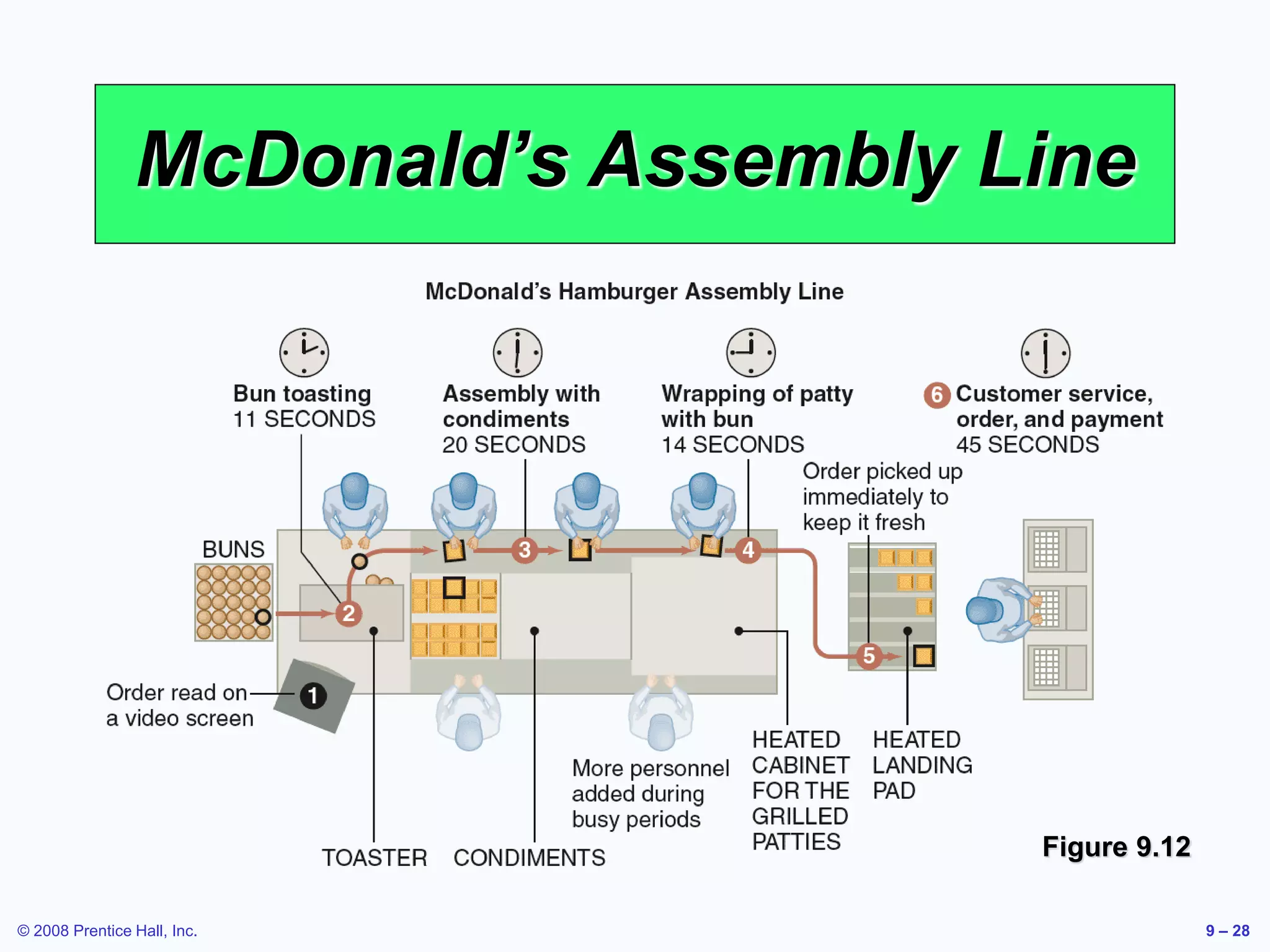
McDonald’s Assembly Line
Figure 9.12

Layout.ppt

  • 1.
    © 2008 PrenticeHall, Inc. 9 – 1 Layout Strategies
  • 2.
    © 2008 PrenticeHall, Inc. 9 – 2 Strategic Importance of Layout Decisions The objective of layout strategy is to develop a cost-effective layout that will meet a firm’s competitive needs
  • 3.
    © 2008 PrenticeHall, Inc. 9 – 3 Layout Design Considerations  Higher utilization of space, equipment, and people  Improved flow of information, materials, or people  Improved employee morale and safer working conditions  Improved customer/client interaction  Flexibility
  • 4.
    © 2008 PrenticeHall, Inc. 9 – 4 Types of Layout 1. Office layout 2. Retail layout 3. Warehouse layout 4. Fixed-position layout 5. Process-oriented layout 6. Work-cell layout 7. Product-oriented layout
  • 5.
    © 2008 PrenticeHall, Inc. 9 – 5 Types of Layout 1. Office layout: Positions workers, their equipment, and spaces/offices to provide for movement of information 2. Retail layout: Allocates shelf space and responds to customer behavior 3. Warehouse layout: Addresses trade- offs between space and material handling
  • 6.
    © 2008 PrenticeHall, Inc. 9 – 6 Types of Layout 4. Fixed-position layout: Addresses the layout requirements of large, bulky projects such as ships and buildings 5. Process-oriented layout: Deals with low-volume, high-variety production (also called job shop or intermittent production)
  • 7.
    © 2008 PrenticeHall, Inc. 9 – 7 Types of Layout 6. Work cell layout: Arranges machinery and equipment to focus on production of a single product or group of related products 7. Product-oriented layout: Seeks the best personnel and machine utilizations in repetitive or continuous production
  • 8.
    © 2008 PrenticeHall, Inc. 9 – 8 Good Layouts Consider 1. Material handling equipment 2. Capacity and space requirements 3. Environment and aesthetics 4. Flows of information 5. Cost of moving between various work areas
  • 9.
    © 2008 PrenticeHall, Inc. 9 – 9 Office Layout  Grouping of workers, their equipment, and spaces to provide comfort, safety, and movement of information  Movement of information is main distinction  Typically in state of flux due to frequent technological changes
  • 10.
    © 2008 PrenticeHall, Inc. 9 – 10 Relationship Chart Figure 9.1
  • 11.
    © 2008 PrenticeHall, Inc. 9 – 11 Supermarket Retail Layout  Objective is to maximize profitability per square foot of floor space  Sales and profitability vary directly with customer exposure
  • 12.
    © 2008 PrenticeHall, Inc. 9 – 12 Five Helpful Ideas for Supermarket Layout 1. Locate high-draw items around the periphery of the store 2. Use prominent locations for high-impulse and high-margin items 3. Distribute power items to both sides of an aisle and disperse them to increase viewing of other items 4. Use end-aisle locations 5. Convey mission of store through careful positioning of lead-off department
  • 13.
    © 2008 PrenticeHall, Inc. 9 – 13 Store Layout Figure 9.2
  • 14.
    © 2008 PrenticeHall, Inc. 9 – 14 Retail Slotting  Manufacturers pay fees to retailers to get the retailers to display (slot) their product  Contributing factors  Limited shelf space  An increasing number of new products  Better information about sales through POS data collection  Closer control of inventory
  • 15.
    © 2008 PrenticeHall, Inc. 9 – 15 Retail Store Shelf Space Planogram  Computerized tool for shelf- space management  Generated from store’s scanner data on sales  Often supplied by manufacturer 5 facings Shampoo Shampoo Shampoo Shampoo Shampoo Conditioner Conditioner Shampoo Shampoo Shampoo Shampoo Conditioner 2 ft.
  • 16.
    © 2008 PrenticeHall, Inc. 9 – 16 Warehousing and Storage Layouts  Objective is to optimize trade-offs between handling costs and costs associated with warehouse space  Maximize the total “cube” of the warehouse – utilize its full volume while maintaining low material handling costs
  • 17.
    © 2008 PrenticeHall, Inc. 9 – 17 Warehousing and Storage Layouts  All costs associated with the transaction  Incoming transport  Storage  Finding and moving material  Outgoing transport  Equipment, people, material, supervision, insurance, depreciation  Minimize damage and spoilage Material Handling Costs
  • 18.
    © 2008 PrenticeHall, Inc. 9 – 18 Warehousing and Storage Layouts  Warehouse density tends to vary inversely with the number of different items stored  Automated Storage and Retrieval Systems (ASRSs) can significantly improve warehouse productivity by an estimated 500%  Dock location is a key design element
  • 19.
    © 2008 PrenticeHall, Inc. 9 – 19 Fixed-Position Layout  Product remains in one place  Workers and equipment come to site  Complicating factors Limited space at site Different materials required at different stages of the project Volume of materials needed is dynamic
  • 20.
    © 2008 PrenticeHall, Inc. 9 – 20 Process-Oriented Layout  Like machines and equipment are grouped together  Flexible and capable of handling a wide variety of products or services  Scheduling can be difficult and setup, material handling, and labor costs can be high
  • 21.
    © 2008 PrenticeHall, Inc. 9 – 21 Surgery Radiology ER triage room ER Beds Pharmacy Emergency room admissions Billing/exit Laboratories Process-Oriented Layout Patient A - broken leg Patient B - erratic heart pacemaker Figure 9.3
  • 22.
    © 2008 PrenticeHall, Inc. 9 – 22 Process-Oriented Layout  Arrange work centers so as to minimize the costs of material handling  Basic cost elements are  Number of loads (or people) moving between centers  Distance loads (or people) move between centers
  • 23.
    © 2008 PrenticeHall, Inc. 9 – 23 Improving Layouts Using Work Cells Current layout - workers in small closed areas. Cannot increase output without a third worker and third set of equipment. Improved layout - cross-trained workers can assist each other. May be able to add a third worker as additional output is needed. Figure 9.10 (a)
  • 24.
    © 2008 PrenticeHall, Inc. 9 – 24 Improving Layouts Using Work Cells Current layout - straight lines make it hard to balance tasks because work may not be divided evenly Improved layout - in U shape, workers have better access. Four cross-trained workers were reduced. Figure 9.10 (b) U-shaped line may reduce employee movement and space requirements while enhancing communication, reducing the number of workers, and facilitating inspection
  • 25.
    © 2008 PrenticeHall, Inc. 9 – 25 Repetitive and Product- Oriented Layout 1. Volume is adequate for high equipment utilization 2. Product demand is stable enough to justify high investment in specialized equipment 3. Product is standardized or approaching a phase of life cycle that justifies investment 4. Supplies of raw materials and components are adequate and of uniform quality Organized around products or families of similar high-volume, low-variety products
  • 26.
    © 2008 PrenticeHall, Inc. 9 – 26 Product-Oriented Layouts  Fabrication line  Builds components on a series of machines  Machine-paced  Require mechanical or engineering changes to balance  Assembly line  Puts fabricated parts together at a series of workstations  Paced by work tasks  Balanced by moving tasks Both types of lines must be balanced so that the time to perform the work at each station is the same
  • 27.
    © 2008 PrenticeHall, Inc. 9 – 27 Product-Oriented Layouts 1. Low variable cost per unit 2. Low material handling costs 3. Reduced work-in-process inventories 4. Easier training and supervision 5. Rapid throughput Advantages 1. High volume is required 2. Work stoppage at any point ties up the whole operation 3. Lack of flexibility in product or production rates Disadvantages
  • 28.
    © 2008 PrenticeHall, Inc. 9 – 28 McDonald’s Assembly Line Figure 9.12