
Ed Marks , Deputy Director for Advocacy, Legal Aid of Western Ohio  Lisa Mantel , Supervising Attorney, Legal Aid Line
Background
ABLE, LAWO, Legal Aid Line Legal Aid of Western Ohio, Inc. (LAWO) and Advocates for Basic Legal Equality, Inc. (ABLE) are non-profit regional law firms that provide high quality legal assistance in civil matters to help eligible low-income individuals and groups in western Ohio achieve self reliance, and equal justice and economic opportunity.  Legal Aid Line is a project of ABLE in partnership with LAWO. Legal Aid Line provides intake and brief service to eligible online, walk-in, and telephone applicants.
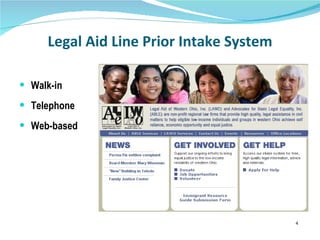
Legal Aid Line Prior Intake System Walk-in Telephone Web-based
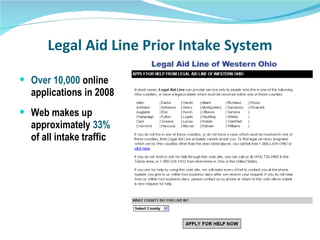
Over   10,000  online applications in 2008 Web makes up approximately  33%  of all intake traffic  Legal Aid Line Prior Intake System
A2J Author ®  Online Intake TIG Legal Aid of Western Ohio, Inc. (LAWO) submitted a $30,000 TIG application in 2007 in order to: Provide the opportunity for all providers to “share” in the  intellectual capital and investment made by Iowa and LSC; Provide Ohio’s legal services providers with 24/7 online  intake capabilities via a link through the LAWO website,  as well as the Ohio Legal Services statewide website; Provide people in need with the ability to contact legal aid  at all hours of the day and night.
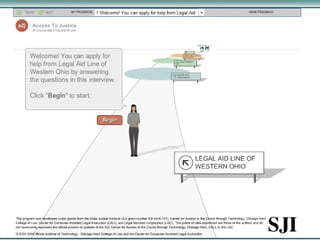
The “New” A2J Online Intake
 
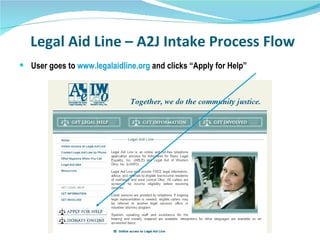
Legal Aid Line – A2J Intake Process Flow User goes to  www.legalaidline.org  and clicks “Apply for Help”
End of A2J Interview The user will see a screen with helpful information based on the legal problem they selected from the A2J interview and the county in which they live. EXAMPLE:  If the user has a Housing issue, then the ClientsWIN system will display county-specific emergency shelter information that the user can utilize while they are waiting for contact from legal aid. The A2J problem code is mapped to ClientsWIN using Mambo  (for the value of the problem code) .
“ What happens next?” An e-mail is generated to a designated Intake Staff distribution list alerting staff an application has been submitted. E-mail contains name, address, phone, and date of birth of applicant; Online application is “held” in a “holding pen” until it can be reviewed by Intake Staff for conflicts utilizing a piece of code developed by the Ohio Legal Assistance Foundation (Ty Acker); At the conclusion of the conflict check, the case is either “Denied as Conflict” or “Accepted for Review”;  Accepted eligible cases are assigned to LAL attorneys for review, and/or brief service, and/or referral to ABLE, LAWO, or  pro bono  partners.
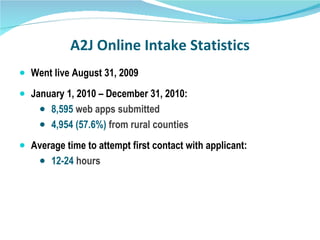
Went live August 31, 2009 January 1, 2010 – December 31, 2010:  8,595   web apps submitted  4,954 (57.6%)  from rural counties Average time to attempt first contact with applicant:  12-24   hours A2J Online Intake Statistics
Advantage of A2J Author ®  Intake Time Savings: Intake process shortened by approximately 10-15 minutes per client. HR Impact – Saved 0.5 to 1.0 FTE A2J Intake available 24/7, which provides potential clients with a way to contact legal services outside of regular business hours; thus, potentially reducing the amount of call traffic (and waits on hold).
The “Mechanics” of A2J Online Intake
The “Script” The script from Iowa’s initiative was used as the starting point for the Ohio intake initiative. Modified as needed, with input from Legal Aid Line intake and attorney staff and ABLE and LAWO attorneys. The script was made available for review to all participating Ohio programs and will be edited based on the individual intake process for each program.
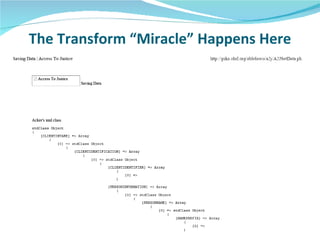
A2J Author ®  Intake – the Process User completes the interview. Information gathered from interview is passed to Legal Aid Line’s Pika case management system by custom-written piece of code called a “transform” that converts  .anx  file to  .php  file.* Generated data file is “held” in Pika staging table for conflict review by LAL intake and advocate staff, prior to acceptance and transfer to the LAL Pika office. Transforms are, and should be, customizable by program based on elements (variables) in Pika, and are based on LSXML principles. *Transform written by John Mayer, Computer-Assisted Legal Instruction
The Transform “Miracle” Happens Here
Special Customizations for Legal Aid Line Interview and transform are designed based on LAL’s current intake practice. Pika fields had to be matched perfectly to ensure information from the interview “matched” with case management. Customized code to link the ClientsWIN (problem-code specific information) system had to be captured appropriately and transferred (from Mambo).
Other Important Considerations Every program’s interview, Pika system, and intake process will be different, so it is important to  identify requirements first   using a Word document as the ‘blueprint’. Even after your first A2J interview iteration is done, you can expect to have several “tweaks” to it before you are ready to ask for the transform code work to be done. What you see in the Legal Aid Line interview is customized to the program’s current practice, so whatever you want your interview to do can be (most likely) done for your program interview.
A2J Online Intake - Reporting Crystal Reports is utilized to track activity Surveys Public (currently running SurveyMonkey)  Over 90% of those surveyed say interview is easy
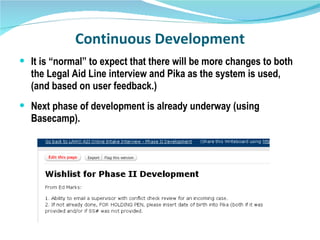
Continuous Development It is “normal” to expect that there will be more changes to both the Legal Aid Line interview and Pika as the system is used, (and based on user feedback.) Next phase of development is already underway (using Basecamp).
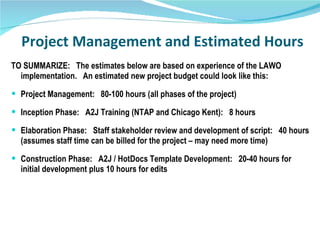
Project Management and Estimated Hours TO SUMMARIZE:  The estimates below are based on experience of the LAWO implementation.  An estimated new project budget could look like this: Project Management:  80-100 hours (all phases of the project) Inception Phase:  A2J Training (NTAP and Chicago Kent):  8 hours Elaboration Phase:  Staff stakeholder review and development of script:  40 hours (assumes staff time can be billed for the project – may need more time) Construction Phase:  A2J / HotDocs Template Development:  20-40 hours for initial development plus 10 hours for edits
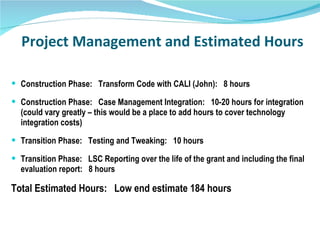
Project Management and Estimated Hours Construction Phase:  Transform Code with CALI (John):  8 hours Construction Phase:  Case Management Integration:  10-20 hours for integration (could vary greatly – this would be a place to add hours to cover technology integration costs) Transition Phase:  Testing and Tweaking:  10 hours Transition Phase:  LSC Reporting over the life of the grant and including the final evaluation report:  8 hours Total Estimated Hours:  Low end estimate 184 hours
Questions? Ed Marks  (Legal Aid of Western Ohio, Inc.) E-mail: [email_address] Phone:  (419) 724-0030 Lisa Mantel  (ABLE’s Legal Aid Line) E-mail:  [email_address] Phone:  (419) 255-0814 Cynthia Vaughn  (Program A2J Development) E-mail: [email_address] Phone:  (614) 728-6930

Online Intake LAWO Slideshow

  • 1.
    Ed Marks ,Deputy Director for Advocacy, Legal Aid of Western Ohio Lisa Mantel , Supervising Attorney, Legal Aid Line
  • 2.
  • 3.
    ABLE, LAWO, LegalAid Line Legal Aid of Western Ohio, Inc. (LAWO) and Advocates for Basic Legal Equality, Inc. (ABLE) are non-profit regional law firms that provide high quality legal assistance in civil matters to help eligible low-income individuals and groups in western Ohio achieve self reliance, and equal justice and economic opportunity. Legal Aid Line is a project of ABLE in partnership with LAWO. Legal Aid Line provides intake and brief service to eligible online, walk-in, and telephone applicants.
  • 4.
    Legal Aid LinePrior Intake System Walk-in Telephone Web-based
  • 5.
    Over 10,000 online applications in 2008 Web makes up approximately 33% of all intake traffic Legal Aid Line Prior Intake System
  • 6.
    A2J Author ® Online Intake TIG Legal Aid of Western Ohio, Inc. (LAWO) submitted a $30,000 TIG application in 2007 in order to: Provide the opportunity for all providers to “share” in the intellectual capital and investment made by Iowa and LSC; Provide Ohio’s legal services providers with 24/7 online intake capabilities via a link through the LAWO website, as well as the Ohio Legal Services statewide website; Provide people in need with the ability to contact legal aid at all hours of the day and night.
  • 7.
    The “New” A2JOnline Intake
  • 8.
  • 9.
    Legal Aid Line– A2J Intake Process Flow User goes to www.legalaidline.org and clicks “Apply for Help”
  • 10.
    End of A2JInterview The user will see a screen with helpful information based on the legal problem they selected from the A2J interview and the county in which they live. EXAMPLE: If the user has a Housing issue, then the ClientsWIN system will display county-specific emergency shelter information that the user can utilize while they are waiting for contact from legal aid. The A2J problem code is mapped to ClientsWIN using Mambo (for the value of the problem code) .
  • 11.
    “ What happensnext?” An e-mail is generated to a designated Intake Staff distribution list alerting staff an application has been submitted. E-mail contains name, address, phone, and date of birth of applicant; Online application is “held” in a “holding pen” until it can be reviewed by Intake Staff for conflicts utilizing a piece of code developed by the Ohio Legal Assistance Foundation (Ty Acker); At the conclusion of the conflict check, the case is either “Denied as Conflict” or “Accepted for Review”; Accepted eligible cases are assigned to LAL attorneys for review, and/or brief service, and/or referral to ABLE, LAWO, or pro bono partners.
  • 12.
    Went live August31, 2009 January 1, 2010 – December 31, 2010: 8,595 web apps submitted 4,954 (57.6%) from rural counties Average time to attempt first contact with applicant: 12-24 hours A2J Online Intake Statistics
  • 13.
    Advantage of A2JAuthor ® Intake Time Savings: Intake process shortened by approximately 10-15 minutes per client. HR Impact – Saved 0.5 to 1.0 FTE A2J Intake available 24/7, which provides potential clients with a way to contact legal services outside of regular business hours; thus, potentially reducing the amount of call traffic (and waits on hold).
  • 14.
    The “Mechanics” ofA2J Online Intake
  • 15.
    The “Script” Thescript from Iowa’s initiative was used as the starting point for the Ohio intake initiative. Modified as needed, with input from Legal Aid Line intake and attorney staff and ABLE and LAWO attorneys. The script was made available for review to all participating Ohio programs and will be edited based on the individual intake process for each program.
  • 16.
    A2J Author ® Intake – the Process User completes the interview. Information gathered from interview is passed to Legal Aid Line’s Pika case management system by custom-written piece of code called a “transform” that converts .anx file to .php file.* Generated data file is “held” in Pika staging table for conflict review by LAL intake and advocate staff, prior to acceptance and transfer to the LAL Pika office. Transforms are, and should be, customizable by program based on elements (variables) in Pika, and are based on LSXML principles. *Transform written by John Mayer, Computer-Assisted Legal Instruction
  • 17.
  • 18.
    Special Customizations forLegal Aid Line Interview and transform are designed based on LAL’s current intake practice. Pika fields had to be matched perfectly to ensure information from the interview “matched” with case management. Customized code to link the ClientsWIN (problem-code specific information) system had to be captured appropriately and transferred (from Mambo).
  • 19.
    Other Important ConsiderationsEvery program’s interview, Pika system, and intake process will be different, so it is important to identify requirements first using a Word document as the ‘blueprint’. Even after your first A2J interview iteration is done, you can expect to have several “tweaks” to it before you are ready to ask for the transform code work to be done. What you see in the Legal Aid Line interview is customized to the program’s current practice, so whatever you want your interview to do can be (most likely) done for your program interview.
  • 20.
    A2J Online Intake- Reporting Crystal Reports is utilized to track activity Surveys Public (currently running SurveyMonkey) Over 90% of those surveyed say interview is easy
  • 21.
    Continuous Development Itis “normal” to expect that there will be more changes to both the Legal Aid Line interview and Pika as the system is used, (and based on user feedback.) Next phase of development is already underway (using Basecamp).
  • 22.
    Project Management andEstimated Hours TO SUMMARIZE:  The estimates below are based on experience of the LAWO implementation.  An estimated new project budget could look like this: Project Management:  80-100 hours (all phases of the project) Inception Phase:  A2J Training (NTAP and Chicago Kent):  8 hours Elaboration Phase:  Staff stakeholder review and development of script:  40 hours (assumes staff time can be billed for the project – may need more time) Construction Phase:  A2J / HotDocs Template Development:  20-40 hours for initial development plus 10 hours for edits
  • 23.
    Project Management andEstimated Hours Construction Phase:  Transform Code with CALI (John):  8 hours Construction Phase:  Case Management Integration:  10-20 hours for integration (could vary greatly – this would be a place to add hours to cover technology integration costs) Transition Phase:  Testing and Tweaking:  10 hours Transition Phase:  LSC Reporting over the life of the grant and including the final evaluation report:  8 hours Total Estimated Hours:  Low end estimate 184 hours
  • 24.
    Questions? Ed Marks (Legal Aid of Western Ohio, Inc.) E-mail: [email_address] Phone: (419) 724-0030 Lisa Mantel (ABLE’s Legal Aid Line) E-mail: [email_address] Phone: (419) 255-0814 Cynthia Vaughn (Program A2J Development) E-mail: [email_address] Phone: (614) 728-6930