LAW OF VARIABLE PROPORTIONS-
PRODUCTION WITH TWO
VARIABLE INPUT
PRESENTED BY
KRISHNAPRIYAA
K P MUBASHEERA
MADHUSREE P P
MAMATHA CHIRAMMAL
LAW OF VARIABLE PROPORTION
■ The law of variable proportion, also known as the law of diminishing
marginal returns or the law of proportionality, is an economic theory
that describes how the output of a production process changes when
one input factor is increased while keeping all other factors constant.
■ There are several terms used in law of variable proportional :
•TPP - Total physical product
•MPP- Marginal physical product
•APP-Average physical product
ASSUMPTIONS OF LAW OF VARIABLE
PROPORTION
■ Constant Technology
■ Factors proportion are variable.
■ Homogeneous factor units.
■ Short run
WHY DOES THE LAW OF VARIABLE
PROPORTION OPERATE?
■ To understand production .
■ Use resource properly .
■ To understand the phases of production.
■ To understand the change in output.
■ To understand underdeveloped countries.
STAGES OF LAW OF VARIABLE
PROPORTION
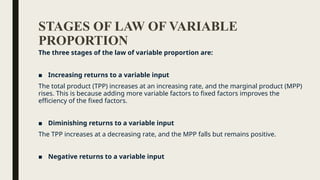
The three stages of the law of variable proportion are:
■ Increasing returns to a variable input
The total product (TPP) increases at an increasing rate, and the marginal product (MPP)
rises. This is because adding more variable factors to fixed factors improves the
efficiency of the fixed factors.
■ Diminishing returns to a variable input
The TPP increases at a decreasing rate, and the MPP falls but remains positive.
■ Negative returns to a variable input
Example
No of workers
(Variable
input )
TOTAL
PHYSICAL
PRODUCT
(TPP)
AVERAGE
PHYSICAL
PRODUCT
(APP)
MARGINAL
PHYSICAL
PRODUCT
(MPP)
REMARKS
1
2
3
4
10
24
39
56
10
12
13
14
10
14
15
17
1st
stage
5
6
7
8
70
78
84
84
14
13
12
10.5
14
8
6
0
2nd
stage
9 81 9 -3 3rd
stage
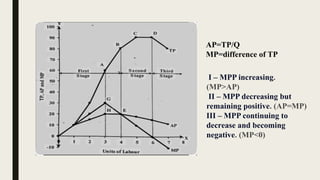
I – MPP increasing.
(MP>AP)
II – MPP decreasing but
remaining positive. (AP=MP)
III – MPP continuing to
decrease and becoming
negative. (MP<0)
AP=TP/Q
MP=difference of TP
Production with two variable inputs
■ A production function with two variable inputs refers to the
relationship between the quantities of two inputs (labor and capital)
and the resulting output. The production function describes how these
inputs are combined to produce goods and services.
Form of Two-Variable Production
Function
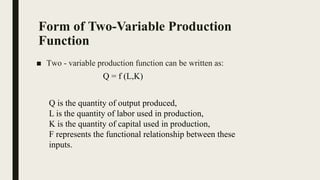
■ Two - variable production function can be written as:
Q = f (L,K)
Q is the quantity of output produced,
L is the quantity of labor used in production,
K is the quantity of capital used in production,
F represents the functional relationship between these
inputs.
Examples of Common Production
Functions
■ Cobb-Douglas Production Function: A common functional form in
economics is the Cobb-Douglas production function:
■ Linear Production Function: production functions may be simpler,
taking a linear form like:
Q = ALαKβ
Q = aL+bK
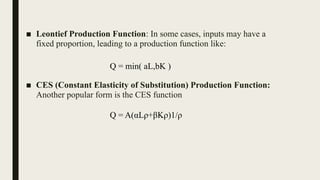
■ Leontief Production Function: In some cases, inputs may have a
fixed proportion, leading to a production function like:
■ CES (Constant Elasticity of Substitution) Production Function:
Another popular form is the CES function
Q = min( aL,bK )
Q = A(αLρ+βKρ)1/ρ

law of variable proportion..............

  • 1.
    LAW OF VARIABLEPROPORTIONS- PRODUCTION WITH TWO VARIABLE INPUT PRESENTED BY KRISHNAPRIYAA K P MUBASHEERA MADHUSREE P P MAMATHA CHIRAMMAL
  • 2.
    LAW OF VARIABLEPROPORTION ■ The law of variable proportion, also known as the law of diminishing marginal returns or the law of proportionality, is an economic theory that describes how the output of a production process changes when one input factor is increased while keeping all other factors constant. ■ There are several terms used in law of variable proportional : •TPP - Total physical product •MPP- Marginal physical product •APP-Average physical product
  • 3.
    ASSUMPTIONS OF LAWOF VARIABLE PROPORTION ■ Constant Technology ■ Factors proportion are variable. ■ Homogeneous factor units. ■ Short run
  • 4.
    WHY DOES THELAW OF VARIABLE PROPORTION OPERATE? ■ To understand production . ■ Use resource properly . ■ To understand the phases of production. ■ To understand the change in output. ■ To understand underdeveloped countries.
  • 5.
    STAGES OF LAWOF VARIABLE PROPORTION The three stages of the law of variable proportion are: ■ Increasing returns to a variable input The total product (TPP) increases at an increasing rate, and the marginal product (MPP) rises. This is because adding more variable factors to fixed factors improves the efficiency of the fixed factors. ■ Diminishing returns to a variable input The TPP increases at a decreasing rate, and the MPP falls but remains positive. ■ Negative returns to a variable input
  • 6.
    Example No of workers (Variable input) TOTAL PHYSICAL PRODUCT (TPP) AVERAGE PHYSICAL PRODUCT (APP) MARGINAL PHYSICAL PRODUCT (MPP) REMARKS 1 2 3 4 10 24 39 56 10 12 13 14 10 14 15 17 1st stage 5 6 7 8 70 78 84 84 14 13 12 10.5 14 8 6 0 2nd stage 9 81 9 -3 3rd stage
  • 7.
    I – MPPincreasing. (MP>AP) II – MPP decreasing but remaining positive. (AP=MP) III – MPP continuing to decrease and becoming negative. (MP<0) AP=TP/Q MP=difference of TP
  • 8.
    Production with twovariable inputs ■ A production function with two variable inputs refers to the relationship between the quantities of two inputs (labor and capital) and the resulting output. The production function describes how these inputs are combined to produce goods and services.
  • 9.
    Form of Two-VariableProduction Function ■ Two - variable production function can be written as: Q = f (L,K) Q is the quantity of output produced, L is the quantity of labor used in production, K is the quantity of capital used in production, F represents the functional relationship between these inputs.
  • 10.
    Examples of CommonProduction Functions ■ Cobb-Douglas Production Function: A common functional form in economics is the Cobb-Douglas production function: ■ Linear Production Function: production functions may be simpler, taking a linear form like: Q = ALαKβ Q = aL+bK
  • 11.
    ■ Leontief ProductionFunction: In some cases, inputs may have a fixed proportion, leading to a production function like: ■ CES (Constant Elasticity of Substitution) Production Function: Another popular form is the CES function Q = min( aL,bK ) Q = A(αLρ+βKρ)1/ρ