Ask the Experts – An Advice
Series for Entrepreneurs
Growing Your Business
AGENDA
RBC Royal Bank:
• Introduction, Retaining your employees
Speaker: Tyler Ray
WelchGroup Consulting/ Welch LLP:
Speakers – Candace Enman, Bron Vasic,
Ryan Dostie
• Increasing the Value of your Business,
Business Valuation, Leasing vs Buying
AGENDA
Perley-Robertson, Hill & McDougall LLP/s.r.l.:
Speakers: Lorraine Mastersmith, Josh
Moon
• Leasing, Franchising, Purchase and Sale
Agreements
Employee Retention
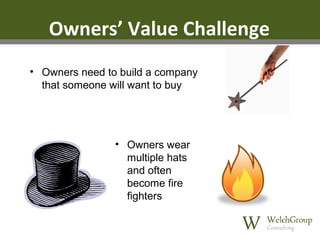
Solutions for building
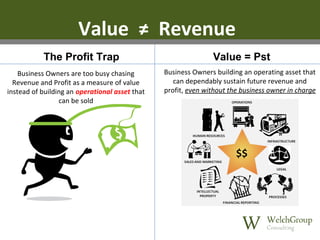
and retaining a
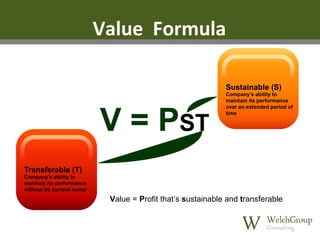
productive workforce
October 31st, 2013
Tyler Ray – RBC Group Advantage
TM

Information included within is current as of April 2013, is for informational
purposes only and does not constitute financial or other advice.
6
Current Employment Marketplace
Industry leaders understand the importance of
building and maintaining a strong team
Key factors in achieving this:
 Attracting and retaining top talent
 Providing more value for money spent on employee
benefits
 Promoting financial wellness
 Being creative with R&R

7
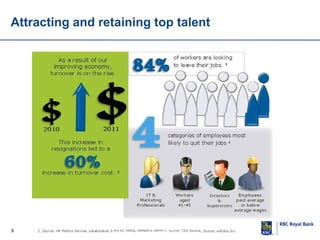
Attracting and retaining top talent

8
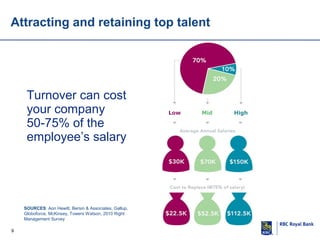
Attracting and retaining top talent

Turnover can cost
your company
50-75% of the
employee’s salary

SOURCES: Aon Hewitt, Bersin & Associates, Gallup,
Globoforce, McKinsey, Towers Watson, 2010 Right
Management Survey
9

Low

Mid

High
Attracting and retaining top talent

10
Employee Benefits - Value for Money
Industry Trends
Employees prioritize benefits in order of:
1. Wages
2. Comprehensive Insurance Benefits
3. Retirement Benefits
Employers are reviewing their offerings in these
categories to assess value for money/cost
effectiveness as well as employee engagement
11
Employee Benefits - Value for Money
Retirement Benefit Plans
Industry Trends
1. DB Pension Plans -> DC Plans
2. DC Plans -> Group RSP Plans
Reasons for change are reduced employer cost,
reduced employer risk and increased employee
engagement in company plan

12
Group Retirement Savings Plans
What is it?

 A collection of individual RRSP accounts
 Members make contributions from their payroll

Who regulates it?

 Individual accounts adhere to the Income Tax Act
 Plan is registered with the Canada Revenue Agency
 CAP Guidelines define sponsor, member and administrator
responsibilities

How are assets
accumulated
Plan Options and
Investments

 Personal and Spousal plan

Restrictions or
Vesting

13

 Employer and/or employee contributions

 Employer and/or employee contributions

 Investment options selected by employees based on choices
available within the plan.
Group Retirement Savings Plans
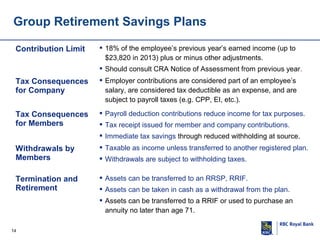
Contribution Limit

 18% of the employee’s previous year’s earned income (up to
$23,820 in 2013) plus or minus other adjustments.
 Should consult CRA Notice of Assessment from previous year.

Tax Consequences
for Company

 Employer contributions are considered part of an employee’s
salary, are considered tax deductible as an expense, and are
subject to payroll taxes (e.g. CPP, EI, etc.).

Tax Consequences
for Members

 Payroll deduction contributions reduce income for tax purposes.
 Tax receipt issued for member and company contributions.
 Immediate tax savings through reduced withholding at source.

Withdrawals by
Members

 Taxable as income unless transferred to another registered plan.

Termination and
Retirement

 Assets can be transferred to an RRSP, RRIF.

 Withdrawals are subject to withholding taxes.

 Assets can be taken in cash as a withdrawal from the plan.
 Assets can be transferred to a RRIF or used to purchase an
annuity no later than age 71.

14
Promoting Financial Wellness
Definition of FINANCIAL WELLNESS:
The balance between having a healthy state of well being
today while preparing financially for tomorrow.
It is not necessarily about being wealthy, but it is a state
of psychological well being in which one feels they
have control over their current finances and financial
future.

15
Promoting Financial Wellness

16
Creative Employee Benefit Best
Practices
 Providing R&R programs that encompass benefits
i.e. Bonuses to Retirement Plans for achieving
milestones or goals, directing bonuses to plans
achieve tax sheltering for employee etc.
 Enhancing employee benefit packages through other
non-traditional means
i.e. Using reward points earned through company credit
cards for employee R&R, provide value add partner
rewards at minimal or no cost to company
17
Business Value
Increasing the Value of
your Business
Candace Enman, CA, CPA
President, WelchGroup Consulting
Owners’ Value Challenge
• Owners need to build a company
that someone will want to buy

• Owners wear
multiple hats
and often
become fire
fighters
Value ≠ Revenue
The Profit Trap
Business Owners are too busy chasing
Revenue and Profit as a measure of value
instead of building an operational asset that
can be sold

Financial
Measures
Revenue, EBITDA

Value = Pst
Business Owners building an operating asset that
can dependably sustain future revenue and
profit, even without the business owner in charge
Value Formula

Value = Profit that’s sustainable and transferable
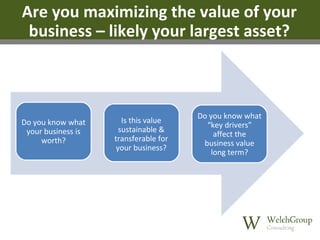
Are you maximizing the value of your
business – likely your largest asset?

Do you know what
your business is
worth?

Is this value
sustainable &
transferable for
your business?

Do you know what
“key drivers”
affect the
business value
long term?
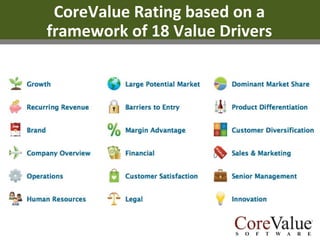
CoreValue Rating based on a
framework of 18 Value Drivers
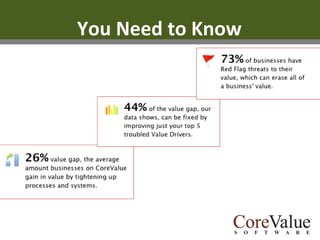
You Need to Know
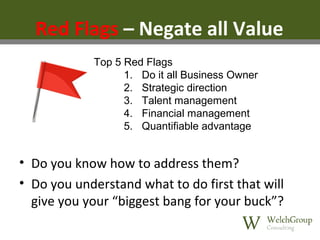
Red Flags – Negate all Value
Top 5 Red Flags
1. Do it all Business Owner
2. Strategic direction
3. Talent management
4. Financial management
5. Quantifiable advantage

• Do you know how to address them?
• Do you understand what to do first that will
give you your “biggest bang for your buck”?
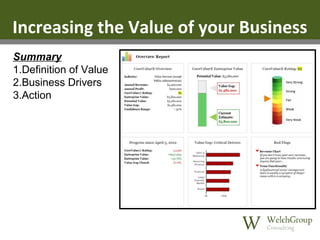
Increasing the Value of your Business
Summary
1.Definition of Value
2.Business Drivers
3.Action
Business Valuation
Valuation Methods

Bron Vasic, CA, CPA,CMC
Chairman, WelchGroup Consulting
Introduction to Valuation
 Process
- Determining how much a business is worth
- Several different business valuation methods
- Many factors need to be taken into account
Valuation – the Formula
 The total value of a company is equal to
• The present value of
• All its future profits
• Discounted for risk

 Can be based on “historical” actuals or
“projections” of the future
Valuation
Essential that you have an accurate
understanding of the company’s current and
future value
Asking basic, yet important, questions about the
business
Valuation
 How much of the company’s top line is recurring revenue?
 Are there contracts with customers / clients?
 Does the business have:
•
•
•
•

Unrecorded assets and/or liabilities
IP or patents not on the books
Property or undervalued assets
Customer relationships

 Can the business survive without the existing owner?
 Are there significant capital investments required in the near
future?
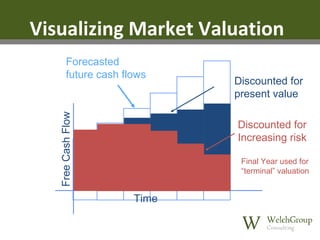
Visualizing Market Valuation

Free Cash Flow

Forecasted
future cash flows

Discounted for
present value
Discounted for
Increasing risk
Final Year used for
“terminal” valuation

Time
Valuation – the Calculations
 Using the NPV (Net Present Value) of future
FCF (Free Cash Flows)
• Assumes a discount “risk factor” depends on
business (from 25% - 40%)
• Brings cash flows into current $’s
• Generate a “Terminal” value
• Brings into current dollars (40% - 50% discount)
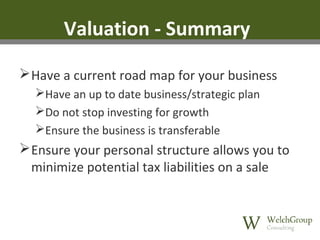
Valuation - Summary
 Have a current road map for your business
Have an up to date business/strategic plan
Do not stop investing for growth
Ensure the business is transferable

 Ensure your personal structure allows you to
minimize potential tax liabilities on a sale
For More Information
Candace Enman
President, WelchGroup Consulting
cenman@w-group.com
(613) 236-9191 x195
www.w-group.com
Bron Vasic
Chairmen, WelchGroup Consulting
bvasic@w-group.com
www.w-group.com
Welch LLP
Chartered Professional Accountants

Lease vs Buy
Ryan Dostie, CPA, CA, CFP
Overview
 Cash flow
 How does this impact my financial statements
 Tax consequences
 Other considerations
 The solution
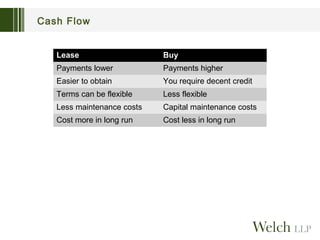
Cash Flow
Lease

Buy

Payments lower

Payments higher

Easier to obtain

You require decent credit

Terms can be flexible

Less flexible

Less maintenance costs

Capital maintenance costs

Cost more in long run

Cost less in long run
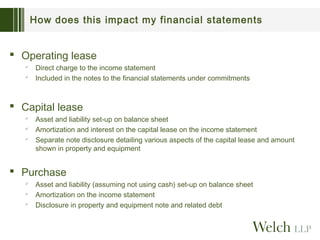
How does this impact my financial statements

 Operating lease



Direct charge to the income statement
Included in the notes to the financial statements under commitments

 Capital lease




Asset and liability set-up on balance sheet
Amortization and interest on the capital lease on the income statement
Separate note disclosure detailing various aspects of the capital lease and amount
shown in property and equipment

 Purchase




Asset and liability (assuming not using cash) set-up on balance sheet
Amortization on the income statement
Disclosure in property and equipment note and related debt
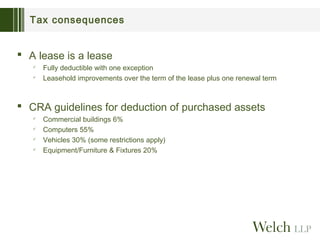
Tax consequences

 A lease is a lease



Fully deductible with one exception
Leasehold improvements over the term of the lease plus one renewal term

 CRA guidelines for deduction of purchased assets





Commercial buildings 6%
Computers 55%
Vehicles 30% (some restrictions apply)
Equipment/Furniture & Fixtures 20%
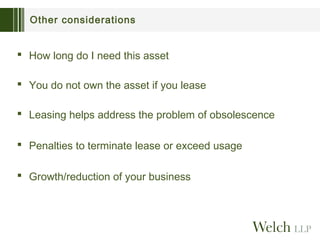
Other considerations

 How long do I need this asset
 You do not own the asset if you lease
 Leasing helps address the problem of obsolescence
 Penalties to terminate lease or exceed usage
 Growth/reduction of your business
The solution

 It depends!
Leasing, Franchising, Purchase and Sale
Agreements
October 31, 2013

Josh Moon and Lorraine Mastersmith
Overview
• Lease Agreements
• Franchise Agreements
• Purchase and Sale Agreements
The Offer to Lease
• Protection in the Offer – Address as many business issues as
possible in the Offer and include a condition allowing your
lawyer’s review before it is binding
Leasehold Improvements
• Who pays to install and who pays to remove?
Operating Costs & Taxes
• What is included in the “extras”?
• Is the management fee fair and reasonable?
• Know all your costs up front
Covenants and Insurance
• Are personal guarantees required and if yes,
can they be limited?
• Have you obtained insurance coverage for all
your risks as a tenant?
Flexibility & Subleases
• Is there an ability to negotiate increase or
decreases in space requirements?
• Pitfalls and Benefits of Subleases
Franchise Agreements
•
•
•

Statutorily governed
Strict disclosure requirements
Personal guarantees
Purchase and Sale Agreements
•
•
•
•

Standard terms
Subcontractors
Web-based contracts
Privacy issues
Lorraine Mastersmith
1400-340 rue Albert Street
Ottawa, ON, KIR 0A5
T: 613.566.2810
F: 613.238.8775
email: lmastersmith@perlaw.ca
Joshua Moon
1400-340 rue Albert Street
Ottawa, ON, KIR 0A5
T: 613.566.2801
F: 613.238.8775
email: jmoon@perlaw.ca
QUESTIONS

Ask the Experts: Growing your Business

  • 1.
    Ask the Experts– An Advice Series for Entrepreneurs Growing Your Business
  • 4.
    AGENDA RBC Royal Bank: •Introduction, Retaining your employees Speaker: Tyler Ray WelchGroup Consulting/ Welch LLP: Speakers – Candace Enman, Bron Vasic, Ryan Dostie • Increasing the Value of your Business, Business Valuation, Leasing vs Buying
  • 5.
    AGENDA Perley-Robertson, Hill &McDougall LLP/s.r.l.: Speakers: Lorraine Mastersmith, Josh Moon • Leasing, Franchising, Purchase and Sale Agreements
  • 6.
    Employee Retention Solutions forbuilding and retaining a productive workforce October 31st, 2013 Tyler Ray – RBC Group Advantage TM Information included within is current as of April 2013, is for informational purposes only and does not constitute financial or other advice. 6
  • 7.
    Current Employment Marketplace Industryleaders understand the importance of building and maintaining a strong team Key factors in achieving this:  Attracting and retaining top talent  Providing more value for money spent on employee benefits  Promoting financial wellness  Being creative with R&R 7
  • 8.
  • 9.
    Attracting and retainingtop talent Turnover can cost your company 50-75% of the employee’s salary SOURCES: Aon Hewitt, Bersin & Associates, Gallup, Globoforce, McKinsey, Towers Watson, 2010 Right Management Survey 9 Low Mid High
  • 10.
  • 11.
    Employee Benefits -Value for Money Industry Trends Employees prioritize benefits in order of: 1. Wages 2. Comprehensive Insurance Benefits 3. Retirement Benefits Employers are reviewing their offerings in these categories to assess value for money/cost effectiveness as well as employee engagement 11
  • 12.
    Employee Benefits -Value for Money Retirement Benefit Plans Industry Trends 1. DB Pension Plans -> DC Plans 2. DC Plans -> Group RSP Plans Reasons for change are reduced employer cost, reduced employer risk and increased employee engagement in company plan 12
  • 13.
    Group Retirement SavingsPlans What is it?  A collection of individual RRSP accounts  Members make contributions from their payroll Who regulates it?  Individual accounts adhere to the Income Tax Act  Plan is registered with the Canada Revenue Agency  CAP Guidelines define sponsor, member and administrator responsibilities How are assets accumulated Plan Options and Investments  Personal and Spousal plan Restrictions or Vesting 13  Employer and/or employee contributions  Employer and/or employee contributions  Investment options selected by employees based on choices available within the plan.
  • 14.
    Group Retirement SavingsPlans Contribution Limit  18% of the employee’s previous year’s earned income (up to $23,820 in 2013) plus or minus other adjustments.  Should consult CRA Notice of Assessment from previous year. Tax Consequences for Company  Employer contributions are considered part of an employee’s salary, are considered tax deductible as an expense, and are subject to payroll taxes (e.g. CPP, EI, etc.). Tax Consequences for Members  Payroll deduction contributions reduce income for tax purposes.  Tax receipt issued for member and company contributions.  Immediate tax savings through reduced withholding at source. Withdrawals by Members  Taxable as income unless transferred to another registered plan. Termination and Retirement  Assets can be transferred to an RRSP, RRIF.  Withdrawals are subject to withholding taxes.  Assets can be taken in cash as a withdrawal from the plan.  Assets can be transferred to a RRIF or used to purchase an annuity no later than age 71. 14
  • 15.
    Promoting Financial Wellness Definitionof FINANCIAL WELLNESS: The balance between having a healthy state of well being today while preparing financially for tomorrow. It is not necessarily about being wealthy, but it is a state of psychological well being in which one feels they have control over their current finances and financial future. 15
  • 16.
  • 17.
    Creative Employee BenefitBest Practices  Providing R&R programs that encompass benefits i.e. Bonuses to Retirement Plans for achieving milestones or goals, directing bonuses to plans achieve tax sheltering for employee etc.  Enhancing employee benefit packages through other non-traditional means i.e. Using reward points earned through company credit cards for employee R&R, provide value add partner rewards at minimal or no cost to company 17
  • 18.
    Business Value Increasing theValue of your Business Candace Enman, CA, CPA President, WelchGroup Consulting
  • 19.
    Owners’ Value Challenge •Owners need to build a company that someone will want to buy • Owners wear multiple hats and often become fire fighters
  • 20.
    Value ≠ Revenue TheProfit Trap Business Owners are too busy chasing Revenue and Profit as a measure of value instead of building an operational asset that can be sold Financial Measures Revenue, EBITDA Value = Pst Business Owners building an operating asset that can dependably sustain future revenue and profit, even without the business owner in charge
  • 21.
    Value Formula Value =Profit that’s sustainable and transferable
  • 22.
    Are you maximizingthe value of your business – likely your largest asset? Do you know what your business is worth? Is this value sustainable & transferable for your business? Do you know what “key drivers” affect the business value long term?
  • 23.
    CoreValue Rating basedon a framework of 18 Value Drivers
  • 24.
  • 25.
    Red Flags –Negate all Value Top 5 Red Flags 1. Do it all Business Owner 2. Strategic direction 3. Talent management 4. Financial management 5. Quantifiable advantage • Do you know how to address them? • Do you understand what to do first that will give you your “biggest bang for your buck”?
  • 26.
    Increasing the Valueof your Business Summary 1.Definition of Value 2.Business Drivers 3.Action
  • 27.
    Business Valuation Valuation Methods BronVasic, CA, CPA,CMC Chairman, WelchGroup Consulting
  • 28.
    Introduction to Valuation Process - Determining how much a business is worth - Several different business valuation methods - Many factors need to be taken into account
  • 29.
    Valuation – theFormula  The total value of a company is equal to • The present value of • All its future profits • Discounted for risk  Can be based on “historical” actuals or “projections” of the future
  • 30.
    Valuation Essential that youhave an accurate understanding of the company’s current and future value Asking basic, yet important, questions about the business
  • 31.
    Valuation  How muchof the company’s top line is recurring revenue?  Are there contracts with customers / clients?  Does the business have: • • • • Unrecorded assets and/or liabilities IP or patents not on the books Property or undervalued assets Customer relationships  Can the business survive without the existing owner?  Are there significant capital investments required in the near future?
  • 32.
    Visualizing Market Valuation FreeCash Flow Forecasted future cash flows Discounted for present value Discounted for Increasing risk Final Year used for “terminal” valuation Time
  • 33.
    Valuation – theCalculations  Using the NPV (Net Present Value) of future FCF (Free Cash Flows) • Assumes a discount “risk factor” depends on business (from 25% - 40%) • Brings cash flows into current $’s • Generate a “Terminal” value • Brings into current dollars (40% - 50% discount)
  • 34.
    Valuation - Summary Have a current road map for your business Have an up to date business/strategic plan Do not stop investing for growth Ensure the business is transferable  Ensure your personal structure allows you to minimize potential tax liabilities on a sale
  • 35.
    For More Information CandaceEnman President, WelchGroup Consulting cenman@w-group.com (613) 236-9191 x195 www.w-group.com Bron Vasic Chairmen, WelchGroup Consulting bvasic@w-group.com www.w-group.com
  • 36.
    Welch LLP Chartered ProfessionalAccountants Lease vs Buy Ryan Dostie, CPA, CA, CFP
  • 37.
    Overview  Cash flow How does this impact my financial statements  Tax consequences  Other considerations  The solution
  • 38.
    Cash Flow Lease Buy Payments lower Paymentshigher Easier to obtain You require decent credit Terms can be flexible Less flexible Less maintenance costs Capital maintenance costs Cost more in long run Cost less in long run
  • 39.
    How does thisimpact my financial statements  Operating lease   Direct charge to the income statement Included in the notes to the financial statements under commitments  Capital lease    Asset and liability set-up on balance sheet Amortization and interest on the capital lease on the income statement Separate note disclosure detailing various aspects of the capital lease and amount shown in property and equipment  Purchase    Asset and liability (assuming not using cash) set-up on balance sheet Amortization on the income statement Disclosure in property and equipment note and related debt
  • 40.
    Tax consequences  Alease is a lease   Fully deductible with one exception Leasehold improvements over the term of the lease plus one renewal term  CRA guidelines for deduction of purchased assets     Commercial buildings 6% Computers 55% Vehicles 30% (some restrictions apply) Equipment/Furniture & Fixtures 20%
  • 41.
    Other considerations  Howlong do I need this asset  You do not own the asset if you lease  Leasing helps address the problem of obsolescence  Penalties to terminate lease or exceed usage  Growth/reduction of your business
  • 42.
  • 43.
    Leasing, Franchising, Purchaseand Sale Agreements October 31, 2013 Josh Moon and Lorraine Mastersmith
  • 44.
    Overview • Lease Agreements •Franchise Agreements • Purchase and Sale Agreements
  • 45.
    The Offer toLease • Protection in the Offer – Address as many business issues as possible in the Offer and include a condition allowing your lawyer’s review before it is binding
  • 46.
    Leasehold Improvements • Whopays to install and who pays to remove?
  • 47.
    Operating Costs &Taxes • What is included in the “extras”? • Is the management fee fair and reasonable? • Know all your costs up front
  • 48.
    Covenants and Insurance •Are personal guarantees required and if yes, can they be limited? • Have you obtained insurance coverage for all your risks as a tenant?
  • 49.
    Flexibility & Subleases •Is there an ability to negotiate increase or decreases in space requirements? • Pitfalls and Benefits of Subleases
  • 50.
    Franchise Agreements • • • Statutorily governed Strictdisclosure requirements Personal guarantees
  • 51.
    Purchase and SaleAgreements • • • • Standard terms Subcontractors Web-based contracts Privacy issues
  • 52.
    Lorraine Mastersmith 1400-340 rueAlbert Street Ottawa, ON, KIR 0A5 T: 613.566.2810 F: 613.238.8775 email: lmastersmith@perlaw.ca Joshua Moon 1400-340 rue Albert Street Ottawa, ON, KIR 0A5 T: 613.566.2801 F: 613.238.8775 email: jmoon@perlaw.ca
  • 53.

Editor's Notes

  • #7 HOW TO USE THIS SLIDE: Ensure that you details, Company Name, Company Logo (if available), date and presenters names
  • #8 HOW TO USE THIS SLIDE: This is a mandatory slide that positions the current environment and should be used in all presentations. Use this to reinforce Business Needs as outlined in Slide 4
  • #9 MANDATORY HOW TO USE THIS SLIDE: Use either slide 10 or 11 SPEAKER NOTES: Attracting and retaining top talent is a major factor today and employee turnover is on the rise Recent studies indicate that an increase in resignations lead to a 60% increase in turnover costs. They also indicated that 84% of workers are looking to leave their current jobs. One of the recent studies indicated that there are 4 categories of employees that are most likely to quit their jobs; IT & Marketing, Workers aged 41-45, Directors & Supervisors and Employees that are paid average or below average wages
  • #10 HOW TO USE THIS SLIDE: SPEAKER NOTES: Turnover of employees can cost your company an average of 50 – 75% of the employee’s salary Some example of the impact of employees leaving your company could have: If you lose 10 Employees in the Low Income category of average salary of $30,000, at 75% replacement cost, it can cost your company $225,000 (10 x Low Income ($22,500) = $225,000) If you lose 5 Employees in $70,000 salary range: 5 x Mid Income ($52,500) = $262,500 If you only lose 2 Employees in the $150,000 salary range: 2 x High Income ($112,500) = $225,000
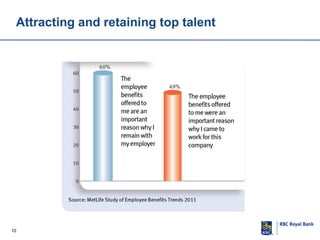
  • #11 HOW TO USE THIS SLIDE: This information can be used as additional speaker notes SPEAKER NOTES: In a recent MetLife Study of Employee Benefit Trends, it indicates that employee benefits continue to be an important factor to retain and attract employees 60% of Employees indicated that the benefits offered by their employer are an important reason why I remain with my employer 49% of employees indicated that the benefits offered by a company were an important reason of why the came to work for their current company
  • #14 HOW TO USE THIS SLIDE: Details regarding Group RRSP and detailed speaker notes provided. Alternatively you can use slide 28 SPEAKER NOTES: Details on how Group RSP work What is it? Collection of individual RSP accounts Allows employees to saving for retirement Who regulates it? Individual accounts adhere to the Income Tax Act Plan is registered with the Canada Revenue Agency CAP Guidelines define sponsor, member and administrator responsibilities How are assets accumulated? A convenient and disciplined way to invest through payroll contributions Don’t have to scramble for funds in February Employer and employee contributions Plan Options and Investments Personal and Spousal plans Investments selected by employees based on choices within the plan Restrictions or Vesting: RBC plan allow “Notification of Withdrawal”, Vesting NOT allowed on GRSP employees not able to make withdrawals without company consent CANNOT legally restrict as funds are part of Salary Best efforts by RBC to get company approval
  • #15 HOW TO USE THIS SLIDE: Details regarding Group RRSP and detailed speaker notes provided. Alternatively you can use slide 28 SPEAKER NOTES: Details on how Group RSP work Contribution Limits: 18% of the employee’s previous year’s earned income OR Maximum annual RRSP contribution limit ($22,970 in 2012), whichever is less. “Earned income”: employment income, rental income, royalties, spousal support Tax Consequences for Company: Employer contributions are considered part of an employee’s salary, and are considered tax deductible as an expense and are subject to payroll taxes Tax Consequences for Member: Payroll deduction contributions reduce income for tax purposes. Immediate tax savings Tax receipt issued for member and company contributions Withdrawals by Members: Taxable as income unless transferred to another registered plan. Withdrawals are subject to withholding taxes Termination and Retirement: Assets can be transferred to an RRSP, RRIF. Assets can be taken in cash as a withdrawal from the plan. Assets can be transferred to another RRSP, RIF or used to purchase an annuity.
  • #24 The way we calculate the CoreValue Rating, is we assess the company in 18 Value Driver Categories, what we like to call the ‘gears’ in the business engine. Let me take a moment to review them with you. Growth, “does your company have a history of sustained growth at or above the industry’s rate” How large is your potential market? do you have a dominant market share or plans to attain a dominant share. Is your revenue recurring or do you have to recreate your customers every month? Do you have documented capital, legal, or market barriers to entry? Is your product or service differentiated? How strong is your brand relative to your competition? Can you show a net and gross margin above your industry norm? Do you have a diversified customer base or are all your eggs in one basket? Can an outsider quickly and efficiently learn about your company Do you have financial systems and processes in place such as financial statements, operating reports, audits and tax Do you have a sales and marketing process…not just an ace sales or marketing person Can your operations consistently deliver on your promises to the marketplace? Do you have a process for measuring customer satisfaction? Do you have high functioning senior management team in place or is the company overly dependent on the business owner? Can you find, hire, and retain the best of the best when you need to? Is your legal house in order? And last, do you have a process to capture innovation at all levels in your organization?
  • #38 Good Morning Everyone., My name is Ryan Dostie and I am an accounting and auditing partner at Welch. I am have been working for Welch for almost 20 years. Considering I have only 10 minutes to present this information, let’s get right to it. I am presenting the question that every business owner faces at one time or another. Should I lease or buy? I am going to cover a few aspects: Cash flow considerations, How does my decision affect the presentation of the financial statements, we will look at the tax aspect, touch on a few other considerations and the most important part and why we are here the answer to the question!
  • #39 Cash flow is King/Queen for businesses. Typically lease payments are less expensive versus financing a purchase. If you are purchasing a building the initial costs will be much higher than a lease due to the required down payment. Leases are usually easier to obtain. Buying you will need decent credit and possibly personal guarantees to get a loan to finance the purchase. Leases can be customized to the customer such as length of time, start and end dates. When leasing premises you pay for general repairs and maintenance but the landlord is responsible for capital upgrades to the building. Leasing equipment for instance typically costs more in the long run when you lease it then purchasing it.
  • #40 We are going to look at two types of leases, operating and capital. You have a capital lease when: 1. Transfer of ownership - does the lease explicitly state ownership at the end of the lease ... OR is there a bargain purchase option?2. Lease term - is the term equal to 75% or more of asset's remaining useful service life?3. Minimum lease payment - is the discounted value of net minimum lease payments at least 90% of FMV? If all answers are no you have an operating lease. So what does that mean to the financial statements Operating lease – it’s a direct charge to the income stmt, and noted in the commitment section Capital lease – Asset and Liability set-up on the balance sheet, amortization and interest on capital lease on the income statement and a separate note disclosing future lease payment obligations by year, amount of interest and interest rate and current and long term portion. Also the capital lease asset is shown with the note with the other property and equipment on a separate line. Purchase – asset and liability set-up on balance sheet and amortization on the income statement. Disclosure in the P/E note. (cost, accum amort and remaining value)
  • #41 LEASE: For tax purposes a lease is a lease. There is no such thing as a capital lease in the income tax act. Thus you can deduct for tax the amount of lease payments paid during the year in either case. Once special restriction regarding leasing is when you lease a passenger vehicle. CRA restricts the amount you can deduct for lease payments to $800 plus tax. . Leasehold improvements are over the lease term plus one renewal. PURCHASE: If you purchase an asset, the tax rules outline how much you can depreciate the asset. Generally speaking: Commercial Buildings are 6%, Computers 55%, Vehicles 30%, equipment and furniture and fixtures 20%, half the amount in the first year, doesn’t matter when you buy it., declining balance Again CRA imposes a restriction of $30,000 plus tax on passenger vehicles.
  • #42 How long do I need this asset or want it. If it’s short term then leasing probably will make more sense but if you plan to keep it for the long term then purchasing will be cheaper in the end especially when it comes to vehicles. Keep in mind you don’t own a lease asset thus you can’t modify it, sell it etc. If you are in a business that you require up to date equipment then leasing makes sense as you can replace the equipment more often and just give back the equipment when the lease is up. Leases can include penalties for excessive wear and tear and vehicles especially there are limitations on the amount of kms you can drive over the lease term. Leasing your operating premises could make sense as well if you plan to continue to grow and need more space. Also could be handy if you need to downsize as well.
  • #43 The solution… It depends on many variables and each case needs to be looked separately.