B Y H . L . A . H A R T
ANALYTICAL POSITIVISM
Hart’s Concept of Law
Hart conceives law as a social phenomenon: It can
only be understood and explained by reference to
the actual social practices of the community.
For a human society to survive as a collectivity,
certain rules must exist for the protection of persons
and property and also for ensuring that promises
are kept.
Hart’s theory thus focuses on “rules”. For him, law
is a system of rules.
Hart’s Concept of Law
Unlike Austin, Hart believed that it was wrong to
identify law exclusively with the commands of the
Sovereign. He criticized the command theory for not
accounting for all the different kinds of rules that
we may justifiably call law.
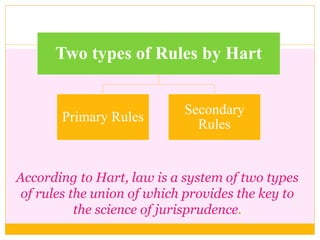
Two types of Rules by Hart
Primary Rules
Secondary
Rules
According to Hart, law is a system of two types
of rules the union of which provides the key to
the science of jurisprudence.
PRIMARY RULES
These impose duties or obligations.
These rules directly govern our behavior by telling
us what we ought and ought not to do.
 Their function is to preserve social order.
Example: The law requiring us to stop at red light.
PRIMARY RULES
These rules are binding because of popular
acceptance. They are backed by social pressure
because they are necessary to regulate behavior
and maintain the society.
These are unofficial rules.
MAJOR DRAWBACKS OF PRIMARY RULES:
1. UNCERTAINTY (identification and scope)
2. STATIC
3. INEFFICIENT (no mechanism of solution of
disputes through adjudication)
Small social groups bonded by kinship and
shared beliefs living in a stable environment
may survive by primary rules alone. But as
society gets larger and more complex, primary
rules prove insufficient and defective. Hence,
there is a serious need for a different type of
rules, that is, secondary rules.
SECONDARY RULES
They confer powers.
They enable the legislators to modify their policies
according to the needs of the society. Without such
rules, the society would become very static.
Powers conferred maybe private (like power to
make a contract) or public (power of adjudication
or legislation).
SECONDARY RULES
These rules set up procedures through which
primary rules can be introduced, modified or
enforced. Thus, these are rules about the rules.
Example: Family Courts Act
• It identifies a primary rule.
• It distinguishes between the social rules that
have authority of law and those that do not.
Rules of Recognition
• It gives the power to change the primary rule.
Rules of Change
• It gives power to adjudicate dispute and pass
judgment, order etc.
• The procedure to be followed, the person
empowered to adjudicate etc.
Rule of Adjudication
TYPES OF SECONDARY RULES
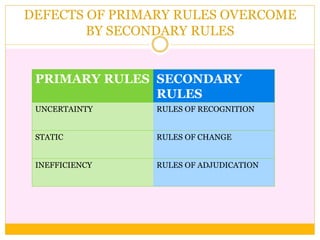
DEFECTS OF PRIMARY RULES OVERCOME
BY SECONDARY RULES
PRIMARY RULES SECONDARY
RULES
UNCERTAINTY RULES OF RECOGNITION
STATIC RULES OF CHANGE
INEFFICIENCY RULES OF ADJUDICATION
Primary rules become a part of the legal system
through their union with secondary rules. An
example of such a union may be taken as the
Industrial Disputes Act.
This union of primary rules with the secondary
rules is the essence of law according to Hart.

Analytical positivism

  • 1.
    B Y H. L . A . H A R T ANALYTICAL POSITIVISM
  • 2.
    Hart’s Concept ofLaw Hart conceives law as a social phenomenon: It can only be understood and explained by reference to the actual social practices of the community. For a human society to survive as a collectivity, certain rules must exist for the protection of persons and property and also for ensuring that promises are kept. Hart’s theory thus focuses on “rules”. For him, law is a system of rules.
  • 3.
    Hart’s Concept ofLaw Unlike Austin, Hart believed that it was wrong to identify law exclusively with the commands of the Sovereign. He criticized the command theory for not accounting for all the different kinds of rules that we may justifiably call law.
  • 4.
    Two types ofRules by Hart Primary Rules Secondary Rules According to Hart, law is a system of two types of rules the union of which provides the key to the science of jurisprudence.
  • 5.
    PRIMARY RULES These imposeduties or obligations. These rules directly govern our behavior by telling us what we ought and ought not to do.  Their function is to preserve social order. Example: The law requiring us to stop at red light.
  • 6.
    PRIMARY RULES These rulesare binding because of popular acceptance. They are backed by social pressure because they are necessary to regulate behavior and maintain the society. These are unofficial rules.
  • 7.
    MAJOR DRAWBACKS OFPRIMARY RULES: 1. UNCERTAINTY (identification and scope) 2. STATIC 3. INEFFICIENT (no mechanism of solution of disputes through adjudication)
  • 8.
    Small social groupsbonded by kinship and shared beliefs living in a stable environment may survive by primary rules alone. But as society gets larger and more complex, primary rules prove insufficient and defective. Hence, there is a serious need for a different type of rules, that is, secondary rules.
  • 9.
    SECONDARY RULES They conferpowers. They enable the legislators to modify their policies according to the needs of the society. Without such rules, the society would become very static. Powers conferred maybe private (like power to make a contract) or public (power of adjudication or legislation).
  • 10.
    SECONDARY RULES These rulesset up procedures through which primary rules can be introduced, modified or enforced. Thus, these are rules about the rules. Example: Family Courts Act
  • 11.
    • It identifiesa primary rule. • It distinguishes between the social rules that have authority of law and those that do not. Rules of Recognition • It gives the power to change the primary rule. Rules of Change • It gives power to adjudicate dispute and pass judgment, order etc. • The procedure to be followed, the person empowered to adjudicate etc. Rule of Adjudication TYPES OF SECONDARY RULES
  • 12.
    DEFECTS OF PRIMARYRULES OVERCOME BY SECONDARY RULES PRIMARY RULES SECONDARY RULES UNCERTAINTY RULES OF RECOGNITION STATIC RULES OF CHANGE INEFFICIENCY RULES OF ADJUDICATION
  • 13.
    Primary rules becomea part of the legal system through their union with secondary rules. An example of such a union may be taken as the Industrial Disputes Act. This union of primary rules with the secondary rules is the essence of law according to Hart.