Jury Assignment
Submitted by:
Jyoti Kumari l Prerana Wagh
Rachana Das l Rupali Vasurkar l Srishti Majumder
NIFT Gandhinagar
Supply Chain & Value Chain
& Operations Research
TOPIC: EMERGING TECH. IN SUPPLY CHAIN MANAGEMENT
INTRODUCTION
To stay ahead of the curve in
today’s fast-changing retail
landscape, companies need to
understand which emerging
technologies currently are
shaping companies’ supply
chain operations.
RADIO FREQUENCY IDENTIFICATION
(RFID)
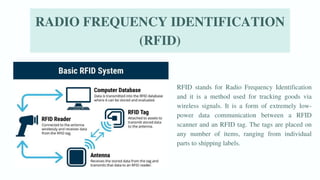
RFID stands for Radio Frequency Identification
and it is a method used for tracking goods via
wireless signals. It is a form of extremely low-
power data communication between a RFID
scanner and an RFID tag. The tags are placed on
any number of items, ranging from individual
parts to shipping labels.
TYPES
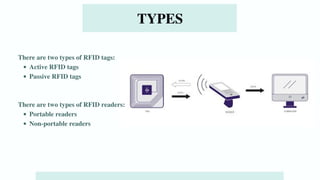
There are two types of RFID tags:
Active RFID tags
Passive RFID tags
There are two types of RFID readers:
Portable readers
Non-portable readers
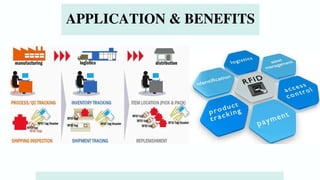
APPLICATION & BENEFITS
Retail Companies using RFID
AR &VR
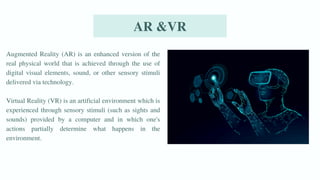
Augmented Reality (AR) is an enhanced version of the
real physical world that is achieved through the use of
digital visual elements, sound, or other sensory stimuli
delivered via technology.
Virtual Reality (VR) is an artificial environment which is
experienced through sensory stimuli (such as sights and
sounds) provided by a computer and in which one's
actions partially determine what happens in the
environment.
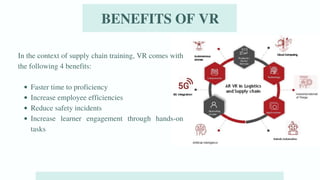
BENEFITS OF VR
In the context of supply chain training, VR comes with
the following 4 benefits:
Faster time to proficiency
Increase employee efficiencies
Reduce safety incidents
Increase learner engagement through hands-on
tasks
Outlook of AR/VR in the Supply Chain
After analyzing various ways in which immersive technologies are being adopted in
logistics and supply chain, the following current and future developments were found :
Inventory Management
Remote Collaboration in Data Visualization
VR Training for Employees
Real-Time Information for Merchandize in Transit
Product Traceability
Retail Companies using AR & VR in their Supply Chain
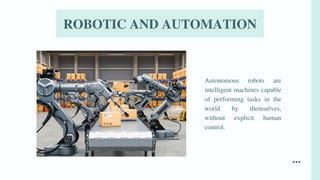
ROBOTIC AND AUTOMATION
Autonomous robots are
intelligent machines capable
of performing tasks in the
world by themselves,
without explicit human
control.
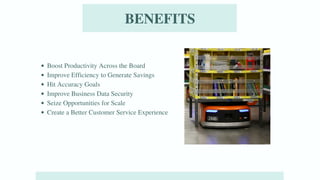
BENEFITS
Boost Productivity Across the Board
Improve Efficiency to Generate Savings
Hit Accuracy Goals
Improve Business Data Security
Seize Opportunities for Scale
Create a Better Customer Service Experience
Brands Incorporating Autonomous Robots in their Supply Chain
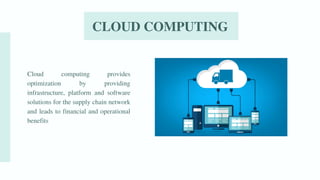
CLOUD COMPUTING
Cloud computing provides
optimization by providing
infrastructure, platform and software
solutions for the supply chain network
and leads to financial and operational
benefits
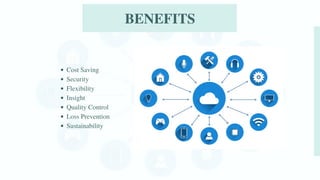
Cost Saving
Security
Flexibility
Insight
Quality Control
Loss Prevention
Sustainability
BENEFITS
Companies using Cloud computing (CC)
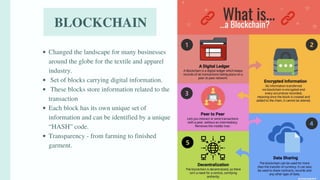
BLOCKCHAIN
Changed the landscape for many businesses
around the globe for the textile and apparel
industry.
Set of blocks carrying digital information.
These blocks store information related to the
transaction
Each block has its own unique set of
information and can be identified by a unique
“HASH” code.
Transparency - from farming to finished
garment.
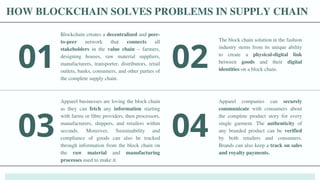
Blockchain creates a decentralized and peer-
to-peer network that connects all
stakeholders in the value chain – farmers,
designing houses, raw material suppliers,
manufacturers, transporter, distributors, retail
outlets, banks, consumers, and other parties of
the complete supply chain.
01
Apparel businesses are loving the block chain
as they can fetch any information starting
with farms or fibre providers, then processors,
manufacturers, shippers, and retailers within
seconds. Moreover, Sustainability and
compliance of goods can also be tracked
through information from the block chain on
the raw material and manufacturing
processes used to make it.
03
The block chain solution in the fashion
industry stems from its unique ability
to create a physical-digital link
between goods and their digital
identities on a block chain.
02
Apparel companies can securely
communicate with consumers about
the complete product story for every
single garment. The authenticity of
any branded product can be verified
by both retailers and consumers.
Brands can also keep a track on sales
and royalty payments.
04
HOW BLOCKCHAIN SOLVES PROBLEMS IN SUPPLY CHAIN
Retail Companies using Blockchain Technology
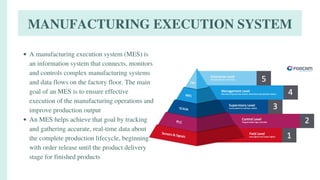
MANUFACTURING EXECUTION SYSTEM
A manufacturing execution system (MES) is
an information system that connects, monitors
and controls complex manufacturing systems
and data flows on the factory floor. The main
goal of an MES is to ensure effective
execution of the manufacturing operations and
improve production output
An MES helps achieve that goal by tracking
and gathering accurate, real-time data about
the complete production lifecycle, beginning
with order release until the product delivery
stage for finished products
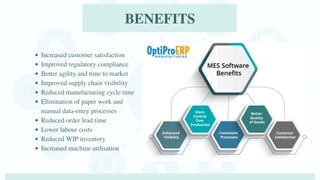
Increased customer satisfaction
Improved regulatory compliance
Better agility and time to market
Improved supply chain visibility
Reduced manufacturing cycle time
Elimination of paper work and
manual data-entry processes
Reduced order lead time
Lower labour costs
Reduced WIP inventory
Increased machine utilisation
BENEFITS
ARTIFICIAL INTELLIGENCE (AI)
Enhance customers' shopping experience, boost sales,
forecast trends and offer inventory-related guidance.
Improving efficiency in warehouse operations and product
design.
Analyse enormous amounts of data extracted from the web.
Speeds up the supply chain process.
Practicality and productivity within stores and online retail.
Analyzes sales to determine which products are popular and
which are sluggish.
Accurate Inventory Management
Warehouse Efficiency
Enhanced Safety
Reduced Operation Cost
On-Time Delivery
BENEFITS OF AI IN SUPPLY CHAIN
Brands Incorporating AI in their Supply Chain
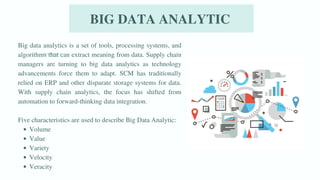
BIG DATA ANALYTIC
Big data analytics is a set of tools, processing systems, and
algorithms that can extract meaning from data. Supply chain
managers are turning to big data analytics as technology
advancements force them to adapt. SCM has traditionally
relied on ERP and other disparate storage systems for data.
With supply chain analytics, the focus has shifted from
automation to forward-thinking data integration.
Five characteristics are used to describe Big Data Analytic:
Volume
Value
Variety
Velocity
Veracity
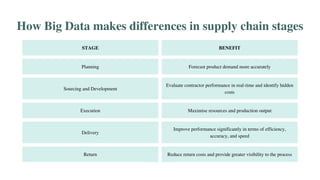
STAGE BENEFIT
Planning Forecast product demand more accurately
Sourcing and Development
Evaluate contractor performance in real-time and identify hidden
costs
Execution Maximise resources and production output
Delivery
Improve performance significantly in terms of efficiency,
accuracy, and speed
Return Reduce return costs and provide greater visibility to the process
How Big Data makes differences in supply chain stages
Brands Incorporating AI in their Supply Chain
07
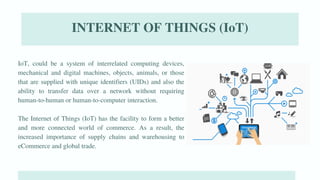
IoT, could be a system of interrelated computing devices,
mechanical and digital machines, objects, animals, or those
that are supplied with unique identifiers (UIDs) and also the
ability to transfer data over a network without requiring
human-to-human or human-to-computer interaction.
The Internet of Things (IoT) has the facility to form a better
and more connected world of commerce. As a result, the
increased importance of supply chains and warehousing to
eCommerce and global trade.
INTERNET OF THINGS (IoT)
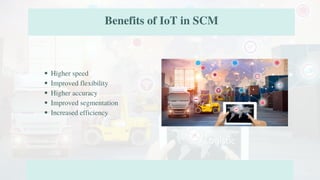
Benefits of IoT in SCM
Higher speed
Improved flexibility
Higher accuracy
Improved segmentation
Increased efficiency
Companies using Internet Of Things
3D printing is a process which uses a three-dimensional digital model to
create a physical object by adding many thin layers of material in
succession, subsequently lowering cost by cutting out waste.
Customers adore customization. To keep up with this trend, manufacturers
are turning to localised production to meet the growing demand for made-
to-order items. On-demand manufacturing relies heavily on 3D printing.
The supply chain benefits from 3D printing in several ways. This reduces
production time as well as logistics and transportation costs. As a result, a
company's carbon footprint can be reduced, and products can reach
consumers much faster. As a result, the customer experience is improved
as the large consumer appetite for instant gratification is satisfied.
3D PRINTING
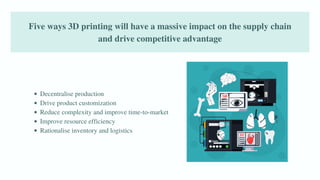
Five ways 3D printing will have a massive impact on the supply chain
and drive competitive advantage
Decentralise production
Drive product customization
Reduce complexity and improve time-to-market
Improve resource efficiency
Rationalise inventory and logistics
Example of 3D Printing In Supply Chain Management
Medical
The technology is already being used to make stock items like hip and knee implants as well as bespoke patient-
specific products like hearing aids, orthotic insoles for shoes, and personalised prosthetics. Open Bionics, a UK-based
manufacturer of 3D prosthetic arms, received a £4.6M investment in February 2019 to expand into the international
market.
Chemical
3D printer manufacturers to develop new resins, polymers, and powdered metals. With a dedicated 3D printing
division and partnerships with a number of hardware OEMs, software vendors, and materials specialists, chemical
giant BASF is one of the companies leading the way.
CCM Hockey
Ice hockey equipment brand CCM Hockey recently used 3D printing to accelerate its design for a safety innovation in
its premier helmet line.
CONCLUSION
As technology develops and the digitalization of the industry increases, the role of
technology like RFID, IoT, Blockchain, Artificial intelligence, Cloud Computing, Big
Data Analytics, Robotic & Automation, 3D Printing, MES, AR/VR, etc becomes ever
more important. These technological innovations improve the efficiency of a
company’s supply chain processes. But they also make it easier for companies to be
transparent about their practices. This is particularly important when appealing to
younger shoppers.
THANK
YOU

Supply Chain & Value Chain & Operations Research.pdf

  • 1.
    Jury Assignment Submitted by: JyotiKumari l Prerana Wagh Rachana Das l Rupali Vasurkar l Srishti Majumder NIFT Gandhinagar Supply Chain & Value Chain & Operations Research TOPIC: EMERGING TECH. IN SUPPLY CHAIN MANAGEMENT
  • 2.
    INTRODUCTION To stay aheadof the curve in today’s fast-changing retail landscape, companies need to understand which emerging technologies currently are shaping companies’ supply chain operations.
  • 3.
    RADIO FREQUENCY IDENTIFICATION (RFID) RFIDstands for Radio Frequency Identification and it is a method used for tracking goods via wireless signals. It is a form of extremely low- power data communication between a RFID scanner and an RFID tag. The tags are placed on any number of items, ranging from individual parts to shipping labels.
  • 4.
    TYPES There are twotypes of RFID tags: Active RFID tags Passive RFID tags There are two types of RFID readers: Portable readers Non-portable readers
  • 5.
  • 6.
  • 7.
    AR &VR Augmented Reality(AR) is an enhanced version of the real physical world that is achieved through the use of digital visual elements, sound, or other sensory stimuli delivered via technology. Virtual Reality (VR) is an artificial environment which is experienced through sensory stimuli (such as sights and sounds) provided by a computer and in which one's actions partially determine what happens in the environment.
  • 8.
    BENEFITS OF VR Inthe context of supply chain training, VR comes with the following 4 benefits: Faster time to proficiency Increase employee efficiencies Reduce safety incidents Increase learner engagement through hands-on tasks
  • 9.
    Outlook of AR/VRin the Supply Chain After analyzing various ways in which immersive technologies are being adopted in logistics and supply chain, the following current and future developments were found : Inventory Management Remote Collaboration in Data Visualization VR Training for Employees Real-Time Information for Merchandize in Transit Product Traceability
  • 10.
    Retail Companies usingAR & VR in their Supply Chain
  • 11.
    ROBOTIC AND AUTOMATION Autonomousrobots are intelligent machines capable of performing tasks in the world by themselves, without explicit human control.
  • 12.
    BENEFITS Boost Productivity Acrossthe Board Improve Efficiency to Generate Savings Hit Accuracy Goals Improve Business Data Security Seize Opportunities for Scale Create a Better Customer Service Experience
  • 13.
    Brands Incorporating AutonomousRobots in their Supply Chain
  • 14.
    CLOUD COMPUTING Cloud computingprovides optimization by providing infrastructure, platform and software solutions for the supply chain network and leads to financial and operational benefits
  • 15.
  • 16.
    Companies using Cloudcomputing (CC)
  • 17.
    BLOCKCHAIN Changed the landscapefor many businesses around the globe for the textile and apparel industry. Set of blocks carrying digital information. These blocks store information related to the transaction Each block has its own unique set of information and can be identified by a unique “HASH” code. Transparency - from farming to finished garment.
  • 18.
    Blockchain creates adecentralized and peer- to-peer network that connects all stakeholders in the value chain – farmers, designing houses, raw material suppliers, manufacturers, transporter, distributors, retail outlets, banks, consumers, and other parties of the complete supply chain. 01 Apparel businesses are loving the block chain as they can fetch any information starting with farms or fibre providers, then processors, manufacturers, shippers, and retailers within seconds. Moreover, Sustainability and compliance of goods can also be tracked through information from the block chain on the raw material and manufacturing processes used to make it. 03 The block chain solution in the fashion industry stems from its unique ability to create a physical-digital link between goods and their digital identities on a block chain. 02 Apparel companies can securely communicate with consumers about the complete product story for every single garment. The authenticity of any branded product can be verified by both retailers and consumers. Brands can also keep a track on sales and royalty payments. 04 HOW BLOCKCHAIN SOLVES PROBLEMS IN SUPPLY CHAIN
  • 19.
    Retail Companies usingBlockchain Technology
  • 20.
    MANUFACTURING EXECUTION SYSTEM Amanufacturing execution system (MES) is an information system that connects, monitors and controls complex manufacturing systems and data flows on the factory floor. The main goal of an MES is to ensure effective execution of the manufacturing operations and improve production output An MES helps achieve that goal by tracking and gathering accurate, real-time data about the complete production lifecycle, beginning with order release until the product delivery stage for finished products
  • 21.
    Increased customer satisfaction Improvedregulatory compliance Better agility and time to market Improved supply chain visibility Reduced manufacturing cycle time Elimination of paper work and manual data-entry processes Reduced order lead time Lower labour costs Reduced WIP inventory Increased machine utilisation BENEFITS
  • 22.
    ARTIFICIAL INTELLIGENCE (AI) Enhancecustomers' shopping experience, boost sales, forecast trends and offer inventory-related guidance. Improving efficiency in warehouse operations and product design. Analyse enormous amounts of data extracted from the web. Speeds up the supply chain process. Practicality and productivity within stores and online retail. Analyzes sales to determine which products are popular and which are sluggish.
  • 23.
    Accurate Inventory Management WarehouseEfficiency Enhanced Safety Reduced Operation Cost On-Time Delivery BENEFITS OF AI IN SUPPLY CHAIN
  • 24.
    Brands Incorporating AIin their Supply Chain
  • 25.
    BIG DATA ANALYTIC Bigdata analytics is a set of tools, processing systems, and algorithms that can extract meaning from data. Supply chain managers are turning to big data analytics as technology advancements force them to adapt. SCM has traditionally relied on ERP and other disparate storage systems for data. With supply chain analytics, the focus has shifted from automation to forward-thinking data integration. Five characteristics are used to describe Big Data Analytic: Volume Value Variety Velocity Veracity
  • 26.
    STAGE BENEFIT Planning Forecastproduct demand more accurately Sourcing and Development Evaluate contractor performance in real-time and identify hidden costs Execution Maximise resources and production output Delivery Improve performance significantly in terms of efficiency, accuracy, and speed Return Reduce return costs and provide greater visibility to the process How Big Data makes differences in supply chain stages
  • 27.
    Brands Incorporating AIin their Supply Chain
  • 28.
    07 IoT, could bea system of interrelated computing devices, mechanical and digital machines, objects, animals, or those that are supplied with unique identifiers (UIDs) and also the ability to transfer data over a network without requiring human-to-human or human-to-computer interaction. The Internet of Things (IoT) has the facility to form a better and more connected world of commerce. As a result, the increased importance of supply chains and warehousing to eCommerce and global trade. INTERNET OF THINGS (IoT)
  • 29.
    Benefits of IoTin SCM Higher speed Improved flexibility Higher accuracy Improved segmentation Increased efficiency
  • 30.
  • 31.
    3D printing isa process which uses a three-dimensional digital model to create a physical object by adding many thin layers of material in succession, subsequently lowering cost by cutting out waste. Customers adore customization. To keep up with this trend, manufacturers are turning to localised production to meet the growing demand for made- to-order items. On-demand manufacturing relies heavily on 3D printing. The supply chain benefits from 3D printing in several ways. This reduces production time as well as logistics and transportation costs. As a result, a company's carbon footprint can be reduced, and products can reach consumers much faster. As a result, the customer experience is improved as the large consumer appetite for instant gratification is satisfied. 3D PRINTING
  • 32.
    Five ways 3Dprinting will have a massive impact on the supply chain and drive competitive advantage Decentralise production Drive product customization Reduce complexity and improve time-to-market Improve resource efficiency Rationalise inventory and logistics
  • 33.
    Example of 3DPrinting In Supply Chain Management Medical The technology is already being used to make stock items like hip and knee implants as well as bespoke patient- specific products like hearing aids, orthotic insoles for shoes, and personalised prosthetics. Open Bionics, a UK-based manufacturer of 3D prosthetic arms, received a £4.6M investment in February 2019 to expand into the international market. Chemical 3D printer manufacturers to develop new resins, polymers, and powdered metals. With a dedicated 3D printing division and partnerships with a number of hardware OEMs, software vendors, and materials specialists, chemical giant BASF is one of the companies leading the way. CCM Hockey Ice hockey equipment brand CCM Hockey recently used 3D printing to accelerate its design for a safety innovation in its premier helmet line.
  • 34.
    CONCLUSION As technology developsand the digitalization of the industry increases, the role of technology like RFID, IoT, Blockchain, Artificial intelligence, Cloud Computing, Big Data Analytics, Robotic & Automation, 3D Printing, MES, AR/VR, etc becomes ever more important. These technological innovations improve the efficiency of a company’s supply chain processes. But they also make it easier for companies to be transparent about their practices. This is particularly important when appealing to younger shoppers.
  • 35.