Looking at IFRS from a
“London view” and the
Rest of the World
Accounting Day 2013
May 20, 2013
Stephen G. Austin, CPA, MBA
Firm Managing Partner
Swenson Advisors, LLP
BREAKING NEWS
May 1, 2013 Investment Company
Institute (ICI) Meeting
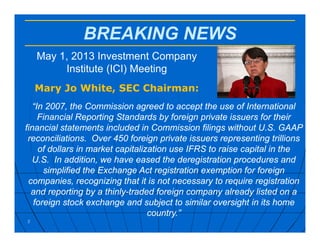
Mary Jo White, SEC Chairman:
2
“In 2007, the Commission agreed to accept the use of International
Financial Reporting Standards by foreign private issuers for their
financial statements included in Commission filings without U.S. GAAP
reconciliations. Over 450 foreign private issuers representing trillions
of dollars in market capitalization use IFRS to raise capital in the
U.S. In addition, we have eased the deregistration procedures and
simplified the Exchange Act registration exemption for foreign
companies, recognizing that it is not necessary to require registration
and reporting by a thinly-traded foreign company already listed on a
foreign stock exchange and subject to similar oversight in its home
country.”
BREAKING NEWS
May 1, 2013 Investment Company
Institute (ICI) Meeting (Continued)
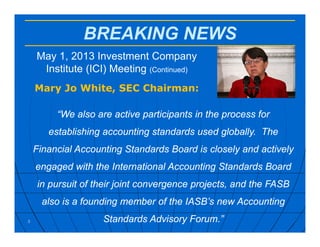
Mary Jo White, SEC Chairman:
3
“We also are active participants in the process for
establishing accounting standards used globally. The
Financial Accounting Standards Board is closely and actively
engaged with the International Accounting Standards Board
in pursuit of their joint convergence projects, and the FASB
also is a founding member of the IASB’s new Accounting
Standards Advisory Forum.”
BREAKING NEWS
May 1, 2013 Investment Company
Institute (ICI) Meeting (Continued)
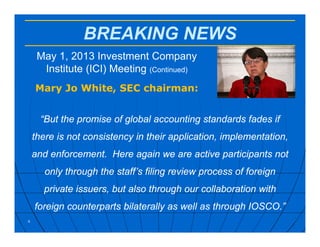
Mary Jo White, SEC chairman:
4
“But the promise of global accounting standards fades if
there is not consistency in their application, implementation,
and enforcement. Here again we are active participants not
only through the staff’s filing review process of foreign
private issuers, but also through our collaboration with
foreign counterparts bilaterally as well as through IOSCO.”
BREAKING NEWS
Russell Golden
Leslie Seidman’s successor:
.
5 Accounting Today, K. Tusiak, 4/23/2013
“We are close to issuing a very important,
converged solution on revenue recognition,
which I have been working on for a number
of years and I believe will be a good
success, and will improve financial
reporting for companies across the world”
BREAKING NEWS
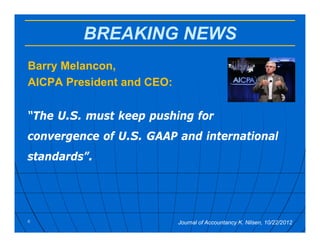
Barry Melancon,
AICPA President and CEO:
6 Journal of Accountancy K. Nilsen, 10/22/2012
“The U.S. must keep pushing for
convergence of U.S. GAAP and international
standards”.
IASB Site Visit with
Michael Stewart
November 1, 2012
London, England
7
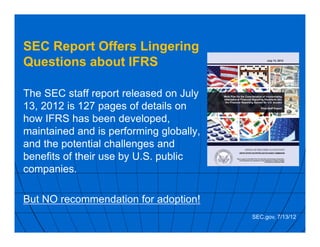
SEC Report Offers Lingering
Questions about IFRS
The SEC staff report released on July
13, 2012 is 127 pages of details on
how IFRS has been developed,
maintained and is performing globally,
and the potential challenges and
benefits of their use by U.S. public
companies.
But NO recommendation for adoption!
SEC.gov, 7/13/12
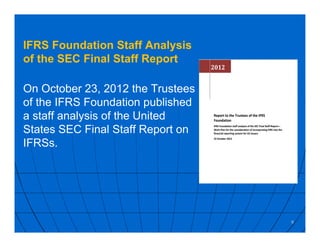
IFRS Foundation Staff Analysis
of the SEC Final Staff Report
On October 23, 2012 the Trustees
of the IFRS Foundation published
a staff analysis of the United
States SEC Final Staff Report on
IFRSs.
9
Analysis of the Conclusion of the
SEC Staff Report
Governance
The SEC staff note that the overall design of the governance structure
of the IFRS Foundation strikes a reasonable balance between
providing oversight of the IASB and recognising and supporting its
independence. In addition, while the IASB’s objectivity could be
threatened by outside political influence, such tension is not unique to
the IASB.
[The IFRS Foundation] believes that the heterogeneous nature of the
IFRS community, the internationally and professionally diverse
composition of the IASB and the creation of the Monitoring Board all
help to dilute undue pressure from any one jurisdiction or special
interest group. Nevertheless, the IFRS Foundation and the IASB will
always have to be vigilant in protecting the independence of accounting
standard-setting.
10
Analysis of the Conclusion of the SEC
Staff Report (continued)
Funding
The SEC Staff Report:
(a) raises concerns about the continued reliance by the IFRS Foundation on funding
from the large public accounting firms;
(b) notes that fewer than 30 countries contribute to the financing of the IFRS Foundation;
(c) notes that the Trustees have been unsuccessful in obtaining the funding for the
portion of the IFRS Foundation budget allocated to the US; and
(d) notes the ‘in-kind’ funding contributions to the IFRS Foundation by US sources,
such as the FASB staff efforts on US GAAP–IFRS convergence projects.
The IFRS Foundation response:
The analysis of the funding arrangements as set out in the SEC Staff Report overlooks
the fact that the European Commission, which is the biggest contributor to our budget,
represents 27 member states of the European Union (EU). Furthermore, the analysis
does not recognise that royalty payments are received from an additional 19 countries.
It also does not take into account that some voluntary funding arrangements by some
countries have been withdrawn in anticipation of the introduction of publicly-sponsored
schemes that have already been agreed. When considering these factors, 69 countries
provide, directly or indirectly, financial support for the work of the IFRS Foundation,
instead of the fewer than 30 as identified by the SEC staff. 11
Analysis of the Conclusion of the SEC
Staff Report (continued)
Due Process
The SEC Staff:
(a) observes that the IASB’s due process is heavily based on consultation and
gathering of facts and views, open deliberations, analysis, and the explanation
of its decisions to the public;
(b) notes that IASB members’ deliberations involve extensive debate and
analysis; and
(c) believes that IASB members decide on the resolution of issues on projects
on the basis of their technical merits and overall usefulness for investors and
other users of financial statements.
[The IFRS Foundation] welcomes the SEC staff’s comments. Furthermore, during
2012 the IASB has been working with the Trustees to further enhance its
reporting, accountability and due process requirements. As a result of these
enhancements, the IASB is required to report throughout the life of each technical
project on the steps that it has taken to protect the integrity of its technical
decisions.
12
Analysis of the Conclusion
of the SEC Staff Report (continued)
Due Process (continued)
The Trustees have:
(a) undertaken activities that highlight the importance of the independence of
the standard-setting process;
(b) enhanced the role of the DPOC to periodically check that the IASB’s due
process is operating against an agreed framework;
(c) intensified the DPOC’s interactions with the IFRS Advisory Council (the
Advisory Council) and the IFRS Interpretations Committee (the Interpretations
Committee) so that more meaningful and better-informed feedback on the
functioning of the IASB is received; and
(d) appointed dedicated staff to support the management of their due process
responsibilities. 13
Analysis of the Conclusion of the SEC Staff
Report. IFRS as Global Accounting Standard.
Comprehensiveness
Remaining differences between US GAAP and IFRS
[The IFRS Foundation] notes that, as a result of more than ten years of
joint work with the FASB to improve IFRS and US GAAP and bring about
their convergence, the differences that the US will have to bridge are
significantly smaller in scope than the differences faced by other major
countries that have already adopted IFRS.
14
Analysis of the Conclusion of the SEC Staff Report.
IFRS as Global Accounting Standard. (continued)
Maintenance
The SEC Staff Report notes observations from outreach conducted by SEC staff
that the Interpretations Committee should do more to address issues on a timely
basis.
[The IFRS Foundation] agrees that the Interpretations Committee should be more
active in providing Interpretations.
In May 2012 the Trustees published the recommendations of a further review of
the efficiency and effectiveness of the Interpretations Committee. This review
recommended that the Interpretations Committee should:
(a) develop a broader range of ‘tools’ to be deployed by the Interpretations
Committee, enabling it to be more responsive to requests for assistance;
(b) revise the criteria used to determine which issues the Interpretations
Committee should take action on;
(c) improve the Interpretations Committee’s communications regarding issues
that it decides not to address; and
(d) expand the Interpretations Committee’s outreach and the transparency
surrounding its decisions.
The recommendations of the review have been now been implemented in full. 15
National Standard-Setters
The SEC Staff Report:
(a) recognises the procedures that the IASB has in place for working with
national standard-setters, as well as the high levels of interaction with
national standard-setters on a bilateral basis; and
(b) recommends that the IASB should extend its involvement with national
standard-setters in several processes, such as during the development of
a new Standard, outreach activities and Post-implementation Reviews.
16
The IASB already has strong and effective relationships with national and
regional accounting standard-setting bodies through a combination of
bilateral, multi-lateral and informal arrangements. However, [The IFRS
Foundation] agrees that these relationships could be strengthened further by
formalising such networks and organising them on a regional and global
basis. This was an important recommendation of the Trustees’ Strategy
Review.
Analysis of the Conclusion of the SEC Staff Report.
IFRS as Global Accounting Standard. (continued)
Enforceability
The SEC Staff Report notes the importance of achieving greater
consistency in the enforcement of IFRS if the benefits of a single set of
global accounting standards are to be fully realised.
[The IFRS Foundation] agrees with this conclusion.
17
Analysis of the Conclusion of the SEC Staff Report.
IFRS as Global Accounting Standard. (continued)
Issues Related to Adoption, Endorsement and Transition
The SEC Staff Report discusses various issues related to incorporating
IFRS into US GAAP. Many of these issues are specific to the US and can
only be addressed by US authorities in the environment in which they
operate.
The IFRS Foundation staff is not in a position to give definitive answers or
suggestions to the observations made by the SEC staff. Instead, in this
chapter we [IFRS Foundation] refer extensively to the way in which many
IFRS jurisdictions have dealt with different issues while adopting IFRS.
While it is true that every jurisdiction has its unique challenges, and this
will certainly be the case in the biggest national capital market in the world,
we believe this international experience provides a useful backdrop for
analysis.
18
Analysis of the Conclusion of the SEC Staff Report.
IFRS as Global Accounting Standard. (continued)
Methods of Incorporation
The SEC Staff Report notes that:
(a) pursuing the designation of IFRS as directly authoritative was not
supported by the vast majority of participants in the US capital markets;
(b) an endorsement mechanism is needed, to ensure that sovereignty is
maintained and proper influence can be exerted in the standard-setting
process of the IASB;
(c) the SEC staff would find it most logical to incorporate IFRS into US GAAP
for legal and administrative reasons.
19
None of these considerations is unique to the US. As stated by the SEC Staff
Report, few jurisdictions designate IFRS as authoritative, with most following
some form of endorsement process through which the Standards become
authoritative. Such a mechanism can serve as an important ‘sovereignty circuit-
breaker’ to ensure that international rules do not automatically form a part of
national law. Such arrangements are used by the majority of IFRS jurisdictions
and are respected by the IASB.
Analysis of the Conclusion of the SEC Staff Report.
IFRS as Global Accounting Standard. (continued)
Transition Arrangements
The SEC Staff Report notes that:
(a) some commentators were opposed to a ‘big bang’ method of
transition, favouring instead a more gradual transition to IFRS; and
(b) indirect methods of incorporation could lessen the total costs
required while extending any timeframe for incorporation.
20
[The IFRS Foundation] note that it is for individual jurisdictions to determine
the most appropriate method to adopt IFRS.
Analysis of the Conclusion of the SEC Staff Report.
IFRS as Global Accounting Standard. (continued)
Investors’ understanding of IFRS in the US
The SEC Staff Report notes that investors generally support the idea of the US
moving to a single set of global accounting standards, but that support for IFRS as
that set of standards is conditional. Investors’ primary concerns are similar to those
of other US stakeholders.
The SEC Staff Report notes that:
(a) most institutional and professional investors who are already familiar with
IFRS do not see investor preparedness being a major hurdle to incorporating
IFRS; but
(b) investors who are focused exclusively on US domestic companies, as well
as smaller companies and private investors who are less familiar with IFRS,
are reluctant to commit to develop a competence in IFRS until it becomes clear
how the SEC will proceed with IFRS.
Experience from other jurisdictions has shown that once a decision is made about
IFRS, even domestic investors have sufficient time and resources to support the
transition.
21
Analysis of the Conclusion of the SEC Staff Report.
IFRS as Global Accounting Standard. (continued)
Regulatory Environment
The SEC Staff Report notes that adopting IFRS can present challenges to
the regulatory environment.
[The IFRS Foundation] agrees with the SEC that these challenges should
not be underestimated. Our analysis of other major jurisdictions that have
already adopted IFRS suggest that adaptations in the regulatory
environment can indeed be challenging, but they can be overcome.
22
Analysis of the Conclusion of the SEC Staff Report.
IFRS as Global Accounting Standard. (continued)
Human Capital Readiness
The SEC Staff Report notes that the large US international public accounting firms
and multinational companies have an extensive understanding of IFRS. We
believe that this substantial human capital capability puts the US at a distinct
advantage when compared to other jurisdictions setting out to make the transition
to IFRS.
However, in the same way as for other jurisdictions, the IFRS Foundation
accepts the argument that US preparers with limited international
operations, and smaller and mid-sized US audit firms, will need to further
develop their IFRS competencies in advance of any transition to IFRS.
23
Analysis of the Conclusion of the SEC Staff Report.
IFRS as Global Accounting Standard. (continued)
Cost of Transition
The SEC Staff Report notes the difficulties associated with developing
implementation plans and assessing transition costs until the SEC decides if and
how to proceed with IFRS.
The experience of other jurisdictions is helpful when assessing the range of
possible costs. In Canada, a study of 146 companies involved in the recent
transition to IFRS showed that 66 per cent of respondents had budgeted less than
$500,000 in Canadian dollars for the transition, while 32 per cent planned to spend
less than $100,000 in Canadian dollars.
In Korea, the costs for non-financial companies making the transition to IFRS were
estimated to be $250,000 in US dollars while the total cost for financial companies
was $2,400,000 in US dollars.
In Brazil, a survey revealed that transition costs were less than $1 million US
dollars for 77 per cent of respondents.
For smaller companies in Europe, the cost of making the transition to IFRS and the
subsequent recurrent application costs were estimated to be respectively 0.31 per
cent and 0.06 per cent of turnover. 24
Analysis of the Conclusion of the SEC Staff Report.
IFRS as Global Accounting Standard. (continued)
2013 International Financial Reporting
Standards IFRS® is the only official printed edition
of the consolidated text of the IASB's authoritative
pronouncements as issued at 1 January 2013.
What's new?
 Government Loans (Amendments to IFRS 1)
 Consolidated Financial Statements, Joint Arrangements
and Disclosure of Interests in Other Entities: Transition
Guidance(Amendments to IFRS 10, IFRS 11 and IFRS
12)
 Investment Entities (Amendments to IFRS 10, IFRS 12
and IAS 27); and
 Annual Improvements to IFRSs 2009–2011
Cycle (which contained separate amendments to IFRS
1, IAS 1, IAS 16, IAS 32 and IAS 34).
25
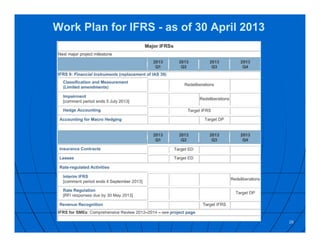
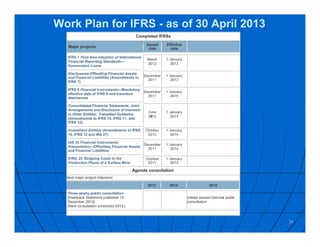
Work Plan for IFRS - as of 30 April 2013
26
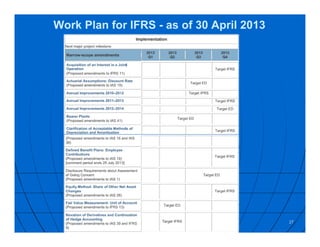
Work Plan for IFRS - as of 30 April 2013
27
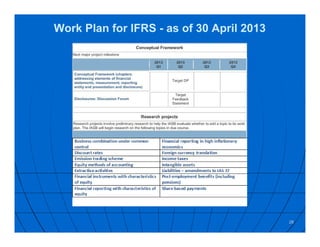
Work Plan for IFRS - as of 30 April 2013
28
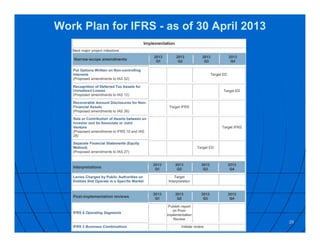
Work Plan for IFRS - as of 30 April 2013
29
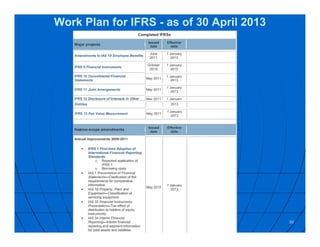
Work Plan for IFRS - as of 30 April 2013
30
Work Plan for IFRS - as of 30 April 2013
31
IASB/FASB Meeting
January 30, 2013
Revenue Recognition. The IASB and the FASB continued
their joint redeliberations on the revised Exposure
Draft, Revenue from Contracts with Customers (the 2011
ED). The Boards discussed the following topics:
 Scope
 Repurchase agreements
 Effect of the revenue recognition model on asset
managers
 Transfers of assets that are not an output of an entity’s
ordinary activities
 Update on outreach regarding disclosure and transition
proposals
32
IASB/FASB Meeting
January 30, 2013 (Continue)
Scope
The Boards tentatively decided to confirm the scope of the
2011 ED, including the definition of a customer.
The Boards also tentatively decided to clarify:
 That a collaborative arrangement (as described in paragraph 10 of
the 2011 ED) is not limited to the development and
commercialization of a product
 That a contract with a collaborator or a partner is within the scope of
the revenue standard if the counterparty meets the definition of a
customer
 That the application of paragraph 11 of the 2011 ED specifies how
an entity would apply the revenue standard when a contract with a
customer is partially within the scope of the revenue standard and
partially within the scope of other standards.
33
IASB/FASB Meeting
January 30, 2013 (continued)
Repurchase Agreements
The Boards discussed the following topics related to the
implementation guidance on repurchase agreements in
paragraphs IG38–IG48/B38–B48 of the 2011 ED:
 Sale-leaseback transactions that include a put option
 Other amendments
 Application guidance
 Call options—significant economic incentive not to
exercise. 34
IASB/FASB Meeting
January 30, 2013 (continued)
Effect of the Revenue Recognition Model on Asset
Managers
The Boards discussed the application of the 2011 ED to the
asset management industry, specifically, the application of the:
 Constraint on revenue recognized
 Contract cost proposals.
35
IASB/FASB Meeting
January 30, 2013 (continued)
Transfers of Assets That Are Not an Output of an
Entity’s Ordinary Activities
The Boards tentatively decided to confirm the consequential
amendments proposed in the 2011 ED for transfers of nonfinancial
assets that are not an output of an entity’s ordinary activities. Those
amendments would require an entity to apply the control and
measurement requirements (including the constraint on revenue
recognized) from the revenue model for the purposes of determining
when the asset should be derecognized and the amount of
consideration to be included in the gain or loss recognized on transfer.
The Boards also tentatively decided that the requirements in
paragraphs 13–15 of the 2011 ED for determining whether a contract
exists should apply to transfers of nonfinancial assets that are not an
output of an entity’s ordinary activities 36
IASB/FASB Meeting
January 30, 2013 (continued)
Update on Outreach Regarding Disclosure and
Transition Proposals
The staff provided the Boards with a summary of the
feedback received on the Boards’ proposed disclosure and
transition requirements in the 2011 ED. This feedback was
received through comment letters, outreach, and
workshops held in Japan, the UK, and the United States
that included both preparers and users. No decisions were
made. The issues will be discussed by the Boards in
February 2013.
37
38
IMA San Diego Meeting
Thursday, August 8, 2013
5:30pm – 8:00pm
Del Mar Doubletree
39
Thank You
Stephen G. Austin, MBA, CPA
steve.austin@swensonadvisors.com
WWW.SWENSONADVISORS.COM
A Full Service Regional Accounting
and Advisory Firm

IFRS and Other International Developments 2013

  • 1.
    Looking at IFRSfrom a “London view” and the Rest of the World Accounting Day 2013 May 20, 2013 Stephen G. Austin, CPA, MBA Firm Managing Partner Swenson Advisors, LLP
  • 2.
    BREAKING NEWS May 1,2013 Investment Company Institute (ICI) Meeting Mary Jo White, SEC Chairman: 2 “In 2007, the Commission agreed to accept the use of International Financial Reporting Standards by foreign private issuers for their financial statements included in Commission filings without U.S. GAAP reconciliations. Over 450 foreign private issuers representing trillions of dollars in market capitalization use IFRS to raise capital in the U.S. In addition, we have eased the deregistration procedures and simplified the Exchange Act registration exemption for foreign companies, recognizing that it is not necessary to require registration and reporting by a thinly-traded foreign company already listed on a foreign stock exchange and subject to similar oversight in its home country.”
  • 3.
    BREAKING NEWS May 1,2013 Investment Company Institute (ICI) Meeting (Continued) Mary Jo White, SEC Chairman: 3 “We also are active participants in the process for establishing accounting standards used globally. The Financial Accounting Standards Board is closely and actively engaged with the International Accounting Standards Board in pursuit of their joint convergence projects, and the FASB also is a founding member of the IASB’s new Accounting Standards Advisory Forum.”
  • 4.
    BREAKING NEWS May 1,2013 Investment Company Institute (ICI) Meeting (Continued) Mary Jo White, SEC chairman: 4 “But the promise of global accounting standards fades if there is not consistency in their application, implementation, and enforcement. Here again we are active participants not only through the staff’s filing review process of foreign private issuers, but also through our collaboration with foreign counterparts bilaterally as well as through IOSCO.”
  • 5.
    BREAKING NEWS Russell Golden LeslieSeidman’s successor: . 5 Accounting Today, K. Tusiak, 4/23/2013 “We are close to issuing a very important, converged solution on revenue recognition, which I have been working on for a number of years and I believe will be a good success, and will improve financial reporting for companies across the world”
  • 6.
    BREAKING NEWS Barry Melancon, AICPAPresident and CEO: 6 Journal of Accountancy K. Nilsen, 10/22/2012 “The U.S. must keep pushing for convergence of U.S. GAAP and international standards”.
  • 7.
    IASB Site Visitwith Michael Stewart November 1, 2012 London, England 7
  • 8.
    SEC Report OffersLingering Questions about IFRS The SEC staff report released on July 13, 2012 is 127 pages of details on how IFRS has been developed, maintained and is performing globally, and the potential challenges and benefits of their use by U.S. public companies. But NO recommendation for adoption! SEC.gov, 7/13/12
  • 9.
    IFRS Foundation StaffAnalysis of the SEC Final Staff Report On October 23, 2012 the Trustees of the IFRS Foundation published a staff analysis of the United States SEC Final Staff Report on IFRSs. 9
  • 10.
    Analysis of theConclusion of the SEC Staff Report Governance The SEC staff note that the overall design of the governance structure of the IFRS Foundation strikes a reasonable balance between providing oversight of the IASB and recognising and supporting its independence. In addition, while the IASB’s objectivity could be threatened by outside political influence, such tension is not unique to the IASB. [The IFRS Foundation] believes that the heterogeneous nature of the IFRS community, the internationally and professionally diverse composition of the IASB and the creation of the Monitoring Board all help to dilute undue pressure from any one jurisdiction or special interest group. Nevertheless, the IFRS Foundation and the IASB will always have to be vigilant in protecting the independence of accounting standard-setting. 10
  • 11.
    Analysis of theConclusion of the SEC Staff Report (continued) Funding The SEC Staff Report: (a) raises concerns about the continued reliance by the IFRS Foundation on funding from the large public accounting firms; (b) notes that fewer than 30 countries contribute to the financing of the IFRS Foundation; (c) notes that the Trustees have been unsuccessful in obtaining the funding for the portion of the IFRS Foundation budget allocated to the US; and (d) notes the ‘in-kind’ funding contributions to the IFRS Foundation by US sources, such as the FASB staff efforts on US GAAP–IFRS convergence projects. The IFRS Foundation response: The analysis of the funding arrangements as set out in the SEC Staff Report overlooks the fact that the European Commission, which is the biggest contributor to our budget, represents 27 member states of the European Union (EU). Furthermore, the analysis does not recognise that royalty payments are received from an additional 19 countries. It also does not take into account that some voluntary funding arrangements by some countries have been withdrawn in anticipation of the introduction of publicly-sponsored schemes that have already been agreed. When considering these factors, 69 countries provide, directly or indirectly, financial support for the work of the IFRS Foundation, instead of the fewer than 30 as identified by the SEC staff. 11
  • 12.
    Analysis of theConclusion of the SEC Staff Report (continued) Due Process The SEC Staff: (a) observes that the IASB’s due process is heavily based on consultation and gathering of facts and views, open deliberations, analysis, and the explanation of its decisions to the public; (b) notes that IASB members’ deliberations involve extensive debate and analysis; and (c) believes that IASB members decide on the resolution of issues on projects on the basis of their technical merits and overall usefulness for investors and other users of financial statements. [The IFRS Foundation] welcomes the SEC staff’s comments. Furthermore, during 2012 the IASB has been working with the Trustees to further enhance its reporting, accountability and due process requirements. As a result of these enhancements, the IASB is required to report throughout the life of each technical project on the steps that it has taken to protect the integrity of its technical decisions. 12
  • 13.
    Analysis of theConclusion of the SEC Staff Report (continued) Due Process (continued) The Trustees have: (a) undertaken activities that highlight the importance of the independence of the standard-setting process; (b) enhanced the role of the DPOC to periodically check that the IASB’s due process is operating against an agreed framework; (c) intensified the DPOC’s interactions with the IFRS Advisory Council (the Advisory Council) and the IFRS Interpretations Committee (the Interpretations Committee) so that more meaningful and better-informed feedback on the functioning of the IASB is received; and (d) appointed dedicated staff to support the management of their due process responsibilities. 13
  • 14.
    Analysis of theConclusion of the SEC Staff Report. IFRS as Global Accounting Standard. Comprehensiveness Remaining differences between US GAAP and IFRS [The IFRS Foundation] notes that, as a result of more than ten years of joint work with the FASB to improve IFRS and US GAAP and bring about their convergence, the differences that the US will have to bridge are significantly smaller in scope than the differences faced by other major countries that have already adopted IFRS. 14
  • 15.
    Analysis of theConclusion of the SEC Staff Report. IFRS as Global Accounting Standard. (continued) Maintenance The SEC Staff Report notes observations from outreach conducted by SEC staff that the Interpretations Committee should do more to address issues on a timely basis. [The IFRS Foundation] agrees that the Interpretations Committee should be more active in providing Interpretations. In May 2012 the Trustees published the recommendations of a further review of the efficiency and effectiveness of the Interpretations Committee. This review recommended that the Interpretations Committee should: (a) develop a broader range of ‘tools’ to be deployed by the Interpretations Committee, enabling it to be more responsive to requests for assistance; (b) revise the criteria used to determine which issues the Interpretations Committee should take action on; (c) improve the Interpretations Committee’s communications regarding issues that it decides not to address; and (d) expand the Interpretations Committee’s outreach and the transparency surrounding its decisions. The recommendations of the review have been now been implemented in full. 15
  • 16.
    National Standard-Setters The SECStaff Report: (a) recognises the procedures that the IASB has in place for working with national standard-setters, as well as the high levels of interaction with national standard-setters on a bilateral basis; and (b) recommends that the IASB should extend its involvement with national standard-setters in several processes, such as during the development of a new Standard, outreach activities and Post-implementation Reviews. 16 The IASB already has strong and effective relationships with national and regional accounting standard-setting bodies through a combination of bilateral, multi-lateral and informal arrangements. However, [The IFRS Foundation] agrees that these relationships could be strengthened further by formalising such networks and organising them on a regional and global basis. This was an important recommendation of the Trustees’ Strategy Review. Analysis of the Conclusion of the SEC Staff Report. IFRS as Global Accounting Standard. (continued)
  • 17.
    Enforceability The SEC StaffReport notes the importance of achieving greater consistency in the enforcement of IFRS if the benefits of a single set of global accounting standards are to be fully realised. [The IFRS Foundation] agrees with this conclusion. 17 Analysis of the Conclusion of the SEC Staff Report. IFRS as Global Accounting Standard. (continued)
  • 18.
    Issues Related toAdoption, Endorsement and Transition The SEC Staff Report discusses various issues related to incorporating IFRS into US GAAP. Many of these issues are specific to the US and can only be addressed by US authorities in the environment in which they operate. The IFRS Foundation staff is not in a position to give definitive answers or suggestions to the observations made by the SEC staff. Instead, in this chapter we [IFRS Foundation] refer extensively to the way in which many IFRS jurisdictions have dealt with different issues while adopting IFRS. While it is true that every jurisdiction has its unique challenges, and this will certainly be the case in the biggest national capital market in the world, we believe this international experience provides a useful backdrop for analysis. 18 Analysis of the Conclusion of the SEC Staff Report. IFRS as Global Accounting Standard. (continued)
  • 19.
    Methods of Incorporation TheSEC Staff Report notes that: (a) pursuing the designation of IFRS as directly authoritative was not supported by the vast majority of participants in the US capital markets; (b) an endorsement mechanism is needed, to ensure that sovereignty is maintained and proper influence can be exerted in the standard-setting process of the IASB; (c) the SEC staff would find it most logical to incorporate IFRS into US GAAP for legal and administrative reasons. 19 None of these considerations is unique to the US. As stated by the SEC Staff Report, few jurisdictions designate IFRS as authoritative, with most following some form of endorsement process through which the Standards become authoritative. Such a mechanism can serve as an important ‘sovereignty circuit- breaker’ to ensure that international rules do not automatically form a part of national law. Such arrangements are used by the majority of IFRS jurisdictions and are respected by the IASB. Analysis of the Conclusion of the SEC Staff Report. IFRS as Global Accounting Standard. (continued)
  • 20.
    Transition Arrangements The SECStaff Report notes that: (a) some commentators were opposed to a ‘big bang’ method of transition, favouring instead a more gradual transition to IFRS; and (b) indirect methods of incorporation could lessen the total costs required while extending any timeframe for incorporation. 20 [The IFRS Foundation] note that it is for individual jurisdictions to determine the most appropriate method to adopt IFRS. Analysis of the Conclusion of the SEC Staff Report. IFRS as Global Accounting Standard. (continued)
  • 21.
    Investors’ understanding ofIFRS in the US The SEC Staff Report notes that investors generally support the idea of the US moving to a single set of global accounting standards, but that support for IFRS as that set of standards is conditional. Investors’ primary concerns are similar to those of other US stakeholders. The SEC Staff Report notes that: (a) most institutional and professional investors who are already familiar with IFRS do not see investor preparedness being a major hurdle to incorporating IFRS; but (b) investors who are focused exclusively on US domestic companies, as well as smaller companies and private investors who are less familiar with IFRS, are reluctant to commit to develop a competence in IFRS until it becomes clear how the SEC will proceed with IFRS. Experience from other jurisdictions has shown that once a decision is made about IFRS, even domestic investors have sufficient time and resources to support the transition. 21 Analysis of the Conclusion of the SEC Staff Report. IFRS as Global Accounting Standard. (continued)
  • 22.
    Regulatory Environment The SECStaff Report notes that adopting IFRS can present challenges to the regulatory environment. [The IFRS Foundation] agrees with the SEC that these challenges should not be underestimated. Our analysis of other major jurisdictions that have already adopted IFRS suggest that adaptations in the regulatory environment can indeed be challenging, but they can be overcome. 22 Analysis of the Conclusion of the SEC Staff Report. IFRS as Global Accounting Standard. (continued)
  • 23.
    Human Capital Readiness TheSEC Staff Report notes that the large US international public accounting firms and multinational companies have an extensive understanding of IFRS. We believe that this substantial human capital capability puts the US at a distinct advantage when compared to other jurisdictions setting out to make the transition to IFRS. However, in the same way as for other jurisdictions, the IFRS Foundation accepts the argument that US preparers with limited international operations, and smaller and mid-sized US audit firms, will need to further develop their IFRS competencies in advance of any transition to IFRS. 23 Analysis of the Conclusion of the SEC Staff Report. IFRS as Global Accounting Standard. (continued)
  • 24.
    Cost of Transition TheSEC Staff Report notes the difficulties associated with developing implementation plans and assessing transition costs until the SEC decides if and how to proceed with IFRS. The experience of other jurisdictions is helpful when assessing the range of possible costs. In Canada, a study of 146 companies involved in the recent transition to IFRS showed that 66 per cent of respondents had budgeted less than $500,000 in Canadian dollars for the transition, while 32 per cent planned to spend less than $100,000 in Canadian dollars. In Korea, the costs for non-financial companies making the transition to IFRS were estimated to be $250,000 in US dollars while the total cost for financial companies was $2,400,000 in US dollars. In Brazil, a survey revealed that transition costs were less than $1 million US dollars for 77 per cent of respondents. For smaller companies in Europe, the cost of making the transition to IFRS and the subsequent recurrent application costs were estimated to be respectively 0.31 per cent and 0.06 per cent of turnover. 24 Analysis of the Conclusion of the SEC Staff Report. IFRS as Global Accounting Standard. (continued)
  • 25.
    2013 International FinancialReporting Standards IFRS® is the only official printed edition of the consolidated text of the IASB's authoritative pronouncements as issued at 1 January 2013. What's new?  Government Loans (Amendments to IFRS 1)  Consolidated Financial Statements, Joint Arrangements and Disclosure of Interests in Other Entities: Transition Guidance(Amendments to IFRS 10, IFRS 11 and IFRS 12)  Investment Entities (Amendments to IFRS 10, IFRS 12 and IAS 27); and  Annual Improvements to IFRSs 2009–2011 Cycle (which contained separate amendments to IFRS 1, IAS 1, IAS 16, IAS 32 and IAS 34). 25
  • 26.
    Work Plan forIFRS - as of 30 April 2013 26
  • 27.
    Work Plan forIFRS - as of 30 April 2013 27
  • 28.
    Work Plan forIFRS - as of 30 April 2013 28
  • 29.
    Work Plan forIFRS - as of 30 April 2013 29
  • 30.
    Work Plan forIFRS - as of 30 April 2013 30
  • 31.
    Work Plan forIFRS - as of 30 April 2013 31
  • 32.
    IASB/FASB Meeting January 30,2013 Revenue Recognition. The IASB and the FASB continued their joint redeliberations on the revised Exposure Draft, Revenue from Contracts with Customers (the 2011 ED). The Boards discussed the following topics:  Scope  Repurchase agreements  Effect of the revenue recognition model on asset managers  Transfers of assets that are not an output of an entity’s ordinary activities  Update on outreach regarding disclosure and transition proposals 32
  • 33.
    IASB/FASB Meeting January 30,2013 (Continue) Scope The Boards tentatively decided to confirm the scope of the 2011 ED, including the definition of a customer. The Boards also tentatively decided to clarify:  That a collaborative arrangement (as described in paragraph 10 of the 2011 ED) is not limited to the development and commercialization of a product  That a contract with a collaborator or a partner is within the scope of the revenue standard if the counterparty meets the definition of a customer  That the application of paragraph 11 of the 2011 ED specifies how an entity would apply the revenue standard when a contract with a customer is partially within the scope of the revenue standard and partially within the scope of other standards. 33
  • 34.
    IASB/FASB Meeting January 30,2013 (continued) Repurchase Agreements The Boards discussed the following topics related to the implementation guidance on repurchase agreements in paragraphs IG38–IG48/B38–B48 of the 2011 ED:  Sale-leaseback transactions that include a put option  Other amendments  Application guidance  Call options—significant economic incentive not to exercise. 34
  • 35.
    IASB/FASB Meeting January 30,2013 (continued) Effect of the Revenue Recognition Model on Asset Managers The Boards discussed the application of the 2011 ED to the asset management industry, specifically, the application of the:  Constraint on revenue recognized  Contract cost proposals. 35
  • 36.
    IASB/FASB Meeting January 30,2013 (continued) Transfers of Assets That Are Not an Output of an Entity’s Ordinary Activities The Boards tentatively decided to confirm the consequential amendments proposed in the 2011 ED for transfers of nonfinancial assets that are not an output of an entity’s ordinary activities. Those amendments would require an entity to apply the control and measurement requirements (including the constraint on revenue recognized) from the revenue model for the purposes of determining when the asset should be derecognized and the amount of consideration to be included in the gain or loss recognized on transfer. The Boards also tentatively decided that the requirements in paragraphs 13–15 of the 2011 ED for determining whether a contract exists should apply to transfers of nonfinancial assets that are not an output of an entity’s ordinary activities 36
  • 37.
    IASB/FASB Meeting January 30,2013 (continued) Update on Outreach Regarding Disclosure and Transition Proposals The staff provided the Boards with a summary of the feedback received on the Boards’ proposed disclosure and transition requirements in the 2011 ED. This feedback was received through comment letters, outreach, and workshops held in Japan, the UK, and the United States that included both preparers and users. No decisions were made. The issues will be discussed by the Boards in February 2013. 37
  • 38.
    38 IMA San DiegoMeeting Thursday, August 8, 2013 5:30pm – 8:00pm Del Mar Doubletree
  • 39.
    39 Thank You Stephen G.Austin, MBA, CPA steve.austin@swensonadvisors.com WWW.SWENSONADVISORS.COM A Full Service Regional Accounting and Advisory Firm