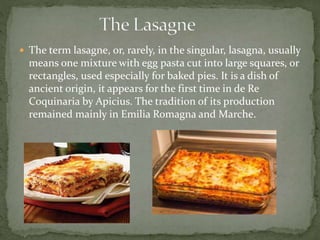
 The term lasagne, or, rarely, in the singular, lasagna, usually
means one mixture with egg pasta cut into large squares, or
rectangles, used especially for baked pies. It is a dish of
ancient origin, it appears for the first time in de Re
Coquinaria by Apicius. The tradition of its production
remained mainly in Emilia Romagna and Marche.
Technically, lasagna, traditionally prepared by so-called
Emilian sfogline or rezdore (or by Romagna azdore) with a
mixture of wheat flour and eggs curved with the rolling
pin, are not pasta, as the pasta, according to Italian law, can
be produced only with wheat, corn almost unknown in that
area before the so-called unification of Italy.
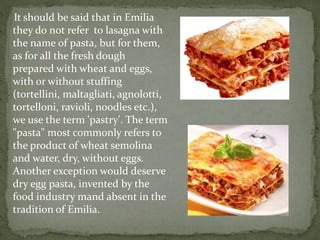
It should be said that in Emilia
they do not refer to lasagna with
the name of pasta, but for them,
as for all the fresh dough
prepared with wheat and eggs,
with or without stuffing
(tortellini, maltagliati, agnolotti,
tortelloni, ravioli, noodles etc.),
we use the term 'pastry'. The term
"pasta" most commonly refers to
the product of wheat semolina
and water, dry, without eggs.
Another exception would deserve
dry egg pasta, invented by the
food industry mand absent in the
tradition of Emilia.
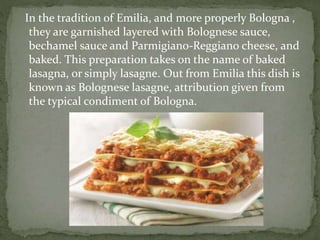
In the tradition of Emilia, and more properly Bologna ,
they are garnished layered with Bolognese sauce,
bechamel sauce and Parmigiano-Reggiano cheese, and
baked. This preparation takes on the name of baked
lasagna, or simply lasagne. Out from Emilia this dish is
known as Bolognese lasagne, attribution given from
the typical condiment of Bologna.
Even in the Two Sicilies the term,
used alternatively to sagne and
lagane, indicates long and wide
strips, derived from a mixture of
wheat semolina and eggs or
water. In Puglia and Basilicata
they use sagne 'ncannulate, that
is twisted, or turned around a
cylindrical support in helical
shape and they do not put eggs
in the dough.
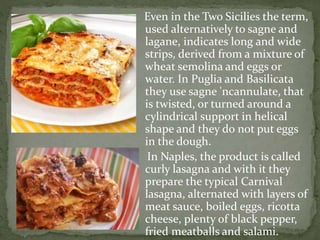
In Naples, the product is called
curly lasagna and with it they
prepare the typical Carnival
lasagna, alternated with layers of
meat sauce, boiled eggs, ricotta
cheese, plenty of black pepper,
fried meatballs and salami.
CREATED BY CAMPANELLA ANGELO

Lasagne

  • 1.
     The termlasagne, or, rarely, in the singular, lasagna, usually means one mixture with egg pasta cut into large squares, or rectangles, used especially for baked pies. It is a dish of ancient origin, it appears for the first time in de Re Coquinaria by Apicius. The tradition of its production remained mainly in Emilia Romagna and Marche.
  • 2.
    Technically, lasagna, traditionallyprepared by so-called Emilian sfogline or rezdore (or by Romagna azdore) with a mixture of wheat flour and eggs curved with the rolling pin, are not pasta, as the pasta, according to Italian law, can be produced only with wheat, corn almost unknown in that area before the so-called unification of Italy.
  • 3.
    It should besaid that in Emilia they do not refer to lasagna with the name of pasta, but for them, as for all the fresh dough prepared with wheat and eggs, with or without stuffing (tortellini, maltagliati, agnolotti, tortelloni, ravioli, noodles etc.), we use the term 'pastry'. The term "pasta" most commonly refers to the product of wheat semolina and water, dry, without eggs. Another exception would deserve dry egg pasta, invented by the food industry mand absent in the tradition of Emilia.
  • 4.
    In the traditionof Emilia, and more properly Bologna , they are garnished layered with Bolognese sauce, bechamel sauce and Parmigiano-Reggiano cheese, and baked. This preparation takes on the name of baked lasagna, or simply lasagne. Out from Emilia this dish is known as Bolognese lasagne, attribution given from the typical condiment of Bologna.
  • 5.
    Even in theTwo Sicilies the term, used alternatively to sagne and lagane, indicates long and wide strips, derived from a mixture of wheat semolina and eggs or water. In Puglia and Basilicata they use sagne 'ncannulate, that is twisted, or turned around a cylindrical support in helical shape and they do not put eggs in the dough. In Naples, the product is called curly lasagna and with it they prepare the typical Carnival lasagna, alternated with layers of meat sauce, boiled eggs, ricotta cheese, plenty of black pepper, fried meatballs and salami.
  • 6.